


A cancerous cell is one which has changed its morphology as well as its function. In particular it has lost the ability that all cells have to control their own growth, either by apoptosis or by decreasing their reproduction rate. Mutations and resulting changes in cell morphology occur throughout an individual's life-time. An intact immune system should be able to destroy cancer cells as soon as they appear. Cancer as a disease appears when the immune system is not capable of maintaining the organism's surveillance.
The association between nutrition and cancer is bi-directional and very complex. Components of foods have been found to induce mutagenic changes or, conversely, to protect against mutagenic factors or to improve the efficiency of the immune system. Once a cancerous process has started in an individual, food and nutrition may exert an important effect on the growth or involution of the tumour.
The beginnings of cancer
Cancer is typically a disease of old age and the increase in life expectancy in most countries, and particularly in developed ones, is clearly increasing the incidence of most types of cancersReference Parham1. Patterns of the disease are not fully explained by known risk factors. Much progress has been made in understanding the molecular basis of carcinogenesis, particularly the near consensus that virtually all cancers arise from an accumulation of genetic mutations and the more recent recognition of the role of inflammation and the tissue microenvironment, in particular for hormone-dependant cancers. However, most genetic mutations that contribute to cancer are not inherited, and thus must be attributable to accumulation of somatic mutations and epigenetic changes, from as yet poorly understood environmental factors, that certainly cannot be explained entirely by tobacco, use and arise over the course of a lifetimeReference Davis, Donovan, Herberman, Gaynor, Axelrod, Van Larebeke and Sasco2. Normal maintenance of any organism means that cells replicate by division to replace old cells and repair any damaged tissue areas. Cell division starts with DNA replication, which takes place in a normal human's lifetime approximately 1016 times. Even though the DNA replication system is extremely accurate, opportunities for errors occur and these may cause mutations. In addition to errors occurring during normal DNA replication, exposure to some chemical agents or radiation, as well as viral infections, may induce further changes in DNA.Reference Parham1
Cancer may develop when a cell accumulates mutations in genes related to cell multiplication and survival. These genes are either proto-oncogenes that normally help initiate and execute cell division or tumour suppressor genes that prevent mutant cell proliferation. The accumulation of mutations appears with advanced ageing of the body and if the immune system is incapable of identifying and destroying the mutated cells.
Cancerous cells replicate at a higher rate than normal cells, thus increasing the likelihood of further mutations, and some of the damaged cells may migrate to other tissues, causing metastasis or tumour growth in a tissue other than the one of origin. The longer a cancer is allowed to continue growing, the fewer the possibilities for the immune system to be able to recognise the damaged cells and destroy them. When mutated cells are few, the immune system may recognise and proceed to destroy them as it would any bacterial or viral infection. However when a cancer grows, the different damaged cells may be so many that the system is incapable of destroying them all and it fails in its surveillance jobReference Parham1.
Studies in animals have shown that epigenetic and metabolic adjustments caused by modifications in the nutritional environment during embryonic or foetal stages of development may have important effects on the genetics of cancer among other chronic diseases. Interactions between single nucleotide polymorphisms in various genes have been associated with metabolic responses to diet influencing the development of chronic diseases such as obesity, cardiovascular disease and cancer. Genetic inheritance allows individuals to develop any one of multiple phenotypes that are determined by metabolic and environmental conditions, such as nutritionReference Stover and Garza3–Reference Lee and Go5.
One of the most thoroughly evaluated associations between nutrition and the immune system is that related to dietary fat. Although total fat intake has been found to increase the risk of various types of cancer, it is the type of fat that has a more important effect on the immune response and consequently on cancer developmentReference De Pablo, Puertollano and Alvarez de Cienfuegos6, Reference Granados, Quiles, Gil and Ramírez-Tortosa7. Polyunsaturated fatty acids (PUFAs) have been shown to modulate cytokine production, lymphocyte proliferation, expression of surface molecules, phagocytosis, apoptosis and natural killer cell activity; these last two effects are closely related to cancer development. An increase in n-3 PUFAs helps control the production of proinflammatory eicosanoids as well as cytokine productionReference Sweeney, Puri and Reen8. It has been shown in vitro that palmitic acid is able to potentiate iron-mediated toxicity in endothelial cells, causing mitochondrial dysfunction, cell death, apoptosis, and DNA mutationReference Yao, Shi, Gou, Zhou, Yee-Aw, Zhou and Liu9–Reference Atshaver, Storey, Petrescu, Greenberg, Lyuksvutova, Smith and Schroeder14.
The role of nutrition in cancer development
The immune system, when acting as the body's primary defence against pathogens and cancer cells, utilises pro-inflammatory cytokines, as well as reactive oxygen and nitrogen species. When the production of these substances is excessive it may lead to chronic inflammation and an increased risk of cancer, as inflammation has been linked to the promotion phase of carcinogenesis, by inhibiting cell to cell communication between normal and cancer affected cells. In this case, the organism's ability to counter-attack this effect is very important to stop the production of cancerous cells. Nutrients such as zinc, selenium, vitamins A and C, n-3 PUFAs and probiotics modulate the immune response or act as antioxidants, helping the immune system to work specifically against the cancerous cell and not against normal adjacent cellsReference Philpott and Ferguson15, Reference Trosko16.
Apoptosis or programmed cell death is the most important mechanism for the maintenance of normal tissues and organs. Cells that are cancerous have lost this ability to balance cell proliferation. Many dietary components may act as chemopreventive agents, interacting at the molecular and cellular level to modulate apoptosis, through selectively activating or inactivating gene expression. Although much of the recent research has been focused on identifying the specific effects of single nutrients or dietary components on gene expression, it is necessary to remember that the individual consumes a combination of nutrients within foods in the diet, and that the interaction of these components may not have the same positive or negative effect. A better understanding of these interactions may help identify the ideal combination of foods for cancer prevention. Low fibre and high red meat intakes, as well as an imbalance of n-3 and n-6 fatty acids have been associated with an increase in cancer riskReference Beruin, Min, Wu, Wu, Perry, Cline, Thomas, Thornburg, Kulik, Smith, Edwarrds, D'Agostino, Zhang, Wu, Kang and Chen17–Reference Neuhouser, Barnett, Kristal, Ambrosone, King, Thornquist and Goodman19. Dietary components can alter gene expression and phenotypes of cells through various steps, thus influencing cancerReference Davis and Ross20–Reference Martin24.
Epidemiologic studies have shown that 30 to 40 % of all cancers may be preventable by maintaining a healthy lifestyle and adequate diet. Increasing fruit and vegetable intake may lower the risk of cancer, particularly breast, colon, rectum, prostate and lungReference Theodoratou, McNeill, Cetnarskyj, Farrington, Tenesa, Barnetson, Porteous, Dunlop and Campbell25, Reference Kimura, Kono, Toyomura, Nagano, Mizoue, Moore, Mibu, Tanaka, Kakeji, Maehara, Okamura, Ikejiri, Futami, Yasunami, Maekawa, Takenaka, Ichimiya and Imaizumi26. This effect may be due to a resulting decrease in total fat intake and through an increase in vitamins and minerals such as selenium, folic acid, vitamin B12, vitamin D, antioxidants such as carotenoids (alpha-carotene, beta-carotene, lycopene, lutein, cryptoxanthin), as well as phytochemicals (phenolic compounds, terpenoids, steroids, indoles and fibres) and pre- and probioticsReference Divisi, Di Tommaso, Salvemini, Garramone and Crisci22, Reference Fernandez, Gallus and La Vecchia27–Reference Nishino, Murakoshi, Mou, Wada, Masuda, Ohsaka, Satomi and Jinno30.
For instance, it has been shown that intake of selenium in pharmacological doses ( ≥ 200 μg/day) may be protective against prostate, colon, and lung cancersReference Cui, Vogt, Olson, Glass and Rohan31. Iron metabolism has also been associated to breast and colon cancerReference Raje, Mukhtar, Oshowo and Ingham Clark32–Reference Hance, Rogers, Hursting and Greiner35. Vitamin E in addition to its well known anti-oxidant functions, modulates the activity of microsomal enzymes, inhibits protein kinase C and induces apoptosis, thus acting on tumour growth and cellular proliferationReference Weinstein, Wright, Lawson, Snyder, Männistö, Taylor, Virtamo and Albanes36–Reference Flora40. Vitamin D has antiproliferative effects, promoting cellular differentiation similar to neoplasic processes; it has also been associated to UV-radiation protectionReference Mullin and Dobs41.
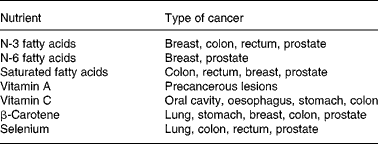
Table 1 presents a list of nutrients that have been associated with the development of different types of cancers either by enhancing the immune system or by exerting an immunosuppressive effect. It is always important to note that although some of these effects have been observed with the use of supplements, most of them are related to the intake of the foods that contain these nutrients.
Dietary components associated with cancer development or prevention
The role of weight in cancer risk
As a consequence of excessive and mostly unbalanced food intakes, as well as sedentary lifestyles, overweight and obesity are increasing worldwide, thus increasing the risk for all chronic diseases, including cancer. In fact, weight related issues have also been associated with the development of various types of cancerReference Ceschi, Gutzwiller, Moch, Eichholzer and Probst-Hensch42. There is much evidence suggesting that excess body weight is a risk factor for development and prognosis of several cancer types including cancer of the colon, breast, endometrium, kidney and oesophagus, as well as possible additional sitesReference Wright, Chang, Schatzkin, Albanes, Kipnis, Mouw, Hurwitz, Hollenbeck and Leitzmann43–Reference Carmichael45. For instance, prostate cancer has been related to higher BMI and adult weight gain, while breast, ovarian and endometrial cancers have been found to be associated with excess weight and weight gain in adult lifeReference Carmichael45, Reference Han, Nie, Bonner, McCann, Muti, Trevisan, Ramirez-Marrero, Vito and Freudenheim46. Weight loss after menopause is associated with a substantially reduced risk of breast cancer, thus suggesting that acquisition and maintenance of appropriate weight or BMI throughout adulthood may well result in an important reduction of cancer riskReference Samanic, Chow, Gridley, Jarvholm and Fraumeni47–Reference McCowen and Bistrian50.
The role of nutrition in cancer therapy
Most of the research that has been done in the area of nutrition and cancer is related to identifying the causes and ways of preventing the onset of a neoplasic event. However, research has also been done on the use of nutrition to improve the outcome of a patient after surgical treatment of a tumour. Enhancing immunity through diet is generally done by adding n-3 fatty acids, arginine, and nucleotides to an otherwise nutritionally complete formula. There are several trials suggesting that pre-operative immunonutrition improves outcomes in patients with upper gastrointestinal (GI) cancer surgery and is cost-effective, as complications are reducedReference McCowen and Bistrian50–Reference Malik, Afaq, Sarfaraz, Adhami, Syed and Mukhtar52.
Pre-operative immunonutrition may induce changes that modulate stress responses and improve the outcome of patients undergoing abdominal cancer surgery. Pre-operative enteral immunonutrition in patients with GI cancer improves nutritional status and immunity and decreases the incidence of post-operative complications and infections, by modulating inflammatory reactions. Pre-operative immunonutrition has been suggested to correct the impaired Th1/Th2 balance found in cancerReference Tsujinaka, Hirao, Fujitani, Mishima, Ikenaga, Sawamura and Kurata53–Reference Moskovitz and Kim57.
A specialised pre-operative oral formula with arginine, n-3 fatty acids, and RNA has been shown to be as effective as pre- and post-operative administration of immunonutrition in decreasing the incidence of post-operative infections and length of hospital stay. Pre-operative enteral nutrition has been suggested to provide better regulation of post-operative immune system restoration than parenteral nutrition. On the other hand, early post-operative enteral nutrition supplemented with arginine, omega-3 fatty acids and RNA has been proven to increase hydroxyproline synthesis and improve surgical wound healing in patients undergoing gastrectomy for cancerReference Ates, Yilmaz, Erkasap, Ihtiyar, Kaya, Pehlivan, Ustuner, Yasar and Kiper58–Reference Sanford60.
Conclusions
There is much literature showing that diet and some nutritional components may help prevent the development of cancer in the long term. It is critical for health care providers to both acknowledge and apply the principles of nutrition for cancer prevention, and as part of a therapeutic regimen to improve prognosis once cancer has been diagnosed. With respect to prevention, the best option is to maintain a healthy lifestyle, following the general recommendations of the World Cancer Research Fund/American Institute for Cancer Research 1997 report61, which have been summarised in Table 2. Unfortunately, although much research has been undertaken since these recommendations were issued, no official guidelines have been published since then. To the best of our knowledge, the WCRF/AICR are planning to issue their new report in November 2007. However, until it has been released no other recommendations can be made. With respect to the therapeutic effects of nutrition on cancer, much work is needed as there are few truly longitudinal studies to investigate theseReference Sanford60.
World Cancer Research Fund/American Institute for Cancer Research 1997 Guidelines for the Prevention of Global Cancer
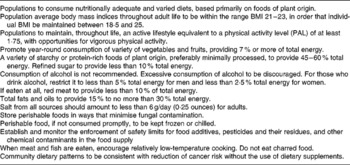
From: World Cancer Research Fund/American Institute of Cancer Research Diet, Nutrition and Prevention of Human Cancer: A Global Perspective London, WCRF, 199761.
The advances in the analysis and understanding of DNA sequences, RNA transcripts and metabolism through genomics, proteomics and metabolomics, will most probably allow the identification of specific geno- and phenotypes, and possibly evolve into metabolic profiling that will lead to individualised dietary therapies for cancer and other chronic diseasesReference Go, Nguyen, Harris and Lee62. Fig. 1 shows the possible ways in which nutrition may have an effect on cancer development at all stages.
Possible effects of nutrition on cancer developmental stages (Adapted from ref.1 Parham P (2005)).

Conflict of interest statement
The authors have no conflict of interests. RVR and ADBA co-wrote the manuscript.



