1 Introduction
There is a long-standing tradition of studying the choice between constructions such as the company's legal status and the legal status of the company, an alternation commonly known as ‘genitive variation’. These constructions consist of what is usually called a ‘possessor’ (the company in the example above) and a ‘possessum’ ((the) legal status in the example above), which occur in different positions in English genitive constructions: in the s-genitive (the company’s legal status) the possessor is positioned prenominally, i.e. before the possessum, while it follows the possessum in the of-genitive (the legal status of the company). Today, genitive variation is arguably the best researched of all syntactic alternations in English. The goal of the present article is to give a state-of-the-art report on research on English genitive variation. I will start with an overview of the changing methods and methodological challenges over the years (section 2) and then proceed to a synopsis of the most important findings to this day (section 3). In section 4 I will address the question of how the results on genitive variation have been embedded into theoretical frameworks, and in section 5 I will discuss some controversial and open questions, pointing out some desiderata and challenges for future research. Section 6 will conclude this article.
2 Method
2.1 From philology to logistic regression
Table A1 in the appendix presents an overview of empirical and quantitative studies on English genitive variation from the very first to the most recent studies.Footnote 2 It specifies the period covered in the analysis, the variety and method applied, the variants and factors analysed and the type of quantitative analysis/method applied. In so doing it basically demonstrates two important shifts in the study of English genitive variation: (1) the shift from focusing on older stages of English to more recent English(es), and (2) the shift from simply counting or listing variants to elaborate statistical techniques. The former is connected to the fact that the most dramatic changes in the distribution of the two genitives took place in the transition from Old English to Middle English, when the inflectional genitive was rather drastically replaced by the periphrastic of-genitive; see the studies by Stahl (Reference Stahl1927), Thomas (Reference Thomas1931) and Timmer (Reference Timmer1939). These early studies are still firmly based in the philological tradition. If they quantify at all, they mainly use absolute numbers of the two variants. The most elaborate among these early studies is the doctoral dissertation by Thomas (Reference Thomas1931), which sketches very meticulously the replacement of the inflectional genitive by the periphrastic of-genitive from the late tenth to the fourteenth century (also providing some relative frequencies) and which is to this day the main reference work for the distribution of the two variants during that period. Overall, some of the quantitative work done by these scholars in the first half of the twentieth century is impressive, but they naturally lack the methodological sophistication of later corpus-based research as far as the quantification of the data is concerned. The shift to more elaborate quantitative measurements can be linked to the rise of sociolinguistics in the 1960s, which initiated the systematic study of linguistic variation, as well as to advances in statistics. At that time linguists began to notice that choosing among alternative linguistic forms does not simply imply tossing a coin for speakers, as had been the received wisdom until then, but reflects the forces of various factors, of whatever nature (some external, some internal to language). The demonstration of such principled preferences required the application of more sophisticated quantitative methods, such as systematically collecting and counting variants rather than impressionistically citing some relevant examples or giving absolute numbers at best, and ultimately the application of statistical procedures to show that the distributional differences found were not simply chance but significant.
Altenberg's (Reference Altenberg1982) groundbreaking monograph is the first comprehensive quantitative study on genitive variation done in the variationist tradition. Although it focuses on seventeenth-century English it serves to this day as one of the major reference works for studying genitive variation, past and present. This study demonstrates impressively how seventeenth-century genitive variation is determined by an interplay of many factors such as lexical class (animacy), types of syntactic modifications (syntactic weight and syntactic complexity), semantic relation and genre. In so doing, Altenberg needed to tackle one of the major methodological problems and dilemmas in the study of genitive variation: we know that genitive variation is determined by a subtle interplay of various factors, but how do we study one factor vis-à-vis all others? Altenberg overcomes this problem by conducting analyses on each individual factor within controlled subcorpora. He is also the first (to my knowledge) scholar of genitive variation to use (chi-square) statistics to test for significances in distributional differences.
From about the middle of the twentieth century the interest shifts from the history of earlier English to changes in Modern English, in particular the extension of the s-genitive to inanimate noun classes, as e.g. in the city's war memorial, last year's budget or the story's peak moment. Some of the first scholars to note this development are Zachrisson (Reference Zachrisson1920: 39–49) and Jespersen ([1949] Reference Jespersen1961: 324–30), later to be followed by Svartengren (Reference Svartengren1949), Thomas (Reference Thomas1953) and Dahl (Reference Dahl1971). This type of work initially starts out from impressionistic observations. The first study to substantiate this claim by quantitative methods is the doctoral dissertation by Jahr Sorheim (Reference Jahr Sorheim1980), which initiates a whole series of corpus-based studies on genitive variation based on electronically available and standardized corpora, in her case a comparison of the British English LOB corpus and the American English Brown corpus, which allowed for a systematic comparison of genitive variation in different varieties of English. Jahr Sorheim's study was to be followed in the 1990s by a series of studies conducted at the University of Freiburg based on a comparison of the LOB and Brown corpora from the 1960s and FLOB and FROWN from the 1990s, which allowed the researchers to track change-in-progress in and between British and American English in real-time data stretching across a period of thirty years in two matching corpora (see the studies by Siemund Reference Siemund1993 and Raab-Fischer Reference Raab-Fischer1995, which complement each other, and Hundt Reference Hundt and Ljung1997, Reference Hundt1998). Hundt (Reference Hundt and Ljung1997, Reference Hundt1998) expands the varietal comparison to include New Zealand and Australian English, although her studies all focus on the (normalized) frequency of the s-genitive only. They do not take the frequency of the of-genitive into account and thus are not studies on genitive variation but on the changing distribution of the s-genitive only.
Jucker (Reference Jucker and Jucker1993) and Leech et al. (Reference Leech, Francis, Xu, Fuchs and Victorri1994) are the first studies to use more sophisticated statistical procedures such as logistic regression. Jucker's study only briefly mentions the use of logistic regression in the footnotes as a means of establishing statistical significance in the presence of many interacting factors, while Leech et al. (Reference Leech, Francis, Xu, Fuchs and Victorri1994) go beyond mere statistical significance and use logistic regression as a means of establishing the relative importance of factors. Studying the individual contribution of a single factor and establishing its relative impact vis-à-vis the many other factors that determine genitive choice has been one of the main challenges in research on genitive variation. One early way of coping with this problem can be found in Altenberg (Reference Altenberg1982), who tests for individual factors in controlled subcorpora (see also above) and then establishes what he calls a ‘selective hierarchy of conditioning factors’ based on the relative frequency of the genitive variants in these subcorpora.
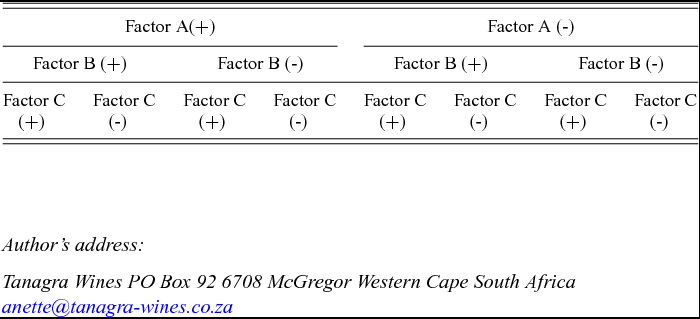
Anschutz (Reference Anschutz1997) and Rosenbach et al. (Reference Rosenbach, Stein, Vezzosi, Bermúdez-Otero, Denison, Hogg and McCully2000) establish relative importance by quantifying the data for the combination of factor values. For practical reasons, however, this type of analysis allows only the comparison of a few factors at the same time, as all possible combinations of the individual factor values need to quantified. For example, comparing three factors with binary factor values yields already eight different contexts, as illustrated schematically in table 1. To be able to do such an analysis the researcher needs to have a sufficient amount of data for each factor combination, which requires a rather rich data set from the start.
Studying the interaction of factors

Comparing genitive frequencies between these different cells allows the researcher to make statements about the relative strength of factors. To illustrate, if for example the relative frequency for the s-genitive for [A(+)/B (+)] is higher than that for [A(+)/ B(-)] this indicates that Factor A is more important for choosing the s-genitive than Factor B.
One solution to the problem of systematically studying various factors at the same time and determining their relative strength is an experimental study. In contrast to analysing naturally occurring data, in an experimental setup the researcher can choose and manipulate the items rather than having to code what s/he finds in a corpus of natural speech. That is, items/stimuli can be designed in such a way as to (a) represent certain factor values in equal proportion of the type illustrated in table 1 and (b) maximally control for all other factors known to affect genitive choice. This approach is taken by Rosenbach (Reference Rosenbach and Brinton2001, Reference Rosenbach2002, Reference Rosenbach, Rohdenburg and Mondorf2003, Reference Rosenbach2005) in a series of experimental studies.Footnote 3 In these studies subjects were asked to choose between the s-genitive and the of-genitive within natural contexts taken from fiction, which had been adapted to control for factors not tested in the study itself in a so-called forced-choice task. This procedure makes sure that when testing for a certain factor (such as animacy) other factors determining genitive choice (e.g. the final sibilancy of the possessor) are kept constant, or in other words are controlled for, and can therefore be seen as an alternative to statistical modelling (see also Rosenbach Reference Rosenbach, Krug and Schlüter2013 for further explication of this method).
However, neither of the above-mentioned approaches, be it controlled subcorpora or experimental set-ups, can take into account the relative strength of all interacting factors in genitive choice. They are restricted to whatever contexts have been selected for in the analysis, and as such represent ‘snapshots’ of the full system of genitive choice.Footnote 4 Such a full picture can only be obtained from statistical models which, ideally, take into account the impact of all factors with all their values at the same time. Statistical modelling in the form of multivariate analyses has now become the standard method of establishing the significance of one factor vis-à-vis the many other factors that determine genitive variation as well as their relative strength in corpus data in what are now called ‘genitive models’; see specifically the work by Hinrichs & Szmrecsanyi (Reference Hinrichs and Szmrecsanyi2007); Szmrecsanyi & Hinrichs (Reference Szmrecsanyi, Hinrichs, Nevalainen, Taavitsainen, Pahta and Korhonen2008), Szmrecsanyi (Reference Szmrecsanyi, Geeraerts, Kristiansen and Perisman2010, Reference Szmrecsanyi, Börjars, Denison and Scott2013), Hundt & Szmrecsanyi (Reference Hundt and Szmrecsanyi2012), Grafmiller (forthcoming), Shih et al. (forthcoming), Wolk et al. (Reference Wolk, Bresnan, Rosenbach and Szmrecsanyi2013), Szmrecsanyi et al. (forthcoming), Tagliamonte & Jarmasz (Reference Tagliamonte and Jarmasz2008), Jankowski & Tagliamonte (this volume), Payne & Berlage (Reference Payne and Berlage2011), Börjars et al. (Reference Börjars, Denison, Krajewski, Scott, Börjars, Denison and Scott2013), O’Connor et al. (Reference O’Connor, Maling, Skarabela, Börjars, Denison and Scott2013). Note, however, that there are also limits to statistical models. Even the most sophisticated statistical analysis necessarily relies on a corpus providing a sufficiently large number of data in order to test the contribution of each individual factor and its values. If the corpus is (too) small, then often only some selected factors can be analysed and more fine-grained factor values need to be collapsed, which again will only provide us with certain aspects of the data rather than ‘the full picture’.
Recently, Ford & Bresnan (forthcoming) have suggested a new method to complement corpus data, i.e. experimentally elicited sentence completions. In this task subjects are given passages adapted from a corpus (in their case the Switchboard corpus) containing a natural context for a genitive construction. In contrast to the forced-choice task in Rosenbach's (Reference Rosenbach2002, Reference Rosenbach, Rohdenburg and Mondorf2003, Reference Rosenbach2005) studies, subjects do not have to choose between the s-genitive or the of-genitive but freely produce their own preferred construction on the basis of two noun phrases functioning as prompts; see example (1) below (example 10 from Ford & Bresnan forthcoming):
(1) Speaker A: Do you have a favorite instrument?
Speaker B: Actually one of my favorite instruments is a harpsichord. I really like those. In fact, I had a harpsichord played at my wedding.
Speaker A: Oh, did you?
Speaker B: Yeah. Which was real nice. I got married during the Christmas season and we played old fashioned Christmas carols instead of normal wedding marches and it was real nice. I liked that a lot. I liked. . . . . . . . . . . . . . . . . . . . . . . . . . . . . . . . . . . . . . . . . . . . . . . . . . . . . . . . . . . . . . . . . . . . . . . . . . . . . . . . . . . . . . . . . . . . . . . . . . . . . . . . . . . . . . . . . . . . . . . . . . . . . . . . . . . . . . . . . . . . . . . . . . . .
[sound]
[the harpsichord]
The genitive constructions obtained constitute a kind of focused mini-corpus containing data otherwise difficult to assess in natural corpora. This is a very good way of getting a corpus of genitives from a variety for which we lack a matched corpus, as in the case of Australian English, which Ford & Bresnan (forthcoming) contrast with American English, or for otherwise only rarely occurring contexts. Two genitive data sets obtained in this way for two varieties of English provide a kind of ‘perfect match’ as speakers of these varieties produced genitive constructions from the same type of noun in the same context, so if we find any principled differences in their choice of genitive construction, these are most likely due to differences between the varieties of English rather than differences in the assembly of corpora. Ford & Bresnan (forthcoming) show that the effects found from their elicited corpus material match those from natural corpora, which indicates the efficiency and accuracy of this method as a means of eliciting natural genitive constructions. Their method looks like a promising way of bridging corpus and experimental studies by providing a method combining aspects of both.
In general, there is no privileged type of method, and researchers should make use of various methods, be it corpus analyses or experimental studies, and use the advantages of either method to make up for limitations of the other, in order to ultimately get converging evidence on genitive variation (for advocates of this rationale see Gries Reference Gries, Brend, Sullivan and Lommel2002 and Rosenbach Reference Rosenbach, Krug and Schlüter2013 for genitive variation, and Arnold et al. Reference Arnold, Wasow, Losongco and Ginstrom2000 and Ford & Bresnan Reference Ford, Bresnan, Krug and Schlüter2013 for other cases of grammatical variation).
2.2 Methodological problems – and possible solutions. . .
The study of genitive variation poses a number of methodological challenges, many of which are not unique to genitive variation but occur in similar form also in other cases of grammatical variation. One of the most fundamental problems in studying variation has already been addressed in the previous section, i.e. the problem of studying the impact of one factor vis-à-vis the presence of many other factors and how to determine their relative strength. Some further problems are discussed below.
2.2.1 The problem of meaning equivalence (‘sameness’)
Researchers of genitive variation, or any type of grammatical variation for that matter, are often challenged with establishing the meaning equivalence or ‘sameness’ of the variants studied. The very idea of linguistic variation is that the variants analysed are ‘two ways of saying the same thing’ (Labov Reference Labov1972: 271) and that any difference found in the distribution of the variants is a reflection of the various factors operating and not due to an inherent difference in the meaning of the two variants. The question, in other words, is whether the company's director and the director of the company are truly mutually interchangeable or whether they have a different underlying semantics. Two positions can be found in the literature. One position, essentially put forward by Stefanowitsch (Reference Stefanowitsch, Rohdenburg and Mondorf2003) and Gries & Stefanowitsch (Reference Gries and Stefanowitsch2004), is that possessive constructions with an s-genitive and an of-genitive (like most syntactic variants) are two different constructions conveying a different constructional meaning and therefore should not be studied as instances of linguistic variation. Strictly speaking, under such a view there is no such thing as ‘genitive variation’ at all. The other position is to assume sameness on the propositional level in that both constructions convey, very generally, the relation between a possessor and a possessed entity (see specifically Rosenbach Reference Rosenbach2002: 22 in defence of this view and further references). Whatever distinguishes the distribution of the two constructions then gets analysed as ‘factors’ rather than being stated a priori.
2.2.2 What precisely are the variants?
Traditionally, the vast majority of studies focus on the distribution of the major variants, i.e. the s-genitive vs the of-genitive, but there appear to be other, minor, variants as well. In fact, the repertoire of adnominal genitive constructions has changed over time and can also vary across different varieties of English. In Old English the main variants are an inflected prenominal genitive and an inflected postnominal variant; the of-genitive was at best a marginal construction (see Thomas Reference Thomas1931). That is, at that time there was already ‘genitive variation’ exhibiting variable position of the possessor but the postnominal variant was an inflected genitive, like the prenominal variant. It is only towards the end of the Old English period that the of-genitive starts gaining ground, replacing the postnominal genitive.
From late Middle English, then, the s-genitive and the of-genitive are the major competing adnominal genitive constructions. However, other genitive variants exist, too, such as the s-less variant of the prenominal genitive (his father boots) or a genitive construction with a linking possessive pronoun, i.e. the so-called his-genitive (John his book). After Early Modern English the s-less genitive persists, mainly in northern English, well into the twentieth century (Klemola Reference Klemola1997). It is not quite clear to what extent the his-genitive survived into Late Modern English and Modern English, but it has been suggested by Seppänen (Reference Seppänen, Cheshire and Stein1997) that traces of it can be found in modern colloquial English (see (2a) below) and regional English (see (2b) below), at least in the area of relative pronouns (examples in (2) are cited from Seppänen Reference Seppänen, Cheshire and Stein1997: 161).
- (2)
(a) There's two fellows that their dads are millionaires. (Jespersen [1927] Reference Jespersen1961: 110)
(b) The crew that their boat wis vrackit are in Aiberdeen. (SND)
Also, there appear to be prepositions other than of that can express a genitive relation, as e.g. in secretary to the Queen. According to Rosenbach & Vezzosi's (Reference Rosenbach, Vezzosi, Sornicola, Poppe and Shisha-Halevy2000: 290) figures, however, the genitive variants mentioned above are rather marginal constructions, at least in their corpus of Early Modern English.
Payne & Berlage (this volume) study a rather specific case of genitive variation, i.e. the variation between what they call the ‘oblique genitive’ (also known as ‘double genitive’) and s-genitives and of-genitives, comparing expressions such as the best friend of John’s (oblique genitive), John's best friend (s-genitive) and the best friend of John (of-genitive). This alternation shares some of the same restrictions as what traditionally is called ‘genitive variation’ but also comes with its own idiosyncrasies. For this reason, oblique/double genitives are usually not considered in studies of ‘classic’ genitive variation.
Noun modifiers may alternate with adnominal genitive constructions, too, and in contrast to the more marginal genitive variants mentioned above, noun modifiers are actually rather frequent, at least in Present-day English. While noun modifiers typically have a classifying meaning, as for example in dog food, specifying a type of food, they can also have a specifying and possessive meaning, as for example in the Berlin mayor or the cottage door, which can be easily expressed by either an s-genitive (Berlin's mayor, the cottage's door) or an of-genitive (the mayor of Berlin, the door of the cottage). The study of the possessive meaning of noun modifiers has long been neglected in research on both genitive variation and noun modifiers, but see Rosenbach (Reference Rosenbach2006, Reference Rosenbach2007a, Reference Rosenbach, Hundt, Nesselhauf and Biewerb, Reference Rosenbach2009), who draws attention to the variation between constructions with s-genitives and noun modifiers, and identifies some areas of overlap between them.Footnote 5 Further research is still needed to determine the precise range of contexts in which noun modifiers overlap and may alternate with s-genitives and of-genitives. For the time being the consensus among researchers into genitive variation is to focus on the s-genitive and the of-genitive as the major variants of English genitive variation.Footnote 6
Note, however, that not just any s-genitive or of-genitive can be considered in the analysis. Possessive pronouns, for example, constitute a special case of s-genitive (e.g. his friend, my strength). They are usually excluded from the analysis of genitive variation as they are overwhelmingly realized prenominally and therefore constitute a kind of ‘knock-out’ context (see Jucker Reference Jucker and Jucker1993; O’Connor et al. Reference O’Connor, Maling, Skarabela, Börjars, Denison and Scott2013); see also the following section for more discussion on pronominal possessors and the status of quasi-categorical variants. Note further that only s-genitives with a specifying (or determiner) function enter into a proper alternation with of-genitives. For example, in [the young child]'s book the possessor NP ‘the young child’ specifies whose book it is, while in an old [children's book] the s-genitive does not designate whose book it is but what type of book and therefore has classifying function. The difference in function is mirrored by differences in syntax; for details I refer to Rosenbach (Reference Rosenbach2006, Reference Rosenbach2007a, Reference Rosenbach, Hundt, Nesselhauf and Biewerb, Reference Rosenbach2009). Classifying s-genitives do not alternate regularly with of-genitives but usually with other periphrastic constructions (e.g. an old book for children and not an old book of children) and should therefore be excluded from the analysis. Likewise, in expressions such as a man of honour the of-phrase of honour doesn't specify whose man it is but designates an attribute, which alternates with an adjective and not an s-genitive (an honourable man and not an honour's man). Syntactically, in these constructions the of-phrase is a modifier and not a complement as in typical of-genitives. These examples demonstrate how important it is to take a close look at the semantics and the syntax of the actual tokens when including them in a data set. Both s-genitives as well as of-phrases form complex families of construction types and not all of them enter proper ‘genitive variation’. In the following section we will see that there are further cases which need to be excluded from the analysis.
2.2.3 Identifying choice contexts
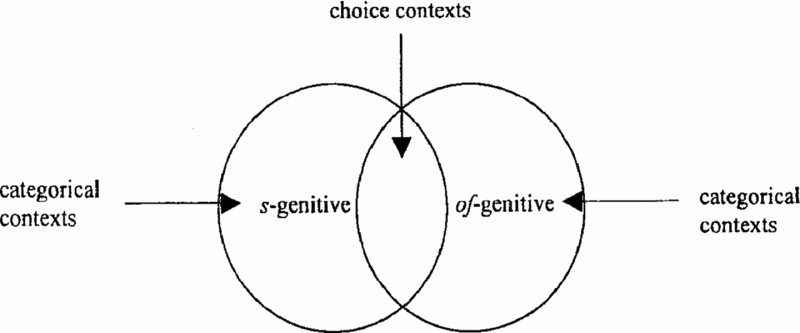
There are contexts in which the s-genitive cannot be expressed by a corresponding of-genitive and vice versa. These are categorical (or ‘knock-out’) contexts for the occurrence of one variant only and they need to be distinguished from choice contexts, where the two genitives can alternate, as illustrated in figure 1. To identify these is one of the greatest challenges for any researcher of English genitive variation.
Categorical versus choice contexts in genitive variation (see Rosenbach Reference Rosenbach2002: 28; Reference Rosenbach2003: 382)
In the following I will give a few examples to illustrate some of the problems involved in identifying alternating genitive variants.Footnote 7 It is obvious that fixed expressions such as the Bank of England are by definition not interchangeable and thus constitute clear cases of categorical contexts. Yet, upon closer examination, things are often more complicated. Take the example of the collocation the tricks of the trade, which is usually considered an idiomatic expression, as in the example in (3a). When googling for it, we can however also find it expressed by the s-genitive the trade's tricks as in (3b), which indicates that the construction is not as frozen as we might think (although the instances occurring with an s-genitive are extremely low in number).
- (3)
(a) Inspired while preparing for her 1996 book Cowboy Spirit: Guy Weadick and the Calgary Stampede, Livingstone learned the tricks of the trade (www.ucalgary.ca/news/utoday/june27.../tricks)
(b) There are several locksmith companies that will hire an apprentice, take them through the process of learning the trade's tricks. (www.powerawesomestuff.com/how-to-become. . .)
As idiomaticity is a matter of more-or-less rather than either/or (Nunberg & Wasow Reference Nunberg and Wasow1994) it is often extremely difficult to decide which idioms to include and which to exclude.
A class of constructions to be excluded for semantic reasons are constructions with of-genitives preceded by any determiner other than the definite article the. That is, constructions such as any/this/some/a supply of fuel are not considered in the analysis because of the fact that s-genitives render the matrix possessive construction definite, usually explained by the fact that they occupy the structural determiner position. In other words, a possessive construction with an s-genitive always translates into an of-genitive construction of the type the X of Y.Footnote 8 For example, an s-genitive construction such as some students’ class assignments can only translate into the class assignments of some students and not into some class assignments of students. The latter construction cannot be rendered by an s-genitive as the determiner slot of the matrix construction is already filled by the s-genitive and there is a constraint in English grammar against the co-occurrence of two (main) determiners. This example again demonstrates how important it is to know the rather intricate syntax and the semantics of genitive constructions rather than simply including any construction with a possessive ’s or any two NPs linked by the preposition of in the analysis.
Yet another problem can be illustrated by the examples in (4).
- (4)
(a) the release of 14 people arrested in the first crackdown on antigovernment protesters
(b) ?? 14 people arrested in the first crackdown on antigovernment protesters’ release
Although (4b) does not look like a true alternative to (4a) and most speakers would probably not accept it as a well-formed s-genitive corresponding to the of-genitive in (4a), there is nothing in the construction as such that would rule it out. Rather, it is the very long possessor, coupled with an indefinite possessor, which together make an s-genitive highly unlikely. To determine the likelihood of a construction occurring is, however, precisely the task of the factor analysis. Note further that it often depends on the intuition of the researcher coding the data whether an individual genitive construction can alternate or not. As is well known, intuitions in such cases may vary: while one speaker may regard (4b) as (very) marginally possible/grammatical, others may straightforwardly rule it out. So rather than relying on his/her own intuition, the researcher should proceed, rather conservatively, from identifying contexts which categorically rule out one of the variants and then include, rather liberally, all other genitive constructions. That is, rather than testing each individual expression for genuine interchangeability we should rather proceed from possible classes of genitive constructions, excluding all those contexts which we know categorically ban one of the variants.Footnote 9
In practice, categorical (or ‘knock-out’) contexts often come in two different forms. There are contexts or classes of constructions that can never alternate, due to some intrinsic semantic or structural properties (as e.g. indefinite of-genitive constructions; see above), and contexts which can alternate in principle but in practice are almost categorical, like e.g. pronominal possessors, which in 99 per cent of the cases get realized prenominally (Jucker Reference Jucker and Jucker1993; O’Connor et al. Reference O’Connor, Maling, Skarabela, Börjars, Denison and Scott2013). Such quasi-categorical contexts are often excluded from a database from the start. Even if included initially in the analysis, they usually get excluded in a second step in the analysis once they turn out to be almost categorical, as they would otherwise blur the statistical results. This, in turn, might cut off what might be simply a strong conditioning factor from our analysis, as very recently pointed out by O’Connor et al. (Reference O’Connor, Maling, Skarabela, Börjars, Denison and Scott2013: 101–2).Footnote 10 And, in contrast to truly categorical contexts, there is still a tiny area of variation and overlap; see the following examples (from the BNC): his strength / the strength of him, my cleverness / the cleverness of me or its size / the size of me. The strength of the conditioning may vary between different varieties or modalities of English or over time (or cross-linguistically; see O’Connor et al. Reference O’Connor, Maling, Skarabela, Börjars, Denison and Scott2013), so when excluding these contexts from the start we might miss out on this variability in our analysis.
2.2.4 Identifying and operationalizing factors
Researchers on genitive variation usually start out by testing the factors previously suggested in the literature, but over the years more and more factors have been identified and already-known factors have been further studied and modified. By now, research has demonstrated that there are general factors that seem to govern any case of word order variation, be it on the clausal or on the NP level, in particular animacy, definiteness, topicality/givenness, syntactic weight/length and rhythmic alternation. Apart from these general determinants of word order there are other factors that are more idiosyncratic to genitive variation, as e.g. the type of semantic relation holding between the possessor and the possessum and the final sibilancy of the possessor; for an overview see also section 3.1 below. It is, however, not always clear how precisely to operationalize them. Take for example the factor of animacy.Footnote 11 Categorizations range from simple binary [± human] (e.g. Rosenbach & Vezzosi Reference Rosenbach, Vezzosi, Sornicola, Poppe and Shisha-Halevy2000 or Tagliamonte & Jarmasz Reference Tagliamonte and Jarmasz2008) to highly complex ones distinguishing categories like ‘human’, ‘organisation’, ‘animal’, ‘place’, ‘time’, ‘concrete inanimate’ vs ‘non-concrete inanimate, ‘machines’, ‘vehicles’ (Zaenen et al. Reference Zaenen, Carlette, Garretson, Bresnan, Koontz-Garboden, Nikitina, O’Connor, Wasow, Webber and Byron2004). It often depends on the data richness (or sparseness) and on the focus of the analysis how many and which of these categories/factor values will or can be employed in the analysis. In general, the more data we have, the more fine-grained the data coding can be. If we are interested in the spread of the s-genitive to inanimate noun classes it is advisable to code for noun classes such as collective nouns (the FBI's headquarters), locative nouns (London's mayor) and temporal nouns (last week's class), which – for various reasons – are known to attract the s-genitive more than other inanimate noun classes (see Rosenbach Reference Rosenbach2008 for details), rather than focusing on a binary human/non-human distinction. Another question when coding the factor animacy is: whose animacy is relevant? These days most studies focus on the animacy of the possessor, but it has been suggested in the literature that rather than the animacy of the possessor alone it is the relative animacy of possessor and possessum that determines genitive choice (see e.g. Hawkins Reference Hawkins1981). Under this view, animates should precede inanimates in a possessive construction, favouring animate possessor + inanimate possessum in the s-genitive (John's car) but animate possessum + inanimate possessor in the of-genitive (the owner of the car). However, very few studies have looked at the distribution of both the animacy of the possessor and that of the possessum for the two genitives. These studies largely concur that genitive choice is primarily determined by properties of the possessor rather than the possessum (Gries Reference Gries, Brend, Sullivan and Lommel2002; Börjars et al. Reference Börjars, Denison, Krajewski, Scott, Börjars, Denison and Scott2013). However, Anschutz (Reference Anschutz1997) concludes that ‘Hawkins’ statement that human NPs have linear precedence over inanimate NPs is correct for 87% cases where the possessive NP takes one of the two main forms’ (Anschutz Reference Anschutz1997: 14). Note that possessors are prototypically human and the constellation of an inanimate possessor and an animate possessum is conceptually highly unusual and practically almost impossible. To my knowledge it can only occur in constructions of the type the owner of X. The only other case which allows an animate possessum is kinship relations, as in Jane's daughter, but in those cases the animacy of possessor and possessum is the same and it is the semantic kinship relation that highly favours the s-genitive. In other words, relative animacy is highly correlated with the type of possessive relation, a fact not considered in Anschutz’ or Gries’ studies (see also Rosenbach Reference Rosenbach2002: 48, 67–8 for discussion).Footnote 12 A study which explicitly compares how well the local animacy of the possessor fares against relative animacy of possessor and possessum, while controlling for all interacting factors such as the semantic relation, is still missing.Footnote 13
Syntactic weight is another central determinant of genitive variation, and again different ways of operationalizing this factor are currently available. One central question is whether weight should be defined in terms of sheer length or in terms of syntactic complexity. According to Wasow & Arnold (Reference Wasow, Arnold, Rohdenburg and Mondorf2003), the results for weight in terms of the number of words versus the number of nodes or phrases are so highly correlated that they appear to be equally good measurements of weight, so most studies of genitive variation to this day define syntactic weight in terms of length and the number of words. More recently, Shih & Grafmiller (Reference Shih and Grafmiller2011) compared different measurements of syntactic weight in a corpus-based analysis of genitive variation, concluding that while the number of words is not as accurate a predictor of genitive choice as the number of nodes in a syntactic constituent, it does not change the results in any meaningful way. They therefore suggest keeping length/number of words for heuristic reasons as it remains the simplest way of operationalizing weight, in contrast to complexity, which is heavily theory-dependent (in the definition of nodes or constituents). Recently, the number of characters has also been used as an operationalization of syntactic weight (length) in a study of genitive variation and shown to be an equally good predictor of weight as number of words (Wolk et al. Reference Wolk, Bresnan, Rosenbach and Szmrecsanyi2013; see also Ehret et al. this volume). Most large-scale studies on genitive variation these days analyse the length of possessor and the length of the possessum as separate variables, but strictly speaking we would have to analyse the relative length of possessor and possessum in every individual token when following the principle of end-weight, according to which short elements should precede long ones in linear order (see Rosenbach Reference Rosenbach2005).Footnote 14 While weight is usually defined syntactically in studies on grammatical variation, there is a long-standing tradition in psycholinguistic research of defining it phonologically in terms of number of syllables (e.g. Pinker & Birdsong Reference Pinker and Birdsong1979; McDonald et al. Reference McDonald, Bock and Kelly1993). Under this view, the possessor in the schoolmaster's book is phonologically longer than the possessor in the man's book, while the two possessors would have equal length in an approach defining length syntactically, in terms of number of words. Gries (Reference Gries, Brend, Sullivan and Lommel2002, Reference Gries2003) employs this measurement in studies of grammatical variation outside psycholinguistics and as such constitutes a notable exception, claiming that it is the better predictor at least in the case of verb–particle constructions (Gries Reference Gries2003: 84), though see Lohse et al. (Reference Lohse, Hawkins and Wasow2004) for arguments against this conclusion. Börjars et al. (Reference Börjars, Denison, Krajewski, Scott, Börjars, Denison and Scott2013: §5.3) coded for both number of syllables and number of words and noted that these two variables were strongly correlated, leading to very similar results. It is of course very well possible that syntactic and phonological weight are independent factors, operating in different domains, rather than being two competing definitions of weight.
A factor only recently added to the list of determinants of genitive variation is rhythm, which is known to be a strong predictor of grammatical choices (see in particular Schlüter Reference Schlüter2005 and references given therein). Given two alternative syntactic structures, usually the one exhibiting a more ideal weak – strong alternation is preferred, a principle which Schlüter (Reference Schlüter2005) has formulated as ‘the principle of rhythmic alternation’. When choosing between the two genitives, rhythm only plays a minor role, however, even in spoken language, where a prosodic factor such as rhythm would be expected to be more influential (see Shih et al. forthcoming; Grafmiller forthcoming). There is some evidence that the effects of rhythm become somewhat stronger from the second half of the twentieth century, though its influence continues to be rather restricted in Present-day English (see Ehret Reference Ehret2012 and Ehret et al. this volume).
Unlike animacy, the factor of givenness is not a property inherent to the possessor but a contextually determined factor, which brings along its own problems for the analysis. If the referent of the possessor has been mentioned before in context, it is considered as ‘given’. But what does it mean for a referent to ‘have been mentioned before in context’? How far do we look back in a text, and do we only look for identical reference to a possessor or do we include any mention of it? Consider the following examples:
- (5)
(a) That was it, he thought. Jewellery. The bedside table. The ring. It wasn't there, where he had placed it last night. Nor was it in the table's drawer. (E. George, Playing for the Ashes, p. 288, emphasis AR)
(b) [the following passage is part of a telephone conversation of Barbara with her mother] ‘We lived in Acton,’ Barbara said gently. ‘You and Dad. Me. Tony.’ – ‘Tony. I’ve a picture upstairs.’ – ‘Yes. That's Tony, Mum.’ ‘He doesn't come to see me.’ – ‘No. Well, you see. . .’ Barbara suddenly felt how tight was her grip on the telephone receiver, and she forced herself to loosen it. ‘He's dead as well.’ As was her father. As was virtually everyone else who had once formed the circumstances of her mother's small world. (E. George, Playing for the Ashes, p. 285, emphasis AR)
In (5a) the givenness of the possessor can be rather straightforwardly established. The possessor table is explicitly mentioned in the preceding context. Example (5b) is a bit more tricky as the possessor mother is given for the reader as s/he knows from the preceding context that Barbara is having a phone conversation with her mother. The mother is also mentioned in one of the preceding lines but as Mum not as mother. That is, any analysis which simply uses an automatic search for string identity of possessor and possible earlier mention within a certain well-defined context will easily identify (5a) as a given possessor but fail to do so in (5b). The alternative is to read through the context of each and every single genitive token in the database, which may be, given the size of the database, a very time-consuming task and therefore be not easily feasible for large data sets. The literature shows that these two ways of defining givenness may yield very different results. Hinrichs & Szmrecsanyi (Reference Hinrichs and Szmrecsanyi2007: 451–2), who operationalized as given any possessor head ‘anywhere up to 50 words prior to the genitive slot under analysis’ via a Perl script, did not find any significant effect of givenness, while Grafmiller (forthcoming: 18), who manually checked for givenness looking for ‘reference of any kind to the possessor in the 10 lines immediately preceding each token’, did find it a significant effect.
Certainly the ‘toughest nut’ to define of all the factors in genitive variation is the semantic relation that holds between possessor and possessum (see also Rosenbach Reference Rosenbach2002: 58–64 for discussion). To this day there is no exhaustive and mutually exclusive list of these relations available in the literature. If considered at all as a factor in the analysis, recent studies on genitive variation mainly use Rosenbach's (Reference Rosenbach2002) binary classification of prototypical vs non-prototypical possessive relation, which subsumes kin terms, body parts and legal ownership as well as part/whole relations as ‘prototypical’, and all other relations by default as ‘non-prototypical’, basically following Koptjevskaja-Tamm's (Reference Koptjevskaja-Tamm, Haspelmath, König, Oesterreicher and Raible2001) division of possessive relations for the languages of Europe (see e.g. Shih et al. forthcoming; Grafmiller forthcoming; or Wolk et al. Reference Wolk, Bresnan, Rosenbach and Szmrecsanyi2013; Szmrecsanyi et al. forthcoming).Footnote 15 This binary categorization is extremely crude and certainly does not do justice to the subtlety and complexity of the various semantic relations holding between possessor and possessum. Yet it is an operationalization that is both theoretically motivated (by linguistic typology and prototype theory) and a practically feasible one for corpus analyses. As recently pointed out by Payne & Berlage (Reference Payne and Berlage2011), however, the semantic relation has a much stronger impact on genitive variation than previously assumed. Payne & Berlage's (Reference Payne and Berlage2011) findings are based on a corpus analysis of genitive constructions with five selected head nouns, each representing a certain type of semantic relation. So, for example, they focus on the possessum ‘eyes’ as representing body parts or ‘parents’ as representing kin relations, and ‘supporters’ as representing what they call ‘interpersonal relations’. Methodologically, this is a good way of clearly distinguishing various semantic relations in a corpus analysis which focuses on the impact of the semantic relation in genitive variation, provided that the possessum head nouns chosen are all typical representatives of their categories and the corpus is big enough to allow a focus on certain possessum nouns only. However, for corpora not as big as the BNC (the corpus used by Payne & Berlage) such an approach is not feasible. Also, the question remains how to categorize all alternating genitive constructions according to their semantic relation, not only the ones with selected possessum nouns. Thus, Payne & Berlage's work still leaves open the question of how to categorize the rich variety of relations we find expressed in all alternating genitive constructions within a corpus.Footnote 16
2.2.5 The problem of factor correlation
Some of the factors determining genitive choice correlate to a great extent and are thus not independent of each other. A typical example is the correlation between animacy and syntactic weight. Both animate and short possessors have been shown to have a preference to occur with the s-genitive, but animate referents are usually short (while inanimate referents are usually long), which raises the question whether the two factors are really only two labels for the same phenomenon. This question has been addressed and empirically tested in detail in Rosenbach (Reference Rosenbach2005).Footnote 17 Fortunately, the problem of factor correlation and independence is one of the methodological problems which seems to have outlived itself. The availability of sophisticated statistical procedures today makes it possible to test for the independence of factors in the models. Although various factors do correlate and overlap quite substantially, so far none of the factors suggested in the literature has been shown to be completely reducible to another one.
3 Results, or: what we know about English genitive variation
3.1 Conditioning factors – a synopsis
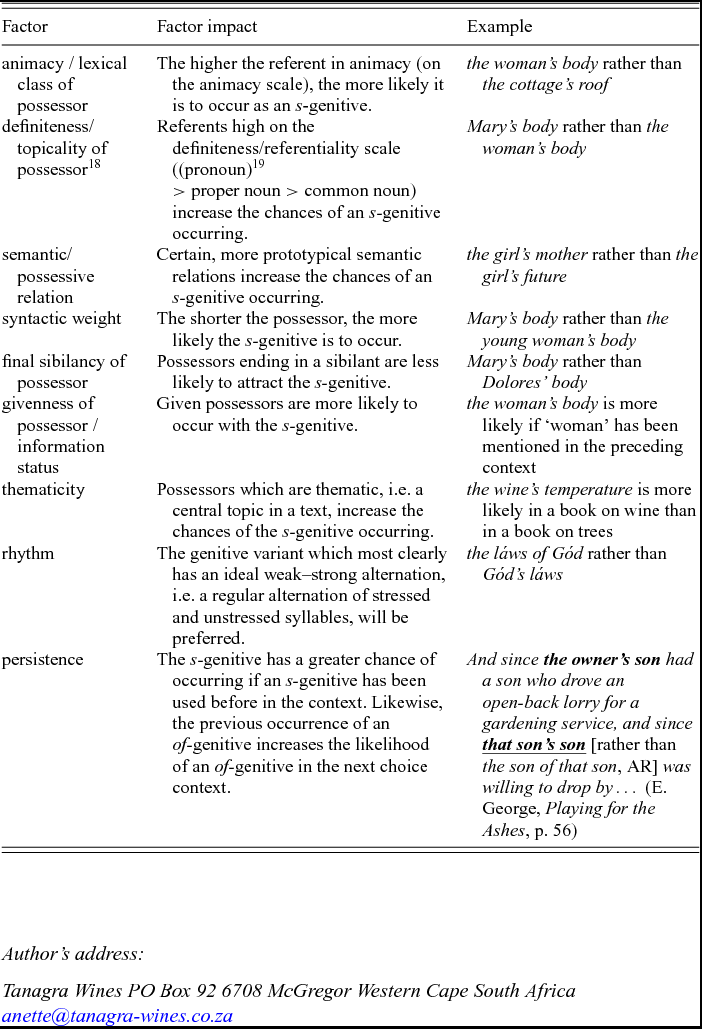
The factors conditioning the choice between the two genitives are rather diverse in nature and operate in different domains. In this section I will focus on linguistic factors, i.e. factors which are internal to language, while the factors discussed in the next section (3.2), i.e. regional variety of English, modality and text type, are ‘external’ to language. Operating ‘internally’ also means that these factors apply strictly within individual speakers when choosing a genitive construction, while an external factor such as ‘regional variety’ can also operate between speakers. Note further that while some factors operate on local, inherent properties of the (possessor) referent, such as animacy, definiteness or the final sibilancy of the possessor, others depend on the context, such as givenness or persistence. Table 2 gives an overview of the linguistic factors that have been shown to play a role in English genitive variation, each with an example of how they operate. For the sake of exposition the results are presented in a much simplified way; for details and problems see the discussion above and the individual studies (references are specified in table A1 in the appendix).
Factors in English genitive variation – an overview
Animacy is often said to be the most important factor in genitive choice (e.g. Rosenbach Reference Rosenbach2002, Reference Rosenbach2005; Wolk et al. Reference Wolk, Bresnan, Rosenbach and Szmrecsanyi2013; Grafmiller forthcoming; Jankowski & Tagliamonte this volume, inter alia), but it naturally depends on the selection and definition of the factors included in the analysis which of them will turn out to be the strongest. For example, including a quasi-categorical context such as e.g. pronominal possessors in the analysis will probably shift the ranking of factors in favour of definiteness/referentiality, as for example pointed out by O’Connor et al. (Reference O’Connor, Maling, Skarabela, Börjars, Denison and Scott2013). As Payne & Berlage (Reference Payne and Berlage2011) show, redefining and fine-tuning a factor (in their case the semantic relation) may reveal far stronger effects of this factor than previously assumed. In their genitive model the semantic relation is the most influential factor, exerting a stronger impact on genitive choice than animacy does. Thus, the ranking of factors is to some degree always relative to the individual genitive study – it all depends on which genitive variants are included in the analysis, and which factors are analysed and how.
In general, we should keep in mind that ultimately factors all play together to determine genitive choice. While animacy is usually regarded as the most influential factor in genitive choice, it is not the all-decisive factor but exerts its impact vis-à-vis the many other factors. As, for example, shown by Rosenbach (Reference Rosenbach2005), an animate possessor will become preferably expressed by the of-genitive if the possessor is getting long(er) – in her study a four-word possessor marked the cut-off point that tipped the scale towards the of-genitive. That is, speakers would usually choose the policy of the right honourable gentleman rather than the right honourable gentleman's policy. On the other hand, factors which only show weak effects in genitive choice may become more important in an otherwise ‘undecided’ context. For example, rhythm has been shown to exert only a minor role in genitive choice (Shih et al. forthcoming), especially with animate possessors, which bias genitive choice so strongly in favour of an s-genitive that considerations of rhythmic alternation do not matter. With inanimate possessors, however, it becomes a significant if still rather weak factor (see Grafmiller forthcoming). That is, in contexts where there was only a low chance of the s-genitive occurring, an ideal weak–strong alternation could tip the balance towards the s-genitive. In the context of animate possessors, however, rhythm virtually made no difference to genitive choice (Grafmiller forthcoming). This example shows that a strong factor such as animacy can bring about ‘ceiling effects’ which neutralize the effects of other, minor factors. Minor factors such as rhythm only have a chance to kick in in contexts which allow for more variation between the two variants.
3.2 Genitive variation across varieties and modalities
The choice between the two genitives has also been shown to be sensitive to the type of regional variety of English, modality (spoken versus written English) and within written English the particular text type.
One strand of research has focused on the differences between British and American English (e.g. Jahr Sorheim Reference Jahr Sorheim1980; Hundt Reference Hundt and Ljung1997, Reference Hundt1998; Rosenbach Reference Rosenbach2002, Reference Rosenbach, Rohdenburg and Mondorf2003; Hinrichs & Szmrecsanyi Reference Hinrichs and Szmrecsanyi2007; Szmrecsanyi & Hinrichs Reference Szmrecsanyi, Hinrichs, Nevalainen, Taavitsainen, Pahta and Korhonen2008; Szmrecsanyi et al. forthcoming). One of the main findings of this research is that the use of the s-genitive with inanimate nouns is more advanced in American English than in British English.Footnote 20 Most of the research on differences in genitive variation between American and British English has focused on press language and the question remains whether and how the results generalize to other text types. Rosenbach's (Reference Rosenbach2002, Reference Rosenbach, Rohdenburg and Mondorf2003) experimental data, which use stimuli from fiction, indicate that it is a general development not restricted to press styles. Hundt & Szmrecsanyi (Reference Hundt and Szmrecsanyi2012) also report differences in the strength of animacy between British English and New Zealand English, in that early New Zealand English seems to tolerate fewer s-genitives with inanimate nouns than early British English. All this indicates that the effect strength of animacy is variable across varieties of English.
Another strand of research focuses on modality and genre/text-type-specific differences in genitive choice, a question most comprehensively addressed by Grafmiller's (forthcoming) recent study. Grafmiller finds clear differences between genitive choice in spoken versus written language. Within written language, press language seems to stand out as a genre as opposed to non-press language and it is again the factor of animacy which is found to be most variable across genres. Grafmiller's (forthcoming) findings show a weaker effect of animacy in press language than in other genres. There is evidence from Canadian English which points to even stronger differences in genitive choice between spoken and written language. Jankowski & Tagliamonte (this volume) find that in their corpus of spoken Toronto data s-genitives get almost obligatorily realized with human possessors, and similarly of-genitives with inanimate possessors.
One theoretical question that often emerges in research on genitive variation is whether and to what extent changes in genitive choice reflect changing style or text-type conventions, such as e.g. the general change of written language towards a more spoken style (Hundt & Mair Reference Hundt and Mair1999), and whether they can be linked to a change towards more economy, i.e. the need to compress information more densely, in journalistic language (Biber Reference Biber, Aitchison and Lewis2003). This theoretical question is explicitly addressed by Hinrichs & Szmrecanyi (Reference Hinrichs and Szmrecsanyi2007), who interpret the increasing power of the factors of lexical density and thematicity they find in their data in favour of the ‘economization’ of journalistic prose, a view cautiously confirmed by Grafmiller (forthcoming).Footnote 21
Note, in general, that the type of language variety as well as modality and text type/genre are ‘external’ factors, which are orthogonal to the linguistic ones presented in section 3.1. In other words, we can construct ‘genitive models’ consisting of an interplay of internal factors for each regional variety, spoken language or written language and for different text types. Comparing such models will help us to find out what is constant and invariant in the system of genitive choice and what is variable. So far research suggests that there is no real qualitative difference between those genitive systems, although there may well be differences in the strength of individual factors (e.g. animacy, syntactic weight/length or thematicity) between different varieties, text types and modalities (see, in particular, Grafmiller forthcoming and Wolk et al. Reference Wolk, Bresnan, Rosenbach and Szmrecsanyi2013) – and also over time as discussed in the following section.
3.3 History of English genitive variation
As pointed out in section 2.2 above, there has always been a prenominal and a postnominal genitive variant throughout the history of English, although the particular variants themselves have undergone considerable change since Old English. Throughout Old English the two variants were still morphological, inflected genitives. During the late Old English and the early Middle English period the postnominal inflected genitive was first increasingly replaced by the periphrastic of-genitive and then disappeared completely. The prenominal inflected genitive got restricted to the -(e)s form and became the ‘s-genitive’ during Middle English. This invariant -(e)s (later to become ’s) started showing characteristics which are incompatible with an inflectional ending, displaying (some) properties of a syntactic clitic from the Early Modern English period. There is a large body of literature on the history of the s-genitive, particularly addressing the theoretical question to what extent it has turned into a clitic and whether this constitutes a counter-example to the alleged unidirectional morphological cline (content item > grammatical word > clitic > inflectional affix), which has been proposed with the framework of grammaticalization (see Hopper & Traugott Reference Hopper and Traugott1993: 7), according to which clitics may turn into inflectional affixes but not vice versa (for discussion see e.g. Janda Reference Janda, Traugott, Labrum and Sheperd1980, Reference Janda2001; Allen Reference Allen1997, Reference Allen2008; and Rosenbach Reference Rosenbach, Fischer, Norde and Perridon2004, inter alia). It is probably because of this particular theoretical interest the s-genitive has received, with respect to the issue of (de-)grammaticalization, that there is such a huge imbalance in what we know about the syntax and semantics of the s-genitive (and its history), as opposed to the historical development of the preposition of towards a major possessive marker in English, of which we know very little.Footnote 22
During the Middle English period the s-genitive got so dramatically replaced by the of-genitive that it almost looked as if it was on the way out of the language or at best becoming a marginal relic. In this respect, the period from late Old English to late Middle English shows the most salient changes in the history of genitive variation, as the variants as such underwent substantial change and as the development observed is so typical of the change from synthetic structures (like the inflectional, or s-genitive) to more analytic structures (like the periphrastic of-genitive). This does not mean, however, that there was no further change, but the changes to be observed from Early Modern English to Present-day English constitute shifts in the frequency of the (now established) variants, in certain contexts, that is, quantitative shifts rather than big qualitative leaps. One such quantitative and in fact rather surprising shift is the resurgence of the s-genitive during the Early Modern English period, as shown by a significant increase in the relative frequency of the s-genitive after a long period of steady decline, in a corpus covering the period from 1400 to 1630 (Rosenbach & Vezzosi Reference Rosenbach, Vezzosi, Sornicola, Poppe and Shisha-Halevy2000).Footnote 23 While the s-genitive was basically restricted to the context of animate (human) possessors during Early Modern English, it then further gradually extended to collective and certain inanimate nouns (mainly locative and temporal) during the Late Modern English period (see Wolk et al. Reference Wolk, Bresnan, Rosenbach and Szmrecsanyi2013; Szmrecsanyi et al. forthcoming). This extension of the s-genitive to inanimate possessors is continuing in contemporary English (e.g. Rosenbach Reference Rosenbach2002; Jankowski & Tagliamonte this volume). Jankowski (Reference Jankowski2013) reports an increase of the s-genitive with inanimate possessors in written Canadian English from 1906 to 2006. Jankowski & Tagliamonte (this volume) also find evidence for an increasing use of the s-genitive with inanimate possessors in their spoken Canadian data in an apparent-time study, where the younger speakers can be shown to use the s-genitive more frequently with collective and organization possessors, so apparently this change has spread to spoken language now in Canadian English.
The question remains why the s-genitive is extending to a context at the lower end of the animacy scale which, strictly speaking, disfavours the choice of an s-genitive, placing an inanimate possessor in initial position. Szmrecsanyi et al. (forthcoming) discuss various alternative explanations for this extension of the s-genitive to inanimate possessors. While they do not put forward one single explanation, the evidence so far is most compatible with a change in the conceptualization of animacy as well as an increase in the frequency of occurrence of certain noun classes which oscillate between an animate and inanimate interpretation in the data, both of which point to a culturally conditioned change. Jankowski & Tagliamonte (this volume) argue that the spread towards inanimate s-genitives is a (rare) case of a ‘change from above’, which originated in press language and from there spread to spoken language.
In sum, the s-genitive has become more frequent from Early Modern English onwards and has extended its domain to inanimate nouns, a development which is still going on in Present-day English but at a different pace in different varieties of English, with American English leading (e.g. Hundt Reference Hundt and Ljung1997, Reference Hundt1998; Rosenbach Reference Rosenbach2002; Szmrecsanyi et al. forthcoming). I refrain here from giving the varying frequencies of the genitive variants from Old English to Modern English, as the frequencies stem from different corpora which all employ somewhat different inclusion/exclusion criteria, so the resulting frequencies are strictly speaking not directly comparable. Nonetheless, what is important is that within individual studies, i.e. Thomas (Reference Thomas1931) for the period from the late tenth to the fourteenth century, Rosenbach & Vezzosi (Reference Rosenbach, Vezzosi, Sornicola, Poppe and Shisha-Halevy2000) for the period between 1400 and 1630, and Wolk et al. (Reference Wolk, Bresnan, Rosenbach and Szmrecsanyi2013) and Szmrecsanyi et al. (forthcoming) for the period between 1650 and 1999, the extensions described above can be found within consistently defined corpora. What all these studies further show is that the factors known to affect genitive variation (as far as they are analysed in these studies) seem to be ‘timeless’ in the sense that they can be found to be operative in any period of English. For example, animacy plays a role in genitive choice throughout the history of English, in that animate possessors prefer prenominal rather than postnominal position. What changes over time is the particular strength of animacy, as witnessed by the ongoing extension of the s-genitive to inanimate possessors, which constitutes a weakening of the animacy constraint (see also Wolk et al. Reference Wolk, Bresnan, Rosenbach and Szmrecsanyi2013 for further discussion). Note finally that a change in the effect strength of one factor can bring about changes in the strengths of other factors as well, which is not surprising given the fact that ultimately all factors work together in genitive choice. This may happen in particular if the factor is a major one, such as animacy. Ehret (Reference Ehret2012) and Ehret et al. (this volume), for example, relate the increase in the effect of rhythm, briefly mentioned above, to the weakening of the animacy constraint in Present-day English. Once the somewhat overpowering effect of animacy starts to weaken a bit, this makes space, so to speak, for rhythm to exert a slightly stronger role in genitive choice (see also section 3.1 above on rhythm).
4 Interpretation: making ‘sense’ – or: embedding findings into theoretical frameworks
It is only with the advent of sociolinguistics that work on genitive variation has become linked to theoretical frameworks, which is not surprising as the era before was dominated by what Chambers (Reference Chambers1995: 26) calls ‘the axiom of categoricity’, which had put variation outside the scope of linguistics. The general goal of any research embedded within the sociolinguist, variationist framework is to show that the choice between two alternating expressions is not random but the result of a choice process determined by various factors. This idea is explicitly expressed by the first large-scale study on genitive variation, conducted by Altenberg (Reference Altenberg1982):
If the ‘choice’ between alternative forms of expression is to a large extent determined by various linguistic and extra-linguistic factors, an important task in linguistic research must be to identify and evaluate these factors. This has also been the point of departure of the present study. (Altenberg Reference Altenberg1982: 12)
In this general spirit the various empirical studies following Altenberg's seminal work go on to determine the distribution of genitive variants in various corpora, although the link to the sociolinguistic framework is often not made explicit in this work (but see recently Tagliamonte & Jarmasz Reference Tagliamonte and Jarmasz2008; Jankowski & Tagliamonte, this volume). Accordingly, in these ‘early’ corpus-based studies on genitive variation the goal is primarily to identify the factors determining genitive variation and to specify the frequency of the genitive variants.
Rosenbach (Reference Rosenbach and Brinton2001, Reference Rosenbach2002, Reference Rosenbach, Rohdenburg and Mondorf2003) is the first study to link English genitive variation to psycholinguistic considerations, in particular to the requirements of language production. In the Bock–Levelt production model (e.g. Bock Reference Bock1982; Levelt Reference Levelt1989; Bock & Levelt Reference Bock, Levelt and Gernsbacher1994) conceptual factors such as animacy or topicality affect the assignment of grammatical functions at the level of grammatical encoding. While this model does not make specific predictions for genitive variation (for further discussion see e.g. Rosenbach Reference Rosenbach2002: 116–20; Reference Rosenbach2005: §5; Reference Rosenbach2008: §5), it does provide a psycholinguistic explanation for the fact that animate possessors get preferably realized first in a possessive construction, i.e. the s-genitive. This production-based explanation of the s-genitive's preference for animate and topical possessors receives support from MacDonald's (Reference MacDonald2013) ‘Easy First’ principle, which states that elements that are easily retrieved from memory (such as animate or given/topical referents) tend to appear early in an utterance and thus ‘allows producers the freedom to place easily retrieved elements early, permitting early execution of the plan, and allowing more time to plan the less accessible elements’ (MacDonald Reference MacDonald2013: 7). In addition to psycholinguistic considerations, Rosenbach also invokes typological evidence to account for the distribution of different possessive relations in her data (see in particular Rosenbach Reference Rosenbach2002: 113–26). That is, this approach tries to provide an independent reason why the distributions found are the way they are, which in turn allows for the postulation of specific hypotheses and testable predictions for the operation of factors. Rosenbach (Reference Rosenbach and Brinton2001, Reference Rosenbach2002, Reference Rosenbach, Rohdenburg and Mondorf2003) also makes a principled distinction between ‘choice’ and ‘variation’, with the former determining the actual choice of speakers in the real-time production process and the latter, more generally, reflecting the statistical likelihood of variants occurring within a speech community. Naturally, these two concepts overlap to a great degree but they are not reducible to each other, as the frequencies represented by ‘variation’ conflate the varying distributions across different speakers and speaker groups.
Subsequent research into genitive variation continues to look for ‘meaning’ in the distribution of variants. Some studies evoke considerations of ‘processability’ (Kreyer Reference Kreyer2003) or ‘factors related to processing and parsing’ (Hinrichs & Szmrecsanyi Reference Hinrichs and Szmrecsanyi2007), which is basically restricted to effects of syntactic weight and without directly relating it to any specific processing theory. Keizer (Reference Keizer2011; see also Reference Keizer, Hannay and Steen2007) gives an account of genitive variation within Functional Discourse Grammar (Hengeveld & Mackenzie Reference Hengeveld and Mackenzie2008), though her model is not based on the precise quantitative distribution of genitive variants vis-à-vis the various interacting factors her model incorporates.
Szmrecsanyi's (Reference Szmrecsanyi2006) monograph, which includes an in-depth study of genitive variation, is the first to draw attention to the factor of ‘persistence’, i.e. the fact that the previous use or mention of a grammatical variant increases the likelihood of the same construction being used in the next choice context. In other words, the s-genitive is more likely to occur if it has been used before in the preceding context (see section 3.1 above for an example). Although Szmrecsanyi is careful not to give an ultimate explanation for this factor, his discussion provides various theoretical motivations and factors contributing to persistence effects, be it restrictions of the processing systems (priming) or more general constraints of discourse management. Szmrecsanyi's (Reference Szmrecsanyi2006) work is a first step towards integrating considerations of speaker choice, determined by language-internal factors, with considerations of inter-speaker variation, determined by language-external factors (see particularly Szmrecsanyi Reference Szmrecsanyi, Geeraerts, Kristiansen and Perisman2010).
Aissen & Bresnan's (Reference Comrie2002) approach of ‘functional’ or ‘stochastic’ Optimality Theory is the first to formalize genitive variation, integrating previous functional and sociolinguistic work on genitives into a more formal model. Their starting point is the observation that the distributions found between the two genitive variants in English reflect a more general cross-linguistic pattern of possessive constructions. Drawing on typological findings which show that in languages which have two variants to express possessive (or genitive) relations this choice is very often determined by the animacy and referentiality of the possessor as well as the type of possessive relation expressed (reflected in what is known as ‘animacy/referentiality splits’ or ‘alienability splits’ in the typological literature on possession – see in particular the work by Koptjevskaja-Tamm Reference Koptjevskaja-Tamm2002), they suggest an analysis of genitive variation in terms of ‘harmonic alignment’, in which a structural scale gets ‘harmonically’ aligned with a substantial scale in that a prominent structural position gets associated with a prominent semantic-pragmatic position within those scales. Transferring this idea to possessive constructions they assume that the Specifier position is the more prominent position for a possessor than a non-Specifier position. The semantic-pragmatic scales applied are the animacy and definiteness scale known from the functional literature (e.g. Comrie Reference Comrie1989):

Harmonic alignment predicts that the Specifier position (the position of the possessor in the s-genitive) should be realized preferably with referents high in animacy and definiteness while the non-Specifier position (the position of the possessor in the of-genitive) should be realized preferably with referents low on these scales, i.e. inanimate and indefinite possessors. This type of argument does justice to the language-specific peculiarities and the specific distributions of genitive variants found in English, while at the same time tying them in to the broader cross-linguistic picture, as different languages may have different cut-off points as to where on the substantial scale a prenominal possessor (in Specifier position) gets preferred over a postnominal one (in non-Specifier position) and vice versa. The generalization is that whatever possessor can be realized prenominally, any referent higher in animacy/referentiality (definiteness) can be realized prenominally as well, with the same or higher frequency (see also Rosenbach Reference Rosenbach2008: §6 and O’Connor et al. Reference O’Connor, Maling, Skarabela, Börjars, Denison and Scott2013 for discussion and illustration of this for possessive alternations in various languages). The assumption of a stochastic generalization, i.e. the fact that this type of harmonic alignment does not need to be categorical but also allows for statistical preferences to be included in the model, was at the time a rather novel assumption within Optimality Theory and opened up this framework for any type of variationist work; see also O’Connor et al. (Reference O’Connor, Anttila, Fong and Maling2004) and Anttila & Fong (Reference Anttila and Fong2004) for Optimality-Theoretic accounts of English genitive variation. Data from English genitive variation has consequently also been used to test for specific theoretical assumptions of Optimality Theory (Jäger & Rosenbach Reference Jäger and Rosenbach2006).Footnote 24
In more recent work Bresnan and collaborators focus on developing ‘probabilistic genitive grammars’, which are supposed to reflect the way the genitive variants are represented in speakers’ minds – reminiscent of Labov's Variable Rules within the sociolinguistic framework and following other recent approaches advocating the idea of ‘probabilistic grammar’ (e.g. Bybee & Hopper Reference Bybee and Hopper2001; Bod et al. Reference Bod, Hay and Jannedy2003; Gahl & Garnsey Reference Gahl and Garnsey2006). This line of research makes use of the enormous advances in statistics and the subsequent availability of sophisticated statistical procedures in recent years, in particular multivariate regression models (see Baayen Reference Baayen2008). Its primary goal is to determine all the factors affecting genitive choice and put them together into a statistical model of genitive choice, which takes into account the interaction of all these factors at the same time. Given a certain input, or factor constellation, these models can predict, often with a likelihood of more than 90 per cent, which of the two genitives will be used, and they are thus taken to represent the predictive knowledge of speakers. In other words, in this type of work the statistical genitive model is a model of speakers’ predictive knowledge. The idea of probabilistic grammar is supported by evidence from rating experiments that show that speakers are amazingly good at predicting corpus probabilities (see particularly Bresnan & Ford Reference Bresnan and Ford2010 for the English dative alternation). The ultimate goal of this work is to understand the underlying cognitive mechanisms and the dynamics of syntactic alternations, such as the genitive variation, in analysing their development over time (Wolk et al. Reference Wolk, Bresnan, Rosenbach and Szmrecsanyi2013; Szmrecsanyi et al. forthcoming), across regional varieties of English (Hundt & Szmrecsanyi Reference Hundt and Szmrecsanyi2012; Ford & Bresnan forthcoming; Szmrecsanyi et al. forthcoming) and within the individual in language acquisition (Bresnan Reference Bresnan2011).
5 Looking ahead and beyond: challenges for future studies of English genitive variation
In the following I will briefly sketch what I believe are currently some of the major challenges for research into English genitive variation.
5.1 The factors
While the accuracy of recent genitive models (e.g. Hinrichs & Szmrecsanyi Reference Hinrichs and Szmrecsanyi2007; Wolk et al. forthcoming; Shih et al. forthcoming; Grafmiller forthcoming) suggests that most of the factors governing genitive variation have probably been ‘discovered’, some of them need further refinement. Most importantly, there is some evidence suggesting that the semantic relation plays a more important role than previously assumed (see Payne & Berlage Reference Payne and Berlage2011), but it will be a major enterprise and challenge to identify all the different relations that can be expressed by genitive constructions in English and operationalize them in a way applicable in corpus analyses, as described in section 3.1 above.
5.2 The underlying mechanisms driving genitive choice
Establishing factors and determining factor values and their impact on genitive variation is one thing and there has been considerable progress in this area, as discussed above. Less clear is the precise nature of these factors. There seems to be some general agreement in the literature that syntactic weight is a processing factor, though the status of animacy, for example, is less clear. While some studies consider it more generally as a ‘semantic-pragmatic factor’ (e.g. Hinrichs & Szmrecsanyi Reference Hinrichs and Szmrecsanyi2007), others regard it as a processing factor (Rosenbach Reference Rosenbach2002, Reference Rosenbach2005). One may of course ask why this should matter: aren't these only labels after all? In a way they are, but finding out the underlying cognitive mechanism for the operation of the individual factors will help us to embed genitive variation within a theoretical framework that tells us where the statistical distributions ultimately come from. It is for this reason that research into genitive variation should not stop at simply listing (varying and changing) frequencies or ‘genitive grammars’ but connect to – and possibly also develop new – theoretical models that will help us understand what drives syntactic alternations. As the best-researched domain of syntactic alternations and one sharing a lot with other syntactic alternations, English genitive variation provides an excellent starting point for this challenging enterprise. The question is how we can get evidence for these mechanisms. Below I give some (tentative) suggestions how this can be done. Note that some of the issues raised have already been discussed earlier in this article but I will repeat them here for the sake of explicating potential types of evidence, focusing mainly on a discussion of the most prominent and best-researched factor in genitive choice, i.e. animacy.
1. Empirical data from genitive variation (and other word order alternations) across varieties and time. If there are cognitive constraints on the choice of genitive construction, we would expect them to be stable over time and across regions, unless we want to assume that the way we process language has fundamentally changed over time or is culture-dependent, which would run counter to the uniformitarian principle (see Wolk et al. Reference Wolk, Bresnan, Rosenbach and Szmrecsanyi2013 for discussion). ‘Stable’ in this context does not mean ‘invariant’; rather, it means that the general preferences should persist over time. This still allows some variability in effect strengths over time, if we assume a plastic cognitive makeup. From the evidence collected so far, we can confirm this for the factor of animacy (see also section 3.3 above). As we have seen, the effects of animacy are not ‘frozen’ and show considerable flexibility, which is just the type of plasticity we would expect from a probabilistic grammar. At the same time the evidence clearly suggests that this plasticity (or variability) is constrained in a principled way, so not just anything goes. In any period of the English language and in any variety of English the s-genitive has always been more frequent with animate possessors than with inanimate ones. What may vary is the degree of preference for either construction along the animacy scale, but not this general preference as such. If we find evidence for a factor like animacy operating in an unpredicted way across varieties or in earlier stages of English, for example if the s-genitive becomes more frequent with inanimate possessors than with animate ones, this would constitute evidence against animacy as a processing/cognitive factor.
2. Cross-linguistic evidence. There is substantial cross-linguistic evidence showing similar patterns of preference according to animacy (and referentiality) and thus the same type of constraint space with respect to the choice of possessive variants as in English genitive variation (e.g. Koptjevskaja-Tamm Reference Koptjevskaja-Tamm2002; Rosenbach Reference Rosenbach2008; O’Connor et al. Reference O’Connor, Maling, Skarabela, Börjars, Denison and Scott2013; see also section 4 above).Footnote 25 If we find a language in which prenominal possessives get preferably realized with inanimate possessors and postnominal ones with animate possessors, this would constitute evidence against a cognitive grounding of the animacy constraint.
3. Cross-constructional evidence. If speakers start conceptualizing certain referents in a different way over time with regard to their animacy status, then we would expect this to be reflected in all word-order alternations, not only genitive variation. Only rarely do researchers compare different alternations in a single (diachronic) corpus study; an exception is the study by Wolk et al. (Reference Wolk, Bresnan, Rosenbach and Szmrecsanyi2013), who show a parallel weakening of the animacy constraint in both genitive and dative alternation throughout (roughly) the same period. This indicates that the animacy effects we find are not idiosyncratic, construction-specific effects but that animacy operates on a more general level.Footnote 26
4. Independent psycho-/neurolinguistic evidence. Research into genitive variation needs to be connected more closely to psycho-/neurolinguistic evidence and models and look more closely at the on-line production of genitive variants to be able to link it to independent mechanisms couched in cognition and language processing. While Rosenbach (Reference Rosenbach2002, Reference Rosenbach, Rohdenburg and Mondorf2003, Reference Rosenbach2005) links the preference for animate possessors for prenominal position (i.e. the s-genitive) to the speech production model by Bock & Levelt (Bock Reference Bock1982; McDonald et al. Reference McDonald, Bock and Kelly1993; Bock & Levelt Reference Bock, Levelt and Gernsbacher1994), MacDonald's (Reference MacDonald2013) Production-Distribution-Comprehension (PDC) account provides further independent evidence for the fact that salient referents (like animates) tend to occur first whenever the language provides alternative forms (MacDonald's ‘Easy First’ principle, which stems from the architecture and needs of on-line language planning/production). More such independent evidence is needed in order to avoid making the argument circular (in the sense that corpus frequencies reflect what speakers do more often).
5. Cognitively real computational modelling. It remains to be seen how well the empirical facts of genitive variation can be captured by computational models that try to depict and simulate language learning and processing in a cognitively real way. How this can be done has recently been demonstrated by Van den Bosch & Bresnan (Reference Van den Bosch and Bresnan2014), who have successfully modelled the acquisition of English dative alternation within TiMBL (Daelmans et al. Reference Daelmans, Zavrel, van der Sloot and van den Bosch2010), a model of memory-based learning, which computationally implements the idea of exemplar-based learning. In particular, they show how children's use of dative variants reflects their caregiver's usage, which suggests that children learn patterns of variation from storing their caregiver's usage. This approach could also be tested for English genitive variation.
Taken together, there is some evidence for a general cognitive underpinning of the internal factors (mainly animacy) governing genitive choice. The operation of factors is stable over time and across varieties and constructions and not restricted to English but can be found in other languages as well that display a similar choice between a prenominal and a postnominal adnominal possessive construction. More independent behavioural data are needed, however, to provide further evidence for the cognitive basis of constraints. As there is no direct evidence for the underlying (cognitive) mechanisms in genitive choice, we will have to work with theoretical models and use indirect evidence, a lot of it merely argumentative. It is important to note that the assumption of cognitive factors does not exclude social factors, which so far are still little understood in genitive variation (see also further below).
5.3 Understanding the variability of genitive choice across varieties of English
Where do similarities between genitive grammars in different varieties of English come from – from their common descent or from their sharing the same cognitive underpinnings?Footnote 27 And how can we empirically distinguish between these two positions? In the previous section a number of arguments were given in favour of cognitive forces being responsible for genitive choice, which would account well for the parallels between varieties. While it is intriguing to see the commonalities between varieties of English, it is at least as interesting to ask where the differences come from. Which factors make genitive grammars shift and in which way, that is, how are such shifts constrained? In order to answer such questions more crossvarietal studies of genitive variation are needed, which compare more varieties than simply two and which take into account the differences between text types and modalities. For example, Hinrichs & Szmrecsanyi's (Reference Hinrichs and Szmrecsanyi2007) paper gives an impressive view on differences between genitive grammars in British and American English, but their study is restricted to press language. As Jankowski's (Reference Jankowski2013) study has shown, however, certain changes (such as the weakening of the animacy constraint) might be largely restricted to written language. On the other hand, Grafmiller's (forthcoming) comprehensive study, comparing the effects of different genres and modalities, is restricted to American English. It is clear that comparing different varieties of English, spoken and written (the latter further differentiated by various genres, distinguishing press versus non-press language), with a sufficient amount of data is beyond the possibilities of a single study. What is desirable, therefore, is to make available studies and corpora comparable to each other and give clear outlines for future studies on English genitive variation, which would – ideally – all proceed from the same inclusion/exclusion criteria and which operationalize factors in a comparable way (see also the section on comparability below). Looking at the variability of English genitive variation across varieties of English will help us to find out whether there is one core (probabilistic) grammar for English genitive variation which all variability in genitive choice across varieties falls out from, or whether there are different co-existing systems for genitive choice.Footnote 28
5.4 Integrating cognitive and social determinants of genitive choice
Traditionally, social factors have been studied with naturalistic data within the domain of sociolinguistics, while anything related to language processing has been studied within psycholinguistics by means of experimental studies. Recently, however, there has been a shift towards integrating social and cognitive/processing factors within models of grammatical variation. So the traditional and rather strict division of labour between sociolinguistics and psycholinguistics is no longer valid (see also Krug et al. Reference Krug, Schlüter, Rosenbach, Krug and Schlüter2013). One central question in this line of research will need to be: what is the precise relation between language-internal (and presumably cognitive factors) and language-external factors (e.g. regional variety, text type/genre, modality)? While we know that different varieties, genres and modalities exhibit different types of genitive frequencies, the ‘big question’ is whether such external variables are really orthogonal to the internal structure of genitive choice or whether they display genitive choice systems which are, in any way, qualitatively different from each other. In the previous section I already raised the question of whether there is one core grammar for different varieties of English, and the same question can be asked for different modalities and genres of the same variety. Is the grammar of genitive choice the same in spoken and in written language? Jankowski & Tagliamonte (this volume) suggest these are different systems. Or does press language have a genitive grammar of its own? We know that use of press language generally boosts the frequency of the s-genitive, especially with inanimate possessors, but the evidence so far suggests that the general factor ranking seems to be the same, although the role of animacy is considerably weakened in this genre (see, in particular, Grafmiller forthcoming). More studies are needed that compare genitive choice across different modalities and genres, and again this requires either very large data sets or comparable single studies.
Furthermore, the social conditioning of genitive choice is certainly an issue which needs to be looked into in more detail in future studies. Only very recently have some clearly social variables such as speaker sex or occupation been included as variables in the analyses (e.g. Shih et al. forthcoming; Tagliamonte & Jarmasz Reference Tagliamonte and Jarmasz2008; Tagliamonte Reference Tagliamonte2010; Jankowski & Tagliamonte, this volume; Ford & Bresnan forthcoming).
5.5 Comparability of results
As demonstrated in table A1 in the appendix, so far a large body of empirical studies on English genitive variation has been accumulated. And yet it is often very difficult to compare the frequencies and the results given in these studies directly with each other. Most of these studies use their own criteria for including or excluding genitive constructions and do not analyse precisely the same set of factors defined in precisely the same way in comparable data sets, so the frequencies obtained are not truly comparable either. It is one of the challenges for present and future research into genitive variation to conduct studies in such a way that results become truly comparable. Once we have comparable data sets we can set out to better compare, on a larger scale, models of genitive choice in different varieties of English and address, in more detail, some of the issues raised in this section. Ultimately, it would also be desirable for these data sets to be made publicly available to the scientific community, so that future scholars of English genitive variation can connect directly to these data.Footnote 29
6 Conclusion
In the introduction to this article (section 1 above) I stated that ‘English genitive variation is arguably the best researched of all of syntactic alternations.’ As the remainder of this state-of-the-art article has shown, this statement does not mean to imply that we are all done with it and can now happily turn our attention to other alternations. Rather, we have made great progress in answering some basic questions, which again produces further questions, problems and challenges for future studies. The more we learn about English genitive variation, the more new questions and directions emerge. Studying genitive variation also means studying a syntactic alternation which is exemplary of and in fact shares fundamental factors and mechanisms with many other syntactic alternations, which is why any in-depth study of English genitive variation will shed new light on the mechanisms driving syntactic variation in general.
Appendix
Empirical and quantitative studies on English genitive variation – an overview