Many researchers have studied the interactional use of gesture as an aspect of communication within interpersonal, conversational situations, arguing that gestures have a major role to play in these contexts (e.g., Alibali, Heath, & Myers, 2001; Gullberg, 1998; McNeill, 1992; Schegloff, 1984). Also, inspired by Vygotsky's notion of private and inner speech, McCafferty (1998) and McNeill (2000) have pointed out that speech and gesture are also closely related in intrapersonal speech behavior. Private speech commonly refers to speech-for-the-self, a type of intrapersonal speech, as opposed to speech intended for others. Private speech is a form of externalized self-directed speech that appears, for example, when we ask ourselves questions and answer them, when we tell ourselves to interrupt a particular activity, and when we tell ourselves that we are wrong, or that we cannot do something, or that we have completed a task. As these examples show, we use private speech as a mediational tool to regulate our thinking by establishing meanings for the self, aiding memory, monitoring, and planning activities, among other functions. However, to date, studies of second language (L2) private speech and gesture have not explicitly focused on the dialogic quality that forms of private speech can take, as in the example of both eliciting a question and supplying the answer. The current study will consider the dialogic (communicative) and self-regulatory (cognitive) functions of particular forms of private speech within the framework of Vygotskian sociocultural theory.
BACKGROUND
Linguistic Signs and Private Speech
The relation between language (or speech) and thought in sociocultural theory constitutes the primary focus of this study—specifically, the influence of language on cognitive development as an aspect of SLA. From a Vygotskian sociocultural perspective, language is considered a linguistic sign or a form of semiotic mediation. Vygotsky (1981) stated that “language or speech; various systems for counting; mnemonic techniques, algebraic symbol systems; works of art; … all sorts of conventional signs; and so on” operate as “psychological tools” that help mediate the world and one's thoughts (p. 137). Speech, in this assessment, includes not only oral production but also written production.
Vygotsky's (1934/1987) position on the social aspects of signs can be seen in his view of the social and individual functions of speech: Both are mediational means, one social (interpsychological) and the other intrapersonal (intrapsychological). Vygotsky also made an essential point regarding the interaction of these two forms of speech in relation to intellectual development:
The initial function of speech is the communicative function. Speech is first and foremost a means of social interaction, a means of pronouncement and understanding. This function of speech, which is usually analyzed in terms of isolated units, has been separated from the intellectual function of speech. Both functions are ascribed to speech as if they were parallel to or independent of one another. Speech, as it were, combines within itself both the function of social interaction and the function of thinking, but what the relationship is between these two functions, what brings about the presence of the two functions of speech, how they develop, and how they are structurally intertwined are questions that have remained uninvestigated. (p. 88)
Private speech is defined as different from social speech in that private speech is not intended for communication with others; it is addressed to the self (Zivin, 1979). Private speech is also different from inner speech because private speech is produced as overtly vocalized utterances, whereas inner speech—silent verbal thought—is produced covertly inside one's head (Sokolov, 1972; Zivin). Moreover, Roebuck (1995) and Lantolf (2000) have both argued that private speech is not limited to oral speech but is also represented in writing; that is, private writing is the written production of private speech and serves psychological functions equivalent to those of private speech (DiCamilla & Lantolf, 1994; Roebuck).
Dialogic Aspects of Private Speech
Language (or speech) has inherent dialogic aspects. Vološinov (1929/1973) argued that “the actual reality of language-speech is not the abstract system of linguistic forms, not the isolated monologic utterance, and not the psychophysical act of its implementation, but the social event of verbal interaction implemented in an utterance or utterances” (p. 94). Vygotsky (1978) noted the resemblance between social speech and private speech (or in Bakhtin's, 1981, terms, dialogicity), in that private speech is a dialogue with the self (i.e., intrapersonal communication). Vygotsky referred to inner speech as a “unique form of internal collaboration with oneself” (p. 273) and described private and inner speech as socially originated dialogic speech addressed to the self (Wertsch, 1985). Wertsch (1991) also pointed out that the dialogicity that explicitly informs Bakhtin's conception of the utterance is at play in Vygotsky's account of intermental and intramental functioning. According to Bakhtin, dialogism is inherent in language. The concept of dialogism or dialogicity encompasses theoretical and epistemological assumptions about human action, communication, and cognition. Based on this conceptualization of language and thought, Vygotsky, neo-Vygotskians (Shotter, 1993; Wertsch, 1979, 1985), and L2 researchers (Frawley & Lantolf, 1986) have adapted Bakhtin's notion of dialogism or dialogicity to interpret speech activities—including private speech—through a dialogic perspective. Thus, social speech is viewed as a dialogue with others, whereas private speech (overt utterance) and inner speech (covert utterance in mental process) are types of dialogues with the self (Kohlberg, Yaeger, & Hiertholm, 1968; Lantolf & Thorne, 2006; Lee, 2006a, 2006b). Vocate (1994) similarly asserted that in intrapsychological communication, the “I-You” social interaction becomes an “I-Me” dialogue in which “I” makes choices with regard to what to talk about and “Me” interprets and critiques these choices (p. 12).
The function of private speech has often been described as self-regulatory (Frawley & Lantolf, 1985; Lantolf & Thorne, 2006; McCafferty, 1992, 1994a, 1994b; Ohta, 1998, 2001; Wertsch, 1985). Self-regulation is internally oriented voluntary regulation that characterizes higher mental functioning; self-regulation is in evidence when a skilled individual is capable of autonomous functioning. Several levels of development are implicated in the process of an unskilled individual (e.g., a child) acquiring the ability to self-regulate. Wertsch suggested that prior to self-regulation, behavior is guided by phenomena in the physical environment that attract a child's attention. This orientation is termed object-regulation and is found in the early use of private speech for describing and naming certain objects, actions, and the environment—rather than for planning—during problem-solving tasks. Also, before a child develops self-regulatory private speech, he or she is often guided through goal-directed activities by adults such as teachers or other experts, a process that Wertsch termed other-regulation. At this level, the child is responsive to the direction of other people. Eventually, the child becomes independent in problem-solving and capable of internalizing thinking skills to resolve difficulties; this highest developmental level is self-regulation. At this level, the child is able to guide, plan, and monitor his or her mental activity. Thus, an unskilled individual learns by carrying out tasks and activities under the guidance of more skilled individuals through a process of other-regulation, which is typically mediated through social speech (DiCamilla & Antón, 2004; Frawley & Lantolf; Lantolf, DiCamilla, & Ahmed, 1997; Ohta, 2001). At a certain point, the unskilled individual begins to regulate himself or herself. At this point of self-regulation, private speech often helps to guide the individual to successful completion of problem solving and other tasks.
Gesture
Gesticulation is the form of gesture that co-occurs with speech, including forms of private speech (McCafferty, 1998). McNeill (1992) distinguished four major categories of manual gestures (i.e., gesticulations): (a) Iconics describe the content of speech in concrete depictions, (b) metaphorics depict abstract entities in concrete form, (c) deictics are largely pointing gestures, and (d) beats are movements that occur in conjunction with prosodic prominence patterns in speech and mainly serve discourse functions. McNeill noted, however, that gestures might be difficult to categorize. Indeed, McNeill (2005) identified dimensions that exist within the categories and recommended that gestures be interpreted in terms of their dimensions rather than being classified by category.
In studies of social interaction (Goodwin, 1986), gestures such as nodding, eye contact, facial expression, and various body movements were found to help coconstruct interactional discourse and to provide important communicative cues (see also Goffman, 1981). Consequently, both the cognitive aspects and the communicative functions of gesticulation—regulatory functions of language—should be considered in interpersonal and intrapersonal communication.
MICRODISCOURSE ANALYSIS OF PRIVATE SPEECH AND GESTURE
Vygotsky (1978) pointed out that the forms of private speech originate in social speech and that parallels can be drawn between social speech (e.g., classroom interaction) and forms of private speech. Although private speech and accompanying gestures do not form interpersonal communicative utterances, they contain both dialogic (communicative) and self-regulatory (cognitive) elements. The present study was designed to explore the dialogic aspects of gesticulation and their self-regulatory functions in the private speech of L2 learners within the framework of Vygotskian sociocultural theory. The approach adopted for the analysis of private speech and gesticulation is called microdiscourse analysis. In this approach, designed to demonstrate the apparent interactional structure of private speech (Lee, 2006a, 2006b), elements of conversation analysis (CA; see Hutchby & Wooffitt, 1998, for details) are integrated with aspects of Goffman's (1981) participation framework for the analysis of intrapersonal speech.
Conversation analysis is the study of talk-in-interaction, which most commonly refers to interpersonal conversation. Although CA has not been widely adopted as an analytic method to examine intrapersonal speech, microdiscourse analysis works from the assumption—based on Vocate's (1994) assertion that private speech involves interactional dynamics between the selves “I” and “Me” and between the self and text materials—that the production of private speech can be elucidated in terms of interactional discourse. CA transcriptional conventions provide a useful tool to describe the dialogic aspects of private speech and gesticulation and are thus used in the current study to point out all of the subtle changes that appear in the private speech analyzed, such as changes in the volume of the voice and relevant details in syntax, phonetics, and gesture production.
Goffman's (1981) notion of footing is the other essential element adopted in the microdiscourse analysis undertaken with the current data. According to Goffman, footing refers to the position or alignment that an individual takes in uttering a given linguistic expression in conversation or social action; furthermore, the roles of speaking and hearing can be broken down into more specific interactional footings. Goffman summarized the notion of footing in participation as follows:
- The participant's alignment, or set, or posture, or projected self is somehow at issue.
- The projection can be held across a strip of behavior that is less long than a grammatical sentence, or longer, so sentence grammar won't help us all that much, although it seems clear that a cognitive unit of some kind is involved, minimally, perhaps, a “phonemic clause.” Prosodic, not syntactic, segments are implied.
- A continuum must be considered, from gross changes in stance to the most subtle shifts in tone that can be perceived. (p. 128)
Participants in an interaction constantly change their footing while speaking as they negotiate the interactional dynamics of interpersonal communication; any linguistic or paralinguistic alignment in the production or reception of an utterance implies changes in footing as a person positions himself or herself as speaker and listener. This interpretation is posited as a useful tool of analysis for intrapersonal communication, as a single person changes voices and footing as speaker and hearer in private speech.
Using microdiscourse analysis—combining CA protocols to depict interactional sequence organization and Goffman's (1981) notion of footing to interpret the data—this study of gesture and private speech among Korean L2 learners of English aims to highlight the variety of gesticulation that accompanies private speech and to analyze its self-regulatory and dialogic functions. The analysis will focus in particular on gesticulations that accompany interactional cues (i.e., all of the positionings that a speaker and listener might deploy in appropriating footings in conversation) as these appear in private speech.
METHOD
Participants and Procedures
Seven Korean students in their early to mid-twenties studying full time at a university in the American Midwest participated in this study. All participants were native speakers of Korean enrolled in an intermediate biology class in an English as a second language (ESL) environment. The participants had learned English in both institutional settings (e.g., foreign language and L2 classes) and natural environments (English-speaking communities). Their level of English proficiency was advanced; that is, all participants had completed or were currently taking the most advanced ESL course offered by the ESL program at the university. A student who passes this course has completed the entire ESL sequence required by the university.
All participants agreed to be videotaped and audiotaped while studying for 3 h in solitude in private rooms. The participants read from textbooks, their own notebooks, and class handouts; they also used electronic dictionaries. All texts were in English except the dictionaries. Some participants occasionally wrote or drew in their notebooks and on the class handouts. Samples of study materials, such as participants' reading texts, writing texts, and drawings created while studying, were also collected.
Two camcorders were used to record participants' activities: one to capture the study materials (i.e., which part of the written materials he or she was reading) and the other to capture the larger scene, including the participant and the study materials as well as any written production. An external microphone connected to the main camcorder was used to capture low-volume sounds made by participants. The videos were digitized and assembled by the picture-in-picture procedure. After digitization, stimulated recall interviews (Gass & Mackey, 2000) were conducted with each participant. The participant and the researcher watched the participant's video together in order to analyze the participant's use of study materials as well as to ensure a correct interpretation of the content of the study materials and the participant's interactions with them. During the interview, the participants provided thoughts on their language use and their study habits as well as their background knowledge of the text materials. The interviews during the recall session were audio-recorded only.
Data Analysis
The spoken data were transcribed following CA conventions (see the Appendix). The total amount of oral production of private speech was measured in minutes with a stopwatch. Silences, including pauses while reading aloud, were not counted, so that only the production of private speech was measured. The written production of private speech—private writing, such as notes and drawings for the self—was also considered in order to catch the details of individual participants' cognitive activity during exam preparation. The private writing data was only considered when it was relevant to the corresponding gesticulation and oral production of private speech.
Three main types of private speech actions will be considered in the analyses:
- Reading the text aloud
- Explaining concepts to the self in both Korean and English
- Reviewing knowledge to the self after reading activities in both Korean and English
All of these actions can be seen as dialogic interaction—interaction within the self or with the text materials—in terms of meaning-making activity (Roebuck, 1995).
The first two of these private speech actions, reading aloud and explaining concepts to the self during reading, are recurrent categories in the data because the task is exam preparation, in which reading is one of the main activities for understanding and memorizing. Roebuck (1995) claimed:
Reading is a meaning-making activity. Faced with textual artifacts readers seek to construct meaning, thus producing an interpretation or representation that is accordingly only valid for a given reader and a given text at a given time. Because individual readers form an inherently diverse group, and in fact, may themselves be different readers at different times, the individual representations that may be constructed for any one text are necessarily different from each other. (p. 13)
As far as written artifacts (e.g., textbooks) are concerned, Rommetveit (1992), aligning himself with the theory of meaning in semiotics and the dynamic nature of signs in this theory (Marková, 1992), argued in his discussion of a dialogically based social-cognitive approach to human cognition and communication that the marks on a printed page do not contain meaning. Rather, they represent meaning potentials—relics of a private meaning construction that may later be actualized for the creation of new meaning. Therefore, reading can be seen as an interactional activity by the readers to make potential meanings meaningful to them. In Goffman's (1981) participation framework, the reader is playing the role of animator of the text when reading the text aloud.
Like reading aloud, from the perspective of dialogism (Bakhtin, 1981; Marková, 1992; Rommetveit, 1992), the actions of explaining and reviewing to the self refer to the process of negotiation with the self, as seen in the self-teaching and dialogical functions of L2 learners' inner speech (de Guerrero, 1994). This dialogic perspective involves the self taking on the roles of addressor and addressee, thereby establishing meaning to the self. If the strategy of reading aloud is understood as the primary component of the meaning-making activity in the current study, explaining to the self might be described as the next important action in intrapsychological functioning.
In terms of the analysis of gesture with private speech, McNeill's (2005) dimensional interpretation of gesture form and Goffman's (1981) notion of footing in conversation are adopted. Single gestures or combinations of gestures are analyzed to uncover how gesticulations during private speech might display both cognitive and communicative functions insofar as they resemble interactive actions. For example, self-teaching actions might exhibit a structure parallel to that of teacher-student social speech activities. Also, gesticulation is investigated with speech to examine the coexpression in both modalities, speech and gesture coming together in sync. The combined features are believed to demonstrate the unity of speech, gesture, and thought as part of the same underlying psycholinguistic process, called the growth point hypothesis by McNeill (1992, 2005).
RESULTS AND DISCUSSION
All seven participants produced private speech and coexpressive gesticulation during cognitive activity. During these meaning-making activities, learners regulated their own thinking through establishing meanings for the self, memorizing, and monitoring their own activities by using private speech and gesticulation. After the presentation of the total amount of private speech, three types of gesticulations occurring with private speech and reading will be introduced: nodding, beats, and deictic gestures. Then, the functions of gesticulations—processes such as memorization, self-teaching, and drawing—will be discussed.
As shown in Table 1, there was considerable variation in the amount of private speech produced by the seven participants, from a minimum of 4% to a maximum of 31% of the total study time. During the solitary exam preparation, various actions occurred that can be characterized as interactional in nature. For example, participants read aloud from their textbook and class handouts. Most of the private speech and accompanying gestures occurred while participants were engaged in reading and explaining. The activity of reading can be seen as dialogic interaction between the text materials and the self and between the author and the self. More than 50% of the participants' production of private speech was reading aloud. As discussed earlier, reading aloud is an interactional activity by the reader to make potential meanings meaningful to him or her, and the reader plays the role of animator of the text when reading aloud. This can be interpreted as self-teaching or self-scaffolding actions. In the data, the participants showed this type of behavior when they deployed conversational sequences such as self-initiated self-repair, question-answer sequences, and reactive expressions in which the reader is both animator or addressor and hearer or addressee simultaneously (Lee, 2006a, 2006b). This dialogic character of private speech was also observed during explaining and reviewing actions.
Duration of private speech during solitary exam preparation

Simple Types of Gesticulations
The most commonly observed gesticulations among the participants were nodding, beating, pointing, and illustrating aspects of biological processes with hand gestures. In the following examples, which have been transcribed to represent both speech and gesture, the italics in double parentheses represent gestures and the bold italics represent the important gesture to be analyzed.
Nodding.
Nodding is one of the most frequently observed gestures in interpersonal communication, serving as a sign of listener status in talk-in-interaction (Goffman, 1981; Schegloff, 1984) and of various reactive expressions, such as acknowledgments. Examples (1) and (2) illustrate the function of reactive expressions in the private speech data.
In (1), Yoonsoo was reading his class handout aloud and uttered “aha::” in line 1, which is a canonical sign of a reactive expression (Lee, 2006b; Young & Lee, 2004) in talk-in-interaction. He then continued to deploy reactive expressions by uttering kreokhun “I see” in Korean, accompanied by a vertical head movement. This gesture signals that Yoonsoo was engaged in a type of intrapersonal communication with the self and with reading the text; he has reached understanding.

Korean private speech is transcribed in four lines: The first line is transcribed in the Korean alphabetic system of Hangul, the second line is the corresponding pronunciation, the third line is the corresponding English morpheme-by-morpheme gloss, and the last line is the overall sentence or clause meaning in English. Grammatical abbreviations: acc = accusative case, cnj = conjunction, fp = final particle, nom = nominative case.
Example (2) is a question-answer sequence (Lee, 2006a, 2006b) often observed in classroom interaction (Markee, 2000). In line 1, Yoonsoo asked a question and then sought the answer, in line 2, by reading the text. In line 3, he nodded and then continued reading the next part aloud. As in (1), this example of nodding supports the interpretation that dynamic dialogic interaction occurs in the process of self-regulation of cognitive activity.

Beats.
McCafferty (1998, 2004, 2006) investigated the use of gesture and its relation to private speech and inner speech, speculating that beats can have a self-regulatory function in the process of internalization (e.g., learning pronunciation in a L2). In line with his suggestions, the next example of the use of beats shows what could be the moment of uptake during the participant's reading action.

In (3), Yoonsoo was reading his textbook aloud in a whisper. After reading for a while, he self-monitored his understanding, as shown in line 2. By uttering “it goes to endometrium,” Yoonsoo appears to confirm his understanding of the text, and his self-confirmation is reinforced by the following word ikeochi “right.” In Korean conversational interaction, ikeochi “right” is used to check a previous utterance, similar to “okay, I see” in English. In the context of reading a L2 text, it functions as an acknowledgment, which implies a reaction to the reading. As noted in line 3, the beats begin right on the first syllable of ikeochi “right”; this seems to emphasize the moment of Yoonsoo's uptake.
Deictics (Pointing).
Pointing occurs both in interpersonal and intrapersonal communication. In intrapersonal communication, such as private speech, pointing can function to help self-regulation (McCafferty, 1998). Allen (2000) noted that deictics and beats are often used in other-regulation in interpersonal communication in the L2 classroom; these gestures are a crucial part of teaching acts—a type of scaffolding action used in the teaching of L2s.
Similar to Allen's (2000) classroom interactional data, in the current study, pointing mainly occurred during reading when the participants encountered new vocabulary. In (4), Yoonsoo produced private speech when he came across important lexical items while reading: “testosterone” in line 1 and “androgen” in line 4. As he uttered the names of these hormones, he pointed at the figure that included the hormonal circulation of the human body (lines 2 and 5).

This gesticulation resembles deictic gestures used by teachers when teaching (Alibali & Nathan, 2007); for example, a teacher might point to a certain part of a figure with his or her finger or a pen for the visual interpretation of certain concepts in science. This particular gesticulation by Yoonsoo thus appears to function as a type of self-teaching action. A self-teaching action is a type of self-scaffolding, which will be discussed further in the discussion of the functions of gesticulation in (6)–(9).
Functions of Gesticulation
So far, single actions of different types of gesticulations in the private speech data have been considered. However, two or more types of gestures overlapping in the local discourse context were also common, especially when pointing and beating gestures in private speech played a mnemonic function.
The Process of Memorization.
Choi (2002) pointed out that repetition mainly serves a mnemonic function when students practice English words and phrases and try to memorize them through repetition (see also de Guerrero, 2004, for the mnemonic function and the importance of repetition in L2 learners' inner speech). Repetitions are often accompanied by beat gestures with deictic properties, as seen in line 6 of (5). This type of repetition is considered to serve a mnemonic function.

In (5), from line 1 through line 3, Byungsoo read his class handout and searched in his electronic dictionary for a Korean translation of “fibrous root.” Then he repeated the words “fibrous roots” and “wheat field” from line 4 through line 7. In the handout, the graphics of the organs and parts of plants with corresponding key terms are given as captions, as shown in Figure 1. Then, in line 5, Byungsoo wrote down the Korean translation of “fibrous root” (

) on his class handout. He had looked this up in his dictionary a few seconds before writing. Byungsoo's repetition was accompanied by new technical vocabulary in English, such as “fibrous roots,” “wheat field,” and “tap root,” all of which also were accompanied by gestures. These gestures could function to help in the memorization of the L2 vocabulary.

Byungsoo annotates his handout with a Korean translation.
Self-Teaching Actions I: Gesture and Private Speech.
Representational gestures are deployed by teachers and instructors to illustrate more or less abstract concepts like those found in mathematics (e.g., Alibali & Nathan, 2007). In L2 classroom contexts, teachers often use gesticulation for effective scaffolding, especially in the explanation of abstract concepts and new vocabulary (Lazaraton, 2004; Sime, 2006). Interestingly, gesture patterns similar to those produced by teachers were observed in this study's private speech data in the form of self-teaching. Learners produced combinations of beats, pointing, iconics, and metaphorics in the action of self-teaching, thereby scaffolding learning in the solitary activity, in which the self was a teacher and a learner as well as an animator of the texts. This seems to bolster the core notion of the dialogic nature of the participants' private speech.
In (6), Dahee was studying hormonal circulation in the human body. She read the text silently for a while and started to explain what she had read to herself using gestures to express the concept of “flow to” in line 4. The onset of her hand gesture representing “to flow” begins on her utterance of –ro “to” and continues throughout the utterance of the verb

“flow.” This gesticulation describes how the chemical messengers are directly transmitted to the human body. Dahee's Korean verb ending in line 3, keoya, signals through talk-in-interaction that the turn is addressed to someone. Therefore, the Korean verb ending implies that the self simultaneously becomes addressor as well as addressee; thus, the whole gesticulation forms a type of self-teaching action. From the onset of gesticulation, Dahee's hand gesture and utterance coexpressed the meaning of “to flow” in her understanding of the relevant context; that is, similar to a teacher's gesture and simultaneous utterance in classroom interaction (Alibali & Nathan, 2007), this representational gesticulation helped Dahee's own understanding of the relevant study point, thereby ultimately functioning as a form of self-regulation.

In (7), Dahee again read her textbook aloud. Her hand gesture in line 7 represents the number 2, and the onset of this gesticulation begins right on the first syllable of tu: kachi “two types” in line 8. Her turn in line 8 represents her moment of uptake of the reading content by signaling it with her utterance of “aha”—an acknowledgment token (Lee, 2006a, 2006b). The moment of uptake can also be recognized by a Korean lexical item, kuna, used to express understanding, in line 7; the acknowledgment token is confirmed by the verb ending, thereby forming interactive structure in conversation.

To understand the coexpressivity in line 1 to line 6, we need to consider the whole context of her reading. The relevant original text—a copy from her biology textbook—is “Epinephrine functions in the vertebrate body as the so-called ‘fight or flight’ hormone and as a neurotransmitter that conveys messages between neurons in the nervous system” (Campbell & Reece, 2002, p. 956). Therefore, what Dahee is trying to grasp from the text is how epinephrine functions in the vertebrate body. At the moment of uptake, as pointed out earlier, she utters “aha” in line 7. Then, right after the sound stretch of the final syllable of “aha,” Dahee produced speech-gesture synchrony of what she understood in lines 7 and 8—her hand gesture of unfolding two fingers represents the two types of jobs of epinephrine.
Self-teaching Actions II: Gestures with private writing and drawing.
So far, the examples have illustrated gesticulation with the oral production of private speech. However, gesticulation also occurs with the written production of private speech. While producing the utterances in (8), Yoonsoo was drawing a part of Figure 2 after reading about cortisol release in the hormonal circulation of the human body. His drawing is like a copy of a textbook figure, although he omitted some parts of it. Yoonsoo's drawing action looks similar to a writing gesture, defined as “writing that the teacher produce[s] while speaking […] temporally integrated with speech in the same way that hand and arm gestures are temporally integrated with speech” (Alibali & Nathan, 2007). For the gesture in line 3, his hand is presenting the notion of release. In the context of other-regulation, such as a classroom setting, this type of gesticulation has been used to avoid ambiguity in listeners' comprehension (Lazaraton, 2004; McCafferty, 2002; Sime, 2006).

As for the action of drawing that accompanied private speech in (8), Keller and Keller's (1996) hypothesis of cognitive development might apply. They argued that vision and visual imagery are prior to language in human cognitive evolution (Keller & Keller, p. 115). The necessity of Yoonsoo's drawing to aid comprehension seems to support such a view. The action of drawing certainly helps to comprehend abstract concepts and improves Yoonsoo's understanding of the hormonal procedure in (8). As indicated by the 1-s pause in line 3, Yoonsoo stopped his action of drawing and gave himself time to parse the hormonal process that he had drawn up to line 2. His gesture expressing releasing after the 1-s pause can be interpreted as an action of preparing for his next step of a drawing action accompanying private speech (i.e., the utterance in line 5). He thus uses the action of drawing along with gesture and private speech as meditational tools or as self-teaching actions to understand the hormonal procedure.

Written production of private speech in Yoonsoo's note.
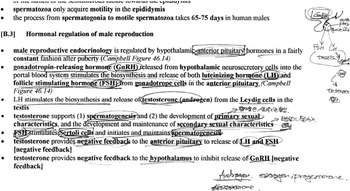
As (9) unfolded, Yoonsoo was taking notes and drawing parts of a figure on the right side of the class handout (Figure 3). Strategic actions in self-teaching, such as reading and explaining to the self, are acts of self-scaffolding via meaning construction and comprehension of the text. After reading the text silently, Yoonsoo began to explain the procedure of the hormonal regulation of male reproduction, occasionally referring back to the text. Various patterns of gesticulation are found in pairs of question-answer sequences (cf. Lee, 2006a, 2006b) together with a reactive expression in line 14.

Written production of private speech on Yoonsoo's class handout.
Each question-answer pair presented in (9) is marked in the transcript, with Q for the question and A for its corresponding answer. Yoonsoo's questions are identified on the basis of syntax and intonation. His gesticulation in lines 3–7, 9, and 12 is a combination of two or more types of gestures.

These examples provide a clear illustration of how Yoonsoo used dual voices as an agent for teaching himself. He simultaneously acts as addressor and addressee by producing a question and its corresponding answer, thereby establishing meaning for the self and monitoring self-understanding. The accompanying gestures in private speech appeared as various combinations of beats, pointing, iconics, and metaphorics. Such complex gesticulation has also been noted when teachers explain new vocabulary and abstract concepts in front of a class (Alibali & Nathan, 2007; Lazaraton, 2004; Sime, 2006). The gesticulation in the private speech in (9) is quite similar physically and functionally to gesticulation in social speech, especially the actions of pointing at a certain part in the written text, representing abstract concepts using hand gestures, and drawing or writing pictorial signs to facilitate learner understanding of the study points. Alibali and Nathan (2007) have emphasized the communicative nature of teaching gestures, and Yoonsoo's self-teaching action in private speech is remarkably similar to the gesture of a teacher they observed, who used pointing gestures to accompany her speech to the class as she presented symbols and their correlations in algebraic sentences (p. 11). This similarity highlights the dialogic aspects of gesticulation in private speech as a self-teaching action.
The examples of private speech in this study have shown how gesticulation in private speech functions as mediating self-scaffolding actions and how this helps in L2 reading comprehension. They have also demonstrated that the discourse structure of private speech and accompanying gestures have dialogic aspects.
CONCLUSION AND FUTURE RESEARCH AGENDA
The main aim of the present study was to explore the dialogic aspects of gesticulation and their self-regulatory functions in the private speech of L2 learners within the framework of Vygotskian sociocultural theory. The participants in this study all actively engaged in intrapersonal activities by deploying various actions, such as reading the text aloud or silently, and explaining and reviewing biological terms and concepts to themselves. The self-regulatory functions observed were achieved by participants establishing meanings for themselves, memorizing, and organizing their own activities. These actions in the solitary exam preparation activity appeared mainly in the form of dynamic reading comprehension. The meaning-making actions of dynamic reading comprehension deployed interactional dynamics through reading aloud and self-teaching. Although the discourse in private speech was not exactly identical to sequences in social speech, which involve turn-taking by two or more people, the types of self-teaching actions observed nevertheless have communicative or dialogic aspects that involve the self and text materials.
The interactional features of meaning-making activities can easily be observed in conversations between experts and novices in interpersonal teaching and learning activities. In this respect, the discourse structure of private speech in the data looks very similar to social speech in the way that the turn-taking-like sequences appear in private speech. For example, the turn-taking-like sequences found included question-answer sequences and reactive expressions. These interactive discourse sequences are commonly found in talk-in-interaction. Also, the observed gesticulations in the private speech data were nodding, beats, pointing, and other kinetic movements used to illustrate abstract concepts and processes in biology. These gesticulations function as communication with the self. Participants also deployed self-teaching actions in the form of drawing biological figures with accompanying gesticulation while producing both written and oral production of private speech. As such, these interactional structures demonstrate the dialogic aspects of private speech by showing how a single individual can situate the self as both addressor (animator of the text) and addressee (agent of monitoring his own understanding of the text) during solitary exam preparation.
From the point of view of SLA, English was not only a tool of mediation but also a learning object; that is, the participants were learning the subject matter (biology) by using English as a tool to understand the written texts and organize thought. Concurrently, they were learning new vocabulary in English—mainly technical terms in biology—via self-teaching. As shown throughout the examples, gesticulation helped scaffold the readers' understanding of the texts in the form of self-teaching that resembles teachers' gesticulations.
Existing notions of gesticulation, however, are not adequate to explain the actions of drawing. As mentioned earlier, Keller and Keller (1996) indicated that thinking occurs in diverse modes and stated the developmental interaction between the modes—in the case of this study, between language and imagery. They also discussed how imagery helps to unfold the linguistic mode as a graphic or pictorial mode of thinking. If we relate this pictorial mode of thinking and gesture, we find a common denominator between gesture and drawing; that is, gesture can be seen as spatial images, whereas drawing is written images. Furthermore, gesticulation refers to a three-dimensional pictorial mode that accompanies speech production, whereas the actions of drawing can be interpreted as a two-dimensional pictorial mode. Therefore, a deeper understanding of the connection between diverse types of pictorial modes might be needed to explore the relationship between gesture and drawing as it appears in learners' private speech.
To conclude, this study analyzed the gesticulations that occurred with forms of private speech for L2 learners studying by themselves, finding that such gestures performed self-regulatory functions, helping the participants to both learn the target language and to study. However, as noted, there was a limitation in analyzing gesticulation with accompanying drawing actions as well as the phenomena of language alternation in L2 learners' private speech. An effective future research agenda should include a closer analysis of these two issues.