I
The extent to which it is possible to combine the economic interests of wealth-maximizing equity owners and the interests of employees is strongly debated. Although it may seem intuitive that a poor work environment is not in the best interests of firm owners, this is far from obvious from a profit maximization viewpoint and not trivial to prove. While some have said that health and safety efforts improve financial performance, conceivably by increasing worker productivity and commitment, others have said that meeting government requirements for health and safety in the workplace is burdensome for employers and provides little financial return. There is convincing evidence to support either of these arguments, but neither is conclusive. This is largely because it is empirically challenging to study the relation between the work environment and the market value of equity, due to their endogenous relation (Billger Reference Billger2007; Cohn and Wardlaw Reference Cohn and Wardlaw2016; Pagell et al. Reference Pagell, Parkinson, Veltri, Gray, Wiengarten, Louis and Fynes2020). If high levels of health and safety provision are the norm, then there is no meaningful variation to study, and, if not, one cannot typically know what causes the results. For instance, if, in the cross-section, firms with a poor work environment are found to have lower equity values than firms with a good work environment, is this, then, because of a high level of health and safety provision, or is it simply because worse performing (better performing) firms cannot (can) afford to improve their work environment?
To overcome this empirical challenge, I utilize a historic natural experiment that uniquely isolates the estimated effects of investments in health and safety provision on the firm's equity market value. It enables one to observe whether shareholders deem an increase in health and safety provision has net beneficial effects or not, considering all the associated costs and benefits. The Swedish general election in 1973 resulted in a hung parliament, with the left- and right-wing blocs winning 175 seats each. Because of the tied outcome, 152 parliamentary votes between 1973 and 1976 were decided by a lottery wherein a member of parliament was asked to randomly draw one of two tickets from a ballot box, representing a yes and a no. The first such lottery occurred on 27 March 1974, when parliament had to decide on proposals for a legislative bill from the opposition, the right-wing bloc, which, if approved, would substantially increase the measures that companies would have to undertake to improve the health and safety provision for their employees (Swedish Parliament 1974:49). The right-wing bloc motivated the proposals on the grounds that companies would not improve their working environment unless they are mandated to do so, whereas the government opposed the proposals, arguing that such health and safety improvements should be reached based on negotiations between workers and employers on a case-by-case basis. Therefore, the decision had to be made by means of a lottery draw. Since the winning lottery ticket was a no to the government's request that the proposal be rejected, the proposal was approved.
I use the outcome of this lottery and the subsequent movement in the stock prices of the companies listed in Section A of the Stockholm Stock Exchange around the lottery to study the impact of health and safety legislation on shareholder value. Employing a standard event study method (Campbell et al. Reference Campbell, Lo and Mackinlay1997), I find that the approval of the proposal led to an abnormal negative market return following the event day that persisted for several days. The economic effect is sizable, with an average immediate abnormal return of −0.955 per cent. Total market value dropped by SEK 411 million on the event day. Depending on the duration of the event window, the average cumulative abnormal returns around the lottery range from −0.217 to −0.354 per cent. More efficient nonfinancial firms experienced lower negative returns, and I also find some evidence that firms with greater ability to bear the compliance costs with internally generated funds fared better.
The use of the Swedish parliamentary lottery as an exogenous event sets this study apart from its closest related study, which is the examination by Billger (Reference Billger2007) of the stock market reaction to the introduction of the US Occupational Safety and Health Act of 1970. Whereas the institutional background in Billger (Reference Billger2007) does not allow for the isolation of one specific day which captures the entire stock market effect, the setting at hand in this study does allow for a precise measurement of the stock market reaction. As such, this article makes two main contributions to the literature. Since the event that I study is truly exogenous and the estimates are therefore causal, conditional on no other unexpected events influencing stock market prices and acceptance of the standard market model used, the first contribution lies in establishing a strong negative causal relationship between the introduction of health and safety regulations and shareholder value. This is an important contribution because the literature is polarized. On the one hand, proponents of the so-called business case for health and safety (e.g. Hart Reference HART2010) argue that a safe workplace improves financial performance. For example, better work safety measures can increase firm value because of lower injury rates (Cohn and Wardlaw Reference Cohn and Wardlaw2016), which is channelled through a lower compensating wage differential to employees and through increased productivity. A friendly work environment and generous benefits could also help retain and motivate talented workers and thus enhance firm value (Edmans Reference Edmans2011). The opposite, a poor work environment, can, instead, carry indirect costs such as reduced employee morale and a damaged reputation, which could translate into a decline in productivity and loss of contracts (Wei Reference Wei2007; Viscusi Reference Viscusi2010; Caskey and Ozel Reference Caskey and Ozel2017). These views suggest a positive association between shareholder value and a good health and safety work environment.
On the other hand, some proponents argue that the costs of the investments needed to improve or uphold good health and safety measures can be higher than the benefits (Billger Reference Billger2007) and that the health and safety regulation results in a net cost for firms. This situation, in which regulation that provides a communal good is costly for firm owners, is commonly labelled the costly regulation hypothesis (e.g. Palmer et al. Reference Palmer, Oates and Portney1995; Levine et al. Reference Levine, Toffel and Johnson2012; Pagell et al. Reference Pagell, Parkinson, Veltri, Gray, Wiengarten, Louis and Fynes2020). Cohn and Wardlaw (Reference Cohn and Wardlaw2016) detail several aspects of how health and safety investments can negatively impact firms with scarce financial resources. Such firms may, for example, abstain from projects with a positive net present value (NPV) if the funds are needed for health and safety investments. While the benefits of investments in health and safety are typically long term, the immediate investments can harm shareholder value, particularly in the short term. Investors may also view such investments as difficult to justify, given that serious workplace accidents are rare. Furthermore, lengthy health and safety training programmes for employees and stringent procedures to ensure high health and safety standards can also cause a productivity decline (Gray Reference Gray1987). This could eventually impact the survival rate of firms. Pagell et al. (Reference Pagell, Parkinson, Veltri, Gray, Wiengarten, Louis and Fynes2020) find that organizations that provide a safer workplace have significantly lower survival odds and shorter lifetimes compared to firms that provide less safe workplaces. These views predict a negative association between shareholder returns and a good health and safety work environment.
In addition, this article also makes an important contribution to the separate debate of whether there is a need for health and safety legislation or if self-regulation suffices (for a review of this debate, see Hart Reference HART2010). Essentially, the debate revolves around the idea that a goal-setting approach to employer responsibilities, with fewer resources allocated to monitoring and enforcement in favour of workplace initiatives, makes self-regulation attractive and justifiable (Tombs Reference Tombs2005). The findings of this article suggest, however, that owners perceive health and safety regulations as very expensive. This makes it difficult to believe that one can fully rely on companies to create safe workplaces within a self-regulatory environment. The study's findings can thus be interpreted in a way that suggests that self-regulation is insufficient for creating a safe work environment and that explicit regulations and laws are needed.
The remainder of the article is organized as follows. Section II describes the institutional background. Section III develops the empirical predictions. Sections IV and V present the main and cross-sectional analyses, respectively. Results from robustness tests are discussed in Section VI and the Appendix (available online). Section VII concludes the article.
II
The economic and social institutional system in Sweden from 1960 to 1985 is often referred to as the Swedish model, which Lindbeck (Reference Lindbeck1997) characterizes as a society dominated by large and centralized institutions. Lindbeck identifies some of the key elements of this society as large public sector spending and high taxes; a strongly interventionist labour market policy; attempts by the government to influence savings, credit supply and investment; centralized wage bargaining on a national level; and highly centralized decision making in the private sector. These characteristics led to an economy where a small group of large firms dominated the production side and where the ownership of financial assets, including shares, was highly concentrated among a few large institutions – three or four corporate banks, half a dozen insurance companies and a few investment corporations. An additional feature of the period of interest for this study – the early 1970s – is that the Swedish economy was then much more dependent on domestic business than currently. For instance, export and import constituted only somewhere between 20 and 25 per cent of the gross domestic product from the 1950s to the first half of the 1970s (Statistics Sweden 2011). One may thus expect that, if domestically made political decisions have an impact on the stock market, this effect will be pronounced in a country that has not yet developed into today's export-oriented nation, where much of the production has also been relocated to other countries.
The chief architects of the Swedish model were the Social Democrats (Socialdemokraterna), who were closely associated with the labour movement (Esping-Andersen Reference Esping-Andersen1992; Therborn Reference Therborn1992). Except for a few months in 1936, all Swedish governments between 1932 and 1976 were led by the Social Democrats (Hermansson Reference Hermansson2010). Even after losing the 1956 election to the second chamber, they managed to stay in power by virtue of their dominant position in the upper chamber. However, in 1971, after a long debate, the Swedish two-chamber parliament was replaced with a one-chamber parliament with 350 seats. The general election in 1973 was the second election of the new and reformed parliament, and it was unusually hotly contested (Möller Reference Möller1986). Although campaigning was interrupted on the day before the election due to the death of the king, the voter turnout was 90.8 per cent, the highest in Sweden thus far (Esaiasson Reference Esaiasson1990). Early opinion polls offered the prospect of the first decisive opposition victory in more than 40 years, and the parties on the right tried to demonstrate a more united façade than in previous elections. In the end, however, the outcome was a draw. The two parties on the left, the Social Democrats and the Communist Left Party (Vänsterpartiet Kommunisterna), jointly won 175 seats, and the same number of seats was won by the three parties on the right, the Moderate Party (Moderata Samlingspartiet), the Centre Party (Centerpartiet) and the People's Party (Folkpartiet). After the election, the opposition leaders argued that the government should resign. Despite this and thanks to the requirement that a majority was needed in parliament to force a resignation, the incumbent Social Democratic government, led by Prime Minister Olof Palme, remained in power (Hermansson Reference Hermansson2010). The government did consider calling new elections in both 1974 and 1975 (von Sydow Reference von Sydow2005), but since ordinary elections were already scheduled for 1976, such discussions eventually lapsed.
The view on private business was greatly polarized between the two main political groupings (e.g. von Sydow Reference von Sydow2005). This is evident from the party manifestos of the time. The Social Democrats (1973, p. 1) clarify their raison d’être as follows: ‘The main task is to assert everyone's right to work and to provide workers and employees greater influence and greater security in the workplace [and we] do not accept that the free powers of economics determine people's labour, health and safety.’ The Communist Left Party (Reference Communist Left Party1968, p. 1), on whom the Social Democrats often had to rely for support, goes even further, stating, ‘The party's goal is that the struggle of the working class should lead to the abolition of capitalism and the implementation of socialism in Sweden’, where, practically, a first step is to ‘abolish unemployment and nationalize the Swedish basic industries.’ These views stand in stark contrast to the non-socialist group. For instance, the conservative Moderate Party (Reference Moderate Party1973, p. 1) works for ‘an economic policy that promotes production, choice and competitive prices’ and sees a ‘versatile and robust business sector as a guarantee for national prosperity’. These views are echoed by both the Centre Party (Reference Centre Party1973, p. 3), which emphasized the importance of ‘continued expansion and modernization of the economy so that the conditions of working life and improved competitiveness are maintained on both the export and domestic markets’, and the People's Party (1973, p. 1), which ‘strongly rejects central control and nationalization of businesses’. However, as shall be seen, the roles could be reversed, with the opposition parties arguing for the need for more regulation and state oversight, with the government trying to maintain the status quo of lax regulation.
On many issues, the propositions in parliament were adjusted to the current parliamentarian situation (Johansson Reference Johansson1976), which enabled consensus across the two political groupings. In addition, motivated by the economic situation, the People's Party and the Centre Party initially made a couple of broader agreements with the Social Democrats on taxes. Yet, in many questions relating to private business, the left and right found it considerably more difficult to agree. As a consequence of these ideological differences, the 1973–6 parliament has become known as the Lottery Parliament, since 7 per cent of the decisions in parliament (152 decisions in total) had to be decided by a lottery after the initial vote ended in a draw.Footnote 1 Overall, 51 per cent of the 152 lottery draws ended with a win for the opposition parties. This situation was not deemed desirable by any of the parties, so it was decided that an odd number of parliamentary members would be used from the following general election, to be held in 1976, and the number of members was reduced by one, to 349.
On 1 February 1974, the opposition parties put forward motions 1974:697 and 1974:700 to adopt a new health and safety law through which the firm's responsibility for health and safety would be vastly enlarged and more tightly regulated (Swedish Parliament 1974:697, 1974:700).Footnote 2 The costs for upholding the requirements of the law were to be borne by the firms, although the proposal included a provision for a small state subsidy for the initial implementation costs that could account for neither more than 25 per cent of the investments made nor more than SEK 2.5 million (corresponding to SEK 16.8 million in May 2022). The new law would require firms to replace dangerous equipment and machines or to improve them such that they become safe to use, enhance protection against harmful chemicals, improve ventilation and reduce workplace pollution, brighten the workspace and reduce indoor noise. The three opposition parties that jointly put forward the proposals argued that there was a strong need to strengthen the general working conditions in Sweden and, if their motions were not approved, companies would continue to not prioritize investments in health and safety.
The government party and its support party soon announced their opposition to these proposals. Thus, it became clear that 50 per cent of the members of parliament would vote against the proposal, and its fate would have to be decided through a lottery. The Communist Left Party opposed the proposal on the grounds that the proposed legislation was essentially a copy of the US Occupational Safety and Health Act of 1970 and therefore too considerate of the needs of capitalists (Swedish Parliament 1974:49). Instead, they argued that any new law should be based on either those of the Union of Soviet Socialist Republics (USSR) or the Czechoslovak Socialist Republic, which simply stated that ‘work environmental factors should not be greater than that a worker should be able to live through her working career without risking injury’ (Swedish Parliament 1974:49, p. 93). The opposition from the Social Democratic government was based on its wish to uphold the principles of the aforementioned Swedish model, by which workers and owners should reach agreements on their own, without legislation (Lindbeck Reference Lindbeck1997). The Minister of Employment responsible at that time, Ingemund Bengtsson, argued that the state should only legislate in areas where firms might have a negative externality effect on, for example, external noise levels and air and water quality (Swedish Parliament 1974:49). Bengtsson further argued that society and not legislation should dictate the requirements for firms to ensure a good work environment. According to him, such societal pressure would lead to firms that did not voluntarily make the necessary investments in health and safety losing face in the eyes of society and thus not being able to sustain their market shares. The Social Democrats further argued that the resulting costs from the proposed measures could harm firms’ profitability and also potentially tilt the competitive situation.
As predicted, the mandatory vote on the contested proposal on 27 March ended in a draw, with 170 votes in favour and 170 votes against. The fact that the total number of votes cast was less than the number of parliament members, that is, 350, reflects the praxis of pairing, where two members of parliament from opposing political parties may agree to abstain when one member is unable to vote. Pairing is conducted by members designated for that purpose by each party and is applied whenever one bloc has lower attendance than the other. Following the protocol in the event of equal votes, the deputy speaker of the house asked a member of parliament to come forward and draw a lottery ticket from a ballot containing one yes and one no vote. Since the drawn ticket was a no ticket, the proposals from the opposition parties were not rejected, hence approved. Accordingly, parliament directed the government to prepare the legislative text satisfying the two motions.
III
It is not ex ante obvious what the effect of a strengthened law regarding the inner working environment would be for shareholders, since the opposing views in the political debate described in the previous section are fully reflected in the academic debate. It was even emphasized in the debate that, ‘though one may assume that there are business-economic reasons for arguing for a good work environment, a complete analysis on this topic is not available’ (Swedish Parliament 1974:49, p. 58). In this section, I review the diametrically opposed literature on the impact of health and safety provision on shareholder value while linking them both to the arguments made in the political debate.
The general argument that a safer workplace will increase firm value rests upon Becker's (Reference Becker1993) insight regarding the importance of developing a firm's human capital to fully enable and capitalize on the firm's competitive advantage. Zingales (Reference Zingales2000) further emphasizes that a typical modern firm's human capital is a particularly important resource and that corporate policies aiming at the well-being of workers that are seemingly very costly and may be seen as a deviation from shareholder value maximization may actually be to the shareholders’ benefit. This notion that shareholders would benefit from voluntarily creating a safe workplace is referred to as the business case for workplace safety (e.g. Hart Reference HART2010). Several empirical studies support this concept. Cohn and Wardlaw (Reference Cohn and Wardlaw2016) find that better work safety measures increase firm value because of lower injury rates. This increase in value is channelled through a lower compensating wage differential to employees to bear lower risk, through less downtime and through increased productivity. Pagell et al. (Reference Pagell, Klassen, Johnston, Shevchenko and Sharma2015) use a survey of 198 manufacturing firms and find a positive link between a safer workplace and improved competitiveness. A friendly work environment and generous benefits can also help retain and motivate talented workers and thus enhance firm value (Edmans Reference Edmans2011). Gubler et al. (Reference Gubler, Larkin and Pierce2018) find that operational productivity and the economic value of employees can be increased by socially responsible health policies that improve worker wellness, and Kaur et al. (Reference Kaur, Mullainathan, Oh and Schilbach2021) find that less stressed employees are more productive. Conversely, the absence of a good working environment can lead to reduced employee morale and damaged reputation, which may manifest itself in financial terms, such as through a decline in employee productivity and loss of contracts (Wei Reference Wei2007; Viscusi Reference Viscusi2010; Caskey and Ozel Reference Caskey and Ozel2017). With a particular focus on productivity, Das et al. (Reference Das, Pagell, Behm and Veltri2008) find that workers in unsafe environments spend time and effort in terms of self-protection rather than focusing on operations.
These academic findings are all reflected anecdotally by the proponents of the new legislation, as noted in the previous section. Although their arguments could not be substantiated by any quantitative analysis, because the research at the time was based on inadequate data and poor methodology, they were convinced of the economic value in itself of a company whose workers are ‘happy and safe’ (Swedish Parliament 1974:49, p. 58). The main mechanisms for such a link were thought to be though increases in productivity and reductions in personnel turnover, sick leave absences and stress (Swedish Parliament 1974:697).
On the other hand, the costs of the investments that would be needed to comply with the mandatory health and safety rules can outweigh the positive effects described above. Palmer et al. (Reference Palmer, Oates and Portney1995) and Levine et al. (Reference Levine, Toffel and Johnson2012) therefore suggest that companies will not provide a safe workplace by their own choice and regulation is thus necessary. This notion is commonly referred to as the costly regulation hypothesis. This has, to some extent, been documented by Billger (Reference Billger2007) in a study of the stock market reaction to the passage of the 1970 Occupational Safety and Health Act in the United States. The author argues that a negative stock price reaction to such laws may partly be attributed to the investment costs needed to comply with the new regulations. Related to this point, Cohn and Wardlaw (Reference Cohn and Wardlaw2016) highlight that firms with scarce financial resources may need to abstain from positive-NPV projects if available funds are needed for health and safety investments. These arguments are also reflected in the parliamentary debate, since high investment costs were the main concern of those who argued against the proposed law (Swedish Parliament 1974:49, pp. 74–5).
Billger (Reference Billger2007) also attributes some of the negative share price reaction to a competition effect, since firms with relatively newer equipment or less dangerous machinery would have lower costs than their competitors. Thus, some firms would win relative gains vis-à-vis their peers, even if the state subsidized some of the initial investments. Such gains can also stem from economies of scale, since larger firms can have lower per-unit compliance costs as they upgrade machinery or alter production processes. Again, these arguments were made by the opponents to the proposal, since numerous representatives for the government party emphasized their concern that the new law would change the competitive situation and thereby interfere with the competitive marketplace (Swedish Parliament 1974:49, pp. 74 and 80). Furthermore, investors might not see the need for health and safety investments, since serious workplace incidents are rare (Cohn and Wardlaw Reference Cohn and Wardlaw2016) or they might even view such investments as wasteful (for a broader discussion on owners’ attitudes towards potentially excessive employee benefits in general, see Cheng et al. Reference Cheng, Hong and Shue2016; Masulis and Reza Reference Masulis and Reza2015). In addition, Gray (Reference Gray1987) documents that higher health and safety standards can reduce productivity, because of the long-term needed to implement new procedures and training. This could eventually impact a firm's survival rate. Pagell et al. (Reference Pagell, Parkinson, Veltri, Gray, Wiengarten, Louis and Fynes2020) study firm survival and safety outcomes over 25 years in the US state of Oregon. They find that the odds and length of survival are significantly decreased by providing a safe workplace; they conclude that relying on the market to make the workplace safe is inadequate and effective regulation is necessary to protect workers.
All in all, the two opposing strands of literature can be summarized in the following two hypotheses.
Business case hypothesis: A positive causal relation exists between an improved health and safety work environment and the market value of a firm's equity.
Costly regulation hypothesis: A negative causal relation exists between an improved health and safety work environment and the market value of a firm's equity.
Under the assumption that capital markets are efficient, stock prices reflect the present value of the future profit stream. It follows that the resulting testable prediction of the business case (costly regulation) hypothesis is that the lottery outcome that led to the approval of the Swedish parliamentary proposal should have a positive (negative) impact on a firm's equity value.
IV
PDF files of daily scanned stock market data of the stocks trading in Section A of the Stockholm Stock Exchange were obtained from the Swedish House of Finance National Research Data Center (NRDC).Footnote 3 The stocks listed in Section A represent the most traded stocks in Sweden. Quotes and all information relating to dividends, rights issues and stock splits were digitized from these scanned files by an optical character reader. Only the common stock class for each company listed in Section A was retained. Each trading day's closing bid quote was used as a measure of the stock price that day. All quotes were adjusted for capital operations, including stock splits, dividends and rights issues. Data on the main value-weighted index, the Affärsvärldens General Index (Affärsvärldens generalindex, hereafter AFGX), were extracted from the digital archives of the Swedish daily broadsheet Dagens Nyheter. The lottery took place at some point between 10:00 a.m. and 2:00 p.m. on Thursday, 27 March 1974 (Swedish Parliament 1974:49), which means that it took place during the trading hours of the Stockholm Stock Exchange. The result immediately became public information since the plenary sessions are open to the general public. Thus, the day of the lottery serves as the event day.
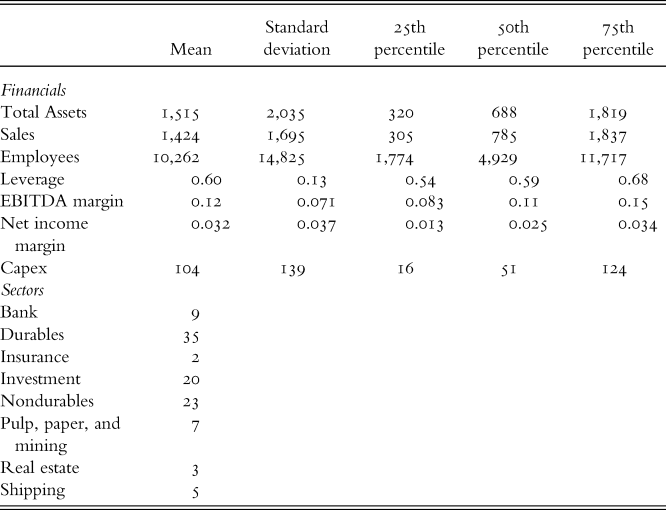
Annual reports for all the sample firms were also obtained from NRDC. Accounting data were manually extracted from the scanned PDF files. Table 1 provides an overview of the sample. The average firm size as of the fiscal year-end 1973 is SEK 1.5 billion, with reported sales of SEK 1.4 billion. The number of employees ranges from a few hundred in the lowest quartile to well over 10,000 in the top quartile. The average leverage ratio is 0.60. Gross and net profit margins amount to 12 per cent and 3.2 per cent respectively. Capital expenditures are greatly dispersed, with an average of SEK 104 million. The most prevalent industry is durable goods, followed by nondurables and investment companies. Firms in these categories account for 75 per cent of the sample. The remaining 25 per cent of the sample is made up of banks and firms active in the pulp, paper, mining, shipping, real estate and insurance sectors.
Sample overview

This table reports the basic statistics of the sample. The variables Total Assets, Sales and Capex are measured in millions of Swedish kronor; Net income margin is calculated as net income over sales; and Leverage is the ratio of total liabilities to total assets. All variables are measured at the end of the fiscal year 1973. Data are obtained from the annual reports available from NRDC.
To test the predictions developed in Section III, I follow the event study methodology of Campbell et al. (Reference Campbell, Lo and Mackinlay1997) and compute abnormal stock returns around the event date. I use a one-factor market model to estimate the normal relation between stock and market returns, since short-horizon event studies are not sensitive to the benchmark specifications (Kothari and Warner Reference Kothari and Warner2007):
 $$R_{it} = a_i + c_i \bullet R_{mt} + e_{it}$$
where Rit is the daily return on the common share of company i on day t, and Rmt is the daily return on the AFGX on the same day. The market model is estimated over a one-year period ending on day t = −7 (i.e. one calendar week prior to the event date t = 0). I derive daily abnormal stock returns ARit as the difference between raw returns and returns, estimated from the market model:
 $$AR_{it} = R_{it}- ( {\^a + {\hat{c}}_i \bullet R_{mt}} ) $$
To account for the impact of the event on shareholders, including any delayed reactions, I derive the cumulative abnormal returns (CARit) for company i around each event date t by aggregating ARit around the event date in a range of event windows. The importance of conducting event studies over very short event windows has been emphasized in finance by de Jong and Naumovska (Reference de Jong and Naumovska2016), since short event windows allow one to control for contamination and to preserve the statistical power of conventional test statistics. Ideally, one should use a one-day event window (Campbell et al. Reference Campbell, Lo and Mackinlay1997); however, somewhat longer windows are common, to account for leakage of information before the event and/or the slow adjustment of stock prices after the event. In the setting at hand, leakage of information is not a concern, since the event is a lottery draw and each of the two potential outcomes is thus expected with a probability of 50 per cent. I also expect all new information to be quickly incorporated into stock prices for this sample of the most traded and liquid stocks in Sweden. Nevertheless, for the sake of prudence, I will consider a range of event windows that both precede, follow and include the event day:
 $$CAR_{it}( {-}n, + m) = \Sigma _{ t = {-}n }^{ + m } AR_{it}$$
The ARit and CARit are standardized by the standard error of the daily abnormal returns, σit:
 $$CAR_{it}( {-n, + m} ) /( {\sigma_{it}{^{} }^2( {-n, + m} ) } ) ^{\raise.5ex\hbox{$\scriptstyle 1$}\kern-.1em/ \kern-.15em\lower.25ex\hbox{$\scriptstyle 2$}} $$
I compute ARit and CARit only for companies with valid stock return data for days in the event window and at least 50 per cent of the days in the estimation window. A total of 104 firms satisfy these criteria. Under the assumption that the standardized abnormal returns are cross-sectionally independent and identically distributed, these 104 firms are treated as one group, and their standardized abnormal returns are tested in cross-sectional regressions against the null hypothesis of no abnormal returns for each respective event window, that is, no significant reactions from shareholders, on average, to the lottery draw.
The results from the market model are presented in Table 2. The model yields an AR of −0.955 per cent that is statistically significant at the 1 per cent level. I conclude that the market reacted negatively to the parliamentary approval of the opposition parties’ proposal. Table 3, panel A, presents the abnormal returns and cumulative abnormal returns in the trading days prior to the event day. The asymmetric event windows start between one and four trading days before the event day and end one trading day before the event day. I note that the CAR values are all small and nonsignificant, which is evidence that the market is anticipating neither a positive nor a negative outcome for the parliamentary lottery draw.
Abnormal return on the event day

This table reports the abnormal returns and cumulative abnormal returns estimated according to the market model described in Section IV. The null hypothesis is zero abnormal returns. The event day, day 0, is the parliamentary lottery day, 27 March 1974. Heteroscedasticity-consistent standard errors are reported in parentheses. The superscript *** indicates statistical significance at the 1% level.
Cumulative abnormal returns before, after and around the event day

This table reports the abnormal returns and cumulative abnormal returns estimated according to the market model described in Section IV. The null hypothesis is zero abnormal returns. The event day, day 0, is the parliamentary lottery day, 27 March 1974. Heteroscedasticity-consistent standard errors are reported in parentheses. The superscripts *, ** and *** indicate statistical significance at the 10, 5 and 1% levels, respectively.
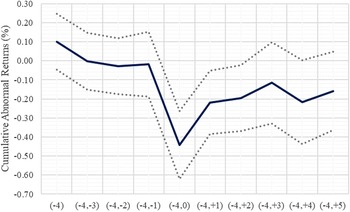
Table 3, panel B, presents the CAR values in the trading days following the lottery. The asymmetric event windows start on the event day and end between one and five trading days later. I note that the negative abnormal returns persist throughout the days following the event day. The CAR values remain negative on the first, second, and fourth trading days after the lottery, but increase somewhat to a nonsignificant −0.190 per cent on 3 April. In panel C of Table 3, I report the results for a range of symmetric and asymmetric windows around the event day. The window asymmetry is due to the fact that I cannot include the fifth trading day before the event, because that day is part of the estimation window. The CAR values range from −0.217 to −0.281 per cent, depending on the window length. All the estimates are significant, with the exception of those for the windows (−3, +3) and (−4, +5).
The cumulative returns around the lottery are displayed in Figure 1. The plots are obtained by applying models (1) to (4), trading day by trading day, from 21 March to 3 April. I note a clear pattern of a decrease in CAR values on the event day that persists throughout the following days. I draw two conclusions from Table 3 and Figure 1. The first is that the market does not anticipate either of the two possible lottery outcomes, yes or no. The second is that the negative abnormal returns stemming from the lottery persists in the days following the event day.
Cumulative abnormal returns around the event day
This figure reports the abnormal returns and cumulative abnormal returns (solid line) and the 95% confidence interval (dotted lines) estimated according to the market model described in Section IV for the period around the event, from 21 March 1974, to 3 April 1974. The null hypothesis is zero abnormal returns. The event day, day 0, is the parliamentary lottery day, 27 March 1974.

To convert the event day abnormal returns into monetary gains, one can use the market capitalization of each company on the eve of the event day. Hence, to determine the total loss in shareholder wealth, I multiply the event day returns with the market capitalization of each firm on 26 March. The decrease in shareholder wealth is SEK 411 million. These monetary losses represent the direct impact of the lottery outcome on shareholder wealth. In the following paragraphs, I will use the abnormal returns and their cumulative analogues to assess the total implied value of the health and safety proposal.
All in all, the results of the event study collectively suggest that shareholders reacted unfavourably to the approval of the proposal to substantially increase the health and safety measures that companies must undertake. It is interesting to compare my results with those of the closest related study, that of Billger (Reference Billger2007). Billger employs a standard event study to analyse the market reaction to the introduction of the US Occupational Safety and Health Act of 1970. While Billger's analysis yields a positive event day return of 0.02 per cent, the event day return in this study is negative and almost 50 times larger in magnitude, at −0.955 per cent. This pattern is repeated for several window lengths. For example, Billger reports a three-day cumulative abnormal return of −0.07 per cent. By contrast, the three-day return in this study is four times more negative, with a coefficient of −0.281 per cent. It is possible that the relatively stronger and more consistent results in this study are due to the natural experiment setting. I conclude that the arguments for a positive relation between the work environment and shareholder returns are rejected in favour of the arguments for a negative relation.
Given that the stock market has priced in the 50 per cent chance of the proposal's approval, the estimates thus represent the value differential of moving from a 50 per cent probability of an event happening to the event happening with certainty. The implied value effects of the proposed legislation differ depending on which investment horizon one considers. On the event day, the AR value is −0.955 per cent. Thus, the total impact of the proposal's approval on the event day amounts to twice the abnormal return, or −1.910 per cent. To interpret whether this abnormal return is large or small, I relate it to one of the findings of Neuhierl et al. (Reference Neuhierl, Scherbin and Schlusche2013), who document the market reactions to a wide range of corporate news. They find that, on average, the announcement of a defective product is associated with a 2 per cent immediate decrease in market value (see their appendix, figure B4). Thus, the size of the implied market impact, in terms of its absolute value, of the approval of the work environment proposal is equivalent to the impact of an announcement that a major product was defective. One can conclude that the market value impact of the lottery draw was substantial. The magnitude of the results also implies that one can reject the arguments that firms would voluntarily make necessary investments in health and safety or otherwise lose face in the eyes of society. The findings from the event study can thus be interpreted as support for the arguments that self-regulation is not sufficient to create a safe work environment and that explicit regulations and laws are needed.
V
This section presents the results of cross-sectional regressions to determine which characteristics explain individual firm responses to the lottery draw. The reaction to the lottery draw presented in Table 2 is a consequence of the shareholders’ assessment of whether the new regulations would increase or decrease profitability. To make this assessment, the shareholders need to consider the resulting costs and benefits of the new legislation. Thus, the main explanatory variables used in the cross-sectional analysis are those that relate directly to the associated benefits and costs of the new regulations, as discussed in Section III. A potentially important factor that could explain the variation in the share price reaction across firms is how efficiently employees are employed in the production. By scaling the number of employees by sales, one obtains a measure of such efficiency. Relatively few employees per sales may indicate that the company can operate on lower costs and thus obtain more sales with fewer employees, or it may indicate that the firm is largely reliant on outsourcing. In either case, for such a firm, the costs of compliance with the new regulations can be less burdensome compared to firms that rely on a relatively higher number of employees to obtain their sales.
An additional important factor could be the degree to which a firm operates at a higher capital intensity than others. Given that much of the necessary costs will revolve around expenditures to upgrade or replace dangerous machinery, it is natural to use a measure such as capital expenditure per employee to control for the relative capital intensity per firm. A firm with a lower capital cost per employee may experience a less negative abnormal return, since such a firm should need to bear relatively lower costs to upgrade their equipment. This could tilt a firm's competitive position if the funds for the necessary investments cannot be used for other planned positive-NPV projects. Firms that have an aging capital stock could thus see their competitive position harmed when trying to adapt to the new regulation, since competitors facing relatively lower costs could take advantage of the situation and make investments that strengthen their market positions.
Furthermore, to make the necessary investments, a firm will need to either use part of the generated net income or raise capital externally through a seasoned equity offering, bond issuance, or new bank loan. A firm's capacity to use internally generated funds for the necessary investments can be measured through the net income margin. A relatively larger net income margin enables firms to finance any investments with a relatively higher amount of internal funds. The firm's ability to raise external debt can be hampered if the debt ratio is already at a high level. Leverage, measured as total liabilities over total assets, gives a measure of a firm's financial flexibility to take on more debt.
I exclude investment companies, insurance companies, banks and real estate companies, due to their regulated status and particular capital and income structure, and I focus on companies active in the durables, nondurables, shipping, paper, pulp and mining sectors. This leaves me with a sample of 70 firms. I employ industry fixed effects to control for the systematic difference in impact that is due to the different levels of capital intensity across industries.
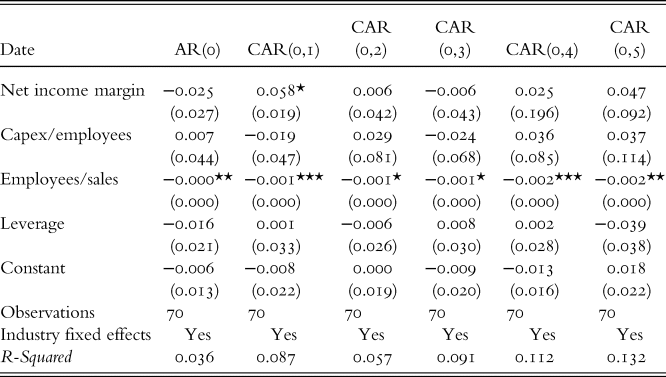
Taking these considerations into account results in the following cross-sectional regression specification: CARiw = ai + bi • Xi + Zi + ei (5) where CARiw is the obtained cumulative abnormal return for each company i for event window w, which ranges from the abnormal return on the event day up to and including five days after the event, and Xi is a matrix of the four explanatory variables discussed above, employees scaled by sales, capital expenditure scaled by employees, net income over sales, and total liabilities over total assets. All explanatory variables are measured at the end of the fiscal year 1973. The matrix Zi assigns industry fixed effects to each firm. Standard errors are clustered by industry to allow for the within-industry correlation of the residuals. The regression results for equation (5) are presented in Table 4. The coefficients of employees scaled by sales show that less efficient firms experience a more negative impact from the lottery draw across all event windows. For the window that encompasses the event day and the day after, the net profitability implies a significantly lower negative impact from the new regulation. Controls for economies of scale and external financing constraints turn out to be nonsignificant. One can conclude that, across all nonfinancial industries, shareholders expected more efficient firms to incur relatively lower compliance costs from the new health and safety regulations. In addition, firms with greater ability to bear the compliance costs with internally generated funds fared relatively better than other firms.
Cross-sectional determinants of the impact for nonfinancials

This table reports the coefficients from a cross-sectional regression. The outcome variables are the abnormal and cumulative returns estimated according to the market model described in Section IV. The event day, day 0, is the parliamentary lottery day, 27 March 1974. The explanatory variables are measured at the end of the fiscal year 1973. The variable Net income margin is calculated as net income over sales, Capex/employees is obtained by dividing capital expenditure by the number of employees, Employees/sales is obtained by dividing the number of employees by sales, and Leverage is the ratio of total liabilities to total assets. The data are from the annual reports available from NRDC. Standard errors are clustered by industry and reported in parentheses. The superscripts *, ** and *** indicate statistical significance at the 10, 5 and 1% levels, respectively.
VI
As discussed in Section II, 1 February 1974 was a key date in establishing the belief in the market that the opposition parties’ proposal would have to be decided by a lottery. That day, it was announced that the proposal had a 50 per cent support level and that there would be a parliamentary deadlock that could only be solved by a lottery. If shareholders saw a mandated improvement of the work environment as value enhancing (destructive), then the returns should be positive (negative) on 1 February. In Table 5, I examine the abnormal returns on this date. The reaction is negative, with a negative AR coefficient of −0.259 per cent that is statistically significant at the 1 per cent level. Although this return does not derive from a lottery, it does provide support for the argument that shareholders saw the proposal as value destructive. I conclude that the reactions of shareholders on this day are consistent with the costly regulation hypothesis.
Market reaction on the proposal announcement date

This table reports the abnormal returns and cumulative abnormal returns estimated according to the market model described in Section IV. The null hypothesis is zero abnormal returns. The event day, day 0, is the day when the proposal was announced in parliament, 1 February 1974. Heteroscedasticity-consistent standard errors are reported in parentheses. The superscript *** indicates statistical significance at the 1% level.
I conduct several additional robustness tests to ensure that the findings on the impact of the lottery draw are not spurious. These tests include (i) a contamination analysis where I re-estimate the cumulative abnormal returns after removing all companies that are mentioned in the media with the event window; (ii) a placebo test to see if the test statistics from the standard market model could yield an over-rejection of the null hypothesis of zero abnormal returns, due to the modest sample size of 104. Neither of these robustness tests can explain away the main findings.
VII
Are mandated improvements in the work environment beneficial or harmful for a firm's value? While, on the one hand, an influential strand of the literature argues that improvements in workers’ health and safety provision can increase costs and harm the market value of equity, another important strand of the literature argues that such improvements can reduce costs and create shareholder value. Typically, it is very difficult to distinguish in equilibrium if the work environment affects shareholder value. I overcome this problem with the help of a historic natural experiment where the Swedish parliament accepted, by means of a lottery, a proposal from the opposition parties to mandate companies to greatly improve the provision of health and safety to their workers. I find that the approval of the proposal led to a sizable decrease in equity market value. Firms with greater ability to bear the compliance costs with internally generated funds and relatively more efficient nonfinancial firms fared better. The main finding is supported by additional tests and can thus be viewed as empirical support for both those who argue that forced investments in the health and safety work environment constitute a net cost for owners and proponents of the view that self-regulation is not sufficient to create a safe work environment and that explicit regulations and laws are needed.
Supplementary material
To view supplementary material for this article, please visit https://doi.org/10.1017/S0968565022000087