Implications
Crossbreeding can be a practical way to improve not only functional traits of dairy cows, but also milk quality and technological properties through the modification of milk protein profile. In this study, stage of lactation, parity and herd-test-day (HTD; which includes feeding and management practices) affected milk protein composition. Compared with purebred Holsteins (HO), cows crossbred from Swedish Red (SR), Montbeliarde (MO) and Brown Swiss (BS) sires yielded milk with a protein composition more favorable to cheese production. Few differences were found between first- and second-generation and within second-generation crossbred cows. Crossbreeding programs might therefore be effectively used to improve milk quality and technological characteristics.
Introduction
The proteins in bovine milk consist of almost 80% caseins (CN), corresponding to 2.5% to 2.8% w/v (Holland et al., Reference Holland, Rahimi Yadzi, Ion Titapiccolo and Corredig2010). Caseins are the most important protein fractions as they are directly responsible for curd formation and cheese yield (Wedholm et al., Reference Wedholm, Larsen, Lindmark-Månsson, Karlsson and Andrén2006), even though they have different characteristics and roles. For instance, κ-CN, which constitutes ~12% of total CN, is responsible for the stability of CN micelles and facilitates micelle coagulation (Creamer et al., Reference Creamer, Plowman, Liddell, Smith and Hill1998). Whey proteins account for ~20% of total milk proteins, and, despite having less economic importance, they have high nutritional value and are much more quickly digested and absorbed than CN (McSweeney and Fox, Reference McSweeney and Fox2013). Therefore, modification of the content, proportion and daily yield of milk protein fractions may have very important nutritional, technological and economic implications. Indeed, the presence of genetic polymorphisms within CN and whey proteins encoding genes influences the amount (and the proportion) of milk protein fractions and consequently affects milk coagulation properties (Bonfatti et al., Reference Bonfatti, Di Martino, Cecchinato, Degano and Carnier2010; Bittante et al., Reference Bittante, Penasa and Cecchinato2012; Jensen et al., Reference Jensen, Holland, Poulsen and Larsen2012). This is highly significant for some countries, particularly in the European Union where the majority of the milk production goes to the cheese-making industry (Wedholm et al., Reference Wedholm, Larsen, Lindmark-Månsson, Karlsson and Andrén2006).
The success of selection for milk production has contributed to the spread of the HO breed throughout the world, but has negatively affected important traits, like milk quality, productive life, fertility and longevity. Nowadays, different selection indices and mating schemes ensure that dairy cows and their genetic richness, including milk quality and functional traits, are better managed. Crossbreeding may be a way of overcoming most of these problems by providing new genetic combinations, and more robust crossbred animals compared with the parental breeds (Sørensen et al., Reference Sørensen, Norberg, Pedersen and Christensen2008). Crossbreeding has been described as a useful strategy to improve the fitness, fertility and longevity of dairy cows, and to genetically alter the yield of milk and its components (Lopez-Villalobos et al., Reference Lopez-Villalobos, Garrick, Holmes, Blair and Spelman2000). Indeed, first-generation offspring (F1) of HO crossbred with MO and Scandinavian Red exhibited better functional traits but lower fat and protein contents and milk yields than pure HO (Heins et al., Reference Heins and Hansen2006; Heins and Hansen, Reference Heins, Hansen and Seykora2012). More recently, however, MO×HO and Viking Red×HO crossbreds, despite a lower productivity in terms of milk yield, were collectively found to have higher fat and protein yields and percentages than purebred HO cows (Hazel et al., Reference Hazel, Heins and Hansen2017). Likewise, BS×HO crosses had higher fat and protein yields than HO purebreds, although the milk production of the latter was still reported to be higher (Dechow et al., Reference Dechow, Rogers, Cooper, Phelps and Mosholder2007). Several other studies have been carried out on the effects of crossbreeding on functional traits, such as fertility and udder health, and on production traits, such as milk yield, fat and protein contents, and cheese-making properties (e.g., Malchiodi et al., Reference Malchiodi, Cecchinato and Bittante2011, Reference Malchiodi, Penasa, Tiezzi and Bittante2014a and Reference Malchiodi, Cecchinato, Penasa, Cipolat-Gotet and Bittante2014b; de Haas et al., Reference de Haas, Smolders, Hoorneman, Nauta and Veerkamp2013; Dezetter et al., Reference Dezetter, Leclerc, Mattalia, Barbat, Boichard and Ducrocq2015) but there is little information on individual milk protein fractions behavior in crossbred cows, which is particularly important in countries, like many in Europe, where a large proportion of milk production is destined for cheese-making.
The objectives of this study, therefore, were (i) to determine the content and proportions of milk protein fractions in individual milk samples of purebred HO, two-way crossbred cows from BS (BS×HO), MO (MO×HO) or SR (SR×HO) bulls, and three-way crossbred cows from the same breeds (MO×(BS×HO); MO×(SR×HO); and SR×(MO×HO)); and (ii) to estimate the effects of HTD, parity and stage of lactation on these traits.
Material and methods
Animals and milk sampling
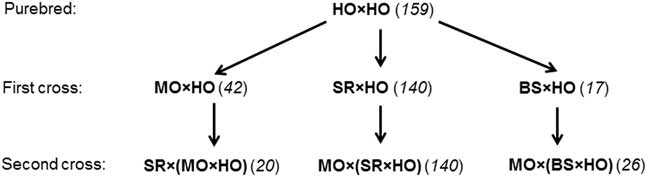
Milk samples were collected once during the evening milking from individual purebred HO cows and crossbred cows (n =544) reared in three herds located in the north of Italy (2 to 3 sampling days per herd). The herds were following the same crossbreeding scheme (Genesis Project SRL, Castelnovo Sotto, Reggio Emilia, Italy) starting from purebred H cows, as detailed in Malchiodi et al. (Reference Malchiodi, Cecchinato, Penasa, Cipolat-Gotet and Bittante2014b). The basic scheme was a three-breed rotational system using SR semen on HO cows (SR×HO), MO semen on SR×HO cows (MO×(SR×HO)) and HO semen again on MO×(SR×HO). A smaller number of purebred HO from each herd were mated inverting the breed order (MO×HO and SR×(MO×HO)) or using BS bulls instead of SR (BS×HO) and then MO bulls (MO×(BS×HO)). Figure 1 shows the crossbreeding scheme together with the number of cows sampled from each breed combination. Herds were managed in accordance with EU regulations for the production of Protected Designation of Origin (PDO) Parmigiano-Reggiano cheese, meaning that silage, pasture and fresh herbage were not allowed, and the rations (fed as a total mixed diet) consisted of dry roughage, concentrates and added water.
Crossbreeding scheme. The number of cows sampled for milk quality traits and milk protein fractions analyses is reported in brackets. HO=Holstein; MO=Montbeliarde; SR=Swedish Red; BS=Brown Swiss.

A preservative (Bronopol, 0.6 : 100 v/v; Sigma-Aldrich, St. Louis, MO, USA) was added to the milk immediately after collection to prevent microbial growth. Milk samples were refrigerated at 4°C, then transferred to the Laboratory of the Department of Agronomy, Food, Natural Resources, Animals and Environment (DAFNAE) of the University of Padua (Legnaro, Padua, Italy), where they were stored at −80°C until protein fraction analysis.
Analysis of milk quality traits and protein fractions by RP-HPLC
Individual milk samples were analyzed for fat and protein with a MilkoScan FT6000 (Foss, Hillerød, Denmark). Milk pH was determined using a Crison Basic 25 electrode (Crison, Barcelona, Spain). Somatic cell counts were obtained with a Fossomatic FC counter (Foss, Hillerød, Denmark) and then log transformed to obtain somatic cell scores (SCS) (Ali et al., Reference Ali, Shook, Gabler and Peters1980).
The α S1-CN, α S2-CN, β-CN, κ-CN, β-lactoglobulin (β-LG) and α-lactalbumin (α-LA) contents were measured in milk samples from 505 animals using the RP-HPLC method proposed by Maurmayr et al. (Reference Maurmayr, Cecchinato, Grigoletto and Bittante2013), which allows CN and whey proteins to be separated in one run, thereby ensuring rapid analysis (<20 min) and good peak resolution. A single mother solution of purified proteins of commercial standards, including κ-CN (>80%), α-CN (>70%), β-CN (>90%), α-LA (~85%), β-lactoglobulin B variant (>90%), β-lactoglobulin A variant (>90%) (Sigma-Aldrich), was used to draw specific calibration curves. The γ-CN fraction, consisting of proteolytic products of β-CN, was not detectable with the current method.
To carry out protein quantification using the current RP-HPLC method, total casein content (caseins, g/l) was calculated as the sum of the κ-CN, α S1-CN, α S2-CN and β-CN contents in the milk, and total whey protein content (g/l) was calculated as the sum of β-LG and α-LA. The proportions of protein fractions were expressed as the percentage (%) of total true protein content (g/l), calculated as the sum of the casein and whey protein contents.
Statistical analysis
Data were analyzed using the SAS GLM procedure (SAS Institute Inc., Cary, NC, USA) according to the following linear model:
 $$y_{{ijklm}} \,{\equals}\,\mu {\plus}HTD_{i} {\plus}{\rm Parity}_{j} {\plus}DIM_{k} {\plus}{\rm Breed}_{l} {\plus}e_{{ijklm}} $$
where y ijkl is the measure of a trait; µ the general mean of the model; HTD i is the fixed effect of HTD i (i=1, … 7); Parity j the fixed effect of parity j of the cow (j=1: first parity, j=2: second parity, j=3: third and subsequent parities); DIM k the fixed effect of days in milk (DIM) class k (five classes of 60-day intervals, except the last class, which included samples collected at DIM 240 or more days); Breed l the fixed effect of the lth breed combination (l=1 to 7); and e ijklm the random residual assumed to have a normal distribution with e ijkl ~ N (0, σ e 2), where σ e 2 is the residual variance. Orthogonal contrasts were estimated between the least square means (LSM) of traits for: (i) the effect of DIM: (a) the linear component and (b) the quadratic component; between LSM of traits for (ii) the effect of parity: (a) first parity v. second and subsequent parities and (b) second parity v. third and subsequent parities; and (iii) the effect of breed combination: (a) the effect of crossbreeding (HO v. all crossbred cows), (b) the effect of generation (first-generation v. second-generation crosses), (c) the effect of SR sires in the first-generation cross (SR×HO v. MO×HO+BS×HO), (d) comparison of the two paternal Alpine breeds in the first-generation crosses (MO×HO v. BS×HO), (e) comparison of SR sires and MO sires in the second-generation crosses (SR×(MO×HO) v. MO×(SR×HO)+MO×(BS×HO)) and (f) the effect of maternal grand-sire breed in second-generation crosses with MO sire MO×(SR×HO) v. MO×(BS×HO).
Results and discussion
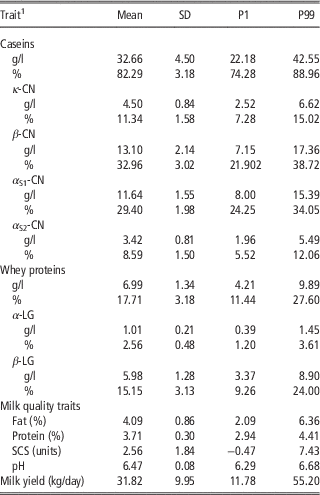
In the present work, we investigated the effect of animal factors, such as parity, stage of lactation and breed combination, and the effects of HTD on bovine milk protein fractions. Descriptive statistics for the investigated traits are reported in Table 1.
Descriptive statistics for protein composition and quality traits of individual milk samples from purebred and crossbred cows (n=505)

P1=first percentile; P99=99th percentile; κ-CN=κ-casein; β-CN=β-casein; α S1-CN=α S1-casein; α S2-CN=α S2-casein; α-LA=α-lactalbumin; β-LG= β-lactoglobulin; SCS=somatic cell score.
1 Contents of all protein fractions were measured by reversed-phase HPLC on skim milk. The proportion of protein fractions were expressed as percentage (%) on total true protein content (g/l). Caseins: sum of total casein fraction; whey proteins: sum of total whey fraction.
Effects of herd-test-day
We found that HTD significantly affected all milk protein fraction contents and proportions (P<0.001), in particular α S1-CN and α-LA, which might reflect the effect of differences in the environmental, management and feeding conditions across herds, and variations in the test records collected on different days. However, HTD explained ~11% of variance for milk protein fractions on average, in line with previous studies which found that the proportion of phenotypic variation for milk proteins explained by herd was relatively small (Schopen et al., Reference Schopen, Heck, Bovenhuis, Visker, van Valenberg and van Arendonk2009), especially compared with fat, while genetic factors play the most important role.
Effects of days in milk and parity
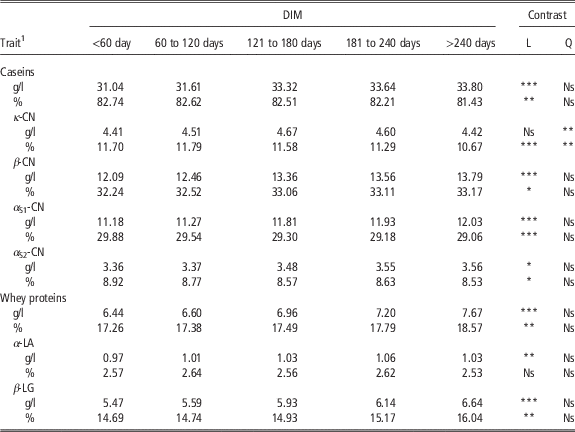
Lactation stage was confirmed as an important source of variation in milk protein fractions (Table 2), as previously reported (Jõudu et al., Reference Jõudu, Henno, Kaart, Püssa and Kärt2008). In this study, the total amount of protein, which averaged 39.65 g/l, increased linearly over the 5-bimonthly periods comprising lactation (P<0.001), whereas total CN and whey contents (g/l) followed the same trend (P<0.001; Table 2), consistent with previous data (Coulon et al., Reference Coulon, Verdier, Pradel and Almena1998). Linear increases were also found for the individual protein fraction contents, except for κ-CN, which showed a quadratic pattern (P<0.01; Table 2). Indeed, after the peak of lactation and just until the dry period, milk production starts to decrease, but at the same time fat, protein and body weight increase, as result of the concentrating effect of decreasing milk volumes and the energy balance change. Stage of lactation also significantly influenced CN and whey protein proportions (%), except for α-LA (Table 2), results that were only partially consistent with previous data (Ostersen et al., Reference Ostersen, Foldager and Hermansen1997). In particular, in the present study the total casein proportion (P<0.01) followed a decreasing trend, as did the κ-CN (P<0.001), α S1-CN (P<0.001) and α S2-CN (P<0.05) proportions, which decreased linearly across lactation, while β-CN exhibited the opposite trend (linear increase; P<0.05). On the other hand, the linear increase of the whey protein proportion (P<0.01) was essentially due to the β-LG proportion being higher in late than in early lactation (P<0.01). Along with the lactation an increase in milk SCS was detected (Malchiodi et al., Reference Malchiodi, Cecchinato, Penasa, Cipolat-Gotet and Bittante2014b), which might be related to an increase in plasmin activity (Politis et al., Reference Politis, Ng Kwai Hang and Giroux1989). The increasing proportion of total whey at the expense of casein might be likely due to the possible increase in plasmin hydrolysis of caseins, which makes late-lactation milk less suitable for cheese making (Akers, Reference Akers2016). During lactation, mammary epithelial cells exhibit an increase in sensitivity to insulin which is an important inducer of milk protein gene expression (Bionaz and Loor, Reference Bionaz and Loor2011). The different behavior of β-CN respect to the other casein proportions, which is in line with previous findings (Ostersen et al., Reference Ostersen, Foldager and Hermansen1997; Barber et al., Reference Barber, Houlihan, Lynch and Poppi2005), might be explained by possible differential effects of insulin on individual casein fractions (Menzies et al., Reference Menzies, Lefevre, Macmillan and Nicholas2009). Another possible explanation might rely, at least partially, on micelles characteristics; indeed, it was reported that micelle size increases in late lactation in the cow (Holt and Baird, Reference Holt and Baird1978) and the relative proportion of β-CN increases with increasing micelle size while κ-CN showing the opposite trend (Ekstrand and Larsson-Raźnikiewicz, Reference Ekstrand and Larsson-Raźnikiewicz1978).
Least squares means of milk protein fraction and milk protein composition across days in milk (DIM)

L=linear; Q=quadratic; κ-CN=κ-casein; β-CN=β-casein; α S1-CN=α S1-casein; α S2-CN=α S2-casein; α-LA=α-lactalbumin; β-LG=β-lactoglobulin.
1 Contents of all protein fractions were measured by reversed-phase HPLC on skim milk. The proportion of protein fractions were expressed as percentage (%) on total true protein content (g/L). Caseins: sum of total casein fraction; whey protein: sum of total whey fractions.
*P<0.05; **P<0.01; ***P<0.001.
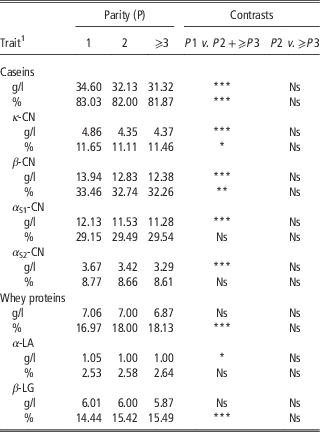
Parity had significant effects on total CN content (g/l) (P<0.001; Table 3), the milk of first-parity cows, in particular, having significantly higher contents of all individual CN fractions (P<0.001). Significantly higher contents of α-LA were also found in primiparous cows (P<0.05), while total whey and β-LG contents were unaffected by parity (Table 3), a finding at variance with Jõudu et al. (Reference Jõudu, Henno, Kaart, Püssa and Kärt2008), who reported a significant effect of parity on β-LG content. The proportion of total CN was also significantly higher in primiparous cows than in multiparous cows (P<0.001; Table 3), in agreement with previous results (Ikonen et al., Reference Ikonen, Morri, Tyrisevä, Ruottinen and Ojala2004), while the percentages of total whey were significantly lower (P<0.001; Table 3). Looking at the individual fractions as proportions of total protein content, those of κ-CN and β-CN were significantly higher (P<0.05 and P<0.01, respectively), and β-LG significantly lower (P<0.001) in the milk of first-parity cows (Table 3). Remarkably, multiparous cows of this study were characterized by higher SCS respect to first-parity cows (Malchiodi et al., Reference Malchiodi, Cecchinato, Penasa, Cipolat-Gotet and Bittante2014b). β-Casein was reported to be the most susceptible casein isoform to degradation by plasmin activity (Crudden et al., Reference Crudden, Fox and Kelly2005). Accordingly, the largest difference between primiparous and multiparous cows among caseins proportions was detected for β-CN. Overall, these results add weight to the evidence that, despite a higher yield, the milk from multiparous cows tends to be of lower quality due to a reduction in the protein content (Hansen et al., Reference Hansen, Friggens, Højsgaard, Kolver, Pleasants, Rook and Beever2006) and particularly of those caseins having a greater involvement in milk coagulation and curd firming.
Least squares means of milk protein fraction and milk protein composition across parities

κ-CN=κ-casein; β-CN=β-casein; α S1-CN=α S1-casein; α S2-CN=α S2-casein; α-LA=α-lactalbumin; β-LG=β-lactoglobulin.
1 Contents of all protein fractions were measured by reversed-phase HPLC on skim milk. The proportion of protein fractions were expressed as percentage (%) on total true protein content (g/l). Caseins: sum of total casein fraction; whey protein: sum of total whey fractions.
*P<0.05; **P<0.01; ***P<0.001.
Effects of breed
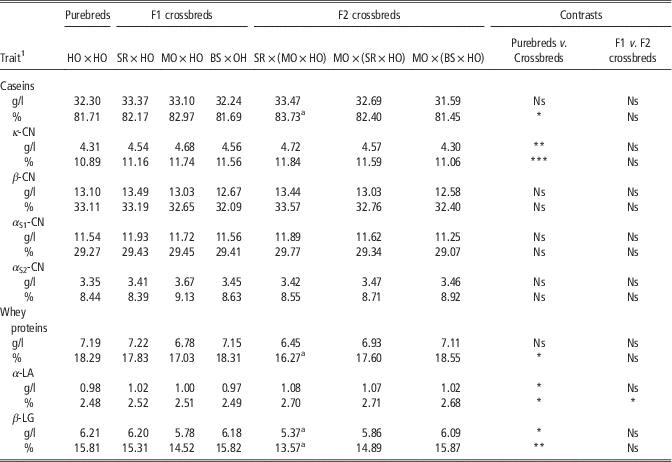
Results regarding the effects of crossbreeding on milk protein fractions are shown in Table 4. Significant effects were found for the proportions of total CN and total whey, and the contents and proportions of κ-CN, α-LA and β-LG. In particular, the milk of crossbred animals had significantly higher proportions of total CN and lower proportions of total whey proteins than purebred HO (P<0.05). With respect to individual protein fractions, the milk from crossbred cows was characterized by higher contents and proportions of κ-CN (P<0.01 and P<0.001, respectively) and α-LA (P<0.05), and lower contents and proportions of β-LG (P<0.05 and P<0.01, respectively). The higher proportion of total caseins in crossbred cows was essentially due to the higher content and proportion of κ-CN content which is related to the higher frequency of B allele in the crossbred populations of this study (38.4% on average) respect to HO (28.9%), with the only exception of SR×HO (18.9%). Selective breeding is able to alter the milk protein composition to improve milk quality and milk technological properties; for instance, a higher amount of κ-CN is associated with better milk coagulation properties (Bittante et al., Reference Bittante, Penasa and Cecchinato2012). Several studies have focused on the relationship between protein composition, milk production and milk protein variants (e.g., Heck et al., Reference Heck, Schennink, van Valenberg, Bovenhuis, Visker, van Arendonk and van Hooijdonk2009; Demeter et al., Reference Demeter, Markiewicz, van Arendonk, Bovenhuis, Andren, Bovenhuis, van Valenberg, van Arendonk, Wauthy and Winter2010). Furthermore, cheese yield increases with a greater CN concentration, and cheese-making properties, like milk coagulation time and curd firmness, depend on casein composition (Wedholm et al., Reference Wedholm, Møller, Stensballe, Lindmark-Månsson, Karlsson, Andersson, Andrén and Larsen2008). Therefore, the high content and proportion of κ-CN observed in crossbred cows may help to explain the more favorable curd firmness characteristics of their milk (Malchiodi et al., Reference Malchiodi, Cecchinato, Penasa, Cipolat-Gotet and Bittante2014b).
Least squares means of milk protein fraction and milk protein composition across breed combinations

HO=Holstein; SR=Swedish Red; BS=Brown Swiss; MO=Montbeliarde; κ-CN=κ-casein; β-CN=β-casein; α S2-CN=α S2-casein; α S1-CN=α S1-casein; α-LA=α-lactalbumin; β-LG=β-lactoglobulin.
a SR×(MO×HO) significantly different from MO×(SR×HO)+MO×(BS×HO) at P<0.05.
1 Contents of all protein fractions were measured by reversed-phase HPLC on skim milk. The proportion of protein fractions were expressed as percentage (%) on total true protein content (g/l). Caseins: sum of total casein fraction; whey protein: sum of total whey fractions.
*P<0.05; **P<0.01; ***P<0.001.
Significant differences between the F1 and F2 generations were observed only for α-LA, which was found in higher proportions in the F2 generation (P<0.05). This could be partially due to recombination effects between the loci, differences in the gene frequencies, or additive by additive and dominance by dominance epistatic effects (William and Pollak, Reference William and Pollak1985). Looking specifically at the various crossbreed combinations, the only significant difference was SR× (MO×HO) v. MO×(SR×HO)+MO×(BS×HO) for total CN and total whey % (P<0.05), and for both the content and proportion of β-LG (P<0.05) (Table 4). This result might be explained by differences between these crossbreds due to genotype interactions and cross-combinations among MO, BS and HO.
Conclusions
In conclusion, our results show that milk protein fraction contents and proportions vary with HTD, stage of lactation and number of lactations, albeit to different extents. Crossbreeding programs can be a very useful strategy in animal breeding. Besides the well-known effects on fertility, longevity and robustness traits, crossbreeding may be a viable option for improving milk quality, in particular milk protein composition. Indeed, the crossbred animals included in this study produced milk with higher amounts of κ-CN, which is desirable in cheese production.
Acknowledgments
The authors thank the Genesis Project SRL (Castelnovo Sotto, Reggio Emilia, Italy), and the managers of the three dairy farms for their help with the study and for providing data on their cows.
Declaration of interest
No conflict of interest is associated with this publication.
Ethics statement
The cows included in this study were not subjected to any invasive procedures. Milk samples were collected during the routine milk recording coordinated by authorized technicians.
Software and data repository resources
No data repository resources are available for this publication.