Introduction
Laryngeal cancer is a common head and neck malignant tumour with a rising global incidence.Reference Smith, McMahon, Lyall, Goulart, Inman and Ross1, Reference Sahoo, Mishra, Panigrahi, Bhoi and Barsocchi2 Total laryngectomy (TL), the standard treatment for advanced disease, effectively controls tumour progression but leaves patients with physiological impairments (such as loss of vocal function, swallowing difficulties, altered breathing) and psychosocial challenges (such as anxiety, depression, role transitions, weakened family support).Reference Andaloro and Widrich3–Reference Bourmand, Olsson and Fijany5 These multi-dimensional stressors significantly impact quality of life and may lead to long-term psychosocial dysfunction.Reference Ghirotto, Catania, Camera, D’Adamo, Ignone and Rizzuto6, Reference Mesolella, Allosso, Salerno and Motta7
Supportive care, a key component of comprehensive cancer management, addresses physical, psychological, informational and social needs through multi-disciplinary collaboration to improve outcomes.Reference Scotté, Taylor and Davies8 However, existing studies have mostly focused on short-term care needs in the early post-operative period (within one month), with insufficient attention paid to the dynamic changes in the long-term recovery phase after surgery.Reference Murariu, Boia, Horhat, Mot, Balica and Trebuian9 Additionally, the relationships between supportive care needs, quality of life and social support remain poorly understood, particularly regarding the buffering role of non-family support (such as community resources and healthcare system support).Reference Choi, Reblin and Litzelman10
This study systematically evaluates changes in supportive care needs, quality of life and social support among patients undergoing TL based on the biopsychosocial medical model, providing scientific evidence for clinical nursing.
Methods
Study design
A prospective, single-centre cohort study was conducted on patients who underwent TL at the Department of Otorhinolaryngology-Head and Neck Surgery, a tertiary care hospital, between 1 June 2019 and 31 January 2025.
Participants and eligibility
All patients meeting the following inclusion and exclusion criteria were selected.
Inclusion criteria: (1) pathologically diagnosed with laryngeal squamous cell carcinoma and treated with TL; (2) age greater than or equal to 18 years; (3) first-time receipt of TL; (4) possess basic reading and writing skills and able to complete the questionnaire independently or with assistance.
Exclusion criteria: (1) concurrent or prior history of other malignant tumours; (2) severe mental or psychological disorders, such as schizophrenia or major depressive disorder, that may affect the assessment of study outcomes; (3) severe post-operative complications, such as massive bleeding or severe infection, requiring prolonged hospitalisation or a second surgery; (4) communication barriers, such as hearing, language or other impairments preventing participation in the questionnaire survey.
The estimated means and changes in scores for each domain of Supportive Care Needs Survey-Short Form 34. T0: before surgery; T1: one month after surgery; T2: three months after surgery; and T3: six months after surgery.

Figure 1 Long description
The graph shows changes in scores for five domains of supportive care needs over four time points: T0 (before surgery), T1 (one month after surgery), T2 (three months after surgery) and T3 (six months after surgery). The domains are Physical and daily living, Psychological, Sexuality, Patient care and support and Health systems and information. The x-axis represents the time points (T0, T1, T2, T3) and the y-axis represents the scores ranging from 0.00 to 60.00. Physical and daily living scores increase from T0 to T1 and remain stable through T3. Psychological scores rise from T0 to T1 and slightly decrease by T3. Sexuality scores remain low and stable across all time points. Patient care and support scores increase slightly from T0 to T1 and remain stable through T3. Health systems and information scores show a slight increase from T0 to T1 and remain stable through T3.
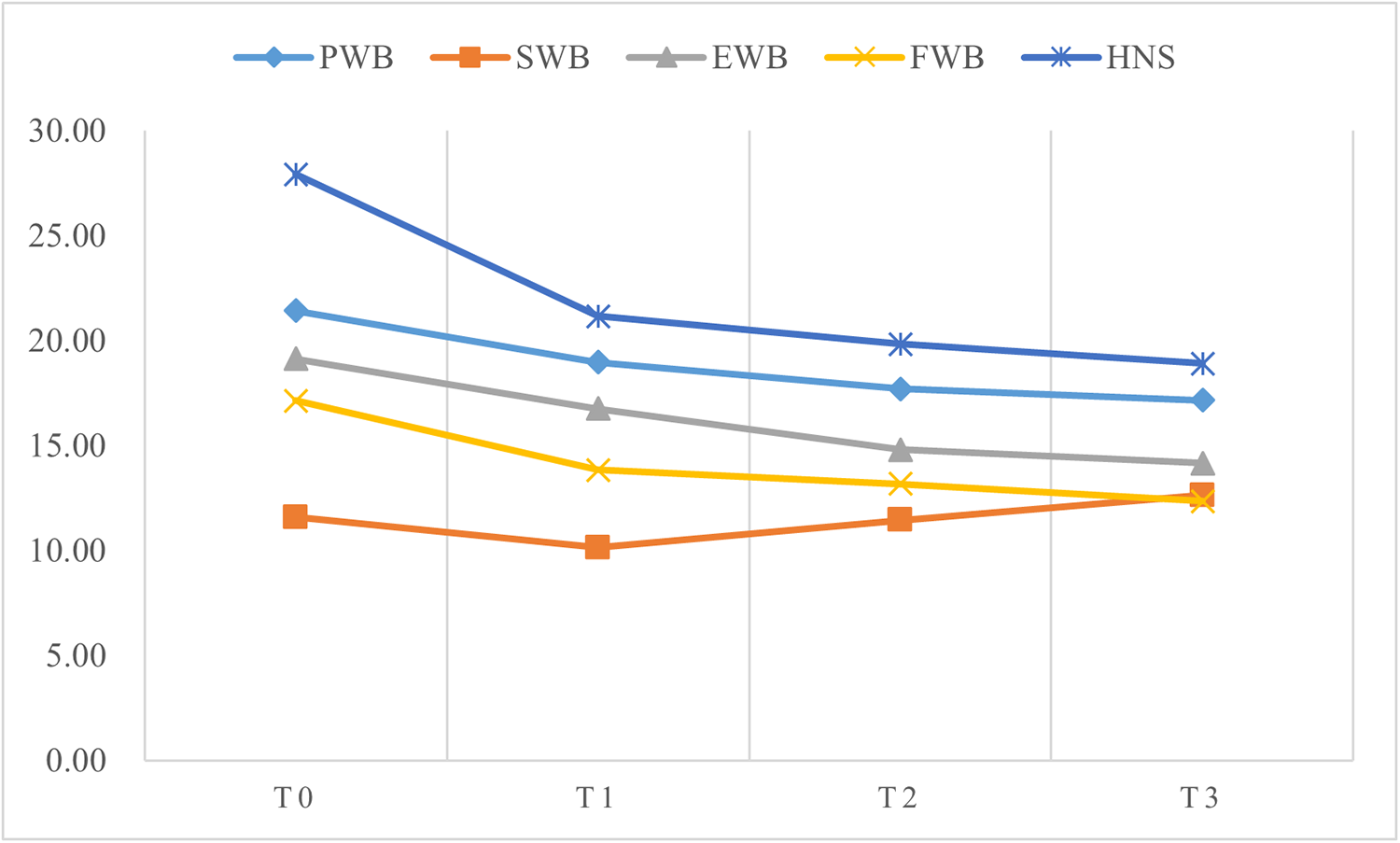
The estimated means and changes in scores for each domain of Functional Assessment of Cancer Therapy-Head and Neck. T0: before surgery; T1: one month after surgery; T2: three months after surgery; and T3: six months after surgery. PWB: Physical Well-Being; SWB: Social/Family Well-Being; FWB: Functional Well-Being; EWB: Emotional Well-Being; HNS: Head and Neck Scale.

Figure 2 Long description
A line graph showing changes in scores for five domains: Physical Well-Being, Social/Family Well-Being, Emotional Well-Being, Functional Well-Being and Head and Neck Scale. The x-axis represents time points labeled T0, T1, T2 and T3. The y-axis shows scores ranging from 0 to 30. Each domain is represented by a distinct line with markers. Physical Well-Being starts at approximately 27 at T0 and decreases to around 20 at T3. Social/Family Well-Being begins at about 12 at T0 and remains relatively stable, ending near 11 at T3. Emotional Well-Being starts at approximately 20 at T0 and decreases to around 15 at T3. Functional Well-Being begins at about 18 at T0 and decreases to around 14 at T3. Head and Neck Scale starts at approximately 15 at T0 and decreases slightly to around 13 at T3.
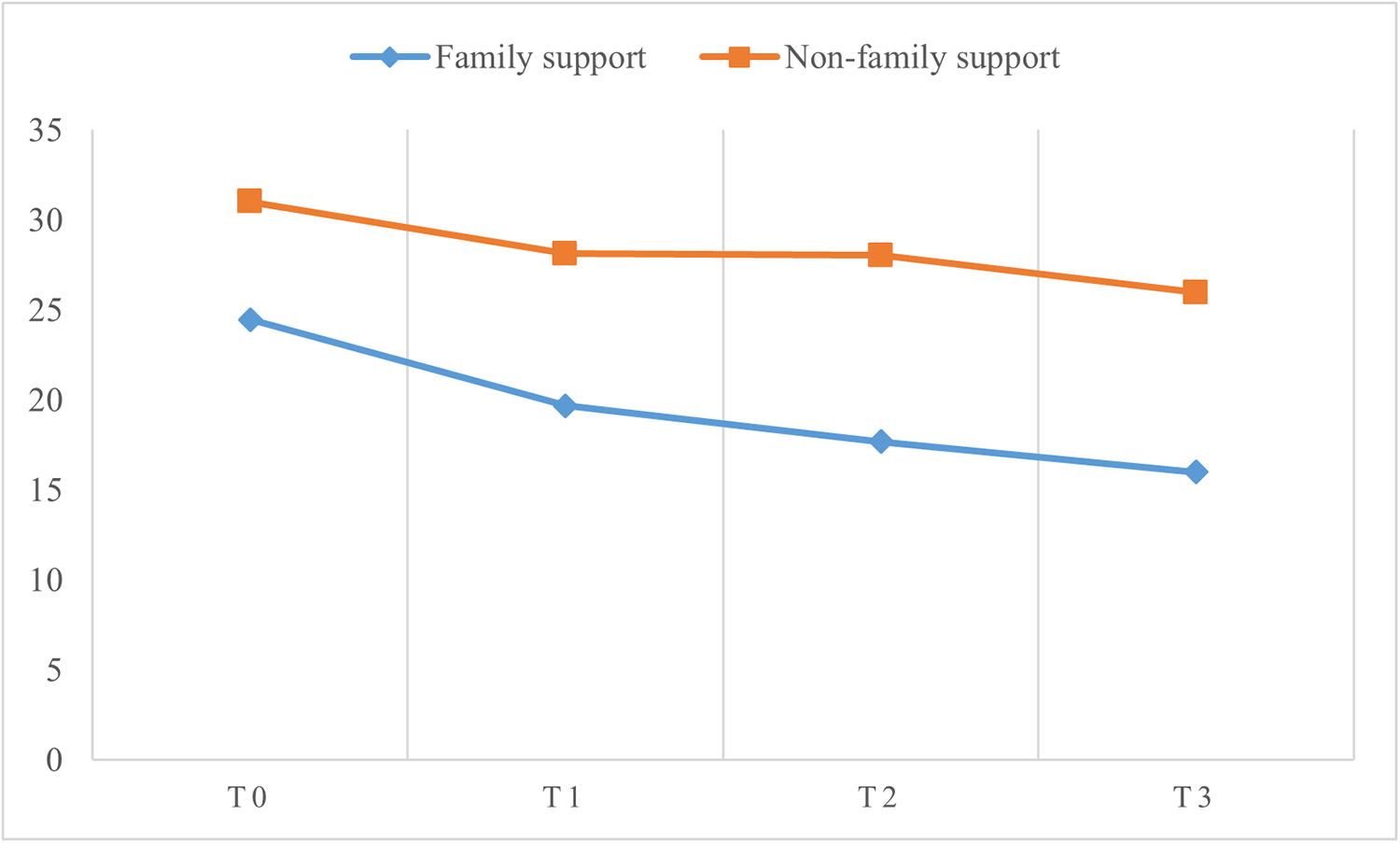
The estimated means and changes in scores for each domain of perceived social support scale. T0: before surgery; T1: one month after surgery; T2: three months after surgery; and T3: six months after surgery.

Figure 3 Long description
The x-axis represents the time points, while the y-axis shows the scores ranging from 0 to 35. The family support line, marked with diamonds, starts at approximately 25 at T0 and decreases steadily to around 15 at T3. The non-family support line, marked with squares, begins at about 30 at T0 and shows a slight decline to approximately 25 at T3.
The estimated means and changes in the sum scores of SCNS-SF34, FACT-H&N and PSSS. T0: before surgery; T1: one month after surgery; T2: three months after surgery; and T3: six months after surgery.

Figure 4 Long description
The graph shows three lines representing the estimated means and changes in sum scores for SCNS-SF34, FACT-H&N and PSSS across four time points labeled T0, T1, T2 and T3. The x-axis represents the time points, while the y-axis shows the score values ranging from 0.00 to 120.00. The SCNS-SF34 line starts at a lower score at T0 and gradually increases over time, intersecting with the FACT-H&N line at T2. The FACT-H&N line begins at a higher score at T0 and decreases slightly over time, maintaining a relatively stable trend. The PSSS line starts at a moderate score at T0 and shows a slight decline over the time points. Each line is marked with distinct symbols for clarity.
Measures
To assess patients’ supportive care needs, quality of life and social support, this study used the three scales.
Firstly, the Supportive Care Needs Survey-Short Form 34 (SCNS-SF34).Reference Choi, Liao, Soong, Chan, Lee and Ng11 A 34-item scale assessing five domains: physical and daily needs, psychological needs, sexual needs, patient care and support needs and health system and information needs. Responses use a 5-point Likert scale, with higher scores indicating greater unmet needs.
Secondly, the Functional Assessment of Cancer Therapy-Head and Neck (FACT-H&N).Reference Yang, Huang, Jiang, Tang and Zeng12 A 39-item measure evaluating quality of life across five domains: physical, social/family, functional, emotional and head and neck cancer-specific concerns. Scores range from 0 to 4 per item, with higher totals indicating better quality of life.
Thirdly, the Perceived Social Support Scale (PSSS).Reference Xiao, Chan, Wang, Xiao and Ng13, Reference Zimet, Powell, Farley, Werkman and Berkoff14 A 12-item scale measuring perceived support from family and non-family sources. Responses use a 1–7 scale, with higher scores indicating stronger support.
Data collection
Before the formal study began, researchers received training to familiarise themselves with the scale content, study objectives and survey methods. After getting the patients’ informed consent, the researchers collected data on their SCNS-SF34, FACT-H&N and PSSS at four time points: before surgery (T0), one month after surgery (T1), three months after surgery (T2) and six months after surgery (T3).
Ethics
The study was approved by the Ethics Committee of the the First Affiliated Hospital with Nanjing Medical University (No. 2024-SR-1122) and conducted in accordance with the Declaration of Helsinki.
Statistical analysis
Data were analysed using SPSS 27.0 statistical software. Quantitative data were expressed as mean plus or minus standard deviation, and categorical data were presented as frequencies (per cent). Repeated-measures analysis of variance (ANOVA) was used to compare the scores of the scales at different time points (T0, T1, T2 and T3) to examine the overall changes over time. Paired t-tests were further applied for pairwise comparisons between specific time points to identify significant differences between each two consecutive or non-consecutive time points. All statistical tests were two-tailed, and a p-value less than 0.05 was considered statistically significant.
Results
Participant characteristics
This study included 99 patients with laryngeal cancer who underwent TL, with an average age of 68.84 (± 9.07) years. In terms of demographic characteristics, all study subjects were male; marital status showed a high degree of concentration, with 94.94 per cent being married. Educational attainment distribution showed that the highest proportion had a junior high school education level (34.34 per cent), with the overall distribution characterised by a predominance of intermediate education levels. In terms of occupational composition, farmers accounted for over half (53.54 per cent), while retired workers (32.32 per cent) and workers (14.14 per cent) together accounted for 46.46 per cent, reflecting a tendency in the occupational distribution of the study subjects. In social support, the primary caregivers were spouses (63.64 per cent), followed by children (33.33 per cent), with only 3.03 per cent of patients self-caring. None of the patients received speaking valve implantation or other voice function restoration surgeries during primary TL, nor were they planned to undergo such procedures in subsequent secondary surgeries. Detailed baseline data and clinical information for the study participants are presented in Supplementary Table 1.
SCNS-SF34
Assessment results at each time point indicate that the majority of patients have low to high-level supportive care needs (Supplementary Table 2). Among these, the proportion of unmet needs for physical and daily living activities increased from 46.46 per cent (T0) to 86.87 per cent (T3), psychological needs rose from 60.61 per cent (T0) to 93.94 per cent (T3) and patient care and support needs increased from 83.84 per cent (T0) to 97.98 per cent (T3). Health system and information needs increased from 85.86 per cent (T0) to 96.97 per cent (T3), all showing a significant upwards trend. However, the proportion of unmet sexual needs remained at a low level, decreasing from 2.02 per cent (T0) to 1.01 per cent (T3), with a relatively small overall change.
Supplementary Table 3 results further show that the SCNS-SF34 total score significantly increased from 113.03 plus or minus 18.38 (T0) to 145.25 plus or minus 8.69 (T3), with statistically significant increases in scores across all domains (F = 93.69, 97.07, 49.14, 41.27, 20.62; all p < 0.001). Among the subdomains, the most notable increases were observed in the health system and information needs and psychological needs, while the physical and daily needs and patient care and support needs showed relatively moderate increases. This trend aligns with the changes in the proportions of unmet needs across domains, suggesting that supportive care needs exhibit a significant overall increase during the rehabilitation process, with varying degrees of change across different domains.
FACT-H&N
Supplementary Table 4 shows that the total FACT-H&N score significantly decreased from 97.17 plus or minus 8.67 before surgery (T0) to 75.19 plus or minus 7.72 at six months post-surgery (T3) (F = 274.44; p < 0.001), indicating a significant decline in patients’ quality of life. Among the specific dimensions, scores for physical well-being (PWB), emotional well-being (EWB) and functional well-being (FWB) decreased significantly over time, while scores for social/family well-being (SWB) showed a trend of first decreasing and then increasing; scores for head and neck scale (HNS) continued to decrease, indicating that patients faced more disease-related specific challenges during the post-operative recovery phase.
To explore the impact of adjuvant therapy on quality of life, patients were divided into two subgroups based on whether they received adjuvant chemotherapy/radiotherapy (RT) after TL: the adjuvant therapy group (n = 25; 25.25 per cent of total sample, including 18 cases of RT alone, 7 cases of concurrent chemoradiotherapy) and the no adjuvant therapy group (n = 74; 74.75 per cent of total sample). The FACT-H&N total scores and dimension scores of the two subgroups across time points (T0–T3) were compared, and the results are shown in Supplementary Table 5. Total FACT-H&N Score: Both subgroups showed a continuous downwards trend in total quality of life scores over six months (time main effect: F = 312.67; p < 0.001), but the adjuvant therapy group had a more significant decline (group main effect: F = 48.92; p < 0.001). Specifically: At T0 (pre-operatively), there was no significant difference in total scores between the two groups (adjuvant group: 96.83 ± 8.21 vs. no adjuvant group: 97.3 2± 8.79; p = 0.786); By T3 (six months post-TL), the total score of the adjuvant group (65.92 ± 6.88) was lower than that of the no adjuvant group (78.25 ± 7.13; F = 19.45; p < 0.001), with a relative decline rate of 31.92 per cent (vs. 19.60 per cent in the no adjuvant group), indicating that the downwards trend of quality of life in the adjuvant group was steeper than that in the no adjuvant group.
PSSS
The level of social support for patients changed significantly over time (p < 0.001) (Supplementary Table 6). Family support scores decreased continuously from 24.47 plus or minus 2.71 (T0) to 16.01 plus or minus 3.02 (T3), with an absolute decrease of 8.46 and a relative decrease of approximately 34.57 per cent. Non-family support scores decreased from 31.01 plus or minus 4.72 (T0) to 25.98 plus or minus 3.57 (T3), with an absolute decrease of 5.03 and a relative decrease of approximately 16.22 per cent.
The total PSSS score significantly decreased from 55.48 plus or minus 6.29 (T0) to 41.99 plus or minus 5.92 (T3) (F = 298.45; p < 0.001), indicating a significant overall reduction in patients’ post-operative social support levels. The absolute and relative decreases in family support were greater than those in non-family support, which may be related to increased post-operative dependence on family and accumulated family care pressure leading to weakened support capacity.
Results of pairwise comparisons between different time points
The pairwise comparisons of SCNS-SF34 in Supplementary Table 7 show that the mean differences between T0 and T1, T2 and T3 were -36.08, -33.80 and -32.22, respectively, all of which were statistically significant (p < 0.001); The mean differences between T1 and T2, T3 were 2.28 and 3.86 (p = 0.008; p < 0.001, respectively); the mean difference between T2 and T3 was 1.58, with all differences being statistically significant (p = 0.005). This indicates that the supportive care needs scores of patients showed significant changes over time, and the differences between time points were statistically significant.
The comparison results of FACT-H&N in Supplementary Table 8 showed that the mean differences between T0 and T1, T2 and T3 were 16.34, 20.21 and 21.98, respectively, all p less than 0.001; the mean differences between T1 and T2, T3 were 3.87 and 5.64, respectively, both with p less than 0.001; the mean difference between T2 and T3 was 1.77, with p equal to 0.002. This indicates that patients’ quality of life scores showed significant differences at different time points and exhibited a continuous downwards trend over time.
The comparisons of PSSS in Supplementary Table 9 show that the mean differences between T0 and T1, T2 and T3 were 7.66, 9.75 and 13.49, respectively, all with p < 0.001; the mean differences between T1 and T2 and T3 were 2.09 and 5.84, respectively, both with p less than 0.001; the mean difference between T2 and T3 was 3.75, p less than 0.001. This suggests that patients’ social support levels showed significant differences between time points and exhibited an overall decreasing trend.
Discussion
The cohort study systematically examined the dynamic changes in patients’ supportive care needs, quality of life and social support within six months following TL. The findings revealed a concerning trajectory: unmet supportive care needs continued to rise, quality of life declined concurrently and social support (particularly family support) gradually decreased, underscoring the urgent need for targeted interventions in long-term post-operative management.
This study indicates that most patients have unmet supportive care needs, with the proportion of unmet needs significantly increasing over time across domains such as physical/daily living, psychological, patient care/support and health system/information. In contrast, the proportion of unmet needs in the sexual domain remained at a low level and was relatively stable, consistent with previous observations in head and neck cancer populations.Reference Murariu, Boia, Horhat, Mot, Balica and Trebuian9, Reference Mukoyama, Nishio, Kimura, Tokura, Kishi and Ogasawara15 The substantial increase in physical and daily living needs (from 46.46 per cent to 86.87 per cent) is closely related to the physiological sequelae of TL. Post-operatively, patients face irreversible damage to swallowing and respiratory functions, necessitating adaptive strategies in daily living activities (such as laryngectomy stoma care, dietary adjustments).Reference Andaloro and Widrich3, Reference Hilgers and Ackerstaff16 It is important to note that the loss of vocal function further amplifies these needs: patients rely heavily on family members or assistive tools for basic communication (e.g., writing down needs, using gesture cards), increasing both their own functional burden and the caregiving pressure on families. As the acute post-operative recovery period transitions to the long-term rehabilitation phase, managing the cumulative burden of these functional impairments (along with fatigue and pain) is likely to exacerbate unmet physical needs. This aligns with the findings of Mukoyama et al. (2024), who reported that functional deficits following laryngectomy are a strong predictor of ongoing care need.Reference Mukoyama, Nishio, Kimura, Tokura, Kishi and Ogasawara15
The significant increase in psychological needs (from 60.61 per cent to 93.94 per cent) highlights the profound impact of TL on patients’ psychosocial well-being. The loss of vocal function, a core component of personal identity and social interaction, often leads to role confusion, stigmatisation and existential distress.Reference Ghirotto, Catania, Camera, D’Adamo, Ignone and Rizzuto6, Reference Lin, Lin, Zhou, Liu, Liu and Jiang17 Without access to speech function restoration, patients face challenges in reestablishing participation in social contexts (e.g., work-related communication, interpersonal interactions), a factor that exacerbates perceived isolation and reduced self-esteem over the follow-up period. Over time, as patients confront the permanence of these changes (such as the inability to return to pre-surgery social or occupational roles), anxiety and depression may intensify, thereby increasing the need for psychological support. This finding further corroborates the observations of Murariu et al. (2024), who noted that mental health is a key determinant of post-treatment adaptation in laryngeal cancer patients.Reference Murariu, Boia, Horhat, Mot, Balica and Trebuian9
Unmet needs are nearly ubiquitous across healthcare systems and information domains (increasing from 85.86 per cent to 96.97 per cent), a finding warranting particular attention. Patients require ongoing access to information regarding wound care, speech rehabilitation, recurrence monitoring and symptom management, among other topics, with these needs persisting beyond the acute post-operative phase.Reference Scotté, Taylor and Davies8, Reference Palmer Kelly, Rush, Eramo, Melnyk, Tarver and Waterman18 However, current clinical practice often focuses on short-term surgical outcomes and is limited in the structured provision of long-term information. This may explain why information needs remain high, a situation also mentioned in other studies on head and neck cancer.Reference Xiao, Chan, Wang, Xiao and Ng13, Reference Pourliaka, Panagopoulou and Siafaka19 Notably, sexual needs remain at a low level, which may reflect cultural norms within the study population (all male, predominantly older, rural and married individuals), where sexual health is often viewed as a taboo topic or given low priority.Reference Choi, Liao, Soong, Chan, Lee and Ng11, Reference Titi and El Sharif20 Another possibility is that, in this cohort, the importance of survival and basic functional recovery takes precedence over sexual considerations, a pattern also observed in other elderly cancer populations.Reference Huang, Zeng, Mao, Zhao and Wu21
Following TL, the FACT-H&N score significantly decreased, primarily due to declines in the physical, emotional and functional domains. This aligns with broader evidence indicating that head and neck cancer treatment, particularly laryngectomy, has a profound impact on quality of life.Reference Bourmand, Olsson and Fijany5, Reference Mukoyama, Nishio, Kimura, Tokura, Kishi and Ogasawara15, Reference Pourliaka, Panagopoulou and Siafaka19 Impairments in physical functioning (such as dysphagia, laryngectomy stoma discomfort) directly compromise patients’ physical health, while the loss of voice function disrupts social interaction, leading to functional decline. Emotional distress arising from changes in body image and role loss further exacerbates this downwards trend.Reference Ghirotto, Catania, Camera, D’Adamo, Ignone and Rizzuto6, Reference Lin, Lin, Zhou, Liu, Liu and Jiang17 Interestingly, the SWB scores showed a temporary decline followed by partial recovery, contrasting with the sustained decline in PSSS scores. This discrepancy may reflect patients’ efforts over time to restore normal family interactions, even as objective family support decreases, a phenomenon also noted in studies on caregiver burden.Reference Rani, Sinha, Sharma, Prasad, Srinivasan and Biswas22 However, the overall downwards trend in quality of life indicates that partial adaptation cannot offset the cumulative impact of TL on patients’ daily functioning and well-being.
Patients perceive a significant reduction in social support, with family support deteriorating more markedly than non-family support, highlighting the dual role of the family as both primary caregiver and vulnerable support source. After TL, patients are highly dependent on family for activities of daily living, medical appointments and emotional support.Reference Rani, Sinha, Sharma, Prasad, Srinivasan and Biswas22, Reference Howard-Jones, Vassilev, Fenlon, Ewings and Richardson23 Over time, this caregiving burden accumulates, depleting family resources and reducing caregivers’ ability to sustain support. Zhang et al. (2023) found a negative correlation between caregiver burden and family resilience, a mechanism that supports the aforementioned viewpoint.Reference Zhang, Ding, Liu, Li, Wang and Li24 The decline in non-family support was relatively smaller, possibly due to structured post-operative care programs (e.g., speech therapy, nursing follow-ups) providing continuous but limited support. However, the overall reduction in non-family support indicates that community and healthcare systems are insufficient to compensate for the gradually weakening family support network, consistent with the observations of Choi et al. (2024) that community support services are underutilised in cancer care.Reference Choi, Reblin and Litzelman10
This study advances previous research in three key areas. Firstly, while existing studies have documented higher supportive care needs in the early post-operative period, our six-month follow-up results show that needs increase over time, challenging the assumption that needs peak during the acute phase.Reference Scotté, Taylor and Davies8, Reference Dhakal, Wang, Mboineki, Getu, Chen and Shrestha25 Second, this study demonstrated that family support is particularly severely impacted following TL, a finding that complements the broader literature on caregiver burden but has been rarely quantified in laryngectomy cohort studies.Reference Rani, Sinha, Sharma, Prasad, Srinivasan and Biswas22, Reference Zheng, Luo, Wang, Liu, Li and Peng26 Third, the concurrent deterioration of needs, quality of life and social support reveals a vicious cycle: unmet needs exacerbate declines in quality of life, which in turn increase reliance on social support, further straining an already fragile support network.
Importantly, voice function restoration surgeries (e.g., speaking valve implantation) are not universally implemented post-total TL in mainland China—consistent with this clinical context, none of the patients in our study received such interventions. In contrast, clinical units in many international settings routinely perform speaking valve insertion during primary TL to restore voice function. This regional difference is key to interpreting our findings: unaddressed voice-related burdens in our cohort likely contributed to the rising unmet physical and psychological needs. For example, van Sluis et al. (2021) conducted a multi-centre cohort study on post-TL voice outcomes, noting that patients with successful voice restoration (including speaking valve) had more favourable psychological well-being outcomes compared to those without access to such voice restoration interventions.Reference van Sluis, van Son, van der Molen, MCGuinness, Palme and Novakovic27 Our results thus reflect contexts where voice restoration interventions are limited, rather than universal—helping international readers contextualise the findings within their local clinical practices.
The limitations of this study must also be acknowledged. First, the single-centre sample (comprising only male patients) limits the generalisability of the findings, particularly for female or more diverse populations. Second, we did not assess confounding factors such as socioeconomic status, educational attainment or co-morbidities, which may modulate the trajectory of changes in needs and support.Reference Huang, Zeng, Mao, Zhao and Wu21, Reference Kleisiaris, Maniou, Karavasileiadou, Togas, Konstantinidis and Papathanasiou28 Third, this study did not explore interventions targeting these needs, leaving questions about effective mitigation strategies. Fourth, the lack of qualitative data hinders a deeper understanding of patients’ subjective experiences, such as why sexual desire remains low or how families perceive their caregiving roles.Reference Ghirotto, Catania, Camera, D’Adamo, Ignone and Rizzuto6, Reference Dhakal, Wang, Mboineki, Getu, Chen and Shrestha25 Fifth, the six-month follow-up duration only captures the early-to-middle post-TL period, and while current data show a continuous downwards trend in key indicators, it cannot explore whether patients will experience a positive adaptation trend in the long term.
What is already known
• Total laryngectomy (TL) for advanced laryngeal cancer causes physiological (vocal loss, swallowing difficulties) and psychosocial (anxiety, weakened family support) issues, lowering patients’ quality of life.
• Supportive care meets multi-dimensional needs, but existing research focuses on short-term (≤ one month) post-operative needs, with poor understanding of their long-term dynamic link to quality of life and social support.
• The roles of family vs. non-family support (especially if non-family support buffers quality of life decline and care needs escalation) are underexplored in TL patients.
What this paper adds:
• Post-TL six-month trajectory: Unmet supportive care needs surge in physical/daily (46.46 per cent →86.87 per cent), psychological (60.61 per cent →93.94 per cent), patient care (83.84 per cent →97.98 per cent) and health system domains (85.86 per cent →96.97 per cent); sexual needs remain low.
• Concurrent declines: Quality of life (FACT-H&N: 97.17→75.19; p < 0.001) and social support (PSSS: 55.48→41.99; p < 0.001) drop significantly; family support declines more (34.57 per cent relative) than non-family (16.22 per cent). Notably, none of the patients received voice function restoration surgery, which likely worsened voice-related quality of life decline.
• Long-term insight: Challenges the “care needs peak acutely” assumption; identifies a vicious cycle, rising needs worsen quality of life, boosting reliance on strained social support.
• Clinical relevance: Provides evidence for long-term, multi-disciplinary interventions targeting physical/psychological/social needs, focusing on supporting family caregivers.
Conclusion
This study reveals that laryngeal cancer patients experience rising unmet care needs and declining quality of life and social support after TL—none of these patients underwent voice function restoration surgery, which further amplifies voice-related burdens. Family support, in particular, diminishes significantly over time. These findings call for long-term, multi-disciplinary care strategies to address patients’ physical, psychological and social challenges, while also supporting caregivers. Future interventions should focus on sustained rehabilitation and holistic support to improve patient outcomes.
Supplementary material
The supplementary material for this article can be found at https://doi.org/10.1017/S0022215125103770.
Acknowledgments
None
Competing interests
The authors declare no conflicts of interest.
Funding
None.
Ethics statement
The study was approved by the Ethics Committee of the First Affiliated Hospital with Nanjing Medical University (No. 2024-SR-1122) and conducted in accordance with the Declaration of Helsinki.
Data availability statement
The datasets generated and analysed during the current study are available from the corresponding author on reasonable request.
Author contributions
All authors contributed to the study conception and design, with specific contributions from Yanmei Zhu, Yiru Gong and Ping Liu. Questionnaire survey, statistical analysis and manuscript drafting were performed by Yanmei Zhu and Yiru Gong. Supervision was provided by Ping Liu. All authors commented on previous versions of the manuscript and read and approved the final manuscript.