

1 Introduction
The international financial crisis highlighted the risk posed by a financial system that was not properly regulated. Afterward, new financial regulation was adopted at the international, regional, and national levels with a view to reducing financial risk. In very few cases, such as capital and liquidity requirements for banks, new detailed international standards—the Basel III accordFootnote 1 —were set by the Basel Committee on Banking Supervision (BCBS),Footnote 2 but the implementation of this soft law was left to individual jurisdictions. In other cases, such as the regulation of hedge funds, “High Level Principles” were agreed by the International Organization of Securities Commissions (IOSCO),Footnote 3 but the issuing of specific rules was the task of individual jurisdictions. Finally, in certain areas of financial regulation, such as bank structure, international standards were not set, and the matter was left for individual jurisdictions to regulate.Footnote 4 Consequently, the specific content of the post-crisis financial regulation was mainly determined at the national level, or the regional level in the case of the European Union, whose rules to a large extent provide the framework for national regulatory changes in the member states.
The United States and the European Union have very large financial sectors and are the main trading partners in financial services. From 2008 onwards, they have adopted a vast array of new financial rules. In the vast majority of cases, the transatlantic regulatory cooperation necessary to manage the cross-border effects of these rules was successful and was facilitated by the background work conducted by international and transnational regulatory fora.Footnote 5 Nonetheless, the repeated interactions taking place in these fora and the soft rules they issued did not manage to prevent a handful of transatlantic regulatory disputes, which are defined as disagreements between the United States and the European Union about the content and/or scope of each other's regulation. These disputes mainly concerned the terms of access to each other's markets, the equivalence between domestic rules, and the extraterritorial effects of those rules.Footnote 6 Some of these disputes were also intra-EU disagreements, whenever the preferences of the United Kingdom were different from those of Continental countries and similar to those of the United States.Footnote 7 This pattern of preference divergence between the United Kingdom and the European Union will intensify after Brexit, following the outcome of the referendum on the U.K.’s membership of the European Union in June 2016.
Why did post-crisis regulatory disputes in finance emerge and how were they settled? The argument developed in this paper is twofold. Firstly, post-crisis transatlantic regulatory disputes emerged because domestic regulatory reforms were sometimes different across jurisdictions. Jurisdictions sought to (re)assert their regulatory power not only vis-à-vis the “market” (which was cross-border), but also vis-à-vis other jurisdictions, which often resisted the projection of regulatory power beyond national borders. Second, the network structure of the financial industry and the patterns of financial interdependence across the Atlantic amplified the extra territorial effects of domestic reforms, but at the same time triggered an active involvement of the transnational financial industry in the management and, eventually, the settlement of these disputes.
By developing this argument, this paper speaks to two main themes of the special issue: the Ostrom School on “polycentric governance” and the recent work on the international “network structure” of the financial industry.Footnote 8 According to Ostrom, “polycentric governance” connotes “many centers of decision making that are formally independent of each other” in a given system.Footnote 9 In the polycentric governance of the international financial system, the United States and the European Union independently reformed their domestic financial regulation with a view to reducing financial risk after the crisis. However, the network structure of the financial industry made the post-crisis reform of financial regulation in one jurisdiction particularly challenging because domestic rules produced de jure or the facto effects in other jurisdictions, impinging upon their respective regulatory power. Sometimes jurisdictions deliberately engaged in regulatory “export.” The ensuing “regulatory clashes” between jurisdictions gave the transnational financial industry a strong incentive to mobilize in order to facilitate the resolution of cross-border (in this specific case, transatlantic) regulatory disputes that would disrupt the network.
Three main caveats are in order. First, the paper sets out to contribute to the scholarly debate on the international political economy of financial regulation at the “systemic” level by adopting an analytical approach that encompasses multiple levels of governance and multiple arenas. Thus, it speaks to the body of scholarly works on the new interdependenceFootnote 10 and the power of the financial industry.Footnote 11 For reasons of space limits, it is beyond the scope of this paper to examine transatlantic cooperation and competition in international regulatory fora, such as the BCBS.Footnote 12 Similarly, this paper does not delve into the domestic political and institutional factorsFootnote 13 that shaped domestic regulatory reforms—it does so only to the extent that this is necessary to account for the emergence and management of transatlantic disputes. In the following sections, the account is streamlined for reasons of space. It is however important to bear in mind that often there were disagreements not only between jurisdictions, but also within jurisdictions, for example, amongst domestic regulatorsFootnote 14 or within regulatory agencies.Footnote 15
The structure of the paper is as follows. The next section reviews the literature on international regulatory cooperation and regulatory competition in finance and outlines the explanation developed in this paper. This is followed by a discussion of the main post-crisis transatlantic regulatory disputes that resulted from the adoption of new domestic financial regulation in the United States and the European Union. The disputes examined in this paper concerned, respectively, E.U. rules (hedge funds), U.S. rules (bank structure), and E.U. and U.S. rules (over-the-counter (OTC) derivatives). These disputes were important, given the large size of the financial services involved. Although some issues have not fully been resolved, the terms for their settlement are, by now, agreed.
2 The politics of international regulatory cooperation and competition in finance
The literature on the politics of international regulatory cooperation and competition in finance points out the “dilemma”Footnote 16 between safeguarding financial stability domestically and protecting the competitiveness of the domestic financial industry internationally.Footnote 17 On the one hand, jurisdictions have an incentive to engage in regulatory cooperation in order to protect financial stability. However, international regulatory cooperation has redistributive implications: It generates costs and benefits that are not uniformly distributed across jurisdictions.Footnote 18 On the other hand, jurisdictions also have an incentive to engage in regulatory competitionFootnote 19 by providing market-friendly rules in order to attract business. Jurisdictions seek to balance regulatory cooperation and competition by projecting their regulatory power beyond national borders.
Consequently, jurisdictions engage in international standard-setting through transgovernmental financial regulatory fora with a view to setting in place rules that protect financial stability without excessively penalizing their financial sector.Footnote 20 However, international standards tend to be rather generalFootnote 21 because they have to be implemented by various (often very different) jurisdictions. Hence, the specific content of financial regulation is determined domestically, at least in the main jurisdictions. Moreover, international standards are not always set by transgovernamental fora.Footnote 22 Sometimes, international standards are de facto set by leading financial jurisdictions, first and foremost the United States and the European Union, which adopt domestic legislation that is not really global in scope and enforcement. Yet, third-country firms and products must comply with U.S. and E.U. rules in order to be able operate in those markets. Footnote 23
Jurisdictions engage in “redistributive cooperation”Footnote 24 not only in international standard-setting fora, but also through bilateral relations. Indeed, jurisdictions can exert regulatory power beyond borders by adopting domestic rules that are “extraterritorial”; these rules affect directly or indirectly, and to a material extent, financial activities or entities in other jurisdictions.Footnote 25 “Direct extraterritoriality” applies when even the “most inconsequential contact with a jurisdiction triggers its authority.”Footnote 26 “Extraterritorial territoriality” applies when not only foreign companies are required to comply with the rules of the host jurisdiction, but also their parent companies.Footnote 27 A similar concept is the “territorial extension,” whereby a jurisdiction governs activities or entities that are not centered upon its territory, with a view to influencing the nature and content of third-country rules.Footnote 28 Jurisdictions generally adopt extraterritorial rules to regulate cross-border activities that partly take place on their territory or have substantial effects on it.
Direct or indirect extraterritoriality and divergent domestic regulation have the potential to trigger regulatory disputes between “financial great powers,”Footnote 29 which are defined as jurisdictions with a large “domestic market” and “regulatory capacity.”Footnote 30 The polycentric governance of the international financial system is centered on the “Euro American condominium.”Footnote 31 Financial great powers, namely, the United States and the European Union, are reluctant to “adjust” their domestic regulation to foreign rules and are likely to resist an attempt by other jurisdictions to exert regulatory power beyond national borders. By contrast, small, third countries generally adjust their rules to those of large jurisdictions with whom they want to do business. However, it is problematic for third countries to comply with the domestic regulation of financial great powers if U.S. and E.U. rules diverge and if they have extra-territorial effects. For example, OTC derivatives can only be cleared once, according to either U.S. rules or to E.U. rules.
How were post-crisis regulatory disputes in finance managed and eventually solved? The literature on the new interdependenceFootnote 32 explains the resolution of transatlantic regulatory disputes by drawing attention to the ability of “regulatory actors to develop transnational alliances” in order to reform domestic regulation and, eventually, global rules. Phil CernyFootnote 33 coined the term “transnational neopluralism,” pointing out the formation of powerful “transnational linkages amongst groups” and the activity of “cross-border interest groups” brought together by “economic interdependence.” Hence, the most important “movers and shakers” in regulatory politics are no longer domestic forces, but rather “actors that can coordinate their activities across borders.”Footnote 34 But which groups have an incentive to mobilize on the resolution of cross-border disputes and are better able to get organized across borders?
The answer is given by two bodies of scholarly work: the literature on the international network structure of the financial industry and the literature on the power of the financial industry. Oatley et al.Footnote 35 “map” the network structure of the international financial system on the basis of the “inbound” and “outbound” financial “ties” of each jurisdiction. Their work highlights a hierarchical network structure in which two countries—the United States and to a lesser extent the United Kingdom—are the “hubs” to which other national financial systems are connected. Thus, European countries have strong financial ties with the United States as well as other European countries (especially in the euro area),Footnote 36 but they have few financial ties to countries in other parts of the world. In this respect, the United Kingdom has an intermediary role between the U.S. and European financial centers, which often connect to the United States via the United Kingdom, albeit Brexit is likely to alter this trend.Footnote 37 This literature suggests that the financial industry is highly interconnected internationally and does business in multiple jurisdictions, especially in the two main hubs, namely, the United States and the United Kingdom. Hence, the financial industry has major incentives to mobilize for the resolution of regulatory disputes that can hamper cross-border business, disrupting the network.
The financial industry has not only the incentive to mobilize, but also the ability to do so effectively. Some scholarly works stress the “structural power” of the financial industry,Footnote 38 namely the “structural dependence” of the state on finance. Others point out the “instrumental power” of the financial industry, that is, its lobbying activity by deploying substantial financial, human, and technical resources.Footnote 39 Some authors also consider the “structuring power” of the financial industry, that is, its ability to shape exit options from a given jurisdictionFootnote 40 as well as the “power of inaction,” that is, the ability of the financial industry, or to be precise some powerful players within it, to avoid joint responses.Footnote 41 Consequently, national and international financial regulations tend to reflect the preferences of the industry, i.e., the rules that the financial industry finds more advantageous or less burdensome.
Research design
In this research, the dependent variable is the management of post-crisis transatlantic regulatory disputes in a system of polycentric governance centered on the Euro-American condominium. The antecedent variable are domestic regulatory reforms in the United States and the European Union, in particular the extra-territoriality of the new rules that originated the transatlantic disputes. The explanatory variable is the international network structure of the industry that accounts for the mobilization of the financial industry in the resolution of disputes that would disrupt cross-border business. The research is operationalized in three interconnected steps. Each empirical section first outlines the content of domestic regulatory reforms in the United States and the European Union, paying particular attention to the rules with extra-territorial effects. It also discusses the domestic regulatory process by focusing on the policy actors most involved in the disputes and their preferences. It then examines the international network structure of the industry in the financial sector directly affected by the dispute as well as industry mobilization with a view to resolving the dispute. Finally, the resolution of the dispute is examined. By considering disputes generated by i) E.U. regulation, ii) U.S. regulation and iii) both E.U. and U.S. regulation, it is possible to put forwards some generalizable explanations concerning transatlantic disputes.
Since the European Union is a regional jurisdiction, the following sections examine the regulatory preferences not only of the E.U. authorities, first and foremost, the European Commission, but also those of the main member states, namely France, Germany, and the United Kingdom. The United Kingdom is of particular interest for three main reasons. First, the making of E.U. financial regulation was often characterized by deep disagreements between the United Kingdom and Continental countries. Second, the United Kingdom is part of the single financial market, hence it is subject to E.U. financial regulation (Brexit is likely to change this), but the United Kingdom opted out of the single currency (the euro) and is not a member of Banking Union. Thus, it is not part of the Single Supervisory Mechanism (SSM), the supervisory arm of Banking Union. Third, the United Kingdom sometimes took positions similar to those of the United States in the transatlantic regulatory disputes examined in this paper because these jurisdictions are the hubs of the system and are highly interconnected with each other. Brexit is likely to increase the convergence of preferences between the United States and the United Kingdom.
The European Central Bank (ECB) does not feature prominently in this paper because prior to the establishment of the SSM, which has the ECB at its center, the ECB was not responsible for banking supervision in the euro area. After 2014, the SSM and within it the ECB became responsible for banking supervision, but not regulation. Moreover, two of the three disputes discussed in this paper did not involve banking regulation. The European Supervisory Authorities, which were established post-crisis, were involved in some of the equivalence decisions prescribed by E.U. legislation at the center of the disputes (see Section 3).Footnote 42 By contrast, Congress sets the objectives of financial regulation, but regulatory agencies issue the enacting rules in the United States.Footnote 43
3 The E.U. directive on hedge funds and its “equivalence” rules
After the international financial crisis, the United States and the European Union adopted new rules for the regulation of hedge funds, which prior to the crisis were mainly subject to private sector governance.Footnote 44 The Dodd-Frank Act (2010) introduced new legislation concerning the compulsory registration and minimal disclosure requirements for the “direct” regulation of hedge funds. However, funds mostly remained subject to “indirect” regulation. By contrast, post-crisis, the European Union opted primarily for the direct regulation of hedge funds. The Directive on Alternative Investment Fund Managers (AIFMs) directive issued in 2011 introduced a legally binding supervisory regime for all AIFMs in the European Union and set up a European passport for AIFMs.
The main promoters of the AIFM directive were France and Germany, which prior to the crisis had called for the regulation of hedge funds.Footnote 45 Post-crisis, French policy-makers argued that it was important for the European Union to regulate hedge funds “without waiting for an international response…the [European Union] can and must play a central role in this field by rapidly taking bold initiatives.”Footnote 46 Similarly, German policy-makers pointed out that “A European initiative would be an essential step to reach an international consent on the framework for hedge fund.”Footnote 47 Amongst the member states, the main opponent of the directive on AIFMs was the United Kingdom, which hosts the majority of hedge fund managers in the European Union. British policy-makers maintained that there was no evidence that hedge funds “contributed significantly to the global financial crisis” and that “many of the risks posed by hedge funds are also posed by other institutions…hence, regulatory interventions focused specifically on the sector are unlikely to be effective.”Footnote 48 With reference to third countries, the highly contentious issues in the negotiations of the directive were the rules of access for non-E.U. AIFMs and non-E.U. Alternative Investment Funds (AIFs) to the E.U. market. Particularly important was the treatment of non-E.U. AIFs because the majority of E.U. AIFMs manage AIFs based outside the European Union. Hence, the transatlantic regulatory dispute mainly concerned the terms of access to the European Union and the equivalence between E.U. and U.S. rules—it was a case of extraterritorial territoriality.Footnote 49
Without going too far into the technical details, French and German policy-makers wanted to make the terms of access to the E.U. market for non-E.U. AIFs and non-E.U. AIFMs more restrictive than the ones initially proposed by the European Commission. They argued that such an approach was necessary to prevent Europe from becoming “the Trojan horse for offshore funds,” as the French Treasury minister put it.Footnote 50 The preferences of the United Kingdom, the U.S. and the hedge fund industry were aligned: They sought a regime that allowed non-E.U. AIFMs and non-E.U. AIFs to operate across the European Union provided that the jurisdiction in which they were based had “equivalent” regulatory standards, with a not very burdensome set of criteria to determine “equivalence,” such as complying with the standards on taxation issued by the Organization for the Economic Cooperation and Development (OECD) and the Financial Action Task Force's (FATF) recommendations against money laundering.Footnote 51
U.K. policy-makers criticized the Franco-German approach to the treatment of third countries as “woefully short-sighted” and “bordering on a weak form of protectionism.”Footnote 52 British policy-makers were very sensitive to the preferences of this sector of the financial industryFootnote 53 because the U.K. hosts four-fifths of the AIFMs in the European Union and many British AIFMs run funds based outside the European Union for tax purposes. The main transnational association in this sector, the Alternative Investment Management Association (AIMA) is based in London. The preferences of U.S. policy-makers were similar to those of the United Kingdom and the hedge funds industry, which has a strong presence in the United States.Footnote 54 The Securities and Exchange Commission (SEC), which is the U.S. regulator for hedge funds, stated that it would be unlikely to be able to comply with the equivalence criteria suggested in the AIFMs draft directive, which would have closed the E.U. market to U.S.-based funds.Footnote 55 Timothy Geithner, the United States Secretary of the Treasury, sent two letters to European policy-makers pointing out that the E.U. rules proposed would discriminate against U.S. firms and deny them the access to the E.U. market that they currently have.Footnote 56
The hedge fund industry has a hierarchical network structure: Its hubs are the United States and to a lesser extent the United Kingdom. Hedge fund assets under management are nearly $3.2 trillion, distributed as follows: 70 percent in North America, 20 percent in Europe, 6 percent in Asia-Pacific, and 2 percent in the rest of the world.Footnote 57 Hedge fund managers are based 60 percent in North America, 20 percent in Europe, 17 percent in Asia-Pacific, and 3 percent in the rest of the world. Moreover, this industry is very concentrated: The 100 largest hedge funds manage $1.4 trillion, or 61% percent of all assets under management.Footnote 58 The AIMA has members in more than forty jurisdictions, with about 50 percent of members based in Europe.
The hierarchical network structure of the hedge fund industry had two implications. To begin with, it gave the hedge fund industry a prime incentive to mobilize for the resolution of the dispute that could cause major disruptions to transatlantic business. Several AIFMs based in the United States also did business in the European Union. Most E.U. based AIFMs managed AIFs based outside the European Union (mostly, in the United States). As argued by AIMA, the directive, as initially drafted, “will have major consequences for non-E.U. funds and managers (particularly in North America and Asia-Pacific) who will face a major loss of business in the [European Union].”Footnote 59 Moreover, the hedge fund industry was able to mobilize on both sides of the Atlantic, which increased its leverage. Hedge funds and their associations intensively lobbied British and U.S. authorities for them to secure a revision of third-country provisions in the draft AIFM directive.Footnote 60 The AIF industry also directly engaged with the E.U. authorities. As pointed out in the AIMA responses to the European Commission's consultation, “[i]ll-thought out [E.U.] regulation will end up either harming the wider investment management industry or driving hedge funds out of the [European Union]…”.Footnote 61 In a subsequent paper, AIMA went as far as arguing that “the directive makes it so difficult and costly for non-E.U. funds and managers to access the E.U. market that it is clearly protectionist in effect, if not in intent.”Footnote 62
In the final version of the directive, the third-country provisions were toned down, contradicting the preferences of the “continental coalition,” even though some constraints remained concerning the access to the E.U. market of non-E.U. AIFs and AIFMs.Footnote 63 Non-E.U. AIFs could continue to be marketed in individual member states through the existing system of national, private placement regimes until the introduction of a “third-country passport,” which would enable the marketing of these services throughout the European Union. Non-E.U. AIFs would be able to apply for the “E.U. passport” provided that appropriate supervisory co-operation arrangements were in place; the third country was not on FATF blacklist and it complied with OECD tax agreements. A cooperation agreement between the European Union and the United States was signed in 2013. However, the extension of the passport to the United States has so far been delayed following the advice of the European Securities Markets Authority (ESMA), which pointed out concerns for “investor protection, competition, market disruption and systemic risk.”Footnote 64
4 The Volcker rule for banks and its implications for third countries
The international financial crisis highlighted the risk posed by financial institutions that are “too big, too complex, and too interconnected to fail”—these financial institutions are generally referred to as “too big to fail” or “systemically important financial institutions.” After the international financial crisis, the United States and the United Kingdom adopted new rules on bank structure, whereas the European Union has not yet done so and the proposed E.U. rules are rather “light.”Footnote 65 The United States and the United Kingdom adopted different domestic regulation to address this problem, namely the Volcker Rule in the United States, which basically prohibited proprietary trading,Footnote 66 and the “ring-fencing” of deposit-taking institutions in the United Kingdom.Footnote 67 The differences between the domestic rules in the United Staes and the United Kingdom explain why British policy-makers joined forces with those in Continental Europe in order to oppose the extraterritoriality of the Volcker Rule.
The Volcker Rule, named after the former chairman of the U.S. Federal Reserve who proposed it, prohibited federally-insured banks from engaging in proprietary trading of securities, derivatives, and other financial instruments.Footnote 68 Proprietary trading is a high-risk form of trading, whereby the financial institution trades on its own account using its own capital and balance sheet, instead of acting on clients orders. Hence, the firm experiences the full profit or loss on positions. The crucial issue is to distinguish “proprietary trading” from trading for the benefits of clients, that is to say, “market-making.” Several exemptions—including market-making and risk-mitigating hedging— were to be defined by the regulatory agencies, which proposed “detailed” rules (300 pages) in late 2011.Footnote 69 The Volcker Rule was strongly opposed by U.S. banks. Indeed, the American Bankers Association initiated a legal challenge against the regulatory agencies.Footnote 70 The transatlantic regulatory dispute focused on the application of the Rule to foreign banks operating in the United States and to their parent companies—it was a case of extraterritorial territoriality.Footnote 71 Another contentious issue was the treatment of non-U.S. sovereign debt because the initial version of the Rule exempted trades involving U.S. Treasury bonds, but it did not give a similar treatment to debt issued by other governments.
All the main European countries and their banks agreed on the need to limit the extraterritorial effects of the Volcker Rule. French policy-makers stressed that implementing the Volcker Rule “may have non-desirable, unhelpful and significant extraterritorial consequences for the non-resident banking entities.”Footnote 72 Concern for the extraterritorial application of the Volcker Rule was also expressed by the British Treasury Minister.Footnote 73 In February 2012, Michel Barnier, the European Commissioner in charge of the single market, sent a letter to the chairman of the Federal Reserve arguing that the proposed U.S. rule should focus only on trading activities that occurred in the United States.Footnote 74 In the same month, policy-makers from France, Germany, Canada, Japan, and other countries gathered in the U.K.’s embassy in Washington to coordinate their response to the Volcker Rule.Footnote 75
European policy-makers were also worried about effects of the Volcker Rule for sovereign bond yields. As pointed out by French,Footnote 76 British,Footnote 77 and E.U.Footnote 78 policy-makers, but also by European banks,Footnote 79 the Rule could hinder the ability of U.S. banks to buy and sell European sovereign bonds on behalf of customers, worsening the sovereign debt crisis in Europe.Footnote 80 Michel Barnier argued that there should be either no exemption for U.S. Treasury bonds, or the exemption should be widened.Footnote 81 In turn, the position of U.S. policy-makers is explained by the fact that the previous international capital accords, Basel I and Basel II, had allowed banks to assign a zero risk weight to exposures to all OECD sovereign debt, which was considered as risk-free. However, the building up of the sovereign debt crisis in the European Union challenged this “optimistic” view and U.S. policy-makers regarded only U.S. Treasury bills as a riskless asset.
As pointed out by Oatley et al. (Reference Oatley, Winecoff, Pennock and Danzman2013), the banking industry has a hierarchical network structure with two main hubs: the United States and to a lesser extent the United Kingdom, which have strong reciprocal ties. This network structure gave the banking industry a major incentive to mobilize for the resolution of the dispute that could cause major disruptions to transatlantic business. All of the main E.U. banks, first and foremost U.K. banks, operated in the United States and would thus be affected by the Volcker Rule. Furthermore, the banking industry was able to mobilize on both sides of the Atlantic against the Volcker Rule and its extraterritorial effects. Thus, banking associations and banks lobbied policy-makers in their jurisdiction (e.g., France, Germany, and the United Kingdom) as well as policy-makers in the United States. International banking associations were also active. The Institute of International Bankers (IIB) and the European Banking Federation (EBF) issued a joint response, arguing that the Volcker Rule “would create unintended negative effects inside and outside of the United States and inappropriately impose U.S. regulation on the home country and other non-U.S. activities of international banks.”Footnote 82 The British Bankers Association (BBA) criticized “narrow exemptions for activities conducted solely outside the [United States].”Footnote 83 The German association of private banks (BDB) argued that the U.S. authorities “should recognize home country regulation of non-U.S. banks” and that the Volcker Rule was “much too extraterritorially burdensome for non-U.S. banks.”Footnote 84
In 2013, the dispute ran the risk of escalating because the European Commission was in the process of drafting the proposal for a “Regulation on structural measures improving the resilience of E.U. credit institutions” and threatened to retaliate against the proposed draft of the U.S. Volcker Rule by exempting only sovereign bonds of European governments from the E.U. ban on proprietary trading.Footnote 85 Eventually, the official draft regulation proposed by the European Commission in January 2014 included equivalence provisions, whereby foreign (including U.S.) government debt could be exempted from the E.U. ban on proprietary trading if the European Commission adopted a delegated act to that effect. The proposed E.U. legislation (not agreed to yet)Footnote 86 also contained equivalence rules concerning its application to E.U. branches of foreign (including U.S.) subsidiaries and foreign subsidiaries of E.U. banks.
The final version of the Volcker Rule was adopted in December 2013. With reference to third-country issues, there was a compromise, whereby non-U.S. banks operating in the United States were allowed to trade in the sovereign bonds of their “home country.” Foreign banks whose trades were undertaken completely outside of the United States were exempted from the Volcker Rule.Footnote 87 U.S. banks were exempted if they undertook trades through a foreign branch, as long as no personnel in American branches had any input in the trading decision. However, the outcome of the U.S. presidential elections and the nomination of Steven Mnuchin as Treasury secretary casted doubt on the future of the Volcker Rule.Footnote 88
5 The extraterritoriality of OTC derivatives regulation in the United States and the European Union
After the crisis, the United States and the European Union adopted new domestic legislation on OTC derivatives. European Commissioner Charles McCreevy explicitly spoke of a “transatlantic consensus”Footnote 89 on the matter. Thus, the regulatory dispute mainly concerned the extraterritoriality and mutual recognition of U.S. and E.U. rules, not so much their content.Footnote 90
The Dodd-Frank Act (2010) required that all standardized OTC derivatives be traded on an exchange or exchange-like platform and to be centrally cleared through an approved “derivatives clearing organization.” It required the establishment of repositories to store trading data. It also required that the new OTC derivatives rules should apply outside the United States if those activities had a direct and significant connection with activities in the United States. As with other parts of the Act, the implementing rules were to be set by regulators, namely the SEC for securities based derivatives (the smaller share of the market) and the Commodity Futures Trading Commission (CFTC) for all other OTC derivatives. In June 2012, the CFTC proposed interpretative guidance regarding the cross-border application of its rules,Footnote 91 whereby non-U.S. counterparties engaged in derivatives transactions with U.S. persons would be subject to U.S. registration and regulatory requirements.Footnote 92 The draft contained a broad definition of “U.S. persons,” and only in a few cases did it permit “substituted compliance” with home country rules in lieu of compliance with U.S. rules.
Shortly afterward, in a letter to the Financial Times,Footnote 93 Michel Barnier pointed out the “danger” that many of the CFTC requirements “would apply to companies in the [European Union] and to trades between the E.U. and U.S. clients. American rules would take primacy over those in Europe.” British policy-makers and the City of London were worried about the extraterritorial effects of the proposed CFTC rules; London is by far the largest center for OTC derivatives trading in the European Union and one of the largest in the world, together with New York. Non-E.U. policy-makers were also unhappy about the proposed U.S. rules. In April 2013, the European Commission and the treasury ministers of France, Germany, the United Kingdom, Italy, Switzerland, Brazil, Russia, Japan, and South Africa sent a joint letter to the U.S. Treasury seeking to persuade the U.S. authorities that “regulators must work together to avoid outright conflicts in regulation and minimize overlaps as far as possible.”Footnote 94
In 2011, the European Union adopted new rules on OTC derivatives. The European Markets Infrastructure Regulation (EMIR) established that OTC derivatives clearing was to take place through Central Counter Parties (CCPs) that should report their transactions to trade repositories.Footnote 95 Clearing obligations applied not only to transactions between E.U. counterparties or between one E.U. counterparty and one non-E.U. counterparty, but also to transactions between two entities established in one or more third countries that would be subject to the clearing obligation if they were established in the European Union, provided that the contract had a direct, substantial, and foreseeable effect within the European Union or where such an obligation was necessary to prevent the evasion of any provisions of the E.U. legislation. This wording was a reaction to a similar wording in the Dodd-Frank Act, and, like the U.S. rules discussed above, it had extraterritorial effects.Footnote 96
The potentially wide scope of E.U. rules was mitigated by equivalence provisions intended to avoid duplicative or conflicting rules through equivalence. If one party to the transaction was established outside the European Union and was subject to a regime declared “equivalent” to the regulatory framework set in place by EMIR, the party would have to comply with the EMIR clearing and reporting obligations. Equivalence rules concerned the terms of access of third countries’ CCPs and trade repositories that wanted to provide services to financial entities established in the European Union. E.U. policy-makers wanted a similar “equivalence” mechanism to be inserted in U.S. rules, but, as initially drafted, U.S. rules did not envisage mechanisms for the recognition of third-country CCPs that wanted to operate in the United States.Footnote 97
In 2015, the global market for OTC derivatives was approximately $690 trillion, whereas exchange-traded futures and options were approximately $73 trillion.Footnote 98 The transatlantic dispute on OTC derivatives regulation should be examined in the context of the power-struggle in the derivatives market. New York is the main center for the trading of OTC foreign exchange derivatives and credit default swaps. London is the main centre for the trading of OTC interest rate derivatives and OTC equity derivatives. The major derivatives exchanges are the Chicago Mercantile Exchange, which also includes the New York Mercantile Exchange; the Intercontinental Exchange, which also includes the London International Financial Futures and Options Exchange; and Eurex in Germany. The Chicago Mercantile Exchange is by far the largest listed derivatives market, so any attempt to pull derivatives from OTC to exchange-traded would benefit the Chicago Mercantile Exchange. The major CCPs are the Chicago Mercantile Exchange in the United States, the London Clearing House in the United Kingdom, and Euroclear in Belgium. The mandatory use of CCPs for OTC derivatives would benefit the CCPs, especially the global ones. The main global dealers of OTC derivatives are thirteen wholesale investment banks, about half of which are European. The International Swaps and Derivatives Association (ISDA), which is based in New York and has members from sixty-seven countries, represents dealers of OTC derivatives, which were unhappy about the push toward listed derivatives.
The hierarchical network structure of derivatives market, which had two main hubs for clearing OTC derivatives, one in New York and one in London, meant that firms dealing with OTC derivatives did business both in the United States and the United Kingdom (under EMIR rules). Therefore, the OTC derivative industry on both sides of the Atlantic worried about, and hence mobilized against, the potential fragmentation of this global market as a consequence of different rules in the United States and the European Union. Particularly important were the effects of the extraterritoriality of those rules. The concerns of market-players were twofold: the duplication of costs of complying with two sets of rules; and above all the impossibility of doing so in the case of clearing—derivatives can only be cleared once, according to either U.S. rules or E.U. rules. That poses an intractable problem if those rules are not compatible. The derivatives industry was most critical of the U.S. proposed rules because they were those with stronger extraterritorial effects, but also because they were somewhat more burdensome than the E.U. rules. Indeed, the ISDA issued two letters in August 2012 criticizing the broad definition of “U.S. person” and pointing out that the substituted compliance described in the proposed guidance was “too particularized and prescriptive to succeed.”Footnote 99
In July 2013, the ISDA coordinated the writing of a joint letter with seven other transnational associations, namely the Global Financial Markets Association, the EBF, the AIMA, Futures and Options Association, Investment Management Association, Wholesale Market Brokers’ Association, and London Energy Brokers’ Association.Footnote 100 The letter, which was sent to Secretary Geithner and Commissioner Barnier, criticized the “extraterritorial effects” of E.U. and U.S. regulation of derivatives as well as the potential dangers ensuing from insufficient, transatlantic regulatory cooperation. Subsequently, the Securities Industry and Financial Markets Association, the International Swaps and Derivatives Association, and the Institute of International Bankers filed a lawsuit against the CFTC for failing to “conduct legally required cost-benefit analysis” and imposing “rules” that were “contrary to international cooperation.”Footnote 101 In July 2013, the European Commission and the CFTC agreed on a “Common Path Forward on Derivatives,”Footnote 102 which was designed to allow firms to avoid the burden of complying with two different sets of regulations and reflected a compromise. The European Union accepted that E.U. entities would have to register with the CFTC when they met applicable standards, while the CFTC accepted a greater degree of “substituted compliance” for entities to comply with E.U. requirements in lieu of CFTC rules. Firms trading swaps that were too complex or unique for a clearing house were free to choose which jurisdiction's rules to apply.
In February 2016, the CFTC and the Commission adopted a “Common approach for transatlantic CCPs,” whereby the European Commission agreed to adopt an equivalence decision with respect to CFTC rules, so that the ESMA would be allowed to recognize U.S. CCPs. Once recognized, U.S. CCPs could continue to provide services in the European Union whilst complying primarily with U.S. rules. In return, the CFTC agreed to adopt a determination of comparability with respect to E.U. requirements, which would permit E.U. CCPs to provide services in the United States whilst complying primarily with E.U. rules.Footnote 103 The European Commission's equivalence decision and the CFTC's determination of comparability decisions were taken in March 2016.Footnote 104
Subsequently, the CFTC and the European Commission began working on the equivalence of trading platforms registered in the United States and the European Union. In a timely manner, the ISDA intervened in the transatlantic regulatory debate by calling for the recognition of “the broad commonalities between the U.S. and E.U. regimes, rather than focus on technical differences between the underlying rules.” The ISDA produced a paper that outlined the principles for achieving comparability determinations that would allow these jurisdictions to recognize one another's derivatives trading platforms.Footnote 105
6 Conclusions
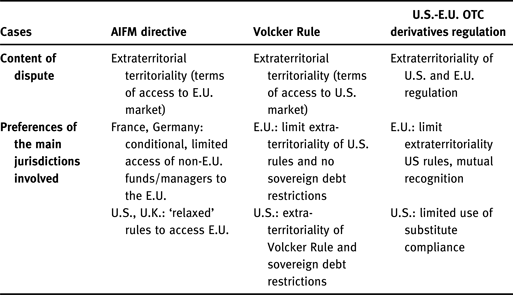
Post-crisis, transatlantic regulatory cooperation was successful in the vast majority of cases and built on the established patterns of pre-crisis international and bilateral cooperation. However, important disputes emerged concerning the regulation of hedge funds, banks, and OTC derivatives. A comparative assessment across cases (see Table 1) reveals that these disputes were the consequence of different domestic regulatory reforms and the United States and European Union's attempts to exert regulatory power beyond national borders through extraterritoriality and extraterritorial territoriality. In the case of the AIFM directive, the United Kingdom sided with United States, hence the “trans-English-Channel” dispute was as serious as the transatlantic one. However, British policy-makers sided with the rest of the European Union in the other two disputes. After Brexit, this is unlikely to be the case in the future.
Post-crisis transatlantic regulatory disputes in finance and preferences of the main jurisdictions

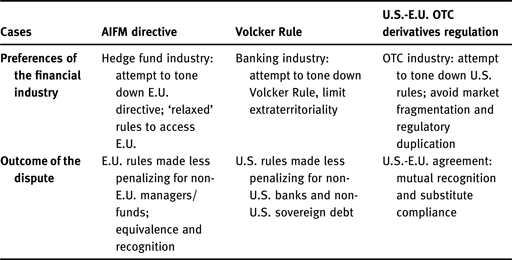
In all the cases examined the resolution of transatlantic regulatory disputes was based on compromises (see Table 2): the United States and the European Union made concessions concerning the scope of direct and indirect extraterritoriality of domestic rules. Eventually, they agreed on mutual recognition/equivalence (which was the “legal formula” favored by the European Union) and substitute compliance (which was the terminology favored by the United States). The network structure of the financial industry had important effects on the management of transatlantic disputes. It meant that the financial industry that had an obvious, sizable stake in the resolution of the disputes because its businesses depended on cross-border flows. Thus, transnational alliances—what Cerny calls “transnational neopluralism”Footnote 106 —were formed by the parts of the financial industry that were directly affected by patterns of substantive financial interdependence across the Atlantic. These alliances were able to orchestrate their lobbying in both jurisdictions to put pressure on domestic policy-makers to settle the disputes.
Preferences of the financial industry and outcome of post-crisis transatlantic regulatory disputes

As noted by Fahey in her article on “The Use of Law in Transatlantic Relations,” the cases examined in my article demonstrate “the use of law as a political tool” by both the European Union and the United States, partly to “protect the autonomy of their respective legal orders,”Footnote 107 partly to “export” aspects of their legal order to other jurisdictions, and partly to regulate cross-border activities that stem from the network structure of the financial industry. However, domestic regulatory reforms, especially those with extraterritorial effects, can generate regulatory clashes between jurisdictions in the polycentric governance of the international financial system. In turn, these clashes mobilize the financial industry in a variety of jurisdictions in order to resolve the disputes, often watering down rules.
This research also highlights a “disjuncture” between the international network structure of the financial industry and the current (ineffective) polycentric governance of the international financial system. The international network structure of the financial industry would require either international (hard) rules jointly agreed by jurisdictions in international fora or rules issued by the main financial center (namely the United States) with extra territorial effects accepted by the other jurisdictions. Both these options are politically unfeasible. The result is weak polycentric governance that generates regulatory disputes (mostly due to overlapping rules) without necessarily filling regulatory gaps in dealing with financial risk.
Acknowldgemnents
I wish to thank the guest editors and the reviewers for their perceptive comments on an early draft. This paper was revised when I was a research fellow at the BIGSSS (University of Bremen) and the Hanse-Wissenschaftskolleg (HWK).