There are complexities in teaching Australian Indigenous studies. The context is often confronting; tutors are often Indigenous, the majority of students are non-Indigenous, and the relevance of the content is not always immediately apparent (IHEAC, 2006). The courses are fundamentally underpinned by the nature of Australia's ‘beginnings’, from colonisation and its historical policy foundations — policies that had, and continue to have, marginalising influence on Aboriginal and Torres Strait Islander people and culture (Gunstone, Reference Gunstone2009). Reflecting the complexity of the space, student resistance is a key impediment to the quality of learning (Asmar & Page, Reference Asmar and Page2009; McDermott, Reference McDermott2014), this itself reflecting the attitudes, values and beliefs of students entering it (Bornholt, Reference Bornholt2002; Bullen, Roberts, & Hoffman, Reference Bullen, Roberts and Hoffman2017). Australian literature details various positive effects of such challenging courses, broadly suggesting the existence of personal shifts in the perspective or worldview of students, while highlighting the efficacy of their adopted teaching and learning models to effect these shifts (e.g., Bierman & Townsend-Cross, Reference Biermann and Townsend-Cross2008; Jackson, Power, Sherwood, & Geia, Reference Jackson, Power, Sherwood and Geia2013; Kickett, Hoffman, & Flavell, Reference Kickett, Hoffman and Flavell2014). While similarities and differences exist contextually across these studies, two unifying themes appear to be the adoption of Mezirow's (Reference Mezirow2000) transformative learning theory as fundamental to the development, delivery and evaluation of the course offerings, and the embedding of explicit opportunities within courses to engage in, or at least develop capacity for, critical reflection (CR). However, despite positive accounts of these learning experiences and/or aligning the learning and teaching process with the principles of transformative learning theory, very little literature actually explores or elaborates in detail the effect of such courses (Clifford, McCalman, Bainbridge, & Tsey, Reference Clifford, McCalman, Bainbridge and Tsey2015) or the mechanisms within doing the ‘heavy lifting’. This phenomenon reinforces the sentiment of a recent review of transformative learning theory itself (Taylor & Cranton, Reference Taylor and Cranton2013), suggesting that studies adopting, or aligning with, Mezirow's theory rely too extensively on interpretive paradigms within the transformative context, to the general exclusion of a positivist approach.
The current study explores the factors conducive to transformative learning within an Indigenous studies context, examining the predictive power of each, and examines factors predicting CR itself. This exploration is done in the context of a tangible outcome beyond simply ‘shifting perspectives’, that is, shifting perspectives in terms of attitudes towards Indigenous Australians and preparedness to work in often challenging contexts of Indigenous health. In this paper, we first review transformative learning (Mezirow, Reference Mezirow2000) as a theoretical construct aligned with, and holding utility towards, the understanding of potential student experiences within complex learning environments such as the Indigenous studies context. We follow this with an exploration of potential predictors of transformative learning. We then present predictive analysis findings, along with post-hoc analyses, examining the mediating role of CR in the relationship between learning approach and precursor steps to transformative learning. Finally, we discuss the implications of these findings for the refinement and development of existing and future course offerings within the transformative Indigenous studies space.
Transformative Learning Theory
Mezirow's transformative learning theory has been coined one of the preeminent theories of adult learning (Merriam & Caffarella, Reference Merriam and Caffarella1999; Taylor, Reference Taylor2007), and has been adopted as a framework across a range of domains, from Mezirow's (Reference Mezirow1978) original exploration of women reentering college, to student experiences within educational disciplines such as business, teaching and health (Brock, 2010; Kickett et al., Reference Kickett, Hoffman and Flavell2014; Taylor, Reference Taylor2003). Habermas (Reference Habermas1984) distinguishes between instrumental and communicative learning, the former concerned with controlling and manipulating environments to assess claims to truth, the latter concerned with the understanding and assessing of claims to authenticity and appropriateness (Mezirow, Reference Mezirow2003). Reflecting this distinction, transformative learning theory's key premise is that of ‘[transforming] problematic frames of reference—sets of fixed assumptions and expectations (habits of mind, meaning perspectives, mindsets)—to make them more inclusive, discriminating, open, reflective, and emotionally able to change’ (Mezirow, Reference Mezirow2003, p. 58). This is facilitated predominantly through a critically reflective process engaging the learner with these beliefs, habits of mind and personal assumptions, with 10 precursor steps proposed to lead to transformative experiences: ‘(1) a disorienting dilemma, (2) self-examination with feelings of fear, anger, guilt or shame, (3) a critical assessment of assumptions, (4) recognition that one's discontent and the process of transformation are shared, (5) exploration of options for new roles, relationships and actions, (6) planning a course of action, (7) acquiring knowledge and skills for implementing one's plans, (8) provisional trying of new roles, (9) building competence and self-confidence in new roles and relationships, (10) a reintegration into one's life on the basis of conditions dictated by one's new perspective’ (Mezirow, Reference Mezirow2000, p. 22).
Despite broad adoption of transformative learning theory, significant on-going critique remains (Taylor, Reference Taylor2007; Taylor & Cranton, Reference Taylor and Cranton2013; Newman, Reference Newman2012). This focuses on a range of elements including cognitive maturity in relation to the capacity for CR (Merriam, Reference Merriam2004), the ethics of inducing potential identity transformation via the deep questioning of assumptions held (Taylor & Cranton, Reference Taylor and Cranton2013), and even the validity of transformative learning theory itself (Newman, Reference Newman2012). While debate remains on-going, transformative learning theory is implicitly acknowledged as relevant to Indigenous Australian studies through the growing use of, and call for, the theoretical framework in detailing the effects of courses in this space (e.g., Jackson et al. Reference Jackson, Power, Sherwood and Geia2013; Kickett et al., Reference Kickett, Hoffman and Flavell2014; Page, Reference Page2014). This body of work, while not necessarily focused on transformative learning itself, approaches the context with a premise of understanding and affecting change, personally and socially.
Predictors of Transformative Learning
Students enter undergraduate education in Australia with a variety of beliefs about, and attitudes towards, Indigenous Australians (Bullen et al., Reference Bullen, Roberts and Hoffman2017). How individuals perceive and interact within the education environment and their own learning preferences are examined below as potential predictors of transformative learning experiences in Australian Indigenous contexts.
Educational Factors
Rapport
Student–teacher rapport predicts a range of positive student outcomes including student perceptions, cognitive and affective learning, and class engagement and participation (Benson, Cohen, & Buskist, Reference Benson, Cohen and Buskist2005; Frisby & Martin, Reference Frisby and Martin2010; Grantiz, Koernig, & Harich, Reference Granitz, Koernig and Harich2008; Wilson, Ryan, & Pugh, Reference Wilson, Ryan and Pugh2010). This is supported by findings around the positive relationship between engagement within the classroom and attitudinal changes towards diverse ethnic groups (Gimmestad & De Chiara, Reference Gimmestad and De Chiara1982; Pettijohn & Waltzer, Reference Pettijohn and Walzer2008) as well as theories of intergroup contact and prejudice reduction (Tropp & Pettigrew, Reference Tropp and Pettigrew2005). Literature within the Indigenous studies domain points to the role of the relational elements of the learning environment as one of facilitating shifts of perspectives (Jackson et al., Reference Jackson, Power, Sherwood and Geia2013; Kickett et al., Reference Kickett, Hoffman and Flavell2014). Thus, the influence of student–teacher rapport, often overlooked (Buskist, Sikorski, Buckley, & Saville, Reference Buskist, Sikorski, Buckley and Saville2002), requires consideration as a predictor of transformative learning.
Classroom Environment
Sense of community within the classroom is related to numerous learning and retention variables (e.g., Freeman, Anderman, & Jensen, Reference Freeman, Anderman and Jensen2007; Kernahan, Zheng, & Davis, Reference Kernahan, Zheng and Davis2014). The need for educators to create classroom environments conducive to the development of reflection and critical thinking within complex learning contexts is recognised, Brookfield (Reference Brookfield1986) acknowledging the imperative in terms of international students. However, to date, there has been very little research around student perceptions of the classroom community in the context of intercultural learning spaces, less when discussing the transformative learning context. Previous research is mostly qualitative in nature, indirect in its acquisition of data and relevance, with transformative learning not necessarily the focus of the study (e.g., Aberdeen, Carter, Grogan, & Hollinsworth, Reference Aberdeen, Carter, Grogan and Hollinsworth2013; Aveling, Reference Aveling2002; Ranzijn, McConnochie, Day, Nolan, & Wharton, Reference Ranzijn, McConnochie, Day, Nolan and Wharton2008). The complexity of many Indigenous studies classrooms is such that participation alone is a considerable part of the battle; effectively developing a sense of classroom community may assist in managing tension and anxiety, consequently attracting and retaining learners within this classroom context (Battistich, Solomon, Watson, & Schaps, Reference Battistich, Solomon, Watson and Schaps1997; Frisby & Myers, Reference Frisby and Myers2008) and ultimately improving learning outcomes. Sidelinger and Booth-Butterfield (Reference Sidelinger and Booth-Butterfield2010) found links between student connectedness, instructor rapport and learning preparation and in-class participatory behaviours, suggesting a student/instructor co-creation of the classroom community and consequent learning environment. Indeed, Sidelinger, Bolen, Frisby and McMullen (Reference Sidelinger, Bolen, Frisby and McMullen2011) suggest student connectedness within the classroom may actually offset poor instructor-based teaching and learning behaviours.
Individual Factors
Learning Approach
Students enter undergraduate education in Australia with preferred learning approaches. Learning approaches refer to ‘the ways in which students go about their academic tasks, thereby affecting the nature of the learning outcome’ (Biggs, Reference Biggs1994). A deep learning approach is characterised by an intrinsic enjoyment in, and personalisation of, the subject, with the learner seeking understanding. This approach involves a range of higher order cognitive capabilities (e.g., analytic and metacognitive skills) to develop a deep grasp of the subject matter. Underpinning this is the assumption that knowledge and understanding constructed through this lens is transferrable and applicable to a range of contexts, not simply the context within which the material has been learned (Biggs, Reference Biggs1987; Marton, Reference Marton1983). In contrast to this is the extrinsically motivated, nonpersonalised, superficial methodology of the surface approach to learning (Leung & Kember, Reference Leung and Kember2003). Both have been linked to academic outcomes across a range of domains and demographics. Purdie and Hattie's (Reference Purdie and Hattie1999) meta-analyses of a range of studies examining the relationship between students’ study strategies and outcomes indicates that, over and above the time spent learning, strategies of a ‘deep or elaborative nature’ (p. 82) had the most significant effect.
From a trait-based perspective, students with a high need for cognition (Cacioppo & Petty, Reference Cacioppo and Petty1982) typically approach their learning deeply (Evans, Kirby, & Fabrigar, Reference Evans, Kirby and Fabrigar2003). However, students low on need for cognition are able to adopt a deep learning approach dependent on the learning environment context (Wilson & Fowler, Reference Wilson and Fowler2005). This is dependent on a range of factors such as interest in the subject, personal engagement and investment, task requirements (Biggs, Reference Biggs1987) and the design and delivery of the course (Baeten, Kyndt, Struyven, & Dochy, Reference Baeten, Kyndt, Struyven and Dochy2010; Meyers & Nulty, Reference Meyers and Nulty2009). This suggests that the more personalised and meaningful the learning experience, the more likely the adoption of the deep approach. Importantly, Biggs’ (Reference Biggs1989) learning model suggests that student perceptions of the learning environment influence approaches to learning, with a consequent influence upon learning outcomes (Wilson & Fowler, Reference Wilson and Fowler2005).
Critical Reflection
Conceptually related to the deep learning approach is CR (Leung & Kember, Reference Leung and Kember2003). The core of CR is the questioning, and potential reformulation, of premises previously held to be true (Mezirow, Reference Mezirow2000). Importantly, learning approach and critical reflective capability are positively related, with deep approaches associated with greater CR (Leung & Kember, Reference Leung and Kember2003; Phan, Reference Phan2007; Sobral, Reference Sobral2001). The implication being that a deep approach to learning is both necessary and conducive to authentic reflection on deeply held beliefs and values, particularly within learning environments relegated to irrelevance (Betancourt, Reference Betancourt2003; McDermott & Sjoberg, Reference McDermott and Sjoberg2012), such as in Australian Indigenous studies. While both deep learning approach and CR are fundamentally related to transformative learning (Mezirow, Reference Mezirow1998), CR has been posited as the central tenet (Brookfield, Reference Brookfield and Mezirow2000).
Previous research (e.g., Bullen & Roberts, in press; Jackson et al., Reference Jackson, Power, Sherwood and Geia2013; Kickett et al., Reference Kickett, Hoffman and Flavell2014) suggests that within the Indigenous studies domain CR occurs, and is the driving force behind any transformative learning occurring. However, there is little within these studies that explicitly examine the nature of CR, or that highlights critically reflective material is indeed aligned with existing definitions of CR. This is despite acknowledging the transformative intent and outcomes of their respective educational interventions. Related to this, Lundgren and Poell's (Reference Lundgren and Poell2016) review of literature of empirical studies on CR (as based on Mezirow's own definition, albeit shifting over time) notes a lack of consensus around the operationalisation of the CR construct across a number of studies, suggesting a lack of fidelity of data related to the existence of CR occurring. This somewhat echoes Taylor's (Reference Taylor2007) concern that further evidence of the existence and role of CR requires greater examination.
Predictors of Critical Thinking
If indeed CR is the primary driver of transformative learning, what aspects of the learning environment are associated with, and conducive to, CR? Teaching environments can be conducive to authentic reflection, Chick et al.’s (Reference Chick, Karis and Kernahan2009) finding that group-based reflective learning facilitated increased empathy and attitudinal change, suggests the nature of the group, classroom context and associated levels of support within as factors impacting upon the quality of reflection. Indeed, across a range of studies within the health domain, these elements have been put forth as influential in facilitating the development of critically reflective practices (Mann, Gordon, & MacLeod, Reference Mann, Gordon and MacLeod2009). These findings further emphasise the importance of relational and student-based factors (rapport, classroom community and learning approach) as fundamental to potentially transformative outcomes, particularly when the context introduces material that may be threatening.
In summary, transformative learning theory posits that, while a range of factors may be involved in facilitating potentially transformative experiences, CR is the preeminent factor behind the potential for perspective transformation (Brookfield, Reference Brookfield and Mezirow2000; Mezirow, Reference Mezirow2000), and this is facilitated by a deep learning approach. Other aspects of students’ engagement in the classroom context may also be conducive to the development of CR within the Indigenous studies learning environment, but are yet to be empirically tested.
Aims and Hypothesis
The current study is the third phase of a broader research project examining the development of student cultural capabilities through a transformative educational course mechanism. Phase 1 examined student attitudes towards Indigenous Australians, and student preparedness to work in Indigenous health settings upon entry to their first Indigenous health course experience (Bullen, Roberts, & Hoffman, Reference Bullen, Roberts and Hoffman2017). Phase 2 examined the efficacy of the course experience in terms of shifting attitudes and preparedness, and the role of transformative experiences within this. After controlling for preexisting attitudes, the number of Mezirow's posited precursor steps to transformative learning self-reported predicted significant changes in student attitudes towards Indigenous Australians (f 2 = 0.03), and student perceptions of Indigenous health as a social priority (f 2 = 0.017), the adequacy of health services for Indigenous Australians (f 2 = 0.027) and preparedness to work in Indigenous health settings (f 2 = 0.067) (Bullen & Roberts, in press).
The aim of this third phase of the research project was to examine the predictors of transformative learning of first year undergraduate health students’ within an Australian Indigenous studies context. First, we aimed to examine which of the individual and classroom factors most powerfully predicted these potentially transformative experiences. We hypothesized that CR, student perceptions of the classroom community, student/teacher rapport and the learning approach adopted would be significant predictors of the number of precursor steps to transformative learning self-reported by students (H1), and that CR would be the strongest unique predictor (H2). Second, assuming CR is the key predictor of transformative learning, we aimed to examine which of the classroom factors predicted CR. We hypothesised that student perceptions of classroom community and student/teacher rapport would be significant predictors of CR. Understanding the key factors driving transformative experiential learning for students has significant implications for institutions implementing courses focused around Indigenous perspectives, knowledge and diversity.
Method
Participants
Participants were 336 students (63 males, 273 females) enrolled in a large Australian university Faculty of Health Sciences interprofessional first-year core unit on Indigenous cultures and health. Of the 336 students (63 males, 273 females), the majority were domestic (n = 301), with 35 international students and 5 students identifying as Indigenous Australians. Participant ages ranged from 17 to 54 years (Mean = 21.5 years; SD = 6.0 years).
Materials
Students completed questionnaires at two time points, at the beginning and end of semester. A measure of student learning approach [Revised Two Factor Study Process Questionnaire (R-SPQ-2F): Biggs, Kember, & Leung, Reference Biggs, Kember and Leung2001] was included in the Time 1 questionnaire (see author details omitted for all measures included in this questionnaire). At Time 2, a questionnaire was developed comprising student approaches to learning, student/teacher rapport, quality of the classroom community, students’ reflective thinking, the number of precursor steps to transformative learning, teacher Indigeneity, the number of classes attended across the semester and student demographics.
Revised Two Factor Study Process Questionnaire
Derived from Biggs’ Study Process Questionnaire (Reference Biggs1987), the R-SPQ-2F (Biggs et al., Reference Biggs, Kember and Leung2001) measures student approaches to learning. The R-SPQ-2F is intended to be responsive to changes in higher education and consists of 20 items across two learning approaches, with responses to each item via a Likert scale of 1 (never/only rarely) to 5 (always/almost always). An example question from the Deep Approach is ‘I find that at times studying gives me a feeling of deep personal satisfaction’. An example question from the Surface Approach is ‘I do not find my course very interesting so I keep my work to the minimum’. Items for each approach are summed with higher scores indicating preferences for a particular approach. Cross-validation in two large Western samples (Immekus & Imbrie, 2010) indicates acceptable reliability for the deep (cohort 1: α = .76; cohort 2: α = .76) and surface (cohort 1: α = .73; cohort 2: α = .7) approaches. Across this study's sample, the measure had acceptable reliability for both Time 1 (deep approach: α = .82; surface approach: α = .76) and Time 2 (deep approach: α = .85; surface approach: α = .80) measures.
Classroom Community Scale
The Classroom Community Scale (CCS: Rovai, Reference Rovai2002) measures the quality of the sense of community in learning environments. It focuses on the extent to which students’ feel learning goals are being satisfied in the classroom, via both a sense of class connectedness, and the use of class interaction to construct understanding. It consists of 20 items evenly split across two subscales (connectedness and learning), with responses to each item statement via a Likert scale of 1 (strongly agree) to 5 (strongly disagree). An example question is ‘I feel connected to others in this course’. To score subscale items are first summed, and then can be added to provide the CCS total, with higher scores indicating higher sense of classroom community. In this sample, the measure had acceptable reliability for the full scale (α = 88), and the learning (α = .82) and connectedness (α = .83) subscales.
Reflective Thinking Questionnaire
The Reflective Thinking Questionnaire (RTQ: Kember et al., Reference Kember, Leung, Jones, Loke, McKay, Sinclair, Tse, Webb, Wong, Wong and Yeung2000) measures students’ engagement in reflective thinking, and was developed in explicit alignment with Mezirow's transformational learning framework. Only the CR subscale was used in the current study. Participants respond to each statement via a Likert scale of 1 (definitely agree) to 5 (definitely agree). An example question is ‘This course has challenged some of my firmly held ideas’. Items are summed with higher scores indicating higher engagement with critically reflective thinking. In this sample, the measure had high internal consistency (α = .85).
Professor – Student Rapport Scale – Brief
The Professor–Student Rapport Scale – Brief (PSRS-B: Wilson & Ryan, Reference Wilson and Ryan2013) measures student perceptions of rapport with their teacher. It consists of six items, with responses to each item statement via a Likert scale of 1 (strongly disagree) to 5 (strongly agree). An example question from the scale is ‘My professor encourages questions and comments from students’. To score, items are summed with higher scores indicating greater perceived rapport. Internal consistency (α = .86) was acceptable in this study.
Teacher Indigeneity perceptions
A single item was used to measure participants’ perceptions of their tutor's cultural background. Possible responses are limited to ‘Indigenous’, ‘Non-Indigenous’ and ‘I don't know’.
King's Learning Activities Survey
The Learning Activities Survey (LAS) developed by King (Reference King1997) is used to measure perspective transformation experiences in the learning environment. The adapted version used by Brock (Reference Brock2010) consists of 13 items, participants responding by checking as many as are applicable to their learning experience. An example item is ‘I had an experience that caused me to question the way I normally act’. Scoring is a matter of counting the number of statements endorsed.
Demographics
Single items were used to measure participant's age, gender, student type (domestic or international) and number of tutorials attended.
Procedure
This study was approved by the university Human Research Ethics Committee. Students completed part 1 of the questionnaire during week 1 of an Indigenous cultures and health unit, and were invited to participate in part 2 of this study in week 10 of semester. All students in attendance completed the questionnaire, after being advised that while participation in completing the questionnaire was part of a tutorial activity, their written consent was required for their data to be used in the research project. Tutors left the room during questionnaire administration to minimise ethical concerns around coercion of students to participate. Questionnaires took approximately 10–15 minutes to complete. Of the 1175 Time 1 and the 614 Time 2 student respondents, 336 were able to be matched on a code to their data at Time 1, forming the dataset for the current study's analysis. Of the 336, 116 students reported having an Indigenous tutor, 189 a non-Indigenous tutor, with 24 unsure and 4 not reporting.
Data was entered into SPSS (v.22) for analysis. Missing values and ‘No Answer’ responses in the original dataset were relatively infrequent across each of the key measures used, the latter recoded as missing values also. Missing values analysis reported Little's MCAR test as significant, indicating that data was not missing at random (Little, Reference Little1988). Missing values were then imputed using expectation maximisation, preserving intervariable relationships.
The factor structure and reliability for each of the four key measures were tested using principal axis factoring with varimax rotation. Examination of scree plots supported the proposed single factor structure of both the PSRS-B (α = .86) and RTQ (α = .85). Factor analysis of the R-SPQ-2F identified five factors with multiple crossloadings, in contrast to the four factors (two deep subscales, two surface subscales) proposed by Biggs et al. (Reference Biggs, Kember and Leung2001). Factor analysis with forced two factor extraction was conducted on the overall scale, resulting in a 10-item deep subscale (α = .85) and a 10-item surface subscale (α = .80) subscale, aligned with Immekus & Imbrie's (2010) validation study. Factor analysis of the CCS also identified five factors with multiple crossloadings, in contrast to the two factor model (connectedness and learning) proposed by Rovai (Reference Rovai2002). Factor analysis with forced two factor extraction was conducted on the overall scale resulting in a 9-item connectedness subscale (α = .85) and a 10-item learning (α = .81) subscale.
Results
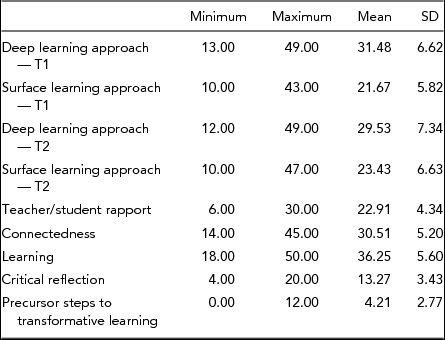
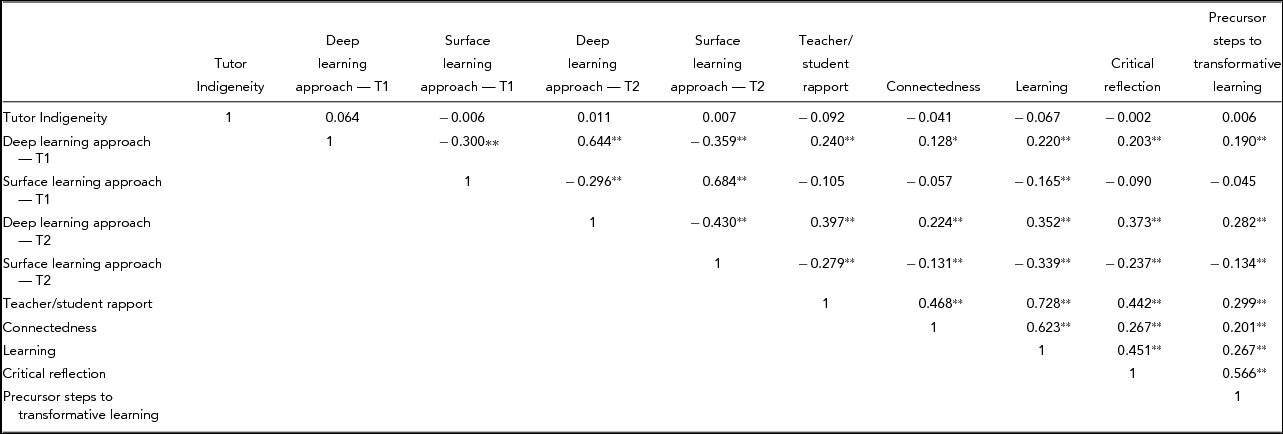
Table 1 outlines the aggregated descriptive statistics across each of the measures. To assess the size and direction of the linear relationships between the key variables of interest, bivariate Pearson's product-movement correlation coefficients (r) were calculated (Table 2).
Descriptive Statistics for Student Respondents (n = 336)

Pearson Correlation Matrix Among all Personal and Pedagogical Variables

**p < .01; *p < .05.
Hierarchical Multiple Regression Predicting Precursor Steps to Transformative Learning
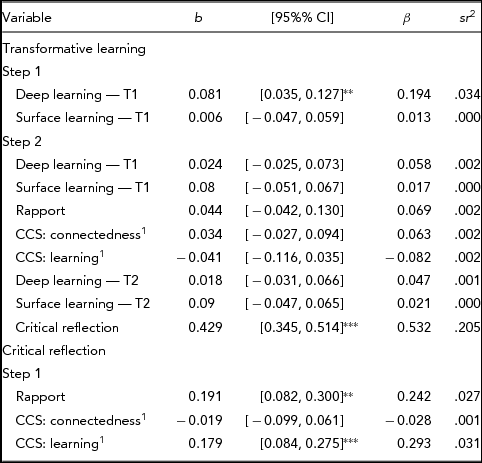
A hierarchical multiple regression analysis (HMRA) predicting precursor steps to transformative learning was conducted in two steps. In the first step, Time 1 measures of deep and surface learning approach were entered and accounted for a significant 3.6% of the variance in precursor steps to transformative learning, R 2 = .036, F (2, 333) = 6.26, p = .002. On step 2, student/teacher rapport, classroom community subscales (connectedness and learning), Time 2 deep and surface learning approach, and CR were added to the regression equation, and accounted for an additional 29.7% of the variance in precursor steps to transformative learning, ΔR 2 = .297, F (6, 327) = 24.27, p < .001. In combination, the eight predictor variables explained 33.3% of the variance in precursor steps to transformative learning, R 2 = .333, adjusted R 2 = .317, F (8, 327) = 20.42, p < .001 (see Table 3). By Cohen's (Reference Cohen1988) conventions, a combined effect of this magnitude can be considered large (f 2 = 0.50). Of these, CR accounted for the largest proportion of significant unique variance in precursor steps to transformative learning, sr 2 = .205, supporting the second hypothesis that the strongest predictor of transformative experiences would be CR.
Unstandardised (b) and Standardised (β) Regression Coefficient, and Squared Semi-Partial Correlations (sr 2) for Each Predictor Variable on Each Step of a Hierarchical Multiple Regression Predicting Precursor Steps to Transformative Learning

***p < .001; **p < .01; 1Classroom community scale.
Mediation
Only deep learning at Time 1 and CR at Time 2 accounted for significant unique variance in precursor steps to transformative learning. Further to this, based on literature suggesting a relationship between deep learning approaches and CR (Leung & Kember, Reference Leung and Kember2003), and the suggested preeminence of the role of CR in transformative learning theory (Mezirow, Reference Mezirow1998), it was hypothesised (post-hoc) that the deep learning approach (prior to commencing the unit of study) indirectly affects the number of precursor steps to transformative learning through the mediating variable of CR.
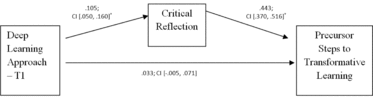
This was tested using PROCESS (Hayes, Reference Hayes2012). Results indicated that deep learning approach was a significant predictor of CR, b = 0.105, SE = 0.028, p < .001, and that CR was a significant predictor of precursor steps to transformative learning, b = 0.443, SE = 0.037, p < .001 (see Figure 1). A deep learning approach was no longer a significant predictor of precursor steps to transformative learning after controlling for the mediator, CR, b = 0.033, SE = 0.019, p = .089. These results support the mediational hypothesis.
The mediating role of critical reflection in the effect of learning approach on precursor steps to transformative learning. *p < .001.

HMRA Predicting Critical Reflection
A second HMRA of classroom factors predicting CR was conducted in two steps. Measurements of student/teacher rapport and classroom community subscales (connectedness and learning) were entered into the regression equation, and accounted for 23.1% of the variance in CR, R 2 = .231, F (3, 332) = 33.29, p < .001. By Cohen's (Reference Cohen1988) conventions, a combined effect of this magnitude can be considered medium (f 2 = 0.30).
Unstandardised (b) and standardised (β) regression coefficients and squared semipartial (part) correlations (sr 2) for each predictor on each step of each HMRA are reported in Table 3.
Discussion
The current study examined whether individual and classroom factors were predictive of first-year undergraduate health students’ transformative experiences within a semester long tertiary Indigenous studies course. Our results indicate that while all variables examined, with the exception of surface learning at Time 1, were individually correlated with transformative learning, deep learning approach upon entering the course and CR were the only unique predictors of transformative learning. As hypothesised, CR accounted for the most unique variance in the number of precursor steps to transformative learning experienced by students.
Post-hoc analyses supported the hypothesis that a deep learning approach (at Time 1) indirectly affected the number of precursor steps to transformative learning through CR. Within the Indigenous studies context, this ties together and perhaps clarifies literature suggesting a relationship between deep learning approaches and CR (Leung & Kember, Reference Leung and Kember2003), and the suggested preeminence of the role of CR in transformative learning theory (Mezirow, Reference Mezirow2000), while offering possible explanation of the nature of the relationship between the three constructs. The level of rapport between student and teacher, and the perceived quality of the classroom learning environment in terms of facilitating and supporting learning were both predictive of the level of student CR. These findings provide support for relational teaching as a mechanism through which learning and potential transformative experiences occur in a complex environment such as the Indigenous studies context.
Overall, these results suggest that CR is indeed the key component of transformative learning. Students bring to the class a range of attitudinal factors, perhaps rendering the learning somewhat in-effectual until CR is facilitated through a relational channel. Previous literature has outlined some factors that make the Indigenous studies context different — for example, resistance (McDermott, Reference McDermott2014), discomfort (Mitchell, Every, & Ranzijn, Reference Mitchell, Every and Ranzijn2011), guilt (Williams, Reference Williams2000) and discussions of power and white privilege (Nicholl, Reference Nicholl2004). It is interesting that student attitudes brought to the learning context have generally developed through the very same sociocultural context that have led so many Australian tertiary institutions to engage in the embedding of this ‘different’ material within their respective courses. The role of CR appears to support literature positing CR as preeminent in transformative learning.
These findings suggest that, beyond simply the course material, the pedagogical approach used within the learning setting — particularly the relational approach adopted by the teacher/facilitator, and the subsequent community of learning invoked — plays a key part in whether students had transformative experiences in relation to their ideas of self, and their consequent/related ideas of Indigenous Australians and culture. Our previous research (Bullen & Roberts, in press) indicated that one of the steps in Mezirow's theory, recognition of shared discontent, was commonly selected by students, further providing support to the role of community within the classroom, a community built on perhaps a shared grappling with highly challenging personal and social content. This appears to be reflected in the community classroom subscale of learning [reflecting ‘feelings regarding the use of interaction within the community to construct understanding and the extent to which learning goals are being satisfied within the classroom setting’ (Rovai, Reference Rovai2002, pp. 202)] significantly predicting greater CR by students. In contrast, the subscale of connectedness (reflecting more the students’ ideas of how connected they felt to the classroom community), while significantly associated with CR when examined individually, did not predict student CR once other variables were controlled for. This highlights the greater importance of the learning environment in the classroom over the student's sense of connectedness in the classroom.
Despite literature suggesting otherwise (Ranzijn et al., Reference Ranzijn, McConnochie, Day, Nolan and Wharton2008), no significant relationships were found between tutor Indigeneity and rapport, classroom community (learning or connectedness subscales), CR or precursor steps to transformative learning. Ranzijn et al. notes ‘Having the opportunity to be taught by and interact with an Indigenous academic is thought to have a major role in reducing stereotypes and negative attitudes about Indigenous people’. Explanation for this lack of influence on outcomes (in relation to the previous quotation) may come in the form of Allport's (Reference Allport1979) contact hypothesis. As a former tutor in the unit in question, when a student raised the idea that practical interaction with Indigenous Australians is vital to social and personal change, the first author responded with ‘you are interacting with Indigenous people — you have an Indigenous tutor’. To this, the student responded ‘yeah, but that's different, you're different’. While this might be interpreted in a range of ways (e.g., the tutor did not reflect the student's external ascription of what they consider an Indigenous Australian to be), an alternative interpretation is also possible — that the student is aware of the structural dynamic of a classroom setting where, despite the tutor being Indigenous, they are also a tutor, a role that perhaps takes precedence, violating one of Allport's four essential conditions (i.e., equal status of interactors) for the contact hypothesis, and thus somewhat nullifying the ‘interaction’ at hand (Pettigrew & Tropp, Reference Pettigrew and Tropp2000). The nature of teaching is such that, whether Indigenous or not, the teacher is in a position of authority — in this context, something likely to lead to elements of resistance, or at least possible ambivalence towards the tutor. This is a real prospect given the documented complex nature of Indigenous/non-Indigenous relations in this country.
Of course, there are benefits to the engagement of Indigenous tutors above and beyond their predictive value, and this ought to be made clear. In this study, tutors’ cultural background did not contribute to significant differences in outcomes. Future research might focus on exploring potential differences between Indigenous and non-Indigenous tutors in terms of pedagogical method, learning outcome and impact on tutors for example, or indeed whether practical and culturally safe interaction with Indigenous Australians and culture outside of the current study's learning context makes a difference to potential transformative shifts.
This study has limitations that temper our confidence in the findings. First, the study was conducted within a single university and, as such, the findings may not be generalisable to health science students in other universities. Second, the study lacked a control group as the ‘intervention’ (the course of study) is compulsory for all health science students. Despite these limitations, this study provides a major contribution to the literature on the factors that contribute to CR and transformative learning in the Indigenous studies context. A future area for research is to examine how well these findings generalise to differing learning settings that require transformative learning.
In summary, this study suggests that health students within Indigenous studies courses benefit from both a deep learning approach and tutors’ ability to develop rapport with their students, and the consequent communal nature of the classroom, leading to greater capacity for student CR. This in turn appears to promote transformative learning possibilities within the Indigenous studies learning environment. The study, while enabling a closer look at the drivers of transformative learning in the Indigenous studies space, also affords a glimpse at areas of difference between Indigenous and non-Indigenous course models, suggesting further rationale for institutions approaching the embedding of Indigenous knowledge into courses differently in terms of both resourcing requirements, human and economic, and in terms of evaluating the effect and quality of the course. Importantly, this study also further highlights the transformative capacity and mechanisms of Indigenous studies courses in enhancing future non-Indigenous health professionals’ capabilities to work with Indigenous Australians in a very practical sense — that is, in ways that play a role in closing the gap between Indigenous and non-Indigenous health outcomes. If Australian universities are to continue offering, and realise the potential of, this course model, it is crucial that those within the institutions are aware of how to implement such courses, and how to measure their effectiveness.
Acknowledgments
We gratefully thank all the individuals who volunteered their time to assist with data collection for this research project, and the many coordinators and tutors for granting us access to their classrooms to administer the research surveys. This research received no specific grant from any funding agency, commercial or not-for-profit sectors.
About the Authors
Jonathan Bullen is a Nyungar (Wardandi) man from the south-west of Western Australia. He is learning designer, Indigenous curriculum nand Pedagogy within Curtin Teaching and Learning. Prior to this, Jon was co-unit co-ordinator of an award-winning large-scale interprofessional Indigenous health unit. His PhD research focuses on the elements underpinning, and outcomes from, transformative pedagogies.
Lynne Roberts is a Wadjella living in Western Australia. She is an Associate Professor in the School of Psychology and Speech Pathology at Curtin University. Lynne is an Australian Teaching Fellow and Chair of Curtin Academy. Her research interests include higher education research and she has published widely on teaching and learning topics.