Undergraduate and graduate courses in bioethics and medical ethics are taught at many institutions of higher learning in the United States. In fact, the Liaison Committee on Medical Education (LCME), which establishes certification requirements for medical schools, requires all medical schools to include bioethics in their curricula.Footnote 1, Footnote 2 These courses cover a broad range of bioethical topics, including informed consent, embryonic stem cell research, reproductive medicine, neuroethics, clinical trials, cloning, euthanasia, and end-of-life care. Bioethics courses often offer various approaches to analyze ethical concerns. Some courses, for example, utilize more traditional philosophical (see Princeton University’s Center for Human Values courses)Footnote 3 or religious-based approaches to address bioethical challenges whereas other courses utilize scientific-based approaches or may integrate a more multidisciplinary approach to their methodology (see the Columbia College course “Crossroads in Bioethics”).Footnote 4 The outcomes of these courses are to enable students to better appreciate existing and emerging bioethical challenges and to help students develop response-strategies to meet these challenges.
In general, undergraduate and graduate bioethics courses stimulate student dialogue and debates. Yet they may not be as popular among pre-health majors, science majors, or medical students as one would expect, considering the fact that these students will likely face numerous bioethical challenges in their future careers. Medical students, for example, often view bioethics as a secondaryFootnote 5 or even a nuisance course, preferring that their classroom time be devoted to other subjects like pathology or neuroscience.Footnote 6 Science professors also devote little time to bioethics, because they believe they do not have sufficient time to present basic science, let alone the ethical ramifications.Footnote 7 Ensuring attendance at lectures and courses and trying to get the students to take exams seriously are well-known problems for faculty who teach introductory courses in bioethics at medical centers. At Columbia University’s College of Physicians and Surgeons, for example, fewer than 20 percent of medical students register for the university’s fourth-year, one-month-long course on medical ethics. There is therefore a need to enrich these courses to stimulate student interest and to prepare students to deal with these issues.
In this article, we present an innovative program, BioCEP, to encourage undergraduate and graduate student interest and preparedness in bioethics and medical ethics. The educational methodologies incorporated in BioCEP are based on two lessons derived from current research in science education. First, the traditional model of science instruction in which a professor only lectures to a group of students does not guarantee that students will develop deep understandings of critical concepts.Footnote 8 Students prefer active class discussions and debates to passively listening to traditional lectures.Footnote 9, Footnote 10, Footnote 11 Second, science learning is enhanced when course material includes practical aspects of a concept.Footnote 12, Footnote 13, Footnote 14 Presenting actual case studies provides an excellent forum to introduce and discuss the practical aspects of bioethics.Footnote 15 The primary objectives of these educational methodologies are to inspire curiosity, to provide broad content knowledge, to develop analytical thinking skills, and to be accessible to a diverse cohort of students.Footnote 16
These educational methodologies were incorporated into the design of BioCEP in response to an educational need that emerged during one medical school course and three undergraduate courses (Crossroads in Bioethics,Footnote 17 Ethics for Biomedical Engineers,Footnote 18 and Stem Cells: Biology, Ethics and ApplicationsFootnote 19) taught at Columbia University through the Center for Bioethics, Department of Biology, and the Department of Biomedical Engineering.Footnote 20
The first educational gap that emerged in teaching these courses at Columbia University was the lack of a laboratory-style component. In almost all universities, science courses are accompanied by a specific laboratory course to teach students the practical side of science.Footnote 21, Footnote 22 Laboratory courses provide students with practical experience in doing science and concretizing the materials covered in the lecture component of the course. A 2002 study of U.S. medical school curricula, in which 87 institutional representatives (a 72% response rate) ranked their ethics syllabi learning objectives,Footnote 23 revealed that only 10.3 percent of surveyed courses provided “ethically relevant educational experiences” as a learning objective. In these courses, hands-on experiences were described as students watching a film rather than, for example, actually visiting an NGO that helps sex workers or meeting onsite with a government consultant tasked with advising on how to allocate limited healthcare funds in a developing country.Footnote 24
The second gap is that students find it difficult to comprehensively understand how different cultures and religions influence contentious issues related to medical ethics and bioethics. Cross-cultural bioethics is a growing aspect of bioethics and medical ethics and plays a critical role in understanding different bioethical views. Differences in cultural and religious views on the beginning of human life, for example, are one critical dilemma in the current debates on embryonic stem cell research.Footnote 25 Differences in cultural understandings of the concept of individual freedom and the authority of doctors are also gaining in relevance as the globalization of federally funded clinical trials continues to grow. Healthcare providers and biomedical researchers will need to have the skills to communicate with a diverse patient and subject population and to recognize that racial and ethnic disparities arise in part due to poor understanding of the impact of culture and religion in medical ethics.Footnote 26 Thus, there is an increasing need to enhance cross-cultural ethics knowledge and experience in medical and science education. The above-mentioned study of U.S. medical school curricula also showed that although the goal of clarifying personal values was prevalent, competency in cross-cultural values remains a learning-objective gap.
Efforts to fill these gaps at Columbia University were less than successful despite the fact that the courses were designed to enable students to develop their own multidisciplinary strategies to confront bioethical dilemmas and to improve their ability to communicate bioethical principles to the public via the submission of opinion pieces for the Columbia University Journal of Bioethics. Thus, the Center of Bioethics at Columbia designed BioCEP as an innovative optional summer educational program to fill these gaps. In this four-week program, 10–20 students are selected to travel to Bangkok, Thailand, each summer and partner with an equal number of Southeast Asian students. Professors from the United States and Southeast Asia provide background material on a topic and stimulate the students to engage in debates, role-playing scenarios, and case study analyses. The students also are taken on off-campus field trips (labs) to observe how various organizations confront real-life dilemmas of bioethics and medical ethics. In this manner, BioCEP provides an ideal opportunity for students and faculty to experience bioethics and public health in a developing country, and to explore firsthand the impact of culture and religion on global public health education and delivery.
Participants
Student participants come from diverse educational and cultural backgrounds, including undergraduate students pursuing premedical, health sciences, nursing, law, and business degrees, as well as graduate students in public health, bioethics, biotechnology, dentistry, and medicine. Since BioCEP’s inception in 2007, more than 100 students from the United States, Canada, Japan, South Korea, China, the United Arab Emirates, Myanmar, and Thailand have participated in the program. Students in BioCEP also represent major global religions including Catholicism, Islam, Protestantism, Judaism, Hinduism, and Buddhism. All participating students are encouraged to present their religious or secular perspectives on challenging bioethical issues.
Students are carefully selected for BioCEP based on academic performance, enthusiasm for cross-cultural bioethics, and an evaluation of their ambassadorship skills. Faculty members from the United States include bioethicists, scientists, and clinicians who have hands-on expertise in bioethics. Faculty members from Mahidol University in Bangkok include scientists, Buddhist monks, historians, bioethicists, and physicians. BioCEP’s curriculum combines lectures, seminars, professional visits, and cultural excursions. In addition, guest speakers from the Ministry of Health, public and private hospitals, and/or other organizations are invited to present their perspectives. The major objectives of all faculty and lecturers are to stimulate the students to think creatively and to analyze some of the challenging bioethical issues in real-life situations.
Topics covered in the program include emerging infections, integration of Western and Eastern medicines, medical tourism, stem cell research, organ transplantation, informed consent, malnutrition, abortion, public health, genetic testing, and reproductive medicine. In addition, there is also a focus on timely topics. In 2010–2011, the earthquakes in Haiti, Chile, and Japan presented an opportunity to discuss ethical issues related to disaster medicine, and topics included healthcare demands within a global environment, triage, the definition of disease, human trafficking, resource allocation, and disaster prevention and management.
Host Country: Bangkok, Thailand
To promote student interest in any international program, it is important to choose a location that has the following features: a highly academic university with English-speaking faculty and students, different cultures and religions, and a safe environment. It should also be in a developing country that is not frequently visited by university students. Mahidol University in Bangkok, Thailand, fits all of these criteria. In addition, Thailand and the United States share contentious bioethical and medical ethical issues such as the following:
• How best to allocate limited funds to support both biomedical research and access to healthcare
• How to resolve bioethical issues related to stem cell research
• How to balance traditional religious and cultural values with current biomedical research and clinical applications of new biotechnologies
• How to resolve public health issues such as sexually transmitted diseases, drug abuse, smoking, obesity, and unwanted pregnancies
There are also many ethical issues that Thailand faces that are unique to that region. These issues include
• Dealing with medical tourism (cosmetic surgery, sex change operations, dental procedures, and organ transplantation)
• Developing detection, educational, and treatment programs for devastating and emerging infectious diseases such as AIDS, malaria, avian flu, dengue fever, and SARS
• Integrating Western medicine with traditional Eastern alternative medical procedures and medications
• Alleviating the paucity of genetic counselors
• Dealing with specific medical disasters such as monsoons and tsunamis
Host University: Mahidol University International College
Mahidol University (MU) is the oldest institution of higher learning in Thailand. Founded in 1889 as a medical school, MU has since developed into the most prestigious university in Thailand, internationally recognized for its high-caliber curriculum, research, and international collaboration. Its academic community consists of 5,600 professors and researchers, 9,500 undergraduate and graduate students, and 1,800 international students representing 45 countries.
Cultural Visits
Visiting historic sites and museums is an excellent method for educating students about the history and culture of a region. Site visits in BioCEP include
• The Grand Palace and the Temple of the Emerald Buddha
• An open-air orchid flower farm
• The Thai Village and Culture Show, a demonstration of traditional folk dances, ceremonies, and martial arts unique to Thailand
• Ayutthaya, the former Thai capital, which contains Khmer-style temples and ruins
• Jajutak Market, the largest open market in Southeast Asia
• A snake farm where the Thailand Red Cross milks venomous snakes to develop antiserum
Course Synopsis
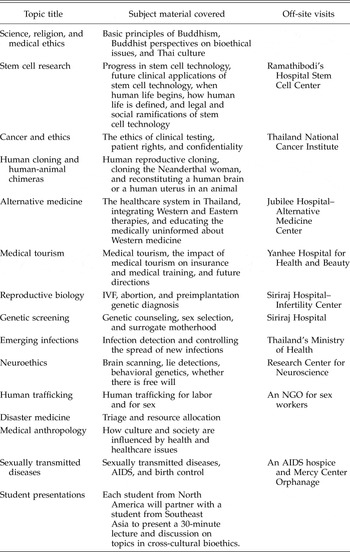
In this seminar-style course, students examine two basic categories of topics (see Table 1). First, they look at how emerging biotechnologies (such as human cloning, transgenic technologies, new reproductive technologies, genomics, and proteomics) will impact bioethical principles. The second topic focuses on issues related to disaster medicine. Students engage in discussions, debates, and role playing, enabling them to better analyze and resolve bioethical dilemmas.
Topics Covered in BioCEP

Educational Methodologies
One of the innovative features of BioCEP is its multidimensional educational approach. First, BioCEP allows students from diverse cultural backgrounds to explore together bioethical issues. Second, this program has a laboratory-style component in which students visit off-site centers to experience or observe actual situations in which bioethical challenges emerge.
As in most courses, BioCEP includes 40-minute lectures given by experts in their fields followed by at least equal time in which students can ask questions or engage in other educational forums. BioCEP also utilizes class debates to encourage students to think creatively and to try to resolve a contentious bioethical or medical ethical dilemma. In the debates, students must be prepared to defend any position. Analysis of actual case studies is another platform used in which the class as a whole must discuss the bioethical issues and attempt to arrive at a consensus practical solution to the bioethical challenges raised. Role playing is another method to stimulate student interest and creativity. Applying theatrical platforms to science education has been successfully used as a vehicle for introducing ethical, cultural, and social issues to academic, professional, and community audiences.Footnote 27 In this platform, audience members act out various characters related to a bioethical situation. Gestational surrogacy is one example. Two female students and one male student act as potential surrogates, and the class interviews them about their attitudes regarding bioethical, social, legal, and financial issues in order to decide who they would choose to carry their child. Role playing has been highly effective, as it has a sense of immediacy, a compelling aspect engaging the listeners and actors to focus, and to think creatively.
A distinguishing component of BioCEP is its off-site field visits, which occupy between 30 and 40 percent of the students’ time. Students are taken to various private and public hospitals, NGOs, and clinics to examine real-life situations in which culture and religion influence bioethical issues. Before each visit, students are asked what they expect to see and to identify the ethical issues that they expect will emerge from their visits. After the visits, students express their views regarding how these centers or organizations dealt with the bioethical or medical ethical issues that they faced. For example, after a lecture on human trafficking, students visited an NGO community center that services sex workers. Before the visit, the students envisioned that the NGO would offer programs to help those workers who wanted to leave the sex trade industry, or to provide comprehensive education on sexually transmitted diseases, or to distribute condoms, free of charge. After their visit with the head of the NGO and several sex workers, the students reflected on what they observed. This NGO did provide free condoms to the sex workers, as expected, but most of their programs centered on teaching the workers English or Japanese and pole dancing to improve their income in the sex trade industry. This NGO did provide classes in art, music, the basic use of computers and the Internet, but the objectives in providing these classes were never defined. Although sex workers coming to the community center had the opportunity to chat with one another or with a counselor, it was unclear whether these counselors were appropriately trained to deal with the problems that sex workers face.
Outcomes
At the end of BioCEP, students are required to fill out an anonymous evaluation form and to submit a five-page paper to the Columbia Journal of Bioethics. Topics for their paper focus on cross-cultural aspects of bioethics or medical ethics. Typically, only 20 percent of the papers submitted are accepted by this peer-reviewed journal. The other outcomes of this innovative program are designed to influence both students and faculty. For example, faculty from the United States and Thailand gain important insights into how each culture and government attempts to resolve challenging bioethical issues. Faculty members also share educational experiences in bioethics course curriculum development. Furthermore, several clinics began to adopt Western bioethical standards, such as improving their informed consent process and encouraging patients to make autonomous decisions concerning their healthcare options. Student outcomes go beyond classical classroom-based education. BioCEP fosters experience in real-life situations, creative thinking, and conflict resolution, all of which are essential components in cultivating the next generation of leaders graduating from American and international universities in the developing world. The tremendous value of an international presence and cross-cultural exchange is rarely realized to its fullest extent in bioethics. Sharing knowledge across cultures builds bridges and promotes communication between diverse societies.
Finally, the peer bonding and respect that develop between students and faculty participating in BioCEP are some of the most important outcomes. In a world in which so much strife and conflict occurs as a result of religious and cultural differences, participants in BioCEP are able to gain an understanding of the commonalities of cultures and religions. In addition, bioethical discussions foster human bonds and collegiality that can be instrumental in averting conflict. Getting to know more personally those on multiple sides of issues was one of four goals recognized as critical to dialogue on contentious issues in an ethics discussion and debate at Princeton University on the polarizing issue of abortion.Footnote 28 Participating in BioCEP builds these types of friendships and academic bridges. The importance of humanities in the medical science curriculum is increasingly recognized.Footnote 29 Programs such as BioCEP that incorporate humanitarian aspects reinforce the social responsibility that should be inherent in medical and science education.