





Numerous epidemiological studies have reported markedly elevated mortality among people receiving psychiatric care. This excess mortality is most consistently observed in patients with schizophrenia spectrum disorders and bipolar disorder, where standardised mortality ratios (SMRs) are typically in the range of 2–3 and life expectancy is reduced by approximately 15–20 years. Reference Walker, McGee and Druss1,Reference Hjorthøj, Stürup, McGrath and Nordentoft2 Premature death in these conditions is predominantly driven by long-term physical illness, including cardiovascular, respiratory, metabolic disorders and cancer. Reference Correll, Solmi, Veronese, Bortolato, Rosson and Santonastaso3 From a psychiatric perspective, these illnesses are characterised by recurrent episodes, impaired capacity for self-care during exacerbations and a need for sustained medical management, including pharmacological treatment, and periods of compulsory care. As a result, they represent a clinically coherent group with well-established and reproducible population-level mortality gradients, and a substantial but often under-recognised burden of preventable premature death. Reference Walker, McGee and Druss1
In parallel, drug-related mortality has emerged as a major and explicitly prioritised public health issue in Scotland. Reference Parkinson, Minton, Lewsey, Bouttell and McCartney4 Deaths associated with substance use are widely recognised, systematically monitored and the focus of targeted national strategies. A substantial proportion of mortality among patients presenting with crisis-driven or substance-related conditions falls within this domain. This represents a distinct pattern of risk from that observed in schizophrenia and bipolar disorder, where drug-related deaths are relatively uncommon and excess mortality is predominantly driven by chronic physical illness and health inequity. Conflating these sources of excess mortality risks obscuring the scale of the problem in severe and enduring psychiatric illness and misdirecting service and policy responses.
A recent national Scottish study by Fleetwood and colleagues examined life expectancy trends using a severe mental illness (SMI) framework combining schizophrenia, bipolar disorder and the full depressive disorder ICD range (F32–F33). Reference Fleetwood, Alotaibi, Scheuer, Smith, Wild and Jackson5 This heterogeneity complicates interpretation, as outcome differences may reflect diagnostic composition rather than underlying clinical trajectories.
We therefore retain this general framework but apply a more consistent definition to identify a group with comparable clinical course and health-system needs. This approach aligns with National Health Service (NHS) and national epidemiological practice; for example, NHS England defines SMI as schizophrenia/psychosis and bipolar disorder for physical health monitoring, 6 and the Quality and Outcomes Framework (QOF) register includes psychosis, schizophrenia and bipolar disorder. 7 We additionally include severe unipolar depression (e.g. psychotic depression requiring electroconvulsive therapy (ECT)) for clinical and conceptual completeness. Accordingly, we use the term severe and enduring psychiatric illness (SEPI), reflecting a clinically coherent group with established population-level outcome gradients. Reference Kendell8
From a clinical and health-system perspective, the SEPI construct identifies a trajectory characterised by recurrent illness episodes, impaired capacity during exacerbations and a requirement for sustained medical management. Conditions such as schizophrenia, bipolar I disorder and severe unipolar depression with melancholic or psychotic features have well-established medical treatment evidence, Reference Zhao, Lin, Teng, Khoo, Soh and Furukawa9–Reference Rhee, Shim, Nasir, McIntyre, Kaster and Wilkinson12 and are frequently associated with structured in-patient care, including use of the Mental Health Act. These features define a trajectory of enduring illness with sustained medical responsibility and high cumulative utilisation of in-patient resources.
In contrast, a substantial proportion of presentations to general psychiatric services arise from conditions outside the SEPI category, including ‘personality’-related conditions, substance-use disorders and situational or crisis-driven presentations. These are typically managed through brief, episodic contacts, with greater emphasis on psychological, social and harm-reduction approaches. Sustained compulsory treatment is limited: for example, detention for primary substance-use disorders is not permitted under the Mental Health Act, and prolonged in-patient care is uncommon. Within this broader trauma-related, stressor-related and substance-use (TSRS group, emotional intensity disorder (EID; or borderline personality disorder) represents a recognised subgroup characterised by recurrent crises and repeated but typically brief admissions. Reference Hayward, Fourie, MacIntyre and Steele13,Reference Paris14
Despite these distinctions, both groups are managed within a single undifferentiated general adult psychiatry (GAP) service, and no study has directly compared their service utilisation and mortality within the same system. We hypothesised that the GAP in-patient population comprised at least these two distinct clinical trajectories: SEPI and TSRS. Specifically, (a) the groups differ in patterns of service utilisation, including age distribution, number of admissions and cumulative in-patient bed utilisation; and (b) the groups differ in mortality outcomes, including overall mortality rates, age at death, annual mortality hazards, SMRs, years of life lost and projected survival trajectories.
Method
Ethics (ref 26-EMREC-028) and Caldicott (ref 24221) approvals were obtained.
Data processing and cohort construction
Lothian Analytical Services extracted from the NHS Lothian electronic health record (TRAK) the initial data-set which comprised 5204 longitudinal in-patient episodes representing all admissions between April 2016 and December 2024 to a specific NHS GAP service (St John’s Hospital, Livingston; a district general hospital with a 22-bed GAP ward, a 10-bed intensive psychiatric care ward and an alternative to hospital and home treatment team, serving a Scottish central belt urban population of about 57 000 and a surrounding more rural population of about 125 000). April 2016 was selected as the entry date because this was when the QOF financial incentives for general practitioners (GPs) to register and monitor physical comorbidities in people with SEPI in the community were withdrawn in Scotland; Reference Steele, Hayward and MacIntyre15 a change that is likely to have impacted the quality of care.
To facilitate patient-level survival and bed utilisation analyses, each admission episode was examined, then individual admission and discharge dates were aggregated to determine the total duration of hospital contact and the frequency of readmissions for each individual over the study window.
Definition of diagnostic groups
SEPI group
The study utilised a specific, reproducible case definition for SEPI, derived from ICD-11 16 and equivalent ICD-10 17 codes. SEPI is defined as an operational, epidemiological construct for mortality and health-services analysis, aligned with national NHS frameworks. It is anchored to conditions with well-established population-level mortality gradients and corresponds to illnesses most consistently managed within a medical treatment framework, characterised by a strong pharmacological evidence base, a recurrent and enduring illness course and use of compulsory treatment where required. Severe therefore refers to the severity of outcomes: premature mortality and long-term disability at a level commonly resulting in eligibility for state disability financial support, not just subjective distress. This definition is consistent with standard NHS constructs (psychosis and bipolar disorder) and explicitly includes severe unipolar depression with psychosis.
-
(a) Schizophrenia and schizoaffective disorder: schizophrenia (6A20/F20.x) and schizoaffective disorder (6A21/F25.x), affecting approximately 1% of the population.
-
(b) Severe bipolar illness: bipolar I mania and depression, with or without psychotic symptoms (6A60.0, 6A60.1, 6A60.5, 6A60.6 / F30.1, F30.2, F31.1, F31.2, F31.4, F31.5), affecting approximately 0.5% of the population.
-
(c) Severe unipolar illness: single or recurrent episodes identified as severe, with or without psychotic symptoms (6A70.3, 6A71.3, 6A70.4, 6A71.4/F32.2, F33.2, F32.3, F33.3), affecting approximately 1.5% of the population.
To ensure a unique classification for each patient, a diagnostic hierarchy was applied in cases of multiple recorded codes, prioritising schizophrenia over bipolar illness, and bipolar illness over unipolar illness. This classification system mirrors the standardised ICD code lists used to classify drug-related deaths. This is also the convention used in the national Scottish SMI cohort, Reference Fleetwood, Alotaibi, Scheuer, Smith, Wild and Jackson5 in which people with a record of more than one severe psychiatric illness were assigned to their most severe condition. The hierarchy applied to 18 of the 771 SEPI patients (2.3%), of whom 16 were assigned to the schizophrenia spectrum group. Pooled SEPI estimates do not depend on the ordering, and reversing the precedence shifts each subtype SMR by less than 0.21 (Supplementary Table S2 available at https://doi.org/10.1192/bjo.2026.12139).
TSRS group
Patients who did not meet the SEPI criteria were classified within the TSRS group. In contrast to SEPI, sustained compulsory treatment is not a feature of TSRS management: detention for primary substance-use disorders is not permitted under the Mental Health Act and long-acting depot medication is not a standard component of care. The TSRS group was further partitioned into two subgroups, as differing patterns of service use have been reported in EID/BPD:
-
(a) Emotional intensity disorder/borderline personality disorder (EID/BPD): identified by specific ICD codes for ‘personality’-related vulnerabilities (6D10-11/F60.3). These codes are the ICD-11 and ICD-10 classifications for personality disorder, so EID is operationalised directly from routine diagnostic coding rather than as a local construct.
-
(b) Non-psychotic mood, stress-related and substance-use (NMSU): a heterogeneous group comprising patients with mood, stress-related or substance-use conditions that did not meet the severity or diagnostic thresholds for SEPI or the criteria for EID/BPD.
Analysis of service utilisation
To assess the burden of in-patient care across clinical trajectories, cumulative bed occupancy and admission frequency were calculated for each patient. Total in-patient duration was determined by aggregating the number of nights spent in hospital across all recorded episodes within the study window (2016–2024). Service utilisation was compared between the SEPI and TSRS groups, with the latter further stratified into EID/BPD and NMSU to examine heterogeneity. Differences in median bed-days and admission counts between groups were evaluated using non-parametric Wilcoxon rank-sum tests, given the anticipated right-skew of the utilisation data.
Mortality and survival analysis
Mortality rates were calculated using person-years at risk. Admissions were included from April 2016 to December 2024, with mortality follow-up continuing to censoring on 27 January 2026; each patient contributed follow-up time from first admission until death or administrative censoring at that date. Follow-up time was partitioned into one-year intervals, and mortality hazards were estimated as deaths per person-year.
Comparative mortality between SEPI and TSRS groups was assessed by calculating group-specific mortality rates and applying a likelihood ratio test under the null hypothesis of equal rates. Differences in age at death were evaluated using non-parametric Mann–Whitney U tests, with bootstrap resampling (B = 10 000) used to estimate 95% confidence intervals for median differences.
SMRs were calculated by dividing observed deaths by expected deaths, derived from age-, sex- and calendar year–specific Scottish population mortality rates. 18
SMRs were estimated for the overall cohort and stratified by clinical trajectory and calendar year, with 95% confidence intervals calculated to assess excess mortality. 18
Time-to-event analyses were conducted using Kaplan–Meier methods with left truncation, such that patients entered the risk set at the later of 1 January 2016 or their first admission. Survival time was measured in days until death or censoring. To characterise sustained mortality risk, annual hazards were estimated from first admission and averaged over the first five years of follow-up. These were used to construct cumulative risk estimates under a constant-hazard assumption and compared with age-matched population mortality to derive hazard ratio approximations. Mortality rates were additionally stratified by admission period to compare pre-COVID-19 and COVID-19/post-COVID-19 outcomes. In a sensitivity analysis, follow-up time rather than patients was split at 1 March 2020, so that patients under observation across the cut-off date contributed person-time to both periods.
Years of Life Lost (YLL) were calculated using a reference age of 80 years, with observed YLL compared with expected YLL derived from population mortality rates. Excess YLL was defined as the difference between observed and expected values. As a supplementary analysis, YLL was also estimated by assigning each death the age-, sex- and period-specific remaining life expectancy from the Scottish National Life Tables (NLTS), 18 without truncation at a fixed age. Expected YLL was derived as the sum of person-years age-sex-period mortality rate remaining life expectancy, consistent with the SMR methodology. Confidence intervals for YLL were obtained by non-parametric bootstrap over the 270 observed deaths (10 000 resamples, percentile method), with expected YLL treated as fixed. Life expectancy projections from age 20 were modelled using a hazard multiplier consistent with the observed SMR, with survival to age 65 also estimated.
All analyses were conducted in R version 4.5.0 for Windows (R Foundation for Statistical Computing, Vienna, Austria), using the survival package (version 3.8-3, r-project.org) for survival and time-to-event analyses; dplyr, tidyr, readr, lubridate, stringr, readxl, MASS and ggplot2 for data handling and graphics; and base functions for the SMR and YLL calculations.
Results
Data processing and cohort construction
Following aggregation of 5204 in-patient episodes, the final study population comprised 2665 unique patients. TSRS presentations accounted for 71.1% of the cohort (n = 1894), including EID/BPD (n = 235) and other TSRS presentations (n = 1659). The remaining 28.9% (n = 771) met criteria for SEPI, comprising schizophrenia spectrum disorders, bipolar disorder and severe unipolar depression with psychotic or melancholic features.
Analysis of service utilisation
SEPI patients represented 28.9% of the cohort but accounted for 69.3% of total in-patient bed occupancy. Median cumulative length of stay was 49 nights for SEPI compared with nine nights for TSRS (Wilcoxon rank-sum test: W = 1 158 128, p < 0.001). Admission frequency was higher in SEPI (mean 2.09 admissions per patient) than TSRS (mean 1.54; Wilcoxon rank-sum test: W = 870 823, p < 0.001). Within the TSRS group, EID/BPD patients had the highest admission frequency (mean 3.26 admissions per patient), compared with 2.09 for SEPI and 1.29 for NMSU. Median cumulative in-patient stay for EID/BPD was 14 nights, compared with 49 nights for SEPI and 8 nights for NMSU. Differences between EID/BPD and NMSU were statistically significant (Wilcoxon rank-sum test, p < 0.001).
Mortality and survival analysis
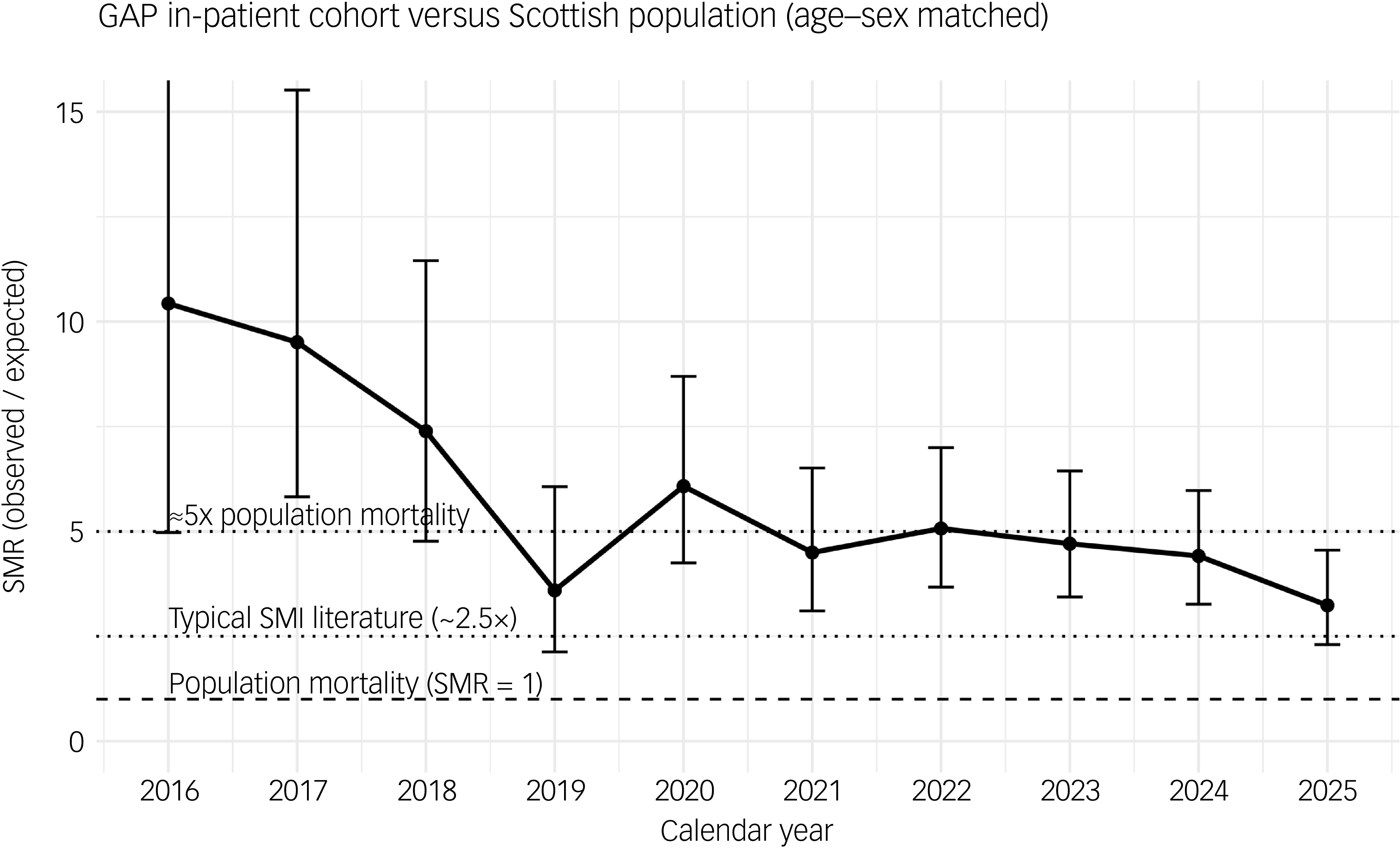
Mortality across the GAP in-patient cohort was markedly elevated compared with the general population. Between 2016 and data extraction (January 2026), 270 deaths were observed versus 55.4 expected based on age- and sex-matched Scottish population rates, corresponding to an SMR of 4.87 (95% CI 4.32–5.49). This indicates 4.87-fold excess mortality following in-patient admission (Fig. 1), corresponding to an annual mortality risk of approximately 2% and a cumulative five-year risk of around 9–10%, compared with approximately 0.4% per year in the age-sex matched general population, and exceeding the SMR of 2–3 commonly reported in the literature. Reference Walker, McGee and Druss1,Reference Hjorthøj, Stürup, McGrath and Nordentoft2 Analysis by calendar year showed persistently elevated mortality throughout the study period, with the highest SMR observed early in the window (2016: 10.4; 2017: 9.51), declining but remaining markedly elevated in 2025 (SMR 3.24; 95% CI 2.30–4.55), see Fig. 1. Kaplan–Meier analysis demonstrated broadly similar overall survival trajectories between SEPI and TSRS, with temporal divergence over follow-up; Cox proportional hazards modelling indicated a higher mortality hazard within the observation window for SEPI compared with TSRS (hazard ratio 1.42; 95% CI 1.09–1.85; p = 0.010), attenuating to 1.16 (95% CI 0.89–1.52; p = 0.281) on adjustment for age at entry, Fig. 2.
Standardised mortality ratios (SMRs) by calendar year for the general adult psychiatry (GAP) in-patient cohort (2016–2025). Observed deaths within the cohort were compared against expected deaths derived from age, sex and calendar year matched Scottish population mortality rates. The solid black line represents the annual SMR, with error bars indicating 95% CI. Horizontal reference lines denote baseline general population mortality (SMR = 1), typical excess mortality reported in severe mental illness (SMI) literature (SMR ≈ 2.5) and a 4.87-fold excess (SMR = 4.87). Peak mortality was observed early in the study window (2016 SMR: 10.4) and, although declining, remained markedly elevated at the end of the follow-up period (2025 SMR: 3.24).

Left-truncated Kaplan–Meier (KM) survival estimates for severe and enduring psychiatric illness (SEPI) versus trauma, stressor-related and substance use (TSRS) presentations. Survival probability is shown in days from 1 January 2016. Patients entered the risk set at the later of 1 January 2016 or their first admission to account for left truncation. The solid black line represents the SEPI trajectory, and the dashed red line represents the TSRS trajectory. While overall survival trajectories were broadly similar, the TSRS hazard was higher initially, whereas the SEPI hazard became higher later in the follow-up period. Over the entire observation window, Cox proportional hazards modelling indicated an overall higher mortality hazard for SEPI compared with TSRS (hazard ratio 1.42; 95% CI 1.09–1.85; p = 0.010).

Comparison between clinical trajectories
Cumulative mortality was higher in SEPI (13.5%) than TSRS (8.8%), a 53% relative increase. However, when differences in follow-up time and age at risk were taken into account, the estimated mortality rate was 0.030 per person-year for SEPI (mean follow-up 3.32 years) and 0.035 for TSRS (mean follow-up 2.86 years), with no statistically significant difference (likelihood ratio test: likelihood ratio 1.395, p = 0.23). SMRs were also comparable (SEPI: 4.91 (95% CI 4.05–5.95); TSRS: 4.85 (95% CI 4.16–5.64)). It is important to note that these adjusted analyses remove core features of the SEPI trajectory (namely older age and enduring illness) and therefore do not represent equivalent clinical processes between groups. In SEPI, age is not an independent variable but a direct expression of disease chronicity: a patient aged 50 with SEPI is older because they have lived with the condition for approximately 30 years. The SMR captures excess mortality relative to a contemporaneous age-matched population, but not the cumulative lifetime burden of a condition that is by definition enduring.
Mortality characteristics and context
Most deaths occurred outside the in-patient setting, with only 1.5% occurring during GAP admission and 98.5% occurring in the community or other healthcare settings. EID/BPD patients were more likely than SEPI patients to die in the community (odds ratio ≈ 3.75, p = 0.043). Among cases with a confirmed cause of death (61.5%), 59% were due to internal medical or surgical causes and 41% to external causes such as accidents or suicide. Stratification by admission period showed persistent excess mortality across the study window, with an apparent modest increase in mortality following the COVID-19 pandemic (rate ratio 1.29; hazard 0.0239 v. 0.0186). That figure compares admission cohorts with follow-up truncated at five years; on a calendar-time split of follow-up at 1 March 2020 the ratio was 0.86 (95% CI 0.65–1.16). The excess was in fact greater before the pandemic than after it (pre-COVID-19 SMR 6.61, 95% CI 5.17–8.44; during and after 4.51, 95% CI 3.93–5.17), indicating that the overall SMR of 4.87 is not an artefact of the pandemic period (Supplementary Table S1).
Burden of premature mortality
The cohort experienced a substantial burden of premature mortality, with 8206 observed YLL (95% CI 7761–8650) compared with 1372 expected (6834 excess years; 95% CI 6389–7278); mean YLL per death was 30.4 years (95% CI 28.7–32.0) versus 24.8 in the general population. Mean YLL per death was higher in TSRS (32.1 years; 95% CI 30.0–34.2) than SEPI (27.6 years; 95% CI 25.2–30.1), a difference of 4.5 years (95% CI 1.3–7.8), reflecting earlier age at death in TSRS, particularly within EID/BPD. Using NLTS remaining life expectancy rather than a fixed cut-off of 80 years, observed YLL was 8798 years (expected 1512; excess 7286), mean 32.6 years per death (95% CI 31.2–34.1; SEPI 29.8; TSRS 34.3), consistent with the fixed-cut-off approach but modestly higher as deaths above age 80 contributed remaining expected years (Supplementary Table S3). Life expectancy projections from age 20, 18 based on the observed mortality hazard, indicated a reduction from 59.8 to 42.2 years, corresponding to a loss of 17.6 years. The probability of survival to age 65 was reduced from 0.859 in the general population to 0.473 in the cohort. Among those reaching age 65, remaining life expectancy was reduced by approximately 10 years for both males and females.
Internal consistency of mortality estimates
The multiple approaches used to quantify mortality yielded internally consistent results: the observed SMR of 4.87, annual hazard of ∼2%, five-year cumulative risk of ∼10%, life expectancy reduction of 17.6 years and both YLL estimates converge on a coherent quantitative description of substantially elevated and persistent mortality risk.
Discussion
The aim of this study was to characterise patterns of in-patient service use to evaluate whether clinically distinct patient groups are appropriately managed within undifferentiated GAP wards. We hypothesised that patients with SEPI would differ from TSRS presentations in both patterns of in-patient utilisation and mortality outcomes.
In this longitudinal cohort of 2665 patients contributing 5204 in-patient episodes between 2016 and 2024, two main findings emerged. First, patterns of service utilisation differed markedly: although SEPI patients comprised approximately 29% of the cohort, they accounted for nearly 70% of total in-patient bed occupancy and had longer and more recurrent admissions. Second, despite these differences, excess mortality was similar across trajectories, with both SEPI and TSRS groups showing markedly elevated mortality relative to the general population (SMR 4.87). These findings indicate that distinct clinical trajectories are associated with contrasting service demands but a comparable long-term risk of premature death.
Drug-related mortality is already a major and explicitly prioritised public health issue in Scotland, Reference Parkinson, Minton, Lewsey, Bouttell and McCartney4 and a substantial proportion of TSRS mortality falls within this recognised domain. In contrast, drug-related deaths are relatively uncommon within SEPI, where excess mortality is predominantly driven by long-term physical illness and health inequity. SEPI-associated mortality therefore represents a distinct and comparatively under-recognised public health problem. Conflating these sources of excess mortality risks obscuring the scale of the SEPI burden and misdirecting service responses.
The concentration of in-patient bed utilisation within SEPI is consistent with its clinical course, which necessitates prolonged or repeated hospital treatment during relapse. The TSRS trajectory by contrast is characterised by brief, episodic admissions during acute crises, indicating that the in-patient system is accommodating two structurally different types of demand within the same service framework. Within TSRS, the EID/BPD subgroup shows a distinctive pattern of high admission frequency with relatively short lengths of stay (mean 3.26 admissions per patient against 2.09 in SEPI and 1.29 in NMSU, with median cumulative stays of 14 nights against 49 in SEPI). This pattern is consistent with recurrent crisis presentations rather than prolonged in-patient treatment. Recommended interventions, such as multimodal psychological therapies, are not readily delivered within short admissions and do not require in-patient infrastructure. 19 The demand generated by this subgroup therefore falls on the assessment and crisis interface rather than on bed capacity, the inverse of the SEPI pattern in which a minority of patients account for 69.3% of bed occupancy. Mortality in this subgroup is also largely a community phenomenon: 98.5% of deaths occurred outside the in-patient setting, EID/BPD patients were more likely than SEPI patients to die in the community and death occurred at younger ages. Repeated brief admission addresses the acute crisis but leaves the distribution of risk substantially unchanged, suggesting that capacity for this group is better placed in continuity-based psychological and harm-reduction provision, with brief admission reserved for crisis management.
Cumulative mortality was higher in SEPI (13.5%) than TSRS (8.8%), a 53% relative increase, reflecting older age and enduring illness in the former group. When adjusted for these factors though, mortality across the entire GAP cohort was markedly elevated relative to the general population, with a 4.87-fold excess (SMR 4.87). This level of excess mortality is higher than the SMR of 2–3 commonly reported in the literature Reference Walker, McGee and Druss1,Reference Hjorthøj, Stürup, McGrath and Nordentoft2 and is more consistent with the observed reduction in life expectancy of 15–20 years Reference Walker, McGee and Druss1,Reference Hjorthøj, Stürup, McGrath and Nordentoft2 when considered under a sustained hazard model (e.g. Gompertz).
The apparent contradiction between the Cox model and the age-adjusted comparison is definitional rather than substantive: the SMR is a conditional, contemporaneous ratio against same-aged peers, whereas the Cox model is fitted on follow-up time and is not age-adjusted. Adding age at entry reduces the hazard ratio from 1.42 to 1.16 (95% CI 0.89–1.52, p = 0.281), and adding sex gives 1.13 (95% CI 0.86–1.47), so the excess hazard in SEPI is largely attributable to older age at entry. Because SEPI is defined as enduring, age here incorporates duration of illness and acts partly as a component of the exposure rather than as an extraneous confounder. The proportional hazards assumption is only marginally satisfied (p = 0.075), so the single hazard ratio is best read as an average over the observation window. However, a similar adjusted SMR across groups does not imply equivalent mortality burden across the lifespan. Longitudinal studies indicate that a substantial proportion of patients with BPD/EID no longer meet diagnostic criteria 10–15 years after initial presentation, Reference Zanarini, Frankenburg, Hennen and Silk20 with symptomatic remission being both common and often sustained; Reference Zanarini, Frankenburg, Reich and Fitzmaurice21 accordingly, excess mortality risk is likely to be concentrated in earlier phases of illness and attenuate with remission. SEPI, by contrast, imposes a sustained elevated hazard throughout life. The crude mortality difference (13.5 v. 8.8%) and the higher mean YLL per death in TSRS (32.1 v. 27.6 years), reflecting younger age at death in TSRS, together indicate structurally different mortality trajectories: front-loaded and potentially remitting in TSRS, sustained and cumulative in SEPI.
The effects of medical treatments on SEPI all-cause mortality are notable. In a study of 62 250 patients with schizophrenia followed for up to 20 years, antipsychotic use was associated with lower all-cause mortality compared with non-use (aHR ≈0.48). Reference Taipale, Tanskanen, Mehtälä, Vattulainen, Correll and Tiihonen10 In a study of 25 787 patients with bipolar illness, lithium treatment was associated with reduced all-cause mortality (aHR ≈0.38). Reference Chen, Tsai, Chen, Pan, Su and Chen11 In a meta-analysis of 17 longitudinal cohorts (>40 000 patients) with severe unipolar depression, ECT was associated with a lower all-cause mortality (pooled hazard ratio ≈0.70). Reference Rhee, Shim, Nasir, McIntyre, Kaster and Wilkinson12 These large effects relate to specific SEPI illnesses. In contrast, antipsychotics are associated with increased mortality in dementia. Reference Wang, Schneeweiss, Avorn, Fischer, Mogun and Solomon22 This implies SEPI-specific medication benefits do not necessarily generalise to TSRS, where the benefit/harm ratio for these treatments may be unfavourable, underscoring the importance of distinguishing between trajectories. Doctors who reduce or withhold these treatments on side-effect grounds for SEPI, unaware of their survival benefits, may inadvertently worsen the very mortality they seek to prevent.
The years of life lost in SEPI (27.6 years per death) is closely aligned with findings from a large US epidemiological study of schizophrenia by Olfson Reference Olfson, Gerhard, Huang, Crystal and Stroup23 which reported a mean of 28.5 years of potential life lost per death. This concordance is notable given that the present estimate is not restricted to schizophrenia but reflects the broader SEPI construct. Notably, the TSRS group showed a higher mean YLL (32.1 years per death). These findings therefore replicate prior large-scale estimates in a diagnostically comparable international population and extend them to a broader GAP cohort.
Although SMRs have historically been reported in the range of 2–3, more recent studies have found values comparable to the SMR of 4.87 observed here: a Danish study of 38 500 patients with schizophrenia and 23 092 with bipolar disorder (4.58), Reference Lomholt, Andersen, Sejrsgaard-Jacobsen, Øzdemir, Graff and Schjerning24 a 5-year follow-up of 99 214 patients with schizophrenia in China (4.98), Reference Ren, Duan, Wang, Sun, Wang and Geng25 a 6-year Norwegian study of 125 744 patients with schizophrenia (4.9) Reference Heiberg, Jacobsen, Nesvåg, Bramness, Reichborn-Kjennerud and Næss26 and a 6-year Netherlands study of patients with severe psychiatric illness (4.51). Reference de Mooij, Kikkert, Theunissen, Beekman, de Haan and Duurkoop27 As in the present study, these large independent studies focused on severe illness rather than using broader diagnostic definitions, suggesting diagnostic inflation Reference Frances28 causes SMR deflation. Our findings extend previous work by showing an SMR of similar magnitude (4.87) applies to SEPI and TSRS.
The timing of death differed between clinical trajectories, with SEPI patients dying later on average than those in the TSRS group, with particularly early mortality observed in the EID/BPD subgroup. These differences are consistent with distinct underlying mechanisms: long-term physical illness and health inequity in SEPI, and a higher proportion of external acute causes of death in TSRS. Cause of death was confirmed in only 61.5% of cases, and that incompleteness is unlikely to be random, so we do not attempt a cardiovascular versus respiratory split from these data. The established literature indicates that premature death in schizophrenia spectrum and bipolar disorder is predominantly attributable to long-term physical illness, with cardiometabolic disease the largest single contributor, followed by respiratory disease and then cancer. Reference Correll, Solmi, Veronese, Bortolato, Rosson and Santonastaso3 An important observation is that only a small minority of deaths occurred during GAP in-patient admission, with the vast majority occurring in the community or other healthcare settings. This indicates that excess mortality associated with psychiatric illness is primarily a community phenomenon rather than a function of in-patient care, reinforcing the importance of sustained physical health management beyond periods of admission, for both SEPI and TSRS.
Continuity of GP care can reduce all-cause mortality by 25% Reference Sandvik, Hetlevik, Blinkenberg and Hunskaar29 but this has been declining in the UK, falling from approximately 13 consultations per year to around 3 by 2012. Reference Lester30 Following QoF withdrawal in Scotland in 2016, Reference Steele, Hayward and MacIntyre15 we observed in a follow-up of 231 SEPI out-patients from the same cohort, that only around half reported any GP contact in the past year, and fewer than 40% could recall any discussion with their GP practice about physical health. Given the high prevalence of metabolic risk factors, reduced primary care engagement likely contributes to the observed excess mortality.
These distinct mortality pathways are frequently obscured when heterogeneous patient groups are analysed together. Effective prevention requires trajectory-specific approaches: sustained medical treatment and continuity of care for SEPI, and interventions targeting acute risk, crisis stabilisation and harm reduction for TSRS.
Limitations
Several limitations should be considered when interpreting these findings. First, the analysis was conducted within a single NHS service which, although representing a diverse and broadly typical region, may limit generalisability to other settings. Second, although the data-set included comprehensive information on admissions and mortality, analyses were restricted to variables available within the administrative data-set and did not include detailed information on comorbidities or other clinical factors such as smoking status or body mass index, so the contribution of metabolic and lifestyle factors to the observed excess mortality cannot be isolated. Detailed medical characterisation of general adult psychiatry populations is rare, and we intend to address this in further work. Third, although mortality outcomes were robustly captured, cause-of-death data were incomplete for a proportion of cases due to ongoing Procurator Fiscal investigations, with ‘undetermined, awaiting investigation’ frequently recorded on death certificates. This limited the ability to fully characterise differences in mortality mechanisms between clinical trajectories. The incompleteness is also unlikely to be random with respect to trajectory, since referral to the Procurator Fiscal is triggered by sudden, unexplained or potentially unnatural death, whereas death from long-term physical illness is usually certified without referral. Cause was undetermined or awaiting investigation in 31.7% of SEPI deaths (33 of 104), 42.8% of TSRS deaths (71 of 166) and 47.6% of EID/BPD deaths (10 of 21); this gradient does not reach conventional significance (Fisher exact p = 0.074). The observed distribution of 59% internal medical or surgical and 41% external causes therefore probably understates the external-cause contribution in TSRS, and the mechanistic contrast between the trajectories is inferred rather than established.
In conclusion, general adult psychiatry in-patient populations comprise at least two distinct clinical trajectories with contrasting service demands but similarly elevated mortality. Most deaths occur outside in-patient settings, and reduced engagement with primary care likely contributes to this excess. The withdrawal of QOF incentives for physical health monitoring in Scotland in April 2016, which coincides with our study entry point, is a plausible contributor and, unlike age or illness duration, is directly modifiable. The present design cannot attribute a specific share of the excess mortality to it, but systematic physical health review in primary care remains the most tractable of the available interventions. Current services accommodate structurally different clinical demands within a single model that is unlikely to be optimal for either trajectory.
Supplementary material
The supplementary material is available online at https://doi.org/10.1192/bjo.2026.12139
Data availability
Materials supporting the findings are available from the corresponding author upon reasonable request.
Acknowledgement
We would like to thank Ms Daniela Ene, Information Analyst, Lothian Analytical Services. No artificial intelligence tools were used in the research or writing process for this paper.
Author contributions
D.S. conceived the study, conducted the majority of the statistical analyses and drafted the manuscript with D.H. D.H., J.H. and H.J. collected the data and undertook an initial appraisal. D.H., J.H., H.J., D.M. and D.S. contributed to revising the final manuscript.
Funding
This work received no specific grant from any funding agency, commercial or not-for-profit sectors.
Declaration of interest
None.


 Open access


eLetters
No eLetters have been published for this article.