Transhepatic access is an alternative strategy when problems arise with frequently used venous pathways for cardiac catheterisation. Transhepatic access can be used in cases of inferior caval vein obstruction, iliac vein thrombosis, long-term use of a central catheter, or when other venous pathways must be preserved for later access.Reference Ebeid 1 , Reference Qureshi, Prieto, Bradley-Skelton and Latson 2 There are no reports about its usefulness to retrieve foreign bodies from the heart.
Case
A 13-year-old girl was admitted with severe burns from a bomb that landed on her house during the war in Syria. The patient stayed in the burn ICU for ∼3 months. She had burn-related scars, limb deformities, and in the last 10 days developed dyspnoea and orthopnoea. A chest X-ray revealed a long guide wire from the superior caval vein below the level of the azygos vein to the iliac vein with a loop from the right atrium to the right ventricle. A diffuse pulmonary embolism was observed in both lungs of the patient by computed tomographic scan. Echocardiography revealed thrombi of varying sizes in addition to the guide wire inside the heart. Vascular access was obtained via a silastic catheter through the brachial vein, and plastic surgeons performed multiple skin grafts and tissue debridement operations.
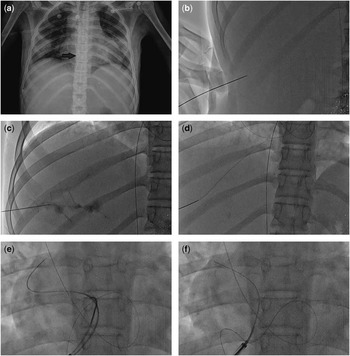
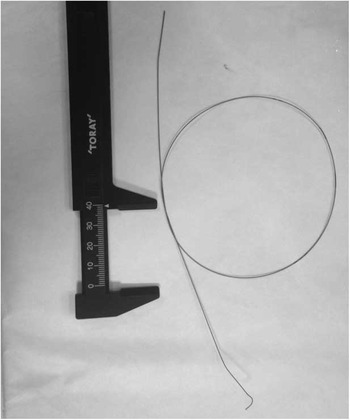
We decided to remove the foreign body in the heart via cardiac catheterisation, followed by continued intravenous anticoagulant treatment. There was a diffuse scar and granulation tissue that spread across her entire body, especially to her limbs. Her skin was drier and rougher than normal, and she had scars from graft replacement surgery on her neck. The right femoral vein was punctured, but the guide wire could not be advanced. The left femoral vein, the left and right subclavian veins, and the right and left internal jugular veins of the patient were punctured. Manual contrast medium injections revealed that the entire venous system was thrombosed and tortuous, and collateral circulation developed at these sites. The attempts at peripheral access were terminated, and transhepatic access was planned for the patient. The peripheral hepatic vein was sought using a 22-Gauge Chiba needle (Cook, Bloomington, Indiana, United States of America) under the costal margin at the mid-axillary line, aiming towards the left shoulder in the superior–posterior and medial direction. The stylus of the needle was removed after passing the mid-clavicular line followed by insertion of a 5-mL injector with diluted contrast medium. The injector was aspirated to check for blood flow. Portal venous and hepatic vein circulation was identified using frequent injections of a very small amount of contrast material. A floppy 0.014-inch coronary wire was advanced to the heart via the needle when the flow of contrast medium from the inferior caval vein to the right atrium was observed. The needle was retracted and replaced with a 4 Fr sheath. A 0.035-inch standard guide wire was advanced alongside, whereas the coronary wire remained in the sheath, and the 4 Fr sheath was replaced with a 6 Fr sheath. A 5 Fr Judkins right catheter was advanced to the right atrium and the superior caval vein, and a snare catheter was advanced inside the Judkins catheter; however, the superior caval vein end and the iliac end of the guide wire were stuck in the thrombosis, and therefore the wire could not be held. The sheath was replaced by a 9 Fr Flexor Cook long sheath. A 4 Fr Judkins right catheter was advanced into the long sheath. A 0.035-inch Terumo hydrophilic guide wire (Terumo Medical Corporation, Sommerset, New Jersey, United States of America) was advanced under the embolised wire at the right atrium. The snare was advanced using another 4 Fr Judkins right catheter over the embolised wire, and the hydrophilic guide wire was snared just over the embolised wire. Therefore, the embolised wire was trapped between the snare catheter and the hydrophilic guide wire. Both catheter systems were retracted simultaneously, and the embolised guide wire was easily drawn into the long sheath (Fig 1). The total length of the embolised guide wire was 45 cm (Fig 2). The long sheath was retracted, and a 7-mm Amplatzer vascular plug (St. Jude Medical, Plymouth, Minnesota, United States of America) was inserted in the liver parenchyma. The procedure was terminated with a small suture on the skin. Fluoroscopy duration was determined as 20 minutes, and no intra-operative complications occurred. Abdominal ultrasonography on the following day confirmed the absence of intra-peritoneal bleeding and liver haematoma. Laboratory investigations demonstrated that liver function was within normal limits. The patient was closely monitored while receiving intravenous anticoagulant treatment for 45 days. The patient no longer has dyspnoea, and the latest transthoracic echocardiography revealed absence of cardiac thrombi. Her treatment will continue using subcutaneous low molecular weight heparin for 8 months.
( a ) The embolised guide wire is observed in this chest X-ray from the midpoint of the superior caval vein to the iliac vein, with a loop in the heart. ( b ) Entrance to the liver with the Chiba needle. ( c ) The manual contrast medium injection through the Chiba needle reveals the blood flow to the heart with hepatic vein and the portal venous flow spread in the portal area. ( d ) The coronary guide wire inside the Chiba needle is advanced from the hepatic vein to the inferior caval vein and right atrium. ( e and f ) The embolised guide wire (arrow), which is trapped between the two right Judkins catheters and the hydrophilic guide wire, is advanced inside the long sheath.

The embolised long wire of the peripheral central catheter.

Discussion
Surgical approach with removal of the wire and thrombectomy was considered as high risk. Therefore, we preferred a transhepatic retrieval technique. The patient had the risk for intraperitoneal bleeding, requiring relatively large transhepatic sheath and urgent anticoagulation therapy. After the procedure, we usually start with a high-dose anticoagulation medication, but due to massive cardiac and lung thrombosis we put the vascular plug to the tract instead of coils.
Transhepatic access is a reasonable approach for experienced users when other access sites cannot be used.Reference Ebeid 1 , Reference Qureshi, Prieto, Bradley-Skelton and Latson 2 Transhepatic access has been used for secundum atrial septal defect closure, pulmonary balloon dilatation, pulmonary artery stenting, catheter ablation, and some other procedures in the paediatric patient population.Reference Ebeid 1 – Reference Neves, Ferreiro, Fontes and Pedra 4 To our knowledge, the present report is the first for successful retrieval of an intra-cardiac foreign body via hepatic access. There was no free-end of the embolised wire to snare it. Therefore, we thought to snare our hydrophilic wire over the embolised wire. Original and unusual methods, other than the classical lassoing methods such as the one we used in our case, might be necessary during the retrieval of intra-cardiac foreign bodies. We did not identify the details of how this complication occurred, but we observed that the brachial central vein catheter guide wire, which was inserted during admission to the burn ICU, was embolised. We could not determine whether the guide wire caused the pulmonary embolisms, but rapid improvements in the patient’s symptoms suggest a relationship.
Conclusion
Transhepatic access is a suitable access point for experienced physicians. We provide a new area of application that opens doors for the discovery of other procedures.
Acknowledgements
None.
Financial Support
This research received no specific grant from any funding agency, commercial, or not-for profit sectors.
Conflicts of Interest
None.
Ethical Standards
The authors assert that all procedures contributing to this work comply with the ethical standards of the relevant national guidelines on human experimentation (Turkey) and with the Helsinki Declaration of 1975, as revised in 2008, and has been approved by the institutional committees (Gaziantep University).