2017 marks the twentieth anniversary of the establishment of the Portable Antiquities Scheme (PAS) in 1997 as an initiative to record archaeological objects found by members of the general public. Initially in pilot form, in 2003 it was extended to the whole of England and Wales.Footnote 1 Surveys of Roman period finds recorded by the PAS have been published in Britannia annually since 2004. This fourteenth annual report gives an overview of the character and distribution of finds reported in 2016 and publishes significant individual artefacts recorded by Finds Liaison Officers in this year.
OVERVIEW
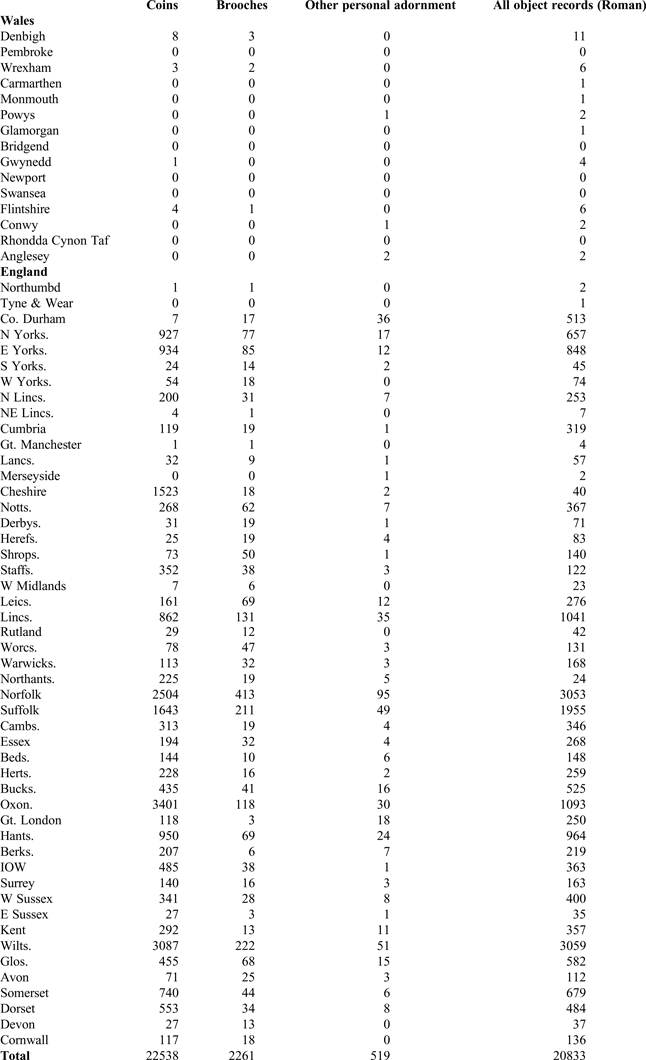
The account of the Roman period finds reported to the PAS in 2016 begins as in previous years with an overview of their distribution. Table 1 presents the numbers of some object types recorded on the database by county, using older administrative boundaries for consistency with previous reports; as before counties are grouped by PAS region. Following the practice of recent reports, the first three categories comprise coins, brooches and other personal ornaments, the numerically most significant categories of Roman period finds. The fourth column in the table shows the number of records of Roman objects, including both metallic and non-metallic objects (i.e. ceramic, glass and stone objects and building materials), made for each area during 2016, rather than the total number of Roman metallic objects as documented in previous years.Footnote 2 As a record such as a coin hoard or a ceramic assemblage from the same findspot may contain more than one item, the total number of Roman objects is larger than the number of records listed here. Indeed the number of coins both in toto and in many individual regions is therefore greater than the number of Roman period records. Nonetheless the distribution of record findspots may in general be considered as a meaningful proxy for the distribution of Roman period object findspots in the survey period. As in previous years many more records of Roman finds were made in 2016 in eastern England, from north Yorkshire to Suffolk, and in some central southern English counties, in particular Oxfordshire, Hampshire and especially Wiltshire, than elsewhere. In western Britain from Cornwall to Cumbria and especially in Wales the number of records is very much lower. In individual cases the low number of records may disguise a large number of objects documented, especially where individual hoards containing large numbers of coins have been recorded (see below).Footnote 3 County Durham has unusually few coins documented compared to the high number of object records. This is explained by the creation of records in 2016 to document objects including military and horse equipment found in the river Tees at Piercebridge. Leaving aside such special circumstances, the regional variability is determined by multiple factors, including differences in the circulation of metal objects in Roman period societies, historic and modern agricultural practice and the associated varying intensity of metal-detector use across Wales and England.Footnote 4
NUMBERS OF NON-CERAMIC ARTEFACTS RECORDED BY THE PAS IN 2016 BY COUNTY AND TYPE

The number of coins recorded in the database in 2016 (22,538) is similar to the totals documented in previous years. In all more than 230,000 Roman coins have now been recorded by the PAS, as calculated from these annual totals, demonstrating the enduring impact of the initiative to record large assemblages of Roman coins in toto.Footnote 5 The change in tabulation makes it impossible directly to compare the frequency of coins relative to all other metallic objects documented in 2016 with results from previous years. However the outnumbering of brooches by coins at a ratio of c. 10 to 1 suggests that patterns of discovery and documentation resemble those of past years.Footnote 6 The regional distribution of coin finds is also similar to that of previous years, many more coming from eastern and (some) central and southern counties of England than from Wales and western and northern England. The unusually high numbers in some counties can be explained by the discovery and documentation of several hoards containing many hundreds of coins, for example two radiate hoards from Stoke Lyne, Oxon., a mainly radiate hoard from Pattingham and Patshull, Staffs., and a fourth-century hoard from Paul, Cheshire.Footnote 7
25,705 brooches have been documented by the Scheme since 2003 in these annual reports, including the 2,261 examples recorded in 2016.Footnote 8 As before, this number comprises brooches of which the date spans the late Iron Age–Roman transition as well as brooches dated firmly within the Roman period proper. The distribution of the 2016 examples, with high concentrations in the counties of eastern England, and in some central southern and south-western counties, especially Wiltshire and Oxfordshire, once again follows previously established patterns. A significant regional variability in the ratio of coins to brooches can however again be noted. In particular, the high ratio of brooches to coins among objects recorded in several counties of the English West Midlands, including Herefordshire, Shropshire, Worcestershire and Staffordshire, stands out as an exception to the general pattern.Footnote 9 In some neighbouring areas of the East Midlands and Yorkshire the brooch:coin ratio is also unusually high among objects documented in 2016. Other items of personal adornment (mainly finger-rings, bracelets and beads) are documented in smaller numbers, comprising in total about one quarter the number of brooches, but with much local variability. The large numbers from County Durham are again explained by the creation of many records in 2016 for non-coin objects found on the bed of the river Tees at Piercebridge, especially hairpins.
ARTEFACT DESCRIPTIONS
The entries below present individual highlights of the past year's discoveries recorded by members of the PAS and Treasure Department at the British Museum.Footnote 10 As previously these are selected because of their contribution to the study of the material and visual culture of the province, including understanding of object type, distribution and iconography. In some instances they comprise objects not previously recorded from the province. The reference number associated with each record is the unique identifier which can be used to consult these object records on the PAS website: www.finds.org.uk. One object was also treated as a Treasure case and is thus also designated with its Treasure number in the format of year (20XX) and reference number (TXX).Footnote 11
As in previous reports the copper-alloy artefacts presented below belong to diverse ‘small find’ functional categories and vary widely in technique, style and iconography. Their dates of manufacture extend from the late Iron Age to Late Antiquity. As well as a single figurine they include elements of military dress and harness pieces, brooches and other personal ornaments, vessel mounts and furniture fittings, and one knife-handle. Like several objects reported this year, the latter takes an unusual zoomorphic form (a licking dog); the decorative repertoire also comprises anthropomorphic decoration (humans and deities) and non-figural elements, the latter often drawing on polychrome enamel.
CUMBRIA
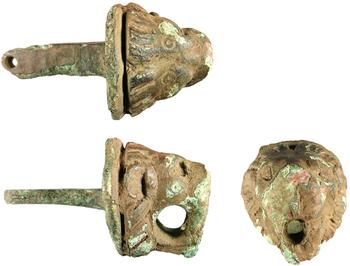
(1) Brampton (LANCUM-56EB5A) (fig. 1).Footnote 12 A near-complete copper-alloy ‘lock pin’ of lion head form. The well-preserved object is 52.5 mm long and 28 mm at its widest. It weighs 56.7 g. All surfaces show wear, but the moulded details are still recognisable. The lock pin comprises a short shank at the back, an oval plate and a lion's head at the front/handle. The shank has a rectangular cross-section with a circular perforation at the end. The middle section is a flat oval plate which separates the shank from the heavy lion's head. Details of mane, eyes and ears are modelled on the head; the maw is rather flattened and the open mouth reveals two large canines extending from the upper to the lower jaw.
Brampton, ‘lock pin’ (No. 1). Scale 1:1. (Photo: D. Boughton; © D. Boughton)

Objects of this kind are widely documented as excavated examples, but in almost all other cases seen the head is a plain dished circular element rather than rendered in figural form.Footnote 13 Exceptions are represented by very similar ‘lock pins’ with lion's head and perforated shank from Bonn and Nijmegen.Footnote 14 The purpose of these objects is not definitively established. They are conventionally identified as lock pins, but other purposes have been suggested, including acting as handles for a box or drawer or a wagon fitting. This example may combine the lock pin form and function with the lion-head studs used as casket fittings, of which many examples have been documented as metal-detected as well as excavated finds.Footnote 15
LANCASHIRE
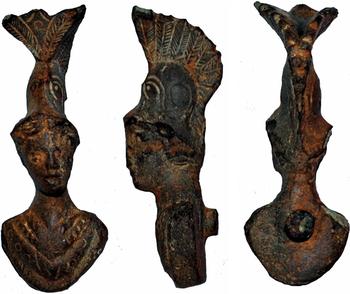
(2) Ribchester (LANCUM-B19766) (fig. 2).Footnote 16 A worn copper-alloy mount depicting the goddess Minerva, helmeted and wearing a tunic. The mount is 52 mm long and 21 mm at its widest. It weighs 22.9 g. The plumage of the helmet's high-splayed crest is rendered by hatching; the body of the helmet carries curvilinear decoration. The hair visible beneath the helmet is swept back from the forehead on both sides towards the nape of the neck. Although the face is worn, with the left eye almost lost, it is modelled with some care, tapering to a narrow chin. On the chest the two parallel V-folds, one scored, the other also decorated with punched circles, indicate the folds of a tunic worn beneath and the aegis above. A lug projects from the back of the bust. The closest affinities of the bust are with the Minerva bust wax spatula handles of second- to third-century date.Footnote 17 However the absence of traces of an iron blade or of a socket to attach it as well as the projecting lug suggest that this object is a furniture mount or similar.
Ribchester, mount in form of Minerva bust (No. 2). Scale 1:1. (Photo: S. Noon; © Lancashire County Council Museums Service)

Other mounts of approximately similar size in the form of heads or busts of the same goddess have been documented by the PAS, for example Barton-le-Willows, N Yorks. (NCL-5DCFF6), Leckhampstead, Berks. (BERK-711A53) and Gravesham, Kent (SUR-8F3073). A Minerva bust of similar probable purpose with a projecting lug is documented from an unknown provenance in the Rheinisches Landesmuseum in Bonn.Footnote 18
EAST YORKSHIRE
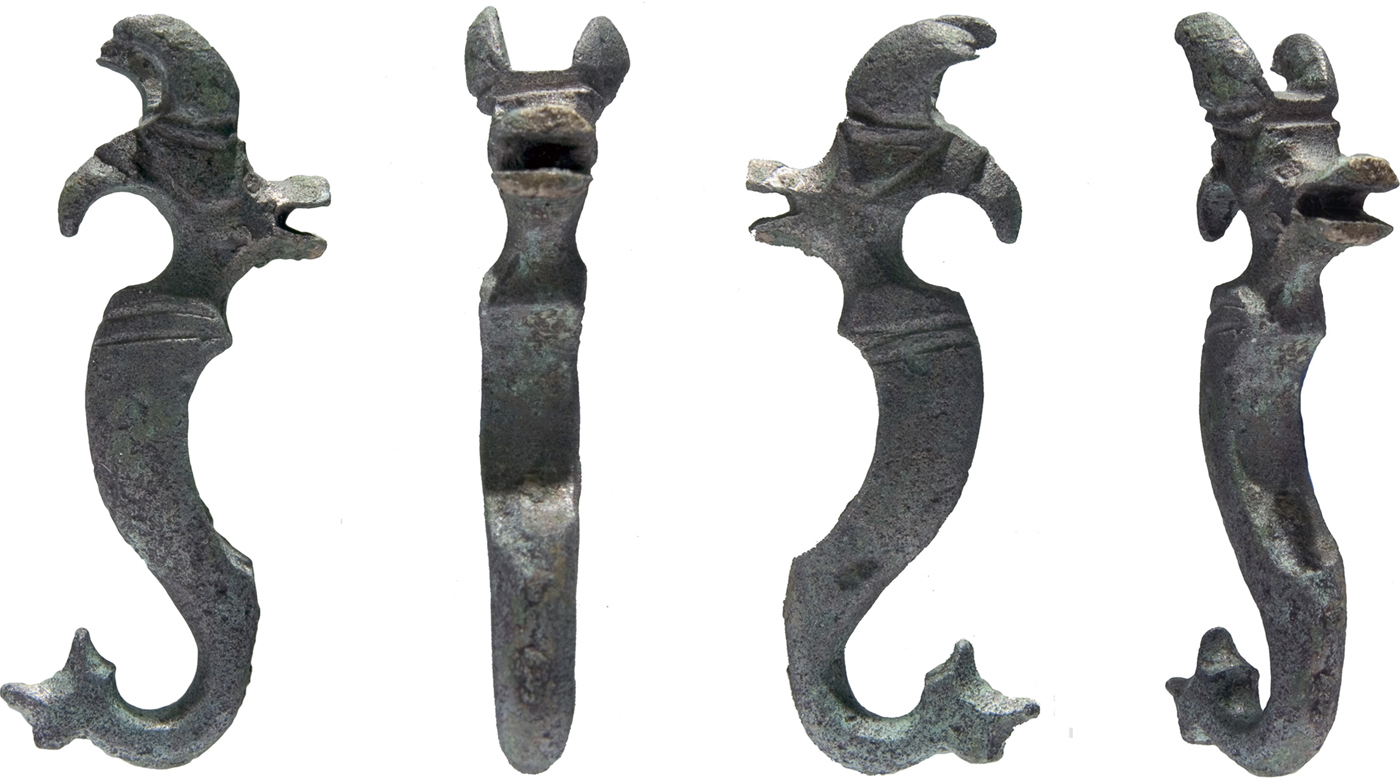
(3) Thwing (FASW-D3A9FD) (fig. 3).Footnote 19 This is a cast copper-alloy zoomorphic support, probably one of three for a candlestick. It is 53.5 mm tall, 23.5 mm wide (from tip of tail to tip of snout) and 11.7 mm thick at its widest (ear to ear). It takes the form of a hybrid marine animal, with a griffin's head and dolphin-like sinuous body and tail. The griffin's head is rendered in some detail. A small eye is set high on the head behind the hooked beak. There is a transverse moulding where the high forward-curving ears meet the head. Beneath the ears on both sides are two folds or flaps. Behind the head is a projection with a central slot allowing the attachment of the support to the candlestick from which it probably derives. At the base of the neck two transverse lines mark the transition with the body which curves gently to the three-fluked tail. The latter turns back on the body to form the base of the support. No fins are shown. At the back the body is recessed.
Thwing, zoomorphic tripod leg (No. 3). Scale 1:1. (Photo: S. Laidlaw; © S. Laidlaw)

No exact parallel to this piece could be found, but supports for candlesticks with some similarity to the Thwing piece are documented, of varying elaboration. Bailey reports an example of suggested second- or third-century date from the British Museum of a candlestick of brass pricket type with the drip-collector supported by three tripod legs resting on the heads of griffins. These supports are of a similar size to the Thwing example.Footnote 20 A much more elaborate instance is documented from the villa at Dalton Parlours, W Yorks. This has a flower-like drip-pan, an elongated tripod and three cast dolphin feet; the dolphins’ mouths grip the collar beneath the tripod base.Footnote 21 Other adaptations of feline and avian forms as supports for candlesticks and other similar objects are more widely documented.Footnote 22 As Henig notes, such supports probably translate the forms of larger furniture which does not usually survive into smaller objects. However, hybrid monsters on mosaics perhaps offer the closest parallels, anatomically speaking, to the Thwing support. Sea-griffins with large pricked-up ears and divided tails feature, for example, in marine scenes from southern Britain among other oceanic creatures which cavort or hunt (e.g. Mosaic IV 421.45, Insula XVII, Dyer Street, Cirencester).Footnote 23 The candlestick's decoration is also likely to reference this realm of playful leisure.Footnote 24
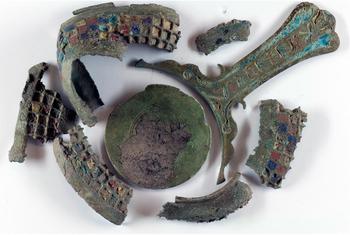
(4) Eastrington (YORYM-20B68C) (fig. 4).Footnote 25 An incomplete copper-alloy enamelled vessel, found in eight fragments including a handle, base and six body pieces. A further two undecorated copper-alloy fragments, also possible body pieces, were found in close proximity.
Eastrington, enamelled vessel (No. 4). Scale 1:1. (Photo: R. Griffiths; © R. Griffiths and York Museum Trust)

The flat handle is 95.9 mm long, 69.5 mm at its widest and 3.3 mm thick. It weighs 22.9 g. From its trilobate terminal it narrows slightly until widening again where it joins the body of the vessel, spreading into two semi-circular extensions with scrolling projections. The handle bears an engraved inscription (VTERE FELIX) comprising cast letters alternately filled with blue and red enamel (though the touching ‘L’ and ‘I’ of FELIX both contain red enamel).Footnote 26 Two crescentic cells, both with traces of red enamel, are adjacent to the first letter (V) and three cells, one crescentic (with traces of red enamel) and two curvilinear (one with traces of blue enamel) follow the ‘X’ of FELIX. The inscription is framed above and below by two channels inlaid with blue enamel. At the junction with the vessel these channels continue scroll-like onto the handle extensions. At the other end towards the handle terminal these channels thicken into notched ovoid extensions. The reverse of the handle is flat and undecorated.
The circular base is slightly concave with worn outer edges and near its centre carries two concentric incised rings, possible traces of lathe turning. It is 50 mm in diameter and 0.8 mm thick. It weighs 7.9 g.
Most of the body of the vessel survives as six worn fragments of varying sizes, the largest weighing 24.5 g, the smallest 1.9 g (individual fragments are described in the website entry). The interior of the vessel is plain but much of the exterior is decorated. There is a plain band below the rim and continuous chequerboard decoration formed by recessed squares around the entire circumference of the vessel, three squares high. The distortion makes it difficult to assess in detail, but the squares appear to diminish in size closer to the base. The survival of the enamel varies, but the scheme shows a repeating sequence of yellow, red, blue and turquoise cells. Each row is offset from the next by one colour. The two undecorated fragments comprise small pieces of sheet copper alloy of similar thickness to the others.
This vessel is a well-preserved example of one of several of this type recorded by the PAS. Complete save for its handle and base, a pan from Winterton, N Lincs. (NLM-F50443), is similarly but not identically decorated. An example of the same form, albeit with curvilinear rather than chequerboard decoration, is documented from Crowle, N Lincs. (FAKL-9900E3).Footnote 27 The best known vessels of this type are, however, the pans which bear inscriptions listing auxiliary forts at the western end of Hadrian's Wall, including the Ilam pan.Footnote 28 A further fragment from a pan of this type was also recorded by the PAS in 2016 at Bowers Gifford and North Benfleet, Essex (ESS-5945F8). On this fragment a small number of surviving letters are visible as well as part of the decoration in the register below the text.Footnote 29 This mural decoration resembles the scheme on the Hildburgh fragment, comprising rectangular panels (one survives) containing a four petal motif within a crenellated border. However the ‘turret’ within the crenellated border bears closer affinities with the Rudge Cup, with its crenellations being square rather than wedge-shaped.Footnote 30
(5) Brantingham (YORYM-4786D1) (fig. 5).Footnote 31 A complete copper-alloy sheath-footed, P-profiled sprung brooch, with a dark green patina and surviving in good condition. It is 56.7 mm long, 23.9 mm wide and 3.3 mm thick. It weighs 22 g. The head comprises a hollow cylinder, within which a spring mechanism with approximately six turns is housed. The arched upper bow has a central groove housing a knurled rib with gilded rectangular panels on both sides. There is a flange just above the angle with the lower bow which is also faceted, with a cross-moulding at the foot. The lower bow has raised triangular borders and gilded surfaces. The integral catchplate is complete. Similar examples of sheath-footed, P-profiled sprung brooches are documented by Bayley and Butcher who observe that the type is likely to be continental in origin. They are regarded as soldiers' brooches, although examples are also found on non-military sites. They are dated to the later second and/or earlier third centuries.Footnote 32
Brantingham, brooch (No. 5). Scale 1:1. (Photo: R. Griffiths; © R. Griffiths and York Museum Trust)

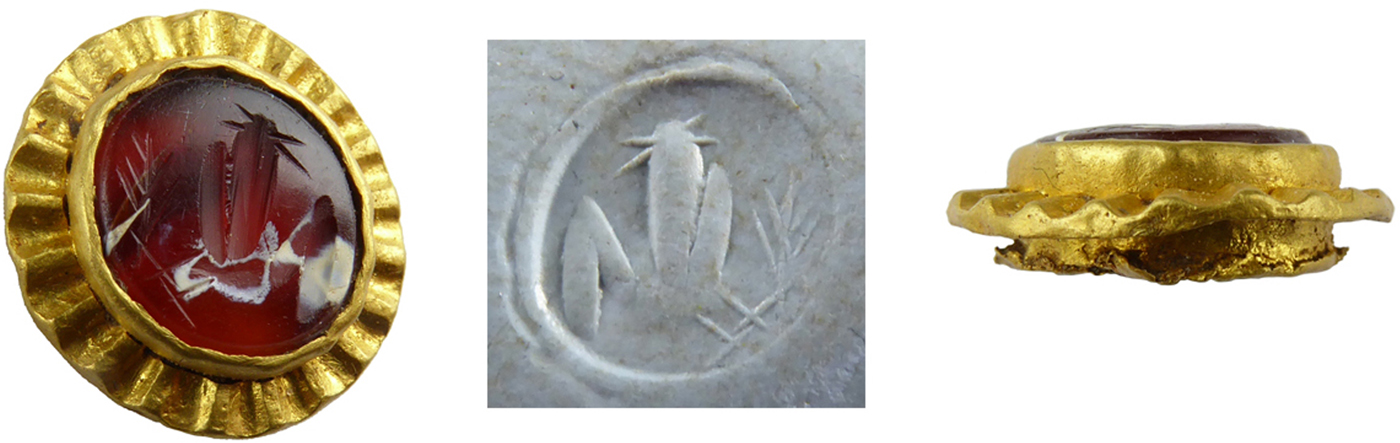
(6) Rowley (LANCUM-3C3804; 2016 T1075) (fig. 6).Footnote 33 A Roman intaglio within a gold setting, probably a pendant from a necklace or earring. The object in its entirety measures 14.1 mm by 13 mm and has a maximum thickness of 4.7 mm. It weighs 2.1 g. The near-circular, slightly ovoid intaglio is set within a short gold-sheet tube, with a separate sheet applied to cover the back of the gem. An overlapping joint is visible on the tube. A collar has been fitted over the tube, forming a flanged border of crimped or rilled appearance. This effect is achieved by undulating ridges, flattened at the top on the upper surface. At the top of the pendant, between the sheet setting and collar, are traces of two broken-off projections of circular section by which the item was probably suspended. These are about 7 mm apart.
Rowley, intaglio (No. 6). Scale 2:1. (Photo: D. Boughton; © D. Boughton)

The gem itself is red in colour, possibly carnelian, with some white veins, and is slightly convex, measuring 10 by 11 mm. The crudely carved intaglio depicts a bird standing left (as seen), with wings (or possibly tail plumage) spreading away from its body and a branch at its feet, the latter each being rendered by two engraved lines, one perpendicular to the other. A long open beak and short crest are schematically rendered by pairs of engraved lines. A crack is visible in the gem in the area of the branch.
Other similarly set gems have been recorded by the PAS, for example LIN-F9B9C2 (Wickenby, Lincs.), LIN-47E0E2 (Market Rasen, Lincs.) and BUC-CE48C1 with pendant loops (Grafton Regis, Bucks.). The Market Rasen and Grafton Regis finds are dated respectively to the third century and second to third centuries. A further example of a gem within a crimped setting was found in the third-century Beaurains hoard (BM 1924,0514.8). The position of the suspension loop at the top of the Rowley gem and not on both sides may suggest that the item was intended to be suspended, perhaps as an earring. Earrings of this type (Allason-Jones type 11) are dated to the third century.Footnote 34 Allason-Jones illustrates circular examples from Vindolanda (no. 67) and York (no. 80). The latter has a similar method of construction, although the suspension loop is attached to the back.
The closest parallel to the intaglio itself may be a gem from Winchester showing a cockerel pecking at foliage, tentatively dated to the second century by Henig.Footnote 35 Guiraud dates similar designs on gems from France to the first or second centuries.Footnote 36 These are slightly less schematized, as is an example from a hoard from Slay Hills (Kent) in the British Museum, dated to the second century (BM 1894,0803.57). The motif also occurs on intaglios from the Snettisham Jeweller's Hoard, dated to the mid-second century.Footnote 37
DONCASTER
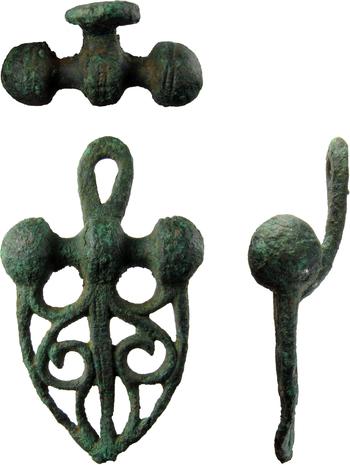
(7) Hampole (SWYOR-1CA6D5) (fig. 7).Footnote 38 A copper-alloy button-and-loop fastener with dark green uneven patina. The object is 65.9 mm long, 37.7 mm wide and 17.4 mm thick. It weighs 37.4 g. This example has a bar with bulbous mouldings in the centre and at either end. All three mouldings are decorated with a circumferential band of beading bordered by incised lines. Extending from the bar is an oval attachment loop at the top and a shield-shaped openwork plate at the bottom. The plate has a central vertical rib from the bar to the apex around which curvilinear decoration is arranged symmetrically. The rib itself carries two longitudinal grooves framing pellet decoration. Many button-and-loop fasteners have been documented by the PAS but no close parallel has been identified for the Hampole object; the style is perhaps related to that of Wild's Class IX.Footnote 39
Hampole, button-and-loop fastener (No. 7). Scale 1:1. (Photo: A. Downes; © A. Downes)

LINCOLNSHIRE
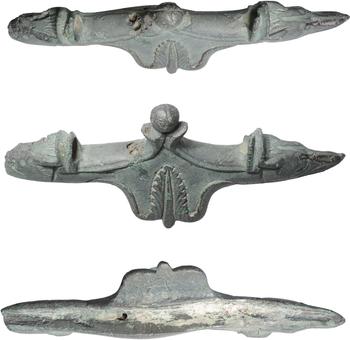
(8) Riseholme (LIN-EE5C6A) (fig. 8).Footnote 40 A copper-alloy handle-fitting from a basket-shaped vessel (vaso a paniere) with a deep green patina and in good condition. The fitting is 120.1 mm long, 52 mm high and 13.7 mm wide across each dog-head terminal. It weighs 147.9 g. A shallow groove runs the length of the fitting which would have attached it to the vessel. Patches of a white-coloured substance survive in this, perhaps the remnants of a solder.
Riseholme, vessel handle (No. 8). Scale 1:1. (Photo: A. Daubney; © A. Daubney)

Where it sat on the outside of the vessel the fitting comprises a central element, to which handles would have attached, and dog-head terminals at both ends, one worn and damaged. On the outer face of the fitting this central element is edged by raised mouldings. At the top these mouldings flare to frame a solid oval knop decorated with an incised cross. From this the mouldings curve outwards towards the attachment point for the handles and the dog-heads. A palmette motif in relief decorates the bottom of this central element, with its apex extending upwards towards the knop and its central stem projecting below the base of the attachment. The stem is bordered on either side by a groove which separates it from the fronds. Each of the latter ends with a wedge-shaped incision.
From the central element the fitting narrows and extends in both directions towards dog-head terminals. On top of the fitting, just behind each head, is a projecting semi-circular moulding with two raised edges decorated with incised lines. The recessed interior of these mouldings allows for the attachment of the swinging handles of the vessel. The mouldings are worn, consistent with this use. The better preserved of the dog's heads has a long face, tapering from the top of the cranium to the tip of the upturned snout. The slender ears sweep back along the head. On the top and sides of the head incised lines indicate a mane or ruff. The top of the head also carries a shallow groove which extends (seemingly) along the nose. The eyes are rendered by recesses which narrow to a point on either side. Short curving incisions around the eyes and forehead are likely to indicate facial markings. The mouth, indicated by a horizontal groove is closed. As noted, the snout of one dog is missing.
Findspots of this distinctive vessel form concentrate in the Bay of Naples. The Riseholme fitting derives from Tassinari's most common type (2210), accounting for 26 of the 31 vessels of the vaso a paniere form.Footnote 41 One complete vessel with very similar fittings as well as a single fitting of the same type are held by the Metropolitan Museum of Art (Acc. nos 1989.281.86 and 1972.118.89).Footnote 42 While the general form of the fitting remains consistent across surviving examples, the foliate decoration and the animal terminals vary. Bird-heads, especially ducks, are commonly seen, as are dogs, as in this case, and dolphins. More rarely the terminals take the form of satyrs and goats.Footnote 43 The Pompeian corpus contains some instances of dog-heads similar to those on the Riseholme fitting.Footnote 44 It also offers parallels to the palmette.Footnote 45 A similar handle fitting, albeit with water-bird-head terminals was documented in close association with the Winchester hoard, dated to the first half of the first century.Footnote 46
(9) Dunholme (LIN-B1C0E7) (fig. 9).Footnote 47 A rectangular copper-alloy belt-plate with a medium brown patina. It is 65.4 mm long, 37.6 mm wide and 1.8 mm thick. The plate has a rivet-hole in each corner. One rivet survives with a shank of circular section and a flattened head at both ends. A small square washer is fixed between the plate and the flat-head on the reverse. The face of the belt-plate is slightly convex and is divided into ten rectangular cells. Each cell contains a repeated design of millefiori enamel in grid form (poorly preserved in the central cells), formed by squares and near-squares of varied sizes. Nine cells contain a grid of four by six squares, one corner cell contains four by five. The millefiori squares take two forms. One comprises a motif approximating to a Maltese cross in a pale enamel set within a blue enamel square. The other comprises a square with a perimeter of red enamel, containing within it what seems to be a three by three grid of alternating blue and white squares, though these too are poorly preserved.
Dunholme, belt-plate (No. 9). Scale 1:1. (Photo: A. Daubney; © A. Daubney)

The plate may date to the second or third centuries and is paralleled in its general form, if not its specific decoration, by examples from Caerleon.Footnote 48 The decoration itself is better paralleled in an example illustrated by Appels and Laycock.Footnote 49 The taste for chequerboard enamelled decoration is also seen on other military fittings and other mounts with complex millefiori motifs documented by the PAS, for example at Buslingthorpe, Lincs. (LIN-225302) and Ludford, Lincs. (DENO-FE87A5).Footnote 50
(10) Waddington (DENO-E18F19) (fig. 10).Footnote 51 An enamelled copper-alloy openwork plate brooch, dated to the second century. It is complete save for a small fragment from its edge and part of its catchplate. The brooch is 50 mm long, 30 mm wide and 12 mm thick. It weighs 18 g.
Waddington, plate brooch (No. 10). Scale 1:1. (Photo: J. Edeson: © J. Edeson and Derby Museums Trust)

The main part of the plate is a crescent element with eight knops projecting from its outer edge. A further crescent moulding projects from the outer edge of the plate at its thickest point. The surface of the main crescent element is recessed with two rows of triangular cells of varying sizes, the outer inlaid with red enamel, the inner with yellow. The points of the main crescent converge at the back of a zoomorphic head which forms the catchplate. The head has a long ridged snout which flares at the tip and a pair of bulging eyes. Each eye has a large central pupil and a raised outer rim. A knop is preserved on the outer edge of the right eye. A further bar connects each eye to the outer edge of the main crescentic element. On the reverse, a lug with a rounded end projects from the crescent to house the hinge for the pin. The pin itself is intact though bent. The catchplate beneath the zoomorphic element is partially preserved.
Similar examples have been recorded on the database from eastern England, though none as elaborately decorated (or as well preserved) as the Waddington brooch.Footnote 52 The zoomorphic head with its reptilian character is a widely documented characteristic of elaborate openwork plate brooches found among British and especially among continental European examples.Footnote 53 However, the heads rarely take this form, most examples having small eyes and a short snout on a head at the end of a wrinkled ‘turtle’ or ‘serpent’ neck extending from the main body of the brooch. The specific zoomorphic decoration on the Waddington brooch is thus difficult to parallel directly.Footnote 54
STAFFORDSHIRE
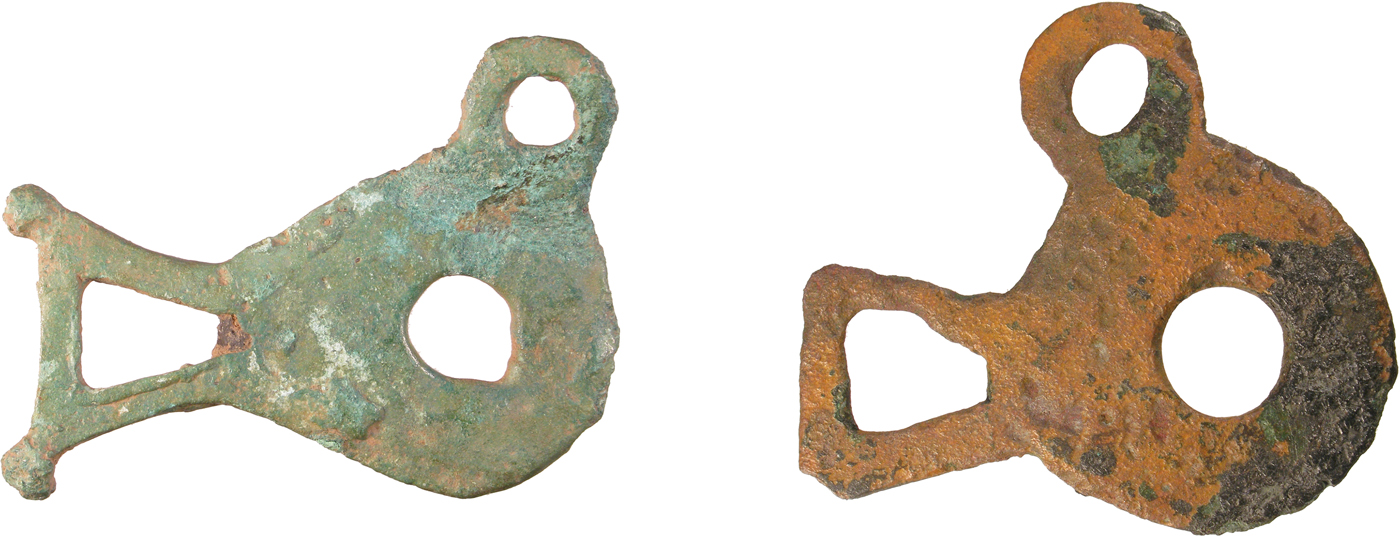
(11) Penkridge (WMID-F11707) (fig. 11).Footnote 55 Two complete copper-alloy bridle bit side plates of first-century date. The first is 64.8 mm long, 47.6 mm wide and 4.4 mm thick. It weighs 34.3 g. It has an even mid-green patina. The second is 61.9 mm long, 59.5 mm wide and 3.9 mm thick. It weighs 37.1 g. It is dark brown with patches of dark green. Both side plates are flat and have irregular shapes. Both plates have a circular body, with a central circular perforation. In each case two loops extend from the body, one triangular, the other circular. On one plate the triangular loop has spherical knops on each corner. These side plates closely resemble examples documented among the first-century metalwork from the auxiliary fort at Hod Hill, Dorset.Footnote 56
Penkridge, bridle bit plates (No. 11). Scale 1:1. (Photo: T. Gilmore; © T. Gilmore and Birmingham Museums Trust)

(12) Mavesyn Ridware (WMID-9912C5) (fig. 12).Footnote 57 An incomplete copper-alloy belt-buckle plate in the form of two opposed and highly stylised dolphins, perhaps of fourth- to fifth-century date. The flat plate measures 24.6 by 36.9 mm and is 3.1 mm thick. It weighs 7 g. On the plate the opposed animal heads grasp an oval object between their jaws. From their backs, just below the neck, extend circular perforated lugs. Between the bodies is a T-shaped perforation, made from several circular holes joined together. A circular hole is present to either side of the upright of the T. The bodies of the dolphins join again at the tails which then extend at an angle from the plate. The buckle plate is flat. No specific parallel has been identified but the object has a general affinity with other late Roman belt buckles of dolphin type.Footnote 58
Mavesyn Ridware, belt buckle plates (No. 12). Scale 1:1. (Photo: T. Gilmore; © T. Gilmore and Birmingham Museums Trust)

SHROPSHIRE
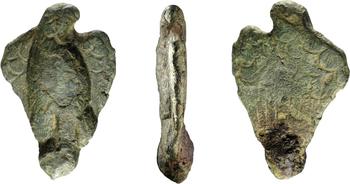
(13) Wistanstow (HESH-4F216E) (fig. 13).Footnote 59 A cast copper-alloy decorative fitting in eagle form, with a grey-green patina and surface decoration lost to wear and ongoing corrosion. It is 44.9 mm long, 27.9 mm at its widest point and 9.6 mm thick at the base. It weighs 22.8 g. The eagle has a thick body from which narrow wings, partly lost to damage, extend on either side. The body tapers towards the neck of the bird and the head, raised above the line of the wings, turns to the right. The detail of the head is lost save for the curve of the beak. The legs of the eagle extend onto a spherical base, grasped by the talons. Care has been taken to indicate the varying feather patterns across the body, wings and legs. On the upper wings and body the plumage is rendered with short curving lines. On the legs and lower wings (flight feathers) the feathers are rendered with vertical lines with herring-bone hatching on either side (wings only). The base is approximately spherical and heavily stained by iron-corrosion product. Within it are embedded the remains of a square-sectioned iron rod, the probable fixing of the eagle to a piece of furniture or similar object, perhaps a rod or sceptre.
Wistanstow, decorative fitting (No. 13). Scale 1:1. (Photo: P. Reavill; © P. Reavill and Birmingham City Council)

Other examples of similar objects have been documented by the PAS, including a likely sceptre terminal from a possible temple site at Bosworth, Leics. (LEICS-9F3451).Footnote 60 Other parallels can be documented, including similar examples from the early Roman legionary fortress at Neuss, the Legs Lambert in the Musée de Lyon and Carnuntum, the last more streamlined. In discussing the Carnuntum example Fleischer suggests its extended wings echo those of the eagles on legionary standards.Footnote 61
(14) Lapley, Stretton and Wheaton (WMID-CE834B) (fig. 14).Footnote 62 An incomplete copper-alloy mount of late Iron Age or early Roman date. It is 108.6 mm long, 34.3 mm at its widest and 5.3 mm thick. It weighs 59.6 g. It is flat and damaged at the edges and on one corner; elsewhere it preserves its dark green patina. The mount has a trilobate form, the central lobe being larger. It carries curvilinear relief decoration in the form of a plant scroll, organised symmetrically. From a stem within the larger central lobes a line of raised decoration follows the outer edges of the mount, returning along the bottom of the object to the base of the stem. In each lobe a pair of stalks curl off, turning back on themselves towards the main stem. In the smaller lobes these are arranged so as to form a pelta. In the centre of each pelta is a rivet, i.e. at either end of the mount. The back has a rough and abraded finish.
Lapley, Stretton and Wheaton, mount (No. 14). Scale 1:1. (Photo: V. Allnatt; © V. Allnatt and Birmingham Museums Trust)

There are no direct parallels for this object recorded on the PAS database. It shares some affinities in form with the handle of the Balmaclellan mirror from Kirkcudbright in south-west Scotland, dated by Macgregor to c. a.d. 110–240.Footnote 63 It is not possible, however, to determine with confidence the specific object to which the mount would have been attached. It may have been from a vessel or a harness-fitting; a mirror is less likely.Footnote 64 It shares motifs with another mount from Chitterne, Wilts. (BERK-A9109A); A. Gwilt (pers. comm.) suggests that it may date to the post-conquest period.
SUFFOLK
(15) Freckenham (SF-8498A5) (fig. 15).Footnote 65 A complete copper-alloy strap-fitting, most likely to be Roman in date, for which no parallel could be found. The strap-fitting is 40 mm long and 29 mm wide. It weighs 19.7 g. It has a near-circular front face with a flat rounded projection from one edge; the projection has a central circular hole and small rounded knops at its corners. On the back of the fitting are three joining rectangular loops (7 mm in height) arranged at right angles to each other along the edges; the edge with the projection lacks a loop. The face of the fitting is recessed to accommodate a rosette of which the six petals radiate from a central circular hole. Within the pointed oval of each petal are traces of a now light green enamel; traces of red enamel are visible in the spaces between. The fitting is likely to have been riveted to a strap and to have acted as a strap junction with three straps, one running through each of the rectangular loops. Functionally similar though plainer examples of the phalera strap junction type are documented by Nikolay from the Rhine eastern delta area, dated to the first century.Footnote 66 The Freckenham fitting, however, is distinctive in having three rather than four loops on the reverse and the specific purpose of the projection with its large circular perforation is not clear.
Freckenham, strap fitting (No. 15). Scale 1:1. (Photo: F. Minter; © Suffolk County Council)

NORFOLK
(16) Great Dunham (NMS-DB2ED6) (fig. 16).Footnote 67 An incomplete copper-alloy fitting in the form of a tigress modelled in three dimensions. The hollow fitting is 156 mm long (nose to tail), 108.7 mm high (head to base of left leg) and 34.4 mm at its widest (across the shoulders). The thickness of the body around the cavity varies between 3.1 and 5.3 mm.
Great Dunham, fitting in form of tigress (No. 16). Scale 1:2. (Photo: J. Shoemark; © Norfolk County Council)

The tigress stands, its head turned to the right. The form of the head itself resembles more that of a cat than a tiger. The right side of the head is modelled in detail, the left not, the eye, ear and jawline being indicated but not further elaborated. The open jaws show the canines, with a worn muzzle and chin above and below. Iron-corrosion product within the mouth may derive from a now missing attachment point. The pointed oval of the right eye contains a drilled recess for the pupil, while lines engraved around the socket indicate lashes. Above the eyes a prominent brow ridge runs into a pointed recessed ear flattened against the head. The jawline is accentuated by a moulded ridge which runs from ear to chin and carries incisions to indicate fur. Traces of an iron rivet are visible in the right cheek and also through the neck. The left foreleg is roughly moulded and the corroded remains of an iron shank project from the bottom. The right foreleg is lost just below the shoulder. The position of the break suggests that it may have been raised. From the top of the head to the rump the right side of the slender body of the tigress carries several oblong recesses so as to render the stripes. These recesses are inlaid with alternating strips of silver and copper alloy, some of which are now incomplete or missing. A single continuous recess inlaid with copper alloy forms a dorsal stripe from head to rump. In order to provide a colour contrast the copper-alloy inlays may have differed in composition, but this has been obscured by oxidisation. The fur's texture on the body is rendered by repeated long engraved sinuous lines and shorter incisions. Along the edge of the belly are seven prominent moulded dugs, indicating that the tigress is lactating. On the left undecorated side a rectangular opening reveals the hollow centre, indicating that the object was meant to be seen from one side only. The rear feet are missing, both back legs ending in worn breaks. The tail projects from the base of the rump and curls around the right leg, terminating in an old break. Another trace of an iron shank is visible beneath the rump, surrounded by iron-corrosion product. The presence of the rivets suggests that the object has been repaired or repurposed during its life history.
Although large felines sometimes occur as free-standing statuettes (e.g. WILT-5A8A35, a leopard), the Great Dunham example is not one of these. In size, form and decoration, the object recalls in general the silver vessel handle in tigress form from the Hoxne hoard, but the Great Dunham figure will have served a different function.Footnote 68 The distribution of decoration shows that it was intended to be viewed from one side only and the evidence of attachment points may indicate that it served as a fitting for furniture or, perhaps more likely, a vehicle. A very similar figurine of a tigress from Banasa, Morocco, also with an opening on its undecorated side, is argued to be part of the decoration at the front of a vehicle body, comprising framing feline figures symmetrically arranged on either side of a central group. Boube Picot notes several examples of framing feline figures of similar form and scale from across the Empire. The reconstructed carriage displayed in the Römisch-Germanisches Museum in Cologne shows how the slot on the undecorated side of such figures allows for attachment to the carriage with a wooden strut.Footnote 69 Recent excavation of a structured deposit from a well at Châteaumeillant (Cher) has revealed another example of a much larger feline figure (27 cm long), a lion with the head of a wild ass between its jaws, with a rectangular slot on its underside. This has been interpreted as perhaps having the same function (i.e. as a vehicle fitting, partly because of the presence of a broken-up vehicle within the well deposit) or alternatively given its greater size as a monumental door handle, on analogy with third-century finds from Ladenburg (Baden-Wurttemberg).Footnote 70 As an animal associated with India, and thus by extension with the journey of Bacchus, the tiger sometimes substitutes other large felines in the god's entourage.Footnote 71 The Great Dunham object adds a further example to the accumulating body of evidence documented by the PAS for elaborate fittings and amulets serving to embellish and protect vehicles.Footnote 72
(17) Little Witchingham (NMS-F35D92) (fig. 17).Footnote 73 A rather worn cast copper-alloy mount in the form of the head of Pan. The mount is 60 mm tall and 37 mm at its widest. It weighs 41.6 g. The mount is sub-triangular with moulded and engraved features in the form of a bearded face. The god's forehead is topped by thick locks of hair, above which rise two small out-turned ram horns, one of which is damaged. Other features include small goat-like ears flattened against either side of the head, finely moulded and engraved eyes, and a very broad nose. A straggling moustache and long beard frame the lips. Secondary perforations have been made in the ears and the point of the beard to take three elongated spikes or rivets, one broken with its point missing, the other two bent over onto the reverse. Corroded remains of solder are present on the concave reverse. The mount may derive originally from a copper-alloy vessel, with evidence for later use, perhaps for example being attached to wood or leather.
Little Witchingham, mount in form of Pan (No. 17). Scale 1:1. (Photo: S. Ashley; © Norfolk County Council)

At least six further possible representations of the god are present on vessel mounts (and a handle) from Norfolk, the closest parallel to this mount being a very worn example from Cawston (NMS-57CB72, HER 30455).Footnote 74 The object is suggested to be of second-century date. On Pompeian bronze vessels the face of Pan is one of the less common motifs drawn from a wider Dionysiac repertoire, especially for handle attachments for jugs; the mask has a likely apotropaic value.Footnote 75
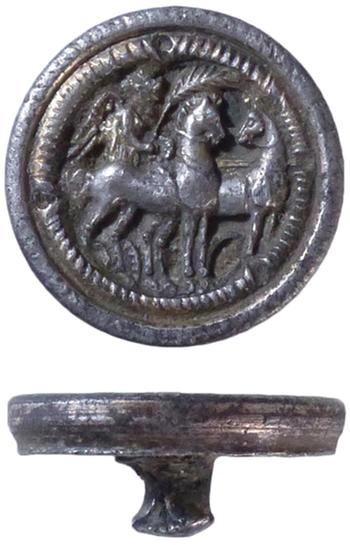
(18) Walsingham (NMS-1071C6, Treasure: 2016T530) (fig. 18).Footnote 76 A silver disc-headed stud with a figural scene modelled in relief. The stud has a diameter of 16.4 mm and is 7 mm thick, including the extension of 4.2 mm from the reverse of the stud of an integral round-section rivet. It weighs 4.8 g. Within a cabled border a winged Victory is shown, facing right and holding a palm and wreath. Between the two facing horses to her right may be seen part of the biga in which Victory stands. This is an elaborate example of a type of stud with repoussé decoration, probably from military dress or harness, which is widely documented and dated to the first to third centuries. While Victory in a biga is the commonest scene represented on studs of this type in other provinces this is the first example known to us from Britain.Footnote 77
Walsingham, stud (No. 18). Scale 2:1. (Photo: E. Darch © Norfolk County Council)

ESSEX
(19) Little Hallingbury (ESS-820B43) (fig. 19).Footnote 78 A copper-alloy figurine of an owl, rather worn with a well-preserved mid-light green patina. It is 46.1 mm high and 17 mm wide. It weighs 41.3 g. It stands with legs slightly apart on top of a flattened spherical base. The figure is worn but surviving traces show detailed modelling of the bird's features and plumage. The owl faces forward. Surviving silvering of its eyes and large facial discs, the marked ridge above these discs, incisions showing markings on either side of what remains of the beak and traces of feathers on top indicate the original detailing of the bird's head. After tapering at the neck the bird's chest swells; it carries short curving lines indicating plumage on the body. The long wings extend all the way to the owl's feet; of their plumage traces of individual leaf-shaped feathers decorated with cross-hatching survive. The thick upper legs are also feathered. The owl's talons grip the base. There are two parallel engraved lines running around the circumference of the base at its widest point. Portable XRF (pXRF) analysis by J. Davis shows the object to be of a high-leaded tin bronze, the high quantity of lead making the figurine heavier than most of this type.
Little Hallingbury, owl figurine (No. 19). Scale 1:1. (Photo: B. Paites; © B. Paites and Colchester and Ipswich Museums Service)

As Durham has shown, owl (or possible owl) figurines are not common finds in Britain, nor are they in continental Europe.Footnote 79 A less-well-modelled owl, with its facial discs marked out with enamel, was recorded from southern Carmarthenshire (NMGW-DAED29). Owl and owl-like figurines are sometimes interpreted as cult statuettes associated with the goddess Athena, for instance figurines from Chester and Willingham Fen, also with enamelled eyes.Footnote 80
CAMBRIDGESHIRE
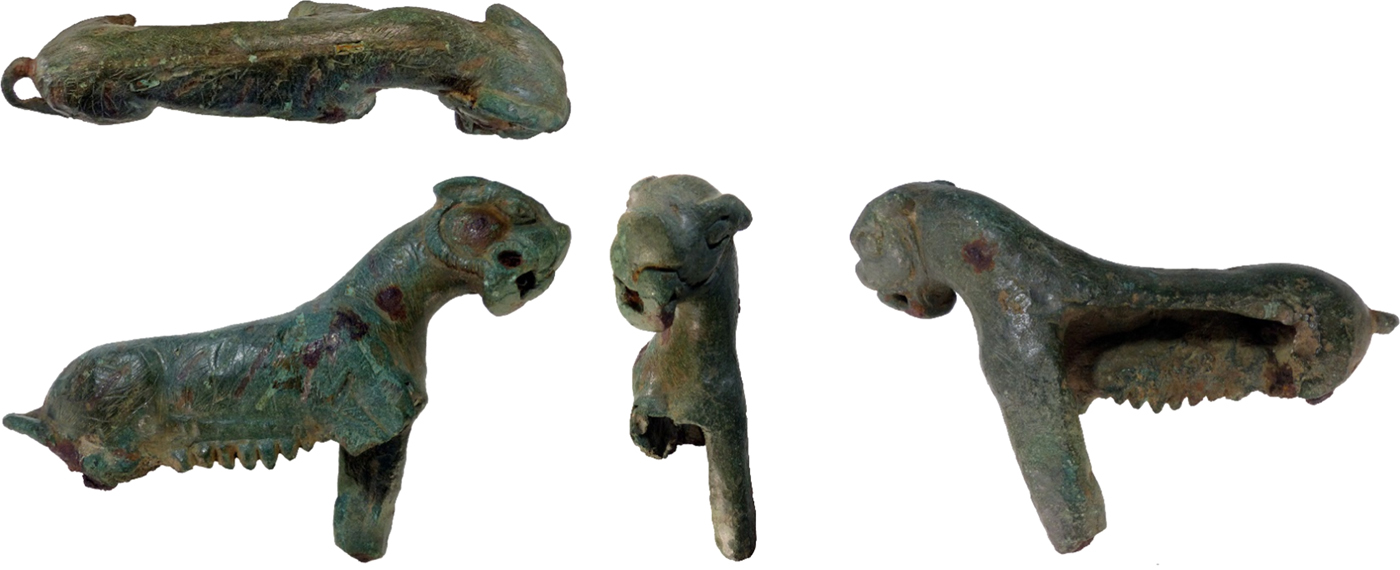
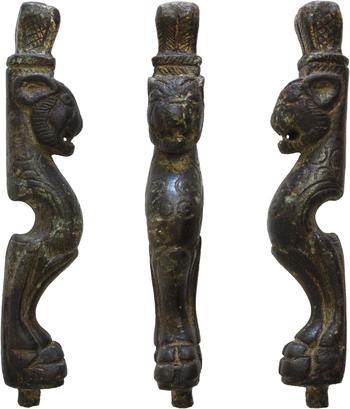
(20) Pidley cum Fenton (CAM-43C844) (fig. 20).Footnote 81 A copper-alloy furniture fitting of zoomorphic form. The object is 80.4 mm long, 11.3 mm wide (maximum) and 15.2 mm thick. It weighs 53.7 g. It takes the common form for fittings and other objects of a trapezophoric feline, comprising its head and schematized chest and leg. The lentoid eyes with a central recess for the pupil, set beneath thick curving brows, are the most visible elements at the top of the face. Outsize ears project almost to the back of the head. The mouth is open with the canines visible. From ear to chin a mane-like fringe separates the head from the neck. The curve of the neck and chest is decorated with large incised circles, evoking the creature's (leopard's?) dappled hide. The calyx-like leg terminates in a schematised rather hoof-like foot with pads or claws turned outwards. The back is plain and straight, except for a curved notch at the rear of the creature's outward-thrust chest. On top of the head is a hatched double moulding, above which is a near-cubic projection with criss-cross hatching on the sides and herring-bone hatching on the front. Below the foot projects a short narrow extension.
Pidley cum Fenton, furniture fitting (No. 20). Scale 1:1. (Photo: H. Fowler; © Cambridgeshire County Council)

This fitting appears to be complete and would have formed one part of an item of furniture. It seems likely that the projections at top and bottom were intended to articulate with another component. The notch at the back of the figure perhaps also connected with a horizontal element of the item of furniture which this object was once a part of. Fittings of this kind in trapezophoric form are not uncommonly documented.Footnote 82
HAMPSHIRE
(21) Easton (HAMP-997D86) (fig. 21).Footnote 83 An incomplete cast copper-alloy probable pin head in the form of a stylised male head with an even green patina. The pin head is almost spherical although the face is somewhat flattened. It is 12.9 mm long, 10.3 mm wide and 10.8 mm deep. It weighs 5.6 g. The hair is rendered by long parallel incisions swept back from the forehead to the base of the neck. The mask-like face is modelled in low relief. A groove runs from ear to ear over the top of the head to separate the hair from a smooth high forehead. Arched eyebrows are rendered by a ridge above each round eye. The nose is formed by a narrow ridge. The head tapers a little towards the chin. Two D-shaped ears sit low on either side of the head beneath the hair, the left being filled with iron corrosion. At the base of the head is a recess filled with corroded copper alloy.
Easton, pin head (No. 21). Scale 2:1. (Photo: R. Henry; © R. Henry and Hampshire Cultural Trust)

A similar size pin head also in the form of a human head, possibly male, is known from Colchester and another from Itchen Stoke, Hants., was reported to the PAS (HAMP-1E6536).Footnote 84 However, the stylisation of the features of the Easton head is better paralleled on other objects, for example a larger copper-alloy head from an object of unknown type from Wetwang, E Yorks. (YORYM-C0BAAA), or a head of similar size, perhaps from a figurine, from Dorchester (SOMDOR-DC9D32). The head is likely to date to the centuries spanning the late Iron Age and early Roman period.
WILTSHIRE
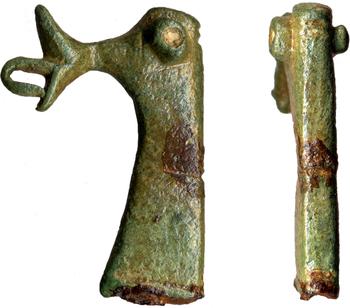
(22) East Knoyle (DOR-CA6972) (fig. 22).Footnote 85 A zoomorphic copper-alloy handle from a small fixed-blade knife. The handle is 30.5 mm long, 21 mm wide and 21 mm high at its maximum extent where the head projects from the body of the knife. It weighs 8.1 g. From the point of attachment with the blade, of which a small remnant survives, the flat handle first tapers before flaring at the terminal which takes the form of a highly stylised animal (canine) head in a Celtic artistic tradition. On either side is a projecting ‘eye’ in the form of a raised circular-recessed setting. One recess contains traces of possible enamel or paste for the attachment of a glass setting; surviving material, perhaps yellow glass or amber, was documented in one of these settings on a similar handle from Braughing, Herts., documented by the PAS (BH-0D3333).
East Knoyle, knife-handle (No. 22). Scale 1:1. (Photo: C. Haywood Trevarthen; © C. Haywood Trevarthen and Somerset County Council)

Between the junction with the blade and the terminal the handle is crossed by two transverse grooves. Both grooves are associated with further incised decoration. On the groove nearest the blade junction this is visible as oblique incisions on the side away from the blade. On either side of the groove closest to the canine head terminal are oblique incisions arranged in herringbone fashion, perhaps intended to indicate a collar. The mouth projects at a right angle from the terminal, flaring open and with a schematised tongue protruding in the form of small metal hoop. As well as the Braughing find, a very similar handle was found during the forum-basilica excavation at Silchester, both these examples being slightly longer.Footnote 86 Boon's interpretation of the Silchester example as a probable toilet knife can also be applied to the East Knoyle find. Boon suggests that the decoration is self-referential, alluding to the therapeutic power of a canine lick to heal any cut inflicted by misuse of the knife. Other knife handles of the same type derive from Augusto-Tiberian contexts in Germany. The East Knoyle handle therefore probably dates to the very late Iron Age or the earliest decades of the Roman period.
SOMERSET
(23) South Petherton (GLO-460D3B) (fig. 23).Footnote 87 A copper-alloy vessel escutcheon with hooked back plate, rather worn and corroded, with unusual decoration. It is 47 mm high, 27 mm wide and 25 mm thick. It weighs 58.3 g. The outer part of the escutcheon consists of a 5 mm thick rectangular plate with curving sides. In the centre of this plate is a long mask-like worn human face with limited modelling. Beneath the low ridge of the eyebrows are two oval eyes on either side of a simple rectangular nose. No mouth is clearly visible. On either side of the face on the edge of the mount are pairs of grooved vertical lines. Beneath the head are two circular rivet-holes. At the top the mount curves to form the back plate with a flat upper surface. The back plate is sub-triangular and is also decorated with what may be a mask-like face of which only a simple nose(?) is clearly visible. Between the front and back plates is a gap of c. 6 mm.
South Petherton, vessel escutcheon (No. 23). Scale 1:1. (Photo: K. Adams; © K. Adams and Bristol City Council)

The presence of mask-like faces on vessel mounts has a long pedigree, for example on buckets from late Iron Age burials from Aylesford and Baldock,Footnote 88 but the limited modelling of facial features makes it difficult to establish whether the South Petherton mount takes its inspiration locally or from imported Roman bronze vessels.
GLOUCESTERSHIRE
(24) Cromhall (GLO-4D4341) (fig. 24).Footnote 89 A circular copper-alloy harness pendant suspension mount. It is 30 mm in diameter and 3 mm thick. It weighs 8.2 g. It is white metal coated with a dished face and bevelled outer rim. There is a circular perforation in the centre of the mount for a rivet, surrounded by six radiating lines that run to the lip of the mount. These alternate between single and paired thin lines with ovoid terminals. These lines are filled with a darker metal which is possibly niello. On the reverse are traces of four lugs, poorly preserved because of corrosion; two occur close to one another near the edge of the mount, the other two are on either side of the central perforation. A better-preserved example from Fincham, Norfolk (NMS-82149A), shows that the former are all that remains of a suspension loop while the latter are the remnants of rivets for attachment onto a harness strap. Very similar examples occur among the horse harness assemblage found at Fremington Hagg in Swaledale in the mid-nineteenth century and at Xanten (Group B).Footnote 90 Examples from Caerleon, Usk and Caersws are also documented, as well as from the Dutch Eastern river delta area.Footnote 91 These parallels suggest a date of the later first century.
Cromhall, horse harness mount (No. 24). Scale 1:1. (Photo: K. Adams; © K. Adams and Bristol City Council)

ISLE OF WIGHT
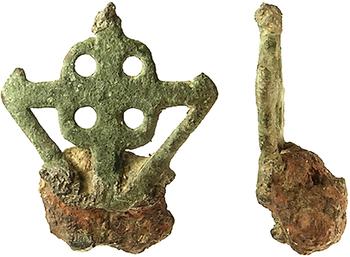
(25) Shalfleet (IOW-807C07) (fig. 25).Footnote 92 A fragment probably from a late Roman copper-alloy openwork belt-fitting. The object is 21.9 mm high, 18.3 mm wide and 1.7 mm thick (excluding iron). It weighs 2.8 g. The fragment is part of the frame of the belt-fitting and is flat on both sides. It has a green patina, save where this is partially obscured on the rear face by corroded iron. Before breakage this surviving part was in the form of an openwork lozenge containing a square centre-piece with rounded corners. This centre-piece connects to the frame by arms extending from the inner corners of the lozenge. It has four evenly spaced circular openings.
Shalfleet, belt-fitting (No. 25). Scale 1:1. (Photo: F. Basford; © F. Basford)

The object is best paralleled in (though not identical to) a small group of other openwork copper-alloy belt-fittings from southern England and northern France, including one from the British Museum, with which it shares the same lozenge-shaped frame and four piercings in a rounded square at the centre of the crossing.Footnote 93 Ager notes that occasional further examples have since been documented. Context information, however, is poor; he suggests a late fourth- to early fifth-century date for the group, but there are too few to identify likely production centres.
KENT
(26) St Margaret at Cliffe (KENT-82B1A6) (fig. 26).Footnote 94 An enamelled copper-alloy brooch of a rare continental type with hinged pin and zoomorphic decoration. It is 47.6 mm long, 2.9 mm thick and 13 mm wide across the lozenge. It weighs 6.5 g. The head of the brooch is in the form of a recessed crescent inlaid with enamel. The enamelling of the crescent is fragmentary but most likely a dark cobalt blue with a hint of red at one end. The main body of the brooch comprises pairs of raised semi-circular mouldings, each with vertical incisions, one larger and one smaller, on either side of a lozenge-shaped enamelled central panel. Much of the enamel is worn away and only traces of the original red and blue design survive. The double lug for the hinged pin is just below the crescentic head and the extended catchplate, more or less complete, starts before the zoomorphic foot. The foot is in the form of an animal's head. The back of the broad head is squared off; pointed ears stand erect on either side. Hair is schematically rendered on the top of the head by three crescentic grooves. Above the shallow circular recesses for the eyes are prominent brow ridges. The face tapers until flaring slightly at the flattened-off muzzle. It is difficult to attribute a species to this animal. Comparison with figurines suggests that identification as a boar is more plausible than as a dog, as suggested by Notte and Révillion.Footnote 95
St Margaret at Cliffe, brooch (No. 26). Scale 1:1. (Photo: M. Erwin; © Kent County Council)

A brooch of a very similar form, with a crescentic head and zoomorphic foot is documented from Good Easter, Essex (ESS-F474F6), although with only two rather than four circumferential mouldings. The type is not otherwise well documented in Britain, but continental parallels can be identified. The brooch falls into the wider group sometimes known as ‘Fibules émaillées à un axe de symétrie’/‘Scheibenfibeln mit einer Symmetrieachse’Footnote 96 or as the ‘Groupe de Lille’ from a find in the collection Louis Théry made in the late nineteenth or early twentieth century in excavations in the Faubourg des Postes in Lille.Footnote 97 The St Margaret at Cliffe and Good Easter brooches both fit the criteria for Notte and Révillion's ‘Type II’ sub-type because of the lozenge-shaped plaque on the bow. The known examples of the type cluster mainly in Gaul and the Rhineland. No brooches of this type derive from a well-documented stratified context; on stylistic criteria Notte and Révillion suggest a date after a.d. 150, while Pietruk proposes the previous half century.Footnote 98