In 1957 two Australian entrepreneurs visited Japan in search of entertainment to import. David N. Martin (1898–1958) and Harry Wren (1916–73) were rival managing directors, presenting variety-revue at theatres in Australia and New Zealand. Their competing interests in commercial entertainment led them to Japan. In that year the governments of Australia and Japan signed a landmark trade agreement. The agreement transformed former enemies into economic allies. It was significant for Japan's post-war reconstruction and Australia's trade in the region. But its negotiation was controversial in Australia. Opposition to the agreement revived wartime fears of a Japanese invasion, recast in the terms of trade protection. The prevailing view, however, was that trade with Japan represented an investment in Australia's future. The terms of the debate informed the trade in entertainment. Martin's interest in Japan was hampered by the antipathy of wartime attitudes, whereas Wren embraced the optimism of the trade agreement. He became the Australian promoter for the Toho Company of Japan, presenting a series of Toho revues on tour until 1968.
Why did Australian entrepreneurs become interested in Japanese entertainment? And what were Toho's interests in touring Australia? Wren presented the Toho tours as promoting ‘better understanding’, ‘good relations’ and ‘mutual interests’ between Japan and Australia. These terms reflect the discourse of ‘Cold War orientalism’ that Christina Klein describes in her book of that title. Focusing on the period between 1945 and 1961, Klein explores how American artists and writers projected a ‘sentimental discourse of integration’ between Asia and America, expressed in the rhetoric of good relations, personal friendships and family ties.Footnote 1 She reveals how this discourse developed in alignment with the foreign policy of the United States, humanizing the Cold War expansion of American power across the Pacific. As an ally in the Cold War, Australia participated in this process. Signature works like Rodgers and Hammerstein's musical South Pacific (1949), and John Patrick's play, Teahouse of the August Moon (1953), were given commercial productions in Australia, in the years between their opening on Broadway and their adaptation as Hollywood films.Footnote 2 However, the discourse of ‘Cold War orientalism’ does not map directly onto trade in entertainment between Australia and Japan.
In this article, I follow Klein in drawing insight into cultural production from foreign policy of the time. But, instead of analysing ‘integration’ as a product of American imagination, I examine it as a form of entrepreneurial diplomacy, realized through trade in touring productions, created in Japan, presented in Australia. In weaving together an account of what Australian entrepreneurs saw in Japan, what the Japanese company sent on tour, and how Toho's revues played in Australia, I draw on archival evidence from a range of sources. These sources include Martin's audition notes on Japanese acts, Wren's publicity for Australian audiences, materials on Toho productions from Tokyo collections and critical response in Australian newspapers. In considering the significance of Japanese revues touring Australia, I also draw on studies of the Takarazuka revue, a company closely affiliated with Toho, which toured similar revues to North America and Europe during the period.
As a contribution to historical research on transnational theatre, this article advances a regional perspective on the mobility of international touring and entrepreneurial trade.Footnote 3 In Veronica Kelly's formulation, a regional perspective ‘allows interrogation of the radial hierarchies found in nationalist and imperial accounts’, while ‘fostering historically contingent readings of global activities’.Footnote 4 Whereas the American artists and writers analysed by Klein projected a ‘global imaginary of integration’, I argue that Australian entrepreneurs and Japanese producers entered negotiations to present touring productions that realized the prospects of regional trade.
Entertainment and trade between Australia and Japan
By the early 1950s, with the rise of Communism in China, trade between Australia and Japan acquired strategic significance. In the context of the Cold War and their common alliance with the United States, the governments of Australia and Japan sought to formalize relations in a trade agreement that afforded the status of ‘most-favoured nation’ to each.Footnote 5 There was opposition in Australia from manufacturers, ex-servicemen and the Labor Party, who feared that cheap Japanese goods would ‘flood the market’, undercutting local industries and threatening workers’ jobs.Footnote 6 Some ex-servicemen supported the levy of an import duty on products from Japan as reparation for war crimes committed by the Japanese military against Australian prisoners of war during the Pacific War.Footnote 7 Yet negotiations proceeded, recognizing the mutual benefits of trade given the growing complementarity of Australian agricultural production (in particular wool, wheat, sugar and barley) and Japanese manufacturing (including industrial machinery, motor vehicles, electrical goods, chemical products, textiles and homewares).
The Agreement on Commerce, signed at Hakone, near Tokyo, in July 1957, signalled a new era in relations between Australia and Japan. The two governments promoted the agreement through a series of trade missions and travelling exhibitions.Footnote 8 In those years Japanese trade fairs in Australian cities were major civic events. In 1959 an exhibition of Japanese products in Sydney attracted over 9,600 people to its opening and a traffic-stopping display of fireworks over the harbour that evening was front-page news the next day.Footnote 9 Australian businesses and cultural organizations took up the opportunity of promoting trade with Japan. Department stores staged fashion parades of Japanese textile designs and galleries presented touring exhibitions of Japanese photography and modern art.Footnote 10 Historian Neville Meaney observed ‘cultural exchanges’ developing in the 1960s between Japanese and Australian artists in the fields of poetry, painting and pottery.Footnote 11 Diplomat David C. S. Sissons noted the growing audience for Japanese cinema at Australian film festivals, the emergence of Japanese themes in Australian theatre and ballet, and the popularity of a Japanese television series, The Samurai, among the ‘younger generation’.Footnote 12
This government-initiated promotion of trade relations with Japan provides the Australian context for Toho's tours with Harry Wren. It is striking, then, that neither Meaney nor Sissons discusses Toho's revues, given their interests in cultural exchange. Their perspectives were informed by Australian developments in cultural policy. Government funding for theatre production, introduced in Australia from 1954, entailed drawing a distinction between the ‘arts’ and ‘entertainment’.Footnote 13 The arts included classical forms of high culture (ballet, opera, drama) deemed worthy of government support, while entertainment described middle- to lowbrow culture (circus, variety, burlesque, revue) relegated to the market for commercial distribution. If Wren's dealings with Japan were disregarded as commercial entertainment, that would explain why Toho's tours have been overlooked in Australian histories of cultural exchange with Japan.Footnote 14
In contrast with government attitudes to entertainment in Australia, Miriam Silverberg's history of Japanese ‘mass culture’ demonstrates how popular entertainment and state ideology were ‘intricately interconnected’ in twentieth-century Japan.Footnote 15 A key figure in this connection was Kobayashi Ichizo, founder of the Takarazuka revue, a wartime government minister, and the managing director of Toho. Kobayashi founded Takarazuka in 1913 as an all-female theatre company specializing in musical revue. The theatre company was managed as a subsidiary of the Hankyu Corporation, Kobayashi's railway business that grew to encompass suburban housing, department stores, travel agencies, tourist hotels, amusement parks, theatres and cinemas. After establishing the Takarazuka theatre near Osaka, Kobayashi opened an equally large theatre in Tokyo in 1934, providing the base from which he built the Toho chain of theatres, cinemas and production facilities throughout Japan.Footnote 16 The name, Toho, is a contraction of the company's original name, the Tokyo-Takarazuka Theatre Company.
Kobayashi conceived of the Takarazuka revue as a form of ‘state theatre’: in Jennifer Robertson's terms, it was ‘an ideal theatrical medium through which to impart the spirit of a new Japan’.Footnote 17 In 1938–9 the Japanese government encouraged Kobayashi to send the revue on diplomatic tours to strengthen Japan's relationships with European allies and ease anti-Japanese sentiment in the United States.Footnote 18 On these tours, the programme blended tradition and modernity to represent contemporary Japan. As Sang Mi Park explains, ‘The troupe articulated Japan's cultural modernity by blending Western revue, tap dance, and orchestra with Japanese artistic heritage such as ancient dance, dramas, and folk songs, employing traditional costumes and postures’.Footnote 19 This facility for integrating tradition and modernity was retained when Takarazuka resumed international touring in the 1950s, as part of a government programme of cultural diplomacy to position Japan as ‘a crucial link mediating between East and West’.Footnote 20
Tradition and modernity were just as integral to the revues from the Nichigeki Theatre in Tokyo that Toho sent on tour to Australia. In fact, adjusting the mix of tradition and modernity to appeal to audiences in different places was a key point of distinction when three Japanese revues were preparing to embark on international tours in 1958. As reported in Variety, Shochiku emphasized ‘uptempo numbers’ for touring to Hong Kong, Manila and Singapore; Takarazuka prioritized ‘classical Japanese dances’ for touring in Europe and North America (deferred to 1959, North America only); while Toho's Nichigeki troupe ‘blends modern Japanese numbers with Western routines’ for touring to Australia.Footnote 21
There were no consistent alignments that stabilize the meaning of these terms: ‘Japanese’ could be ‘modern’ and ‘traditional’, ‘Western’ could be ‘classical’ and ‘uptempo’, and their refractions only proliferated with the shifting perspectives of touring productions. As Sang Mi Park explains, it is an oversimplification to assume that ‘traditional’ elements served only as a form of ‘orientalism’ appealing to Western audiences abroad, while ‘modern’ elements were introduced primarily to appeal to Japanese audiences at home.Footnote 22 In practice, the revues from Toho were a mix – ‘traditional’ and ‘modern’, ‘Japanese’ and ‘Western’, at home and on tour. What is revealing is how producers, presenters and reporters commented on the mix.
With the prospects of trade setting the agenda, Australian entrepreneurs were less interested in the ‘classical’ forms of Japanese tradition and more interested in ‘modern’ Japan. They assessed the appeal of Japanese entertainment in terms of modernity, using the measures of industrial production. In technical terms, they valued brilliance, efficiency and speed. And, in terms of the Australian apprehension about Japanese imports, they exercised quality control, rejecting acts that did not meet their standards for novelty, suitability and polish. The producers at Toho also expected that the modernity of their productions would appeal in Australia. What they found was that the appeal of Japanese modernity was signified in touring revues by translating between folkloric tradition and technological innovation.
The Tivoli's talent-scouting tour in Asia, 1957
The Tivoli Circuit was the leading producer of variety-revue in Australia, managed by David N. Martin from 1944 until his death in 1958. Under Martin's direction, the Tivoli produced a regular stream of revue for theatres in Sydney and Melbourne, with successful productions transferring to Brisbane, Adelaide and Perth, and over to New Zealand. Martin's entrepreneurial distinction was his success with imported acts. His talent-scouting tours to North America and Europe helped diversify the entertainments offered to audiences in Australia. As Veronica Kelly observes, Martin was ‘the force driving the Tivoli's diverse cosmopolitan cultural presence and influence’, importing internationally famous black stars for Tivoli revues, including dancers Norma Miller (1955) and Katherine Dunham (1956), pianist Winifred Atwell (1955) and singer Shirley Bassey (1957).Footnote 23
Martin also presented Asian-Australian artists and touring acts from Asia, including the tenor Chung Doo, well-known to Australian audiences on regional circuits since the 1930s; the Kwam Brothers, acrobats who became Tivoli regulars after first appearing in 1941; and the Pan Yue Yen Troupe, who performed in Peep Show (1951–52) and The Tourist Trade (1952). Returning from his first post-war tour to North America and Europe, in 1946 Martin produced Forbidden City, a travelogue revue inspired by the Chinese-American nightclub in San Francisco.Footnote 24 Some Tivoli revues included orientalist fantasies, danced by white Australians, such as ‘Ivories of Old China’ in Happy and Glorious (1948), and the ‘Willow Pattern Plate’ in The Tourist Trade (1950–2).
On his only talent-scouting tour to Asia in 1957, Martin auditioned acts in Singapore, Calcutta, Bombay, New Delhi, Bangkok, Hong Kong, Tokyo, Yokohama and Manila.Footnote 25 In Tokyo he visited the leading theatres and nightclubs, including Toho's Nichigeki. Martin was focused on signing individual artists for Tivoli productions; he was not seeking to import an entire production, like Wren. Yet the only artist auditioned by Martin in Tokyo to subsequently appear in a Tivoli revue was the Puerto Rican dancer Margo the Z-Bomb.Footnote 26
Martin's response to the Japanese acts he auditioned in Tokyo was less than enthusiastic. The notes he took indicate that two acts at the Benibasha nightclub were possibly of interest: ‘Oyama – Young, good-looking Japanese girl acrobatic dancer, very useful’ and ‘Hara – Japanese young man. Does ginger whistling act. Novel’.Footnote 27 Other performers at nightclubs in Tokyo and Yokohama were regarded as unlikely prospects for the Tivoli. In Martin's notes, costumes are described as ‘unsightly’ or ‘poor’; gear is described as ‘shoddy’, ‘shabby’ or ‘crude’; and the performers ‘lack presentation and personality’, even when performing ‘good tricks’. The most promising is Nakao Misako, who ‘does foot juggling of umbrella on slack wire’. Although she works with ‘crude gear’ and appears ‘badly costumed’, Martin concedes that ‘with grooming and presentation’ she ‘would be useful’. He filed three publicity photographs of her act on his return, but there is no evidence that she came to Australia.
Despite the prospects of trade with Japan, then, Martin's 1957 talent-scouting tour was not a success and no Japanese acts were signed for the Tivoli revues. Martin's untimely death on his next overseas tour would have cut short any connections between the Tivoli and Japan.Footnote 28 His audition notes indicate that he regarded many Japanese acts as unsuitable for the Tivoli. The terms that Martin chose to describe these acts recall post-war Australian attitudes toward products manufactured in Japan. The view that Japanese products were ‘shoddy and unreliable’ was precisely the reputation that the Japanese trade missions to Australia addressed with exhibitions demonstrating how technological innovations were improving the quality of Japanese production.Footnote 29 However, Martin's aesthetic judgement of the poor quality of Japanese acts is consistent with an expectation that anti-Japanese sentiment in post-war Australia would lead audiences to disregard imported acts from Japan. It was this expectation that Martin's rival, Harry Wren, set out to challenge in touring Toho revues.
Harry Wren tours Toho's Cherry Blossom Show to Australia, 1958
As an independent producer, Harry Wren operated in a precarious manner, relying on business deals, short-term leases and upbeat publicity, without the investment in property that anchored the Tivoli. Wren built his enterprise through a series of nostalgic revues, stocked with stars from Australia's vaudeville past. Yet he also attracted audiences with overseas acts, importing the American comedians Olsen and Johnson (1949), the striptease Gypsy Rose Lee (1954) and the Harlem Blackbirds musical revue (1955). On turning to Japan, why did Wren succeed where Martin of the Tivoli had not?
In a souvenir programme, Wren recounts how he brought the Cherry Blossom Show to Australia:
And then came the night when we were ‘invited’ to the fabulous Nichigeki Theatre. We were pretty exhausted by this time, losing hope rapidly, not knowing whether we would like the show or not, or even if we wanted to see it. But when the curtain went up I felt like Hillary must have felt when he scaled the peak of Everest. THIS WAS IT. THE ‘CHERRY BLOSSOM SHOW’. It was Japan Westernised, as modern as to-morrow, fast, brilliant. Designed for Western eyes and Western ears, a glittering, breath-taking spectacle. And, above all, one irresistible ingredient – the exotic charm and fascination of the Japanese girl. She gives a smile and the glow and the warmth and the wonder of her reaches across the footlights direct to you. That was how we felt in the Nichigeki Theatre that night. And it will be an experience that will be uniquely yours to-night.Footnote 30
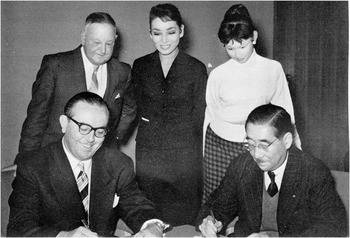
Wren relates how he saw the Nichigeki revue fifteen times and entered into months of negotiations with Toho to bring the production to Australia (Fig. 1). As told to the audience at the theatre, the timeline of Wren's story does not tally with reports in the press.Footnote 31 Wren's story is told in the genre of the traveller's romance, in which white men tell of their adventure abroad, surmounting formidable obstacles to bring home trophies that attest to their achievement.Footnote 32 Wren translates the genre's orientalist tropes into the entrepreneurial stakes of importing Japanese entertainment to Australia. There is his conviction that an Australian audience ‘is not interested in the tradition of any attraction’; his excitement at finding a show that is ‘Japan Westernised’, not traditional Japanese but Japan ‘as modern as to-morrow’; and his expectation that ‘the exotic charm and fascination of the Japanese girl’ will clinch the deal. In these terms, Wren wagered that the appeal of Japanese entertainment could overcome anti-Japanese sentiment in Australia and turn into a profitable trade with Toho in the future.
Harry Wren in Tokyo signing the agreement with Toho to tour the Cherry Blossom Show to Australia, 1957. (Source: Cherry Blossom Show, souvenir theatre program for the Australian tour, 1958, Arts Centre Melbourne, Australian Performing Arts Collection).

By 1957 Toho was the leading entertainment company in Japan, producing live entertainment, motion pictures and television across a broad range of genres: kabuki, drama, musicals and revue on the stage; historical romance, science fiction and horror for the screen (most famously Godzilla). The company commanded a chain of theatres throughout Japan, forming an extensive distribution network for movies and stage shows.Footnote 33 Alongside the capacious Toho Theatre (Tokyo Takarazuka Gekijo), which provided a home in Tokyo for the Takarazuka revue, Toho's premiere venue was the Nichigeki (Nihon Gekijo), located nearby between the Yurakucho train station and the Ginza shopping district.Footnote 34 There the Nichigeki Dancing Team presented lavish seasonal revues, Spring Dance, Summer Dance and Autumn Dance, staged annually on a grand scale.
The Nichigeki revues were comparable in spectacle with Takarazuka. They emphasized modern choreography, popular music and folk dances from Japan and other places. Unlike Takarazuka, they were performed by a mixed cast of male and female performers. From Toho's perspective, the Nichigeki style of revue was more suitable for Australian touring because of the upbeat tempo, mambo-style music and modernity of its spectacle. In line with Wren's wager on what would appeal to audiences in Australia, the view from Toho was that a chorus of showgirls, with the added romance of a few male leads, would serve as a charm against any anti-Japanese sentiment that more traditional forms of Japanese performance might have aroused.Footnote 35
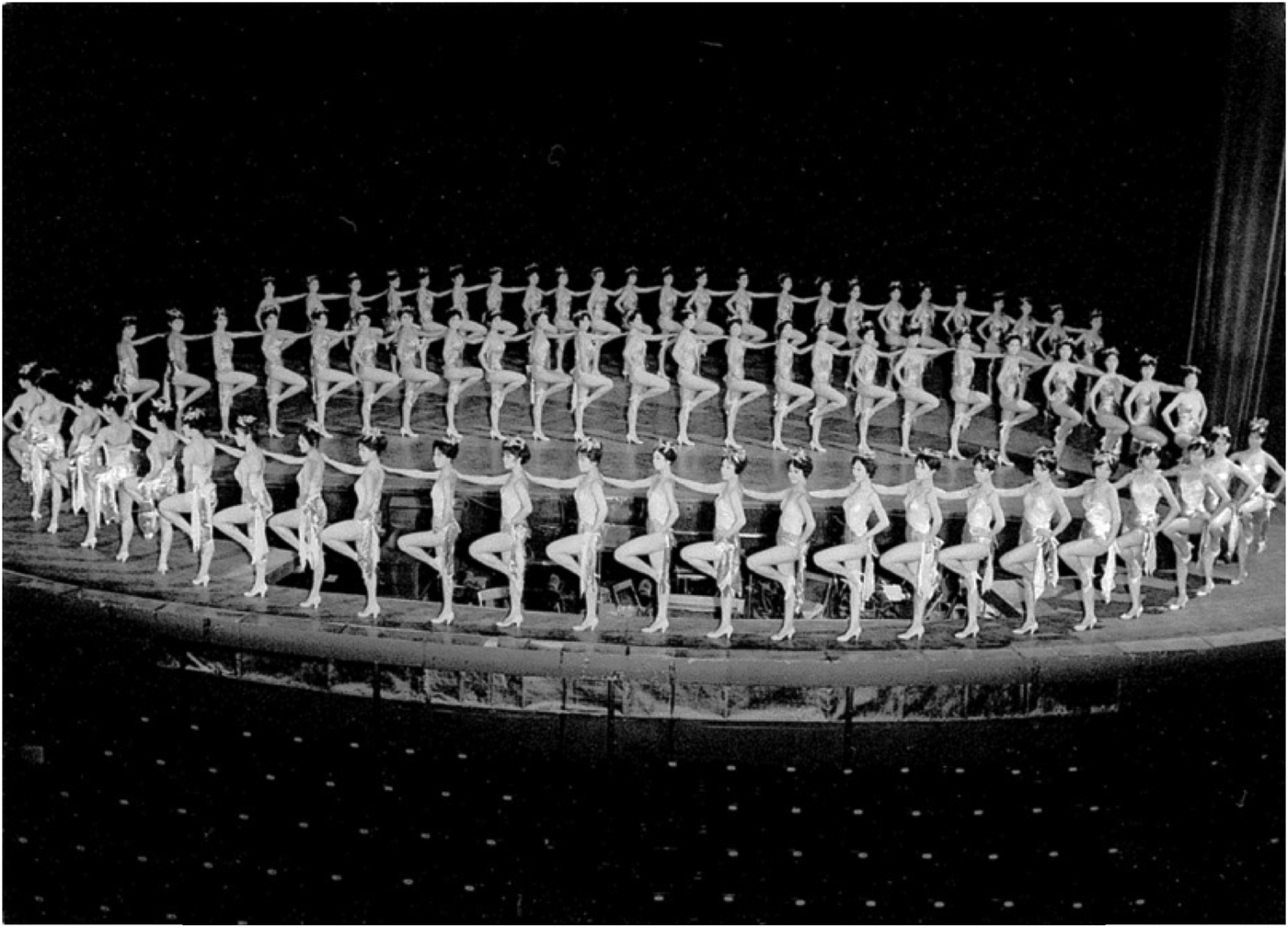
Wren saw the Autumn Dance at the Nichigeki in October 1957 (Fig. 2).Footnote 36 A comparison of the programmes for Autumn Dance and the Cherry Blossom Show reveals substantial similarities in production and repertoire. Of the thirty production staff who worked on the Autumn Dance, twenty-two are credited in the same roles for the Cherry Blossom Show, including Ito Kosuka as producer; Yamamoto Shiro on composition and direction; all five composers; and most of the choreographers, designers and technicians. The male singers James Shigeta and Shimizu Hideo performed in both revues, as did dancers from the Nichigeki Dancing Team, although some players differed. The leading female vocalist of the Autumn Dance was the jazz singer Peggy Hayama; in Australia, the actress Koshiji Fubuki starred in the revue, singing from the Cole Porter songbook, ‘Begin the Beguine’, ‘My Heart Belongs to Daddy’ and ‘Love for Sale’, and the French song, ‘C'est si bon’, made popular by Eartha Kitt.Footnote 37
The Nichigeki Dancing Team in a scene from Autumn Dance (秋のおどり) at the Nichigeki (Nihon Gekijo), Tokyo, 1957. (Source: © TOHO CO., LTD. Theatrical Division, Tokyo).

Around half of the scenes in the Cherry Blossom Show appear to be direct transfers from Autumn Dance. The first half of Autumn Dance includes ‘Puerto Rican Hussy’, ‘Cuban in Me’, ‘Love Letters in the Sand’ and ‘Masquerade’. In the Cherry Blossom Show, these scenes appear translated as ‘Jamaican Hussy’, ‘Orchids in Moonlight’ (to the music of ‘Cuban in Me’), ‘Love Letters in the Sand’ and ‘Masquerade’. A photograph from ‘Masquerade’, depicting ‘a modern ballet number’ with a French theme, is included in a souvenir programme for the Cherry Blossom Show; another photograph from the same scene is held by the archive at Toho in the collection for Autumn Dance. Other scenes shared in the second half of each revue include ‘Slapping down the Street’ and ‘Ginza Street’, ‘Toric Rush’ and ‘Topic Rush’, ‘Carmen Fantasy’ (in both), ‘Dream of (the) Chrysanthemum’ (in both), and ‘Autumn on Parade’ and ‘The Grand Finale’. While the international repertoire of Autumn Dance was retained, some scenes inserted specifically for the Australian tour conveyed touristic impressions of Japan, such as ‘In the Land of the Cherry Blossom’, ‘Japanese Folk Song Medley’ and ‘Ukiyoe Mood’.Footnote 38
Wren's Cherry Blossom Show was Toho's Autumn Dance from the Nichigeki, repackaged for touring with the inclusion of some recognizably Japanese folkloric scenes. Wren reported that the cast flew to Australia at a cost of £35,000 return, indicating the substantial money invested in the tour.Footnote 39 Sixty showgirls arrived at Sydney's Mascot airport on 8 March 1958 and disembarked from the plane dressed in kimono for the publicity photographers.Footnote 40 The show opened at the Empire Theatre in Sydney on 14 March for a four-week season, performing twice nightly, with matinees on Wednesdays and Saturdays. It then transferred for seasons in Brisbane, Adelaide and Melbourne, where it played until 14 June. Wren predicted the box office takings for the tour would be £1 million but it was not to be. In 1968 Wren admitted that the tour had ‘bombed’; his obituary describes it as a ‘flop’ and reports of the loss range from £36,000 to £100,000.Footnote 41 At the time, however, Wren reported the tour a success.Footnote 42 Whatever the loss, it did no long-term damage to either Toho or Wren. Toho followed the Australian tour by taking the Nichigeki Dancing Team on tours to Europe and South East Asia in 1960.Footnote 43 Wren negotiated with Toho to tour another Cherry Blossom Show to New Zealand in 1963 and he went on to import two more Toho revues to Australia: Tokyo Nights in 1965 and Japan by Night in 1968.Footnote 44
The Toho revues divided critics in Australia. In tabloid newspapers and on commercial radio, commentators praised the Cherry Blossom Show as ‘lavish’, ‘spectacular’, ‘charming’, ‘glamorous’ and ‘enchanting’; settings and costumes were admired as ‘ingenious and lovely’, the performers as ‘beautiful and talented – so unusual and exciting’.Footnote 45 But the critic at the Sydney Morning Herald disregarded the efforts of the Japanese artists at ‘aping’ Western entertainment, preferring the folkloric scenes in a ‘Japanese style’.Footnote 46 Critics elsewhere were confounded by what they saw as a confusion of East and West. Stafford Northcote in the Adelaide Advertiser described the revue as a ‘copy of Occidental entertainment’, implying that it was an aesthetic compromise in poor taste.Footnote 47 Bruce Grant in the Melbourne Age complained that ‘these are not so much Japanese artists as Japanese enthusiasts in the international style of entertainment popularised by Hollywood’: ‘the smooth, clicking, boy-meets-girl, million-dollar manner of an MGM musical’.Footnote 48 Grant's view was that the Cherry Blossom Show failed to deliver a performance of adequately national distinction. His conviction that ‘the world of song and dance is improved by national variety’ would only be satisfied by ‘an impression of a folklore built on the past’.
Anticipating these critical distinctions, Wren sought to assure spectators of their disinterest in ‘the tradition of the attraction’ by hailing Toho's international style ‘as modern as to-morrow’. In this way, the critics of Toho's revue in Australia encountered disappointment at the point where Wren wagered on the revue's appeal to spectators: in the translation between a world order defined by the national distinction of folkloric tradition and the smooth surfaces of modern entertainment in the ‘international style’. This translation between folkloric tradition and international modernity is neatly visualized on either side of a souvenir cigarette lighter distributed to patrons at the opening night in Brisbane. One side reads ‘Harry Wren Presents the World Famous Cherry Blossom Show from Tokyo’, with branches of cherry blossom and a Shinto temple gate in red enamel as iconic representations of the revue's name and national origin. The reverse side depicts a dancing showgirl in the international style, dressed in a green bikini and flowing bustle (Fig. 3).
‘Harry Wren Presents the World-Famous Cherry Blossom Show’ – a souvenir cigarette lighter, 1958. (Source: QPAC Museum Collection, Queensland Performing Arts Centre, Brisbane).

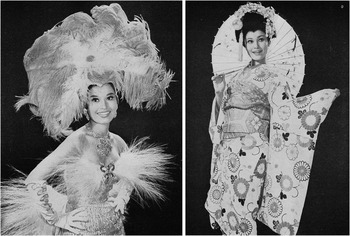
Similar translations between folkloric tradition and international modernity characterized subsequent tours. In the programme for Tokyo Nights, for example, performer Kamijo Misao appears in two guises, wearing a traditional kimono in one photograph, and the feathered outfit of an international showgirl in another. Wren captions the photographs ‘Happy Relations Between East and West – Same Girl – Same Show’, framing Toho's translation between folkloric tradition and international modernity in the terms of entrepreneurial diplomacy as an Australian–Japanese romance (Fig. 4).Footnote 49
‘Happy Relations Between East and West – Same Girl – Same Show’ – Kamijo Misayo in Tokyo Nights. (Source: Tokyo Nights, theatre program, Her Majesty’s Theatre, Melbourne, 1965, Arts Centre Melbourne, Australian Performing Arts Collection).

Entrepreneurial diplomacy, Japanese innovation and the future of Australian entertainment
From the outset, Wren sought the legitimacy of state diplomacy for his dealings with Toho and reported his liaisons with government officials in the press. In Tokyo to finalize preparations for Toho's first Australian tour, Wren told Variety that he had ‘solicited the backing of each country's government’ and was ‘the only theatrical representative invited to all the functions’ when the prime minister of Japan, Kishi Nobusuke, visited Australia in December 1957.Footnote 50 In the souvenir programme for the Cherry Blossom Show tour, Wren reports on consultations with ‘the Japanese consul-general, their ambassador, Japan's Foreign Ministry, and the Australian Commonwealth Government’, and recounts how the Australian government's decision to promote trade with Japan convinced him to ‘do something on the cultural level as well’.Footnote 51 If either government facilitated Wren's negotiations in Japan or Toho's tours of Australia, their support was not overt; there are no official statements from either government in programmes or the press. Yet Wren's rhetoric of entrepreneurial diplomacy only strengthened with the Toho tours of 1965 and 1968. Under the heading ‘Better Understanding and Good Relations for Our Mutual Interests’, Wren described Tokyo Nights as a ‘proven stimulant’ for ‘Export and Import Trade between Australia and Japan’, and urged his audience to recognize Japan as Australia's ‘most needed friend and our best and closest cash customer’.Footnote 52 The same sentiments were expressed in the programme for Japan by Night in 1968.
Wren's advocacy of trade with Japan was not only theatrical promotion in the national interest. In his dealings with Toho, Wren envisioned the future of his enterprise in Australian entertainment. By the mid-1960s, Wren was negotiating with executives at Toho to expand the company's operations in Australia and thereby shore up his own. In late 1967, he signed a contract for a $2 million partnership with Toho, under which Toho acquired a 50 per cent interest in Wren's company.Footnote 53 At the time, Wren was operating the Celebrity Theatre-Restaurant in Adelaide, offering cabaret entertainment in a converted theatre; he also claimed to be constructing theatre-restaurants in Sydney, Brisbane and Auckland, and negotiating an arrangement with the Lido Theatre-Restaurant in Melbourne. Wren's prospect as Toho's partner was to manage the Australasian leg of an international touring circuit. ‘This is how Toho works’, he explained: ‘If an act is bought in the US, say, it plays San Francisco, Honolulu, Tokyo, Osaka, Hong Kong, Bangkok, Brisbane, Sydney, Melbourne, Adelaide, Auckland, then back to Honolulu’.Footnote 54 In particular, the appeal of Toho's system of production was the jet-age ‘efficiency’ of its transport logistics, which Wren planned to adopt for his circuit. The conventional approach to touring companies in Australia kept performers waiting as sets and equipment were transported between venues. By adopting the Toho system, Wren hoped to avoid the ‘dead week’ between seasons and keep the company performing. Under this system, Wren envisaged bringing two shows from Japan to Australia each year, and sending two Australian shows onto the international circuit.
Wren's deal with Toho included the prospect of property development. In February 1968, while Japan by Night was playing in Melbourne, Wren took Toho executives on a site tour of the Tivoli Theatre in Sydney and an adjacent hotel.Footnote 55 The next day Wren announced Toho's intentions to submit a multimillion-dollar redevelopment proposal to the city council, claiming that he had also ‘negotiated the purchase of hotel-restaurant-theatre complexes by the Toho company in Adelaide, Melbourne and Brisbane’.Footnote 56 But these plans did not proceed. On the evening in March when Japan by Night opened at the Tivoli in Sydney, Wren's harbourside home on Rose Bay in Sydney's eastern suburbs was gutted by fire. The police initially suspected arson but subsequently determined that ‘thieves who broke into the home accidentally lit the fire’; evidence of deliberate arson could have implicated Wren in an insurance scam.Footnote 57 Toho's confidence in dealing with Wren might have been dented by reports on the fire.Footnote 58 After concluding the tour of Japan by Night, the company took steps to disassociate from Wren's plans. Hasegawa Jusihiro, a Toho executive who had inspected the Tivoli site in Sydney with Wren, issued a statement in April denying that Toho had an interest in the redevelopment plans; the chief commissioner from the City of Sydney expressed regret that ‘Toho did not make their attitude plain much earlier than this’ and Wren was unavailable for comment.Footnote 59 With this statement out of Tokyo, Wren's association with Toho lapsed.
Although his ambitions for Toho were not realized in full, the question remains: why did Wren look to Japan to envision a future for his enterprise in entertainment? What could Wren foresee that Martin overlooked? The efficiency of Toho's international operations evidently appealed and Wren was equally impressed by the company's technological innovations. On preparing to bring the Cherry Blossom Show to Australia, Wren was delighted to discover that the company had created a 16 mm film of the entire revue ‘to ensure that the first all-Japanese show ever to visit Australia would be at its best’ and an audio tape recording of the musical score ‘so that we could bring this to Australia for our musical director’. From Wren's perspective, Toho's innovations with media technologies pointed to the future of production integrated with distribution across both stage and screen.Footnote 60
Toho demonstrated technological innovation in staging the revues with scenes acted live against a backdrop of projected film. In one scene in the Cherry Blossom Show, a modern-day romance played out on the stage in front of a widescreen projection of the Ginza street in Tokyo. In another scene, James Shigeta performed onstage with ‘a large Tohoscope screen’ showing ‘a movie of a deserted beach’ behind him; as Shigeta sang, ‘letters written in sand, “I Love You”, are washed away gradually by the thoughtless waves’.Footnote 61 ‘Ginza Street’ and other segments combining film with live action were included when the Toho revues returned to Australia in 1965 and 1968. In Tokyo Nights, a scene called ‘Miracle Scope’ is described as ‘the new presentation of combining film and live show on the stage’ in which ‘you will witness that beautiful gems of the screen becoming very much “alive”’.Footnote 62 In Japan by Night, the revue's twenty showgirls were amplified by dancing in front of a film projection of fifty more showgirls ‘direct from the glamorous Ginza of Tokyo’.Footnote 63
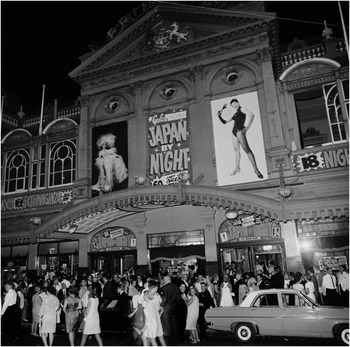
While Toho's innovations demonstrated the modernity of Japanese entertainment, their Australian tours amplified the significance of trade. In 1966–7, Japan became Australia's largest export market, realizing expectations about Australia's trade in the region.Footnote 64 The Australian News and Information Bureau, an agency of the Australian government, photographed Japan by Night as a ‘Multi Million Australian–Japanese Show Business Deal’ (Fig. 5).Footnote 65 By that time, however, Australian critics had fixed against the efficiency of Toho's style. In Melbourne, Japan by Night was labelled ‘Japan Western Style’ by Geoffrey Hutton of The Age:
This slick, quick and well-dressed sample of the giant Toho organisation's pre-packaged entertainment is as international and as efficient as a jet airliner … This is variety straight from the computer, a set of camera-slides where every image is sharp and produced exactly on time … Japan has entered the world market, but it has lost something in the process.Footnote 66
‘Multi Million Australian-Japanese Show Business Deal’ – the audience for Japan by Night outside the Princess Theatre, Melbourne, 1968. (Source: Keith Byron, photographer, National Archives of Australia, A1501, A7957/1).

Post-war reservations about the quality of Japanese mass production are inverted in Hutton's distaste for Toho's international style. Whereas Martin of the Tivoli had described Japanese acts as ‘shoddy’, a term used in Australia to describe Japanese products of poor quality, Hutton's nostalgia for the national distinction of folkloric tradition regrets the mechanized efficiency of Japanese innovation. Yet critical judgement need not outweigh the evidence of entrepreneurial success. Toho's revues provided commercial opportunities for cross-promoting technological innovations in Japanese production. Theatre programmes for the touring revues carried advertisements for local Japanese restaurants, Japanese musical recordings and holiday tours to Japan, alongside advertisements for Japanese transistor radios, miniature television sets and the latest Datsun and Toyota cars imported from Japan. Realizing the prospects of trade between Australia and Japan, Toho's revues became vehicles for translating Japanese distinction into marketable products for Australian consumers.
Conclusion: Australian entrepreneurs, Japanese entertainment and regional integration
Australian entrepreneurs and Japanese producers negotiated their interests in entertainment through circumstances shaped by international diplomacy and the prospects of trade. Whereas post-war antipathy toward Japanese products as ‘shoddy and unreliable’ clouded Martin's interest in Japanese acts, Wren wagered that he would find in Toho's revues a future for his enterprise ‘as modern as tomorrow’. For Toho, the prospects of touring in Australia were ventured through a trade policy that opened Australian markets for Japanese products and demonstrated quality production through technological innovation. For Wren, the prospects of trade with Japan played out as a business romance between the appeal of modernity in Toho's revues and theatrical promotion in the national interest. Wren borrowed the coordinates for promoting Australian trade with Japan from the American map of ‘East–West’ integration. But his dealings with Toho were diplomacy through entrepreneurial means, an investment in building relations between Australia and Japan that looked to the future of regional integration.
A regional perspective on trade distinguishes the Australian experience of Japanese entertainment within the discourse of ‘Cold War orientalism’. American accounts of cultural exchange with post-war Japan emphasize the appeal of tradition. Barbara Thornbury describes how an ‘exoticizing focus on tradition and ahistorical continuity’ characterized the promotion of kabuki on American tours (1954–60) as the ‘preeminent example’ of Japanese culture within ‘a larger, postwar project focusing on American-initiated international reciprocity and exchange’.Footnote 67 From an American perspective on Cold War security, the emphasis on tradition constructed Japanese culture as a trophy to be protected, supported and saved. In these terms, kabuki became ‘a symbolic prize in the Cold War struggle with the Soviet Union for an alliance with Japan’, whereas the Takarazuka revue was dismissed as a modern invention, an ‘unclassifiable hodgepodge’ that betrayed Japan's ‘theatrical heritage’.Footnote 68 By contrast, Toho's tours of Australia (1958–68) point to the significance of modernity, international style and technological innovation in the appeal of Japanese entertainment. This emphasis on modernity reflects the terms of trade between Australia and Japan. Toho's revues promoted Japanese entertainment as an innovative product for distribution in Australian markets. Touring Australia advanced the entrepreneurial prospects of regional integration, even as some critics expressed a preference for Japanese tradition to preserve the national distinction.
Wren's enterprise was ultimately too precarious an investment for Toho but their entrepreneurial diplomacy set the course for what was to come. While Toho and Wren were building an Australian audience for Japanese revue, a younger generation were becoming fans of The Samurai, the unexpectedly successful Japanese television series broadcast in 1960s Australia.Footnote 69 The television series translated into sell-out seasons for actor Ose Koichi, who performed as Shintaro, the lead character of The Samurai, in martial arts demonstrations in Sydney and Melbourne. Ose's tour of Australia in the summer of 1965–6 was presented by David Blank and James McDonald in arrangement with Shochiku, Toho's rival in Japan. Earlier in 1965, Blank had been co-producer for Wren's tour of Toho's Tokyo Nights. A decade later, after the governments of Australia and Japan signed the Cultural Agreement at Canberra in 1974, Shochiku would return to present kabuki on tour in conjunction with the Adelaide Festival and the Australia Council for the Arts. The entrepreneurial trade that brought Japanese entertainment to Australia in the 1950s and 1960s became the cultural diplomacy of artistic exchange that the governments of Australia and Japan have promoted since then.