Introduction
Depression in old age differs from other adult forms of depression and is characterized by fewer emotional symptoms and more common cognitive symptoms, such as attention deficit complaints (Blazer, Reference Blazer2002). These symptoms may be captured more sensitively with dimensional depression questionnaires, such as the Geriatric Depression Scale (GDS) (Yesavage and Sheikh, Reference Yesavage and Sheikh1986). This is reflected in findings from epidemiology. The prevalence of categorically diagnosed major depression according to diagnostic systems (American Psychiatric Association, 2012) is lower than the prevalence based on dimensional instruments. It ranges from 1–3% in Australia, (Kay et al., Reference Kay, Henderson, Scott, Wilson, Rickwood and Grayson1985) to 4.6–9.3% in a systematic review (Luppa et al., Reference Luppa2012a), whereas the pooled prevalence of depressive symptoms was estimated to be 17.1% in participants aged 75+ years (Luppa et al., Reference Luppa2012a).
Research has identified late-life depression as under-recognized and under-treated in the healthcare setting (Young et al., Reference Young, Klap, Sherbourne and Wells2001; Unutzer et al., Reference Unutzer2003). The concordance of a general practitioner diagnosing depression and actual depressive symptoms is rather low, leaving many individuals in need of treatment untreated (Schwarzbach et al., Reference Schwarzbach2014). Some research indicates that recognition of late-life depression is rising, but the in the age group of people 75 years and older depression and depressive symptoms remain under-recognized (Crystal et al., Reference Crystal, Sambamoorthi, Walkup and Akincigil2003). If diagnosed, however, effective treatment strategies are available for these patients. Treatment with anti-depressants (Gill, Reference Gill2000), and also psychological interventions have shown to be effective (Wolf and Hopko, Reference Wolf and Hopko2008; Guhne et al., Reference Guhne, Luppa, Konig and Riedel-Heller2014). Additionally, other low-intensity psychosocial interventions, such as increasing physical activity and self-help have shown promising results (Fiske et al., Reference Fiske, Wetherell and Gatz2009; National Institute for Health and Clinical Excellence, 2009). Collaborative care models can be considered the most sophisticated approach to late-life depression treatment (Unutzer et al., Reference Unutzer2003). They include antidepressant medication, brief structured psychotherapy, and care management services.
Once patients are diagnosed with depression and offered a treatment option, the acceptance of this option largely impacts the success of the intervention. If patients are treated according to their personal preferences, treatment success is higher (Chilvers et al., Reference Chilvers2001; Kwan et al., Reference Kwan, Dimidjian and Rizvi2010). Shared decision making (SDM) has been one approach that underlines the significance of patient participation as a key factor for improving treatment adherence and clinical outcomes (Loh et al., Reference Loh, Leonhart, Wills, Simon and Harter2007). In this model, there is a “meeting of experts” wherein the physician is the expert in medicine, and the patient is an expert in his or her own personal choices and preferences. The physician carefully elicits the patient's ideas about treatment including his or her concerns and preferences (Godolphin, Reference Godolphin2009). In order to practice SDM in older adults with late-life depression, it is important to know the origin of their preferences and their attitudes toward treatment options.
It was a common assumption among German physicians that older adults prefer pharmacological treatments. This attitude is reflected by low rates of psychotherapy and high prescription rates of psychotropic drugs in elderly patients (Spießl, Reference Spießl, Hübner-Liebermann, Schmid, Cording and Hajak2006). There is, however, emerging evidence that older adults prefer psychosocial interventions over pharmacological treatment (Gum et al., Reference Gum2006). It remains unclear, however, if that is the case for all older adults or if these preferences differ depending on depression status. Recent studies have focused on samples in which all patients were depressed (Gum et al., Reference Gum2006) or recruited in special settings, such as patients in home care (Raue et al., Reference Raue, Weinberger, Sirey, Meyers and Bruce2011). To compare preferences of depressed and non-depressed patients, it is important to disentangle disease-driven alterations of treatment preference. One example of these mechanisms is reported in a study investigating the effect of treating depression on preferences for life-sustaining medical therapy. In patients with severe depressive symptoms, opting for life-sustaining therapy increased after treatment, and their prior reluctance was partly explained by their symptoms (Ganzini et al., Reference Ganzini, Lee, Heintz, Bloom and Fenn1994).
Aims of the study
This study, therefore, sets out to examine treatment preferences for depression in the elderly and compares these preferences between depressed and non-depressed elderly. It investigates the association of patient characteristics and treatment preferences and takes different levels of depression severity into account.
Methods
Sample
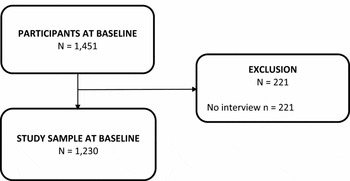
The data were derived from the German AgeMooDe-study (“Late-life depression in primary care: needs, health care utilization and costs”). Within this study, 1,230 patients aged 75 years and older were recruited from primary care practices in the cities of Leipzig, Bonn, Hamburg, and Mannheim. The recruitment process is described in detail elsewhere (Stein et al., Reference Stein2016a, Reference Stein2016b). Figure 1 displays the sample flow chart for the present analysis.
Flow chart of the sample selection.

The baseline assessment was carried out from May 2012 to December 2013. General practitioners (GP) were asked to provide a list of all patients who met the following inclusion criteria: 75 years and older, at least one contact with the GP within the last six months, no severe illness (probably fatal within three months), no moderate or severe dementia, sufficient ability to speak and read German and sufficient ability to consent. The practice staff was asked to indicate on the study enrollment list patients with depression according to GP diagnosis coding. Furthermore, they were asked to list individuals who were not coded as depressed. From the list of non-depressed patients, the study team randomly selected the same number as depressed patients. The GP then contacted all selected patients via post and invited them to participate in the study. The GPs in this study are regular family medicine doctors who generally do not have a specialty in psychiatry. Following this simple, easy to implement recruitment strategy, we recruited a large sample of primary care patients in late life that was enriched with depressed individuals.
Ethics statement
The ethics committees of all participating centers approved of the study (Ethics approval Leipzig: 020-12-23012012). Written informed consent was obtained from all GPs and patients. The authors assert that all procedures contributing to this work comply with the ethical standards of the relevant national and institutional committees on human experimentation and with the Helsinki Declaration of 1975, as revised in 2008.
Data collection
After patients signed an informed consent at the GP office, trained interviewers (psychologists and physicians) contacted each participant for an appointment. The face-to-face interviews took place at the participants’ homes. All interviews were conducted in German.
Instruments
The interview consisted of basic socio-demographic questions and a range of instruments covering needs and service use. The Mini-Mental State Examination (Folstein et al., Reference Folstein, Folstein and McHugh1975) was used to determine cognitive impairment in participants. If a participant scored below 19, the interview was shortened.
Depressive symptoms were assessed using the short version (15 items) of the GDS (Yesavage and Sheikh, Reference Yesavage and Sheikh1986)). The GDS showed good validity and reliability in elderly patients. Factor analysis of the original 30-item scale revealed three factors that are covered by the GDS: Dysphoric mood, Withdrawal–Apathy–Vigor, Hopelessness, Cognitive, and Anxiety (Adams et al., Reference Adams, Matto and Sanders2004). The short version includes seven items on dysphoric mood, three form the Hopelessness and Withdrawal–Apathy–Vigor scales and one each from the Cognitive and Anxiety scales (Adams et al., Reference Adams, Matto and Sanders2004). Confirmatory factor analysis of the short version showed a valid one-factor solution and allows for analysis of the composite score (Launeanu and Hubley, Reference Launeanu and Hubley2012). The first item of the GDS asks whether participants are generally satisfied with their lives. Two different cut-off points were used: A score of 4 to 5 points represents mild depressive symptoms, whereas a score ≥ 6 points indicates moderate depressive symptoms. For both scores, associations with increased costs in healthcare and impairment in quality of life have been demonstrated (Luppa et al., Reference Luppa2013).
Additionally, all participants were asked a set of questions regarding treatment preferences for depression. They were asked to imagine that they suffered from depression and then asked to indicate whether they would turn to one of the presented options for help. This set of questions was derived from previous research (Angermeyer et al., Reference Angermeyer, Matschinger and Riedel-Heller1999) and adapted for this study. In the original study, participants were asked to whom they would turn for help with their depression (e.g. self-help group and psychotherapist). In the present study, items were reworded, specifically asking: “Would you consider psychotherapy as a treatment option for depression?” In a rating scale question, nine therapy options were given and each was to be rated from 1 “very unlikely” to 5 “very likely.” The options were as follows: medication, psychotherapy, a combination of the former, alternative approaches, talking to family and friends, exercise, self-help books, and self-help groups. Psychotherapy was not further specified. Interviewers could also mark an “I do not know” category, but this category was not presented verbally to the interviewees. After these options, respondents were asked to rank these options with the question: “If you suffered from depression, which of the former options would be your first (resp. second) choice of treatment?”
Social support was assessed with the ENRICHD Social Support Inventory (ESSI, Kendel et al., Reference Kendel2011). Low social support is determined with a score of lower than 18 points, whereas scores greater than 18 indicate high social support.
Data analysis
All data were analyzed using Stata 13.0 (StataCorp, 2013). Preference for each therapy option in case of depression was analyzed by regression analyses controlling for socio-demographic information (age, gender, education, and living situation), cognitive status (MMSE), and social support (ESSI) as potential confounding variables. Depressive symptoms from 4 to 5 points and ≥ 6 points were used as main independent variables. In bivariate analysis, t-tests were used to determine differences in means. For the data analysis of the rating of treatment preference, eight regression models were conducted; the answer category “I do not know” was treated as a missing value. Additionally, logistic regression models using a categorical outcome for each option for help were conducted. Here, the answer category “I do not know” was compared to any other answer pattern for each option. The ranking of options was analyzed descriptively.
Results
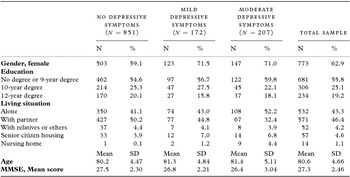
Sample socio-demographics are displayed in Table 1. The mean age of participants was 80.6 years with 62.9% of the sample being women. The prevalence of mild depressive symptoms was 14.0% (GDS = 4–5) and reached 15.9% (GDS ≥ 6) for moderate depressive symptoms.
Socio-demographics, according to level of depressive symptoms (N = 1,230)

MMSE = Mini-Mental Status Examination.
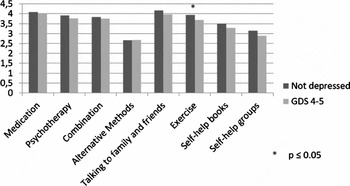
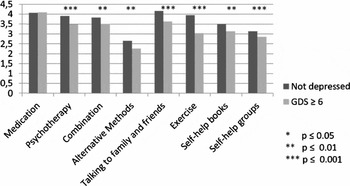
When we compared mean endorsement for each treatment option according to the existence of depressive symptoms, we found significant differences between mildly depressed patients and not depressed patients in terms of preference for physical activity as a treatment (p = 0.044, Figure 2). In participants with a GDS score of 6 and higher, we observed differences in the preferences of all treatments except for medication (Figure 3). Participants with depressive symptoms were more hesitant about all options except medication.
Preference compared across GDS = 4–5, mean of rating of preference (range: 1–5).

Preference compared across GDS ≥ 6, mean rate of rating (range: 1–5).

Table 2 summarizes the results from the regression analyses for each treatment option. The presented models were adjusted for age, gender, education, living situation, MMSE score, and social support. Even after these adjustments, a significant association between depressive status and several treatment options remained in participants with moderate depressive symptoms. A GDS score of greater than 6 was associated with a lower endorsement of psychotherapy, alternative methods, exercise, and self-help group and books as an option for treatment seeking. Participants with mild symptoms (GDS 4–5) did not differ from non-depressed counterparts.
Support of treatment strategies according to depression status, beta-coefficients and confidence intervals (CI)

Dependent variable: would you consider this kind of treatment if you had depression? 1 – very unlikely to 5 – very likely.
*p < 0.05.
**p < 0.01.
***p < 0.001.
Adjusted for Age, gender, education, living situation, cognitive status, social support.
Looking at the probability of choosing the answer category “I do not know,” Table 3 shows significant differences according to depressive status. For each treatment option, the probability of choosing this category was significantly increased for participants with moderate depressive symptoms. Odds ratios for moderate depressive symptoms ranged from OR = 3.021 (95% CI: 1.706–5.349, p < 0.001) for self-help groups to OR = 4.406 (95% CI: 2.524–7.693, p < 0.001) for alternative methods. We found no differences in those participants with mild depressive symptoms.
Logistic regression, “do not know category” versus preference decision, odds ratios and confidence intervals (CI)

Dependent variable: Would you consider this kind of treatment if you had depression? 1 – very unlikely to 5 – very likely.
*p < 0.05.
**p < 0.01.
***p < 0.001.
Adjusted for Age, gender, education, living situation, cognitive status, social support.
Ranking information supported these results (data not shown). 7% of non-depressed participants (GDS < 6) declined to indicate their first treatment choice, whereas this was the case in 21% of depressed participants (GDS ≥ 6). For non-depressed participants, medication and talking to family and friends were the most common first choices. The pattern medication (first choice) – psychotherapy (second choice) was most common (11%), followed by medication (first choice) – talking to family and friends (second choice, 8%). In depressed participants, medication was the most common first choice, but here the second most common answer was a denial or inability to rank answer categories. Again, the pattern medication–psychotherapy was most common (10%), followed by medication–talking to family and friends (10%).
Discussion
This is the first study reporting support for a variety of different depression treatment options in a large sample of participants aged 75 years and older. It provides evidence that older patients in Germany accept medication and psychotherapy (and accordingly a combination of both) as treatment options in late-life depression and it stands in contrast to earlier clinical lore that suggested older adults preferred pharmacological treatments. Talking to family and friends is also a preferred option. Depressive symptoms, however, influence these preferences, leading to a lower general support of most interventions. Additionally, depressed elderly show a profound difficulty in choosing preferred treatment options, which is not surprising from a clinical perspective.
Comparing our results to previous studies is difficult, as there are no studies in patients of that age. One study included depressed patients with an average age of 57 in their sample. They found that older patients preferred treatment with medication compared to psychotherapy or held an equal preference for psychotherapy and medication (Lin et al., Reference Lin2005). In contrast, we generally find an equal acceptance of psychotherapy and medication as treatment options. Reportedly, the use of psychotherapy in the elderly remains low (Wei et al., Reference Wei, Sambamoorthi, Olfson, Walkup and Crystal2005). Although few data are available, studies on health service use indicate that much fewer older patients receive psychotherapy as compared to medication (Luppa et al., Reference Luppa, Sikorski, Motzek, Konnopka, Konig and Riedel-Heller2012b). This is unfortunate, as it has been shown that psychotherapy is effective in treating late-life mental disorders (Gum and Areán, Reference Gum and Areán2004; Pinquart et al., Reference Pinquart, Duberstein and Lyness2007; Guhne et al., Reference Guhne, Luppa, Konig and Riedel-Heller2014). It can be concluded from our results that older adults are, in general, willing to pursue treatment with psychotherapy.
Furthermore, the respondents in our study also endorse other relevant treatment options, such as psychosocial lay support and exercise. Both have shown to positively affect depression outcomes in older persons (Mather et al., Reference Mather, Rodriguez, Guthrie, McHarg, Reid and McMurdo2002; Ell, Reference Ell2006). The finding that individuals with depressive symptoms are more reluctant to talk to friends and family may be a reflection of social withdrawal because of these symptoms. Talking to friends and family can also be read as utilizing the lay system. Befriending as a treatment option has also shown moderate beneficial effects on depression (Mead et al., Reference Mead, Lester, Chew-Graham, Gask and Bower2010). At the same time, our findings also reflect the known mismatch of patients’ preferences and treatment efficacy. For instance, electro-convulsive therapy (ECT) is known to be an effective way of treating severe depression in particular (Frazer et al., Reference Frazer, Christensen and Griffiths2005; Spaans et al., Reference Spaans2015), but the stigma associated with ECT and concerns about its safety may keep patients from stating a preference for this treatment option (Brandt and Ugarriza, Reference Brandt and Ugarriza1996; Stein et al., Reference Stein2016b). Additionally, many countries have imposed mental health acts to overrule the patients’ preference when it comes to acute self-endangerment. In less severe cases, as detailed, it may however be beneficial to apply treatment options that are endorsed by the patient as well in order to increase efficacy of the treatment.
It has been widely discussed why over 75-year olds are under-treated when it comes to depression (Arean and Unutzer, Reference Arean and Unutzer2003), and our findings indicate that depressive symptoms have an impact on treatment preferences and, moreover, on the probability of choosing a preferred treatment. Recent studies in younger patients oftentimes do not report answer patterns for an “I do not know” category, but present figures for a “wait-and-see” option. Results here indicate that depressed individuals do not tend to choose the “wait-and-see” option, but these studies are based on patients that are already in treatment for their depression (Dwight-Johnson et al., Reference Dwight-Johnson, Sherbourne, Liao and Wells2000; Raue et al., Reference Raue, Schulberg, Heo, Klimstra and Bruce2009). In our study, this difficulty is not evident in non-depressed older individuals either, but to depressed patients indecisiveness may represent a major barrier to SDM. This finding is worrying since the probability for treatment in general, as well as treatment success, is driven by a preference for treatment (Chilvers et al., Reference Chilvers2001; Kwan et al., Reference Kwan, Dimidjian and Rizvi2010). Not being able to determine the preferred treatment option can, therefore, negatively impact treatment success. SDM is also negatively influenced if the patient is indecisive due to the symptoms he or she is experiencing. Taken together with our finding that the endorsement for some treatment options is reduced in patients with depressive symptoms, healthcare providers will need to recognize the limitations of SDM in older depressed individuals.
In clinical practice, providers must be attentive to the influence of depressive symptoms on their treatment alliance with patients. The symptoms of depression include anhedonia, hopelessness, and an increased disability to make decisions (Spießl et al., Reference Spießl, Hübner-Liebermann, Schmid, Cording and Hajak2006). This study further underlines that depressive symptoms can translate into difficulties making treatment decisions. Furthermore, patients will need to be informed about options and strategies in more detail than other clientele. It seems that strategies that involve activity and social interaction by the patients are less often supported by depressed patients. This pattern can also be attributed to the existence of depressive symptoms and is supported by the fact that more severe symptoms result in higher rejection and lower support of even more options. For example, there is evidence that depression leads to a more sedentary lifestyle and a reduction in physical activity (Roshanaei-Moghaddam et al., Reference Roshanaei-Moghaddam, Katon and Russo2009), which in turn explains a reluctance to engage in exercise as a treatment option.
Limitations
Patients’ previous experience with any depression treatment was not included in this analysis. Studies have shown that familiarity with treatment impacts treatment preferences – if a patient has had a positive experience with a certain type of treatment, support rates of that specific treatment increase (Gum et al., Reference Gum2006). In addition, the psychotherapy item may have been confusing as it relied on the patients’ interpretation of what is meant by psychotherapy. In Germany, the health insurance system covers three psychotherapeutic treatments (cognitive-behavioral, psychodynamic, and psychoanalytical treatment), all of which may have different acceptance in the general public. Furthermore, the specific role of life satisfaction could not be studied in detail due to concerns of multi-collinearity with the first item of the GDS, in which satisfaction is covered precisely. It can be assumed, however, that this is a variable influencing treatment options as well.
Additionally, we are not able to compare patients that declined to participate in our study with those who did. However, data are based on a large sample and 97% of German elderly individuals are regularly seen by a GP. Additionally, our data showed to be perfectly comparable to a large German study in the primary care setting (AgeCoDe, Luck et al., Reference Luck2007), where an average age of 79.6 years was observed in a sample consisting of 65.4% women. Even MMSE scores were comparable to our sample (27.3). At the same time, the AgeCoDe study showed a prevalence of 9.7% of moderate depressive symptoms (GDS ≥ 6, Weyerer et al., Reference Weyerer2008), clearly showing that we were able to obtain an enriched sample of depressed individuals.
However, the proportion of depressed individuals in the study as determined by the study assessment tools was below 50%. It could be that patients who were listed as depressed on the GP list had been successfully treated or that individuals demonstrated an improved symptom profile at the interview at a later point of time, thereby resulting in individuals having been misclassified on the GP lists.
Conclusions
Depression in the elderly is still an under-treated condition. This is the first study to compare treatment preferences for depression in the oldest old according to depressive symptoms. Depressive symptoms influence preferences in treatment options and also influence indecision of patients. Treatment preferences may have a large impact on treatment and success, and it is therefore crucial to provide the patient with sufficient information and support when making a treatment decision. The paper points to the limitations of SDM in depressed individuals in latest life and to the fact, that especially in mental disorders, treatment preferences are inflated by the experience of current symptoms. The high support of psychotherapy indicates a much higher demand for late-life psychotherapy in the future; the healthcare system will need to prepare to be able to meet this need.
Conflict of interest
None.
Description of authors' roles
CLS, JS, SW, HK, MS, HHK, WM, BW, and SRH were involved in the conception and design of this study. This included the sampling procedure as well as the development of the final assessment. CLS, KH, JW, and JOB interviewed participants, and acquired and managed the data. BW and LM monitored data collection for the whole study and cleaned the data. CLS analyzed the data, and drafted and revised the paper. All authors have read the first draft of the manuscript and have revised it for important intellectual content. All authors have read and approved of the final version of the manuscript.
Acknowledgments
This study was funded by the Federal Ministry of Education and Research (AgeMooDe-study, BMBF, grant numbers: 01GY1155A – D) and by the Federal Ministry of Health (AgeMooDe+Synergie, BMG/BVA Grant Number: II A 5–2513 FSB 014). We thank all participating general practitioners in Mannheim, Bonn, Hamburg, and Leipzig.