At the height of the Blitz, the illustrated weekly Picture Post offered a photo-essay on wartime London enduring the privations of bombing. Below a shot of a woman putting on makeup in the Underground, a caption read: “Here All One's Life is Public. Privacy, so highly cherished by Britons, is gone. Family life at evening has vanished. Here nothing is intimate. One talks, eats, sleeps, lives, with a hundred, a thousand others.” With other pictures of everyday life in the shelter, of people getting along during raids, the photo-essay celebrated the ordinary qualities of “patience, cheerfulness, resignation, friendship, even gaiety, and, most of all, helpfulness” that would save London and the nation from the Luftwaffe.Footnote 1 Photographs thus helped construct the discourse of a national community mobilized and reinvigorated by the demands and experience of total war, and a familiar theme of many cultural histories of the Second World War has been this relationship between culture and “societal regeneration.”Footnote 2 Though there has been considerable work on wartime cinema in this regard, there is much less literature on wartime photography. But still photographs were as crucial, and certainly more ubiquitous, than cinema in constructing a visual discourse of the People's War. Such visual discourses complemented what Geoff Eley has called the “democratic romance of 1945” with its “narrative of popular democratic accomplishments.”Footnote 3
As a photographer active during the war, Bill Brandt (1904–83) helped shape these visual discourses. Brandt is perhaps the most important British photographer of the twentieth century. Working for the magazines Picture Post and Lilliput in the war years, he produced iconic images of a war fought and won by ordinary people. Brandt's studies of Londoners taking shelter in the Underground and in church crypts offered a moving portrait of London's resilience during the Blitz. His composite photograph “St. Paul's Cathedral by Moonlight” (1940) was similarly eloquent, the cathedral's dome rising in darkness against a foreground of bomb rubble.Footnote 4 With such photographs, Brandt operated within and helped sustain a dominant discourse of wartime culture and politics in which the private intersected with the public, the individual with the community, not only in the survival of the nation, but in its rebirth in a period of crisis.
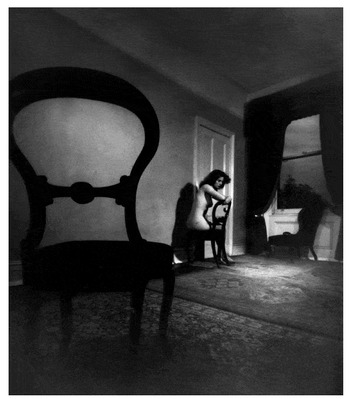
Yet Brandt followed a very different road away from 1945. He largely abandoned documentary work, returning to the “poetic trend” of his earlier photography with landscapes, portraits, and nudes.Footnote 5 Some of his most challenging work came with the last. In 1961, Brandt published Perspective of Nudes, featuring distorted bodies and close-up shots of hands, feet, and skin. This work helped secure his reputation as a consciously “artistic,” rather than documentary, photographer. The nudes he made in the transition from war to peace, between 1944 and 1953, were particularly striking as an apparently sharp departure from his documentary work. They mapped a dark and often surreal world of sexual and psychological obsession. “Campden Hill, 1947” (see fig. 1) is a good example. A nude female figure is placed center-frame and in the middle distance. The eye is first brought into the photograph by the chair in the left foreground, then moves over the seated figure and finally to the window framing a night sky. By using a Kodak police camera with considerable depth of field and a tiny aperture, Brandt tricks the spectator: almost everything in the picture is in focus, despite different distances. The photograph thus subverts any sense that it represents something real. Instead, “Campden Hill, 1947” is suffused with a hallucinatory quality. But it is a dream wound through with desire and mystery, signaled by the position and pose of the model. Her body is embedded in a dark interior, rather than placed in the foreground. She is half-turned away from the photographer. Partly shielding her body, her eyes are averted from the observer's voyeuristic gaze, introducing an atmosphere of sexual tension.
With photographs like “Campden Hill, 1947,” Brandt seemed to turn his gaze to worlds beyond the reach of wartime and postwar society. Unlike his earlier work, Brandt's nudes apparently refused the call of a public or social world. But I will argue that we can still see in them a dialogue with the experience and discourse of war. To adopt a comment of Annette Kuhn, the “space of narrative”
“Campden Hill, 1947.” © Bill Brandt/Bill Brandt Archive, Ltd., 2005.

in Brandt's nudes was “marked by the traces of war.”Footnote 6 In particular, I will demonstrate that there is a strong thematic and stylistic continuity between Brandt's wartime “documentary” photographs of London during the Blitz and the nudes.
In his reflection on British film and the Second World War, Eley suggests that we should “craft … new social and cultural histories of the complex realizations, failures and transmutations of 1945's original hopes.”Footnote 7 Sonya Rose has similarly pointed to the “contradictions and instabilities” of the People's War.Footnote 8 Following the arguments of Eley and Rose, the present article excavates darker and more angular visions arising from the war than those to which we have become accustomed. These visions grew out of the experience of photographing war, but could not be accommodated within the dominant discourse of a People's War. Writing of Brandt's pictures in 1942, Picture Post's editor, Tom Hopkinson, noted, “This is not the comfortable world we know.”Footnote 9 This article maps that dark, unfamiliar world as a way of suggesting a new understanding of the representation of the Second World War. I will also show that Brandt was not alone in this dissonant vision by discussing the wartime literature of Elizabeth Bowen, Graham Greene, and Henry Green.
Following other work, the present article is an attempt to read a particular body of photographs as social and historical texts.Footnote 10 This is made more complex because the photographs are of the body. Writers on photography have often argued for placing photography of the body in a social context.Footnote 11 I will trace the relationship in a specific way. Looking at Brandt's photographs in this fashion blurs the line between a number of categories: between nude photography and documentary photography, between public and private spheres, and between the psychological and the social.
Discussing photography of the body and nude photography necessarily involves an examination of the relationship between the male gaze and the female body. The nude has, of course, enormous meaning in Western art. In 1956, Kenneth Clark famously divided the naked figure from the nude, arguing that in art, the latter was an idealized form, largely transcending sexuality.Footnote 12 Just as famously, John Berger troubled this distinction in the early 1970s, suggesting how fine a line it was between the naked and the nude. Berger also pointed to the highly gendered and sexualized relationship captured in the nude between the woman on display and the unseen male spectator.Footnote 13 Of course, there is also a tradition of the male nude, particularly in photography.Footnote 14 But, as Lynda Nead has pointed out, in the Western tradition, it is the female nude that is “not simply one subject among others, one form among many, it is the subject.”Footnote 15 And in visual culture, the female nude has been a subject shaped by the male gaze. Laura Mulvey has written of the power and pleasure accruing to the male eye in narrative film. Men's power is that of scopophilia, the pleasure of looking. “Woman” is the object and the spectacle of that gaze. But Mulvey also suggests that the female spectacle challenges the male spectator, particularly as the former signifies the attraction and anxiety of sexual difference.Footnote 16 Following these arguments, looking at photography of the female body involves an understanding of a shifting balance of sexual power between male spectator and female object. As I will suggest, this relationship is key to understanding the social and historical context of Brandt's photographs in the 1940s.
Bill Brandt was born in Hamburg, Germany, in 1904 to a wealthy merchant family.Footnote 17 His father was British-born, and Brandt had family in England. After a spell in a tuberculosis clinic, Brandt apprenticed as a photographer in Vienna and Paris. In Paris, he briefly worked with Man Ray, who was using photography to explore a surrealist vision. Disillusioned with Europe, Brandt settled in England in 1934. Two years later, he published The English at Home, followed in 1938 by A Night in London: both were photographic meditations on his adopted country and city. In the same period, he produced memorable images of the industrial north and London's East End. This work seemed to confirm Brandt as a poetic social documentarian. But even in the thirties other forces were at play in his photographs, such as surrealism and an interest in psychoanalysis. A better description of his work in the 1930s might be one coined by Ian Walker for a different context: “documentary surrealism,” the production of a “documentary” photograph “threaded through with enculturation, with subjectivity, with desire.”Footnote 18 Charles Hayes has suggested that for Brandt this involved “the Surrealist mystery of the remembering, dreaming self, imposing its emotional needs on the world around it.”Footnote 19
Brandt's representation of Britain has been the subject of considerable discussion. As a German by birth and upbringing, his position was that of an outsider to English society, yet he made some of the most indelible pictures of that society between the wars, just as the Swiss photographer Robert Frank memorably captured fifties America in The Americans (1958). Brandt loathed his native country from an early age. Once in England, he proceeded to reinvent himself as an Englishman. “Bill Brandt” the Englishman was a hybrid production, combining a fascination for upper-middle-class society and upper-middle-class women with a name smacking of working-class solidity. Paul Delany, Brandt's recent biographer, has suggested that the process of invention spilled over from his own identity to that of England itself: “[Brandt] wanted to be English, and really belong to the fairy-tale island. This meant inventing a new identity for himself … but also inventing an England that would satisfy his childhood fantasies.”Footnote 20 This England was made of images and ideas culled from half-remembered Victorian and Edwardian children's books. But, as other studies have shown, it was also made from foreign sources. Brandt's construction of England continually involved European or American influences, whether surrealism, German expressionism, psychoanalysis, or the aesthetic of films such as Citizen Kane (1941).
When war came in 1939, Brandt worked for Picture Post on subjects such as the wartime Derby and the bombing of Bath and contributed photo-essays on the war effort. He also documented the conditions on the Bournville housing estate near Birmingham.Footnote 21 In Lilliput, he published extended studies of London at night, Soho, and the Blitz shelters. On occasion, Brandt shaped his wartime photographs into a narrative, such as 1941's “A Simple Story about a Girl,” following a young woman's romance with a soldier. Brandt also photographed for the war effort in an official capacity. In the autumn of 1940, the Ministry of Information's Photograph Division commissioned him to take photographs of people in public shelters. Over a period of about ten days, Brandt went through the underground and into church crypts, photographing ordinary Londoners. The pictures received wide circulation. They were published in Lilliput and Horizon in 1942 and (reportedly) were passed on to President Roosevelt as evidence of Londoners’ capacity to withstand the bombing campaign.
Despite such documentary work, war did not end Brandt's interest in surrealism or in the psychological. Early in the war, he published “Night Walk: A Dream Phantasy in Photographs” in an American magazine, Coronet. It offered a sequence about a girl's dreams and nightmares inspired by German expressionism. As a number of authors have suggested, “Night Walk” was an explicit articulation of Brandt's interest in the surreal, the psychological, and the sexual. As shall be suggested, these became dark threads running through much of his wartime documentary work.
On the surface, Brandt helped construct a familiar patriotic wartime discourse. Like many other photographers, he showed the British people (and, in particular, the citizens of London) winning the war by asserting the continuity of ordinary life in the midst of extraordinary hardship and danger. His series “Soho in Wartime: Eight Bits of a Quarter” explored, for example, the continuing rhythms of everyday life in that neighborhood, much in the style of The English at Home. Soho's denizens went about their business and pleasure almost as they would in peacetime: “in spite of the war, and the bombs, you can still go from the bookies’ pub to the swing pub, the film to the French, the poets’ to the barbers’, the tradesmen's business house to the house where it isn’t your business, from the pick-me-up to the knock-you-down.”Footnote 22 Only the last photograph in the series made explicit visual reference to the war, showing a waiter crossing a street with a glass of wine on a tray, as a bomb-damaged building stood in the background.Footnote 23
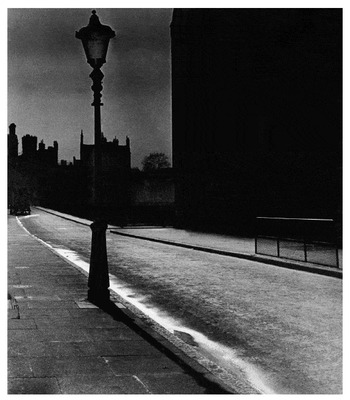
Two groups of photographs are particularly important in Brandt's wartime work: the studies of nighttime London and those of the Blitz shelterers. The first includes pictures taken of Bloomsbury, the City of London, and St. Paul's Cathedral during the blackout. The second comprises photographs made of the Underground and church crypts. Most of these photographs were taken in the first two years of war. They were published singly and in sets; in 1942, for example, Lilliput published both the shelter pictures and those of nighttime London.Footnote 24 These photographs can certainly be read as documents and celebrations of the survival of London and its inhabitants. Almost all the photographs of shelterers show Londoners in repose; sleep indeed seems to be the greatest weapon in the fight against German bombers.Footnote 25 The text accompanying the photographs underlined this sense. Of the photograph of an older woman sleeping in a Spitalfields crypt, the caption read, “face and attitude show determination, even in sleep.” Another photograph of a family sleeping together was accompanied by the remark, “this is a group typical of the thousands of Cockney families who made their homes in the Underground during the Blitz.”Footnote 26 Even one of Brandt's more playfully surreal photographs, that of “The Sleeper,” published in Lilliput in 1941, can be read as contributing to this discourse: a young woman is sound asleep with a smile on her face, while antiaircraft searchlights form a forbidding latticework on a dark London sky.Footnote 27 If Londoners survived and resisted the bombing by sleeping, London's buildings did so by remaining intact. Brandt's photographs of London above ground show buildings in the blackout standing like mute, stolid guardians of an abandoned city (see fig. 2). Of a photograph of Holly Place, Hampstead, the caption noted “the house dates probably from about 1812. It has survived the bombing.”Footnote 28
There are somber undercurrents in these photographs that unsettle discourses about a reinvigorated public world, in which the nation was saved by the patriotism and stoicism of ordinary people. If these are pictures of resistance and survival, they are also photographs about darkness and death. The photographs of London are nightscapes shot in existing light over long exposures that bring out the relationship not between darkness and light but rather between shades of grey and black. Light is almost completely absent. The photographs are studies in blackness, sculpted out of shadow. They are also desolate of any human presence. The absence of light and human figures adds to the dreamlike atmosphere of the photographs; the viewer moves through London alone and isolated. Brandt himself remarked upon the “brooding fantasy hidden in [London’s] stones” and the surreal vista opened up by the blackout: “for a minute or two this street in Bayswater had something of the dream-like atmosphere of an Italian piazza in a Chirico painting.”Footnote 29 Rupert Martin has suggested that in these photographs London “[appears] to be a vast deserted necropolis”: it is a world of death.Footnote 30 The mix of darkness, dreams, and death can also be seen in the photographs of shelterers. In contrast to the photographs of London above ground, these are landscapes with figures. However, as already noted, they are figures in repose. Sometimes that repose seems not to be of sleep, but of death. In Brandt's celebrated picture of “Elephant and
“Bloomsbury, 1940.” © Bill Brandt/Bill Brandt Archive, Ltd., 2005.

Castle, 3.45 am” (1940), bodies stretch out into the blackness of the Tube. No one is awake (indeed, Brandt excised the one person who looked back into the camera). They could be piles of corpses as much as Londoners resisting the Blitz. The intimate family portrait in “Liverpool Street, 1940,” showing a father, mother, and child with limbs entwined, might also be viewed as bodies in the embrace of death. Perhaps the clearest example of this is the photograph “Spitalfields, 1940,” of a man lying asleep in a sarcophagus in the crypt of Christ Church, Spitalfields. It is, of course, a stone coffin; the man is asleep in the pose of a medieval effigy. If in the photographs of London streets, there is a relationship between darkness and death, in the shelter photographs, there is a relationship between sleep and death. This is also consonant with a surrealist sensibility that often associated sleep, dreams, and death.Footnote 31 The buildings of London suggested this, as did “the long alley of intermingled bodies” Brandt noted below ground.Footnote 32 The stillness of a graveyard hung over both bodies and buildings.
Other photographs taken during the war also explore death and transformation. In 1943, Brandt did a series of elegiac photographs of Hadrian's Wall that dwelt upon the decay of the wall (under threat from nearby quarrying), while calling to mind ancient invasions and conflicts.Footnote 33 In other photographs, the connection with death is more explicit, as in his wartime studies of cathedral interiors, including many pictures of tombs and effigies.Footnote 34 Images of immanent decay or death were also accompanied by studies of immediate destruction. One of Brandt's assignments for Picture Post in 1942 was to document the aftermath of a German raid on Bath. His photographs of damaged houses and streets—including the renowned Assembly Rooms and Royal Circle—were direct representations of the destruction of war.Footnote 35 Ian Jeffery has remarked that the war “rewrote Brandt's terms of reference, introducing him to apocalypse.”Footnote 36 That sense of death or destruction pervades his wartime photographs. Brandt's photographs thus subvert, as much as construct, a visual discourse of the People's War based upon the celebration of the unity and survival of the nation. They are as much photographs of death as of regeneration.
Sex walks hand in hand with death in Brandt's photography from the 1940s. The expression of female sexuality and femininity was a particular theme. We can see this in his portraits of independent and often uncompromising female figures, though these portraits were of course colored by male voyeurism. In the series on wartime Soho, a bored nightclub hostess leans back in a chair, staring into the middle distance, smoking a cigarette, thinking about “the jokes she has heard a hundred times, smiling at the compliments that have grown flat as the beer in front of her.”Footnote 37 There are other examples of independent women in his photographs, as in the essay “A Simple Story about a Girl,” which tracked a young woman's walk in the park and her romantic encounter with a young soldier. Brandt also did photo-essays on women war workers and a mildly risqué study of the exotic dancers of London's Windmill Theatre. His interest in representing such women might be seen in the context of what has been called the “mobile femininity” of wartime, which afforded young women greater freedom and autonomy, particularly in terms of sexuality.Footnote 38 Brandt also focused on the expression of heterosexuality in wartime, as a kind of English equivalent to France's Brassaï. One of Brandt's most popular pictures in Lilliput was “Soho Attic,” of an embrace in a darkened bedroom, though this was photographed in the late 1930s. He did a series of photographs for a Picture Post photo-essay called “A Day on the River” that featured pictures of heterosexual couples along the Thames. One photograph in this series, which was left unpublished, showed the bodies of a man and a woman entangled in an embrace on the riverbank.Footnote 39
The nudes of the late 1940s must be seen in the context of Brandt's wartime photographs. The nude was not a form in which he had shown much interest before the war, but during the forties, Brandt began to publish nude photographs in Lilliput. Lilliput was an interesting forum for this work. In its pages, cheesecake nudes with illuminating captions such as “My Name Is Judith!” competed for space with high art photography from Edward Weston and Man Ray, while essays by Geoffrey Grigson and Robert Graves jostled with advertisements for Vital Books, publishers of The Technique of Sex (“illustrated”) and It's Only Natural: The Philosophy of Nudism (“fully illustrated”). A broadly comic surrealism dominated Lilliput's pictorials: penguins in the mating season were placed against a field of Royal Air Force officers in physical training followed by a visual duet between a long-haired goat and the Hollywood starlet Veronica Lake.Footnote 40 With this mix, Lilliput was aimed at the raffish intellectual-about-town. Lilliput's taste in nudes ranged from straight kitsch to gently challenging exercises in surrealism by Laelia Goehr, Berko, and Peter Rose-Pulham.Footnote 41 Brandt began to contribute nudes to Lilliput during the war, though these erred more on the side of glamour than experiment.Footnote 42 But in 1946, with the appearance of the photograph “The Watcher,” Brandt began to publish his signature darker studies of the nude. These pictures would have disrupted the jovial and light tone often taken by Lilliput but would not have been entirely out of place, given the work of Goehr and Rose-Pulham.
I will concentrate on the nudes that Brandt did between about 1944 and 1953 and on a number of pictures within this body of work. Perhaps typically, Brandt was both revealing and cryptic when he spoke of his nude photography: “it's very difficult to talk about the nudes … they are my favourite pictures.”Footnote 43 Though the nudes of the 1940s have not attracted as much attention as the later nudes or the 1930s pictures, they have still elicited considerable comment and attempts at interpretation.Footnote 44
A common thread is their “disturbing” and transgressive quality. This was, according to Michael Hiley, “unsafe subject matter, touching on raw nerves, trespassing into forbidden areas.”Footnote 45 One strain of interpretation sees this in psychoanalytical terms. David Mellor fits the nudes into his compelling survey of the “phantasms” ranging across Brandt's entire oeuvre. Drawing from the work of Wilhelm Stekel, the psychoanalyst who treated Brandt briefly in the early thirties, Mellor highlights the way the photographs unveil a “forbidden chamber” to which the viewer gains “illicit entry.” The nudes articulate a sexual fantasy firmly lodged in childhood: “the thwarting of patriarchal authority; the bewitching, petrifying, and petrified woman; confining rooms that frame and fix the body within; doors giving onto secret chambers; the night dreams of a curious child; and rhymes, nonsense, fairy stories, and their picturing.”Footnote 46 In his recent biography, Paul Delany sees latent sadomasochism in the pictures, a playing out of Brandt's childhood traumas and fantasies. He also suggests that the historical context to the photographs lies in the retelling of Victorian children's stories and pictures.Footnote 47 In these readings, the nudes’ primary meaning is psychological. If, as John Pultz has suggested, photography in the first half of the twentieth century gave “form to heterosexuality,” Brandt's photographs added a troubled psyche to that form.Footnote 48
The nudes have also been seen through the lens of surrealism. Brandt had, of course, briefly apprenticed with Man Ray in Paris. He also admired the work of de Chirico and Magritte. A surrealist tone imbued many of his pictures. In his nudes, we can see something of what David Bate has called the “enigmatic” mode of surrealistic photography, in which both the means of photographing and the subject photographed are surreal—in this case through the distorted perspective given to the photograph by Brandt's Kodak police camera.Footnote 49 The photographs also conveyed a preoccupation of the surrealists, the recording of a psychic, rather than physical or social reality. The use of female figures is, of course, a prominent and controversial element of surrealism. Rosalind Krauss has suggested that surrealism's obsession with “the [heterosexual] love act and its object—woman” is, in part, about the exploration of a “sexuality that is not grounded in an idea of human nature, or the natural, but instead, woven of fantasy and representation.”Footnote 50 There is a strong element of this in Brandt's work: his fantasy about “woman” serves as the ground for sexuality and eroticism. The surrealist tone of the 1940s nudes certainly moved them away from a traditional lineage of nude photography idealizing the form of the body. A text on the nude published in the 1930s associated that form with modernity and progress: “the Victorian horror of the unclothed was the sign of a repressive age, but, with the advance of true education, hygiene and open-air culture, athletics and sun-bathing … every normal person can and should take a natural delight in the pure loveliness of the human body untrammeled by the ugliness of false conventionality.”Footnote 51 Clearly, Brandt's work showed little interest in pure loveliness or natural delight, emphasizing instead the surreal possibilities of the body.
The photographs also open up questions about the male gaze and visuality. In part, following Mulvey, they are exercises in a voyeuristic, scopophilic male gaze, suffused with an atmosphere of power, pleasure, and confrontation. Like cinematic mise en scène, the female bodies are carefully composed within interiors, contained and circumscribed within the specular field. The nudes seem like frozen moments in a film narrative, albeit moments in a film never made. In their mood and lighting, Brandt's debt to cinema (notably German expressionism, Alfred Hitchcock, Carol Reed, and Orson Welles) comes through these pictures. A comparison that has never been made, but seems reasonable in this regard, is between the 1940s nudes and the American Cindy Sherman's “Untitled Film Stills” of the 1970s and 1980s.
But we might also see these as pictures in which the male gaze is confronted. Ian Jeffery and Carol Armstrong have discussed Brandt's nudes with respect to the problem of the male gaze.Footnote 52 Jeffery has stressed the way the self-possession, casualness, and mystery of the female subjects in the photographs pose “a challenge to male apprehension.”Footnote 53 Armstrong, mostly writing of a later series of nudes, has suggested that Brandt's vision was less about a predatory male eye than about the eye itself. She argues that the nude photographs “problematize the relation between photographic subject and photographed object.” In particular, they introduce “the pleasure of being descended from, connected to, and identified with the body from which we are also separated: the power of the female body, quite specifically, and of our own corporeality.”Footnote 54 In other words, the photographs challenge the basis of male subjectivity.
Psychoanalytical readings or those that concentrate on surrealism or the question of the gaze inevitably pull the 1940s nudes away from a social reading of the photographs and away from a particular temporal mooring. There was a trace of regret in John Berger's observation that in the photographs of the 1940s (both landscapes and nudes) “everything has been sacrificed to Brandt's private purpose.” Berger saw this as “withdrawal into, or concentration upon, the problem of a few private verities” with “no life except Brandt’s” and a “formidable reduction of the possibilities of photography, [even if] they may in one single direction have extended those possibilities.”Footnote 55 The existing scholarship on Brandt has clearly set out important ways of thinking about the relationship between the nudes and Brandt's working through of psychoanalytical problems and those of visuality. I wish to build on this work and, at the same time, challenge it by reintroducing the historical to a consideration of these pictures. There are strong links between the nudes and the experience of war. This is, admittedly, a paradoxical relationship: the nudes represent both a reflection of the war and a rejection of it. But the historical is nonetheless an important element to understanding the nudes. In this way, the psychological and surreal elements to the 1940s nudes might be an aspect of, rather than opposed to, a historical reading of the photographs.
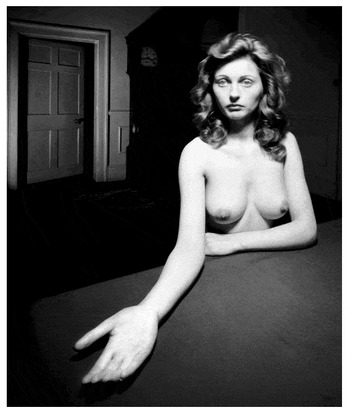
There are clear aesthetic and thematic continuities between Brandt's nudes and both the documentary work of the 1930s and his war photographs. I first want to discuss the nudes as interiors. Brandt remarked that he initially called the nudes “experimental interiors”; he had taken the photographs in rooms of “my own choice,” not studios or sets, but “real rooms.”Footnote 56 In these rooms, doorways, chairs, and windows figure almost as prominently as the female body. There are some pictures, such as “Campden Hill, 1947” (see fig. 1), in which a chair dominates the picture. Rooms also contain and sometimes constrain the female figure. In “Campden Hill, 1949,” the Ingres-like female figure, in a trompe d’oeil of perspective, towers over a bed in the background, but is herself hunched within the room. Toward the end of the period, particularly if we think of a picture such as “Belgravia, 1951,” in which the nude figure emerges from outside the picture's frame, Brandt began to explore the limits of the body within an interior, an interest that guided his later work. In all of these photographs, there is very clearly a visual dialogue between the body and its surroundings. This is also consonant with Brandt's approach to portrait photography and his emphasis on the sitter being placed in his or her surroundings.Footnote 57 The geography of these rooms is also important. Half-open doorways and windows with their curtains drawn to reveal a moonlit night often lie in the background of the photographs. Again, there is a conscious play between the female figure in the picture and these openings. In “Belgravia, 1951” and “Micheldever, 1945” (see fig. 3), respectively, a leg points to the window and a hand points away from the door. All of this suggests multiple points of entry into the photograph and its dreamworld.
We can first see in this a connection with Brandt's prewar photography. In the thirties, Brandt offered the viewer a way into the English character through the home. Bodies in material surroundings suggested something about English society, particularly in terms of social class. The nurseries and drawing and dining rooms of the upper middle classes attracted particular interest. With his nudes of the 1940s, Brandt returned to these interiors, but furnished them with new meaning. The bookseller and publisher Anton Zwemmer had remarked that The English at Home was “not ‘erotic’ enough.”Footnote 58 From the late 1930s, Brandt had infused more of his photographs with eroticism, particularly in A Night in London and his photographs of Charlie Brown's bar. The nudes saw a full realization of this, albeit in a dark and enigmatic way. They filled the upper-middle-class English interiors of Hampstead, Belgravia, and Campden Hill with sexuality and desire.
The question of Englishness in such photographs is a complex one. As has already been suggested, Brandt tended to construct his own idiosyncratic vision of his adoptive country. During the 1940s, as David Matless and others have suggested, there was a powerful visualization of Englishness encapsulated in evocations of idealized rural landscapes and regenerated, modernized cities.Footnote 59 This was very much a public and purposive Englishness. Interiors, when present in such visions, were represented as modern and streamlined, physical manifestations of the reconstruction and reform of the flawed and shabby prewar world. At the same time, as Sonya Rose has pointed out, such wartime expressions of Englishness effaced a broader and more heterogeneous Britishness that included Scotland, Wales, and Ireland.Footnote 60
Can the interiors of Brandt's nudes be seen as an expression of Englishness?
“Micheldever, 1945.” © Bill Brandt/Bill Brandt Archive, Ltd., 2005.

The point should not be strained, but there are traces of a particular kind of Englishness in these pictures. Their very titles of course are an explicit connection to upper-middle-class neighborhoods in London or the ancient Hampshire village of Micheldever. As already suggested, these were upper-middle-class interiors, distinguished by delicate furniture, expensive wallpaper, clean wainscoting, and, ironically, French windows. They are a world away, in terms of class, from the homes Brandt had photographed in the North during the 1930s and in Birmingham and on the Bournville Estate in the 1940s. They are also interiors that seem to reach backward into the past rather than into the future, in contrast with other European photography at the time. If not exactly the overupholstered interiors of the late Victorian or Edwardian period, the rooms inhabited by Brandt's nudes certainly seem closer to the Edwardian world of Walter Sickert (particularly the latter's series of Mornington Crescent nudes) than to the ascetic, calculated, and recognizably modern photography of Man Ray or Horst P. Horst or the light-dappled bohemian rooms photographed by Andre Kertész. Thinking of Englishness, we might also relate the nudes Brandt made in the 1940s to the landscape photographs taken during the same period, some of which were collected in Literary Britain (1951). I have argued that the nude photographs sexualized the English interior. Rather than spaces of comfort and respite, these rooms are suffused with tension and confrontation. This can also be seen in Brandt's representation of the British landscape during the 1940s. These photographs capture, first of all, not just Englishness, but Britishness, with photographs of the Isle of Skye and the Outer Hebrides. In contrast to the visual representation of landscape as gentle and familiar, redolent of an easily understood, stable, and reassuring national identity, Brandt's photographs dwell upon the tenebrous, untamed power of the land. This is particularly apparent in the photographs later published in Literary Britain. The pastoral beauty of the Marlborough Downs and the Pilgrim's Way had their place in this collection, but the most powerful and characteristic photographs were drawn from the harsher worlds of the Brontës, Thomas Hardy, Matthew Arnold, and George Crabbe: the storm-swept Top Withens; Stonehenge grimly dominating Salisbury Plain; a desolate Dover Beach; and the bleakness of Aldeburgh.Footnote 61 Like the nudes, these landscapes leave little room for the viewer's comfort.
The expression of sexuality and desire in the nudes owed much to the visual language Brandt had developed during the war. In aesthetic terms, we can see first of all, the same tonal range dominated by shadows. This atmosphere also pervades his series of portraits made after the war. Of these, Alan Ross remarks: “they are denizens of black-out and of the dark, of those shadowy moments when faces emerge under lamplight but bodies remain dark.”Footnote 62 It is the lack of movement in the nudes that resonates so strongly with the wartime photographs. It is a discomfiting stillness, at once forbidding and compelling; the same atmosphere hangs over the streets of London and the shelterers in the Underground and church crypts. There is little that animates the nude photographs except their compositional quality and the psychological tension embedded in them. It is sometimes as if the photographs are taken either just before or just after a critical moment between the viewer and the subject. The presence of the female figure within these interiors is usually jarring; there is a sense of quiet tension between the nude and her surroundings. That tension envelopes the dreams or hallucinations of the subconscious in the photographs. This owes a great deal to a surrealist sensibility. Rosalind Krauss has suggested that surrealism attempted to articulate a moment of “`convulsive beauty’ … something that shakes the subject's self-possession, bringing exultation through a kind of shock.”Footnote 63 This sensibility may have been confirmed by the experience of war. In her study of the Blitz, Amy Bell has suggested that, for many observers, the destruction of wartime London seemed like an exercise in surrealism, including the “darker aspects of [surrealist] exploration of the unconscious, where the return of repressed unconscious material, in the form of the `uncanny,' disrupted unitary identity, aesthetic norms and social order.”Footnote 64 This is exactly what we can see in Brandt's photographs of the blackout and the shelters in the early war years; it was represented even more explicitly in the nudes of the later forties. The tonal range and surrealist approach explored in the early documentary work during the war thus became a means of expressing a private psychological journey in the nudes.
What is particularly striking is the way Brandt brought desire and death together in the nudes. These are photographs from within the necropolis of wartime London. The skies we see framed in the windows are generally nighttime skies, reminiscent of the moonlit skies of London in 1940 and 1941, the city without people. The bodies of some of the nudes themselves also bring out this theme of death. Some seem deliberately corpselike. The best example of this is the “Micheldever, 1945” nude (see fig. 3). Her expression is blank. She stares into the middle-distance glassy-eyed, as if without life. Other photographs, such as “Hampstead, 1953,” also show apparently lifeless female figures. A nonnude—“Young Girl, Eaton Place, 1955”—places the profile of a young girl in the foreground, against a wall of open windows. Her eyes are, however, lifeless, staring blankly upward. Particularly in his later prints, such as those of “Hampstead, 1945” (see fig. 4), Brandt drove up the contrast, emphasizing the whiteness of the nudes’ flesh and the darkness of the backgrounds. An immediate reference point is the bodies of sleeping shelterers. In this way, the trace left by war is death. I am not suggesting that the nudes trade in an eroticism of necrophilia, but I am arguing that one of the disturbing elements to them is the association between desire and death in the subconscious conveyed through the representation of the body. Again, this owes something intellectually to surrealism, in which, as Bate suggests, “the loved feminine object returns unconsciously as the sign of an anxious male threat, castration, death.”Footnote 65 But it was the experience and landscape of war that brought out most forcefully the connection between death and desire.
In other photographs, there is a life and defiance to some of the female figures. We might see a particular kind of female sexuality emerging in nudes. Clearly, these are pictures from the perspective of a male voyeur and thus imbued with male power. But some of the female figures in the 1940s nudes are unabashed in their nakedness; they are not demure, nor are they in abjection to the male gaze. Indeed, their nakedness seems both banal and challenging. Some of the female figures are uncompromising in the way they meet the gaze of the viewer, such as “Hampstead, 1945” (see fig. 4), “London, 1940s,” “The Watcher” (1946), or “Reflection, 1949.” As Ian Jeffery has said, there is also an atmosphere of confrontation in the pictures. In part, this is a confrontation about subjectivity of the viewer. “Reflection” is, therefore, a female nude reflecting a male viewer. “The Watcher” is watching the (male) observer. Given some of his earlier photo-essays from the war, it is also possible that these are photographs of the kind of confident, mobile female sexuality of the war years. This might be compared to what Kuhn has called the “expressivity” of wartime cinema, in particular its “low-key lighting,
“Hampstead, 1945.” © Bill Brandt/Bill Brandt Archive, Ltd., 2005.

marked camera angles, big distorted close-ups, [and] deep-focus cinematography,” all of which helped form the “melodramatic codes” of some film in the forties.Footnote 66 Film noir, of course, concerned itself with the threat of female sexuality in this way.Footnote 67 As Marcia Landy and others have suggested, wartime melodrama also dealt with the problem of mobile femininity and the “continuing crisis … in representing femininity.”Footnote 68 Some of Brandt's pictures shared both aesthetic qualities with such film and a preoccupation with the representation of a new kind of femininity. There are other ways the nudes are tied to a particular historical moment. In the late 1950s, Brandt's nudes featured very tight close-ups of limbs and skin, usually cropping out the face and head. But in the earlier nudes, we see the entire woman, including the telling detail of hairstyle. Most of these nudes have distinctive layered and styled forties haircuts. The women in the photographs are, in this way, both fixed in time and positioned outside of the social.
In aesthetic and thematic terms, therefore, the 1940s nudes drew, in part, upon the experience of wartime, the sights of London during the war. This blurs the line between documentary and nude photography in Brandt's work. But we must also see the photographs as moments of dissonance with other wartime discourses. In the first place, they take up the dark aspects of Brandt's wartime aesthetic. The most obvious point of departure is the nudes’ sharp rejection of any sense of the public or the social. After the life lived in public during the war, in the streets and shelters, Brandt seemed to assert the primacy of the private and the intimate, indeed, the primacy of a private world unknown to others. Brandt's world has also shifted spatially, from city streets to interiors, though the latter often featured windows continually referring to an external world. It is a point of considerable irony and importance that Brandt took the photograph entitled “Hampstead, 1945” (see fig. 4) on VE-Day 1945, a moment of public and national triumph, which led, to repeat Eley's phrase, to the “democratic romance” of Labour's election victory.Footnote 69 Brandt's photographs set the dark valleys of sexual and psychological obsession against the sunlit uplands of that romance.
In other ways, with particular reference to sexuality and subjectivity, Brandt's nudes might also be seen as a counternarrative to prevailing discourses of the 1940s. Sonya Rose, Gillian Swanson, Antonia Lant, and Marilyn Lake have highlighted the tensions among sex and citizenship, pleasure and patriotism, circling around the expression of female sexuality during the war. One response to this by a progressive elite was to contain (and thus control) femininity within a reinvigorated heterosexuality.Footnote 70 In the 1940s and 1950s, for example, psychologists, government, voluntary groups, and some churches encouraged the promotion of female sexual pleasure as a central component to a successful and stable marriage. This represented a normalization of sexual activity: sex would be therapeutic for marriage and for the nation. But it was also about restraint, control, and management. This might be seen as part of the “management of the self” that Becky Conekin, Frank Mort, and Chris Waters have suggested is central to British modernity after 1945; it also speaks to the broader question of subjectivity.Footnote 71
Brandt's nudes pointed a different way entirely. Their dark dream worlds showed the fissures and ruptures around sexuality and subjectivity. Indeed, sexuality and subjectivity in these photographs were, despite their careful composition, both impermeable and ungovernable. In terms of sexuality, whether we think of Delany's emphasis on sadomasochism, Mellor's belief in the playing out of childhood fantasies around authority and prohibition, or Jeffery's suggestion that they are an intersection between a predatory male eye and an uncompromising female subject, the current scholarship on Brandt underlines the uncontrollable and enigmatic nature of sexuality in the pictures. The desires portrayed in the nudes are not only impossible to normalize, to gather into a progressive discourse about sexuality, but they resist apprehension and categorization. The photographs are also challenging about subjectivity. The nudes at once construct and dissemble the authority of the male eye, undercutting the subjectivity of the spectator. Instead, the viewer is confronted by the subjects in the photographs. Armstrong pushes this analysis further. In her discussion of Brandt's later photographs, she suggests that they are not merely the projection of particular psychological obsessions but also photographic explorations of the permeability and boundaries of the body itself. They break down the barrier between viewer and object. One or two photographs from the early 1950s also suggest this. “Belgravia, 1951” is striking because it seems that the legs in the picture actually emerge from the viewer him- or herself, that one is looking at one's own body. There is a tension between the sense of alienation that this is not one's own body and the way it pushes one into thinking that this is one's body. There is a similar sense in “Hampstead, 1953.” In a very basic way, therefore, Brandt's photographs put sexuality and subjectivity beyond governance or management.
Brandt was not an isolated example of this counternarrative emerging in the war years and after. There are striking parallels between his photographs and some wartime writing. In short stories such as “Mysterious Kôr” (1945) and the novel The Heat of the Day (1949), Elizabeth Bowen evoked the same mix of shadow, death, and desire in her portrait of wartime London as we find in Brandt's photographs. The Blitzed London of both works is a “psychic London” with a “particular conjunction of life and death,” whose ruins “took their places as a norm of the scene.”Footnote 72 A “glass clear darkness” pervades Bowen's London, with the same register of grays and black we find in Brandt's photographs.Footnote 73 For Bowen's protagonist in The Heat of the Day, Stella Rodney, the blackout is, in fact, a looking-glass revealing rather than obscuring the private and public worlds of wartime London: “she seemed to perceive on all sides around her, with phantasmagoric clearness, everything that … the darkness hid.”Footnote 74 The blackout held a world of flux and volatility, in which borders dissolved: “War at present worked as a thinning of the membranes between the this and the that.”Footnote 75 In a later essay, Bowen suggested that this permeability extended to subjectivity: “in war, this feeling of slight differentiation was suspended: I felt one with, and just like, everyone else. Sometimes I hardly knew where I stopped and someone else began.”Footnote 76 This was less a statement of collective solidarity than an articulation of the sense of porousness between lives, a questioning of subjectivity. It was accompanied by an intensified sense of the private. Bowen highlighted the tension between the communal, public experience of the war and private worlds: “however many people have crowded together, each has … his or her accesses of solitude.”Footnote 77 A heightened sense of desire and sexuality is perhaps a product of that tension between that solitude and the contact with other individuals. Most interesting is the way in which Bowen talked of the use of dreams and hallucinations as a form of resisting or making sense of the war: “the hallucinations in the stories are not a peril … the hallucinations are an unconscious, instructive, saving resort on the part of the characters: life, mechanized by the controls of wartime, and emotionally torn and impoverished by changes, had to complete itself in some way.”Footnote 78 Jacqueline Rose has suggested of The Heat of the Day that it asks the question, “what might be the link between hallucination and history?”Footnote 79 All these themes—the dominant tone of darkness, the flux in subjectivity, the undercurrents of sex in war, and the power of the unconscious—are common between Bowen and Brandt.
The topographies of two literary Greenlands charted by the novelists Graham Greene and Henry Green also provide examples of affinities with Brandt's photographs. In this work, the Blitz is both a backdrop and moving force. Graham Greene brought death, desire, and dreams together amid the debris of wartime London in both The Ministry of Fear (1943) and The End of the Affair (1951). In the former, the protagonist Arthur Rowe wanders through a surreal world of church fêtes, spiritualist circles, and spies, caught in a plot he does not understand. With a backdrop of German bombers “muttering … `Where are you? Where are you? Where are you?’” Rowe seems to occupy a liminal world between consciousness and unconsciousness: “there are dreams which belong only partly to the unconscious; these are dreams we remember on waking so vividly that we deliberately continue them, and so fall asleep again and wake and sleep and the dream goes on without interruption, with a thread of logic the pure dream doesn’t possess.”Footnote 80 Again, this is reminiscent of the world of Brandt's nudes and Bowen's London. In The End of the Affair, as in Brandt's nudes, sex, death, and war are forcefully brought together. The Blitz becomes a “rather disreputable and unreliable accomplice” in a liaison between a novelist and a civil servant's wife.Footnote 81 Henry Green's Caught (1943), an account of a Fire Brigade unit, is also suffused by sex and death. At one point during a raid, the firemen come upon a couple in a shelter, immobile in their embrace as statuary:
There was a surface shelter close by. Richard went inside. … The structure seemed to shake, the one light to flicker with that percussion, concussion of gun fire up above. And in the near corner a girl stood between a soldier's legs. He had been kissing her mouth, so that it was now a blotch of red. He held on to her hips, had leant his head back against the white painted brick. Hair came down and trembled over his closed eyes with the trembling in the wall. Man and girl were motionless, forgotten, as though they had been drugged in order to forget, as though he had turned over a stone and climbed down stairs revealed in the echoing desert, these two were so alone.Footnote 82
In Green's London, the “livid incandescence” of the Blitz does less to illuminate a comprehensible public than to reveal individuals “each in his or her deep mystery.”Footnote 83 The literary narratives of Bowen, Greene, and Green thus work against a narrative of a comprehensible, public world. Instead, like Brandt's nudes, they evoke a world of private meaning and desire often opposed to that public world.
What comes from these accounts, whether the photographs or Bill Brandt or the novels of Elizabeth Bowen, Graham Greene, and Henry Green, is a counternarrative of war, one that jars with other discourses emerging in the 1940s. Peter Stansky and William Abrahams have argued that, at least in the case of Henry Moore and Humphrey Jennings, the communal experience of a total war was reflected in and celebrated by art.Footnote 84 The picture for Brandt was much more complicated. In a period in which the idea of a national community became dominant, Brandt pointedly moved into the private sphere, even if that private sphere was marked by the traces of the public experience of war. At a point when faith in social reform and progress were at their height, Brandt questioned rationality itself. Of course, Brandt was not alone in this. We must remember that it was also in 1945 that Francis Bacon's “Three Studies for Figures at the Base of a Crucifixion” gained attention. Bacon's work, Herbert Read remarked, offered up “symbols of a disintegrating world of paranoic consciousness.”Footnote 85 This theme was an important one in visual culture of the 1950s. In literature, this is also the period in which Auden published Age of Anxiety (1944–47) and Mervyn Peake wrote his Byzantine, surreal fantasy, Gormenghast (1946). To fully understand the cultural meaning of the war and its aftermath we need to map these dissonant margins, which Brandt's nudes of the 1940s also inhabited as shadowy, enigmatic citizens of a new and unfamiliar world.