Health-related quality of life (HRQL) measures are increasingly used as outcome measures in clinical trials and information on HRQL is increasingly being used to support decision making regarding treatment choice. Lately, several investigators have examined the effects of using HRQL measures in routine clinical care. This increasing attention to HRQL is in part attributable to the growth in the aging population resulting in an increased prevalence of chronic diseases and to a more active role played by patients in their treatment and their interest in quality of life (Reference Cella, Hahn and Dineen4;Reference Ross, Kolotkin and Williams19).
Clinicians are familiar with the interpretation of physiologic measures such as forced expiratory volume or hemoglobin level. Their experience with these measures allows them to meaningfully interpret the results. However, the clinical interpretation of HRQL scores and changes in those scores presents a challenge. What scores correspond to large, medium, and small burdens or improvements? The determination of the magnitude of change in scores that is meaningful may assist in the evaluation of the effectiveness of a given treatment and be used to classify patients as improved, stable or declined.
Fatigue is the most common and troubling symptom reported by cancer patients, particularly by those on chemotherapy (Reference Bruera, Valero and Driver2;Reference Cella, Paul and Yount5). Fatigue is present at least a few days of the month in 76 percent of these patients (Reference Cella6). The National Comprenhensive Cancer Network defined cancer-related fatigue (CRF) as “unusual, persistent subjective sense of tiredness related to cancer treatment that interferes with usual functioning” (Reference Barnes and Bruera1).
Recent studies (Reference Cella6;Reference Stone, Richardson and Ream22) have suggested that fatigue has a major impact on patient's quality of life, is underecognized, and often untreated. Fatigue can profoundly impact the patient's HRQL by interfering with a patient's ability to perform physical tasks and limiting social activities (Reference Cella, Paul and Yount5).
It is generally accepted that the goal of therapy is to make patients feel better and who better to assess this than the patients themselves (Reference Guyatt, Naylor and Juniper9). The inclusion of HRQL measures in the routine clinical care of cancer patients may facilitate better detection, understanding, and management of fatigue in cancer patients. Therefore, it is important to determine the magnitude of a clinically important difference (CID) in HRQL fatigue scores to support the use of fatigue measures in clinical practice. The smallest amount of change that can be perceived and this is regarded as important is known as the minimally important change, MID. Guyatt and colleagues (Reference Guyatt, Osoba, Wu, Wyrwich and Norman10) (p. 377) defined the MID as “the smallest difference in score in the domain of interest that patients perceive as important, either beneficial or harmful, and which would lead the clinician to consider a change in the patient management.”
There are two major approaches used to determine important changes in HRQL scores following treatment: distribution-based and anchor-based. The main difference between these approaches is that the distribution-based interpretations are statistically derived, whereas, the anchor-based interpretations are derived by comparison to clinical or other measures (anchors) that are readily interpretable. Distribution-based interpretations include effect size and the standard error of measurement. All of the distribution-based measures involve a ratio of signal (change or difference in scores) to noise (variability of scores, for some measures at baseline, for others the variability in change scores). A commonly used anchor-based measure is the global rating of change that asks the patient to provide a rating of their perceived change over time.
The primary objective of this study is to determine clinically important difference in cancer patients’ fatigue subscale scores using the Functional Assessment of Cancer Therapy-Fatigue (FACT-F) based on patient's perception. The second objective is to evaluate the ability of the FACT-F subscale to discriminate between patients with or without fatigue progression while on chemotherapy. The third objective it to examine the agreement between patient and physician assessments using the Qualitative Patient Self-report Fatigue Level (QPSRF) and Qualitative Physician Report Fatigue Level (QPRF) overall scores.
METHODS
Patients
Consecutive patients with advanced primary lung cancer attending the outpatient clinics of the Cross Cancer Institute (CCI), Edmonton, Canada, were invited to participate in this prospective cohort study, before initiation of palliative chemotherapy. Eligible patients had to be at least 18 years old, with locally advanced or metastastic nonsmall cell (NSCLC) or small cell lung cancer (SCLC); American Joint Committee on Cancer/Union International Centre le Cancer (AJCC/UICC) Stages IIIa, IIIb, or IV. Patients were to receive platinum-based chemotherapy (various regimens) as part of their standard care recommended by their oncologist. The study was approved by the Alberta Cancer Board Research Ethics Committee. Informed consent was obtained from all patients before study participation.
Participants were asked to complete a battery of questionnaires (see the Measures section) in the outpatient department. Data collection was supervised by a research nurse. Baseline measures were completed by patients before undergoing chemotherapy. At follow-up clinic appointments, patients completed questionnaires before their second and subsequent cycles of chemotherapy. The final assessment was conducted 2 weeks after their final cycle of chemotherapy.
Measures
Functional Assessment of Cancer Therapy-Fatigue Subscale Score (FACT-F) Version 3
FACT-F is a forty-seven-item cancer-specific questionnaire consisting of a core twenty-seven-item general questionnaire (FACT-G) measuring physical well-being (PWB), social/family well-being (SWB), emotional well-being (EWB), and functional well-being (FWB), as well as a twenty-item anemia questionnaire (FACT-An Anemia subscale) that includes the thirteen fatigue-related FACT-F items (e.g., “I feel weak all over”, “I am too tired to eat”) and seven anemia nonfatigue related items. FACT-F scores range from 0 (minimum fatigue) to 52 (maximum fatigue). The FACT-F has been found to be valid and reliable (test–retest intraclass correlation coefficient 0.87, Cronbach's alpha 0.96) and easy to complete with an average time for completion of 15 minutes (Reference Cella, Tulsky and Gray3).
Eastern Cooperative Oncology Group Performance Status Rating Scale (ECOG)
ECOG (Supplementary Box 1, which can be viewed at www.journals.cambridge.org/thc) is a simple five-level rating scale that provides a coarse indication of the patient's physical activity level. It is designed to be completed by either the patient or the healthcare provider. The ECOG asks the patient or provider to rate the degree of symptoms severity that interferes with activity level. Its ratings range from 0, indicating that the patient is completely asymptomatic and fully ambulatory, to 4, indicating that the patient is bedridden (Reference Oken, Creech and Tormey16).
Goldberg General Health Questionnaire (GHQ)
The GHQ is a measure of mental health that has been used to detect psychiatric disorders in general population including primary care and outpatient clinics. The original version contains thirty items that screen for depression and anxiety. Responses are on a 4-point scale, “better than usual,” “same as usual,” “worse than usual,” much worse than usual” (Reference Goldberg8). The GHQ yields an overall score (the maximum score is 30), the higher the score the more severe the condition. Patients displaying overall score equal or higher than nine are possible cases (Reference Smith21). The GHQ is self-administered and easy to complete (less than 10 min). The GHQ is a valid and reliable instrument (Reference Naughton, Shumaker, Anderson, Czajkawski and Spilker14).
Qualitative Patient Self-report of Fatigue Level (QPSRF)
The QPSRF (Supplementary Box 2, which can be viewed at www.journals.cambridge.org/thc) was used as a criterion against which actual change scores could be compared and calibrated. At each cycle patients rated whether they had experienced worsening, no change or an improvement in fatigue, when they answered the question: “compared to my last cycle of chemotherapy, I am: more tired, as tired, less tired.” Thus, the definition of a clinically important difference (CID) being used in this study relies on the perception of patients.
Qualitative Physician Assessment of Patient Fatigue Level (QPRF)
The physicians used the QPRF (Supplementary Box 3, which can be viewed at www.journals.cambridge.org/thc) to assess patient's fatigue progression. After each visit physicians rated whether the patients had experienced worsening, no change or an improvement in fatigue.
Procedure
Demographic (age, gender, histology, stage of disease) and clinical (hematological and biochemical) parameters were obtained from patient self-reports and medical history at baseline. The GHQ was also completed at baseline to evaluate depressive mood disorders, which may affect fatigue levels. Clinicians assessed the patients’ ECOG Performance Status at baseline and each follow-up visit after the first cycle of chemotherapy.
To assess patient reporting of fatigue status two self-reported measures were used: FACT-F and QPSRF. Patients completed the FACT-F at baseline and each follow-up visit before receiving their chemotherapy. The QPSRF was completed by the patient before each subsequent chemotherapy cycle after the first cycle. This instrument was used to evaluate the clinically important difference in patients’ Fatigue subscales from the FACT-F.
To assess clinicians’ reporting of the patient's fatigue status, the QPRF was completed by clinicians at every patient follow-up visit after the first cycle of chemotherapy.
Statistical Analysis
The primary objective in this study was to determine the clinically important difference in FACT-F scale scores. FACT-F change scores were computed as the mean change in score (e.g. end of study score minus baseline score). A clinically important deterioration in fatigue was defined as the mean FACT-F change score that correspond to patients’ qualitative self-report of “more” fatigue. This mean change score was expressed with its standard error. Similarly a clinically important improvement in fatigue score was defined as the mean FACT-F change score that correspond to patients’ qualitative self-report of “less” fatigue.
Analysis of variance (ANOVA) was used to determine whether Fatigue subscale change scores were able to discriminate the three fatigue progression categories. Agreement between clinicians and patients qualitative assessments, QPSRF and QPRF, were studied using weighted kappa. To interpret the agreement, the scheme provided by Landis and Koch (Reference Landis and Koch13) was used: “poor” agreement 0–0.2 “slight” 0.21–0.40 “fair” 0.41–0.60 “moderate” 0 .61–0.80 “substantial” and 0.81–1 “near perfect”. Landis and Koch (Reference Landis and Koch13) describe these ratings as “clearly arbitrary, but useful benchmarks.”
Because fatigue limits patient's physical activity, the ECOG was used by physicians to assessed patient's physical activity level at every visit. The Cochran-Mantel-Haenszel test (Chi-squared test) was carried out to assess the relationship between physician's ECOG scores and patient-reported fatigue level (QPSRF) scores. SAS software was used in all analyses (20).
RESULTS
Patients
A total of forty-three patients were enrolled in the study. All patients agreed and completed baseline measures. One patient was excluded from the study due to discontinuation of chemotherapy after only one cycle. Four patients did not complete the “relationship with doctor” (RWD) item of the FACT-F at baseline. One patient did not complete the “additional concerns” related to Fatigue and Anemia of the FACT-F at final assessment post chemotherapy. Two patients did not complete any of their post chemotherapy assessments due to progressive disease resulting in hospitalization.
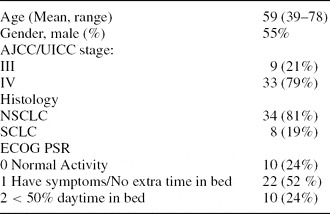
The characteristics of the patients are summarized in Table 1. 55 percent of the study sample was male and the mean patient age was 59 (±19) years. At baseline there were no significant differences in clinical or HRQL variables between female and male patients (Reference Dharma-Wardene and Au7).
Baseline Patients Demographic and Clinical Characteristics (N = 42)

AJCC/UICC, American Joint Committee on Cancer/Union International Centre le Cancer; NSCLC, non-small cell lung cancer; SCLC, small cell lung cancer; ECOG PSR, Eastern Cooperative Oncology Group Performance Status Rating Scale.
Results from the GHQ revealed that 86 percent of the patients felt happy. Although 95 percent managed well alone, 62 percent of these patients were unable to enjoy day-to-day activities. Five percent of the patients felt that life was not worth living.
Baseline HRQL
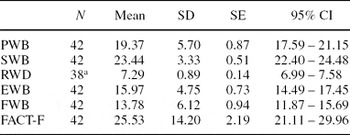
Baseline FACT-F scores are presented in Table 2. The highest possible score is 28 for the PWB, SWB and FWB subscales; 24 for the EWB subscale and 52 for FACT-F subscale. Thus at baseline the most affected domains in this population were FACT-F, SWB, and PWB.
Baseline FACT-F Scores

aFour patients did not complete the RWD item of the FACT-F at baseline.
PWB, Physical Well-Being Subscale; SWB, Social/Family Well-Being; RWD, Relation with Doctor; EWB, Emotional Well-Being Subscale; FWB, Functional Well-Being Subscale; FACT-F, Fatigue subscale.
FACT-F Change Scores
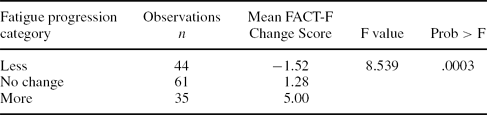
Results revealed a mean change in FACT-F subscale change score of 5.0 (SE = 1.06) for patients who rated themselves as more tired, 1.28 (SE = 1.00) for those who rated themselves the same (no change) and −1.52 (SE = 0.84) for those patients who rated themselves as less tired.
ANOVA testing demonstrated that Fatigue subscale change was able to discriminate between these three categories of self-reported fatigue progression (p < .001) (Table 3).
Discrimination of FACT-F Change Scores by Fatigue Progression Category

FACT-F, Functional Assessment of Cancer Therapy- Fatigue.
Agreement between Patient and Clinician Fatigue Assessments
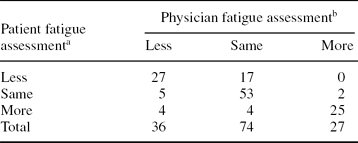
Agreement between patients and clinicians was assessed by comparing QPSRF and QPRF scores using weighted kappa. The result showed a moderate agreement, with a linear weighted kappa of 0.65 (95 percent confidence interval, 0.54 to 0.77). Three patients were lost to follow-up, the number of assessments was reduced to 137. Of 137 assessments, there was complete agreement for 105 assessments (Table 4).
Frequencies Patient–Physician Assessment

aAs determined by the Qualitative Patient Self-Report of Fatigue Level (QPSRF).
bAs determined by the Qualitative Physician Report of Fatigue Level (QPRF).
Further analysis was conducted to corroborate the change in patient fatigue level. Chi-squared (Cochran-Mantel-Haenszel) statistic was used to assess the relationship between patient-reported fatigue assessed by QPSRF and ECOG scores. There was a statistical significant relationship (χ24 = 10.89; p < .05) between QPSRF and ECOG.
DISCUSSION
This study explores clinically important difference in FACT-F scores as determined by patients’ own perception of their fatigue status, correlated with physicians’ assessments of patients’ fatigue and performance status. The amount of change seen in the Fatigue subscale scores was ≤5 units, patients were able to perceive this change. It would appear that ≤5 units changes in fatigue subscale scores are meaningful.
Our findings complement distribution-based results reported by Cella and colleagues (Reference Cella, Paul and Yount5) showing that Fatigue subscale change scores in the range of 3.98–9.96 are in keeping with small to moderate differences (effect size 0.2–0.5) in a U.S. general population internet survey. Our findings support that smaller differences in fatigue status are likely more important to a cancer population for whom fatigue is prominent. This is in keeping with other findings from Cella and colleagues (Reference Cella, Hahn and Dineen4). In investigating meaningful changes in FACT-G and its subscales, they also found that small changes are important to patients. The degree of change in scores described by them as minimally better and minimally worse fell between 1 and 3.
Recently, Reddy and collaborators (Reference Reddy, Bruera, Pace, Zhang and Reyes-Gibby18) reported differences of 10 units in the FACT-F to be meaningful for patients. Our study differs from Cella's and Reddy's in that our study includes exclusively lung cancer patients, and reports CID in FACT-F scores as determined by patients’ own perception of their fatigue status.
Traditionally, the magnitude of change scores has been assessed as independent from the direction of change, assuming that the magnitude of an important improvement in HRQL is equivalent to the magnitude of an important deterioration. However, Cella and colleagues (Reference Cella, Hahn and Dineen4) reported that smaller gains than declines in HRQL are regarded as meaningful, “perhaps due to the tendency of the patients to minimize personal negative evaluations about one's condition.”
Our findings are consistent with several previous studies (Reference Cella, Hahn and Dineen4;Reference Osoba, Rodrigues, Myles, Zee and Pater17). As expected, we found a greater magnitude of change of scores in patients who reported a worsening of HRQL than in patients who reported improvement. In this study, patients were able to perceive a small degree of improvement. A larger magnitude of decline was required for the change to be perceivable.
In the oncology field, this small degree of change associated with global rating improvement may be related to different factors. Cella and collaborators (Reference Cella, Hahn and Dineen4) discussed this issue from several point of views. Response bias, response shift and optimism are possible explanations. The first related to the fact that patients value small changes as positive in the light of the substantial emotional and physical investment that patients make in treatment. Response shift refers to patients changing expectations about HRQL after cancer diagnosis. Optimism may cause patients to overestimate small improvements. Cella and colleagues (Reference Cella, Hahn and Dineen4) suggested adding a measure of optimism as adjuster when global rating is used as criterion for improvement.
The agreement between patients and physicians assessments is moderate, confirming the fact that physicians were aware of their patients’ fatigue progression. Given the disabling effects of fatigue in cancer patients, a close agreement is important in managing patient's fatigue.
This study has several limitations. First, the sample size is small and restricted to advanced lung cancer patients on chemotherapy. This may limit generalizability. Second, we look only at the clinically important difference (CID) in FACT-F subscale using the global rating, QPSRF. As the anchor, the QPSRF includes only three categories (less, no change, more fatigue) compared to the global rating scale used by Cella and colleagues (Reference Cella, Hahn and Dineen4) with five categories (sizably worse, minimally worse, no change, minimally better, sizably better). Other investigators have used a global rating of change scale with fifteen categories (Reference Juniper, Guyatt, Willan and Griffith11;Reference Juniper, Guyatt and Feeny12). The reduction in response options in the QPSRF may affect the ability to discriminate among the degree of difference in fatigue. Third, the anchor used in the study relies on patients being able to recall how they felt during their previous course of chemotherapy. Nevertheless, patient recall is sometimes less than perfect (Reference Norman15). However, the moderate agreement between patient and clinician ratings of fatigue ameliorates some of the concerns about the accuracy of patient recall.
In conclusion, we provide evidence on the magnitude of change in FACT-F score that is associated with the perception by patients of improvements in fatigue and magnitude of change in score that is associated with deteriorations in fatigue. These findings support the responsiveness of the FACT-F subscale and that small change is detectable and important. Results indicate an asymmetry in the magnitude of those change scores. It will be important to examine the extent to which these estimates are confirmed in other studies and how these findings may be applied to clinical practice to advance patient care.
CONTACT INFORMATION
Maria-Jose Santana, MPharm (msantana@ualberta.ca), PhD candidate, Research Associate, Lung Transplant Program, Division of Pulmonary Medicine, University of Alberta Hospital, Edmonton, Alberta, Canada
Heather-Jane Au, MD, MPH (heathera@cancerboard.ab.ca), Associate Professor, Department of Oncology, University of Alberta; Medical Oncologist, Department of Medicine, Cross Cancer Institute, 11560 University Avenue, Edmonton, Alberta T6G 1Z2, Canada
Melina Dharma-Wardene, MPH, MBA (dharmawm@bethanycare.com), Director of Quality & Research Development, Bethany Care Society, 1001-17 Street NW, Calgary, Alberta T2N 2E5, Canada
Joanne D. Hewitt, RN, NP, BScN (joannehe@cancerboard.ab.ca), PhD student, Faculty of Nursing, University of Alberta, 4th Floor, Clinical Sciences Building, Edmonton, Alberta T6G 2G3, Canada; Nurse Practitioner, Hematology Tumour Group, Cross Cancer Institute, 11560 University Avenue, Edmonton, Alberta T6G 1Z2, Canada
David Dupere, MD (david.dupere@cdha.nshealth.ca), Assistant Professor, Departments of Medicine and Family Medicine, Dalhousie University, 442 1278 Tower Road, Halifax, Nova Scotia B3H 2Y9, Canada; Senior Staff, Department of Medicine, QEII Health Sciences Centre, 306-1278 Tower Road, Halifax, Nova Scotia B3H 2Y9, Canada
John Hanson, MSc (Johnqhanson@yahoo.ca), Biostatistician, Sunita Ghosh, PhD, PStat (sunita.ghosh@cancerboard.ab.ca), Research Biostatistician, Department of Experimental Oncology, Cross Cancer Institute, 11560 University Avenue, Edmonton, Alberta T6G 1Z2, Canada
David Feeny, PhD (david.feeny@kpchr.org), Professor, Department of Economics, University of Alberta, 8-14 HM Tory Building, Edmonton, Alberta T6G 2H4, Canada; Senior Investigator, The Center for Health Research, Kaiser Permanente Northwest, 3800 N. Interstate Avenue, Portland, Oregon 97227-1110