Over the years, there has been a shift away from palliative banding of the pulmonary trunk towards complete repair for symptomatic infants with atrioventricular septal defects, common atrioventricular valvar orifice, and pulmonary over-circulation. In addition, with increasing success in neonatal surgery, there has also been a shift towards repairing these defects earlier and earlier. Paediatric cardiologists are now challenging surgeons to close these defects in ever smaller patients. While delaying surgery may facilitate the operative repair, early intervention reduces the period of time these patients require aggressive medical therapy to prevent heart failure, maintains growth, and minimizes exposure to elevated pulmonary pressures.
Methods
From December, 2002, to July, 2005, 92 patients underwent repair of atrioventricular septal defects with common atrioventricular valvar orifice and balanced ventricles. We reviewed their operative and postoperative data, excluding any patient who weighed more than 10 kilograms. We included in the analysis patients who underwent concomitant closure of a patent oval foramen or atrial septal defect, and those who required ligation of a persistently patent arterial duct, but excluded those requiring other concomitant procedures. Following surgery, we assessed left atrioventricular valve regurgitation by transthoracic echocardiography prior to discharge from the hospital.
Statistical analysis
Our analysis was conducted to assess the association between operative and postoperative variables and weight at the time of surgery. For categorical variables, we used the Mann-Whitney test to compare two groups with respect to a continuous endpoint, such as weight at the time of surgery. To assess the relationship between weight and continuous data, we calculated Spearman correlation coefficients. Regression models were then used to study the effect of weight on the operative and postoperative variables. All reported p values are two-sided.
Operative technique
We did not repair any patient using the standard single-patch technique necessitating division of the bridging leaflets. In 17% of the cases, we did use the modified single-patch, closing the ventricular septal component without a patch. The remaining patients all underwent surgery by a two-patch technique. Of these, a Dacron patch was utilized for closure of the ventricular septal defect component in 97% of cases, and pericardium in 3%. The leaflets of the atrioventricular valve were then sutured to the patch, completing closure of the ventricular septal defect. The zone of apposition between the left ventricular components of the bridging leaflets, the so-called “cleft”, was then closed in all patients. In one-fifth of patients, additional annuloplasty sutures were needed to reduce regurgitation across the left atrioventricular valve. The atrial component of the defect was uniformly closed with a pericardial patch, baffling the coronary sinus to the left atrium in 60% of cases, and leaving drainage to the right atrium in 40%.
Results
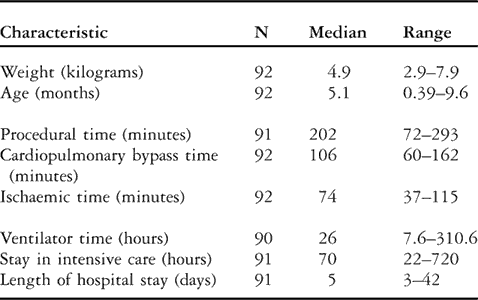
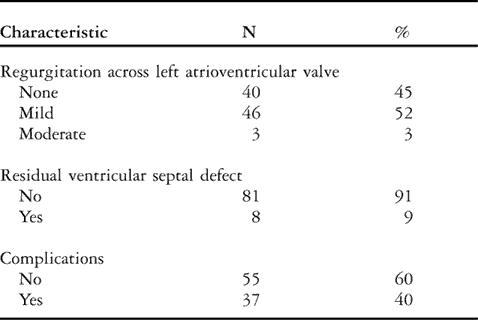
Table 1 and 2 show summary statistics for continuous and categorical data, respectively.
Summary statistics for continuous operative and postoperative data.

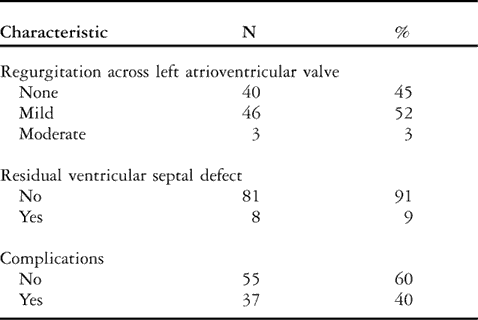
Summary statistics for categorical postoperative data.
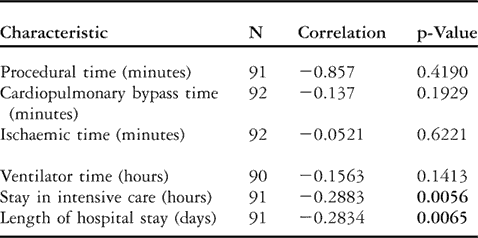
The correlations between weight and continuous variables are given in Table 3. Operative data included times of cardiopulmonary bypass, aortic cross-clamping, and the overall procedure. Neither the period of cardiopulmonary bypass (p = 0.193), cross-clamping (p = 0.622), or the overall time of the procedure (p = 0.419) were significantly affected by decreasing weight.
Correlation analysis by weight for continuous variables.
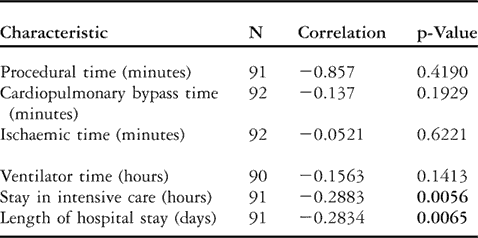
Postoperative continuous data included duration of ventilation, length of intensive care unit and hospital stay. Length of stay in intensive care (p = 0.006) and hospital (p = 0.007) both increased significantly with decreasing weight.
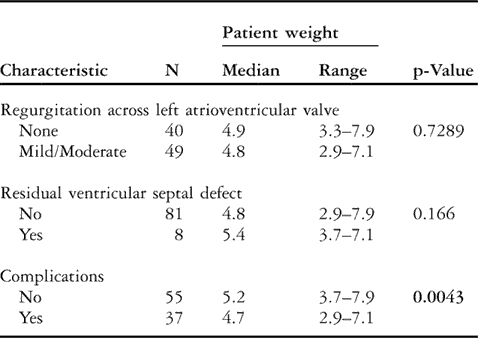
The correlations between weight and categorical variables are given in Table 4.
Correlation analysis by weight for categorical variables.
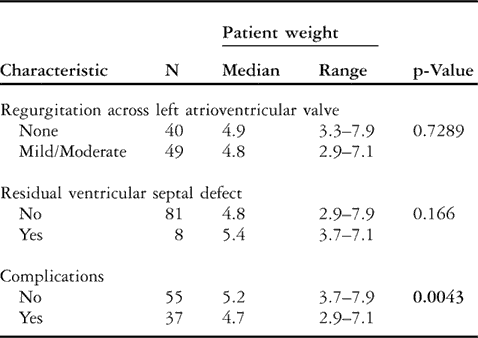
Postoperative categorical data included residual ventricular septal defects, degree of left atrioventricular valvar regurgitation, and complications. We encountered 46 complications in 37 patients, including re-admission within 30 days of surgery in 1, postoperative sepsis in 3, re-intubation in 3, chylothorax in 5, pleural effusion requiring drainage in 4, pericardial effusion requiring drainage in 1, postoperative arrhythmias or heart block requiring temporary pacing in 20, and miscellaneous events in the other 9. There was no mortality, and no persistent heart block requiring placement of a permanent pacemaker. There was a significantly higher presence of these complications overall with decreasing weight (p = 0.0043). There was a 2.28 increase in the odds, with 95% confidence intervals from 1.27 to 4.07, of a complication occurring for each decrease of 1 kilogram in the weight of the patients. On the other hand, there was no difference in residual defects (p = 0.166) or valvar regurgitation (p = 0.729) based on weight at the time of surgery.
Discussion
With improvements in our technology and surgical technique, we are continuously challenged by our paediatric cardiologists to repair those having atrioventricular septal defects, common atrioventricular valvar orifice, and balanced ventricles earlier in their life, and when they are smaller. We have typically been using the age and weight of the patients as criterions for determining the timing of such repair. Although some remain relatively asymptomatic, the majority of patients are referred with symptoms of heart failure. We typically recommend that complete repair be deferred until the patient has achieved a weight of 5 kilograms. Earlier surgical intervention is performed for children referred with intractable heart failure and failure of maximal medical therapy. Unfortunately, the definition of “intractable heart failure” and “maximal medical therapy” are highly variable.
The timing for surgical correction also depends on the size of the septal defect, the degree of incompetence of the common atrioventricular valve, and the haemodynamic consequences. The asymptomatic patient lies at one end of the spectrum, and elective repair is undertaken by 6 months of age.Reference Castaneda, Jonas and Mayer1–Reference Yasui, Nakamura and Kado4 This timing is based on the progression of pulmonary disease, and the desire to obtain an acceptably low postoperative pulmonary vascular resistance.Reference Chin, Keane, Norwood and Castaneda2, Reference Matsuda, Hirose and Nakano3, Reference Yamaki, Yasui and Kado5, Reference Malec, Mrozcek, Pajak, Januszewska and Zdebska6 Also, degenerative changes in the leaflets of the atrioventricular valve, and dilation of its annulus, increase significantly as age at repair increases, as does the incidence of residual regurgitation across the left atrioventricular valve following repair.Reference Castaneda, Jonas and Mayer1, Reference Yasui, Nakamura and Kado4, Reference Michielon, Stellin, Rizzoli and Casarotto7, Reference Studer, Blackstone and Kirklin8
At the other end of the spectrum are the children who suffer from severe, intractable congestive heart failure, despite aggressive in-hospital medical and nutritional support. They require early surgical intervention, often within the first month of life. More commonly, the situation is between these extremes, since the fall in pulmonary vascular resistance that occurs following birth leads to an gradual increase in left-to-right shunting and a gradual onset of symptoms.Reference Malec, Mrozcek, Pajak, Januszewska and Zdebska6 Children become increasingly tachypnoeic, particularly related to feeding, and fail to gain weight. These children are referred for elective surgical repair of the defect as they become progressively more symptomatic within the first six months of life.
The optimal timing of repair within this period is unclear, and typically depends on the preferences of the paediatric cardiologists and paediatric cardiac surgeons. Based on the constraints of size, and securing a functional valvar repair, it is the impression of the surgeons that repair is technically easier as the child gets closer to 5 or 6 kilograms in weight. During this period of delay, it is usually possible to manage the symptoms with appropriate anti-congestive medical therapy, including digitalis and furosemide.Reference Jonas9, Reference Mavroudis, Backer, Jacobs, Mavroudis and Backer10 If the standard regime is unsuccessful, other medications, such as captopril, carvedilol, spironolactone, and chlorothiazide can be utilized.Reference Buchhorn, Bartmus, Siekmeyer, Hulpke-Wette, Schulz and Bursch11, Reference Shaw, Wilson and Dickenson12 Increasing the caloric concentration of oral feeds has also been employed to help combat congestive heart failure and improve growth.Reference Mavroudis, Backer, Jacobs, Mavroudis and Backer10 Offering nasogastric tube feeds may also help to increase caloric intake and maintain growth, without children tiring with oral feeds.
Unfortunately, this desire to delay surgery is often cumbersome on the families and the paediatric cardiologists, and these children are often referred for early repair when weighing from 3 to 4 kilograms. Early intervention reduces the period of time these patients require aggressive medical and nutritional therapy to prevent heart failure, maintains growth, and minimizes exposure to elevated pulmonary pressures. Some have advocated elective repair at the initial appearance of detectable clinical signs of congestive heart failure, even within 1 or 2 months of age.Reference Michielon, Stellin, Rizzoli and Casarotto7, Reference Hanley, Fenton and Jonas13 Progress in surgical technique and critical care medicine overall has substantially decreased the morbidity and mortality in small infants.Reference Kopf and Mello14 Also importantly, experience-related technical progression has progressed in young infants to the point that it should not be a limiting factor in achieving competence of the left atrioventricular valve.Reference Hanley, Fenton and Jonas13 Reports show that early repair is easily accomplished at a low mortality rate, with no mortality in some experiences over the last 7 years, and at the same time ensures excellent long-term competence of the left atrioventricular valve, with only 2.7% reoperations, and 94.7% actuarial freedom from reoperation at 14 years.Reference Michielon, Stellin, Rizzoli and Casarotto7
We conclude, therefore, that once children with balanced atrioventricular septal defects become symptomatic, early surgical results appear to be such that prolonged or aggressive medical therapy is unwarranted. While performing surgery early within the first 6 months of life seems to prolong the recovery, as shown by increased stays in intensive care and hospital, and increase the risk of minor complications, there is no mortality or incidence of complete heart block requiring placement of a permanent pacemaker. Also, there is no effect on operative times or surgical results relative to residual defects or degree of postoperative left atrioventricular valvar regurgitation. Overall, it appears from our data, with the exception of a slightly longer and more complicated postoperative course, that early surgery can be undertaken safely and effectively, with excellent outcomes.