

1. Introduction
What an honour it is to be giving the first Dow lecture. When I joined the Institute in 1995, Christopher Dow was working on his final book—Major Recessions (Dow, Reference Dow1998). It is unfortunate that he was not with us to offer his analysis of the depression which started in 2008 and in whose shadow we are still living. But Christopher’s connection with the Institute went back a long time.Footnote 1 He first came to the National Institute on secondment from HM Treasury in 1954 and became Deputy Director in 1957. In 1959, he set up the National Institute Economic Review which of course continues to provide valuable quarterly analysis, now, not only on the state of Britain’s economy but also on the state of the world.
This evening, I would like to talk to you about expectations in economics and their possible influence on the world with a focus particularly on expectations of wage and price increases but also with some discussion of orders, employment and unit costs. Christopher stressed the role of expectations in recessions. He argued that they were the result of breaks in confidence (Dow, Reference Dow1998, p. 376). But I cannot avoid noting that for much of history expectations have not arisen from an understanding of the behaviour of either people or the natural world.
Why are expectations as important to economists as dreams were in the ancient and medieval worlds? The answer is that a wide range of economic decisions is influenced by expectations. Businesses invest to meet future demand, not current demand, and thus investment has to be influenced by expectations. Consumption, similarly, is likely to be affected to some extent by people’s expectations of their future circumstances. Wage growth is probably influenced by expected price growth,Footnote 2 and the assumption that price increases depend on expected future price increasesFootnote 3 features in many of today’s macroeconomic models.
The body of my talk will provide an empirical focus on the nature of expectations. Where do they come from? Can they be influenced by policy decisions of the Bank of England? Are they related to subsequent behaviour and how accurate are they?
There are three forms of expectational indicators. The firsts are forecasts produced by so-called professional forecasters. These have had plenty of scrutiny, and I do not intend to discuss them further here. Second, there are measures of expectations of future interest rates and prices derived from financial markets. These are not the main focus of my talk, but I cannot avoid saying something about them. Third, there are measures produced by surveying households or firms, and the bulk of this lecture is prepared from work with three former colleagues from the Bank of England, Lena Boneva, James Cloyne and Tomasz Wieladek (Boneva et al., Reference Boneva, Cloyne, Weale and Wieladek2020), on the Confederation of British Industry’s Industrial Trends survey. We are very grateful for the CBI for supplying the data in a form which made this work possible.
2. Expectations in financial markets
I would like to illustrate the performance of market forecasts by looking first at the foreign exchanges and second at the forecast for inflation implied by the gilt market. In its earliest days, the Monetary Policy Committee (MPC) assumed that movements in the exchange rate would follow the values set in forward markets. Wadhwani (Reference Wadhwani1999) pointed out that the current spot rate offered a better forecast of the future than did the forward exchange market, and the Committee adopted the compromise of taking the average of the two, an approach which remained in use while I was still on the Committee. I sometimes argued, rather ineffectively, that perhaps we should revisit the empirical basis for the way in which we used forward exchange rates and other market indicators. That never happened, but for today, I thought it might be interesting to explore whether Wadhwani’s finding still holds. I looked only at quarterly movements in the US$/Sterling exchange rate from the end of June 1989 to the end of June 2016, fitting the regression equation
 $$ \ln \left(\frac{e_t}{e_{t-1}}\right)=\alpha +\beta \ln \left(\frac{f_{t-1}}{e_{t-1}}\right)+{\epsilon}_t. $$
Here,  $ {e}_t $ is the exchange rate at the end of quarter t and
 $ {f}_{t-1} $ is the 3-month forward rate at the end of quarter t − 1.
 $ {\epsilon}_t $ is a random disturbance. If the forward rate provides a forecast, which is on average correct, I should expect to find
 $ \alpha =0 $ and
 $ \beta =1 $. In fact, I find no explanatory power, but a value of
 $ \beta =-0.22 $. A plot of the data in figure 1 sums it up. If the forward rate is any good, we should expect to see the dots close to the 45° line while in fact they are close to the vertical line. But the negative value of
 $ \beta $ tells us not only that the current rate is better than the forward rate as a predictor, but that on average it points slightly in the wrong direction. So, no marks here to financial markets as predictors. And perhaps the MPC need to consider whether they should go on using the compromise from 1999 rather than follow the logic of Wadhwani’s findings, th
(Colour online) Exchange rate movements compared with expectations derived from forward markets (percentage points)

at the spot rate is the best predictor of the future exchange rate.
What about inflation? A comparison of the interest rates on ordinary gilts with that on index-linked stocks allows us to explore the capacity of the financial markets to forecast the inflation rate. The full dataset stretches from June 1985 to December 2015 although with some gaps arising presumably from the absence of any stocks of the maturities needed to work out the inflation forecast. Figure 2 shows predictions for the inflation rate in 25-monthsFootnote 4 time plotted against outturns. Once again, I would expect the points to be distributed around the 45° line if the markets are good at predicting. You can see that the slope,Footnote 5 although well below 1, is at least positive.
(Colour online) Inflation rates compared with expected values derived from indexed and ordinary gilt yields: 1985–2015

The positive slope arguably masks a less successful record shown in figure 3. Over the full period shown, the inflation rate has fallen markedly, and it is not surprising that inflation expectations have also come down. Over the last 5 years from January 2011 to December 2015, however, the inflation rate was much more stable, fluctuating between about 0 and 5 per cent per annum. If I look at the relationship between forecasts and outcomes for this period I find, once again, a perverse relationship. Inflation turned out to be low when it was expected to be high and high when it was expected to be low. That is not to say that any forecasters (apart of course from the National Institute and the MPC) could necessarily have done better. But it does suggest that we should not pay too much attention to market forecasts as a guide to the shape of things to come.
(Colour online) Inflation rates compared with expected values derived from yields on indexed and conventional gilts: January 2011–December 2015

3. Business surveys
3.1. The industrial trends survey
So much for market signals. Let me now turn to the message from business surveys. I would like to focus on the survey conducted by the Confederation of British Industry. They have kindly supported a body of work on their survey by making responses of individual firms available to us, on an anonymous basis. Over the years, Silvia Lui, James Mitchell and I sometimes working with other colleagues carried out a number of studies looking at their data. We showed, for example, that responses about the state of individual businesses were coherent with what the same firms reported to the Office for National Statistics in what was the Monthly Production Inquiry (Lui et al., Reference Lui, Mitchell and Weale2010). At the same time, we found that each firm’s response was influenced not only by what was going on in its own business but also by the average of other responses. We took this to indicate that responses were influenced by collective sentiment. This observation made me very doubtful of the practical importance of the gloomy response shown in a different survey, the Purchasing Managers Index, immediately after the 2016 referendum. With hindsight, those doubts were justified. At the same time, of course, if businesses react to their own expectations, it provides empirical support for the possibility of multiple ‘sunspot’ equilibria (Azariadis, Reference Azariadis1981).
Historically, the CBI only asked questions which expected qualitative answers—do you expect a rise, no change or a fall over the next 3 months. However, in 2008, they began asking about past and expected future price and wage changes over the last or coming 12 months. Firms were requested to provide answers in ‘buckets’. For price changes, firms were asked to respond in 1 of 11 buckets covering the range from −10 per cent to 10 per cent, while for wage increases, there were 10 buckets covering the range from −2 per cent to 8 per cent. Firms could also write in their own answers. The CBI kindly made available to the Bank of England the individual responses to its survey to these questions on wages and prices and to some of the questions which solicited qualitative answers. And, even more helpfully, they agreed to allow access to the data to allow me to complete the work even after I, and my colleagues, had left the Bank. Once again, the data were provided on a fully anonymised basis.
In the work described here (Boneva et al., Reference Boneva, Cloyne, Weale and Wieladek2020), we looked at three questions which expected quantitative answers, about the firm’s own prices, its wages and its rate of operation as a percentage of full capacity. We also looked at three questions which solicited qualitative answers about past and expected future movements. These concerned the volume of new orders, the volume of employment and costs per unit of output.
The CBI collects data from about 1000 firms in each quarter. It aims to go back to the same firms repeatedly, but turnover is fairly rapid and there are some gaps. The qualitative data are coherent with the wage and price data only from 2011Q1 to 2016Q3, but the median number of responses per firm is only four, giving a very unbalanced panel.
Let me look first at the price and wage data in figure 4. We can see that they are broadly similar to the macroeconomic aggregates, although they do not pick up high-frequency movements. In the early part of the current decade, the average across firms of the price growth that they reported was materially below the increase in both the producer price index (PPI) and the consumer price index (CPI). I should say here that the PPI used is weighted, as far as is possible to reflect the industrial structure of the CBI sample. The data are closely aligned at about zero, from mid-2012 onwards. Reported and expected wage growth, in the right-hand panel, look as though they are running slightly ahead of the official data for most of the period.
(Colour online) Survey data for past and expected price and wage growth compared with relevant macroeconomic variables
Source: Boneva et al. (Reference Boneva, Cloyne, Weale and Wieladek2020).

Most analysis of business surveys focuses solely on the aggregates. But with access to the individual responses, we can also explore the distribution of responses. In figure 5, I show the distribution of the pooled data.
(Colour online) The distribution of expected price (LH) and wage (RH) changes
Source: Boneva et al. (Reference Boneva, Cloyne, Weale and Wieladek2020).

Looking first at the price data in the left-hand panel, the most striking feature is the spike at zero. About one-third of firms do not expect to change their prices over the coming 12 months. A body of work suggests that about 15 per cent of firms change their prices in each month. If the probability of changing in each month is unrelated to when the previous change was made, then I would expect just under 15 per cent of firms not to change prices in a 12-month period. If a recent change makes a price movement less likely, then the proportion expecting unchanged prices over 12 months is likely to be lower. Beyond this, we see limited evidence of price stickiness. Expected increases are much more common than expected decreases, but well over 10 per cent of firms are expecting to reduce their prices. In the right panel, we can see that expected wage decreases are much less common than expected price decreases. There is also a spike at zero which may reflect stickiness of nominal wages.
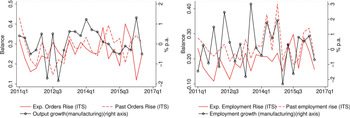
I now turn to the three qualitative items and for these consider the balance statistic, the proportion reporting a past or expected increase less the proportion reporting a past or expected decrease; I also look at capacity utilisation. The first panel for figure 6 compares these statistics for new orders with the growth in manufacturing output, while the second panel does the same for employment. As with prices, we can see that these do not reflect the high-frequency movements in the ‘hard’ data.
(Colour online) Qualitative data on new orders and employment
Source: Boneva et al. (Reference Boneva, Cloyne, Weale and Wieladek2020).

In the left-hand panel of figure 7, I look at the balance statistic for unit costs, comparing these to the PPI for inputs into manufacturing. Here, the balance reflects movements rather better—at least, it points to rapid growth and the start and end of the period. The right-hand panel of figure 7 shows capacity utilisation plotted with the unemployment rate. The former of course relates only to manufacturing, while the latter is indicative of slack in the economy as a whole. Nevertheless, the comparison perhaps indicates that the unemployment rate is better as a guide to low-frequency slack than to high-frequency movements in spare capacity.
(Colour online) Qualitative data on unit costs and the rate of operation
Source: Boneva et al. (Reference Boneva, Cloyne, Weale and Wieladek2020).

I should also mention that the relationship between expectations and outturns shows one characteristic, which we would expect to find. For wages and prices, the standard deviation of outturns is greater than that of expectations, as table 1 shows.
Summary statistics for past and expected wage and own price growth

Source: Boneva et al. (Reference Boneva, Cloyne, Weale and Wieladek2020).
Similarly, for the qualitative data, we find that ‘no change’ is more common ex ante than ex post as table 2 shows. Both of these observations reflect the fact that forecasts cannot reflect subsequent surprises. So outturns are more volatile than forecasts.
Summary statistics for responses to qualitative questions

Source: Boneva et al. (Reference Boneva, Cloyne, Weale and Wieladek2020).
I would now like to move on to discuss how the different responses are related to each other. Table 3 shows the correlations between the responses, again from the pooled dataset. For correlations between qualitative responses, I have used polychoricFootnote 6 correlations (Oulson, Reference Olsson1979), while for those between qualitative and quantitative variables, I have used polyserial correlations (Oulson et al., Reference Olson, Drasgow and Dorans1982). These compute correlations without giving arbitrary values to qualitative responses which simply indicate a ranking.
Correlations between responses

Note: Correlations greater than 0.3 are shown in bold.
Source: Boneva et al. (Reference Boneva, Cloyne, Weale and Wieladek2020).
I have marked those correlations greater than 0.3—an arbitrary reference point, but it does help to bring out the stronger relationships. So, we can see a correlation between expected price and cost growth but also between past and expected price growth. Similarly, past wage growth is quite strongly correlated with expected wage growth. Indeed, among the qualitative variables, we see the same tendency for past and expected future values to be correlated. Expected employment growth is also correlated with expected and past growth in orders, while past orders growth is correlated both with past employment growth and with the rate of operation. But we do not see material evidence of a relationship between price or wage growth and new orders or capacity utilisation. So, these data suggest that prices are linked to costs and that employment and orders are similarly linked. It is true that, just below our arbitrary limit, we see a correlation of 0.28 between expected wages and employment growth and 0.24 between outturns. But this hardly suggests the wage rates that firms pay are strongly sensitive to the need to bid for labour.
3.2. Determinants of expectations
Of course, expectations may depend not only on each firm’s own experience but also on the macroeconomic environment, including views about macroeconomic prospects. So, I would like to examine this with further results from our study of the CBI data.
3.3. Price and wage expectations
Table 4 shows the results of fitting a regression equation to explain expectations of price and wage growth. The models are fitted by Bayesian model averaging. This technique explores all possible combinations of the variables and produces an overall view based on the ability of each model to explain the data. Here, I have indicated in bold those coefficients that are significant at a level of 5 per cent.
Influences on price and wage expectations

Note: Coefficients significant at 5 per cent are shown in bold.
Abbreviations: AWE, average weekly earnings; CPI, consumer price index; GDP, gross domestic product; IR, Inflation Report.
Source: Boneva et al. (Reference Boneva, Cloyne, Weale and Wieladek2020).
I have not included past movements as an explanation of expectations. The reason for this is that I subsequently explore, as far as is possible with these data the idea that outcomes may be a function of expectations, a key feature of the New Keynesian model of inflation. Also, because the orders, employment and costs variables are qualitative, I have to represent them by dummy variables—two for each question. Thus, one dummy takes a value of 1 if a rise is reported, and another takes a value of 1 if no change is reported. Firm-specific fixed effects are also included.
We can see that price expectations react significantly to past import price growth and also to movements in past costs and to the rate of operation. But strikingly, macroeconomic expectations, as represented by the forecasts in the MPC’s Inflation Report (IR), do not play a significant role.
Wage growth is affected by the IR forecast of gross domestic product (GDP) growth but not by that of inflation, pointing to labour market demand effects. We see once again firm-level influences reflecting past growth in orders and employment, and also the rate of operation. Perhaps, not surprisingly, the fact that we have suppressed the term in past experience means that the influence of demand factors is augmented.
3.4. Policy as an influence on expectations
These results need to be compared with a recent study by Coibion et al. (Reference Coibion, Gorodnichenko and Kumar2018). Using data from New Zealand, they asked firms about their expectations of inflation and showed these were influenced by whether or not firms were reminded of the inflation target adopted by the Reserve Bank of New Zealand. Of course, our data relate to firms’ expectations of their own price increases. So now, let me look at the question of whether firms’ expectations are influenced by central bank policies. While that could be examined in the context of the equations described above, I am here drawing on earlier results presented by Boneva et al. (Reference Boneva, Cloyne, Weale and Wieladek2016). They focused explicitly on the monetary policy announcements made during the period in which the Bank Rate was held at ½ per cent per annum.
The first panel of figure 8 shows price expectations and the timing of three announcements about asset purchases (QE 1–QE 3), the funding for lending scheme and both incarnations of forward guidance (FG1 and FG2). The second chart shows announcements about amounts of assets to be purchased, either as an extension of an existing scheme or as a new scheme. The graphs do not show a clear response of expectations of price growth or, in the second panel, wage growth, to policy announcements. But I should remind you of the general principle that ‘eyeball econometrics’ does not allow researchers to reach conclusions—at best, it serves to illustrate them.
(Colour online) Monetary policy announcements and expectations of own and industry price increases
Source: Boneva et al. (Reference Boneva, Cloyne, Weale and Wieladek2016).

Table 5 shows the results of a regression equation, which does suggest that there are influenced from both asset purchases and Funding for Lending, after we control for a range of other variables including macroeconomic news reflected here as deviations of data outcomes from consensus forecasts. Forward guidance, on the other hand, is not shown to have any effect.
Effects of policy announcements

Note: Coefficients significant at 5 per cent are shown in bold.
Abbreviation: CPI, consumer price index; ER, exchange rate; GDP, gross domestic product; VIX, Chicago Board Options Exchange’s volatility index.
Source: Boneva et al. (Reference Boneva, Cloyne, Weale and Wieladek2016).
I should mention one caveat in interpreting these results. The estimates of the effects of quantitative easing announcements on expectations can be compared with estimates produced by Weale and Wieladek (Reference Weale and Wieladek2016) of the actual effects of the policy. These suggest that the peak influence on CPI inflation was only about one quarter of the impact on expectations indicated in table 5. I cannot say that either price effect is either right or wrong. Both effects are significant, but there are obviously large margins of error round both estimates. Thus, the coefficient of 1.407 has a t-statistic of 2.19. This is indeed significant at a 95 per cent level of confidence. But at the same time, the 95 per cent confidence interval probably overlaps with the confidence interval surrounding the estimates produced by Weale and Wieladek (Reference Weale and Wieladek2016).
These results suggest that wage and price expectations are influenced by policy announcements. But I would like to distinguish this from the suggestion by Coibion et al. (Reference Coibion, Gorodnichenko, Kumar and Pedemonte2018) that central banks should aim to influence expectations directly by means of economic forecasts. I am quite clear that forecasts, even when produced by a body such as the MPC, need to represent what forecasters expect to happen and not what they would like to happen. Of course, in the period immediately after the financial crisis, bank officials were criticised for not being optimistic enough and for stressing that the future was uncertain, surely no more than the truth. We have recently seen an outbreak of boosterism among politicians who seem to think that, if people believe firmly enough that the land of Cockaigne lies just around the corner, reality will catch up with fiction.
When I hear criticisms of the economists for not being optimistic enough, I can make only one observation. If the MPC’s growth forecasts produced in the aftermath of the financial crisis had turned out to be right, then the economic situation would be much more favourable than it currently is. Of course, trying to influence an inflation rate by talking it up is not the same thing as trying to influence output per person. Output is constrained by supply, while inflation is probably influenced by expectations in some form—despite the evidence of figure 3. But without announcements about plausible policies, it seems unlikely that communication about aspirations can do very much.
3.5. Influences on qualitative expectations
What about influences on qualitative measures of expectations? Here, the technology is a bit more complicated? In table 6, I show odds ratios generated by fitting a fixed effects logit equation to a variable which takes a value 1 if the response to the question on new orders, employment, or unit costs is that a rise is expected, and 0 otherwise. This means that I do not distinguish no change from fall; I am afraid there is no way of making that distinction while at the same time including firm fixed effects. An odds ratio greater than 1 indicates that an increase in the independent variable raises the probability of the dependent variable showing 1, while one below 1 indicates that it decreases. Coefficients significantly different from 1 are shown in bold.
Influences on qualitative expectations data

Note: Coefficients significant at 5 per cent are shown in bold.
Abbreviations: AWE, average weekly earnings; CPI, consumer price index; GDP, gross domestic product; IR, Inflation Report.
Source: Boneva et al. (Reference Boneva, Cloyne, Weale and Wieladek2020).
We can see that expectations of new orders are significantly adversely affected by wage growth but positively affected by past orders. Employment expectations are positively liked to past orders and also to past price growth, while unit cost expectations are linked to import price growth and also to past costs, but not to past wage growth or to the rate of operation.
3.6. Expectations and outcomes of price and wage growth
From these observations about influences on expectations, I would now like to focus specifically on wages and prices, and in particular whether there is evidence that wage and price increases are connected to expectations. To many of you this may seem to be putting the question back to front, but, as I mentioned earlier, an important feature of today’s economic models is that price decisions reflect expected future prices. One reason for this may be that, if there are costs to changing prices and firms seek to minimise these costs, then they will choose a price today which reflects not only today’s costs but also expected future costs. The same result follows if one makes a different assumption, that firms change their prices only intermittently. Then, intuitively, they will set prices with reference to expected future costs, and this relationship can be turned into a recursion which turns into setting prices with reference to expected future price movements. Gali (Reference Gali2011) shows that the same logic can be applied to wage setting, although one based round a view of the labour market which I must say I do not find very plausible.Footnote 7 Anyway, with both the price model and the wage model, a theoretical feature is that actual prices should depend on expected future prices with a coefficient slightly above one.
Mavroedis et al. (Reference Mavroedis, Plagborg-Moeller and Stock2014) provide a survey of the substantial literature devoted to examining these models using aggregate data. A problem with empirical work in the area is that it is difficult to provide convincing identification. In a regression equation, price increases appear to be explained by expected future prices. If the expectations are observed before the price increases actually happen, then it is unlikely that the true causation is reversed. But it may still be the case that the relationship is an illusion due to the fact that both expectations and outturns are influenced by some third variable. This issue can be addressed by means of instrumental variables but that requires the existence of suitable instruments.
My colleagues and I do not claim to have resolved the question of instruments. But the fact that we are able to look at expectations and outcomes firm by firm means at least that we can remove firm fixed effects and can control for a wide variety of firm-specific factors.
A specific feature of our data that needs to be addressed is that responses to the questions on wages and prices relate to four quarters rather than just to one quarter. If we were to use expectations reported in one quarter and outturns a quarter later, our results would be distorted by serial correlation. But, by imposing a lag of three quarters between the expectation and the outturn, we can derive a valid econometric model.
I indicate the results of this in table 7. It shows the coefficient on expected prices/wages lagged by three quarters in a regression equation explaining changes in firms’ own prices or their wages. The coefficients tend to be weaker when firm-level control variables are present than in their absence, but the general pattern is coherent. The regression coefficient is about 0.3 and is statistically significant at a 5 per cent level in all the specifications. But its value is materially below the coefficient of just below one that the theoretical model suggests. It is also worth noting that Mavroedis et al. (Reference Mavroedis, Plagborg-Moeller and Stock2014) quote a number of macroeconomic studies which have suggested a value of about 0.7; they are critical of these, because, although they are estimated by instruments variables, Mavroedis et al. (Reference Mavroedis, Plagborg-Moeller and Stock2014) do not find their instruments convincing.
Coefficients on expected price and wage changes

Notes: Coefficients significant at 5 per cent are shown in bold. The dependent variable is the reported growth in prices or wages. The coefficient shown is that on expectations with a lag of three quarters.
Source: Boneva et al. (Reference Boneva, Cloyne, Weale and Wieladek2020).
Anyway, this leads me to the conclusion that, while expectations may well influence actual price movements, the empirical evidence, as best as I can judge it, implies a coefficient well below models which are strongly influenced by economic theory. Of course, my control variables may be mopping up some influences that would properly be seen as arising from expectations, but then nothing is ever perfect.
3.7. Expectational errors
If expectations have some importance as influences on outcomes, although weaker than theory implies, then I should perhaps look at the performance of firms’ expectations. How good are firms at predicting their own behaviour over the coming year? This can be explored both for the quantitative wage and price expectations and the qualitative expectations of new orders, but the techniques needed are rather different.
To look at expectations of quantitative variables, I need to explore the properties of the forecast errors, the difference between the forecast and the outturn reported four quarters later. I am particularly interested in whether forecast errors are predictable using information known at the time of the forecast. Should that turn out to be the case one might think that firms could try to learn from at least some of their past mistakes. Of course, one might also be interested in whether firms have been misled by the MPC. Do errors in the MPC’s forecasts help explain firms’ forecast errors? Should that be the case it does not, of course, mean that either firms or the MPC are poor forecasters. It may simply indicate that both the firms in question and the MPC have been taken by surprise by the same events.
Table 8 shows the results of this. In the first two columns, I include macroeconomic forecast errors. In the second pair of columns, they are replaced by time fixed effects. All the models include firm fixed effects. Once again, those coefficients significant at 5 per cent are shown in bold.
Explaining price and wage forecast errors

Note: Coefficients significant at 5 per cent are shown in bold.
Abbreviation: MPC, Monetary Policy Committee.
Source: Boneva et al. (Reference Boneva, Cloyne, Weale and Wieladek2020).
You can see that firms which forecast high values for prices or wages are likely to find outturns coming in below expectations, while those who report low forecasts are likely to be surprised on the upside. This implies a degree of over-reaction similar to that observed by Bordalo et al. (Reference Bordalo, Gennaioli, Ma and Sheifer2020) observed in the macroeconomic forecasts produced by individual forecasters. Price forecast errors are also sensitive to errors made by the MPC, and errors in the growth forecast are almost as important as errors in the inflation forecast. That may support the view that price expectations are influenced by expected demand. For wages, there is also evidence that past wage increases matter. Firms that have experienced fast wage growth in the past are likely to have outturns below their forecasts. This offers support for the idea that at least some firms have adaptive expectations.
It is not possible to include both macroeconomic forecast errors and time fixed effects. But when I include the latter, you can see that both expectations and lagged effects are significant. Finally, I show test statistics for the hypothesis that the variables known when the expectations were reported actually all have zero coefficients. This statistic is chi-squared distributed with eight degrees of freedom. Any value above 15.51 is significant at a 5 per cent level. So, the hypothesis that the forecast errors are unaffected by variables that firms knew at the time they were making their forecasts is firmly rejected. Firms in the United Kingdom do not seem to forecast efficiently.
When I look at qualitative data, my options are rather limited. Das et al. (Reference Das, Dominitz and van Soest1999) suggest looking at the position of the median respondent. I would like to be able to accept the hypothesis that the median respondent is in the same category when reporting outcomes as they were when reporting forecasts. Or, if I separate the firms expecting rises from those expecting falls, I can then examine whether the median firm of those expecting a rise also reports a rise ex post. This test, unlike the earlier regression model, can be done period by period. But I need to allow for the fact that we simply observe a sample of possible respondents. If I observe the proportion of ‘rise’ forecasters who also report rise ex post, I can use the binomial theorem to test whether the population proportion is at least 50 per cent. The results can be shown graphically, and in figure 9, I plot both the proportion who actually reported rise (fall) ex post conditional on rise (fall) ex ante and the upper limit of a one-sided 5 per cent confidence interval. If this upper limit is less than 50 per cent, then it is reasonable to reject the view that the median rise-forecasting firm is correct. Since I have just over 20 observations, I should not be surprised if this test is failed on one or two occasions. Nevertheless, multiple failures certainly suggest that the median outcome is different from the median forecast.
(Colour online) (a) New orders. (b) Employment. (c) Unit costs

You can see from this that for new orders in figure 9a. There are seven cases when the 95 per cent confidence interval for the median response was not for rise, despite all the firms contributing to this plot having expected it. The probability of so many failures when there are 22 observations is obviously rather low. On the other hand, when I look in the right-hand graph at those firms which expected a fall, there are only 2 cases when the median outcome was different from that—not a great surprise when I am testing at 5 per cent significance and there are only 22 observations. With employment in figure 9b, there are three failures among those expecting rises and none among those expecting falls. So, in the round, it would be hard put to say that the forecasts of employment movements are poor.
The situation with unit costs, shown in figure 9c, could not be more different. There are 9 failures among those expecting rises and 11 among those expecting falls. Moreover, there are some cases when failures occurred for both those expecting rises and those expecting falls. So, firms have considerable difficulty in forming accurate expectations of cost movements.
Of the three qualitative variables considered, the only one which is within each firm’s control is employment. Firms decide how many people to employ while orders and costs are outside their control. So, perhaps it is not surprising that the most reliable forecasts they produce are those of employment.
4. Conclusions
In this talk, I have pursued an empirical investigation of expectations of some key economic variables. Economists often make the assumption that forecasts are on average correct. But these results show that they are not. I think I have shown that, whether one looks at expectations of some key variables in the financial markets or expectations as reported in the CBI survey, this widely used assumption, often referred to as rational expectations, is no more than a simplifying assumption. This does not mean that economists are wrong to use it. Modelling, by its nature, is the art of simplification, and there is always a trade-off between convenience and detail. But any users of economic models and the results that they produce need to ask themselves what the key assumptions leading to those results are. And, there are good grounds for being uneasy about an analysis that flows from the assumption that expectations are on average correct. Certainly, the sort of learning processes studied by Levine et al. (Reference Levine, Pearlman, Perendia and Yang2012) in their model of the U.S. economy merits wider application.
Of course, the work I have presented here is, to say the least, not the first to explore the validity of the assumption that expectations are on average correct. But I think the use of microdata here is relatively novel and I hope you found it interesting to see where things stood with data from financial markets as well.
I have focused on expectations and where they come from. But there are a couple of additional points I would like to close. First, it was in the past suggested that policy-makers, instead of setting policy with respect to their own forecasts, should do so with reference to measures of expectations. Bernanke and Woodford (Reference Bernanke and Woodford1997) considered but rejected the idea on the grounds that measures are contaminated by noise. The data I have shown suggest that market measures may be perverse. So, I would much rather stick with the approach the MPC uses—basing the policy decision on its own judgements about the future rather than on the judgements of others.
The main data source that I have used post-dates the downturn of 2008, although the data do cover the period of stagnation which came after the first phase of recovery. But, while, as Christopher Dow argued, breaks in confidence may be factors in recessions, there are also circumstances, as after the referendum in 2016 when there is a sharp fall in confidence but nothing much happens. There is further work to be done in learning how to distinguish those breaks which do matter from those which do not. I am certainly not saying that forecasts should be produced quite independently of surveys, or indeed market expectational data. There is more work to do in understanding the importance of systematic forecast errors for economic behaviour. In the meantime, expectational data have to be seen in a broader context.
Acknowledgements
Dow Lecture presented at the National Institute of Economic Social Research on 6 November 2019. This lecture draws very heavily on a paper by Boneva, Cloyne, Weale and Wieladek (Economic Journal, 2020), and I am very grateful to my collaborators for having had the opportunity to work with them on the issues discussed here. Our work was in turn made possible by kind co-operation and support from the Confederation of British Industry for which we are very grateful.