Introduction
Aedes aegypti (L.) (Diptera: Culicidae) mosquitoes almost exclusively inhabit urban areas (Valença et al., Reference Valença, Marteis, Steffler, Silva and Santos2013; Ye et al., Reference Ye, Chenoweth, Carrasco, Allen, Frentiu, van den Hurk, Beebe and McGraw2016). The marked feeding preference of females for human blood makes them efficient vectors of mosquito-borne viruses, such as dengue fever, yellow fever, chikungunya, and Zika. Male and female mosquitoes also feed on plant sugars, with sugar being the only food for male mosquitoes, regardless of the species (Yee and Foster, Reference Yee and Foster1992; Foster and Hancock, Reference Foster and Hancock1994; Gary and Foster, Reference Gary and Foster2004). Sugar consumption has a significant influence on vector dispersion capacity (Stone and Foster, Reference Stone and Foster2013), and both males and females need sugar throughout their adult life (Foster, Reference Foster1995). Initially, both sexes usually visit a plant for the first time after emergence. Afterward, males require sugar at frequent intervals to maintain their energy reserves (Yuval, Reference Yuval1992), while females consume sugar between blood samples when they are digesting blood or when they are gravid.
Neither the relationship of sugar feeding with blood feeding nor the behavioral outcomes associated with food source selection have been elucidated for Ae. aegypti. The relevance and frequency of each type of intake depends on the mosquito species and physiological state.
The common sugar sources in nature are floral and extrafloral nectar (Patterson et al., Reference Patterson, Smittle and DeNeve1969; Foster and Hancock, Reference Foster and Hancock1994), honeydew (Gary and Foster, Reference Gary and Foster2004), and ripe fruits (Joseph, Reference Joseph1970). Several factors help attract and orient mosquitoes toward vascular plants (e.g., floral scents and nectar) (Raguso, Reference Raguso2004). Cues such as flower color and nectar provide mosquitoes with information regarding the location, abundance, quality of food, and pollen, thus influencing their attraction toward the plant (Magnarelli, Reference Magnarelli1977).
The positive response of mosquitoes to floral volatiles was observed in the absence of visual stimuli (Jepson and Healy, Reference Jepson and Healy1988), suggesting that volatiles act as long-range attractants, even before visual contact. Floral scents seem to drive long-range host localizing, while visual signals might play a role in short-range detection (Jepson and Healy, Reference Jepson and Healy1988). Mosquito feeding field studies have shown that they feed on a very limited number of plant species (Abdel-Malek and Baldwin, Reference Abdel-Malek and Baldwin1961; Abdel-Malek, Reference Abdel-Malek1964; Müller and Schlein, Reference Müller and Schlein2006), which may explain the importance of these volatile cues. In the case of Ae. aegypti, laboratory behavioral bioassays and electroantennograms have demonstrated their ability to recognize volatile compounds commonly associated with specific species as a way of locating nectar sources (Jhumur et al., Reference Jhumur, Dötterl and Jürgens2007; von Oppen et al., Reference von Oppen, Masuh, Licastro, Zerba and Gonzalez-Audino2015).
Because both sexes rely on sugar sources, attractive toxic sugar baits have been proposed as lower impact mosquito trap. Traditional mosquito control methods are pesticide-intensive which can lead to resistant mosquito populations (Smith et al., Reference Smith, Kasai and Scott2016), and negatively impact ecosystem or human health. Therefore, efforts to find methods with low environmental impact are worthwhile. However, the results from field traps that use sugar baits are still controversial (Xue et al., Reference Xue, Ali, Kline and Barnard2008; Fikrig et al., Reference Fikrig, Johnson, Fish and Ritchie2017). A study carried out in Australia suggests that female mosquitoes seldom feed on sugar making it in an unreliable bait, while recent work in South America found that sugar feeding is in fact common (Fikrig et al., Reference Fikrig, Johnson, Fish and Ritchie2017). Our area of interest is also in South America, where Ae. aegypti is extensively spread and has been responsible for several dengue epidemics. These circumstances could make South America an ideal candidate region for testing sugar trap efficacy.
This research examined how plant volatile compounds affect mosquito behavior generally in order to gain insight into native Aedes feeding behavior. An initial screening assessing adult mosquito preferences for domestic plants found that Lobularia maritima, Plectranthus neochilus, Euryops pectinatus, and Tagetes patula were preferred (von Oppen et al., Reference von Oppen, Masuh, Licastro, Zerba and Gonzalez-Audino2015). As a continuation of this project, we screened mosquitoes' preference for Senecio madagascariensis as it is largely distributed in the Argentine Pampa Region, including their breeding sites located in an urban area around our campus. No information is currently available regarding the role of S. madagascariensis scents in the chemical ecology of insect pests. This prompted us to study the attraction properties and chemical composition of its volatile compounds. Once preference for S. madagascariensis was established, behavioral bioassays were carried out, the chemical composition of volatiles was assessed, and the active components of flowers were identified and incorporated in controlled release formulations. Ultimately, the goal of this project was to use these insights in the application of field traps.
Materials and methods
Mosquitoes
A CIPEIN insecticide-susceptible strain of Ae. aegypti mosquito was used. This colony was derived from a Rockefeller strain introduced from Venezuela in 1996 and was reared in our laboratory. Eggs were laid on wet cotton for 2 days and then dehydrated at ambient temperature and stored for at least 30 days. Before the experiments, the eggs were placed in distilled water (250 eggs l−1) at 25 ± 2°C (Seccacini et al., Reference Seccacini, Masuh, Licastro and Zerba2006). After hatching, the larvae were placed in 250-ml plastic containers and transferred to 20 × 20 × 20 cm3 acrylic boxes for molting. Larvae were fed with a mixture of rabbit pellets and yeast powder (80:20 wt:wt). Adults were fed ad libitum with water and 10% sucrose. The mosquito breeding room was set at 25 ± 2°C and 70 ± 5% R.H., with a L12:D12 photoperiod. To enhance the responses of adult mosquitoes toward volatile cues from food sources, they were subjected to starvation (24 h) in separate cages before tests were conducted (Vargo and Foster, Reference Vargo and Foster1982; Jhumur et al., Reference Jhumur, Dötterl and Jürgens2007). All adults were tested between 2 and 7 days old.
Plant material
S. madagascariensis plants found in bloom around the breeding sites of mosquitos were collected at our institute campus. They were examined to check whether they were undamaged by herbivory. Whole plants were extracted from the ground, transferred to polypropylene pots, brought to the laboratory, and rinsed with clean water. They were left outdoors for 3 days before being used in the experiments to reduce any putative cross contamination. The material was carefully manipulated with latex gloves to avoid contamination with skin volatiles.
For the landing preference bioassay, the flowers were cut short at their stems within approximately an hour of the experiment. The cut ends were carefully covered with moistened cotton and placed into containers without damaging the flower.
For the olfactometer behavioral assay, the flowers were cut at their stems and placed in vases with clean water during the day of the experiment to prevent them from wilting. Cut flowers were maintained under light to avoid closing. During the experiment, entire vases were insulated with an oven bag (30 × 45 cm2; B.P. Premium, Argentina) to avoid interference from volatiles released by the cut area.
Chemicals
Acetone (>99.8%) was obtained from Merck (Darmstadt, Germany). Paraffin wax (mp 53–58°C, ASTM D 87) and chemical standards 1-nonene (>99%), (+)-α-pinene (>98%), (−)-α-pinene (>98%), β-pinene (>98%), and alkane standards (C5–C30) (>99%) were all purchased from Sigma-Aldrich (St. Louis, MO, USA). Stearin wax of technical grade was obtained from Parafarm® (Saporiti, Argentina). Dichloromethane (DCM) (HPLC grade, >99.5%) was acquired from Sintorgan S.A. (Argentina). Sucrose (>99%) was purchased from Anedra (Tigre, BA, Argentina). Imidacloprid (94.3%) was supplied by Bayer (Leverkusen, Germany).
Are Ae. aegypti attracted to the floral scent of S. madagascariensis? Using imidacloprid to assess sugar feeding
Landing preference bioassay
To assess the attraction to a sugar bait, we incorporated the insecticide imidacloprid into sucralose solutions in both the control (clean vessel) and treatment (flowers) boxes. According to our established protocol (von Oppen et al., Reference von Oppen, Masuh, Licastro, Zerba and Gonzalez-Audino2015), cotton plugs soaked at 10 p.p.m. imidacloprid in 10% sucrose solution was placed next to the plant stimulus as a phagostimulant for mosquitoes (Xue et al., Reference Xue, Müller, Kline and Barnard2003; Müller et al., Reference Müller, Junnila and Schlein2010; Allan, Reference Allan2011). Imidacloprid was added as feeding marker to facilitate the counting of mosquitoes, which would be knocked down after ingesting the toxic sugar baits. Imidacloprid is an insecticide that acts though oral ingestion and has little contact or inhalation toxicity, and it does not elicit spatial repellency or attraction per se toward Ae. aegypti (Antonio-Arreola et al., Reference Antonio-Arreola, López-BelloI, Romero-Moreno and Sánchez2011). In this way, we could determine if the number of mosquitoes selecting the enhanced bait was significantly more than if they selected it at random.
In detail, the experimental setup was polyacrylate boxes (40 × 30 × 40 cm3) in a controlled environment at 27 ± 1°C, 60–70% R.H., and L12:D12. Both boxes, i.e., test and control, contained three plastic vessels, as described in fig. 1. The only water-containing vessel (125 ml) was placed in the middle of the cage, and it contained water-soaked cotton on the top of a permeable nylon over an empty vessel. The second vessel (250 ml) was placed in one corner and had cotton soaked in 10% sucrose on top of the nylon cloth. This container was left empty to offer the option of food without scent stimulus. The third vessel (250 ml) was placed in the other corner and included cotton soaked in sucrose and imidacloprid at 10 p.p.m. and 30 g of cut S. madagascariensis flowers as the scent stimulus. For the control experiment, the same setup with the three vessels was used but without plant material (i.e., no scent stimulus). Seven to twelve starved mosquitoes of each sex were released into separated boxes and left for 24 h. After this period, mortality was surveyed by counting knocked down mosquitoes and living mosquitoes. Four replicates of bioassays were carried out. Mortality was corrected with Abbott's formula (Abbott, Reference Abbott1925).
Treatment and control cage used in the landing preference bioassay on cut S. madagascariensis flowers or on impregnated disks.

In a tracking experiment for environmental conditions, solutions were provided simultaneously in each replicate by putting a plastic vessel with 0.25 g of cotton soaked in a 10% sucrose solution at the bottom of the acrylic cage and releasing ten mosquitoes inside. This experiment indicated whether the dead mosquitoes in the treatment and control cages (groups) were caused by the ingestion of imidacloprid alone. If nonzero mortality was observed in this experiment, then the bioassay was discarded.
Olfactometer behavioral assay
The Y-tube olfactometer setup was the same as that used in von Oppen et al. (Reference von Oppen, Masuh, Licastro, Zerba and Gonzalez-Audino2015) and designed according to Geier and Broeckh (Reference Geier and Broeckh1999). The air flowing through the olfactometer was provided by a central supply at 80 liters min−1, filtered through activated charcoal, and adjusted to 75% ± 10 R.H. and 26°C. After air flow splits inside the apparatus, the linear speeds were 0.5 and 0.25 m s−1 at the central arm and each lateral arm, respectively. The olfactometer was cleaned with 96% ethanol between replicates, and latex gloves were worn at all times.
Flowers with covered stems were put into a polypropylene bottle connected to one arm and were changed with fresh ones every hour. The bottles had two connections for air entry and exit. At the beginning of the experiment, ten starved mosquitoes of the same sex were loaded through the acclimatization chamber in the olfactometer base with the airflow in the closed position. After 5 min of acclimatization, the airflow ran for 30 s before opening the door to release the insects, which were allowed to freely move through the arms for 5 min. After this time, the doors were closed and the mosquitos in each sector of the olfactometer were surveyed. Eight replicates for each sex were performed. Between experiments, the mosquitoes were removed with a vacuum cleaner.
Identification of natural components present in the floral scent
Headspace of S. madagascariensis
Flowers were cut at the stem and put into a 500 ml Erlenmeyer tube containing purified water to maintain freshness. Inflorescences, including bracts, were covered with an oven bag (30 × 45 cm2; B.P. Premium, Argentina). The system was equilibrated for 30 min at 30°C in a temperature-controlled system, and afterward, a solid phase microextraction (SPME) divinylbenzene/carboxen/polydimethylsiloxane (DVB/CAR/PDMS) fiber (Supelco, Bellefonte, PA, USA) was punctured through the bag for adsorption of volatiles. Then, the fiber was exposed for 30 min to the sample headspace and subsequently injected in a Shimadzu QP-5050 gas chromatograph-mass spectrometer (GC-MS) for desorption at 240°C for 1 min with the injector in splitless mode. A blank with the same setup as the fiber in an empty bag was performed before collection of each volatile. DB-5MS (30 m × 0.25 mm, 0.25 μm film thickness) and DB-Wax (30 m × 0.32 mm, 0.25 μm film thickness) columns were used, and for chiral analysis, a CYCLOSIL-B (30 m × 0.25 mm, 0.25 μm film thickness) column was used (Agilent Technologies, Santa Clara, CA, USA). The detector operated in electron ionization mode at 70 eV, and masses were scanned from 45 to 280 m/z, with an interface at 245°C. For the chemical identification of single compounds, according to the availability, standard references were used. Comparisons of RI values were performed with the literature data and/or by matching the mass spectrum (MS) against the Wiley 7 library.
Flight preference bioassay of the main components of S. madagascariensis
Olfactometer behavioral assay
The same Y-tube olfactometer, setup, and procedure applied in the previous section were followed. To test pure compounds found in the S. madagascariensis headspace, 100 μl of a 1 mg ml−1 acetone solution of each compound was placed into one arm with 100 μl of pure acetone in the opposite arm. Once the chemical was in place, the mosquitoes were put into the olfactometer through the base and then exposed to airflow inside the acclimation camera for 2 min before being released. The first arm chosen by each mosquito was registered. If the mosquitoes were unresponsive after 3 min, the trial was discarded. Overall, 71 ± 6 responsive mosquitoes were tested, and a control was performed by measuring the response of the mosquito to acetone in both arms using 67 ± 3 responsive mosquitoes. The sample was randomly placed in the right or left arms of the olfactometer.
Formulation of attractant components in solid matrices for controlled release and evaluation of their biological activity
Preparation of solid disks containing 1-nonene: molded disks composed of 10 ml of paraffin or stearin were impregnated with 10, 1, and 0.5 mg of 1-nonene. For this, waxes were melted at their fusion temperature in a water bath and poured in a 25 ml flask. Then the active component was added to a DCM solution (5 mg ml−1) under stirring to achieve the final doses of 10, 1, and 0.5 mg per disk. DCM was chosen because it easily solubilizes alkenes and waxes, and because its boiling point (40°C) is lower than the melting points of stearin (54–75°C) and paraffin (52–54°C); thus, it evaporates during the preparation of disks. The boiling point of 1-nonene is 146.9°C, which is higher than the stearin and paraffin melting points. 1-Nonene solutions were poured into an open aluminum mold 6 cm in diameter. The disks were allowed to solidify, and the mold was used to perform a bioassay on the same day of preparation.
Landing preference bioassay on impregnated disks
The experimental design described in the landing preference bioassay (fig. 1) was followed, although impregnated disks were used instead of flowers to evaluate the influence of the individual attractant-impregnated disks on mortality caused by imidacloprid.
The disk was set inside at the base of the 250 ml receptacle, covered with a nylon cloth, and a 0.25 g piece of cotton embedded in a 10% sucrose and 10 ppm imidacloprid solution. For the control experiment, prepared disks of paraffin or stearin containing no attractants were simultaneously used.
Once the cages were setup, 12 starved mosquitoes of each sex were transferred from the stock cage to the experimental or control cage by very careful aspiration. Four to six replicates were carried out, and mortality was evaluated after 24 h. Simultaneous tracking experiments with the same setup detailed in the landing preference bioassay were performed.
Statistical analysis
Statistical analyses were performed using the InfoStat program package (InfoStat group, FCA, Universidad Nacional de Córdoba, Argentina). In landing preference bioassays, the mortality rates (after correction) were compared with the Kruskal–Wallis test, which is a nonparametric method adequate for nonnormality datasets. To evaluate the flight preference response in the olfactometer bioassay, the chi-square test was used. In all cases, P ≤ 0.05 was considered statistically significant.
Results
Landing preference bioassay
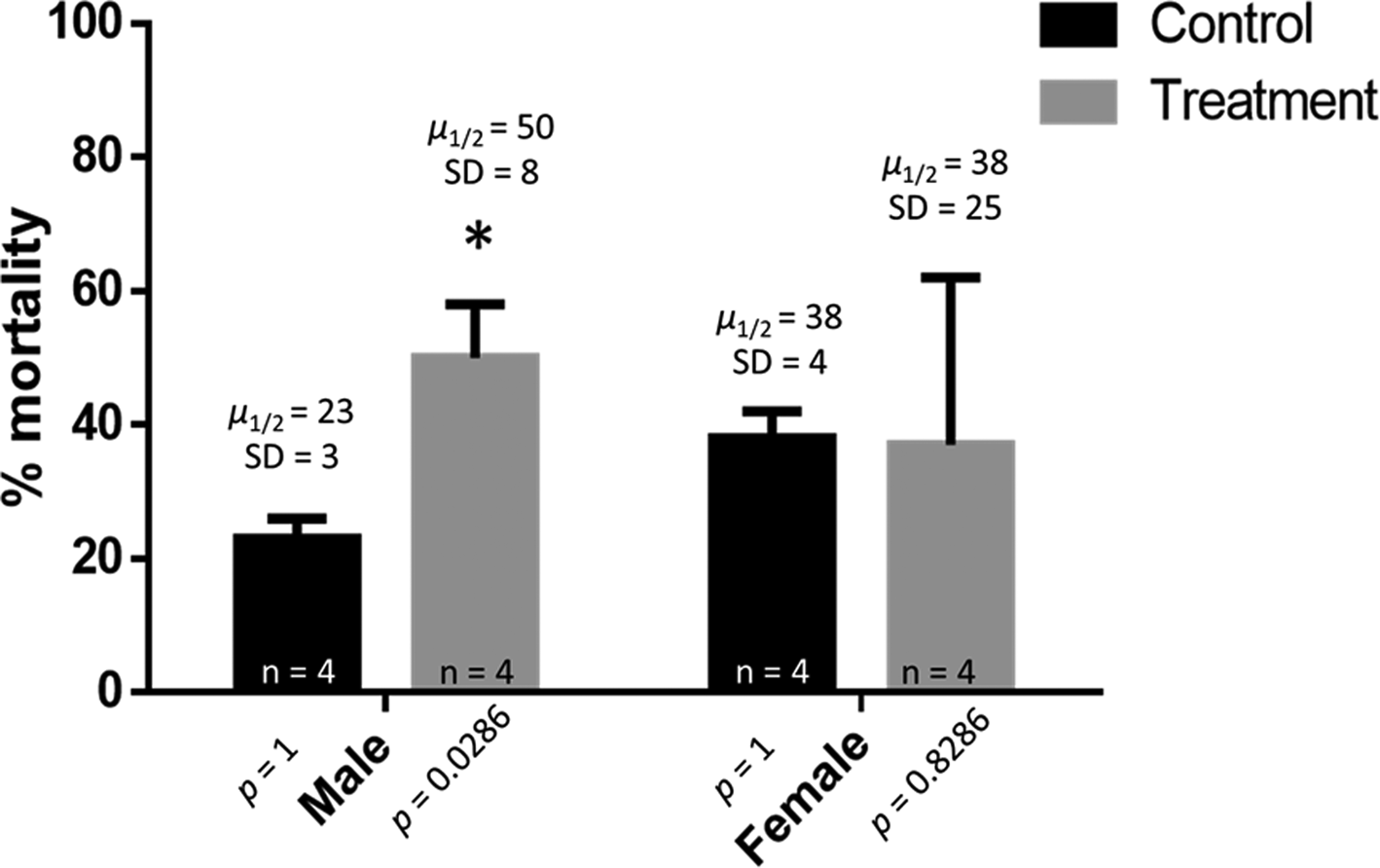
As observed in fig. 2, the presence of S. madagascariensis led to an increase in mortality in males (n = 4, P = 0.0286) but not in females (n = 4, P = 0.8286) compared to the control conditions (absence of S. madagascariensis). Based on this result, we tested the potential attractant effect of S. madagascariensis in a two-way olfactometer. No dead mosquitoes were found in the tracking cage during the experiments.
Landing preference bioassay on cut S. madagascariensis flowers. Asterisks express significant differences in response vs. the acetone control in the K–W test (*P < 0.05). μ 1/2, median; SD, standard deviation.

Olfactometer bioassay
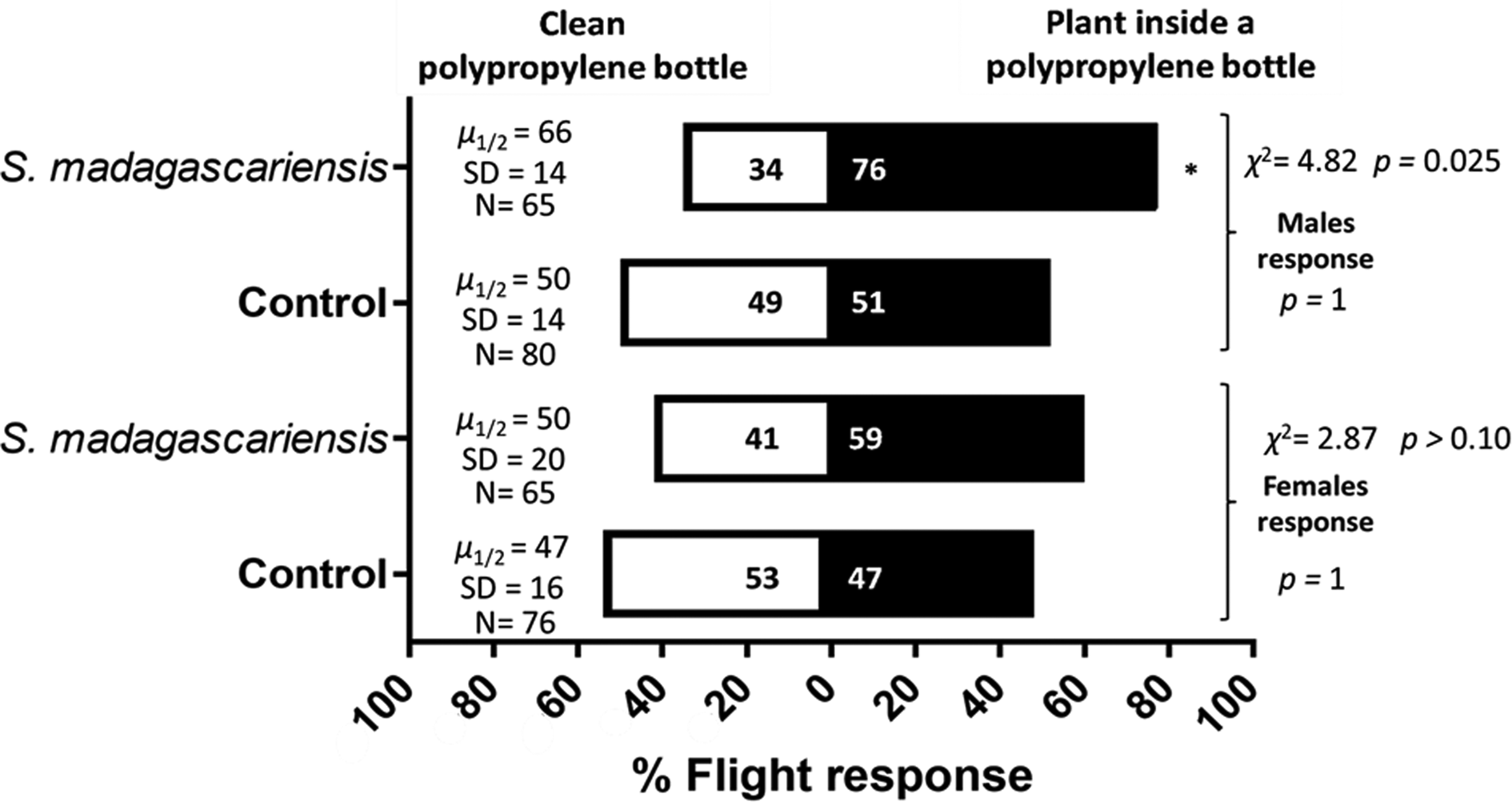
From the observations of the landing preference test, the potential attractant effect of S. madagascariensis flowers on male Ae. aegypti was confirmed in the two-way olfactometer. Both males and females were evaluated, and only male mosquitoes were observed to prefer the airstream containing volatiles of S. madagascariensis inflorescences (P < 0.05) (fig. 3), which is consistent with previous results. Female mosquitoes showed no preference (P > 0.10), which is also consistent with the results of the landing preference bioassay. Less than 20% of the mosquitoes were nonresponsive.
Two-way olfactometer behavioral assay of S. madagascariensis toward male and female Ae. aegypti. μ 1/2, median; SD, standard deviation. Asterisks express a significant difference in response vs. the acetone control in the chi square test (*P < 0.05, df = 1, critical value χ2(1, 0.05) = 3.84).

Plant volatile identification
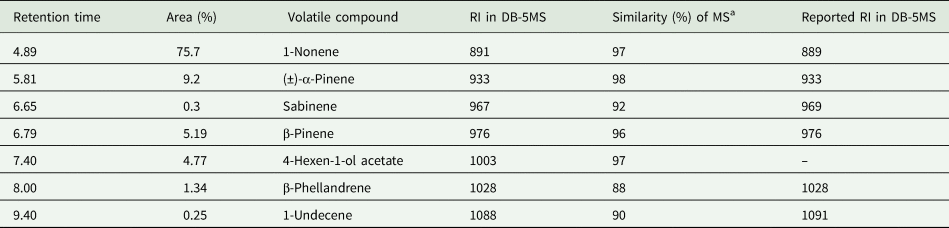
The observed attractant effect of S. madagascariensis flowers on males led us to identify the volatiles presumably responsible for that behavior. From the list of compounds collected from the flowers, the volatiles found in the oven bag and the components from column bleeding, e.g., alkyl siloxanes, were eliminated. After subtraction, terpenes and 1-alkenes were found to be the main components of floral scent (table 1). All the terpenes found corresponded to monoterpenes, including (±)-α-pinene, β-pinene, sabinene, and phellandrene. The 1-alkenes corresponded to 1-nonene and 1-undecene.
Headspace analysis of S. madagascariensis plants with flowers collected by SPME in a DVB/CAR/PDMS fiber and analyzed by GC-MS in a DB-5 column

a Compared to the Wiley database.
The identities of the monoterpenes and alkenes were confirmed by co-injection of authentic standards. The chirality of pure enantiomers was confirmed using a chiral column. 1-Nonene was by far the most abundant component, suggesting its crucial role as an attractant of male mosquitoes.
Flight orientation bioassay with S. madagascariensis volatiles
The volatiles found in S. madagascariensis inflorescences and available as commercial standards were subsequently evaluated in an olfactometer.
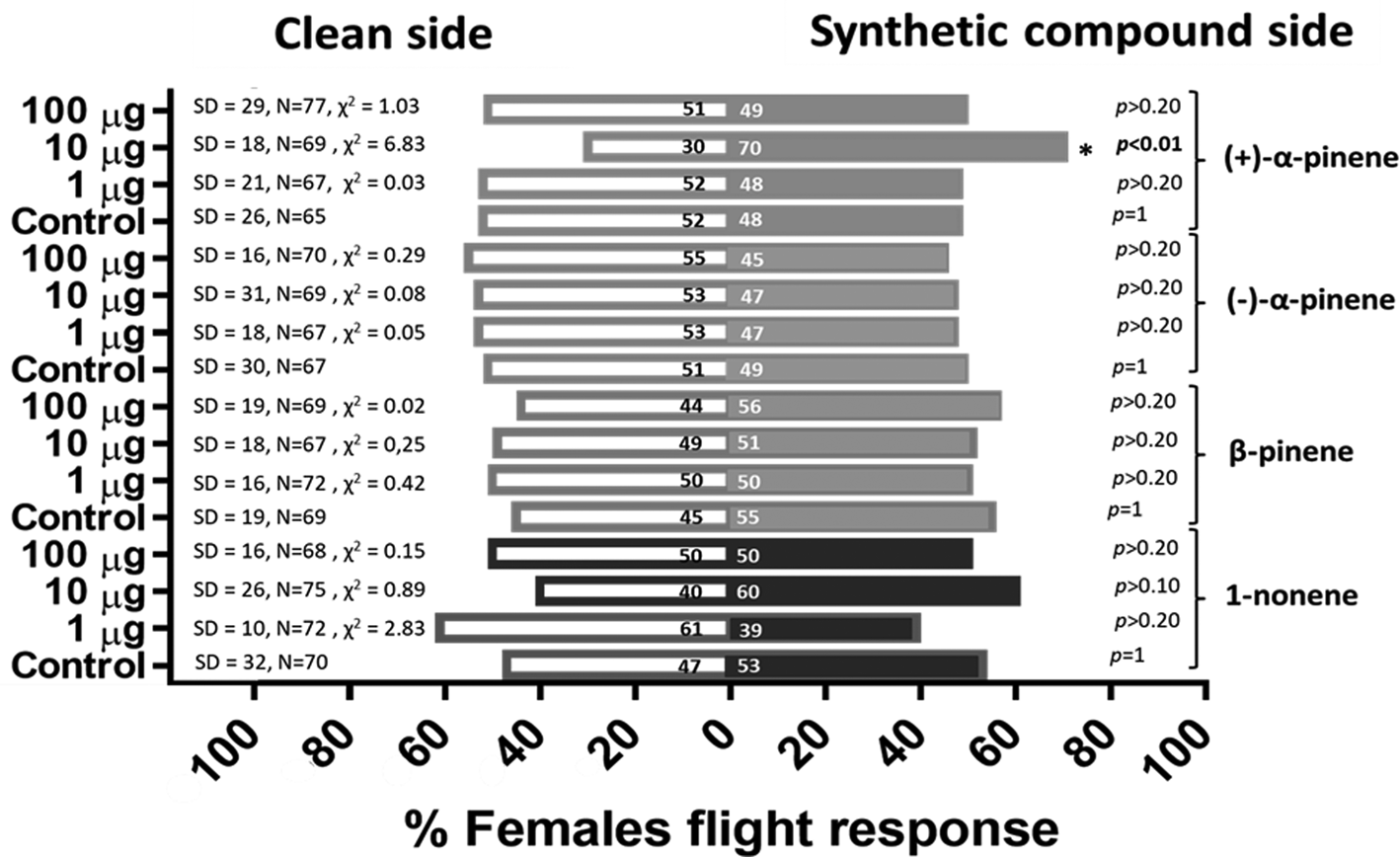
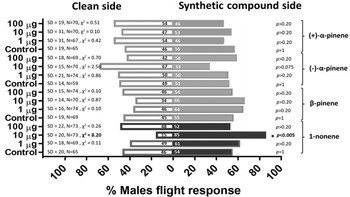
Females showed a significant positive response only to (+)-α-pinene at a 10 μg dose (P < 0.01, fig. 4). Males showed a positive flight response only toward the main component 1-nonene at a 10 μg dose (P < 0.005, fig. 5). Less than 20% of the mosquitoes were nonresponsive.
Behavioral responses of female Ae. aegypti to four S. madagascariensis volatiles using a dual-port flight olfactometer. Responding mosquitoes that crossed the mark at the end of the arm were counted. Asterisks express significant differences in response vs. the acetone control in the chi-square test with a significance threshold of 0.05 (*P < 0.05, critical value χ2(1, 0.05) = 3.84). SD, standard deviation.

Behavioral responses of male Ae. aegypti to four identified S. madagascariensis volatiles using a dual-port flight olfactometer. Responding mosquitoes that crossed the mark at the end of the arm were counted. Asterisks express significant differences in response vs. the acetone control in the chi-squared test (*P < 0.05; df = 1; critical value χ2(1, 0.05) = 3.84). SD, standard deviation.

Landing preference bioassay on attractant impregnated disks
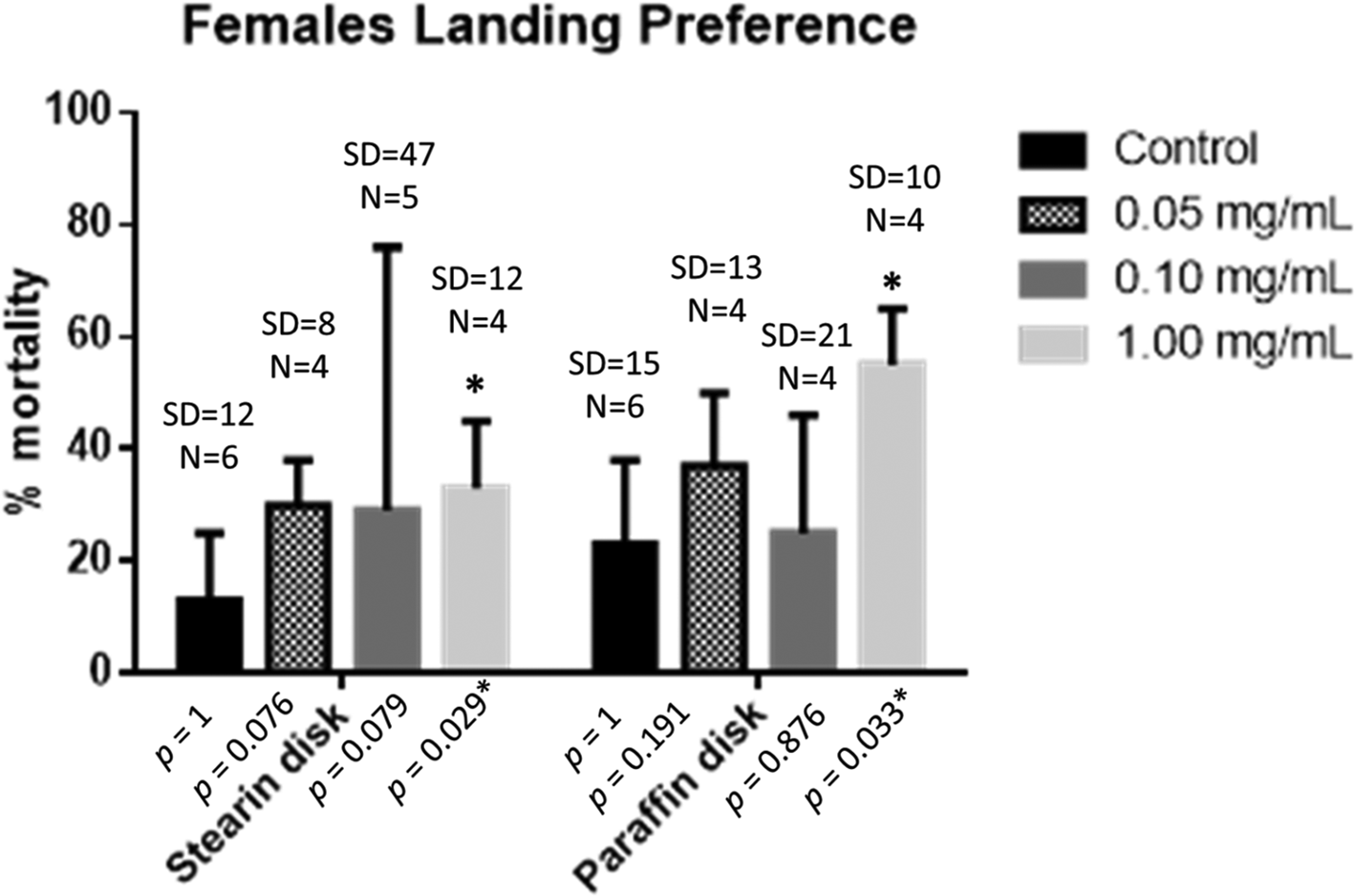
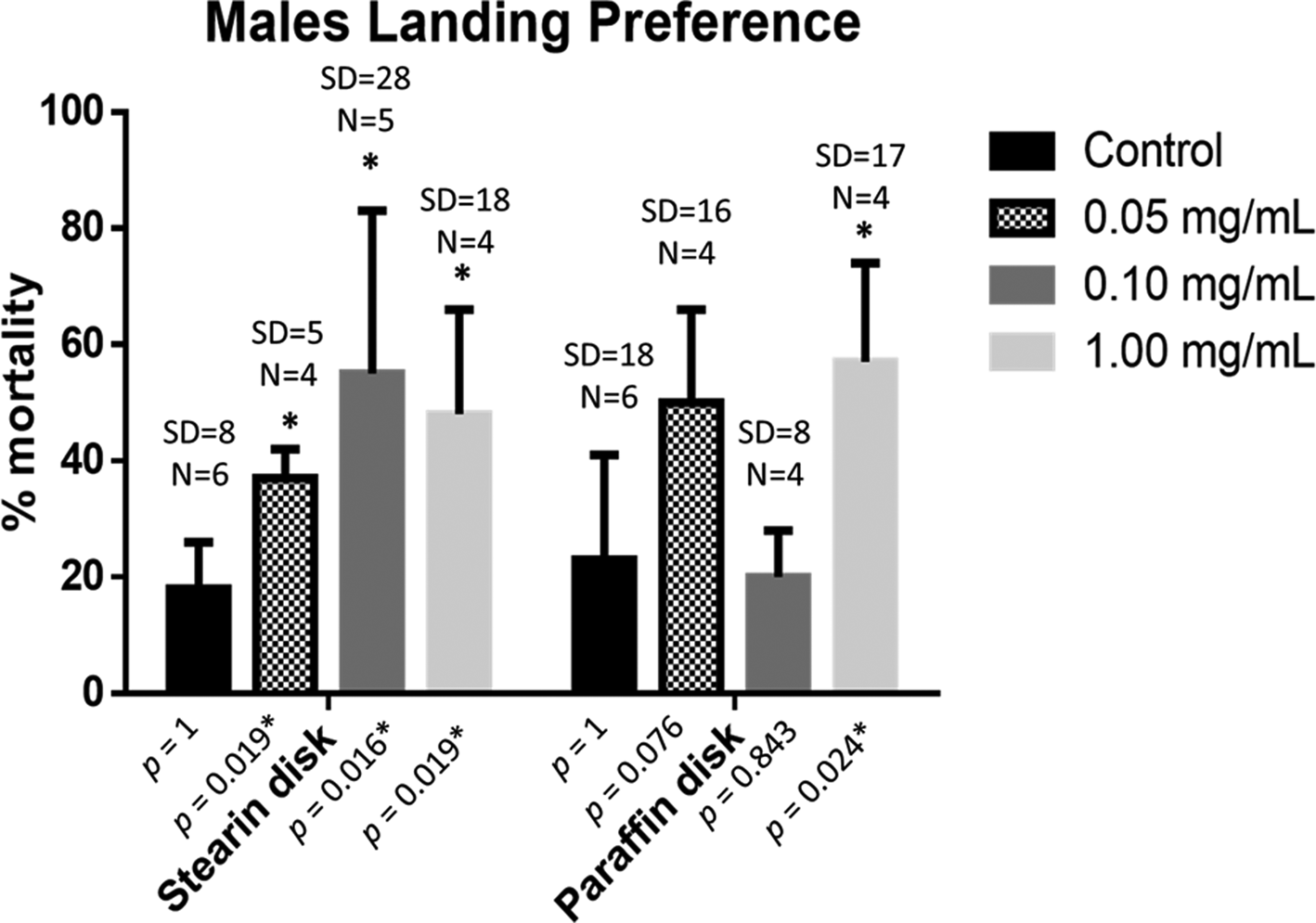
The landing preference bioassay was performed on stearin and paraffin disks impregnated with 1-nonene (figs 6 and 7). For male mosquitoes, the mortality caused by imidacloprid in the presence of stearin disks impregnated with 1-nonene was significantly higher than that in the control test without 1-nonene at all tested doses (P < 0.019, fig. 7). For females, only the highest dose of 1-nonene (1 mg ml−1) produced significantly more landings (P = 0.033), and it also corresponded to more deaths than the other doses used (fig. 6). For paraffin disks (figs 6 and 7), the 0.05 and 0.1 mg ml−1 doses of 1-nonene did not increase landing preference for females or males. However, the 1 mg ml−1 dose increased overall mortality for both males (P = 0.024) and females (P = 0.033). No dead mosquitoes were found in the tracking cage during the experiments.
Mortality of male Ae. aegypti in the presence of toxic sugar food baited with stearin and paraffin disks containing imidacloprid with the addition of 1-nonene at different concentrations. Asterisks express significant differences in response vs. the acetone control in the K–W test (*P < 0.05).

Mortality of female Ae. aegypti in the presence of toxic sugar food baited with stearin and paraffin disks containing imidacloprid with the addition of 1-nonene at different concentrations. Asterisks express significant differences in response vs. the acetone control in the K–W test (*P < 0.05).

Discussion
This work found that the volatiles of S. madagascariensis flowers elicit a differential behavioral attraction response in male and female Ae. aegypti mosquitoes. S. madagascariensis flowers attracted males but not females under the tested conditions, and this differential effect between sexes was observed in both experimental setups, namely, the two-way olfactometer and the landing preference bioassay. Once the attractant effect of S. madagascariensis was characterized, the volatiles emitted by flowers were identified and the main components were individually tested in laboratory behavioral bioassays. The terpenes identified in the S. madagascariensis headspace were (+)-α-pinene, (−)-α-pinene, β-pinene, sabinene, phellandrene, and 1-alkenes; 1-nonene and 1-undecene, with 1-nonene representing the main compound. There are no previous reports on the composition of S. madagascariensis, although 1-nonene has been reported in volatiles of Ruta chalepensis, Arabidopsis thaliana, Larrea tridentata, and Vigna unguiculata (Lwande et al., Reference Lwande, McDowell, Amiani and Amoke1989; Jardine et al., Reference Jardine, Abrell, Kurc, Huxman, Ortega and Guenther2010; Haddouchi et al., Reference Haddouchi, Chaouche, Zaouali, Ksouri, Attou and Benmansour2013; Kegge et al., Reference Kegge, Weldegergis, Soler, Eijk, Dicke, Voesenek and Pierik2013). However, to our knowledge, it has not been reported as an attractant for insects.
In the behavioral evaluation of individual attraction to pure compounds, across all the tested compounds and doses, only 10 μg of 1-nonene was an attractant for males, while 10 μg of (+)-α-pinene was an attractant for females. In both cases, higher or lower doses did not show a significant attractant effect, thus indicating a clear optimal concentration. It is worth mentioning that (+)-α-pinene vapor pressures elicited a knockdown effect on Aedes (Lucia et al., Reference Lucia, Zerba and Masuh2013).
This differential attraction of males and females to volatile cues could be attributed to several factors, two of which seem to us most probable. First, the physiological status of females may influence their sugar seeking and flower attraction behavior. In our experiments, both male and female adults were kept in the same cage with free sugar access post-eclosion up until 24 prior to bioassays. Thereby, before isolation adults have free access to potential mates, meaning some females could have started their gonotrophic cycle. Their potentially nulliparous or gravid conditions could be impacting over their sugar-seeking impulses or response to floral scents. Second is the experimental design and mosquito biology. Ae. aegypti often live in urban habitats (Braks et al., Reference Braks, Honório, Lourenço-De-Oliveira, Juliano and Lounibos2003; Tsuda et al., Reference Tsuda, Suwonkerd, Chawprom, Prajakwong and Takagi2006) meaning that may have less access to carbohydrates. In our design, adults had free access to sugar feeding post-eclosion, being starved 24 h prior the bioassays. The continuous sugar provision could have led to multiple feeding instances and high sugar intakes, impacting a sugar seeking impetus (Wensler, Reference Wensler1972; Vargo and Foster, Reference Vargo and Foster1982). For a deeper understanding of the influence of these factors, more parameters need to be controlled.
Regardless, the existence of a plant or chemical that only attracts males is quite relevant because it can be exploited in sterile male programs. In this context, traps baited with flowers or with formulated bioactive chemicals could be displayed in a potentially infested environment and withdrawn before the release of sterile males, thereby increasing the efficacy of management by reducing the reproductive competition (Lacroix et al., Reference Lacroix, McKemey and Raduan2012).
Regarding traps baited with flowers, Müller et al. (Reference Müller, Kravchenko and Schlein2008) collected up to 75 times more Anopheles sergentii (Theobald) in traps baited with Acacia raddiana flowers than in traps baited with the non-flower part of the plant. Moreover, they sprayed Acacia raddiana flowers with a sucrose solution containing a colorant and an insecticide and found a significant decrease in the mosquito population, thus supporting the use of flowers combined with insecticides as toxic baits in IPM for mosquito control (Müller and Schlein, Reference Müller and Schlein2006; Mathew et al., Reference Mathew, Ayyanar, Shanmugavelu and Muthuswamy2013; Xue et al., Reference Xue, Müller, Qualls, Smith, Scott, Lear and Cope2013).
Differential responses to field traps scented with Psidium guajava (guayaba) and Mangifera indica (mango) in males and females of Ae. aegypti were reported by Fikrig et al. (Reference Fikrig, Johnson, Fish and Ritchie2017), with only males collected in the traps. In this study conducted in Australia, the overall mortality was modest, suggesting that the impetus to feed on sugar might not be strong enough to merit its use as a lure for passive trapping. These authors correlated their findings with a field test performed in Thailand that showed that females did not consume sugar in the field for 2 or 3 days. Although this background might not support our final goal, another recent work carried out in Ecuador (Qualls et al., Reference Qualls, Naranjo, Subía, Ramon, Cevallos, Grijalva, Gómez, Arheart, Fuller and Beier2016) showed that outdoor sugar feeding is a common behavior of Ae. aegypti and can be targeted as a control strategy in urban landscapes of Latin America. In another study, Revay et al. (Reference Revay, Müller, Qualls, Kline, Naranjo, Arheart, Kravchenko, Yefremova, Hausmann, Beier, Schlein and Xue2014) demonstrated the potential use of attractive sugar baits for Ae. albopictus Skuse (Diptera: Culicidae) pest control. These findings support the potential of our laboratory-derived results to drive field testing.
Since the main goal of this study was to introduce a male attractant in toxic baited traps, 1-nonene was formulated in a solid matrix for its controlled release using paraffin and stearin wax, which were selected because they are economic, nontoxic, environmentally friendly, chemically stable, easy to handle, and chemically compatible with 1-nonene due to their similar partition coefficient (Kow) and their low water solubility. The reasonable solubility of the active principle in the matrix is expected to favor its slow release and prevent a burst effect during release.
Mortality caused by imidacloprid in the presence of stearin disks impregnated with 1-nonene at all evaluated doses was significantly higher than that in the control test without 1-nonene for male mosquitoes. Although for females, high mortality was only observed for the highest dose. For paraffin disks, only the highest dose (1 mg ml−1) of 1-nonene showed increased mortality for both males and females.
The increased mortality of males in the presence of disks impregnated with 1-nonene was expected and has promising implications for its use in field traps baited with toxic substances. The differences in mortality between paraffin and stearin disks (with the stearin disk being effective in a wider range of doses) could be attributed to the higher solubility of 1-nonene in paraffin compared to stearin, which would lead to a lower release rate and consequently to lower bioavailability.
The mortality of females, although not expected based on the olfactometer results, could be attributed to the higher dose of 1-nonene in the disks compared to the concentration present in flowers. A bioassay with toxicological end points performed with 1-nonene impregnated on solid disks showed that the incorporation into a solid matrix of a volatile attractant increased the overall mortality of the toxic sugar bait.
The results obtained thus far could be improved by using synthetic blends or combinations of 1-nonene with individually nonattractive volatiles since it is known that stronger behavioral responses can be elicited in insects exposed to appropriate blends compared to insects exposed to single compounds (Bruce and Pickett, Reference Bruce and Pickett2011).
In summary, in this work, the S. madagascariensis flower scent was found to act as an attractant for male mosquitoes. Potential volatile attractants were identified and independently tested in an olfactometer, and one was found to affect males. It was then incorporated in a solid matrix together with a toxin as a successful toxic sugar bait. Beyond describing the floral scent that acts as an attractant for Ae. aegypti, the responsible compound was identified, biologically evaluated, and incorporated in a solid controlled release formulation. Due failures in current control programs, the WHO has prioritized the search for new tools to be incorporated in IPMs for mosquitoes. Among these new tools, the use of attractive toxic baits is strongly suggested (WHO, 2008; Galili, Reference Galili2017). This shows the importance of our study that lays the groundwork for designing a new type of baited trap for mosquito control or surveillance.
Acknowledgements
This study received financial support from ANPCyT PICT 2016-0288 (Agencia Nacional de Promoción Científica y Tecnológica de Argentina). P. G.-A. and L. H. are affiliated with CONICET (National Research Council of Argentina). G. A. K. and S. V. O. received CONICET grants. We are grateful to Andrea Trigueros Ávalos and Giulia De Gennaro from the University of Missouri-Saint Louis (USA) for the English language revision.
Conflict of interest
On behalf of all authors, the corresponding author states no conflict of interest.