Clinical Implications
• The available evidence suggests that substance-related attentional bias in humans may be modulated by dopamine. However, clinical trials are needed to investigate the clinical implications of this knowledge.
• There is currently not sufficient evidence for pharmacological agents to be used in clinical practice to reduce attentional bias.
• A focus on neurotransmitter systems such as acetylcholine and noradrenaline could provide new insights regarding the pharmacology of substance-related attentional bias that may eventually be of clinical relevance.
Introduction
Substance abuse and addiction are associated with enhanced processing of substance-related cues.Reference Franken, Stam, Hendriks and Van den Brink1, Reference Kuhn and Gallinat2 Attentional bias is one of the mechanisms underlying enhanced processing of these cues and is defined as the tendency of substance-dependent individuals to automatically and involuntarily allocate and maintain their attention on drug-related stimuli when confronted with them.Reference Franken3 Attentional bias has consistently been found in various types of addiction,Reference Franken3–Reference Robbins and Ehrman5 and has been determined by utilizing a wide range of experimental paradigms such as emotional Stroop and visual probe tasks. Attentional bias has been linked to subjective cravingReference Field, Munafo and Franken6 and is likely involved in the continuation of addictive behaviors.Reference Marhe, Luijten, van de Wetering, Smits and Franken7 Therefore the investigation of modification of attentional bias is warranted and may eventually be of clinical relevance for substance-dependent patients. The purpose of the current review is to describe the pharmacological mechanisms underlying attentional bias and to critically review empirical studies that have aimed to reduce attentional bias in substance-dependent patients by using pharmacological agents.
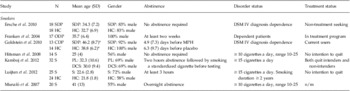
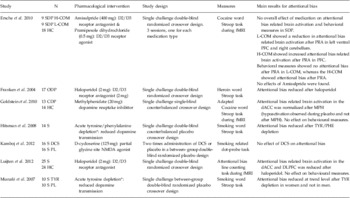
In order to identify these studies, a PubMed/Embase literature search was conducted including the search term “attentional bias,” which had to co-occur with a search term describing any substance-dependent population, as well as a search term related to any neurotransmitter system. A total of 7 studiesReference Luijten, Veltman and Hester8–Reference Franken, Hendriks, Stam and Van den Brink14 was identified that included a substance-dependent study group, employed a behavioral attentional bias task, and involved a pharmacological agent. Studies investigating acute effects of substances of abuse on attentional bias were not included. While these studies provide valuable insights in the continuation of addictive behaviors (eg, Nikolaou etal Reference Nikolaou, Field, Critchley and Duka15), the aim of these studies is not to modulate attentional bias in a clinically relevant way, and therefore they do not fit the scope of this review. Table 1 displays relevant participant characteristics of all included studies. The main results of these studies are summarized in Table 2 and will be discussed and integrated in theoretical models below.
Patient characteristics in included studies

*p < .05; SDP: stimulant-dependent patients, HC: healthy controls, ODP: opiate-dependent patients, CDP: cocaine-dependent patients, MPH: methylphenidate, S: smokers, PL: placebo, DCS: D-cycloserine, n/m: not mentioned.
Overview of pharmacological studies investigating attentional bias in substance dependence

*This mixture contained 15 g isoleucine, 22.5 g leucine, 17.5 g lysine, 5 g methionine, 17.5 g valine, 10 g threonine, and 2.5 g tryptophan. The placebo mixture additionally contained 12.5 g tyrosine and 12.5 g phenylalanine. Females received 20% less by weight of each amino acid than males.
SDP: stimulant dependent patients, H-COM: high compulsive, L-COM: low compulsive, HC: healthy controls, PRA: pramipexole dihydrochloride, ODP: opiate dependent patients, CDP: cocaine-dependent patients, MPH: methylphenidate, S: smokers, TYR/PHE: tyrosine/phenylalanine, DCS: D-cycloserine, PL: placebo, TYR: tyrosine, DLPFC: dorsolateral prefrontal cortex, dACC: dorsal anterior cingulate cortex: PFC: prefrontal cortex.
Theoretical Background and Dopaminergic Manipulations
There is a general consensus that the dopaminergic system, with projections from the ventral tegmental area (VTA) to the striatum, the anterior cingulate cortex (ACC), and other prefrontal brain regions, is responsible for reinforcement learning and experiencing reward.Reference Schultz, Dayan and Montague16 Based on preclinical animal work, it has been suggested that this dopaminergic reinforcement learning system is also involved in the development of attentional bias via conditioned reinforcement learning.Reference Robinson and Berridge17 After repeated drug intake, substance-related stimuli become conditioned stimuli and elicit phasic dopaminergic activity,Reference Volkow, Wang and Telang18–Reference Zijlstra, Booij, Van den Brink and Franken20 thereby signaling the expectation of a future reward (ie, the intake of the abused substance). Gradually, the dopaminergic system becomes sensitized for substance-related cues so that they become extremely salient; these cues become the focus of attention, and they elicit behaviors such as drug seeking and consumption.Reference Phillips, Stuber, Heien, Wightman and Carelli21, Reference Robinson and Berridge22 Functional magnetic resonance imaging (fMRI) studies have indeed shown that attentional bias in substance-dependent patients is associated with activation in the ventral striatum, the ACC, and other limbic and prefrontal brain regions.Reference Luijten, Veltman and Van den Brink23–Reference Vollstadt-Klein, Loeber and Richter26 In contrast to the phasic dopaminergic responses to substance-related cues, the striatal dopamine system in substance-dependent patients is supposed to be generally blunted compared to healthy controls,Reference Blum, Braverman and Holder27 which is an effect that has even been observed for the acute intake of substances of abuse.Reference Narendran and Martinez28 Based on these theoretical accounts, the most straightforward pharmacological manipulation to reduce attentional bias would be to prevent the phasic dopaminergic burst associated with conditioned substance-related cues. This blockade of the dopaminergic response would then lead to a reduction in substance-related attentional bias. Franken etal Reference Franken, Hendriks, Stam and Van den Brink14 were the first to test this dopaminergic attentional bias hypothesis in humans. In this study, heroin-dependent patients performed the heroin word Stroop task in a placebo-controlled, double-blind, randomized crossover study using a single dose of haloperidol (dopamine D2/D3 receptor antagonist) to modulate dopaminergic responses to heroin-related words. The findings of this study provided support for the dopaminergic theory of attentional bias in humans, as attentional bias for heroin words was eliminated after haloperidol was administered. These results were partly replicated for smoking-related stimuli using a smoking word Stroop task in two subsequent studies in smokers.Reference Munafo, Mannie, Cowen, Harmer and McTavish11, Reference Hitsman, MacKillop and Lingford-Hughes12 In both these studies, an amino acid mixture that lacks tyrosine (TYR) and its precursor phenylalanine (PHE) was used to modulate dopamine responses to smoking-related stimuli. As the synthesis of dopamine in the brain is dependent on the availability of these amino acids from plasma, the acute administration of a TYR/PHE-free amino acid mixture has been shown to reduce dopaminergic activity in the brain.Reference McTavish, Cowen and Sharp29 The findings of the first study employing this methodReference Munafo, Mannie, Cowen, Harmer and McTavish11 showed a gender-specific reduction in smoking-related attentional bias after the TYR/PHE-free amino acid mixture was administered. Stroop interference scores (ie, reaction times for smoking-related versus neutral words) were reduced relative to the placebo condition in women but not in men. The second study using the same study design,Reference Hitsman, MacKillop and Lingford-Hughes12 however, showed a reduction in smoking-related attentional bias among both smoking men and women (no gender-specific analyses were performed). These findings suggest that attentional bias may indeed be reduced in smokers, perhaps more strongly in women, when dopaminergic transmission is prevented during the exposure to smoking related cues.
Studies measuring brain activation concurrently with behavioral measures of attentional bias could test the dopaminergic hypothesis of attentional bias in more detail, as brain regions involved in salience detection and attentional bias can be directly evaluated. A pictorial line counting attentional bias task was used in a recent placebo-controlled, double-blind, randomized crossover pharmacological fMRI study in smokers.Reference Luijten, Veltman and Hester8 The dopamine challenge consisted of a single administration of the dopamine D2/D3 receptor antagonist haloperidol. While haloperidol did not alter behavioral measures of attentional bias for smoking-related stimuli, brain activation in the dorsal ACC and dorsolateral prefrontal cortex (DLPFC), which are associated with attentional bias, was reduced in smokers by haloperidol. That is, no differences in brain activation between smokers and non-smokers were found after haloperidol intake. As the dorsal ACC is involved in the salience detection network, as well as in top-down control of attention in cooperation with the DLPFC, these findings suggest that a reduction in dopamine may affect the salience detection of smoking-related stimuli in smokers, as well as top-down control over these cues to continue ongoing behavior.
A placebo-controlled, double-blind, randomized crossover pharmacological fMRI study in stimulant-dependent patients measured brain activation associated with the performance of a stimulant word Stroop task under several dopaminergic conditions.Reference Ersche, Bullmore and Craig9 This study involved both a single challenge of a D2/D3 dopamine antagonist (amisulpride) as well as a D2/D3 dopamine agonist (pramipexole dihydrochloride). While no effects were found of both medications on attentional bias–related brain activation or behavioral measures for the total stimulant-dependent patients group, compulsivity levels within the patient group appeared to modulate due to medication effects. On a behavioral level, attentional bias was reduced in low-compulsive stimulant-dependent patients after the dopamine agonist, whereas the high-compulsive stimulant-dependent patients still showed an attentional bias. In line with behavioral findings, the dopamine agonist pramipexole enhanced attentional bias–related brain activation in the left ventral prefrontal cortex and the cerebellum in high-compulsive stimulant-dependent patients, whereas it reduced activation in these regions in low-compulsive stimulant users. These findings suggest that individual differences in compulsivity levels may modulate the effects of a dopamine agonist for behavioral attentional bias measures as well as attentional bias–related brain activation. Compulsive behavior has previously been associated with striatal dopamine transmission.Reference Evans, Pavese and Lawrence30 More specifically, it has been suggested that optimal dopamine levels for cognitive functioning follow an inverted U-shaped curved depending on personality traits such as compulsivity.Reference Cools31 In contrast to the study in smokers, attentional bias–related brain activation was not reduced following the administration of the dopamine antagonist amisulpride in either low- or high-compulsive stimulant-dependent patients.
Goldstein etal Reference Goldstein, Woicik and Maloney10 performed a placebo-controlled, single-blind, counterbalanced pharmacological fMRI study using a crossover design in cocaine-dependent patients using methylphenidate (a dopamine transporter blocker) as the pharmacological agent. Instead of investigating whether a dopamine antagonist can ameliorate attentional bias and related brain activation, this study implemented a different approach, as methylphenidate is known to increase synaptic dopamine levels. Findings of this study revealed that cocaine-dependent patients displayed reduced brain activation in the dorsal ACC for cocaine-related words relative to controls after placebo, whereas this hypoactivation was normalized after methylphenidate administration. No medication effects were found for behavioral measures. These findings may suggest that methylphenidate could be beneficial for brain activation associated with attentional bias. While these findings seem to contradict the dopaminergic theory of attentional bias, they can be explained by the known cognitive enhancing properties of methylphenidate.Reference Peterson, Potenza and Wang32 Current addiction models suggest that substance abuse is not only caused by motivational processes such as attentional bias, but that the combination of an overactive motivational system with reduced cognitive brain functions drives the continuation of addictive behaviors.Reference Field and Cox4, Reference Volkow, Fowler and Wang33, Reference Wiers, Bartholow and Van den Wildenberg34 More specifically, it has been proposed that the ineffective prefrontal cognitive control circuit in substance-dependent patientsReference Goldstein and Volkow35 influences the strength of attentional bias in such a way that reduced cognitive control results in enhanced attentional bias.Reference Field and Cox4 This interaction between cognitive control–related brain functions and attentional bias provides a second plausible working mechanism to ameliorate attentional bias using pharmacological agents. Cognitive enhancing medications such as methylphenidate may therefore result in indirect beneficial effects on attentional bias–related brain activation. In line with this hypothesis, modafinil, another cognitive-enhancing medication, has been shown to have effects on both cognitive control as well on motivational aspects of cocaine dependence.Reference Goudriaan, Veltman, van den Brink, Dom and Schmaal36, Reference Schmaal, Joos and Koeleman37
Overall, studies using dopaminergic challenges to investigate the effects on attentional bias are promising and provide, to a certain extent, support for the dopamine theory of attentional bias. Nevertheless, the results are not always consistent, and future research is needed to further clarify the role of modulatory factors such as gender and compulsivity levels. Especially, large methodological differences such as different substance-dependent groups, dopaminergic challenges, and attentional bias paradigms in the pharmacological fMRI studies may have contributed to inconsistencies in results between these studies. In addition, all studies until now have investigated acute effects of pharmacological agents, so it is currently unknown whether chronic pharmacological treatments may reduce attentional bias in the long term.
Targeting Other Neurotransmitters to Ameliorate Attentional Bias
Only one study was identified that investigated an alternative neurotransmitter system to reduce attentional bias. Kamboj etal Reference Kamboj, Joye and Das13 investigated the effect of D-cycloserine (DCS) on attentional bias, which is a partial agonist at the glycine site of the N-methyl-D-aspartate (NMDA) receptor. The rationale for this is based in preclinical work that has suggested that DCS can have extinction-enhancing properties during cue exposure therapy.Reference Myers and Carlezon38 Smokers in this between-group, double-blind, placebo-controlled study received two cue-extinction sessions combined with either DCS or placebo. Attentional bias was measured using a dot-probe task before and after the two cue-extinction sessions. The results did not show a beneficial effect of DCS or cue-extinction in general for smoking-related attentional bias, suggesting that DCS combined with two sessions of cue-extinction may not be a promising tool to reduce attentional bias in smokers. Despite these null results, it may be worth exploring the involvement of alternative neurotransmitters in substance-related attentional bias. Acetylcholine, for example, is known for its modulating effects on attention,Reference Sarter, Givens and Bruno39 and a link has been proposed between the dopaminergic theory of attentional bias and the acetylcholine system.Reference Bushnell, Levin and Marrocco40 For example, increases in dopamine in the ventral striatum have been suggested to be associated with increases in cortical acetylcholine release,Reference Moore, Fadel, Sarter and Bruno41 such that repeated administration of substances of abuse may also sensitize cortical acetylcholine via projections with the basal forebrain.Reference Bushnell, Levin and Marrocco40 It would be worth investigating whether such a sensitization of the cortical acetylcholine system represents an integral component of attentional bias.
Another neurotransmitter system that may be worth investigating in the context of attentional bias is the noradrenaline system. Noradrenaline is mostly released from the locus coeruleus (LC), which is a nucleus in the brainstem that has strong reciprocal connections with the prefrontal cortex and the ACC. Preclinical research has shown that both tonic and phasic LC discharge activity is closely related to the overall salience and arousing properties of the presented stimuli.Reference Berridge and Waterhouse42 This may suggest that the noradrenaline system could be involved in the detection of salient substance-related stimuli in the environment, probably in cooperation with the dopamine system. Atomoxetine is a noradrenaline reuptake inhibitor that increases noradrenaline levels in the prefrontal cortex including the ACC,Reference Bymaster, Katner and Nelson43 and may be a useful tool to investigate noradrenergic regulation of attentional bias in substance-dependent patients. Atomoxetine has been shown to improve cognitive functions and boost ACC activation in healthy controls,Reference Graf, Abler and Freudenmann44, Reference Hester, Nandam and O'Connell45 so it may also have a beneficial effect on cognitive functioning in substance-dependent patients, and therefore may indirectly reduce attentional bias via improving cognitive control similarly to the way that has been proposed for methylphenidate. In conclusion, a focus on other neurotransmitter systems such as acetylcholine and noradrenaline could shed some new light on the pharmacology of attentional bias.
Treatment Implications
In summary, some of the reviewed pharmacological attentional bias studies in substance-dependent individuals show evidence that attentional bias and related brain activation can be modulated by dopaminergic agents, although the results are not always consistent. In addition, it may be that cognitive enhancing agents will be able to indirectly reduce attentional bias via boosting cognitive control. However, we should be very careful with generalizing these positive attentional bias–related findings for particular drugs to beneficial treatment effects for several reasons. First, it is unknown whether chronic treatment with dopaminergic agents will result in a long-term reduction in attentional bias, and whether this in turn will improve clinical outcome measures such as relapse or reduced substance use. There is one study that showed that attentional bias was reduced in opiate-dependent patients after chronic treatment with methadone or buprenorphine as compared to current usersReference Gardini, Caffarra and Venneri46; however, the same effect was found in a group of patients receiving nonpharmacological treatment, suggesting that prolonged abstinence in general may have caused the reduction in attentional bias. As the study was not double-blind and did not include a placebo, it is particularly difficult to attribute the reduction in attentional bias to the chronic pharmacological treatment. Further studies are needed to show if chronic pharmacological treatment will lead to a reduction in attentional bias.
Clinical application of positive findings for certain dopaminergic agents to reduce attentional bias is further complicated by the fact that attentional bias is not the only dopaminergic-mediated process involved in addiction. While attentional bias and craving are supposed to have mutual reinforcing associations in theoretical models,Reference Franken3, Reference Field and Cox4 none of the studies discussed in this review found beneficial effects of the dopamine challenges on subjective cravings. This may be explained by the original concept of the dopaminergic incentive sensitization theory of attentional bias, implying that dopamine release following exposure of substance-related cues may occur independent of neural mechanisms that mediate withdrawal and related withdrawal-induced cravings.Reference Munafo, Mannie, Cowen, Harmer and McTavish11, Reference Robinson and Berridge17 While a phasic dopaminergic response in response to conditioned substance-related cues may trigger the enhanced attentional processing of these substance-related cues, other dopaminergic deficiencies such as tonic dopamine depletion may induce withdrawal-related craving and can motivate drug-seeking behavior.Reference Koob, Ahmed and Boutrel47 Besides attentional bias and craving, there is also accumulating evidence that prefrontal dopamine levels can modulate cognitive control–related brain functions. An inverted U-curve theory of dopamine and cognitive control suggests that there is an optimal prefrontal dopamine level for cognitive performances, and that either too low or too high levels may reduce cognitive controlReference Cools31; this is further confirmed by findings that the effects of dopaminergic agents on cognitive functioning are modulated by dopaminergic genotypes.Reference Forbes, Brown and Kimak48 In this context, it is interesting to mention that the same group of smokers in which normalized attentional bias–related brain activation was found after the dopamine antagonist haloperidol was administered also performed a Go/NoGo task to measure inhibitory control under placebo and dopamine-deprived conditions.Reference Luijten, Veltman and Hester8 In contrast to the beneficial effects of the dopamine antagonist on attentional bias–related brain activation, reduced inhibitory control and prefrontal brain function was found after haloperidol relative to the placebo condition.Reference Luijten, Veltman and Hester49 Besides the unpleasant side effects, these differential effects of dopaminergic agents on different processes that are all involved in the continuation of substance-related behaviors may be one of the reasons why dopamine antagonists do not seem to be successful in the treatment of cocaine dependence.Reference Amato, Minozzi, Pani and Davoli50 Future research therefore faces the challenge to investigate the effects of pharmacological agents on the multiple processes involved in addictive behaviors. Pharmacological agents that may be able to restore the balance between motivational processes and controlling processes may eventually succeed to more effectively treat substance dependence.
Besides pharmacological interventions, attentional bias modification training may provide an alternative way to reduce attentional bias in addiction. While attentional bias modification (ABM) training could probably constitute a treatment obstacle for some substance-dependent patients, it is worth investigating nonpharmacological interventions to reduce substance-related attentional bias. While some of the initial proof-of-concept studies yielded promising findings, others did not,Reference Field, Duka, Tyler and Schoenmakers51–Reference Fadardi and Cox57 and evaluations of ABM in substance abusers who are motivated to change their behavior have either been underpowered,Reference Schoenmakers, De Bruin and Lux53 or have failed to include appropriate control conditions.Reference Fadardi and Cox57
Conclusions
The findings of the current review show that pharmacological challenges with antagonistic dopaminergic properties were able to decrease attentional processing of substance-related stimuli when substance-dependent individuals were confronted with these conditioned cues. These findings should, however, be interpreted as a proof-of-principle concerning the role of dopamine in attentional bias rather than as a finding with direct clinical relevance. Future research is necessary to evaluate the effects of chronic pharmacological treatment on attentional bias, as well as its effects on other important processes involved in addiction, such as craving and cognitive control. These future research suggestions are necessary to find out whether the net effect of a pharmacological intervention will be beneficial in the treatment of addictive behaviors.
Disclosures
The authors do not have anything to disclose.