In Kuro Tanino’s (1976–) remarkable play Daaku Masudaa (The Dark Master, 2016), a person arrives at a dark rundown restaurant in working-class Osaka and orders typical Japanese comfort food (croquette and rice, omurisu—Japanese omelet rice topped with a squirt of ketchup), served with a too-long simmering bowl of miso soup. Such restaurants (yo¯shokuya) used to be everywhere in Japanese cities and the cooking was done by crochety old “masters.” Typically, using only one or two hot plates and a rice cooker, these self-taught cooks delivered an array of cheap Western-style dishes, beer, and friendly conversation. Ramshackle and tiny, such places have largely disappeared in Japan. They are part of the memory of the low-cost wooden-clad buildings that appeared immediately after the Pacific War. Part of the joy of Kuro’s play is the closely observed re-creation of the past as a place of comfort that plays on the Japanese love of nostalgia, especially for the early postwar period of the Shoˉwa era (1926–1989), when life was beginning to return to normal and Japan was embarking on an era of reconstruction.
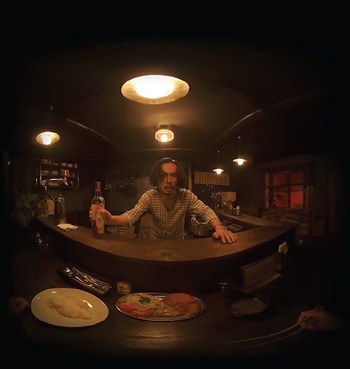
Kiyobumi Kaneko greeting the customer in The Dark Master VR, 2020. (Photo courtesy of Japan Society)

The sense of comfort is soon broken in Kuro’s play when the customer is asked to take over the cooking from the master. In the original version of the play, the onstage visitor is given an earphone and the master gives detailed instructions on how to cook the dishes on the menu, while apparently looking down from the floor above through a spyhole (see TPAM Reference Wakeling2017; Performing Arts Network Japan Reference Sorgenfrei2021). Like the smoke-stained walls of the restaurant, the atmosphere of the play that is already dark turns to a deeper sense of disquiet as we begin to realize that the visitor is trapped in the restaurant, destined to work as the new master, and we are no longer sure of what the old master is—apparition or human? The play is an invocation of the sense of being trapped by uncanny forces—social, familial, and phantasmic—that are longstanding themes in Japanese folk stories and modern literature. Like a character in one of Abe Koˉboˉ’s (1924–1993) Kafkaesque novels, the visitor loses his sense of the past and no longer resists his new role. He is possessed by the spirt of the ghostly forces: we don’t quite know why or how; it is just this constant feeling of haunting and the passive acquiescence to being trapped—in other words, a very Japanese horror story.
Kuro is the playwright, director, and founder of Niwa Gekidan Penino (Garden Theatre Penino), founded in 2000. His 2020 VR theatre version of the play, Daaku Masudaa VR, produced in the time of Covid, intensifies these feelings of unease and affectively heightens the tropes and markers of the horror genre. Using the extreme disorientation and intimacy of VR goggles and headphones, Kuro creates a sense of immersion that feels claustrophobic and threatening. In adapting his play, Kuro was struck by “the strength of the physical experience” of VR and a “weakening of the emotional feeling” of the dramatic text (Performing Arts Network Japan Reference Sorgenfrei2021).
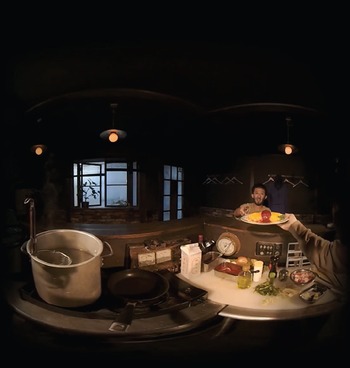
A dish of omurisu is passed to a customer in the restaurant. The Dark Master VR, 2020. Actor: Kazuya Inoue; Hand: F.O. Pereira Koichiro. (Photo courtesy of Japan Society)

The 2020 VR version premiered at the Tokyo Festival; I experienced it on 24 June 2021 at the Japan Society in New York City. The space is laid out as an arrangement of booths, each curtained-off from the others. Inside a chair faces a small bench and a metallic mirror-like surface or backplate. Upon arrival, the viewer is given instructions on using the headgear and then led to their booth by an usher in black clothes. Once seated, the curtain behind the chair is lowered and the viewer is completely alone. For the convenience of the spectator, there is a small basket for personal items placed on the floor, a nice touch that recalls the attention given to customer service in Japan. The space is somewhat reminiscent of a rent-by-the-hour cubical in a manga café, or, given what happens later in the performance, perhaps a booth for viewing pornography; both are nominally “private” spaces in Japan, and, in different ways, both have connotations that connect them with horror stories and ghosts. Perhaps the cubicles are designed to evoke memories of licit Japanese pleasures while they are also claustrophobic and seem to close in on the viewer. As the play begins, after adjusting the headset and earphones, there is a moment of darkness and silence followed by an unnerving effect when the viewer looks through the VR lens and sees an outline of their own face mirrored as a gray tone negative image on the backplate. This signals an uncanny and phantasmic transition into the VR remediation of the world of the dark master’s restaurant.
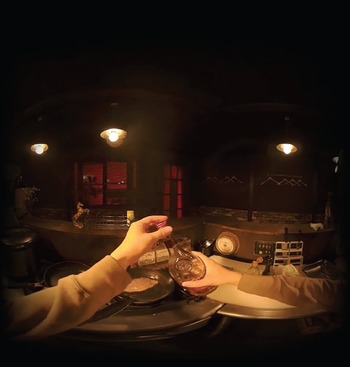
A drink is poured for the customer. F.O. Pereira Koichiro in The Dark Master VR, 2020. (Photo courtesy of Japan Society)

The viewer is immediately put into the action: the pans sizzle and we smell the tobacco smoke, cooking smells, and, later, the perfume of a grotesque apparition. Stage helpers cook some meat backstage and waft its smells and the steamy heat of the pans into the space using handheld fans. This is a surprisingly effective action that is revealed after the performance in an explanatory video projected into the auditorium as the viewers leave the space at the end of the show. The VR enables a wide and jerky view of the restaurant, as the perspective shifts back and forth from the customer sitting at the bench to the food preparation side. Dishes are prepared and placed on the countertop and then hands appear in the frame to move the dishes in front of the viewer. The hands are apparently, by their placement, intended to simulate the viewer’s hands, yet they are small and feminine—not to scale and disconnected, creating a sensory distortion and uncanny effect. The hands are not the viewer’s hands, and while they helpfully assist with placement of food items, the intimacy of another person’s hands doing this feels a little invasive. At the same time, these actions were, for me, comforting in that they reproduce the performative ritual actions of eating in Japan: first, the presentation of the plated food so that it might be contemplated when placed on the counter before eating (even in cheaper places, like this one, the custom is observed), followed by the splitting of the disposable chopsticks and dragging them against each other to shed splinters, and finally, a moment of repose or silent prayer before taking a first bite. With the push-pull of disembodied sensations rubbing against the comfort of the everyday, these actions performed in the VR theatre were akin to an out-of-body experience.
Kuro’s theatre updates the immersive and invasive tactics of artists such as Terayama Shuˉji (1935–1983) and Kara Juˉroˉ (1940–). Terayama’s performances sometimes involved spectators in reality bending theatrical encounters that were designed to upturn their understanding of reality, thereby making it more porous and liminal. Theatre’s assault on the senses and the practice of making audiences feel uncomfortable was a tactic used by many artists in the 1960s and ’70s and has been interpreted as a political statement about the need for people to reconnect with their senses and with disconsolate unresolved feelings (see Sorgenfrei Reference Terayama2005; Eckersall Reference Nakamura2006). In thinking about Kuro’s connections to this history of immersive theatre in Japan, Corey Wakeling notes that the artist “invent[s] cultural geographies in which disfiguration is a central concern” (2018:59). The sensibility of disfiguration leads to what Wakeling suggests is an “irruption” of space and a psychic disturbance (61). A comparable sense of irruption in Kuro’s VR performance is created by the actuality of horror that begins to play on our senses and is deeply unsettling.
Japanese theatre has often dealt with ghost stories and its history is full of gruesome tales of possession coupled with taboo depictions of sexuality. Kuro plays on this in a scene in which the viewer takes over the perspective of the master. Tired and a little drunk at the end of the workday, the master/viewer is visited by an aging sex worker. Her face is an apparition that appears in close, sticky detail in the VR goggles; a diseased, exhausted, revenant being.
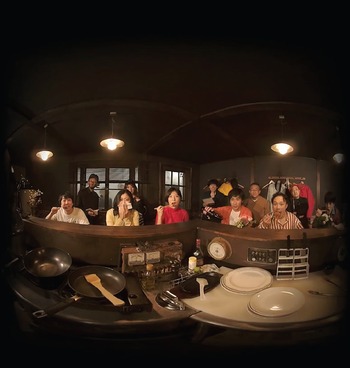
A view of the customers at the restaurant as seen from the spectator wearing a VR headset. The Dark Master VR, 2020, featuring background actors: Katsuya Tanabe, Saika Ouchi, Masafumi Uchida, Manami Hirokawa, Hironari Miyachi, Takehito Terui, Kazuya Inoue. (Photo courtesy of Japan Society)

The thick powder of the cheap geisha makeup is sweaty and clumping and the viewer’s proximity to this is further unbounded by whispered grubby intimacies in broken English. The VR inserts the viewer into the middle of this scene, climaxing when the figure in the screen transforms into a demon. Kuro reminds us of Japan’s history of ero-guro (erotic and grotesque) art that has been a constant presence in theatre, film, literature, visual arts, and popular culture since the 1920s. Popularized by writers such as Edogawa Ranpo (1894–1965), the ero-guro boom of the prewar era took on a different meaning in the 1960s and ’70s when to contemplate dark violence and sexual transgression was associated with the memory of the pain and unresolved trauma of the war. Artists appropriated ero-guro to create new horror genres that remind us of the fact that history always haunts the present. In Kuro’s VR theatre version of The Dark Master, the combination of ghosts and ero-guro make for a potent mix.
This is after all a story in the style of archetypal Japanese horror. We can anticipate both the sense of passive entrapment and the transforming figure of the demonic woman because these tropes are well known in theatre, film, and art in Japan. As the Japanese literature scholar Miri Nakamura writes: “these monsters represent the ‘abnormal’ bodies of the modern empire—diseased beings, colonial subjects, and illegitimate existences—bodies marked by […] uncertainty” (2015:9). In particular, the sexualized gendering of monsters in Japanese horror harkens back to the mythic foundation narratives of Japan’s beginnings that are connected to the sexualized figures of Amaterasu, the Sun Goddess, and Ame-no-Uzume-no-Mikoto, the Dread Female of Heaven. Both are associated with the Japanese performing arts and are seen as important to the foundations of kabuki theatre as a bawdy form of performance that was part of the rise of popular theatre in the Tokugawa era (1603–1867). In Japanese horror studies, such indigenous mythical figures preempt the cinematic idea of the monstrous feminine (Creed Reference Dumas1993). The social meaning of this is much debated. For instance, Raechel Dumas argues that such sexualization in Japanese horror highlights “tensions between the masculine national subject and the vast body of female identities that threaten to undermine the fantasies of Japanese national unity and social order” (2018:30). In each of these perspectives on horror and ghosts, questions of disturbance are not only considered at the level of sensation and affect, but are also seen as culturally significant in establishing norms in terms of sexual relations and ensuring conformity.
That Kuro’s VR theatre brings the ghostly possession into a visceral connection is therefore significant in exploring experiences of Japanese subjectivity, politics, and existence. In collapsing the distance of theatrical space and bringing the viewer into the dilapidated fragmented memories of the Shoˉwa era we see what Wakeling calls “the compartmentalized and anti-social circumstances of the contemporary Japanese subject” (2018:66). The forceful intimacy of the VR technology and the self-contained nature of the production substantially heighten this sense of disturbance and make it feel like a kind of possession. One way to think about this is in terms of a visceral occupation of the body by Japan’s traumatic past bleeding into the present day via the uncanny hybridity and forced, much-too-close intimacy of VR. This might well be a very Japanese sense of horror indeed, but, in an age of zombie capitalism and necro-authoritarian clones, it is one that we all can relate to.