INTRODUCTION
The amount of carbon (C) partitioned to the canopy and root components of the trees depends on a number of factors, which include genotype, tree age (Chalmers & Van Den Ende Reference Chalmers and Van den Ende1975; Palmer Reference Palmer1988), orchard density and training systems (Robinson & Lakso Reference Robinson and Lakso1991; Caruso et al. Reference Caruso, Inglese, Marra and Sottile1999), scion/rootstock interaction in terms of vigour (Glenn & Scorza Reference Glenn and Scorza1992; Caruso et al. Reference Caruso, Inglese, Sidari and Sottile1997), fruit production (Maggs Reference Maggs1963) and orchard management (Pace et al. Reference Pace, De Jong, Inglese, Failla and Piagnani2000; Inglese et al. Reference Inglese, Caruso, Gugliuzza and Pace2002).
Most of the increases of orchard yields realized in the last few decades can be linked to an increase of the harvest index (HI), i.e. the fraction of annual dry matter allocated to the fruits (Forshey & McKee Reference Forshey and McKee1970). Indeed, the efficiency of horticultural systems can be evaluated in terms of light use (Robinson & Lakso Reference Robinson and Lakso1991) and it is commonly related to high C partitioning to the fruit fraction and a lower carbon stock of ‘unproductive wood’ parts (Forshey & McKee Reference Forshey and McKee1970), which are considered a net cost in terms of energy and nutrient allocation (Daie Reference Daie1985).
The strategy applied to orchard systems of most fruit tree crops has been to use high-density plantations with small-sized trees, obtained through the reduction of plant vigour (Forshey & McKee Reference Forshey and McKee1970; Caruso et al. Reference Caruso, Inglese, Sidari and Sottile1997). This can be achieved using dwarfing rootstocks and/or appropriate training and pruning systems (Robinson & Lakso Reference Robinson and Lakso1991; Caruso et al. Reference Caruso, Inglese, Marra and Sottile1999).
However, the ability of perennial crop systems to sequester C in perennial structures may be analysed from a different perspective, as a potential sink (or source) of atmospheric CO2.
In contrast to annual crops, orchards for fruit production are able to sequester C for longer periods with smaller annual fluctuations. Many annual crops such as maize or sugar beet can fix more CO2 than forestry systems (Valentini et al. Reference Valentini, Matteucci, Dolman, Schulze, Rebmann, Moors, Granier, Gross, Jensen, Pilegaard, Lindroth, Grelle, Bernhofer, Grünwald, Aubinet, Ceulemans, Kowalski, Vesala, Rannik, Berbigier, Loustau, Guomundsson, Thorgeirsson, Ibrom, Morgenstern, Clement, Moncrieff, Montagnani, Minerbi and Jarvis2000; Watson et al. Reference Watson, Noble, Bolin, Ravindranath, Verardo and Dokken2000). However, their biomass is usually rapidly decomposed and the rate and the return of sequestered CO2 to the atmosphere are very fast. Tagliavini et al. (Reference Tagliavini, Panzacchi, Ceccon, Liguori, Bertolla, Meggio, Tonon, Corelli Grappadelli, Celano, Gucci, Pitacco and Inglese2008) report, for intensive apple orchards, values of canopy net primary productivity (NPP) of 4·7 t C/ha/year, while Montanaro et al. (Reference Montanaro, Dichio, Tuzio, Celano and Xiloyannis2008) report NPP values of 5·1 t C/ha/year in peach orchards; even higher values have been measured for kiwifruit and olive orchards, with the eddy-covariance system (Facini et al. Reference Facini, Georgiadis, Nardino, Rossi, Maracchi, Motisi, Carli, Cavarretta, Colacino and Fuzzi2007). The carbon content of the structural component of perennial orchard plants may represent appreciable C sequestration.
Understanding the C cycle in terms of C sequestration and C release from low- and high-density orchards needs investigation to assess their ecological sustainability. For instance, low-vigour trees in high density and early yielding orchards may sequester, on an area basis, more C than highly vigorous and low density traditional ones, which have large tree structures associated with a lower fraction of total dry matter allocated to fruits. Moreover, orchard systems and management strategies that maximize carbon sequestration may not necessarily reduce the emission of CO2.
Evergreen species such as orange (Citrus sinensis L.) (3·9 million ha globally; FAO 2007) could create a sustainable ecosystem with favourable C sequestration potential, due to their year-round activity and tree longevity (>30 years), vigorous growth, large root system, high leaf area index (LAI) and slow leaf turnover. However, there is no data on the C balance of orange orchards or simple canopy measurements of net photosynthesis or dry matter partitioning in adult trees with which to support this hypothesis.
The orange industry in Italy is a mix of traditional groves and newly planted intensive orchards. Traditional groves date back to the 1960s and 1970s, with 450–550 trees/ha. Tarocco, with its several clones, is the main cultivar, covering an acreage of 33 500 ha. Intensive orchards have been established during the last 15–20 years, with closer spacings within and between the rows giving 800–1000 trees/ha. Cultivars of the Navel group are typically grown under these conditions, with an estimated acreage of 25 000 ha (ISTAT 2005).
The present experiment was designed to study the C balance (sequestration and release) of mature orange orchards in Sicily, strongly contrasted in terms of planting densities, but similar in terms of yield potential and leaf area. The objectives of the study were (i) to quantify NPP of the canopy components (tree and ground cover) and (ii) to measure the seasonal pattern of soil respiration and decomposition of leaf litter bags.
MATERIALS AND METHODS
Site description
The experiment was carried out in 2005/06, in two contiguous orchards located in the alluvial plain of Motta S. Anastasia (Catania, Sicily, 37°28′N, 14°58′E, 71 m asl), with alluvial soils. The soils are typically >1·5 m deep, 30% clay by vol., 20% silt and 50% sand; 10 g organic matter/kg soil; wilting point=95 ml water/l soil and field capacity=240 ml water/l soil. The site is characterized by a Mediterranean climate, with hot and dry summers and relatively cold winters. Average daily air temperatures range from 19 to 26°C during summer and from 8 to 14°C in winter. Annual rainfall is 750 mm, mostly concentrated in November–April. The two plots are part of the same experimental site and are made up of 14-year-old trees of cv. Tarocco Scirè (a blood orange) trained to a globe and spaced 4·5×4·5 m apart (494 trees/ha) in the traditional system, and 12-year-old trees of cv. Newhall (a seedless navel orange) trained to a globe and spaced 4·0×2·5 m (1000 trees/ha) in an intensive system. In both cases, the C. sinensis scions were grafted onto Citrus aurantium (bitter orange) rootstock. In terms of single tree development, fruiting performance and total leaf area (LAI/ha), both systems were at their mature stage, which for orange orchards lasts from 6–8 years to 40–50 years after plantation (Davies & Albrigo Reference Davies and Albrigo1994).
The experimental design included four single-tree block replicates for each orchard density. Trees were randomly chosen in uniform blocks in the middle of the two orchards, being sure that their apparent cropping performance and overall development fully reflected orchard conditions. Rows were oriented N–S.
Ordinary horticultural care was applied in both production systems, in terms of floor and pest management, pruning, irrigation (subdrip irrigation with two laterals per row and four emitters per tree) and fertilization.
The ground cover was left untouched from October to May, when the cover crops were cut and left on the ground as mulching.
Quantify canopy dry mass primary productivity (tree and ground cover)
NPP and C partitioning among canopy components of trees and the ground cover were measured, over the season, by:
(a) fresh and dry weight of abscised and harvested fruits;
(b) fresh and dry weight of abscised leaves, collected on nets located under the trees, and weighed monthly; and
(c) fresh and dry weight of current-year twigs and suckers, which were completely removed twice a year, in April and September.
Annual growth of canopy woody parts (primary and secondary branches) was calculated from allometric relationships based on the basal circumference of primary branches and the total weight of their subtending woody parts, measured early in spring and at the end of the growing season. The allometric relationship was determined as: y=1·2069x–19·201, R 2=0·9995, where y is total weight of 1st order branch components and x is the primary branch basal circumference. The circumference was measured with a tape at 100 mm from the intersection of the branch with the trunk. To obtain the allometric relationship, three plants of each cultivar were excavated and destructively sampled, and each of their canopy components was weighed (fresh and dry weight) and measured (length and diameter). The dry weight of the root components was also measured. Trunk circumference was measured with a flexible measuring tape 150 mm above the soil surface, early in spring and at the end of the growing season. The ground cover was collected every 2 months from October to May (no growth occurred during the dry summer season), in three plots of 20 m2 placed between the single-tree block replicates, and its fresh and dry weight was measured.
To measure the dry weight of all tree components, all samples were dried to constant weight at 70°C in a forced-oven chamber and carbon content of each of the canopy and root components was determined on dried samples by Leco Autoanalyzer (Leco SC, Leco Sweden).
Total leaf area per tree was calculated from the ratio of leaf area to leaf dry weight of a 1 kg sample of fresh leaves randomly taken from the excavated trees and the total leaf dry weight of the tree. LAI (orchard) was then calculated.
Quantify soil respiration and litter bag decomposition
Soil respiration was measured every 2 weeks from June 2005 until May 2006, from 12.00 noon to 15.00 h (local standard time) for maximum respiration and from 02.00 to 05.00 h for minimum respiration. In order to follow minimum and maximum soil respiration rate during the season, soil respiration was measured every 3 months, six times a day to cover a 24 h cycle. A soil respiration closed system (PP Systems, UK soil respiration chamber type SRC-1, environmental gas analyser type EGM-4 and a soil thermometer probe) was utilized. The soil respiration chamber was located on each of three PVC collars, with a height of 1·0 m and a diameter of 1·2 m that were inserted into the soil at 0·7 m, 1·4 m from the trunk and in the middle of the alley. Four sampling plots were established in each of the two orchards, and a total number of 12+12 collars were used for soil respiration measurements.
Soil temperature and moisture were measured in each plot along with each flux measurement, using a soil temperature probe (STP; PP Systems, UK) placed 50 mm below the soil surface and with a soil moisture sensor (ThetaProbe model ML2-X; Delta-T Devices, Cambridge, UK) 150 mm below the soil surface and calibrated using the gravimetric method.
In order to estimate the time course of soil organic matter decomposition in the soil, 24 litter bags were prepared as described by Harmon et al. (Reference Harmon, Nadelhoffer, Blair, Robertson, Bledsoe, Coleman and Sollins1999). The litter bags were made of 1 mm mesh nylon and were filled with c. 5 g of dry orange leaf litter and pruning residuals taken from the fresh litter collected in the orchard, dried at 70°C and placed into the bags. Three subsamples were analysed for total C and nitrogen (N) content (Leco CHN-1000, Leco Sweden). On May 2005, the bags were placed 100 mm below the soil surface at distances of 0·7 and 1·4 m from the trunk of three trees per plot and in the centre of the alley. A microbial inoculum to start the decomposition process was prepared by water extraction of the superficial soil and then sprayed on the litter bags before putting them into the soil.
Six litter bags, randomly chosen in each of the two orchard-plots, were removed at each sampling time, 6 and 12 months after placement; samples of dried material were analysed to determine their dry weight, C and N content.
Statistics
Data were submitted to analysis of variance (ANOVA) and means were separated with Tukey test at P⩽0·05. The statistical analysis was carried out using the statistic programme SYSTAT 12.0 (SYSTAT 1990).
RESULTS
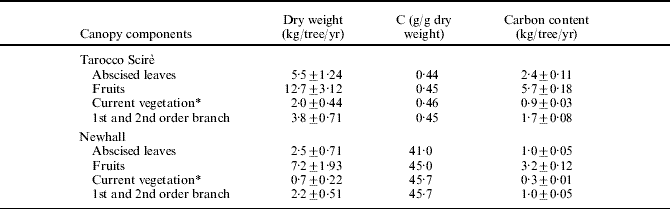
Carbon fixation by single tree canopy components was higher in the traditional (cv. Tarocco Scirè, TS) planting system (10·7 kg C/tree) than in the intensive (cv. Newhall, NH) system (5·5 kg C/tree). The fruit was the highest C sink in both systems, accounting for 0·53 and 0·58 of the C content in TS and NH trees, respectively (Table 1). Indeed, orchard crop yield was 35 t/ha for TS and 40 t/ha for NH, while the LAI was 2·6 in the intensive orchard (NH) and 2·3 in the traditional grove (TS).
Measured net primary production in orange (C. sinensis L.) trees, cv. Tarocco Scirè (spaced 4·5×4·5 m apart) and cv. Newhall (spaced 4×2·5 m apart). Each value is a mean of four trees for each cultivar (±s.e.m.)

* Current-year twigs and suckers (including leaves).
Fruit dry weight in the traditional system with cv. TS was almost twice that in the intensive system with cv. NH, while net annual growth of woody canopy parts was 43% lower in NH than in TS. Current-year vegetation (twigs and suckers) was four times lower in individual NH trees than in TS ones. C content in each component did not change significantly, except for the leaves of NH trees, which had a lower C content (Table 1). Total NPP of the orchard (carbon fixation on the above ground components) did not change with planting density, being 5·3 t C/ha/year in the traditional system compared with 5·5 t C/ha/year in the intensive system.
Calculated carbon fixation by the ground cover was higher in the traditional system than in the intensive one (1·1 t C/ha/year v. 0·5 t C/ha/year).
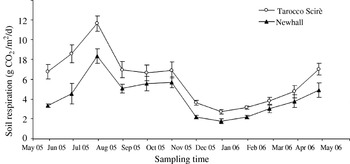
Soil respiration rate, monitored from June 2005 to May 2006, was always higher in the traditional planting system with cv. TS than in the intensive one with cv. NH. Differences between the two planting systems were larger from May to September (Fig. 1).
Soil respiration in traditional (494 trees/ha, cv. Tarocco Scirè) and intensive (1000 trees/ha, cv. Newhall) orange (C. sinensis L.) systems, from June 2005 to May 2006. Each point is a mean of 24 daily soil respiration measurements, taken twice per month (bars indicate s.e.m.).

Maximum and minimum soil respiration rates were 8·32 and 1·7 g CO2/m2/day, respectively, for the intensive system with NH and 11·6 and 2·7 g CO2/m2/day, respectively, for the traditional system with TS (Fig. 1).
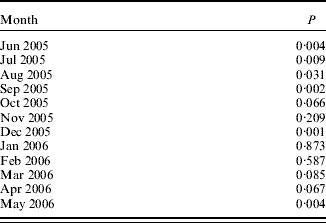
Total soil respiration was 5·9 t C/ha/year in the traditional system and 4·2 t C/ha/year in the intensive system. Soil respiration showed a positive relationship with soil temperature (y=0·3589x−0·4328, where y is the soil respiration rate and x is the soil temperature; R 2=0·88), being higher in summer than in winter (Fig. 1; Table 2).
ANOVA of soil respiration in traditional (494 trees/ha, cv. Tarocco Scirè) and intensive (1000 trees/ha, cv. Newhall) orange (C. sinensis L.) systems from June 2005 to May 2006

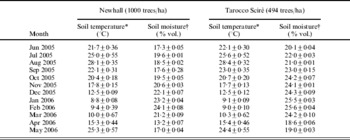
There were no differences in soil temperature between the two orchards but the soil moisture was higher in the traditional system for a large part of the season (Table 3).
Soil temperature (°C) and soil moisture (% vol.) measured in traditional (494 trees/ha, cv. Tarocco Scirè) and intensive (1000 trees/ha, cv. Newhall) orange (C. sinensis L.) systems from June 2005 to May 2006

* Measured with a STP placed at the depth of 50 mm below soil surface. Each value is a mean (±s.e.m.) of 24 measurements taken monthly, every second week, from June 2005 to May 2006.
† Measured with a soil moisture sensor at the depth of 150 mm below soil surface. Each value is a mean (±s.e.m.) of 24 measurements taken monthly, every second week, from June 2005 to May 2006.
Both planting systems were efficient in C sequestration, but the carbon balance was almost four times higher in the intensive system with cv. NH (1·8 t C/ha/year) than in the traditional one with TS (0·5 t C/ha/year), due to large differences in soil respiration.
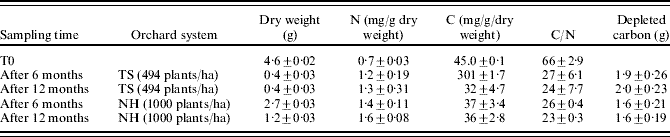
Litter bag decomposition was much faster and much higher in the traditional than the intensive system (Table 4). In fact, 6 months after being placed in the soil, the dry weight of litter bags in the traditional system had decreased by 90%, while in the intensive system it only decreased by 40%. At the last sampling dates, 6 months later, there was no further decrease in dry weight in litter bags in the traditional system, while the dry weight in litter bags placed in the intensive system was 25% of the initial value (Table 4). Carbon content was higher in litter bags in the intensive system at both sampling dates and the total C depletion was higher in litter bags placed in the traditional system (Table 4).
Variation of dry weight, C and N concentrations in decomposing orange leaf and pruning litter in traditional (494 trees/ha, cv. Tarocco Scirè (TS)) and intensive (1000 trees/ha, cv. Newhall (NH)) orange (C. sinensis L.) systems (each point is a mean of six litter bags ±s.e.m.)

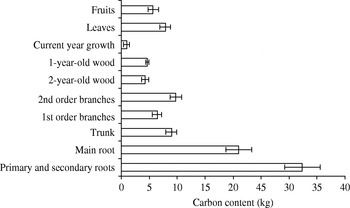
Data obtained from excavated trees showed that carbon fixation in TS trees (traditional system) was higher than in NH trees (intensive system; 103·5 kg C/tree v. 38·7 kg C/tree, respectively). Larger differences were found in the root system; TS trees accumulated 3·5 times more C in the root components than did NH ones.
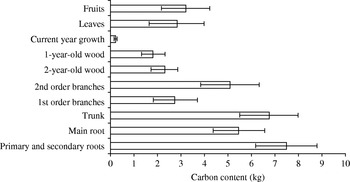
Carbon partitioning in canopy components did not change with planting density (Figs. 2 and 3).
Carbon content in canopy components of 12-year-old orange (C. sinensis L.) trees, cv. Newhall (spaced 4·0×2·5 m apart). Each point is a mean of three trees (bars indicate s.e.m.).

Carbon content in canopy components of 14-year-old orange (C. sinensis L.) trees, cv. Tarocco Scirè (spaced 4·5×4·5 m apart). Each point is a mean of three trees (bars indicate s.e.m.).

DISCUSSION
The citrus industry in Italy is based on traditional orange groves that play a substantial role in the local agricultural economy and landscape ecology. The present data suggest that orange groves can also play a role in terms of carbon sequestration, in both traditional and intensive planting systems. Indeed, carbon sequestration by orange groves is similar to that reported for other fruit orchard systems (Facini et al. Reference Facini, Georgiadis, Nardino, Rossi, Maracchi, Motisi, Carli, Cavarretta, Colacino and Fuzzi2007; Montanaro et al. Reference Montanaro, Dichio, Tuzio, Celano and Xiloyannis2008; Tagliavini et al. Reference Tagliavini, Panzacchi, Ceccon, Liguori, Bertolla, Meggio, Tonon, Corelli Grappadelli, Celano, Gucci, Pitacco and Inglese2008) but lower than C uptake by European forests (Valentini et al. Reference Valentini, Matteucci, Dolman, Schulze, Rebmann, Moors, Granier, Gross, Jensen, Pilegaard, Lindroth, Grelle, Bernhofer, Grünwald, Aubinet, Ceulemans, Kowalski, Vesala, Rannik, Berbigier, Loustau, Guomundsson, Thorgeirsson, Ibrom, Morgenstern, Clement, Moncrieff, Montagnani, Minerbi and Jarvis2000).
The reduction of single tree size is not cultivar-dependent but is related to planting density (494 trees/ha v. 1000 trees/ha). A closer spacing within the row resulted in smaller canopy, lower fruit yield and lower secondary growth of single trees. However, in terms of C sequestration on hectare basis, the higher number of trees made up for the lower C content of single trees in high-density orchards, making high- and low-density orchards comparable in terms of NPP of canopy components.
Forshey & McKee (Reference Forshey and McKee1970) found that total dry matter accumulated per unit ground area was essentially the same for small and large McIntosh apple trees grafted into low- and high-vigour rootstocks, though great differences occurred in the dry matter partitioning between the fruit and the woody components. In the case of citrus, dwarfing rootstocks, even if available (Roose Reference Roose1986), are scarcely used, and the closer spacings account for the restriction of root size and weight that occurs because of root competition of contiguous trees (Faust Reference Faust1989). As a matter of fact, the size of the root system was much larger at the lower planting density (i.e. larger available soil volume). Eventually, the HI, measured in terms of dry matter fixed in the canopy, did not change with orange tree size, confirming that, in contrast to dwarfed trees (Reforgiato Recupero et al. Reference Reforgiato Recupero, Caruso, Russo, Bertolami, Tribulato, Gentile and Reforgiato Recupero1992) no preferential diversion of dry matter accumulation towards fruit growth occurred along with the reduction of tree size.
The intensive system using cv. NH accumulated three times more net C than the traditional one using TS, mostly because of a lower soil respiration, since the total amount of C fixed in the trees was similar and C fixed by the ground cover was higher in the large alleys of the TS traditional system. Soil respiration depends on several variables, e.g. soil physical characteristics, water content and temperature as well as canopy gross primary productivity (Curiel Yuste et al. Reference Curiel Yuste, Baldocchi, Gershenson, Goldtein, Misson and Wong2007; Moyano et al. Reference Moyano, Kutsch and Rebmann2008). Soil respiration clearly decreased in winter with the decrease in soil temperature, as reported by Li et al. (Reference Li, Yan, Yue and Wang2008), while in summer, soil moisture was likely to be the source of variability of soil respiration between the two systems. No differences in air and soil temperatures between the two systems were measured in the present experiment, but during the summer, soil moisture was higher in the traditional systems with larger plant spacing. As indicated by Li et al. (Reference Li, Yan, Yue and Wang2008), the improvement of soil water conditions could promote the increased contribution of soil microbial activity and root production of the large roots system of trees in the traditional system.
Soil respiration can be also related to photosynthetic activity and root-derived carbon respiration (Moyano et al. Reference Moyano, Kutsch and Rebmann2008) and LAI has been used as a predictive parameter. LAI of traditional and intensive plots did not change significantly; however, the different size of single tree root system, which changes with plant spacings, may involve different carbon respiration patterns and rates, also in relation to root turn-over. These aspects deserve further investigation to clarify the role of different root systems in soil respiration.
It is important to note that the carbon fixation by the trees was underestimated, because only the above-ground components were measured. If it is considered that annual C partitioned to the roots is 0·30 of that fixed in the canopy (Montanaro et al. Reference Montanaro, Dichio, Tuzio, Celano and Xiloyannis2008), total C sequestration would be 6·9 t C/ha/year for the low-density traditional system and 7·1 t C/ha/year on the high-density intensive system, with a final C balance of 2·4 t C/ha/year in the traditional and 3·3 t C/ha/year in the intensive systems. Considering that the maturity stage of such orange orchards, beginning 7–8 years after plantation, may last for a further 40 years, these values represent a steady-state condition of mature orchards in terms of yield potential. However, actual values achieved may differ from year to year for sometimes unpredictable reasons (Inglese et al. Reference Inglese, Gullo, Germanà, Policarpo and Rosati1994).
Plant density had a specific effect on C leaf content that is likely to be related to the shade condition determined by the denser planting system which results in a larger fraction of ‘shaded’ leaves (Faust Reference Faust1989). Indeed, the measured LAI orchard was similar to that recorded with non-destructive methods in orange orchard (about 600 trees/ha) of the same area (Consoli et al. Reference Consoli, D'Urso and Toscano2006).
Moreover, closer plant spacings resulted in a lower light penetration through the tree canopies and a consequent reduction of weed development in the alley.
The daily soil respiration rate was similar to measurements taken using eddy covariance on citrus groves in summer, and so was the overall C balance (2·2 t C/ha/year) (Pitacco et al. Reference Pitacco, Panzacchi, Liguori, Inglese and Tagliavini2007).
Wide ranges of C net ecosystem productivity in terms of C fixation in orchard systems may come from different strategies of orchard management. It is likely that mulching and composting, as well as utilization of prunings, may substantially increase the C budget of mature groves, without penalizing their fruiting performances. This deserves further investigation.