1. Introduction
Burgess Shale-type deposits (BSTs) provide an unrivalled view on early animal groups during the so-called ‘Cambrian explosion’. This event is best documented in particularly prolific sites, such as the lower Cambrian Chengjiang biota of China (Hou et al. Reference Hou, Aldridge, Bergström, Siveter, Siveter and Feng2004), and middle Cambrian Burgess Shale of Canada (Briggs, Erwin & Collier, Reference Briggs, Erwin and Collier1994); however, numerous other sites with their own unique faunas are known throughout the Cambrian (Hagadorn, Reference Hagadorn, Bottjer, Etter, Hagadorn and Tang2002), and contain potentially significant components for tracking the progress of the ‘Cambrian explosion’. One such deposit, the lower middle Cambrian (Series 3, Stage 5) Spence Shale, located in northern Utah, USA, is situated within the Glossopleura Assemblage Zone (Robison, Reference Robison1976), and is thus marginally older than the Burgess Shale Formation. The Spence Shale contains a diverse biota including algae (Robison, Reference Robison, Simonetta and Conway Morris1991), sponges (Rigby, Reference Rigby1978, Reference Rigby1983), brachiopods (Robison, Reference Robison1964), eldoniids (Conway Morris & Robison, Reference Conway Morris and Robison1988), stem-molluscs (Babcock & Robison, Reference Babcock and Robison1988; Conway Morris et al. in press), cycloneuralians (Robison, Reference Robison1969; Conway Morris & Robison, Reference Conway Morris and Robison1986), deuterostomes (Ubaghs & Robison, Reference Ubaghs and Robison1985, Reference Ubaghs and Robison1988; Sprinkle & Collins, Reference Sprinkle and Collins2006; Conway Morris et al. in press), lobopodians (Conway Morris & Robison, Reference Conway Morris and Robison1988), and a variety of arthropods including trilobites (Resser, Reference Resser1939; Gunther & Gunther, Reference Gunther and Gunther1981) and non-trilobites. The latter include carapace-bearing arthropods (Robison & Richards, Reference Robison and Richards1981; Briggs & Robison, Reference Briggs and Robison1984), megacheirans (Robison, Reference Robison, Simonetta and Conway Morris1991; Briggs et al. Reference Briggs, Lieberman, Hendricks, Halgedahl and Jarrard2008; Conway Morris et al. Reference Conway Morris, Selden, Gunther, Jamison and Robison2015), xenopods (Briggs & Robison, Reference Briggs and Robison1984), and the enigmatic taxa Meristosoma paradoxum (Robison & Wiley, Reference Robison and Wiley1995) and Utahcaris orion (Conway Morris & Robison, Reference Conway Morris and Robison1988).
Utahcaris orion has frequently been compared to Sanctacaris uncata Briggs & Collins, Reference Briggs and Collins1988, from the Kicking Horse Member of the Burgess Shale Formation (Conway Morris & Robison, Reference Conway Morris and Robison1988; Bousfield, Reference Bousfield1995; Paterson et al. Reference Paterson, Jago, Gehling, Garcia-Bellído, Edgecombe, Lee, Rábano, Gonzalo and Garcia-Bellído2008, 2016), with which it shares a number of features, specifically an elongate, paddle-shaped telson and 11 trunk somites. Sanctacaris was recently identified as belonging to the crown-group of chelicerates (Legg, Reference Legg2014), and thus Utahcaris potentially represents one of the oldest representatives of this clade. In order to decipher the relationships of Utahcaris, material attributed to this taxon is re-examined.
2. Material and methods
Just two specimens of Utahcaris orion, from the Wellsville Mountains in Utah, are known; the holotype, KUMIP (University of Kansas Natural History Museum) 204784 (Fig. 1), collected by Benjamin F. Dattilo from Antimony Canyon, and KUMIP 204785 (Fig. 2), collected by Robert and Nancy Meyers from Miners Hollow. KUMIP 204784 is dorso-ventrally compressed and preserves most of the dorsal morphology, including a near-complete cephalon with a phosphatized gut with contents. The smaller individual, KUMIP 204785, is preserved in a lateral-oblique orientation and, like the holotype, possesses a near-complete cephalon and a complete complement of tergites, tipped with an elongate paddle-like telson. Specimens were photographed both wet and dry, under polarized lighting, using a Canon EOS 500D digital SLR Camera with a Canon EF-S 60 mm Macro Lens, which was controlled using the EOS Utility 2.8.1.0 program for remote shooting.
KUMIP 204784a, holotype of Utahcaris orion Conway Morris & Robison, Reference Conway Morris and Robison1988. (a) Part, photographed using polarized lighting, and (b) accompanying camera lucida drawing. Gut content is coloured grey. Abbreviations: P? – putative podomere; and T1–T11 – trunk tergites 1–11.

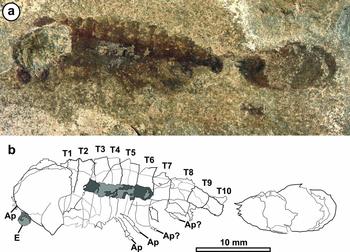
KUMIP 204785a, additional specimen of Utahcaris orion Conway Morris & Robison, Reference Conway Morris and Robison1988. (a) Part, photographed using polarized lighting, and (b) accompanying camera lucida drawing. Gut content and eyes are coloured grey. Abbreviations: Ap – appendages; E – eye; and T1–T10 – trunk tergites 1–10.

3. Systematic palaeontology
Phylum EUARTHROPODA Lankester, Reference Lankester1904
Subphylum CHELICERATA Heymons, Reference Heymons1901
Family Sanctacarididae nom. nov.
Type genus. Sanctacaris Briggs & Collins, Reference Briggs and Collins1988, designated herein.
Other genera. Utahcaris Conway Morris & Robison, Reference Conway Morris and Robison1988, and Wisangocaris barbarahardyae Jago, Garcia-Bellído & Gehling. in press.
Diagnosis. Arthropods with a highly vaulted and bulbous cephalon possessing expansive lateral margins and ventral eyes situated close to the anterolateral cephalic margin, a trunk composed of 11 trunk segments, the most posterior of which lack extensive pleurae, and a paddle-shaped telson with lateral spines towards the posterolateral margin.
Remarks. As part of a recent restudy of Sanctacaris, Legg (Reference Legg2014) conducted an extensive phylogenetic analysis which resolved this taxon as the oldest crown-group chelicerate. To this analysis Utahcaris and Wisangocaris were added herein using the coding provided in the online supplementary materials (S1 and S2). This analysis resolved Wisangocaris and Utahcaris as successive sister-taxon of Sanctacaris, within the stem-lineage of Euchelicerata (Fig. 3), the clade composed of modern horseshoe crab, arachnids, their most recent common ancestor, and all its descendants. Given the morphological similarities and close relationships of Utahcaris, Wisangocaris and Sanctacaris, as resolved in the phylogenetic analysis, these taxa are assigned to a new family, Sanctacarididae, for which the more completely known taxon Sanctacaris is designated type genus.
The phylogenetic position of Utahcaris orion as resolved in this study. An abbreviated consensus tree of 35 Most Parsimonious Trees of 146.67015 steps (CI = 0.497; RI = 0.867), produced using New Technology Search Options in TNT v. 1.1. (Goloboff, Farris & Nixon, Reference Goloboff, Farris and Nixon2008), with implied character weighting (k = 3).

Genus Utahcaris Conway Morris & Robison, Reference Conway Morris and Robison1988
Type species. Utahcaris orion Conway Morris & Robison, Reference Conway Morris and Robison1988 (by monotypy).
Diagnosis. Sanctacaridid with a cephalic shield that is subtriangular in dorsal aspect, a trunk composed of 11 segments, lacking paired carinae, and a two-segmented abdomen differentiated from the more anterior tergites by a lack of extensive pleurae (emended from Conway Morris & Robison, Reference Conway Morris and Robison1988, p. 30).
Remarks. In its original description, Utahcaris was compared to both Sanctacaris, and the leanchoiliid megacheirans Actaeus Simonetta, Reference Simonetta1970, Alalcomenaeus Simonetta, Reference Simonetta1970, and Leanchoilia Walcott, Reference Walcott1912. However, besides the number of trunk tergites, and the presence of a paddle-shaped telson in Alalcomenaeus, Utahcaris shares few features with leanchoiliids, instead bearing more similarity to Sanctacaris. For instance, leanchoiliids lack an abdomen; instead their posterior tergites bear reduced pleurae which become progressively more flexed towards the posterior of the animal. It should be noted that although Sanctacaris has at times been allied with megacheiran arthropods (e.g. Budd, Reference Budd2002), based mainly on the erroneous interpretation of its frontal appendages (see discussion in Legg, Reference Legg2014), few recent phylogenetic analyses have supported this assignment, instead resolving megacheirans outside crown-group Euarthropoda and resolving Sanctacaris within the crown-group amongst vicissicaudates (Legg, Sutton & Edgecombe, Reference Legg, Sutton and Edgecombe2013) or within crown-group chelicerates (Legg, Reference Legg2014).
With viccissicaudates, Utahcaris shares a posteriorly differentiated abdomen (Ortega-Hernández, Legg & Braddy, Reference Ortega-Hernández, Legg and Braddy2013). It differs from most, however, in possessing two segments rather than three, as seen in Sidneyia Walcott, Reference Walcott1911 (Bruton, Reference Bruton1981), or one, as seen in Emeraldella Walcott, Reference Walcott1912 (Stein & Selden, Reference Stein and Selden2012), cheloniellids (Ortega-Hernández, Legg & Braddy, Reference Ortega-Hernández, Legg and Braddy2013) and Sanctacaris (Briggs & Collins, Reference Briggs and Collins1988; Legg, Reference Legg2014). Utahcaris also differs from the latter, and Wisangocaris, in lacking paired tergal carinae. It is this combination of features which confirms its status as a separate taxon.
Utahcaris orion Conway Morris & Robison, Reference Conway Morris and Robison1988
Figures 1 and 2
Holotype. KUMIP 204784, by original designation.
Paratype. KUMIP 204785, designated herein.
Diagnosis. As for genus.
Description. The majority of new information regarding this taxon was retrieved from KUMIP 204785 (Fig. 2). KUMIP 204784 (Fig. 1) and KUMIP 204785 (Fig. 2) measure 87 mm, and 44 mm, from the anteriormost tip of their cephalic shield to the posteriormost tip of their telson, respectively.
Although incompletely preserved in the holotype, the cephalic shield appears subtriangular in dorsal aspect, with a pointed anterior margin, a gently rounded posterolateral margin and a straight posterior margin with a poorly developed medial emargination (Fig. 1). The centre of the cephalic shield of KUMIP 204784 possesses a slight convexity which may be due to the underlying phosphatized gut content, although it is thought to be a genuine feature based on comparisons with KUMIP 204785, which, although lacking noticeable relief, appears to have a bulbous cephalic shield (Fig. 2); this bulbous region is flanked on either side by subtriangular pleural extension (Fig. 2). An enlarged, circular compound eye is present under the anterolateral margin of KUMIP 204785 (Fig. 2). Although very poorly preserved, the remnants of cephalic appendages can be observed in KUMIP 204785 (Fig. 2).
Eleven trunk segments can be observed in KUMIP 204784 (Fig. 1). Tergites show little overlap and a slight convexity, although the exact extent of both is difficult to determine based on the available specimens, both of which show considerable post-mortem deformation. The trunk of KUMIP 204784 shows noticeable torsion, and the majority of anterior tergite pleura are missing; however, lateral pleura can be observed on the posterior thoracic tergite, namely tergites 8 and 9 (Fig. 1). These pleura are posteriorly flexed with a subtriangular posterolateral margin (Fig. 1). The pleura of the posterior two trunk somites are extremely reduced, with tergite 11 lacking subtriangular pleural extensions altogether (Fig. 1). The two posteriormost somites are further distinguished from the anterior ones in being more elongate, with tergite 11 nearly twice as long as tergite 1. Poorly preserved appendages are present beneath trunk segments 4–7 of KUMIP 204785 (Fig. 2). The presence of gnathobases and the number of podomeres could not be determined.
A simple gut, lacking accessory glands, runs through the length of the trunk, terminating in an anus between segment 11 and the telson (Fig. 1). The paddle-like telson of Utahcaris is long, accounting for 20% of total body length in KUMIP 204784, and 31% of total body length in KUMIP 204785, subcircular and possesses a strongly curved posterior margin (Figs 1, 2). The posterolateral margins are characterized by subtriangular margins which extend into the telson interior (Fig. 1). A second pair of less prominent spines is present halfway between the last trunk tergite and the more posterior telson spines (Fig. 1).
Discussion. The description of Utahcaris presented herein differs from the original of Conway Morris & Robison (Reference Conway Morris and Robison1988) in a number of key aspects. Specifically, the original describers found no evidence for lateral eyes or appendages, which, although poorly preserved, give additional insight into the ecology of this taxon (see below). The bulbous nature of the cephalon, with its subtriangular posterolateral extension is recognized for the first time, and along with the anterolateral position of the ventral eyes, further strengthens similarities to the slightly younger Sanctacaris uncata. Given the sister-taxon relationship of these taxa, and Wisangocaris, as resolved in the phylogenetic analysis herein, this means that these taxa represent the oldest currently named chelicerates.
Remarks. Our restudy of Utahcaris revealed a number of previously unrecognized features of KUMIP 204785, specifically regarding the morphology of the cephalon, including its bulbous nature and the presence of ventral eyes under the anterolateral margin, and the presence of appendages, which are otherwise lacking from the holotype.
4. Discussion
A number of features of Utahcaris, and other sanctacaridids, indicate they were active predators, or at least scavengers, first and foremost of which is the putative gut content. Identified as fragmented trilobite remains in the original description (Conway Morris & Robison, Reference Conway Morris and Robison1988), phosphatized elements are clearly visible in the cephalic region of Utahcaris (Fig. 1). The affinity of these remains could not be deciphered, however, due to the fragmentary nature of this material, although it is almost certainly biogenic and therefore indicative of a durophagous lifestyle. The presence of this material led Skovsted et al. (Reference Skovsted, Brock, Lindström, Peel, Paterson and Fuller2007) to infer the presence of robust gnathobases in Utahcaris, although none were observed in the present study; they are, however, unequivocally present in closely related taxa, namely Sanctacaris (Briggs & Collins, Reference Briggs and Collins1988; Legg, Reference Legg2014).
The presence of enlarged lateral eyes, and an elongate paddle-shaped telson, at least in the smaller of the two specimens, is further indicative of an active, potentially predatory, lifestyle. A paddle-like telson, also associated with elongate posterior trunk somites, is observed in a number of taxa thought to represent active and agile swimmers, including pterygotid eurypterids (Plotnick & Baumiller, Reference Plotnick and Baumiller1988), and the Cambrian carapace-bearing arthropods Nereocaris (Legg et al. Reference Legg, Sutton, Edgecombe and Caron2012), Jugatacaris (Fu & Zhang, Reference Fu and Zhang2011) and Pectocaris (Hou, Bergström & Xu, Reference Hou, Bergström and Xu2004). The combination of a few elongate trunk somites and a flat paddle-like telson is seen in modern crustaceans (Krasne & Wine, Reference Krasne, Wine and Guthrie1987), in which it serves to provide thrust for rapid escape from predation; however, in a putatively predatory taxon it may indicate a preference for ambush attack rather than active pursuit of prey.
The presence of a predatory lifestyle in the oldest chelicerates, and their nearest outgroups, namely the vicissicaudates (Legg, Reference Legg2014) such as Sidneyia (Zacai, Vannier & Lerosey-Aubril, in press), indicates that this lifestyle was plesiomorphic for Chelicerata, and has proven so successful that it is maintained by the majority of its members, and may have been instrumental in their origin and proliferation during the ‘Cambrian explosion’.
5. Conclusions
This restudy of Utahcaris orion, and the discovery of newly recognized features such as ventral marginal eyes, lends further credence to suggestions of sanctacaridid affinities for this taxon and its status as an active predator. Its phylogenetic position, as sister-taxon to Sanctacaris uncata, within the euchelicerate stem-lineage, makes Utahcaris and Wisangocaris, the oldest currently recognized crown-group chelicerates, and suggests a pleiomorphically predatory ecology for this clade.
Acknowledgements
Specimen loans were facilitated by Una Farrell and Bruce Lieberman (both University of Kansas Natural History Museum). Thanks to Allison Daley (Oxford University Museum of Natural History) for help with photography and for granting use of her photographic equipment.
Supplementary material
To view supplementary material for this article, please visit http://dx.doi.org/10.1017/S0016756816000789.