INTRODUCTION
This article discusses the changing relationship between Kurdish social bandits and the Ottoman and Turkish state. Considerable research has been conducted on the impact of state formation on the establishment and maintenance of a monopoly of violence. But so far, little is known about the state's use of outlaws for various security tasks. In what follows I address this lacuna by focusing on the ebb and flow of Kurdish chieftains' relations to the state. I will argue that although these states followed consistent policies of disarmament and pacification, in periods of crisis such as war this changed as state officials attempted to use the outlaws for their own purposes. I draw on untapped Ottoman and Western sources to portray the experience of one group of Kurdish tribal outlaws who at times found themselves diametrically opposed to the state, but in other times in accord with it.
Theories on state formation have addressed the increasing consolidation of the state monopoly on violence through the prism of disarmament of the population.Footnote 1 Three trends have been constitutive of this long-term process: increasing size, growing monopolization, and functional differentiation. As one sociologist has argued, “Monopolies of violence are always contested, and pacification is never complete.”Footnote 2 The sociology of pacification implies an axis of tension between state and non-state violence: the fewer individuals in society that bear arms, the higher the level of state formation. The Ottoman Empire never pacified all of its territory to the same degree. In the cities and towns the monopoly of violence was often sufficient for most inhabitants to feel safe walking the streets unarmed. But in the highland areas of Albania, Yemen, or Kurdistan the “negotiated empire” lacked a combination of the technology, manpower, political will, and popular support required to successfully establish and maintain a functioning state monopoly of violence.Footnote 3 In the Kurdish areas of the empire the state faced a number of tribes able to mobilize both quantitatively and qualitatively superior resources and means of violence. Many Kurdish tribes were well armed, some of them could mobilize thousands of mounted men, and they knew the territory well.
Besides the monopoly of violence, legitimacy is a central problem in state formation theories. It is sometimes overlooked that Max Weber defined the state as holding “the monopoly of the legitimate use of physical force (das Monopol legitimen physischen Zwanges).”Footnote 4 The concept of legitimacy implies that common myths and symbols are needed to justify the monopoly of violence. Bassam Tibi adds that “a nation-state requires more than the submission of tribes to a central authority; it also requires national integration … the Middle Eastern nation-state failed to integrate the tribes into a citizenship-centered national structure.”Footnote 5 The present article will problematize the relationship between the Turkish state and Kurdish tribes from the perspective of the relationship between legitimacy and the monopoly of violence.
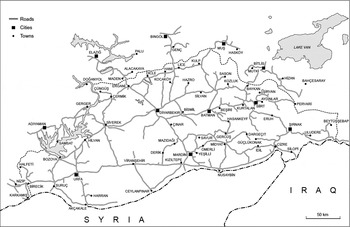
One of the unpacified areas in the Ottoman Empire was the Xerzan region in southeastern Turkey. “Xerzan” is not an official administrative name for the area and only locals use it. Due to the vagueness of topographic delineation in the oral tradition, it is difficult to pinpoint the area on a modern regional map. The area of Xerzan is about as large as Corsica and covers parts of the contemporary southeastern Turkish provinces of Diyarbakır, Batman, Siirt, Bitlis, and Muş. From the late nineteenth to the late twentieth centuries this area witnessed a lack of state formation and levels of violence that were high even for eastern Turkey. This violence consisted of social banditry, diffuse everyday violence, massive state-sponsored violence, and organized political violence. I will limit myself here to social banditry during the first half of the twentieth century.
A GLANCE AT OTTOMAN-KURDISH RELATIONS
Before I turn to the Xerzan region during this period, a brief account of modern Kurdish-Ottoman relations is in order. Three important developments influenced the direction of their relations in the nineteenth century. The first was the 1839 Tanzimat decree that attempted to modernize the Ottoman Empire and consolidate its integrity against internal and external pressures. To strengthen its control of the frail eastern borderlands, the Ottoman government forcefully dismantled the relatively autonomous Kurdish emirates in a series of military campaigns in the 1840s.Footnote 6 Consequently, the territorial scope and nature of Kurdish tribal power diminished considerably as large emirates crumbled into smaller tribes. (Tribes can be defined as extended kin groups organized and regulated according to ties of blood or family lineage.Footnote 7) This decentralization of power increased the number of tribal conflicts since more chieftains now competed over the same territories, loyalties, and resources. The Ottoman government had shot itself in the foot: by destabilizing the region, it created not more control, but more chaos. These were the unintended though quite predictable consequences of the state's policies.Footnote 8
A second development was the internationalization of the “Armenian Question” in the Treaty of San Stefano and the Congress of Berlin, both in 1878. The congress radicalized Kurdish leaders out of fear for Armenian demands for political power over the eastern provinces, including insistence on the appointment of Armenian officials in all ranks of the regional state bureaucracy, the establishment of an Armenian-Turkish militia, and most importantly, the disarming of Kurds. Local notables and urban elites feared that these measures would undermine their own power base, and Armenians and Kurds became polarized.Footnote 9
The final development was the 1890 formation of the Hamidiye corps (named after the sultan), which was a turning point in Kurdish-Ottoman relations. This corps was an irregular Kurdish cavalry formation that operated in the eastern regions of the Ottoman Empire. It was intended to make the area secure by quelling, among other sources of disorder, the Armenian revolutionary activity that percolated into the country, mainly through Russia. Chieftains were asked to provide young men for a school established in Istanbul. Thirty-six mounted and well-armed militias from Kurdish tribes, from different areas, each recruited twelve hundred members. These regiments had the character more of an unruly or irregular group of fighters than a disciplined army with a strict hierarchy. They performed poorly in combat, and the irregulars were motivated by a great deal of political opportunism, material greed, and private grievance. The Hamidiye regiments not only assaulted Armenian villages, but also Turkish and Kurdish ones with impunity. A wave of robberies, rape, and murders contributed to a severe de-pacification.Footnote 10 This macro-structure was bolted onto existing processes such as tribal warfare, and by empowering certain tribes over others the Ottoman government exacerbated existing conflicts.
BANDITS AGAINST AND FOR THE STATE
Peripheral regions were often unpacified due to influential tribes competing for local power. The Xerzan valley, too, was torn by tribal warfare. The largest conflict was that between the Reşkotan and Etmankî tribes, which the Reşkotan ultimately won.Footnote 11 Another source of violence was a feud between the Elîkan and Pencînaran tribes. These tribes fought several battles, with the Ottoman government trying in vain to lull the conflict. The Pencînaran name appears repeatedly in state documents, and the tribe's chieftain Yaşar became notorious for robbing and murdering his tribal enemies at will. After serving a prison sentence, he tracked down and murdered the police officer who had arrested him.Footnote 12 The audacity of this act conveys his confidence in his ability to provoke and resist government forces. The government responded to tribal violence with violence of its own. It tried to cope with the situation by sending extra gendarmes to the region to reinforce its authority.Footnote 13 As tribesmen warred among themselves, the government ordered a military operation to pacify the areaFootnote 14 and stepped up its campaign to end crime and tribal warfare there by ordering the arrest of all chieftains involved in brigandage. Negligent officials were arrested.Footnote 15
One of the social mechanisms that rendered tribal conflicts in Xerzan enduring was the inheritance of the title of chieftain and the accompanying responsibility to manage violence according to the tribal code of honor. In preparation for succession to the “throne,” Kurdish chieftains would narrate past and present feuds to their sons and instruct them in the conduct of warfare. When Yaşar passed away his two sons Bişar and Cemîl succeeded to the title of Pencînaran chieftain and became brothers-in-arms. Under their rule, violence continued unabated as they wreaked havoc in the region, waging war with the Elîkan tribe.Footnote 16 This conflict had been raging since the 1890s, when Hamidiye regiments had threatened the Elîkan's expanding domination in certain areas around Xerzan.Footnote 17 The government failed to capture Bişar and Cemîl due to the timidity of gendarmes and soldiers, who feared the men and refused to pursue them into their home territory.Footnote 18 Feuds like this could last for two decades and were a major source of violence in Xerzan. They were immortalized, transmitted, and disseminated in long laments (kilam) memorized and sung by Kurdish bards.Footnote 19
Tribal warfare brought suffering to powerless peasants, be they Muslims, Yezidis, or Christians. Warring tribes needed resources and therefore extorted and robbed villagers. The relationship between tribesmen and peasants was dominated by the illegal taxing of the (often Armenian) peasants. This tax was called “hafir” and it ensured the peasants protection and patronage, somewhat similar to nineteenth-century mafia practices in the Italian Mezzogiorno.Footnote 20 For example, an Ottoman government document reveals that, “For a long time Bişarê Çeto has been forcibly collecting money from the Armenian and Syriac and Kurdish population of Xerzan.” The government stood powerless in the face of this chieftain, who was so dominant that he forced a commission of villagers to petition the local government about his innocence and benevolence.Footnote 21 When the government failed to act, Armenian guerrillas (fedais) exacted revenge by attacking the Pencînaran tribesmen, whom they considered as oppressive as the government. The government tried to prosecute these guerrillas and ordered them “delivered dead or alive.”Footnote 22 The tribesmen took justice into their own hands and organized retaliatory violence, to which the guerillas responded, in turn, with a strategy of assassinating chieftains.Footnote 23
Between the 1908 revolution and the 1913 Young Turk coup d'état, the Ottoman government tried to solve the problem of non-state violence in Xerzan by prosecuting those responsible.Footnote 24 It put bounties on the heads of the worst outlaws and in November 1909 officially prohibited the practice of hafir.Footnote 25 The situation did not improve, however, and the violence continued apace. The situation reached a boiling point in the area in 1914 when “Armenians had to leave their villages because of oppression by the Kurds.”Footnote 26 The brothers Bişar and Cemîl were still involved in extortion and plunder. They acted with even greater impunity during World War I, when legal action against the tribes was suspended and the Çeto brothers evaded prosecution yet again.Footnote 27 These tribal-state relations did not constitute a unique case. Whenever the opportunity arose to subjugate a tribe, the state would line up with that tribe's enemies. The Zirkî tribe in Lice, for example, had been fighting off their rivals, the Mîlan tribe, in a battle to gain control over parts of northern Diyarbekir, and the Zirkî aligned with the Ottoman government. Once government forces had subdued the Mîlan, they then turned against the Zirkî and imprisoned its chieftain.Footnote 28 This larger situation would play a role in the unfolding of events, when the outbreak of the First World War changed state-tribal relations in profound ways.
WAR AND GENOCIDE
From 11 November 1914 onward, the Ottoman Empire was officially at war with Russia, France, and Britain. According to a recent study, the Ottoman entrance into the war was “part of a strategy to achieve long-term security, economic development, and, eventually, national recovery.”Footnote 29 Apart from regular warfare between standing armies, the First World War also brought paramilitary violence on a large scale, at or beyond the boundaries of ordinary warfare. The Young Turk government drew up formations of irregular militia in order to invade Russia and Persia, foment insurrection, and carry out espionage, counterespionage, and counterinsurgency tasks.Footnote 30 The cadre of these new guerrilla bands was made up of volunteers, convicts, Muslim refugees from the Balkans, and Kurdish tribesmen known as tribal cavalry (aşiret alayları). On 18 November, Interior Minister Mehmed Talaat Bey ordered lists drawn up of the names of convicts and tribesmen “who were able to exert influence.”Footnote 31
While some of these units fought successfully, overall the Ottoman war experience on the eastern front was disastrous. The twin military failures in the Caucasus and Persia sparked a radicalization of anti-Armenian policy at the political center. The first phase of this policy was brought about by the threat of invasion by the British in the west and the Russians in the east. The effect of these threats on the Ottoman political elite was nothing short of apocalyptic—it fueled acute fears of state collapse among the Ottoman elites and spurred persecutions in the winter of 1914–1915, when all Armenian civil servants were fired from their positions and Armenian soldiers were disarmed and put to forced labor.Footnote 32
The policy's second phase developed out of delusional fears that an organized Armenian insurrection loomed. These peaked when Allied forces landed on Gallipoli during the night of 23–24 April 1915. The next day, Talaat ordered the arrest of the Armenian elites throughout the Ottoman Empire. In Istanbul, up to three hundred Armenian intellectuals, clergymen, physicians, editors, businessmen, journalists, lawyers, teachers, and politicians were rounded up and deported to the interior, where they were murdered.Footnote 33 Other provinces followed (see below). This effectively decapitated the community of its political, intellectual, cultural, and religious leaders.
A third phase of the policy was launched when the regime ordered a general deportation of all Ottoman Armenians to the Syrian Desert. Recent detailed research has documented how in each province the persecutions escalated into mass murder and took the lives of about a million Armenians.Footnote 34 What made the massacres genocidal was that the killings targeted an abstract category of group identity, in that all Armenians, loyal or disloyal, were deported and massacred. By the war's end, the approximately twenty-nine hundred Anatolian Armenian settlements were depopulated, and the larger Armenian community had been destroyed.
The recent publication of the biography of Emînê Perîxanê (?–1933), noted chieftain of the Raman tribe, sheds light on Kurdish involvement in the violence of this period. It was published by his son Hüseyin Demirer, who relied on his own memories and the social memory of his immediate family. The Raman tribe reigned in the Xerzan valley and was famous for its female chieftain, Perîxan. She had seven sons, who competed for succession: Mustafa, Said, Ali, Emîn, Abdullah, İbrahim, and Ömer.Footnote 35 In order to succeed their mother, the sons had to outclass each other in their ability to exert power and express leadership qualities.Footnote 36 Of all her sons, Ömer was best known for his ferocity and acumen. Before the war, he had waged a campaign of bravado, plunder, and provocation of government forces. In the summer of 1914 the government declared him persona non grata and ordered his arrest and incarceration, but Ömer escaped prosecution and retreated far into the Xerzan region as an outlaw.Footnote 37 By contrast, his brother Emîn organized a paramilitary unit and in the winter of 1914 successfully fought with the Ottoman army on the Caucasus front.Footnote 38
According to Perîxanê's biography, in the spring of 1915 the governor of Diyarbekir, the fanatical Young Turk nationalist Dr. Mehmed Reshid, summoned Ömer and asked him to undertake a secret mission. When Ömer and Mustafa traveled to the governor's office in Diyarbekir, terrified urbanites saw the outlaw and his intimidating entourage enter the city: “Ömer was of a short stature, darkish, with smallpox scars on his face. He wore a big turban around which hung many colored silk insignias to show that he was a Kurdish chieftain. He also wore a black short tunic (locally made), long breeches, and red shoes … being armed with a Mauser rifle, two revolvers, a sword, a dagger, a yataghan [a short sabre], and carrying with him an enormous quantity of bullets and cartridges.”Footnote 39 When Dr. Reshid received them he explained that the Armenians were betraying the country by helping the Russian army. The governor suggested that he would deliver to the brothers convoys of Armenians that they would escort down the Tigris on rafts, ultimately to kill them all. If they agreed, he said, they could take half of the booty seized. Absolute secrecy would be vital. Seduced by the prospect of riches, the brothers agreed and the plan was set in motion.Footnote 40
Meanwhile, by the end of May 1915 Dr. Reshid had imprisoned the entire Armenian elite of that city, where some had already died under torture. Reshid administered the coup de grace on Sunday 30 May 1915 when his militiamen handcuffed more than six hundred notables, including the Armenian bishop, and led them through the Tigris Gate (Dicle Kapı). On the shores of the Tigris the men were loaded on twenty-three large rafts under the pretext that they were being relocated to Mosul. Militiamen accompanied them as they sailed downstream to the Raman gorge, where the rafts were moored by the river's left bank near two Raman villages. The victims, all men, were robbed of a total of 6,000 Lira (approximately US$22,000), taken away in batches of six, stripped of their clothes and valuables, and massacred by Ömer's tribesmen, their corpses dumped in the river.Footnote 41
After the massacre, Ömer and Mustafa were invited to the governor's house where they celebrated their accomplishment. In the bazaar they sold the expensive clothing they had stolen from the victims.Footnote 42 Reshid congratulated them for their “bravery, patriotism, and services to the state.” He appealed to the Interior Ministry to honor his militia with monetary rewards and medals, and the Directorate for General Security granted this request.Footnote 43 Three other similar, murderous convoys followed. But Reshid did not trust the Pêrîxan brothers to keep these misdeeds a secret and so ordered them executed: his agents killed them in their sleep in the summer of 1915.Footnote 44 Their brother Emîn continued to work for the government, but he would not fare well, either.
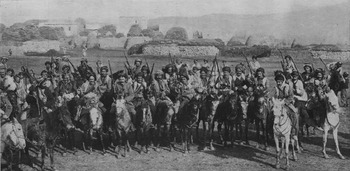
Kurdish tribal cavalry on the Caucasus front in World War I. Source: New York Times, Sunday, 24 January 1915, Picture Section, pt. 1.

Map of southeastern Turkey. From Uğur Ümit Üngör, The Making of Modern Turkey: Nation and State in Eastern Anatolia, 1913–1950 (courtesy Oxford University Press, 2012). www.oup.com

THE END OF THE BANDITS
For the purpose of warfare (and massacre), in 1914 the Young Turk regime had armed dozens of loyal Kurdish tribes with pistols and rifles. By doing so, it also de-pacified large pockets of territory in the eastern provinces: many more men were now armed, a good number of them heavily so. The problem of the bandits continued after the conclusion of peace in 1918, and later after 1923. Taking out the leadership only scattered the remnants of the tribes, fragmented the structure of violence, and sparked new battles for leadership. After the war, the Young Turks' policy backfired when the tribesmen used their newly acquired weapons to turn to crime, a phenomenon that festered for decades in the Kurdish countryside. Although rural crime by tribesmen and social bandits had existed in the eastern provinces for centuries, the de-pacification brought about by the war compounded this phenomenon.
These bands became an increasing source of irritation for the same regime that had created them; they had slipped from the Young Turks' control to become a liability and ultimately to threaten their authority in the region. The 1925 conflict was partly fought by the Kurds with weapons the government had distributed in 1914. When the Kurds' army crumbled after the Kemalist regime crushed the movement in the summer of 1925, armed bands of guerrillas fled into the rural periphery. From there, they assailed government forces and sustained themselves by robbing postal carriages. Moreover, the spread of more weaponry among Kurdish tribesmen in the eastern provinces fueled the flames of tribal wars, which could now be fought more intensely.
Although the Kemalist regime launched reforms and “modernizing revolutions,” the conditions just described typified most of eastern Turkey in the late 1920s. A British observer who traveled through the area, with many bodyguards, noticed that “arms are still abundant,” that “brigandage is spasmodic,” and that large parts of the eastern provinces were “still unsettled areas.” From his conversations with local authorities he gained some insight into the conditions of the countryside: “It was interesting to hear some officers expressing sympathy with these Kurdish villagers, poor devils, who, they said, must live somehow. Years of war and disorder had ravaged the country, and too often the choice for them lay between brigandage and starvation.”Footnote 45
Most of those who turned to social banditry were disgruntled Kurdish chieftains or groups of outlaws without tribal affiliation. For example, in the mountainous region of Xerzan, the Reshwan tribe wreaked havoc. Zekeriya, one of their chieftains, would plunder and rob travelers and then flee to Syria to evade justice.Footnote 46 Others committed acts of banditry and fled to Iran or Russia, and due to these escapes outlawry was always also a matter for the Ministry of Foreign Affairs, which during the 1920s worked closely with the Interior Ministry to clamp down on the bandits.Footnote 47 One can begin to understand how these groups breached the state's monopoly of violence with a glance at the gendarmerie's weekly reports on public security. For example, the following list was compiled for the second week of June 1929:
1. One person was killed in Diyarbekir's Aşanasır village, the perpetrators are being pursued.
2. One person was killed in Diyarbekir's Akveren village, the perpetrators are being pursued.
3. On 9 June 1929, three travelers were robbed by seven armed men in the Silvan district, they are being pursued.
4. On 11 June 1929, two travelers were robbed by three armed men between Diyarbekir and Karacadağ, they are being pursued.
5. One person was caught dead, three persons were caught alive while committing banditry in the Çapakçur district.
6. One person was killed in Diyarbekir's Akveren village, the perpetrators are being pursued.Footnote 48
And the list went on: the next week three armed robbers mugged two more travelers, and another murder was committed in the Kulp district.Footnote 49 This was over a period of just two weeks, in one province; this was no pacified society, and the central government had no functioning monopoly of violence.
The problem of tribal warfare was at least as acute. Although, historically, latent bellicosity between Kurdish tribes had often erupted in open warfare, Kemalist policies had exacerbated the conflicts. Traditional channels of reconciliation had been weakened when Ottoman religious institutions were abolished and Kurdish shaikhs executed and deported. By attacking the Kurds' religious infrastructure the Kemalists eliminated a force that had mitigated violence between the many tribes. Previously, influential sheikhs had conducted conventional reconciliations; with them now gone, conflicts could escalate into years of bloody war. The Reşkotan and Etmankî tribes in the eastern districts of Diyarbekir Province, for example, waged their battles with little government interference for the best part of the 1920s. The Mala Eliyê Unis tribe, too, fought off both hostile tribes and the government for years.Footnote 50 Some, though certainly not all, of these tribes had been armed in 1914 for warfare and massacre, and they were now decimated in a turnaround.
CIVILIZING THE COUNTRYSIDE
It was clear to the Kemalists that the postwar chaos and statelessness in the countryside had to be overcome to lay the foundations for a sustained pacification of eastern Turkey. The regime's attempts at state-building in the countryside were being thwarted because it lacked any monopoly of violence in certain parts, which frustrated both national and local authorities. Many armed groups roamed the countryside, which made travel through the region dangerous during daytime and heroic at night. The government therefore initiated a strict policy of disarmament and pacification and mandated the authorities in Diyarbekir to execute this policy. The lines of influence and command would run exclusively from the center to the periphery since the provincial authorities were to dominate and colonize the hinterland. The pacification campaign swung the pendulum back: whereas the Young Turk regime had de-pacified the eastern provinces by arming tens of thousands of people on the eve of the First World War, the Kemalist regime inherited the task of re-pacifying the region by disarming everyone.
The Kemalist disarmament campaign illustrates pacification, and the state's claim to and seizure of the monopoly of violence, as key components of state formation. The campaign was a continuous process, perhaps best thought of as a “long war” that was accelerated by the 1925 Kurdish rebellion. On 13 June 1925, army headquarters issued the following general decree: “The first objective of the government, which is determined to make radical reforms in the east, is to collect the weapons in the population's possession. Even if it is a gradual process, this job certainly cannot be neglected.”Footnote 51 Another decree a month later specified that ethnic Kurds were to be fully disarmed, since “they smuggled guns across the national borders.”Footnote 52
To formulate the more pronounced and elaborate policies, Interior Minister Şükrü Kaya was summoned. In one of his speeches in parliament, Kaya summarized the development with a triumphant claim and prediction: “Our forces, who crushed and annihilated the rebels and bandits in the east and certain provinces yesterday, are today the agents of safety, security, and peace.” He continued, “Like all of our other measures, this is a public expression of force. Whatever it costs for the strength of the Turkish state, it will render dominant the rule of law in our eastern provinces; our force suffices to render dominant the law.”Footnote 53 He later wrote to the prime minister that the best way “to take measures that will quickly get rid of incidents of banditry” was to “regionally collect weapons.”Footnote 54 The disarmament campaign was no secret to the outside world. In November 1930 Tevfik Rüştü Aras, then foreign minister of Turkey, remarked in Geneva, “The policy of the Turkish government toward the Kurdish question consists for the moment of a military occupation to guarantee order, and the complete and absolute disarmament of the population.”Footnote 55
The inspector-general was almighty in his jurisdiction—he had the authority to hire, fire, and summon all civil, gendarme, police, and army forces under his command. At this point in state formation there was little functional differentiation, and functions that later became separated and are nowadays regarded as incompatible were united in one office, even one person. The Inspectorate-General represented administration, jurisdiction, regulation, enforcement, and arbitration. At the establishment of the Inspectorate, the responsible officials repeatedly acknowledged that “the real reason for the [its] establishment was to maintain security and order.”Footnote 56 The inspector himself frequently reported to Ankara on matters of public order, significantly not to the Interior Ministry but directly to the Prime Minister's Office.
Before 1932, disarmament was an incidental rather than systematic affair, such as when gendarmes raided the town of Mazıdağı during the night of 8–9 October 1931 and captured seven hundred rifles and two hundred draft dodgers.Footnote 57 The campaign entered a new phase in April 1932 with the launch of a Five-Year Program for Security and Disarmament in the First Inspectorate-General region. According to a memorandum written by Şükrü Kaya, “The program aims to discipline the eastern region” by “collecting arms that are the prime factor of unrest.”Footnote 58 The interior minister would collaborate with the army, and funds were requested for a large military operation to disarm the entire province of Diyarbakır.Footnote 59 The army was heavily involved in the campaign. In several decrees, the Seventh Army Corps was summoned for the disarmament of Diyarbakır and Mardin provinces because the operations were expected to bear “the character of combat and skirmishes.”Footnote 60
The army, Interior Ministry, and Inspectorate-General joined forces and allocated 15,000 Lira for the campaign. By the summer of 1932, Inspector-General Dr. İbrahim Tali Öngören could already report to his superiors that 4,050 weapons had been confiscated. Tali specified that “90 percent of these are first-class weapons of war” and that they were gathered from not only sedentary tribes but also nomads such as the Karakeçi tribe in western Diyarbakır. He promised to extend the campaign from west to east toward the more discordant mountains of Sason and the valley of Xerzan. According to Tali, this was an essential part of the process in itself, but it was also necessary to track down those who had fled the operations. Villagers often gave their best horses to these fugitives, who had mobile units following hard on their heels.Footnote 61
By September 1932, the Interior Ministry declared that the disarmament of the towns of Derik, Viranşehir, and Siverek, and the direct vicinity of Diyarbakır city had been completed within two months. Small mobile gendarme units would pursue any leftover weapons. The total take was one machine gun and 5,707 rifles on 6 September,Footnote 62 and by 17 September the number was 5,975 and counting.Footnote 63 İbrahim Tali wrote a more detailed report that announced the eastward expansion of the disarmament campaign. The 1st and 18th Regiments of the Seventh Army Corps' Second Division would launch the operation on Mutki and Sason on 8 September, in tandem with the 10th Mobile Gendarme Battalion. All villages would be raided and all arms confiscated, whether unconcealed or hidden. Particular attention was to be given to the areas still dominated by tribes, such as the Raman, Reşkotan, Şîxolî, and Sînikan tribes in the Xerzan region.Footnote 64
The pacification of the countryside was a risky but effective process in the easily controlled valleys. State officials took pleasure in reporting these successes, and Şükrü Kaya accounted for the numbers with great precision. For example, every few days he reported the cumulative number of confiscations from the village of Sam:
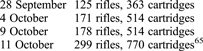
In eastern Diyarbakır, those who fled with a rifle or opened fire on soldiers were punished severely: twelve people had been summarily executed and ten houses were burnt. In the reports, one reads that the disarmament policies not only pressured the population but also presented people opportunities for settling old and new scores. Kaya expressed satisfaction that villagers and competing tribes had informed on each other, betraying each other's weapons depots.Footnote 66 This suggests that coercion and violence were weakening trust and social cohesion in the eastern provinces, fostering a culture of denunciations and informers.
By the autumn of 1932, the campaign was gradually expanding into troublesome eastern Diyarbakır. The army and gendarmerie ventured into the countryside with a broad mandate, and inflicted high levels of violence upon combatants and non-combatants alike. Prime Minister Mustafa İsmet İnönü closely followed this part of the campaign and asked for frequent updates on its progress.Footnote 67 Tali immediately reported back to him that the operation had reached eastern Diyarbekir at Mutki on 8 September, Sason in early October, and Beşiri and Xerzan on 27 October. By that point, the Seventh Army Corps had confiscated 1,633 weapons and 2,175 cartridges in these regions. Anyone who had sheltered “bands” was arrested, several “robbers” and “gangs” were annihilated, and “other bandits were captured dead.” Some of the district towns had now been “brought into a condition permitting all kinds of discipline resulting from state influence and the strength and justice of the Republican regime has manifested itself among the people.” Tali also had more than four hundred Kurds deported from the region to Thrace for “opposing government orders.”Footnote 68
The campaign captured an unprecedented number of weapons in the eastern provinces. For example, on 15 November 1932, only two weeks after the campaign had reached the Xerzan area, Şükrü Kaya reported to İsmet İnönü that 2,335 rifles, 2,175 cartridges, 68 pistols, 5 machine guns, and 26 bombs had been confiscated in Diyarbakır province alone.Footnote 69 Officials were shocked at this huge haul, which proved that certain Kurdish tribes were armed to the teeth and could operate like small armies. Therefore, Interior Minister Şükrü Kaya proposed a policy of pre-emptive personal search. On 29 December, he wrote to İnönü: “In order to prevent murder, wounding, and larceny in many places, suspicious and recidivist persons with no occupation or specific residence must be searched in places where they gather.” Kaya added a table, broken down by regions (west, central, and east), summarizing weapons confiscations throughout the country over the previous six months. The figures are much more complete for the western and central Anatolian regions than for the east with its inaccessible corners like Dersim, Sason, or Hakkari, all unregistered in the list. According to the table, the number of arms collected in the First Inspectorate-General region alone totaled more than the rest of Turkey combined.Footnote 70 In 1934, the campaign spread northwards in two phases: 1,400 weapons were confiscated in the first phase and 3,055 in the second. According to a report written by Inspector-General Ahmet Hilmi Ergeneli, most of these weapons had been in the hands of Kurdish tribes, such as the Zirkî in northern Diyarbakır. Gendarmes sufficed for combing most of the valleys, but for the mountainous areas the army had to be deployed. In the year 1934 alone a total of 5,326 weapons were gathered.Footnote 71 In the early winter of 1932, Tali had written to İnönü declaring the disarmament operation “a veritable success,” and predicted that it would be brought to a successful conclusion within two years, “mainly due to the interest shown by your Excellency.”Footnote 72 But though the campaign would continue, new developments would show he had cheered too soon.
PROBLEMS OF PACIFICATION
Problems soon arose in the disarmament campaign's practical implementation. In one of his reports, Inspector-General İbrahim Tali complained that gendarmes who were stationed in the east for more than three years “had given up hope of being transferred, were exhausted and burned out from working for as many as six to seven years in severe conditions,” and therefore “did not embrace their duties with the necessary seriousness.” Tali explained that “some of them married local girls and instrumentalized their official capacity for the sake of family and tribal interests, leading to serious incidents.” He requested that, in future, gendarmes not be kept in the region for more than three years.Footnote 73 Interior Minister Şükrü Kaya, too, noted in one of his reports that many lower-ranking bureaucrats such as guards and village headmen “were distantly or closely related to a lord or a tribal chieftain.” These bonds were risky and detrimental to government rule, and therefore he argued that locals (i.e., Kurds) had to be preemptively barred from the state bureaucracy.Footnote 74 His argument acknowledged another potential pitfall of imposed state formation: for many families at the local level, the state could become an object of ambition and contestation for political influence (and economic gain). Such a constellation of national and local power-holders could tarnish the independence and autonomy of local government.
Another problem was smuggling: no matter how many weapons the Kemalist regime continued to confiscate on their side of the border, there was no patrolled boundary with designated crossing points through which to control the movement of people and weapons. Thus Kurds could easily cross into Syria, buy guns, and return to their villages. When the Interior Ministry discovered that smuggling was being carried out on a massive scale, undermining the disarmament campaign, Şükrü Kaya reported to the Prime Minister's Office that pacification had to be accelerated. He accused the French authorities in Syria of allowing and even supporting armed “bands” (çeteler).
Kaya diagnosed what he saw as the underlying reason for the problem: “The unity of language, character, and feeling of the people on either side of the Syrian border.” He meant that the Turkish-Syrian border cut through areas where large extended families and tribes were living, so that smuggling and mutual support became in times of crisis more or less inevitable. Kaya then identified some of the elites involved with the smuggling networks.Footnote 75
In an indirect way, such a conception of loyalty to the government came close to equating ethnicity with loyalty: Kurds living in the border regions were not to be entrusted with state offices. The disarmament also elicited various forms of subtle resistance: besides making people afraid of the government, the campaign breached the rural culture of bearing arms as a sign of masculinity. Rural culture was defined by a patriarchal martial ethos, and as such shaped the attitudes of boys socialized in that culture. A man was supposed to be able to wield a dagger, swing a club, and handle a gun. The campaign was therefore a direct blow to Kurdish masculine identity.Footnote 76 Furthermore, the campaign took away the traditional village pastimes of hunting pheasants for sport and food. Although nepotism, smuggling, and tradition disturbed and ultimately delayed the pacification campaign, truly critical problems would arise when marginalized groups began resisting the disarmament policies with violence.
The Young Turk conquest of Ottoman political culture following the 1913 coup d'état had marginalized scores of dissenting politicians and leaders. This diverse group of people was excluded from participation in the political system, from parliamentary to local power circles. Some of these frustrated men and women left Turkey voluntarily, others were expelled, while still others stayed and lived in the country. Among the latter were many disgruntled Kurdish tribesmen who considered the Young Turk and Kemalist regimes oppressive and therefore illegitimate. They were convinced they could resist it only with violence. The regime, in turn, responded with violence of its own. In government jargon these people were systematically dehumanizedFootnote 77 as “bandits” (şaki), “villains” (câni), “thugs” (haydut), or “bands” (çete), that could be dealt with only through “destruction” (imha).
For example, in 1932, when Interior Minister Şükrü Kaya evaluated ongoing clashes in parliament, he mentioned that “Blind Şemo of the Sait Aziz band, Deli Fettah of the Diyarbakır band, Zazo, Hüseyin, Somaki İsmail and many others … sixty-seven of these have been killed this year. There are still two bands that have not yet been destroyed. After they have been destroyed, the issue of public security in the east will have assumed a normal condition.”Footnote 78 Under this policy, Raman chieftain Emînê Perîxanê was ultimately dispensed with: he was ambushed and shot dead by two Turkish soldiers on Sunday, 9 April 1933.Footnote 79 These Kurds were not the only ones excluded from political decision-making processes. Many people who might not have coalesced under normal conditions came together to oppose their common enemy—the regime. In this way, rival Kurdish tribes became rather unlikely bedfellows during this period. Kurds from the large village of Awina, for instance, had been resisting the Young Turk regime since 1913. They forged an alliance with other tribes and with Armenian survivors and maintained a state of confrontation with the regime.Footnote 80 From time to time resistance of this sort erupted into skirmishes and armed robberies.
On 15 March 1937, at 10:30 a.m., fourteen men on horseback robbed a postal carriage carrying a group of travelers near the village of Karaköprü, just outside Diyarbakır city on the road to Mardin, and shot two of them. The perpetrators were led by Cemilpaşazâde Mehmed, a Kurdish nationalist, while the victims included Diyarbakır's public prosecutor, two gendarme officers, one gendarme, and a doctor. The robbers fled with all their belongings and the contents of the carriage and disappeared without a trace. When the news reached Ankara it shook the Interior Ministry. The furious Şükrü Kaya gave a thunderous speech explaining the significance of the incident: “The reason why special importance must be assigned to the Karaköprü robbery is that the band could approach Diyarbakır as close as 15 kilometers, commit the robbery on a busy main road for the duration of seven hours with nobody hearing or seeing it, and return on the same road they arrived on, without getting caught.” The hold up was a humiliation because the culprits proved they could provoke the regime on its own turf and thereby demonstrate its relative powerlessness. But the audacious event was also a jeer at the disarmament campaign, an act of resistance and contempt. For Interior Minister Kaya, it was doubly humiliating in light of his many euphoric reports about the successes of disarmament and its positive effect on public order and security.Footnote 81
The countermeasures—more militarization and more reinforcement of mobile gendarme units—were therefore harsher. Kaya proposed to set up a special gendarmerie unit with expanded, nearly unlimited jurisdiction and authority to be mobile and violent. It was the equivalent of a modern paramilitary unit. He urged closer collaboration between the army and the Inspectorate, and determined to seal off and make secure a triangle from Derik to Diyarbakır to Viranşehir—an area of about 6,300 square kilometers–to guarantee that there would be no more such events there. He also suggested involving the population in the government's policies, for collaborators would increase their effectiveness.Footnote 82 A closer working relationship with the army was immediately instituted, and Chief of Staff Fevzi Çakmak held a meeting with the Inspectorate-General in Diyarbakır.
Çakmak's report to the Prime Minister's Office put forward two policy shifts: first, they would treat those who sheltered outlaws as outlaws themselves, and second, those who resisted the security forces even non-violently, for example by hiding weapons or refusing to disclose information, would be “annihilated.”Footnote 83 The Karaköprü incident, then, spurred a radicalization in the regime's thinking, and another wave of violence engulfed the countryside. In a reversal of earlier policies, disarmament and state-building would now be ruthlessly pursued without any negotiations with Kurdish elites.
POPULAR RESPONSES
How did society respond to these policies? The bland state reports often fail to capture the societal changes that were taking place in the eastern countryside during the interwar period. Due to the lack of written sources or memoirs by ordinary locals, one has to turn to oral tradition for descriptions of how the population experienced the “pacification.” The disarmament campaign and the profound changes it brought about in the east are richly and colorfully documented in the social memory of the rural population. These vivid narratives have now been part of Kurdish oral tradition for decades. Three particularly telling folktales about the pacification process that are still circulated among the common villagers present information not found in official sources or archives. They demonstrate the subtle forms taken by popular resistance to state formation, and also the social function of anecdotes, humor, and lore in dictatorial societies.
The story of one Kurdish villager from Mardin who was arrested for a murder he never committed elucidates how the Kurdish martial culture was outlawed under heavy government pressure. The man was traveling on horseback to a village when he saw a dead man by the roadside. He stopped, stared at the corpse, looked around, and then galloped on to the next village. On arrival, he stalled his horse at an inn and walked in for a cup of tea. The locals were seated, drinking tea, smoking tobacco, playing backgammon, and telling anecdotes often steeped in bravado. To attract his peers' attention and admiration for his courage, the man bragged that he had just killed someone who had disrespected him, and challenged disbelievers to walk up the road and see for themselves. This backfired when someone at the inn called the gendarmerie, and the man was arrested and incarcerated. Since he had already “confessed” to dozens of “witnesses” at the inn that he was responsible for the killing, the unlucky man was sentenced to a heavy prison sentence.Footnote 84 This story served to warn others that the exercise of private violence now belonged to the past.
A second anecdote tells of a gendarme battalion that raided a village in the countryside of Lice, a town in north Diyarbakır notorious for smuggling arms to and from Syria. The commander had the village searched from end to end, but nothing was found. He then decided to set up camp in the village to monitor who came and went. Despite close surveillance, his troops never saw any weapons being transported or noticed anything suspicious. But the commander noticed that what seemed a disproportionate number of people were dying in the small village—on some days he witnessed two or even three funerals. After some time, he received reports from army headquarters that men from the village had been arrested at the Syrian border carrying loads of weapons on a nighttime smuggling operation. It took the commander some time to figure out that the many funeral coffins being carried into the village contained not dead relatives, but weapons. The villagers had been storing them in the cemetery.Footnote 85
Another widely shared anecdote of popular resistance tells of a young, notorious Diyarbakır recidivist who had the dubious reputation of always being arrested for possessing weapons. One day during the period of mass searches the man was strolling down Diyarbakır's main street when a police officer proposed to search him for concealed weapons. “Officer, I am absolutely clean, I'm telling you!” the roughneck stated. “No, you're always up to something,” replied the officer, “I will have to frisk you.” The thug now begged him emphatically: “But really officer, I swear I am unarmed, I haven't touched a weapon in years!” But the determined policeman searched him anyway, found a huge dagger tucked into his vest, and smirked; “You had nothing, you said?” Whereupon the thug answered: “What, we can't peel apples anymore?”Footnote 86
It matters little whether these stories are authentic testimonies, urban myths, or simply ironic, cautionary tales. That there are so many of them reveals the social process of ongoing pacification and societal reaction. Such anecdotes also had social functions; according to one scholar, political humor, “with its comic permissiveness toward taboo violations … can be resorted to as disguised aggression against moral and religious pretensions in politics. Moreover, comic blasphemy often makes the assumed moral superiority of some political pretender the target for ridicule. Thereby, impiety becomes allied with the leveling urge of the people and their repressed aggressions against all authority.”Footnote 87 These examples I have given from the oral tradition also illustrate how processes of state formation were changing popular attitudes toward violence outside the auspices of the state. That this attitudinal change was being generated by a dictatorship that was massively deploying high levels of violence itself was a paradox of pacification.
CONCLUSION
Historical sociologists of state formation have compared the monopoly of violence to an oil spot that gradually expanded and ultimately covered the territory of the state.Footnote 88 But a more apt metaphor would be a dough mix, in which tough flour clods stubbornly refuse to submit to the uniformity of the mass. Special measures taken to dissolve these pockets of resistance have often been central to explanations of how a state consolidated its monopoly of violence. Conversely, in conventional accounts of state violence, the state is portrayed as an extra-societal force that intervenes violently into civilian life and arrests, uproots, punishes, deports, and massacres. This article has challenged this idea by adopting a complex model of interdependencies between state elites and local actors. Banditry and paramilitarism were not only forces opposed to the state, they were also tools the state used to tackle the problem of popular resistance. Political elites capitalized on the ability of local leaders to mobilize multitudes of followers, in order to pursue their own agendas, such as, in the present case, the elimination of discordant tribal chieftains.
Eric Hobsbawm defined social bandits as “peasant outlaws whom the lord and state regard as criminals, but who remain within peasant society, and are considered by their people as heroes, as champions, avengers, fighters for justice, perhaps even leaders of liberation.” He further observed, “Banditry tended to become epidemic in times of pauperization and economic crisis.”Footnote 89 A corollary following from this argument is that state formation could indirectly generate banditry as pacification policies marginalized outlaws who felt relatively safe in the ancien régime. From this picture of violence and counter-violence emerges an axis of tension between peripheral marginalization and state empowerment. How was it possible that in this period of crisis Kurds were among the executioners in the most secret operations but were also seen as the most insidious insurgents? The regime enlisted formerly outlawed Kurdish brigands and deployed them both at the front and in covert operations. In other words, the state did not necessarily clash with social bandits, but recruited them when necessary. In cases of persecution and massacre, even those carried out at the state's behest, such forces could provide the state, at pains to disguise its involvement in the crimes, with plausible deniability. The regime could simply disavow any linkage by claiming that the culprits operated on their own volition.Footnote 90
Karen Barkey, in concluding her study of Ottoman state formation in the seventeenth century, observes, “The Ottoman state centralized mostly through negotiation and incorporation of bandit armies that were largely the product of state consolidation in the first place.”Footnote 91 Reşat Kasaba has argued similarly that the Ottoman authorities sought not only to pacify or eliminate tribal groups, but also to enlist and accommodate them in the region. Especially in frontier regions, these groups were an important source of state power, and at times they were the state.Footnote 92 I have argued in this paper that the early Turkish nation-state, although it employed a strongly anti-tribal political discourse, did not seek to monopolize violence universally. Rather, it quite consistently instrumentalized structures of violence outside of the formal state system by enlisting tribes selectively and opportunistically. Tribal groups continued to play an important role in shaping state institutions in the transition from empire to nation-state.
If we follow this argument to its logical conclusion, we may suggest that the Turkish state unwittingly pursued contradictory objectives: it attempted to Turkify the Kurds culturally and linguistically, but it also left intact pockets of power in which Kurdish culture and language continued to exist. In doing so, it undermined its own source of legitimacy—the spread of Turkish culture and language. Moreover, as the example of the Raman tribe demonstrates, cooperation between the political elites and tribal chieftains provided the former an effective way of carrying out dirty jobs, while allowing the chieftains to perpetuate their own authority. Only in the late 1930s was a more categorical, radical solution sought, but even then some tribes were left virtually alone provided they remained loyal during periods of crisis. We might call this scenario “selective pacification.”