INTRODUCTION
Most phenological observations in tropical plants show that fruiting is episodic and that fruit availability varies seasonally (Chapman et al. Reference CHAPMAN, WRANGHAM, CHAPMAN, KENNARD and ZANNE1999, Foster Reference FOSTER, Leigh, Rand and Windsor1982, Frankie et al. Reference FRANKIE, BAKER and OPLER1974, Haugaasen & Peres Reference HAUGAASEN and PERES2005, White Reference WHITE1994). Many frugivorous and granivorous birds and mammals in tropical forests cope with these seasonal fruit shortages using dietary shifts to non-fruit or keystone fruit resources (Peres Reference PERES2000) or reducing their metabolic requirements (Dausmann et al. Reference DAUSMANN, GLOS, GANZHORN and HELDMAIER2005, Ganzhorn et al. Reference GANZHORN, KLAUS, ORTMANN, SCHMID, Kappeler and Pereira2003). Others will seasonally move into second-growth (Levey Reference LEVEY1988, Loiselle & Blake Reference LOISELLE and BLAKE1991), other forest types (Haugaasen & Peres Reference HAUGAASEN and PERES2007) or elevations (Loiselle & Blake Reference LOISELLE and BLAKE1991) in search for food. However, large diurnal caviomorph rodents in neotropical forests – agoutis (Dasyprocta spp.) and acouchis (Myoprocta spp.) – are exceptions. These scatter-hoarders regularly bury large seeds intact in shallow caches in the soil in anticipation of periods of fruit scarcity (Dubost Reference DUBOST1988, Forget Reference FORGET1992, Reference FORGET1996; Hallwachs Reference HALLWACHS, Estrada and Fleming1986, Smythe Reference SMYTHE1978). In fact, agoutis live almost exclusively off these reserves in times of fruit scarcity (Dubost & Henry Reference DUBOST and HENRY2006, Henry Reference HENRY1999, Smythe Reference SMYTHE1978). Seed hoarding, therefore, appears to be crucial to their survival and reproduction.
Scatter-hoarding accrues several potential advantages to plants. For example, scatter-hoarding involves the transportation of seeds away from the parent, which is required for the colonization of new sites (Stapanian & Smith Reference STAPANIAN and SMITH1978). Scatter-hoarding also reduces the risk of density-dependent mortality and increases the probability of a seed ending up in a suitable site for germination and establishment (Hammond & Brown Reference HAMMOND, BROWN, Newbery, Brown and Prins1998). The scattering of seeds in spatially diffuse caches will similarly reduce the risk of other seed-eaters finding and killing the seeds (Vander Wall Reference VANDER WALL1990). However, scatter-hoarding also carries a potential cost – seeds will only germinate and become established if they happen to escape consumption by seed hoarders. Nevertheless, the net contribution of scatter-hoarding rodents to seedling establishment is likely positive in most years for large-seeded plant species (Jansen et al. Reference JANSEN, BONGERS and HEMERIK2004).
In neotropical forests, seed dispersal and recruitment of some plant species depend heavily on large scatter-hoarding rodents such as agoutis and acouchis. Scatter-hoarded seeds are typically large and nutritious, and are usually produced by large trees. One typical example of such a tree species is the Brazil nut tree (Bertholletia excelsa Humb. & Bonpl., Lecythidaceae). Bertholletia excelsa produces extremely hard globose fruits with 10–25 large seeds (or Brazil nuts) that remain encased after fruit fall. Under natural conditions, the fruits are gnawed open by agoutis that also act as the main scatter-hoarding seed disperser of the species. These rodents are therefore crucial to the natural regeneration of the Brazil nut tree. Given that Brazil nut trees provide one of the most socio-economically important non-timber forest products (NTFP) in Amazonia and that these nuts are collected exclusively from natural forests, this interaction is of primary importance for the future of the Brazil nut industry which in 1998 was worth US$ 57 million (Zuidema Reference ZUIDEMA2003).
The fate of seeds is a critical aspect of plant population ecology (Willson Reference WILLSON and Fenner1992). However, despite the importance of seed dispersal we know surprisingly little about the fate of Brazil nuts under natural conditions. Dispersal distances have been measured during two previous field experiments (Bouwman & van Dijk Reference BOUWMAN and VAN DIJK1999, Peres & Baider Reference PERES and BAIDER1997). It has also been shown that agoutis destroy more and cache fewer seeds when food availability is low (Bouwman & van Dijk Reference BOUWMAN and VAN DIJK1999; but see Peres et al. Reference PERES, SCHIESARI and DIAS-LEME1997), but no study to date has followed the fate of individual seeds from natural caches. The proportion of rodent scatter-hoarded seeds that eventually germinate to become a seedling has yet to be quantified. This study attempts to redress some of these shortfalls by investigating the effectiveness of scatter-hoarding rodents as B. excelsa seed dispersers and track the fate of live seeds handled by these animals. We also investigated how seasonal food availability may influence caching behaviour, focusing on caching rates, dispersal distances and cache longevity. In particular, we tested the hypotheses that more seeds would be buried during the season of plenty, and that these caches would remain intact for longer. We also tested the hypothesis that seed dispersal distances would be longer during the dry-season food resource bottleneck.
STUDY SPECIES
The Brazil nut tree represents a monotypic genus belonging to a pantropical tree family, the Lecythidaceae, which includes approximately 200 neotropical species (Mori & Prance Reference MORI and PRANCE1990). Bertholletia excelsa is an exceptionally large emergent tree regularly attaining 40–50 m in height, 1–2.7 m in diameter at breast height (dbh) and a crown diameter of 20–35 m. The species has a widespread distribution in lowland Amazonia and the Guianan Shield (Mori & Prance Reference MORI and PRANCE1990) where it naturally occurs in upland forests that never flood (hereafter terra firme forest). Climatic limits for its natural distribution are reported to be a mean annual precipitation of 1400–2800 mm, a mean annual temperature of 24–27 °C and a mean annual relative humidity of 79–86% (Diniz & Bastos Reference DINIZ and BASTOS1974).
Throughout its range, the Brazil nut tree is commonly referred to as growing in natural clusters or stands, locally known as castanhais (Mori & Prance Reference MORI and PRANCE1990, Peres & Baider Reference PERES and BAIDER1997, but see Wadt et al. Reference WADT, KAINER and GOMES-SILVA2005), and it has been suggested that the current spatial distribution of Brazil nut trees has been shaped by ancient Amerindian agro-ecosystem practices (Miller Reference MILLER1990, Mori & Prance Reference MORI and PRANCE1990, Müller et al. Reference MÜLLER, RODRIGUES, MÜLLER and MÜLLER1980). The tree is considered to be a gap-dependent specialist (Mori & Prance Reference MORI and PRANCE1990), meaning that it will only reach reproductive size in natural forest gaps where light is abundant.
The Brazil nut fruit is unique among the Lecythidaceae in that the seeds remain encased after fruit fall (Mori & Prance Reference MORI and PRANCE1990). The mesocarp is an extremely hard globose, woody capsule (pyxidium) which drops to the ground after fruit maturation. Given that the pyxidium is functionally indehiscent, mature seeds remain trapped inside the thick pericarps of fruits on the ground unless opened by a vertebrate seed predator. The seeds consist of a lignified seed testa (shell) protecting a large embryo measuring 4.0 ± 0.06 cm (mean ± SE) in length, 2.0 ± 0.03 cm in width and weighing 6.7 ± 0.2 g, although inter- and intra-populational fruit and seed size variability may be extremely high (T. Haugaasen & J. M. Tuck Haugaasen, unpubl. data). The edible embryo is highly attractive to seed predators and contains 17–25% protein and 70–72% lipids (Peres Reference PERES1991).
The scatter-hoarding rodents present in our study area are the black agouti (Dasyprocta fuliginosa Wagler) and the green acouchi (Myoprocta pratti Pocock). Agoutis and acouchis are the only rodents that regularly bury large intact seeds in neotropical forests (Dubost Reference DUBOST1988, Forget Reference FORGET1990, Reference FORGET1991; Smythe Reference SMYTHE1978). However, natural dispersal and predation of Bertholletia seeds is primarily performed by agoutis. These large-bodied (3.0–5.9 kg) diurnal caviomorph rodents occur throughout the geographic range of B. excelsa and are virtually the only rodents capable of gnawing through the thick pericarp wall of newly fallen fruits to access the seeds inside. The Brazil nut tree therefore relies almost entirely on these large terrestrial rodents for the release of their well-protected seeds. Those seeds that are not consumed within the germination period of Bertholletia (12–18 mo; Müller Reference MÜLLER1981) may germinate and seeds may remain viable for at least 6 y (Watson Reference WATSON1901). However, germination success appears to be dependent on moist storage conditions (Kainer et al. Reference KAINER, MATOS MALAVASI, DURYEA and DA SILVA1999).
METHODS
Study area
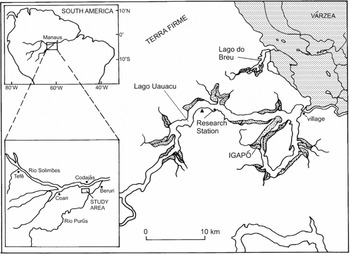
This study was conducted at Lago Uauaçu, a large, 32-km long crescent-shaped black-water lake located in the lower Rio Purús region (04°14′S, 62°23′W) of central Amazonia, about 350 km south-west of Manaus (Figure 1). This lake acts as the northern border of the Piagaçú-Purus Sustainable Development Reserve and the region incorporates a large interdigitated mosaic of unflooded (terra firme) and flooded forests inundated by white-water (várzea) and black-water (igapó) on a seasonal basis for as long as 6 mo of the year (Figure 1, Haugaasen & Peres Reference HAUGAASEN and PERES2006). There is a pronounced seasonal variation in rainfall, with July-October being the driest months, and February–June the wettest (Haugaasen & Peres Reference HAUGAASEN and PERES2006). In terms of basal area, the Brazil nut tree is the dominant species in terra firme forest in the region (T. Haugaasen, unpubl. data) as defined by the importance value index. The 30 extractive households inhabiting the study area rely primarily on the collection of Brazil nuts from natural stands of Brazil nut trees, in addition to small-scale fishing and hunting for their subsistence and income. However, hunting did not take place in our experimental area. In general, recent subsistence hunting has been restricted to light harvest of large-bodied game species such as ungulates. The study area therefore retains a largely intact large-mammal fauna.
Map of the study area in the lower Rio Purús region of central Amazonia, Brazil. The triangle represents the location of the Brazil nut stand in which experiments were carried out.

Experimental design
Experiments were conducted in the wet season towards the end of the 2006 Brazil nut season (April) and then repeated at the same sites during the dry season (September) when Brazil nut trees were no longer fruiting and fruiting trees in general were scarce in the study area (Haugaasen & Peres Reference HAUGAASEN and PERES2005). Seeds used in the experiments were new (i.e. from the same year's seed crop) and had been cleaned and sun-dried until the outer shell was dry. Embryo viability was tested using a water immersion technique widely performed by local Brazil nut collectors across Amazonia in which all seeds failing to sink were discarded. Seeds were subsequently marked with a 50-cm-long piece of dental floss where one end of the thread was glued to the seed testa using transparent weather-resistant epoxy. A small piece (6 cm) of orange fluorescent flagging tape was then tied to the opposite end of the thread and individually numbered using a black permanent marker. In this way the flag stayed visible despite the seed being cached by a scatter-hoarding rodent. Thread-marking techniques have been widely used in neotropical forests (Chauvet et al. Reference CHAUVET, FEER and FORGET2004, Forget Reference FORGET1990, Reference FORGET1991, Reference FORGET1992; Forget & Milleron Reference FORGET and MILLERON1991, Jansen et al. Reference JANSEN, BARTHOLOMEUS, BONGERS, ELZINGA, DEN OUDEN, VAN WIEREN, Levey, Silva and Galetti2002, Reference JANSEN, BONGERS and HEMERIK2004; Peres & Baider Reference PERES and BAIDER1997) and have been shown to be effective in tracking individual seeds following seed removal by scatter-hoarding rodents (Xiao et al. Reference XIAO, JANSEN and ZHANG2006). The advantages and disadvantages of the method have been discussed elsewhere (Forget & Wenny Reference FORGET, WENNY, Forget, Lambert, Hulme and Vander Wall2005).
In total, 900 seeds were placed at 60 circular seed stations (15 seeds per station) surrounding 20 very large (>100 cm dbh) fruiting Brazil nut trees during our initial wet-season experiment, and this was repeated again 5 mo later during the dry season. Our 20 focal trees were widely spaced within a total forest area of ~ 92 ha, and no two trees were closer than 100 m from one another (mean ± SE = 117.4 ± 5.6 m; N = 20). Seed stations were marked with a flagged pole standing upright at the centre of a circular patch of ground approximately 1.5 m in diameter from which all leaf litter and other debris had been removed. At each station, 15 marked seeds were arranged in a circle with their markers stretched outwards, roughly mimicking the average number of seeds contained in a single Brazil nut fruit (17.4 ± 0.3; N = 195). Groups of three stations were positioned at 10 m from the base of each tree, forming a triangle centred at the base of each tree. Once seeds had been laid out, stations were monitored every 2 d by four observers until all seeds had been removed. Where seeds were missing, intensive searches by the observers were undertaken to relocate the marked seeds or markers. Simultaneous searches throughout concentric rings radiating outwards from the seed station were carried out to most efficiently cover a large area. To conform to previous studies (Peres & Baider Reference PERES and BAIDER1997), we abandoned searches only beyond 40 m from the seed station, unless all translocated seeds or seed flags had already been found. Upon finding a given seed, seed fragment or tag, we determined the seed status and position, and measured the distance between each seed and its seed station. If the seed was found to be intact (including those buried into the soil, and those hidden underneath the leaf-litter or simply lying on the ground) we marked its position with a piece of orange flagging tape, and the fate of the seed was then followed every 10 d thereafter. Since markers are known to provide cues for cache pilferage by diurnal rodents (Vander Wall Reference VANDER WALL1991, Reference VANDER WALL, Levey, Silva and Galetti2003), we carefully covered the flags attached to seeds which were removed from the seed stations during both experiments. If a flagged seed disappeared subsequently, intensive searches in the same manner as described above were mounted to determine the fate of the seed, but we restricted these searches to within 20 m of each primary cache location.
Data analysis
To account for the spatially hierarchical nature of our data set, we modelled (1) our short-term proxy of seed survivorship, (2) time-lag to seed removal, and (3) the straight-line distance (log10(x+1)) to which they were carried from the 60 experimental seed stations replicated during each season using generalized linear models (GLMs). In these models, the outcome of seed-handling events (by dispersal agents or seed predators) was assumed to be nested within clusters (seed stations), which in turn were nested underneath the large crowns of the 20 focal Brazil nut trees over which the random effects varied. We collapsed a maximum of nine possible categories of seed status into a single binary outcome (dead or alive) depending on whether seeds had been destroyed or were still intact at the time each seed station was inspected and surrounding areas searched. Individual seed survival for each set of 900 seeds exposed twice (wet and dry seasons) was therefore modelled using a binomial error structure and logit link function, whereas other responses could be modelled using either a normal or Poisson distribution. Since all experimental focal trees were spaced by at least 100 m from one another, they could therefore be considered to be spatially independent. The JMP statistical software package (JMP 8.0. SAS Institute Inc.) was used in all analyses.
RESULTS
Fate of seeds at seed stations
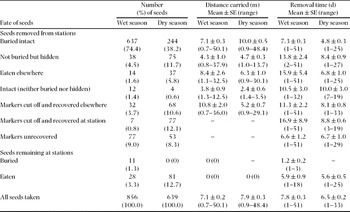
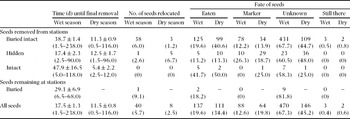
All seed stations were rapidly discovered by seed-eating mammals and all seeds were removed. Additionally, the minority of seeds remained unrecovered or had their markers cut off (13.5% and 31% in wet and dry season, respectively) and a large number of seeds were buried by scatter-hoarding rodents (Table 1). Preferred caching sites included the base of arborescent palms and terrestrial bromeliads, in and around dead and rotting fallen tree trunks and at the base of trees (particularly between buttress roots).
Fate of marked Bertholletia excelsa seeds in dispersal experiments at Lago Uauaçu, central Amazonia, Brazil. The experiments were performed in the B. excelsa fruiting season (April 2006) and in the dry season (September 2006) showing the original distance the seed or marker was carried and the initial time taken for seed removal.

The vast majority of seeds were buried intact as diffuse, single-seeded caches during both seasons. However, there were several significant seasonal differences in the fate of seeds placed at seed stations. Firstly, there was a strong effect of season on seed handling outcomes (χ2 = 305, P < 0.0001), and short-term seed survivorship (GLM: N = 1495, χ2 = 157, P < 0.001), where seeds were more likely to be destroyed immediately upon detection during the dry season. The proportion of seeds buried intact was nearly two-fold higher in the wet season (74.4%) than in the dry season (38.2%; Table 1). The proportion of seeds simply hidden under the leaf litter was higher in the dry season. In addition, more seeds were eaten immediately around or away from the seed stations, and a larger proportion of seeds had their markers severed or lost, during the dry season (Table 1).
Tree dbh (or basal area) had no effect on short-term seed survivorship (χ2 = 0.088, P < 0.767), likely because all focal trees were large. However, the B. excelsa tree density within the immediate neighbourhood of each focal tree had a significant effect on short-term seed mortality, with a larger proportion of seeds being destroyed where the number of conspecific adult Brazil nut trees within a 100-m radius of each focal tree was higher (χ2 = 15.1, P < 0.001). This is likely to largely explain the significant tree identity effect on the proportion of seeds surviving to the end of the experimental period (χ2 = 100, P < 0.001).
Removal time and dispersal distances
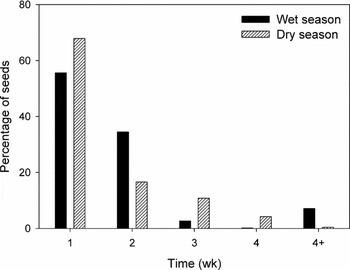
Bertholletia excelsa seeds exposed to dispersal trials were rapidly removed or eaten in situ (Table 1). In fact, most seeds were removed in the first week of both experiments (Figure 2). We also found significant effects of season and distance to the nearest conspecific B. excelsa tree on seed removal time, where seed removal by rodents was significantly faster during the dry season (GLM: χ2 = 14.4, P < 0.0001), particularly if seeds came from seed stations underneath more isolated trees (χ2 = 41.6, P < 0.0001).
Removal time of thread-marked seeds during the wet and dry seasons at Lago Uauaçu, central Amazonia, Brazil.

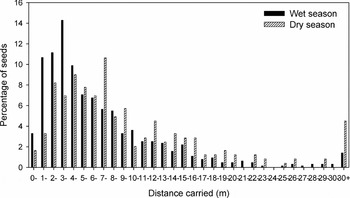
Seeds could be carried and buried at least 50 m from the seed station (Table 1). However, most seeds were buried within 10 m of their seed stations (77.6% and 65.1% of the seeds in the wet and dry seasons, respectively; Figure 3). There were significant effects of season (χ2 = 6.88, P = 0.0087), focal tree basal area (χ2 = 32.5, P < 0.0001), the number of B. excelsa trees within 100 m of each focal tree (χ2 = 95.7, P < 0.0001), and nearest-neighbour distance (χ2 = 42.2, P < 0.0001) on log10(x+1)-transformed distances at which seeds were buried intact. Seeds buried during the dry season were carried significantly farther away than during the wet season, particularly if they came from seed stations placed around larger and more isolated trees.
Removal distance of thread-marked seeds during the wet and dry seasons at Lago Uauaçu, central Amazonia, Brazil.

Cache management and fate of buried seeds
We followed the fate of 881 primary caches during our two experiments. Scatter-hoarding rodents were highly adept at locating buried seeds as only five seeds remained buried intact after the conclusion of our experiments 1 y after they were established. Only one of these seeds was germinating at the time the remaining caches were last surveyed, approximately 1 y after it was buried.
Most buried seeds were rapidly recovered by the rodents. The majority of caches had been recovered within 1–3 wk after burial and few seeds remained cached for more than 1 mo after either of the two experiments. Our experiment during the dry season showed a significantly shorter life span for primary caches than our earlier experiment during the B. excelsa fruit-fall season (F1,874 = 147; P < 0.001; Table 2).
Fate of remaining Brazil nut seeds (those not eaten or lost) from a seed dispersal experiment established during the Brazil nut season and during the dry season at Lago Uauaçu, central Amazonia, Brazil. The number of days until final removal is expressed as mean ± SE (range). The number (percentages) of seeds is given for each category. Marker signifies cases where only tags from seeds were found; Hidden seeds were not buried but hidden in other ways; Intact seeds were neither buried nor hidden, but found intact away from the seed station

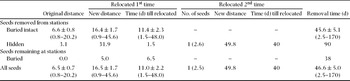
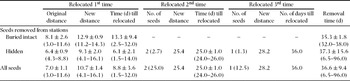
It was difficult to accurately determine the fate of buried seeds as 44.7% and 67.7% of the caches that we found in the dry and wet season, respectively, simply disappeared. Nevertheless, a large number had been eaten at the cache location and the number of seeds eaten was considerably higher in the dry season (Table 2). While searching for buried seeds that had been excavated, we also found that 7.2% of seeds had not been eaten but relocated to secondary caches. These secondary caches stored during the wet season were far more abundant than those in the dry season (Table 2).
Scatter-hoarding rodents were, however, not the only predators of cached seeds. In both experiments, we found that leaf-litter ants destroyed a significant number of buried seeds. Ants destroyed 8.3% and 4.3% of the seeds cached during the wet and dry season, respectively.
Re-buried seeds
Distances from seed stations were greater for secondary caches than primary caches in both seasons although re-buried seeds that were relocated in the wet season were moved considerably farther, more than doubling the average distance between seed stations and primary caches (Tables 3 and 4). This trend was mirrored by seeds hidden underneath the leaf litter which were relocated in a similar manner. We were unable to determine the fate of most relocated seeds, although some seeds were found to be relocated up to three times. However, these all belonged to the category of hidden seeds. For each relocation event the distance of re-buried seeds from the seed station increased farther (Tables 3 and 4).
Fate of relocated seeds from an experiment established during the Brazil nut season (April) at Lago Uauaçu, central Amazonia, Brazil. The original and new distances (m) from the seed stations are expressed as mean ± SE (range).

Fate of relocated seeds from a seed-dispersal experiment established outside the Brazil nut season (September) at Lago Uauaçu, central Amazonia, Brazil. The original and new distances (m) from the seed stations are expressed as mean ± SE (range).

Other seed predators
The fact that some seeds were concealed underneath the leaf-litter rather than buried indicates that smaller rodents, most likely spiny rats (Proechimys spp.), visited our seed stations.
Experimental seed arrays were also handled by arboreal seed predators. At several seed stations, markers attached to seed remains were found hanging from tree branches at heights of 0.5 to 15 m. These were most likely left by the brown capuchin monkey (Cebus apella) which was regularly encountered in the area where our experiments were conducted. In fact, 27.5% of all seeds exposed in the dry season were taken by monkeys compared with 4.8% in the wet season. The collared peccary (Tayassu pecari) also obliterated one of our seed stations during the dry season.
DISCUSSION
Fate of seeds at seed stations
This study tracked the fate of a large number of marked seeds exposed on the forest floor close to the parent tree. Admittedly, handling times for agoutis encountering unprotected seeds were shorter than during an encounter with an intact fruit, and this may have influenced the observed caching rates and dispersal distances. Nevertheless, this is the first study to examine the fate of individual B. excelsa seeds after caching by scatter-hoarding rodents, providing further understanding on how scatter-hoarders either disperse or predate large seeds in neotropical forests.
Conforming to other studies using the thread-marking technique, scatter-hoarding rodents were the first animals to detect our seed stations (Jansen et al. Reference JANSEN, BONGERS and HEMERIK2004). However, in contrast with the Kayapó Indian Reserve located in eastern Amazonia where acouchis are absent (Peres & Baider Reference PERES and BAIDER1997), agoutis and acouchis are sympatric in our study area. Therefore, we are unable to conclusively ascertain the relative importance of each species as visitors to our seed stations, although footprints and the manner in which most seeds were buried suggest that agoutis removed a disproportionate fraction of all seeds.
Typically seeds were buried singly which appears to be a consistent feature of caviomorph rodent caches in the Neotropics (Jansen & Forget Reference JANSEN, FORGET, Bongers, Charles-Dominique, Forget and Théry2001). Preferred caching sites were also similar to other studies (Forget Reference FORGET1990, Kiltie Reference KILTIE1981, Smythe Reference SMYTHE1978, Vander Wall Reference VANDER WALL1990). Equally, we were able to recover the majority of marked seeds (86.5% and 69% in the wet and dry season, respectively). These recovery percentages were notably higher than those of Peres & Baider (Reference PERES and BAIDER1997) and Forget (Reference FORGET1990). The overall seed removal during the first 2-wk period of 90.1% and 84.5% in the wet and dry season, respectively, was similar to that reported by Peres & Baider (Reference PERES and BAIDER1997). However, our results contrast somewhat with Peres et al. (Reference PERES, SCHIESARI and DIAS-LEME1997) who found a consistently lower seed removal in the dry season across their experimental treatments, which they attributed to differences in seasonal foraging behaviour.
Dispersal distances
Previous experiments have shown that Bertholletia seeds are unlikely to be dispersed over long distances by scatter-hoarding rodents (Bouwman & van Dijk Reference BOUWMAN and VAN DIJK1999, Peres & Baider Reference PERES and BAIDER1997). In fact, most seeds were buried within 5–10 m of the seed stations, a trend repeated during both of our experiments (Figure 3). Peres & Baider (Reference PERES and BAIDER1997) attributed the clustered spatial distribution and grove formation of adult Bertholletia trees to the limited seed dispersal distances of the agoutis. Nevertheless, exceptionally long dispersal distances of B. excelsa seeds by scatter-hoarding rodents have been observed. For example, dispersal distances of 100 m were reported from a study in Madre de Dios, Peru (Peres & Baider Reference PERES and BAIDER1997) and dispersal distances beyond 50 m were observed in the current study. At Lago Uauaçu, many seeds were also dug up and re-cached, which further increased dispersal distances. Exceptionally long dispersal distances have also been found to occur in other large-seeded scatter-hoarded tree species (Jansen et al. Reference JANSEN, BONGERS and HEMERIK2004; P.-M. Forget pers. comm.), although scatter-hoarders in general tend to carry seeds over short distances (Asquith et al. Reference ASQUITH, TERBORGH, ARNOLD and MAILÉN RIVEROS1999, Forget Reference FORGET1990, Reference FORGET1992; Hallwachs Reference HALLWACHS, Estrada and Fleming1986). The spatial effects observed on seed survival and dispersal are most likely attributed to the total number of Bertholletia trees within each experimental neighbourhood. Jorge & Peres (Reference JORGE and PERES2005) have shown that local densities of agoutis clearly covary with densities of Bertholletia trees, so there must be a certain amount of density-dependence built into the seed caching/foraging behaviour of scatter-hoarding rodents in Amazonian forests.
Cache management and fate of buried seeds
Most seeds disappeared within a few weeks after caching, which is consistent with studies of other large-seeded species (Forget Reference FORGET1990, Jansen & Forget Reference JANSEN, FORGET, Bongers, Charles-Dominique, Forget and Théry2001). However, the fact that some seeds were still intact in their caches many months after first burial suggests that at least part of the cache were long-term reserves. Large rodents appear to be highly skilled at retrieving buried seeds, as only five seeds remained cached of the 881 single-seeded caches monitored during our 12-mo experiments. Only one of these seeds germinated. However, caution should be taken in interpreting this germination success. Seeds were only monitored for up to 1 y after burial which does not cover the entire dormancy period of the Brazil nut (12–18 mo; Müller Reference MÜLLER1981) and some of the remaining cached seeds could still subsequently germinate. In addition, viable cotyledons may have been damaged by the sun-drying treatment prior to the experiments. In any case, germination success cannot be equated to seedling establishment and survival as many scatter-hoarding rodents eat germinating seeds with seedlings already protruding (Forget Reference FORGET1992, Jansen et al. Reference JANSEN, BONGERS and PRINS2006), and agoutis are known to excavate and consume germinating B. excelsa seeds in much of the geographic range of the Brazil nut tree (C.A. Peres, unpubl. data). Conversely, seed disappearance (markers cut off) cannot be equated to mortality. The number of seeds re-located to secondary caches is probably higher than that suggested here given the large number of unrecovered cached seeds following their disappearance from primary caches (Tables 3 and 4), and these were apparently moved beyond the 20-m search radius.
The excavation and re-caching of seeds appear to be common among scatter-hoarding rodents (Jansen et al. Reference JANSEN, BONGERS and HEMERIK2004, Vander Wall Reference VANDER WALL, Levey, Silva and Galetti2002, Reference VANDER WALL2003). There are several reasons why agoutis and other scatter-hoarders might manage their caches in this way. Jansen & Forget (Reference JANSEN, FORGET, Bongers, Charles-Dominique, Forget and Théry2001) suggest that scatter-hoarders initially hide seeds only provisionally, and as quickly as possible, to decrease the risk of losing exposed seeds to competing granivores. The rapid recovery of caches and the large number of secondary caches encountered in the wet season supports this hypothesis. Rodents may also open caches to refresh their memory or inspect the seed condition (Jansen & Forget Reference JANSEN, FORGET, Bongers, Charles-Dominique, Forget and Théry2001). The fact that ants were also a significant predator of cached seeds in this study suggests that this may be important and monitoring the condition of cached seeds may be key to rodents surviving the dry-season resource bottleneck. However, Vander Wall (Reference VANDER WALL, Levey, Silva and Galetti2002) suggests that the main reason for re-caching of seeds is seed pilfering by other individuals transporting seeds into their own territory. It is therefore unlikely that a single factor can universally explain the occurrence of re-caching.
Seasonal differences
Janzen (Reference JANZEN1971) proposed that food abundance affects the seasonal rate of caching, thereby influencing whether a scatter-hoarding rodent is a seed predator or seed disperser. Assuming that caching is primarily induced by food satiation, one would expect more caching at the time of high fruit abundance. Indeed, our experiments conformed to our initial hypothesis and showed that the number of seeds buried intact was significantly higher in the wet season (75%), when alternative fruits were abundant, than in the dry season (38%), when fruiting trees were scarce in the study area. These results agree with other studies in more seasonal neotropical forests showing that when food is abundant, agoutis cache considerably more than they eat (Bouwman & van Dijk Reference BOUWMAN and VAN DIJK1999, Forget et al. Reference FORGET, HAMMOND, MILLERON, THOMAS, Levey, Silva and Galetti2002, Smythe Reference SMYTHE1978). The same trend has been found for acouchis (Jansen et al. Reference JANSEN, BONGERS and HEMERIK2004). The peak fruiting period in terra firme forests at Lago Uauaçu is January–April (Haugaasen & Peres Reference HAUGAASEN and PERES2005). This suggests that B. excelsa has evolved a fruiting pattern that maximizes seed dispersal by agoutis encountering single multi-seeded fruits by producing fruits synchronously and fruiting during the peak of the community-wide fruiting season (Smythe Reference SMYTHE1970). However, variation in fruit abundance may also occur inter-annually. Bertholletia typically has large between-year fluctuations in crop sizes (Kainer et al. Reference KAINER, WADT and STAUDHAMMER2007; T. Haugaasen unpubl. data) and we are yet to understand how this may affect foraging and caching behaviour, although it may function in a way similar to that described herein between seasons.
The smaller number of secondary caches found in the dry season almost certainly reflects the need for rodents to almost immediately draw on these resources for food in times of food shortage. The immediate consumption of large numbers of seeds during the dry season also suggests that, under natural conditions, seeds from fruits opened at times of fruit scarcity will suffer higher predation rates and thus have less potential for survival. However, in accordance with our expectations, we found that seeds were buried farther away from the parent tree at this time of the year which has been shown to decrease offspring mortality (Jansen et al. Reference JANSEN, BONGERS and Van Der MEER2008). Moreover, in a different investigation we found a number of germinating seeds inside 1-y-old fruits (T. Haugaasen, unpubl. data). It is therefore reasonable to assume that viable seeds in the fruits opened during the dry season will have advanced considerably towards germination. Being buried at this time of the year may therefore enhance the chances of seed germination before the hoarder returns to consume it, although cache longevity decreased dramatically at this time of the year. Further studies are clearly needed to investigate the effect of seasonality on the probability of Brazil nut seedling establishment.
Seeds encountered by scatter-hoarders in the dry season may be of higher value to consumers due to food shortages at this time of year. Seeds may therefore be taken farther from the seed station to make caches more spatially diffuse and thereby more difficult to find for competitors despite the increased foraging effort by terrestrial seed predators during this period. This is supported by studies showing that larger, and thus more valuable, seeds tend to be hidden at greater distances and in lower densities than smaller seeds (Forget et al. Reference FORGET, MILLERON, FEER, Newbery, Brown and Prins1998, Jansen et al. Reference JANSEN, BARTHOLOMEUS, BONGERS, ELZINGA, DEN OUDEN, VAN WIEREN, Levey, Silva and Galetti2002).
Other seed predators
Smythe (Reference SMYTHE1970) showed that agoutis increased their foraging effort in times of fruit shortage. The fact that seeds were removed quicker in the dry season also suggests that scatter-hoarding rodents in our study area increased their effort in search for food items at this time of the year. The general community-wide scarcity in food resources may similarly account for the increased seed predation at seed stations by other animals such as primates and peccaries, assuming that these vertebrates were also affected by food shortages. Peres & Baider (Reference PERES and BAIDER1997) found that their markers were generally cut off by terrestrial echimyid rodents rather than agoutis, suggesting that the increased rate of seed loss in the dry season during this study is due to the activity of these smaller rodents. The larger number of seeds hidden underneath the forest leaf litter in the dry season, a pattern consistent with caching by spiny rats, Proechimys spp. (Forget Reference FORGET1991), also suggests an increased activity of these rodents at our seed stations at this time of year. These observations are nevertheless of limited value for B. excelsa since seeds under natural conditions would be protected by a thick case and on the whole be unavailable to spiny rats. However, unconfirmed local reports state that pacas (Agouti paca) may also open a limited number of fruits. The brown capuchin monkey (Cebus apella) and to a lesser extent the white-fronted capuchin (Cebus albifrons) are also known to crack open older fruits (1–2 y old) with a more fragile pericarp by bashing them on a suitably hard surface (Baider Reference BAIDER2000, Peres & Baider Reference PERES and BAIDER1997, J. M. Tuck Haugaasen & T. Haugaasen, pers. obs.).
Management implications
The Brazil nut harvest inevitably decreases the availability of seeds to scatter-hoarding rodents. Intensive harvest of Brazil nuts may therefore create a dry-season scenario in which agoutis destroy more and cache fewer seeds upon finding a Brazil nut fruit. Consequently, harvest may adversely affect natural Brazil nut regeneration, suggesting that a management plan to contend with reduced recruitment should be considered in intensively harvested natural stands of Brazil nut trees. Similarly, since large caviomorph rodents are the main dispersers of B. excelsa, seedling recruitment may be limited in the absence of these animals. Forget & Jansen (Reference FORGET and JANSEN2007) showed that hunting limited the quantitative dispersal in Carapa procera (Meliaceae), another commercially valuable non-timber forest product in Amazonian forests that depends on scatter-hoarding for seed dispersal and seedling establishment. Given that subsistence hunting usually accompanies the seasonal collection of Brazil nuts, the natural regeneration of the Brazil nut tree and the continued harvest of this non-timber forest product in the future may also depend on adequate measures to protect seed dispersers (Peres et al. Reference PERES, BAIDER, ZUIDEMA, WADT, KAINER, GOMES-SILVA, SALOMAO, SIMOES, FRANCIOSI, VALVERDE, GRIBEL, SHEPARD, KANASHIRO, COVENTRY, YU, WATKINSON and FRECKLETON2003). However, it is still unknown how between-site and between-year community-wide fruit abundance, rodent population density and hunting pressure, and local variation in harvesting systems interact to influence secondary dispersal and seedling establishment of Brazil nut trees, adding further challenges to the sustainable management of this extractive industry and globally significant wild seed crop.
ACKNOWLEDGEMENTS
Special thanks to Evanir, Evandro and Mariene de Almeida Damasceno for their invaluable help in the field and all the local Brazil nut collectors at Lago Uauaçu for sharing their knowledge and experience with us. This research was supported by the Research Council of Norway (grant no. 165879/V10), the Brazilian Research Council (CNPq; grant no. 152077/2005-7), the British Ecological Society and the Rufford Foundation. The dental floss was kindly donated by BDF Healthcare Ltd. International. We thank Pierre-Michel Forget and one anonymous reviewer for constructive comments on an earlier version of this manuscript.