INTRODUCTION
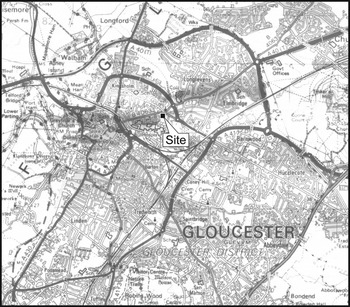
Until recently Gloucester lacked cemetery evidence gathered under modern conditions. Unlike other Roman towns, such as Dorchester, Winchester and St Albans, Gloucester's cemeteries were poorly understood, the information deriving from antiquarian records, chance finds or small-scale work. In the 1990s the opportunity arose to rectify this when a large area to the south of the London Road, leading down to the Roman town from the north-east and known to lie within one of the city's major cemeteries, became available for investigation in advance of development ( figs 1 and 2). The excavations reported here were carried out in 2002 at 124–30 London Road, Gloucester (NGR SO 844 189) by Foundations Archaeology, and were followed by excavation at the adjacent site of 120–22 London Road in 2004–6, undertaken by Oxford Archaeology and published in 2008.Footnote 1 The two London Road reports make a major contribution to our knowledge of Roman Gloucester's archaeology, bringing the scale of its cemetery evidence in line with that from the majority of the other Roman towns in the province, presenting the combined data from 29 cremations, 118 inhumations, and at least 91 individuals from a mass grave.
Site location. (© Crown Copyright. Reproduced under licence AL523064A)

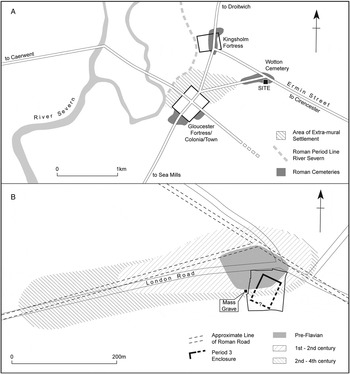
The sites at 120–30 London Road lay within the Wotton Roman cemetery, which has been known since the nineteenth century as the location of cremation and inhumation burials and as one of the extramural cemeteries of Roman Gloucester ( fig. 3). The excavations have shown that the cemetery originally served the fortress at Kingsholm, dated to the 50s and 60s a.d., before its association with the fortress and subsequent colonia and town of Gloucester.Footnote 2
Previous archaeological discoveries demonstrated the cemetery's use from the first to the fourth centuries, with burials located for a distance of 480 m between 50 London Road and the junction with the Cheltenham Road ( fig. 2). Within the excavation area, previous findings had comprised a fourth-century grave containing a flanged bowl and coins of Gratian (a.d. 367–83),Footnote 3 while 17 burials were excavated in 1993 during an archaeological evaluation undertaken by Gloucester Archaeology Unit. In 1996 four inhumations were recorded on the street frontage and in 1993 a further four were found to the east of 124–30 London Road in a Gloucester Archaeology Unit watching-brief. On the opposite side of the London Road, burials were found at the St Mary Magdalen graveyard in 1856; nine inhumations and a possible funerary monument at 3 Denmark Road in 1987 and 1991; and a cremation within a stone cist, other cremations and a further possible monument foundation at St Catherine's church in 1912 and again in 1999. A total of 110 cremations were located in 1870 on land belonging to a Mr Niblett of Wotton, but the precise location of these is not known. This and other antiquarian discoveries before the 1930s have been listed elsewhere.Footnote 4 Two military tombstones located at the junction of London Road and Cheltenham Road in 1827 are justly famous, one commemorating a soldier of Legion XX and the other a cavalryman of the 6th Cohort of Thracians.Footnote 5 The excavation in 2004–6 at 120–22 London Road found 9 cremation burials, 64 inhumations and at least 91 individuals in a mass grave ( fig. 3). The mass grave was argued to date to the later part of the second century and to have been associated with the Antonine Plague — a smallpox epidemic known in the Empire between a.d. 165 and 189. These and the other findings in the Wotton cemetery outlined here are mapped, described and referenced in the report on the 120–22 London Road excavations.Footnote 6
Location (A) of Wotton cemetery in relation to Roman roads, fortresses and the colonia, and its expansion (B) through the Roman period. Based on Simmonds et al. Reference Simmonds, Márquez-Grant and Loe2008, figs 1.3 and 6.1.

Traces of the leper hospital of St Mary Magdalen founded by Llanthony Priory in the early twelfth century were found in the excavation — this post-Roman archaeology is not reported here. The hospital buildings were demolished in the nineteenth century and the land was then used for private residences followed by industrial and office use in the later twentieth century.
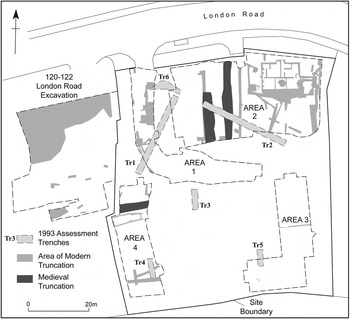
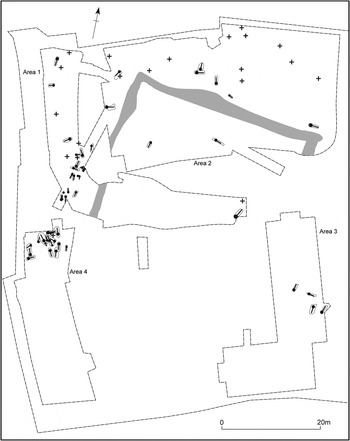
At 124–30 London Road desk-based assessments and the archaeological evaluation in 1993 (noted above) had suggested that archaeologically significant deposits were restricted to the northern half of the development area with extensive medieval and modern disturbance noted across the site.Footnote 7 The archaeological project design focused excavation on access roads and the footprints of the proposed new buildings, the latter comprising three large buildings located in the northern, western and eastern parts of the site.Footnote 8 Area 1, comprising the access route was fully excavated ( fig. 3). Area 2, the location of the northern building and its surroundings, was stripped under archaeological supervision, and here all burials were excavated, but features of other types were only excavated within the proposed building footprint. Areas 3 and 4 were the footprints of the eastern and western buildings, with excavation in Area 3 limited to the foundation trenches which were machined under archaeological supervision and thereafter cleaned and excavated by hand. Subsequent watching-briefs were maintained in Area 4 and along the southern boundary wall footing.
Site and excavated areas with location of 2006 excavation.

Owing to site access restrictions Area 1 was excavated in five sections with each section backfilled in advance of the opening of a new section. In all areas, topsoil and overburden were machine-excavated with subsequent cleaning and excavation conducted by hand. All burials were totally excavated, while other features were sampled. A limited programme of palaeoenvironmental sampling was undertaken, but no suitable material was found from Romano-British levels.
The site is situated at c. 24 m OD on a natural geology of Lower Lias, overlain by grey to orange-brown clay.Footnote 9 Excavation revealed that the north of the area had been levelled in recent times, while the south had been made up to a depth of 1 m. Thus the northern part of the site saw a thin skim of modern topsoil over natural, grading down to the southern limit where c. 0.6–0.9 m of overburden was removed by machine. In Areas 2 and 4 deeply cut medieval ditches had removed all Roman archaeology, while the more recent truncation in Areas 1 and 2 affected upper levels only with some cremation and inhumation evidence surviving ( fig. 3).
The specialist reports included here were written before the results from 120–22 London Road were known. The reports on the pottery and small finds of metal and glass have been revisited by their authors, but are not an overview of both sites. Since the same two authors also undertook the analyses for the finds from 120–22 London Road they were able to use both sets of data in their reports there. The osteological report here has not been updated, but that for 120–22 London Road was written with the 124–30 report to hand and an overview of the two sets of data can be found there.Footnote 10
THE EXCAVATIONS
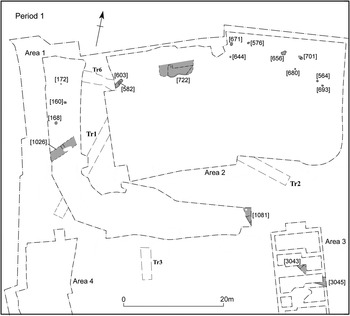
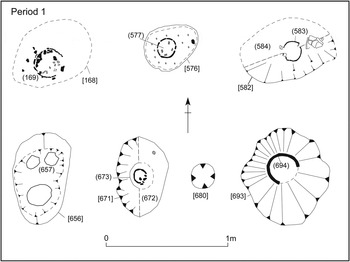
PERIOD 1: PRE-FLAVIAN (FIG. 4)
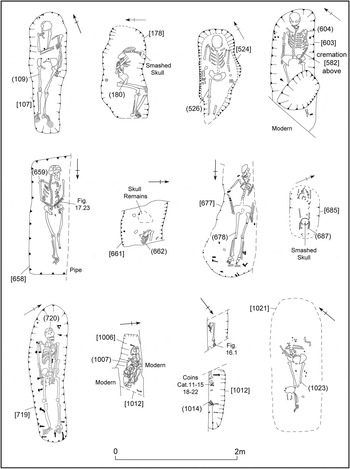
A small number of features, principally cremations of pre-Flavian date, were excavated. The apparently earliest feature was a grave [603] containing a probable male skeleton (604), aged 20–25 years, buried in a supine position with coffin nails present ( fig. 9). This was cut by one of the cremation pits [582] described below. No pre-Roman inhumations are known from the Wotton cemetery so there are no parallels for a pre-Roman date — an early Roman native-influenced burial is therefore suggested. Four sherds of second-century pottery were present in the upper fill, but in view of the stratigraphic relationship with the cremation are regarded as intrusive.
Period 1: pre-Flavian.

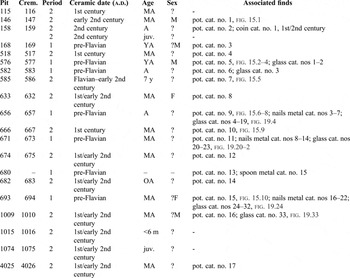
In the same northern area as the burial were six cremations placed in vessels whose manufacture could be related to the period of occupation of the fortress at Kingsholm ( fig. 5; Table 1). Of these, two — (169) and (583) — lay in cremation pits [168] and [582] to the west, and four — (577), (657), (673) and (694) in pits [576], [656], [671] and [693] respectively — in a curving line to the east. A probable cremation pit [680], lying between [656] and [693], contained fragments of an early vessel and a metal find, but no cremated remains survived. Three possible cremation pits, all undated and none retaining evidence of the cremation, may have been associated with the eastern group. Pit [564] contained silty sand with charcoal fragments, pit [644] contained sandy clay with charcoal, and pit [701] a similar fill with areas of burning and frequent charcoal fragments.
Period 1 cremations.

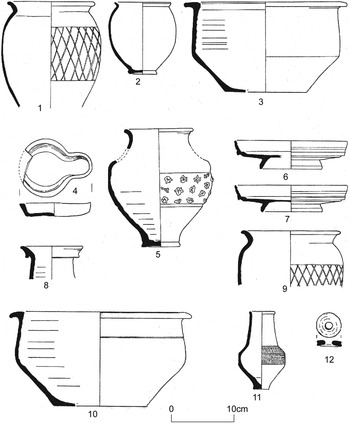
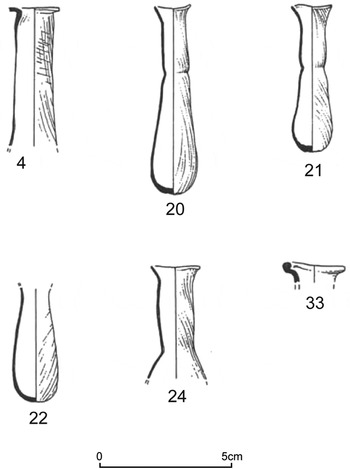
Of the two cremations to the west, (169) of a probable male young adult was in a large greyware jar (pot. cat. no. 3), while cremation (583) was of an unsexed adult in a ring-necked flagon (pot. cat. no. 6); a further vessel, a square-rimmed jar, was also present. It was the latter cremation pit [582] in which this was set that cut grave [603]. In the eastern group, cremation (577) was of a young adult male in a small jar (pot. cat. no. 5, fig. 15.2). A minimum of two other vessels (pot. cat. no. 5, fig. 15.3–4), one substantially complete and the other an unburnt lamp, were also present together with fragments of a glass vessel (glass cat. no. 1) and two melted lumps (glass cat. no. 2). Cremation (657) was of an unsexed adult. Sherds from three vessels were present (pot. cat. no. 9, fig. 15.6–8), two of which — a stamped samian Dr 15/17 and a Hofheim-type flagon — were heavily burnt. A further samian vessel, also stamped originally, was unburnt. Glass unguent bottles (glass cat. nos 5–9, 13, 16–19), other vessels (glass cat. nos 4, 10–12, 14, fig. 19.4) and a melted lump (glass cat. no. 15) were also present as well as nails burnt in the pyre (metal cat. nos 3–7). Cremation (673) was of an unsexed mature adult in the surviving lower half of a closed form vessel (pot. cat. no. 11). Four unburnt tubular unguent bottles were present, including an almost complete example suggesting an unusual burial rite (glass cat. nos 20–3, fig. 19.20–2). Two hobnails (metal cat. no. 8), four complete nails and two broken examples, all burnt in the pyre (metal cat. nos 9–14) were also present. Cremation (694) was of a probable female of middle adult age in a deep bowl. A number of sherds in different fabrics were also present (pot. cat. no. 15, fig. 15.10) as well as seven burnt nails (metal cat. nos 16–22). A number of unguent bottles were present (glass cat. 24–32, fig. 19.24). Cremation pit [680] contained fragments of a flagon (pot. cat. no. 13) and a copper-alloy spoon (metal cat. no. 15). Two of the cremations [656] and [682] contained cremated pig bones.
Near cremation pit [168] was a 0.25 m deep post-hole [160], from which six sherds of pre-Flavian pottery were recovered. Between the west and east cremation groups was a quarry pit [722]. This was 0.3 m deep with sloping sides and a flat base. Its fill had been cut by later features. A short length of gully [172], also cut by later features, was undated.
South of these features, ditch [1026] was 0.50 m deep with steep sides and a wide base ( fig. 12). It had been cut by a Period 2 grave. To the east, ditches [1081], [3043] and [3045], all with similar steep-sided and flat-based profiles, may have formed part of a continuous boundary feature. Ditch [1081], cut by a later feature, was 0.7 m deep with four sherds of undiagnostic Roman pottery in its fill. Ditch [3043] was 0.39 m deep and ditch [3045] 0.54 m deep. As recorded, these ditches taken together display a slight curve, but this may be a reflection of the recording constraints in the contractor's trenches. If taken as running in a straighter line the resulting boundary would have run more or less parallel to Ermin Street and some 50 m to its south.
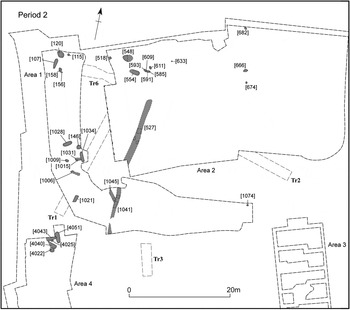
PERIOD 2: LATER FIRST/EARLY SECOND CENTURY (FIG. 6)
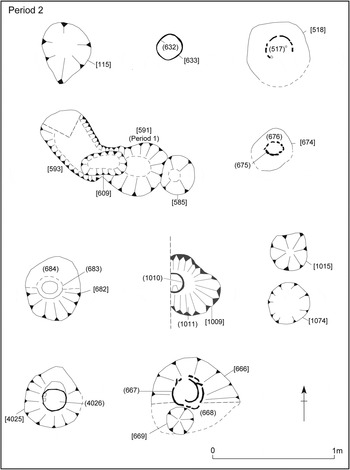
Thirteen further cremations and at least one possible cremation pit were present, dating to the early years of the Gloucester fortress and subsequent colonia ( fig. 7). The distribution of cremations extended further south than in Period 1. In addition there were six graves as well as ditches, pits and post-holes that could be allocated to this period on the basis of finds and stratigraphic relationships.
Period 2: later first century and earlier second century a.d.

Period 2 cremations.

In the northern area, cremation (116) was of an unsexed mature adult in a first-century vessel set in pit [115]. Near by, cremation pit [158] contained sherds which may have represented a first/second-century vessel associated with the cremated remains, (159), of an unsexed adult and a juvenile aged c. 6 years. A first/second-century dupondius/as, possibly Neronian, was also present (coin cat. no. 1), while a sherd of amphora and two black-burnished sherds were thought to be intrusive. This may therefore be a Period 1 cremation. The cremation pit cut Period 1 gully [172] and was cut by a Period 3 feature. Post-hole [156], 0.22 m deep, may have been associated with the cremation as a marker. This was also cut by the same Period 3 feature.
Further east, cremation (517) in pit [518] was of an unsexed mature adult associated with the lower part of a first-century jar. Also present were sherds of a further first-century vessel (pot. cat. no. 4). Cremation (586) a little to the east in pit [585] was of an unsexed child of c. 7 years in an almost complete rusticated necked jar, dated Flavian to early second century (pot. cat. no. 7, fig. 15.5). This cremation had been cut by a possible cremation pit [591], its fill containing quantities of charcoal and burnt clay as well as a small number of very small burnt animal bone fragments not identifiable to species. Three post-holes [609] and [593], the former replacing the latter, and [611] may have been associated with [585] and [591]. Post-hole [593] contained five fragments of Roman brick/tile and eleven sherds of first-century pottery including three large sherds of Spanish amphora. Post-hole [611] was limestone-packed with fragments of brick/tile with mortar fragments adhering to some surfaces and four sherds of first/second-century pottery also present.
Nearby cremation (632) in pit [633] was of a female mature adult in the base of a first/early second-century greyware vessel (pot. cat. no. 8). This had been cut into the Period 1 quarry pit [722]. Cremation (667) in pit [666], 15 m to the east, was of an unsexed mature adult. Two pottery vessels of the early second century were present (pot. cat. no. 10), one in black burnished ware ( fig. 15.9) and the other in Severn Valley ware. The pit had been cut by a later feature. Nearby cremation (675) in pit [674] was of an unsexed mature adult with two pottery vessels — a pre-Flavian flagon and a later first/early second-century black burnished jar (pot. cat. no. 12). To the north of these, on the edge of the excavated area, was cremation (683) in pit [682] of an unsexed, old adult, with a flagon and jar present of a date later than Flavian (pot. cat. no. 14).
In this northern strip there were also two pits, [120] and [548], one certain grave [107] and one possible cenotaph [554]. Pit [120] was steep-sided and 0.42 m deep from which 40 sherds of first/second-century pottery were recovered. Pit [548] was 0.79 m deep with a similar profile. This contained two sherds of first/second-century pottery. Grave [107] contained a supine ?male skeleton (109), aged 25–35 years (Table 2; fig. 9). Coffin nails, hobnails and a single sherd of first/second-century pottery were recovered. Feature [554] may have been a cenotaph or memorial grave. This grave-shaped, but empty feature, contained two sherds of late first/second-century pottery and a fragment of ceramic building material.
South of this northern strip were five further cremations — (147), (1010), (1014), (1075) and (4026) — in pits [146], [1009], [1015], [1074] and [4025] (see fig. 7 for the latter four), as well as five graves ( fig. 6). Cremation pit [146] contained an early second-century jar (pot. cat. no. 1, fig. 15.1) with the remains of a male middle adult (147). From a hollow beneath the urn came a number of additional pottery sherds and fragments of burnt bone. Cremation pit [1009] contained a burial urn of first/early second-century date (pot. cat. no. 16) for a probable male middle adult (1010) and fragments of an unguent bottle of late first-century date (glass cat. no. 33, fig. 19). Cremation pit [1015] contained a baby aged 0–6 months with no vessel present, though three sherds of undiagnostic Roman pottery were recovered from the fill. This pit cut grave [1031]. Cremation pit [4025] contained a late first/early second-century jar (pot. cat. no. 17) with the cremated remains of an unsexed mature adult (4026); a pre-Flavian sherd was also present. This was cut by a Period 3 feature. Finally cremation pit [1074], 30 m to the east of the others, contained part of a burial pot for an unsexed juvenile (1075), aged about 13–15 years. This cut the Period 1 ditch [1081].
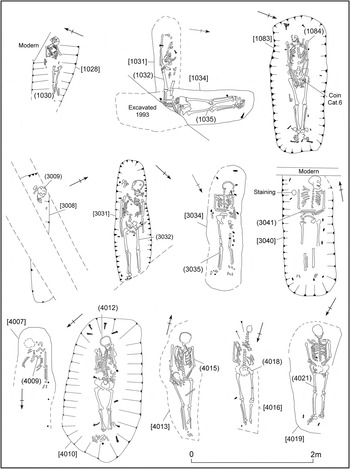
These cremations and possible cremation pits were accompanied in Area 1 by inhumations in graves [1006], [1021], [1028], [1031] and [1034] (Table 2; figs 9 and 10). Except for [1028] these were all dated to the first/early second century by their pottery fills. Grave [1028] contained a single prone child c. 7 years old (1030) of indeterminate sex, together with first-century pottery. It cut the Period 1 ditch [1026] ( fig. 12). Grave [1031] contained a supine female (1032), aged 20–24 years. A single sherd of first/second-century pottery was recovered. The grave was cut by cremation [1015] and by grave [1034]. This latter grave (part excavated in 1993) contained a supine, probable female (1035), aged over 30 years, and three sherds of first/early second-century pottery. Grave [1006] contained a young supine male (1007), aged about 15–16 years. Nine sherds of first/second-century pottery and a number of hobnails were recovered from the fill. The grave was cut by a Period 3 grave. Lastly grave [1021] contained a supine female (1023), aged 30–40 years, decapitated with the head beside the lower limbs. Six sherds of pottery were recovered. Coffin nails were present in all of these graves with the exception of [1028].
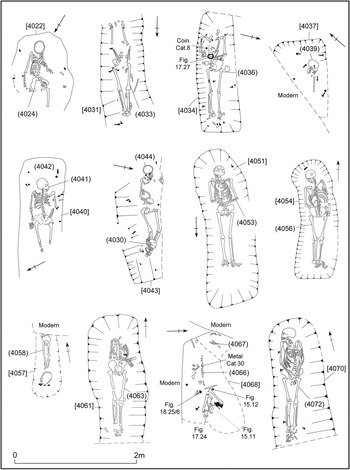
Further south in Area 4 were four intercutting graves ( fig. 8 inset, fig. 11). Grave [4051] contained a probable male skeleton buried in a supine position (4053), aged 20–23 years; six sherds of second-century pottery were recovered from the fill. It was cut by grave [4043] which contained a prone female skeleton (4044), aged 40–50 years, and the skeleton of a baby at its feet (4030), aged 0–6 months, with second-century pottery present. This grave also cut the Period 2 cremation [4025]. Grave [4022] contained a supine female skeleton (4024), aged 40–50. Both graves [4022] and [4043] were cut by grave [4040] in which was the supine skeleton of a probable female (4041), aged 12–15 years. Pottery of second-century date was present in [4040].
Period 3: later second to fourth century a.d.

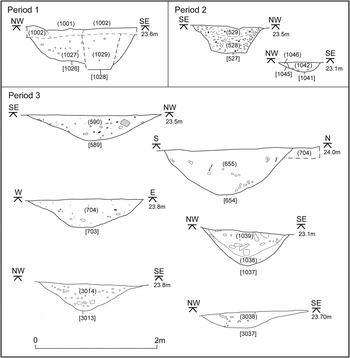
To the east of these burials was a ditch, [527] and [1041], recorded over a length of nearly 30 m in two sections. Ditch [527] was 0.48 m deep with steep sides and a wide, flat base ( fig. 12). A primary fill, in which stone and charcoal and flecks of ceramic building material were present, contained a coin of Hadrian dated a.d. 118–19 (coin cat. no. 2) and both primary and secondary fills contained sherds of second-century pottery. Ditch [1041] continuing the line of [527] to the south was shallower (0.16 m deep) but with a similar profile and stone also present in its fill, as was the case with a further ditch [1045] running obliquely into it.
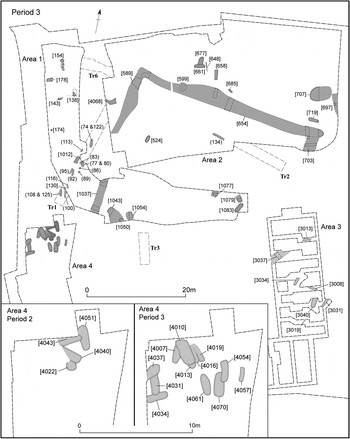
PERIOD 3: SECOND TO FOURTH CENTURY (FIG. 8)
The Period 2 ditch line [527]/[1041], perhaps silted and out of use by the date of the Hadrianic coin in [527], was replaced by ditch [589]/[1037]. This formed the west side of a rectangular enclosure with a north side represented by ditch [654] and an east side suggested by a short length of ditch [703] ( fig. 12). Ditch [589] was 0.40 m deep with sloping sides and a rounded base. Its fill contained fragments of charcoal and occasional limestone inclusions. The same line was represented further south by ditch [1037], 0.60 m deep, with steep sides sloping to a narrow base. Several large, rounded limestone fragments were present set in a line along the base of the ditch and pressed into the natural clay. Ditch [654] along the northern side of the enclosure varied in depth from 0.40 m at its east end to 0.75 m at the west end with steep, irregular sides and a wide, rounded base. Its eastern terminal, presumably a recut, overlay ditch [703] which was 0.46 m deep with steep, irregular sides and a narrow, rounded base. All these ditches contained a similar clay fill. The enclosure ditches contained a range of dating evidence: a second/third-century coin in [703] (coin cat. no. 3), a late third/fourth-century coin in [654] (coin cat. no. 7), third-century pottery in [589], and second/third-century pottery in [654] and [1037].
Only three graves were present within the enclosure. Grave (134) excavated in 1993 contained the supine skeleton of a 30–40-year-old female. Toward the north-west corner, grave [524] contained a supine female skeleton (526), aged 30–40 years ( fig. 9). Grave [1083] contained a supine male skeleton (1084), aged 40–50 years with a coin of Allectus, a.d. 293–96 (coin cat. no. 6), in its left hand ( fig. 10). Unless curated the date of the coin is likely to have been the date of the burial (see Wells, coin report). First-century pottery was also present. Although much of the skull was missing the lower jaw bone was present. Both [524] and [1083] had coffin nails in their fills — there is no record of their presence or absence in grave (134).
Inhumations [107]–[1021].

Inhumations [1028]–[4019].

A handful of pits was also found within the enclosure. Pit [1079] was 0.52 m deep, with steep sides and a narrow base, with a fill containing large pieces of limestone, brick, charcoal and oyster shell, and a single sherd of Roman pottery. Pit [1054] was 0.16 m deep, with shallow irregular sides and an uneven base. It contained a single sherd of second-century pottery. Pit [1077] was only partly excavated, but was 0.20 m deep with two sherds of undiagnostic Roman pottery. Pit or ditch [1050] was 0.28 m deep with steep sides and a rounded base with stone and charcoal and also with a single sherd of undiagnostic Roman pottery in its fill. This was cut by pit [1043], 0.70 m deep, with steep, concave sides and a wide, uneven base. Its fill contained stone and charcoal and three further sherds of undiagnostic Roman pottery.
To the west of the enclosure were two groups of close-spaced and intercutting graves. Burial in the southern group (Area 4) had been initiated by the four graves noted in Period 2 ( fig. 8 inset). These second-century graves were followed by twelve with later dates ( fig. 8 inset Period 3; figs 10 and 11). Grave [4016] contained a supine, probable male, adult skeleton (4018) and was cut by graves [4010], [4013] and [4019]. Grave [4019] to its east contained a supine female skeleton (4021), aged 40–50, and this cut [4040] which was the latest grave in the earlier second-century group. Grave [4013] containing a supine male skeleton (4015), aged 60+, and grave [4007] to its west containing a supine, probable male skeleton (4009), aged 43–55 years, were both cut by grave [4010], the latest in this intercutting group. As noted [4013] cut [4016]. Grave [4010] contained a supine male skeleton (4012), aged 40–50 years, and cut graves [4007], [4013] and [4016].
Inhumations [4022]–[4070].

Closely positioned near by were other graves either isolated or in less complex sequences. To the west grave [4031] contained a supine adult skeleton (4033) of undetermined sex and was cut by graves [4034] and [4037]. Grave [4034] contained a supine female skeleton (4036), aged c. 50 years, while grave [4037] contained a ?supine probable male skeleton (4039), aged 55+ years. To the east grave [4061] contained a prone, headless male skeleton (4063), aged 50–60 years, and just to its east grave [4070] contained a supine female skeleton (4072), aged 20–25 years, and was cut by grave [4054] which contained a supine male skeleton (4056), aged 50–60 years. Finally to the east of these, grave [4057] contained the prone, decapitated skeleton of a child (4058), aged approximately 7–9 years, with the head at the skeleton's feet.
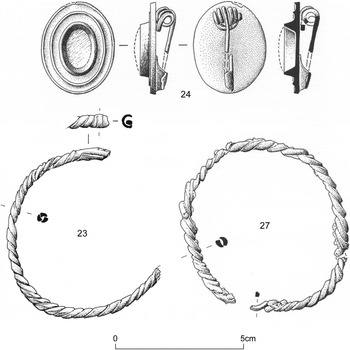
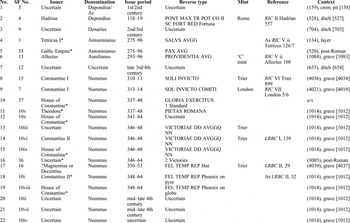
Numerous sherds of third/fourth-century pottery were recovered from the fills of graves [4007], [4010], [4013], [4016], [4019], [4031] and [4034]. A coin of a.d. 313–14 that may have been in circulation until a.d. 330 (coin cat. no. 9) was found in the fill of grave [4019], while grave [4034] yielded a coin dated a.d. 310–11 (coin cat. no. 8) which like the coin with [4019] may have circulated till a.d. 330 (see Wells, coin report). Grave [4037] yielded a mid-fourth-century coin (coin cat no. 17) that might have been in circulation until a.d. 364 (see Wells, coin report). Metal finds, apart from the coins, comprised a bracelet (metal cat. no. 27, fig. 17) on the wrist of skeleton (4036) in grave [4034], and a spearhead and T-clamp (metal cat. nos 28–9) in the disturbed grave [4037]; the spearhead perhaps indicative of military connections but the T-clamp wholly out of place and presumably intrusive. All of these burials bar [4013] and [4016] were coffined judging by the presence of coffin nails — the two exceptions had been disturbed by later burials.
There is thus a sequence of intercutting burials starting in Period 2 with an apparent second-century group of four for which an order of [4051], [4043], [4022] and [4040] can be suggested. Burying continued with a later sequence of five for which the order [4016], [4019], [4013], [4007] and [4010] is possible, with [4019] possibly dating later than a.d. 330 as noted above. For the remaining seven only two, [4031] to the west and [4070] to the east, could be shown to be earlier than the otherwise isolated burials — from west to east [4037], [4034], [4061], [4054] and [4057]. Of these the three to the west belong in the later third/fourth-century group judging by pottery of that date in [4031], while the others are undated and could belong to either group. The limits of this complex sequence of graves were only securely established on the south where excavation on the further side of a later ditch (see fig. 3) revealed no further burials. An eastern edge could be argued not only by a 2 m-wide blank area, but also by the possibility that the west side of the enclosure (continuation of [1037]) lay just beyond the excavation limit here. Burials could have continued to the north and west. The intercutting character of the excavated burials stands out from the other evidence from both the London Road sites. The group is analysed further in the discussion.
To the north, burial continued in Area 1 where Period 2 graves were located. This linear group aligned against the enclosure was less concentrated than the southern one, though intercutting graves were present. It comprised eleven of the twelve graves excavated in 1993 ( fig. 9). None of these were dated, and they may all belong with the Period 2 group. However, one grave was further excavated in 2002 where it was numbered [1012] and proved to be of later fourth-century date. The northernmost of the 1993 graves contained two skeletons, (74) and (122), the first of a supine male aged 28–30 years and the second of a 9–10-year-old child of undetermined sex. Skeleton (83) was of a 55+ year-old supine, probable male. Near by a single grave held a 24–25-year-old supine burial (77) of undetermined sex with a c. 6-year-old child (80) also of undetermined sex. To the south in two poorly defined graves was, first, a possible male mature adult (86) and further south again a 30–35-year-old supine female (89). More remained of two adjacent graves, one containing an adult supine female (95) and the other a 30+ year-old supine, decapitated male (92). Of the remaining burials, skeleton (116) was of a 60+ year-old supine female, (130) of an adult possible male, and (100) of a prone 55+ year-old female. A final burial contained a further adult and child pairing with an adult male (125) and an 8-year-old, prone child (108) of undetermined sex.
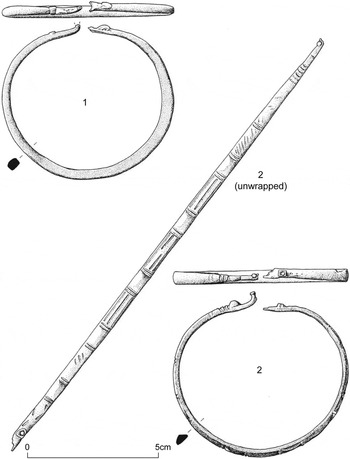
Grave [1012] represented, as noted above, further excavation of one of those revealed in 1993 (numbered 105 there). It contained a probable female adult skeleton (1014) of uncertain age ( fig. 9). Two bracelets (metal cat. nos 1–2, fig. 16) and ten mid-fourth-century coins dating between a.d. 337 and 364 came from the grave (coin cat. nos 11–15, 18–22). These coins seem likely to have been together in a container of some kind giving a burial date close to that of the latest coin (see Wells, coin report). Residual first/second-century pottery was also present. The grave cut Period 2 grave [1006]. The presence or absence of coffin nails was not recorded for those graves excavated in 1993.
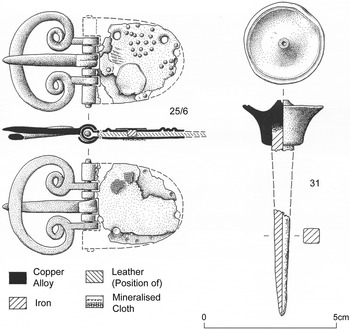
To the west of the enclosure, grave [4068] contained two badly disturbed burials; an adult skeleton (4066) and an infant aged c. 1 year (4067), both of undetermined sex. From the grave fill came four sherds of third/fourth-century pottery together with a brooch (metal cat. no. 24, fig. 17) and a buckle and buckle plate (metal cat. no. 25/6, fig. 18). These metal finds could indicate a person of authority from the late fourth or early fifth century and are discussed in detail below (see Cool, metal finds). A ring (metal cat. no. 30) was found with the infant bones. A complete beaker (pot. cat. no. 18, fig. 15.11) and ceramic spindle whorl (pot. cat. no. 18, fig. 15.12) of third- or early fourth-century date were also present as well as coffin nails ( fig. 11). Grave [178] in Area 1 to the west contained a probable male skeleton (180), aged 25–35 years. The skeleton lay in a crouched position — no coffin nails were recorded ( fig. 9).
A small group of five inhumations was located to the north of the enclosure ( fig. 9). Grave [677] contained a supine female skeleton (678), aged 18–20 years. A sherd of third/fourth-century pottery came from the fill. Possible grave [648] was only seen in a small exposure, the profile suggesting a grave. The fill contained limestone and charcoal and two sherds of undiagnostic Roman pottery. Both [648] and [677] were cut by grave [661] which contained the little that survived of skeleton (662) of undetermined sex, laid supine, aged 25–35 years. A sherd of undiagnostic Roman pottery came from the fill which also contained limestone and charcoal. Grave [658] contained a supine female skeleton (659), aged 20–25 years. A copper-alloy bracelet of second- to fourth-century date, with a date later in the range more likely (metal cat. no. 23, fig. 17), and four sherds of second-century pottery were recovered from this fill. Lastly, grave [685] contained a supine, decapitated child burial (687), aged c. 4 years, with the skull placed on the lower part of the legs.
Laid out parallel with the northern side of the enclosure at its east end, grave [719] contained a supine male skeleton (720), aged 50+ years ( fig. 9).
Finally, on the east side of the enclosure was a group of four graves, three undated ( fig. 10). Grave [3034] contained a supine female skeleton (3035), aged 30–40 years. Grave [3008] contained part of a male skeleton (3009), probably in a supine position, aged 40–50 years. Grave [3040] to its south contained a male skeleton (3041), aged 25–30 years, with second-century pottery present in the fill. Finally grave [3031] lying parallel to [3040] to its east contained a supine male skeleton (3032), aged about 30 years. Coffin nails were recorded in all these graves north and east of the enclosure with the exception of [3008].
Other features outside the enclosure comprised pits and ditches. In Area 1 pit [138] was 0.12 m deep with sloping sides and a gently rounded base. Undiagnostic Roman pottery came from its fill. The pit lay beneath the only Romano-British deposit identified. Layer (134) appeared to have been preserved by its proximity to a post-medieval cellar. It covered an area approximately 2 m by 2 m and was 0.18 m thick. It consisted of a mid-yellow-brown sandy silt from which seven sherds of undiagnostic Roman pottery were recovered along with a coin dated a.d. 275–96 (coin cat. no. 4). Nearby pit [143] was 0.28 m in depth with sherds of early second-century pottery recovered from its fill. Further south, post-hole [174] had second-century pottery in its fill. To the north a short section of ditch [154] 0.28 m deep, with steep sides and a narrow, rounded base, terminated to the north. Its fill contained second/third-century pottery. On the east side of Area 2, ditch [697] lay only partly within the excavation. This was 0.35 m deep with one sloping side recorded and a flat base. A few sherds of possible second-century pottery were present. Its relationship with pit [707] was not established. This was 0.40 m deep with late second-century pottery recovered from its fill.
In Area 3 to the south there was no evidence of the east side of the enclosure. Instead two ditches [3013] and [3037] with similar profiles and fills seemed unlikely to be the same ditch ( fig. 12); ditch [3037] lay where the east side of the enclosure might have run. Second-century pottery was recovered from [3013] and first/second-century pottery from [3037]. Pit [3019] to the south was 0.13 m deep and contained quantities of charcoal with second-century pottery present.
Selected sections.

The northern enclosure ditch [654] had been cut by a pit [599] which appeared to be of Roman date. This was 0.20 m deep, with sloping irregular sides and a rounded base, and with 16 sherds of third-century pottery and substantial quantities of cattle bone in its fill.
DISCUSSION
CEMETERY BEGINNINGS
The evidence from these excavations and from that to the west suggests that the cemetery was initiated to serve the Kingsholm fortress, as is shown by the fabrics shared by the earliest cremation urns and by vessels in use at the fortress. In addition, the possible Claudian or early Neronian glass found at 124–30 London Road in cremation pit [656] and the possible Neronian coin in cremation pit [158] also attest an early date (see below). The position of these early cremations, almost 1 km from the fortress, requires explanation given that there are also similar cremations known much nearer to it.Footnote 11 The excavators of 120–22 London Road suggest that the site was chosen because it was a visible point in the landscape.Footnote 12 The activities involved in cremation were strikingly visual and a position on the skyline, when seen from the fortress, could certainly have influenced the choice of site, as at Brougham, Cumbria.Footnote 13 They suggest, too, that the location at the point where the road down to the river crossing joined Ermin Street must also have been a factor. This point was some 50 m from the early cremations recorded at the London Road sites (two at 120–22, plus another dated by an early radiocarbon date, and six from the excavations reported here), and it may have been the case that the cremation pits were allocated sites away from a more ceremonial area at or near the junction where pyres and processions took place. Whether this was the case or not, the position of these early cremation pits confirms the early status of the London Road spur and would also show a consciousness of landscape planning not usually associated with fort sites.
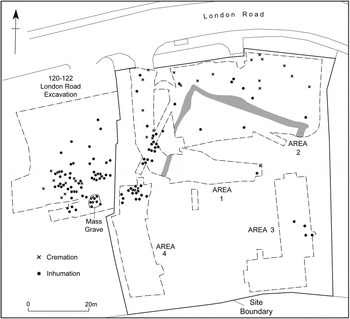
Although later activity may have distorted the picture, the apparent south-west limit of the group of eight Period 1 cremation pits and accompanying possible examples in Area 2 in the north-east of the 124–30 London Road excavations does suggest that they were aligned with Ermin Street rather than the later London Road ( fig. 13). These would have lain 20 m or so from Ermin Street. The other Period 1 cremations to the west, [168] and [582], may mark a southern limit to cremation parallel with the London Road. If this were the case then they would have been later than those to the east although still occurring in Period 1, as would the construction of the spur road.
Inhumations and cremations from 124–30 London Road.

At 124–30 London Road the earliest feature seems likely to have been pit [722], perhaps a gravel quarry pit for road construction infilled before the Period 2 cremation [633] was placed ( fig. 4). Another early feature requiring explanation is inhumation [603] which, although later ceramics were present, was cut by pre-Flavian cremation [582]. This was a coffined supine burial similar to the great majority of the later examples. Burial earlier than cremation at this date seems likely to be an indication of a native practice with a date within the Roman period rather than earlier — there is no evidence of pre-Roman activity at Wotton. Four crouched burials at 120–22 London Road of first/second-century date were similarly interpreted.Footnote 14 It should be noted that the later, second-century, pottery present in [603] was regarded as intrusive, but it cannot be ruled out that the cremation itself was later and placed in a curated pre-Flavian ceramic vessel. The cemetery appears to have been laid out in fields from the evidence of ploughmarks from 120–22 London Road,Footnote 15 although none were recorded in the excavations reported here.
CREMATIONS
A total of 19 certain cremation burials (20 individuals) were identified, along with a further possible cremation from which all human bone had been lost ( fig. 13). Each certain cremation contained human bone from a single individual, with the exception of [158], which contained two sets of remains. An urn was recovered from each burial apart from pit [1015] where the cremation was unurned. The majority of cremations were clearly located towards the north of the site despite that being the area with the greater degree of later disturbance. Only two examples, [1074] and [4025], were identified further back from the road junction, to the south.
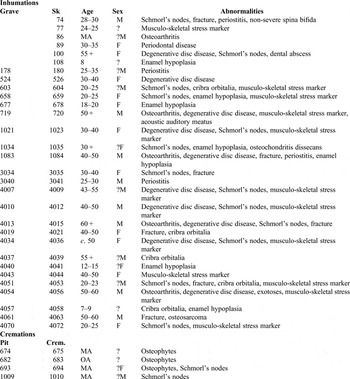
Most of the cremations were associated with pottery sherds from other vessels. Some of these may have been complete and have contained food offerings (as in [656] and [682]), while others may have been the debris from smashing pots at the time of burial and placing the fragments in the cremation pit along with the main vessel. At 120–22 London Road the cremation urns tended to be in reduced fabrics, whilst ancillary vessels were oxidised.Footnote 16 The same was true to a lesser extent at 124–30 London Road with six similar examples, but the majority displayed a greater variety of vessel use and so of colour as noted by Timby.Footnote 17 Other objects, including a nearly complete ceramic oil lamp (in cremation pit [576]), iron nails (in cremation pits [656], [671] and [693]), hobnails (in [671]), glass vessels (present in [576], [582], [656], [671], [693] and [1009]), and part of a copper-alloy spoon (with cremation [680]) were also found associated with the cremation pits (Table 1). The coin found in cremation pit [158] and securely identified only as first/second-century may have been an as of Nero (see Wells below).
CREMATION DETAILS

A = adult; YA = young adult; MA = mature adult; OA = old adult; juv. = juvenile
Glass vessels were common in the pre-Flavian group with examples present in five out of the six cremations, in contrast to the absence of glass vessels from the pre-Flavian cremations at the adjacent excavation. Cool (see below) notes that the coloured glass in [656] may indicate a Claudian or early Neronian deposit. She also notes that the iron nails may have been specifically made for funerary purposes, perhaps for the bier. Animal bone (see Mant below) representing large joints was present in two of the pre-Flavian cremations. These were, where identifiable, of pig and the same dominance of pig bones was noted at 120–22 London Road, where animal bone was overall more common with six out of the nine cremations accompanied by meat offerings.Footnote 18 Glass and hobnails were also recorded with three and two of the later cremations respectively at 120–22 London Road.Footnote 19
No conclusions can be drawn as to change in the cremation rite with regard to age or sex, from the pre-Flavian period through to the second century. Apart from inhumation [603], cremation was the only pre-Flavian method of burial, but inhumation became almost as popular during the second century (at least six identifiable inhumations of this date to nine cremations). There were no cremations dated later than the second century.
The ages of the individuals covered all ranges, from new-born to mature adult, with both males and females represented, indicating that the cremation rite of burial within this population was not the preserve of any particular age or gender group. Although the sample is small and few of the cremations could be accurately sexed, it is apparent that early cremation was not reserved for military personnel at the Kingsholm fortress and at the later Gloucester fortress. The presence of females and children may, of course, represent the families of soldiers, particularly senior officers who might have had spouses and children with them. Cremation was the favoured burial rite throughout Romanised Britain during the first two centuries and was by no means restricted to military personnel even in the earliest periods. It is unfortunate that the majority of pre-Flavian cremations are unsexed, with only a single probable male and a probable female to add to the two males and one female at 120–22 London Road.
The cremation pits were a variety of shapes ( figs 5 and 7). The majority were sub-oval or oval, although sub-square and irregular cuts were also present. Three possible grave markers — not paralleled on the adjacent site — were present: post-hole [156] for cremation [158], and post-holes [609] and [611] for cremation [585].
THE ENCLOSURE
The Period 3 enclosure represents a distinctive finding and is an unusual feature given the general conformity of urban cemeteries in the province. Apart from its function the enclosure requires special consideration in terms of its significance for the layout of the site ( figs 8, 13 and 14). Three of its sides were established. The northern side was clear in Area 2, the western boundary in Areas 1 and 2, and the eastern also in Area 2. The eastern and western sides were not picked up in Areas 3 and 4 to the south ( fig. 8). The absence of a southern extension of the western ditch in Area 4 seems a real one, given the excavation there, but the absence of the eastern ditch in Area 3 is less certain in view of the limited nature of the archaeological exposures at the bottom of modern foundation trenches. A south side may therefore be presumed unexcavated to the south of Area 1.
There are suggestions that the enclosure might have had a predecessor or predecessors before Period 3. The line of its north side is close to that of the Period 1 cremations in the north-east corner of Area 2 and hence to Ermin Street, differing by around ten degrees ( figs 2 and 4). In Period 2, ditch [527/1041] might be part of a preceding enclosure with north and east sides replaced on the same line in Period 3. Further, the position of the Period 2 cremations lying outside the enclosure bounds to the west and north, and the presence of only one cremation lying within it, could suggest they were sited to respect an existing landscape feature ( fig. 6).
Disuse of the Period 2 ditch [527] may be marked by the Hadrianic coin in its fill, which could then be argued to be near the date of its replacement by the Period 3 enclosure. There is conflicting evidence for the subsequent disuse of the latter. The date may be indicated by the late third/fourth-century coin in [654] and by the absence of fourth-century pottery and the presence of the apparently fourth-century pit [599] cutting ditch [654]. However, the evidence of the line of stones in the bottom of [1037] could suggest padstones at the base of posts continuing the ditch line as a boundary after it was backfilled. The position of fourth-century inhumations respecting the enclosure (discussed below) would indicate that it continued in some form in the later Roman use of this part of the cemetery, while the fourth/fifth-century buckle plate in grave [4068], respecting the enclosure on its west side, opens up the possibility of an even later date.
The alignment of the three burials within the enclosure — [524], (134), and [1083], the last dated by a coin of a.d. 293–96 likely to represent the date of burial — respects its bounds. They lie between 2 m and 5 m from the respective nearby ditch, and parallel to it, and this might be an indication of the presence of an interior bank.
A function for the enclosure as the surround for a major burial, perhaps in a mausoleum, is possible. However, it would seem unlikely that this would lie so distant from the roads — any such major feature must have been intended to be both highly visible and readily accessible to passers-by. It has been rightly pointed out that the archaeological evidence is biased to the terminal closure process of burial itself, while the pre-burial processes remain invisible.Footnote 20 It is possible that the enclosure at 124–30 London Road was the location of activities preceding the actual inhumation, and that in this part of the Wotton cemetery burials clustered round this significant place of pre-burial rites. Cremation burial was accompanied by elaborate displays often at locations away from the final resting place of the remains, and it would be possible that the same might apply for inhumation burial, at least in its early period of use. The Period 3 enclosure might have acted as a terminal for funeral processions and a place for final mourning ceremonies prior to those that took place at the graveside itself. The late third-century date of one of the three burials within the enclosure might apply to all three and be an indication of the period when such rites were no longer practised, though the small number of graves within the enclosure shows a continuing respect.
If the suggestion of a preceding enclosure in Period 2 or even Period 1 is accepted, then this too might have been associated with rites that preceded deposition of the body from the period when cremation was the norm. At the King Harry Lane cemetery at Verulamium, albeit from the first half of the first century, a number of enclosures of a similar size to the London Road example acted as the locus of the funeral pyre, and other enclosures are known from the town.Footnote 21 Although there was no evidence at London Road of cremation ceremonies other than the urn deposits themselves, it is possible that the enclosure was associated with activities preceding the deposition of the remains.
Whatever the interpretations put forward for the function of the enclosure or its possible predecessor(s), discussion below of the inhumations brings out the density of burial along its west side, with two groups of burial beside the western ditch. Looking at the distribution pattern at 120–22 London Road ( fig. 14), it could be argued that even there the enclosure influenced the location of the burials — particularly with the position of the mass grave some 10 m outside the putative enclosure line. A rather different circumstance obtained at the Bath Gate cemetery, Cirencester, which is discussed below.
Alternatively, it may have been that an initial enclosure or enclosures of non-cemetery function became incorporated into the cemetery as it spread southward in the later Roman centuries ( fig. 2B). At Poundbury enclosures of a similar size were incorporated into the late Roman cemetery, but were, in fact, initially part of the earlier Roman settlement.Footnote 22
INHUMATIONS
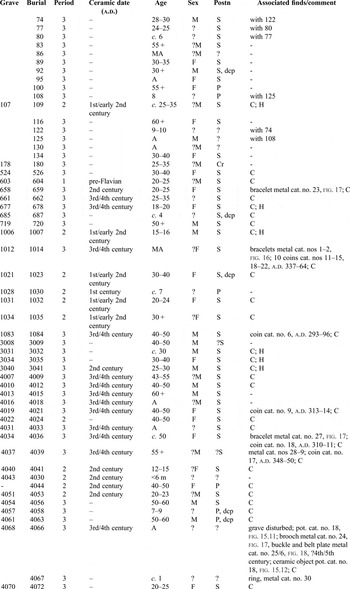
A total of 39 inhumation burials were recovered from 37 graves ( fig. 13; Table 2). In addition 17 skeletons had previously been recovered from 12 graves in 1993, of which two were equivalent to burials excavated in 2004. In total, therefore, 54 identifiable inhumation burials in 49 graves have been recovered from the site. Quantities of disarticulated bone were also recovered from a minimum of four individuals, but are likely to represent many more than this (see Clough and Brayne below). No dating evidence or description of body position was provided for the Gloucester Archaeology evaluation which has, to a degree, inhibited integration of this skeletal material with the results of the later excavation.
INHUMATION DETAILS

Age: A = adult; MA = mature adult
Position: S = supine; P = prone; Cr = crouched; dcp = decapitated
Associated finds: C = coffin nails; H = hobnails
The great majority of the inhumation burials, where identifiable, were supine (Table 2; figs 9–11). Of those with distinguishable positions, seven had the hands across the pelvis — (659), (720), (1084), (4015), (4021), (4033) and (4072) — six had arms straight by their sides — (526), (604), (678), (3032), (4024) and (4041) — five had one arm (four right and one left) crossed and the other straight — (109), (1032), (3035), (4012) and (4056) — three had both arms crossed over the chest — (3041), (4036) and (4053) — and, finally, one (4018) had the right arm flexed back on itself. At the adjacent 120–22 London Road site the larger groups were similarly buried with hands on the pelvis, arms by the side, and one arm crossed, but no examples were noted specifically of both arms folded across the chest. In London's Eastern Cemetery it has been suggested that burials with the right arm across the chest and the left arm straight are an indication that the body was clothed in a toga.Footnote 23 No significant groups or preponderance by sex or age were noted in the examples above, including those with one arm across the chest, two of whom were female militating against the interpretation that they were wearing the exclusively male toga.
There were a total of six prone bodies — (1030), (4044), (4058) and (4063) from the 2002 excavations, together with two burials recovered in 1993, (100) and (108) (Table 2; figs 9–11). This total of 6 out of 54 can be added to that of a further 6 out of 64 from the adjacent 120–22 London Road group making a figure of c. 10 per cent for the two areas. This is far higher than figures for other urban cemeteries,Footnote 24 though close to the 8.8 per cent at the Bath Gate cemetery, Cirencester.Footnote 25 There are a variety of explanations for prone burials ranging from general carelessness to deliberate burial alive.Footnote 26 For the six prone burials at 120–22 London Road, the excavators invoked the Roman belief that the dead should thus be retained in the grave and so barred either from a return to the living or from a continued journey to the underworld.Footnote 27 In the mass grave at 120–22 London Road the bodies had been deposited without formality, an indication that disease might be another factor in the choice of prone burials.
At 124–30 London Road, three of the prone burials, (108), (1030) and (4058), were of children aged between 7 and 9 years old. Carelessness could not have been a factor in the case of (4058) where the body had been decapitated indicating an attention to the meaning of the burial process. The child might be thought to be barred by its age from journeying on from the grave and so likely to return as a revenant. Of the three adult prone burials, burial (100) was of a female aged 55 or older, (4044) a female of 40–50 years along with an infant aged 0–6 months, and (4061) was a male 50–60 years old. Again the age of these adults, all over 40, may be significant, perhaps suggesting that in life these were people of some power. The grave containing burial (4044) in Area 4 cut several graves containing supine skeletons. It is possible that this prone burial with a newborn reflected a social or cultural stigma, although the adult was presumably too old to be the mother of the child. However, if the burial did reflect some stigma, it was not sufficiently strong to require separation from a densely packed group. It was speculated whether two of the prone burials at 120–22 London Road may have had their hands tied behind their backs.Footnote 28 This could not have been the case for burial (4063) in grave [4061] at 124–30 London Road, where the arm lay beneath the body ( fig. 11). The six prone burials were divided equally between the two groups of close-spaced inhumations west of the enclosure. These groups of burials may be seen as family plots (as discussed below), and it might be the case that the adult prone burials express a desire that the dead be securely separated from the living; older powerful figures might have been a specific concern for surviving family members.
Of the total of five decapitated burials from the excavation, two were children comprising burials (687) and (4058), the latter lying prone as noted above, in graves [685] and [4057] ( figs 9 and 11). Burial (1023) was a 30–40-year-old female in grave [1021] and burial (4063) was a male aged between 50 and 60 in grave [4061] and, as noted above, buried prone. From the 1993 evaluation, burial (92) consisted of a supine male aged 30+ years, with the skull placed beneath the knees. In the case of the burials excavated in 2002 the skull was placed on the lower limbs, (687) and (1023), or at the feet (4058) or, in the case of (4063), was absent. No grouping of decapitated burials was apparent. There were, therefore, two prone decapitated burials. In comparison, only one example of decapitation was recorded from 120–22 London Road, the head being absent.Footnote 29
A single crouched burial, (180) in grave [178], was present ( fig. 9). Early examples from 120–22 London Road have been noted above and others of second- to fourth-century date are known from Kingsholm where the survival of the native tradition is suggested.Footnote 30 Isotope analysis of one of the crouched burials from 120–22 London Road indicated a local origin.Footnote 31
A total of three child burials — (80), (108) and (122) — were recovered from the evaluation, and five (including two infants) from the excavations — (687), (1030), (4030), (4058) and (4067) — where two adolescents (1007) and (4041) were also located. The percentage of children (excluding the adolescents) was c. 15 per cent.
There were 23 male and 19 female skeletons which could be assigned sex (or a likely sex). This part of the cemetery is, therefore, unusual in that there is no clear preponderance of males over females as is generally the case in urban cemeteries in the south of the province. The contrast with the adjacent grave population, biased 2:1 in favour of males at 120–22 London Road, is particularly marked. It has been suggested that the difference is owing to specific areas being allocated by sex and it is the case that female burials there, with two exceptions, are concentrated in two areas.Footnote 32 If this suggestion is applied to the pattern of burials at 124–30 London Road, then it is possible to argue that inhumations of females all lie close to the enclosure while male burials, though present with female burials, also occur as isolated outliers at a greater distance from the enclosure. It is not clear whether this pattern is more apparent than real given the limited areas excavated and the extent of later disturbance. The sharp difference in gender ratio between the two areas — divided only by a modern property allotment — also remains a puzzle. The excavators at 120–22 London Road list cemetery proportions close to the joint figure for the London Road sites, while pointing out that a greater number of males is far more common.Footnote 33
Very few skeletons could be accurately ascribed a height, although the stature of six males (between 1.62 m and 1.78 m) and two females (both c. 1.58 m) could be ascertained. The impression given, therefore, is that males were slightly taller than females, but the sample is too small for meaningful statistical analysis.
Grave goods were relatively scarce (Tables 2 and 5; figs 9–11). Burial (659) was an adult female who had been buried wearing a bracelet on the lower left arm. Burial (1014) was a probable adult female buried with what must have been a purse or bag of ten coins and with two bracelets encircling her left wrist. Burial (1084) was an adult male with a coin of Allectus in his left hand. Burial (4021), a 40–50-year-old female, had been buried with a coin of Constantine I. Burial (4036), a c. 50-year-old female, was associated with a second coin of Constantine I and a copper bracelet, broken into five fragments, situated just below the pelvis. Burial (4039), an adult male, had a coin of Magnentius or Decentius, a spearhead and an iron object. Burial (4066) was an adult of undetermined sex associated with a brooch, and a buckle and buckle plate, as well as a pottery beaker and a ceramic spindle whorl. This grave [4068], which was badly disturbed, also contained an infant burial (4067) aged c. 1 year, which was associated with a copper-alloy ring. The beaker was dated third- or early fourth-century, while the brooch was third-century and the buckle a late second- or early third-century military type. However the buckle plate is suggested to be of late fourth- or early fifth-century date and the buckle therefore re-used in a late Roman belt fitting (see Cool, metal finds below). The brooch, too, would have been old when deposited. Interpretation is made difficult by the disturbed nature of the grave, and, possibly, by the presence of the infant. A candidate for a military grave was burial (4039) with the spearhead, although this grave too had been badly disturbed. Apart from (659), (1084) and (4066), burials with grave goods were from the two groups west of the enclosure.
Burial (4039), which may have been of a soldier, adds to the evidence from Gloucester that the town's military origins as a settlement for military veterans continued over the successive centuries from the colonia's foundation.Footnote 34
Although no wooden remains were present within the graves, many of the burials contained nails, indicative of the presence of wooden coffins. These were found with every inhumation except burials [178], [1028], [3008], [4013] and [4016]. Of these, burial [178] was crouched and clearly not buried in a coffin, while [1028] was a prone child burial that may also not have been placed in a coffin. Burial [3008] was very incomplete and the lack of coffin nails may be owing to later disturbance. Burials [4013] and [4016] were both located in an area of dense burial and evidence for associated coffins may have been removed by later burials. The proportion of coffined burial as evidenced by nails (87 per cent) was higher than at 120–22 London Road (61 per cent).Footnote 35 The contrast of the figure of 69 per cent for both sites with the two out of six coffined burials at St Margaret's Hospital further to the south-west, or with the 25 per cent at Bath Gate cemetery, Cirencester is marked.Footnote 36 Hobnails were found with burials (109), (678), (1007), (3032), (3035) and (3041), of which four were male.
Sherds of pottery were recovered from a number of graves. This material did not represent grave goods, but may be generally considered to provide a terminus post quem for the inhumations (see Timby below).
Any analysis of the grave orientations, as was undertaken at 120–22 London Road, needs to take into account the apparent concordance of grave alignment with the enclosure. Nevertheless a generally north–south line was shared by 25 graves, with eight west–east (both these being equivalent to alignment with the enclosure), six north-east–south-west, three north-west–south-east with slight variations, and the remaining alignments represented by single examples. This dominance of cardinal orientation was shared by the graves at 120–22 London Road.Footnote 37
There appears to be no chronological significance to the orientation of graves; both east–west and north–south alignments being present from the first century through to the fourth century, although north–south-aligned graves are more common throughout. All ages and sexes were present within the dense group in the western part of the site, while securely identified male inhumations are present in the north-west corner of the site, and predominantly female inhumations, as already mentioned, in the group to the south.
There were a significant number of people over the age of 40 amongst the burials and of these five had suffered from osteoarthritis and ten from back problems owing to the degeneration of spinal discs (Table 3; see Brayne and Clough below). The location of degeneration in the neck region of some of these, predominantly women, indicated that they may have habitually carried loads on their heads. A number of stress markers were observed suggesting a high level of physical work. Seven individuals had suffered fractures most likely resulting from accidents rather than any violence. Five of these were male and two female (Table 3), marking a difference with 120–22 London Road where fractures were all on males. There were seven examples of enamel deficiencies in teeth which may indicate health problems experienced in early life. Caries was present in a quarter of the burials and abscesses were being suffered by five. The poor dental health of the two London Road groups in comparison with the province-wide data has been noted in the 120–22 London Road report suggesting high carbohydrate consumption or different diets.Footnote 38 The high level of non-specific infection noted at 120–22 London Road was thought to be an indication of poor sanitation, but this was not paralleled at 124–30 London Road where the occurrence of periostitis (7.1 per cent) was close to the national figure (6.7 per cent).
OVERALL CEMETERY PATTERNING
Of the three periods, the pre-Flavian Period 1, which can be taken back to a Neronian or even Claudian date, must be associated with the Kingsholm fortress, while Period 2 coincides with the Gloucester legionary fortress and the establishment of the colonia. The great majority of coins come from the second half of the third century and the first half of the fourth, while the pottery falls into two groups of second-century and third/fourth-century date. This may well indicate a hiatus in burying. A later second-century closure of this part of the cemetery may have followed the mass grave at 120–22 London Road, but a disuse could also have resulted from the presumed second-century expansion of the cemetery south-westward towards Gloucester with a later expansion from its original core onto the site reported here.
Any analysis of the spatial layout of burials must take account of the different areas of excavation and the different methodologies applied — as outlined in the introductory section of this paper, but especially the essentially keyhole excavation of Area 3. Areas lost to later activity shown on fig. 3 combined with the unexcavated areas need to be borne in mind, but nevertheless it does appear that the distribution recorded can be subjected to some analysis.
As excavated there were two principal groups of burials, one in Area 1 and one in Area 4 both close to the west side of the enclosure ( fig. 13). A third group in Area 3 comprised four burials lying to the east of the enclosure, and a fourth group of four or possibly five burials to its north in Area 1. The remaining four burials were spaced across the north of the site. The two main groups in Areas 4 and 1 were marked by intense intercutting. The closeness of the two groups may be significant, but the quite different plan of the grave layouts would suggest that they were unrelated. Although groups can be distinguished, the remaining burials form a different, dispersed, pattern.
The southern intercutting burial group in Area 4 — looking at the results from Periods 2 and 3 together — comprised a total of 17 skeletons in 16 graves. The sex ratio was more or less equal at 7:6 male to female or 9:6 including ?males/females. The age range fell principally within the 30–50 bracket (a total of seven), with four older, two in their 20s, one adult, one teenager, one child and one infant. The incidence of grave goods was limited to [4034] and [4037], the former a female with a bracelet and a fourth-century coin suggesting a burial date between a.d. 310 and 330, and the latter, a ?male, buried with a spearhead and a coin giving a burial date between a.d. 348 and 364. Three of the burials, as noted above, had been placed in a prone position. The spearhead found with the ?male skeleton (4039), perhaps also the finds with burial (4066), and features of the male skeleton (4012) which are indicative of the habitual carrying of a weight on the head as for example a heavy helmet, are all suggestive of possible candidates for members of the military (see Cool; Clough and Brayne below). Thirteen of the group had abnormalities of one kind or another, including seven out of the total site count of twelve with stress markers, five out of the ten with disc disease and four of the seven with fractures (Table 3). This group was markedly different to the group to the north and would appear to have had a greater involvement with manual work.
Again combining the Period 2 and 3 figures, the intercutting group to the north in Area 1 comprised 20 skeletons in 17 graves. This group, as already noted, is apparently a linear one, laid out along the line of the west side of the enclosure. It comprises those excavated in 1993 with three from the 2002 excavation. Analysis of the group is limited by the lack of dating and skeleton position data for the burials excavated in 1993. Nevertheless, the identifiable sex ratio was 4:6 male to female or 7:7 including ?males/females. The age range was younger than the southern group with three children, six 20–30-year-olds, three 30–50s, and three over 55s. The grave goods were limited to [1012] — bracelets and ten later fourth-century coins — and hobnails from two graves. Of particular note is the relationship between [1006] and [1012] where the earlier grave [1006] had been reopened. The presumably excarnated bones of skeleton (1007) appeared to have been moved over to make room for the later burial.
The pottery from both groups suggests a period of disuse, with four Area 4 burials dated to the second century and five Area 1 examples dated to the first or first/early second century. In both groups the later burials were dated to the third/fourth century by the pottery and the fourth century by the coins. Both groups, particularly the southern one in Area 4, suggest family plots where successive burials were undertaken in the same constricted area. The density of burying, involving the intercutting of graves, stands out, as does the presence of all but two of the burials of children under 12 years of age from the excavation.
Of the other slight indications of groups — one with four to the east and another with four to the north of the enclosure — it was noticeable that three burials of the eastern group were male to one female and two of the three reported in the north group were female. Two of the three burials within the enclosure were female and one male; the latter being dated by coins to the end of the third century.
There was no indication of a physical boundary to the cemetery, as might be expected, though a limit is suggested by the absence of graves in the southern parts of Areas 3 and 4.
Inhumations and cremations from both 120–22 and 124–30 London Road.

Looking at the distribution of features from both London Road sites, it is important to bear in mind the extent of later disturbance and the different excavation methodologies applied to different areas.Footnote 39 Nevertheless, it is possible to suggest that cremations tend to be in groups and to be placed at a fairly regular c. 2.5 m distance apart ( fig. 14). The pattern at 120–22 London Road, where cremations appear to group in the south of the site, is likely to be misleading, while those from 124–30 London Road give a truer picture with denser cremations to the north tailing away to the south. Putting the two inhumation plans together, it is possible that the two intercutting, perhaps family, plots in Areas 1 and 4 to the west of the 124–30 London Road site, together with the burials from 120–22 London Road — including the mass grave — can perhaps be allowed to suggest an overall concentration of burying. This L-shaped concentration alongside and at right angles to the enclosure's west side could be argued to lie in a position that perhaps is taking advantage of whatever aspect of mortuary meaning was represented by the enclosure. An association of boundaries and burials in urban cemeteries in Roman Britain is generally considered to indicate the need for a clearly bounded burial place, and so a ditch surrounding an urban cemetery is generally assumed to have been the norm. However, in rural contexts boundaries and burials have a more complex relationship. Rural burial need not be at a defined site, but an association with ditches is common whether at the side of fields or alongside thoroughfares. Boundaries as in-between spaces separating more recognised and definable spaces may have encouraged an association with the place of the dead.Footnote 40 It is thought there may have been an association between disused settlement features and the dead, which allowed the latter to remain separate from the living but also allowed them to contribute symbolic meaning to the agricultural cycle and to the prosperity of the settlement as a whole.Footnote 41 These cosmological ideas of rural origin may have influenced the location of the London Road burials close to the enclosure, but another possible explanation may have been a desire to associate the dead with a ditched feature that may have had an earlier significance for the town.
The report on the 120–22 London Road excavations advanced a number of arguments — the paucity of grave goods and the position of the mass grave in particular — which possibly indicate that the London Road sites examined may have lain away from more controlled burial and cremation toward the thoroughfares.Footnote 42 This must almost certainly have been the case given the evidence of impressive funerary finds elsewhere in the Wotton cemetery. A possible scenario might be that behind mausolea on the road frontage (as at 3 Denmark Street and St Catherine's church) were well-ordered graves (as seen for instance at Poundbury or Lankhills) shading into the layout revealed at the London Road sites, which is perhaps associated with lower status burial. However, it must also be a possibility that the long-standing enclosure, perhaps related to Ermin Street, exerted its influence on burial at the London Road sites throughout the Roman period. That this was an area where it was appropriate to locate a mass plague grave would indicate that it was not the burial place for powerful and influential citizens. Indeed there are indications — the early burial [603], the crouched and prone burials, and the relationship with an enclosure — that here, at the cemetery limits, was the place for burials in traditions that deviated somewhat from more standardised and purely Romanised ones.Footnote 43 The suggested third/fourth-century return to the north-eastern end of the cemetery and its expansion away from the road might well have led to a less strict control of burial practices than would have been enforced nearer to the city and the road leading out of it.
Peter Brown has suggested that a factor in late Roman burial patterns was the tension between the needs of the family and the needs of the community.Footnote 44 Such tensions may be visible here on the outskirts of the Wotton cemetery where there are family groups close to features indicative of wider community influences, such as the mass grave and the enclosure. The presence of later Roman prone and decapitated bodies in spatially associated groups at the London Road sites on the outskirts of the cemetery could be an indication of the presence of people of rural origins, since such burials tend to occur in poorer rural contexts rather than on urban sites. The contrast has been noted between urban burial that assimilated the individual dead into the town's dead and rural burial where individual identity may have been maintained and thus the influence of the family.Footnote 45 This urban/rural difference might be reflected in the London Road burial pattern. Further, osteological analysis of burials from 120–22 London Road suggested more diverse origins than simply rural for the Gloucester population as a whole, including Mediterranean connections, and this would have increased differing and perhaps conflicting expectations of burial practices.Footnote 46 All of these factors, possibly indicative of the tensions Brown identified, may perhaps be visible in the heterogeneous overall pattern from the two London Road sites.
The new evidence from the Wotton cemetery contributes to the long-running discussion of the similarities and differences between the neighbouring towns of Gloucester and Cirencester. The most important finding is the presence of two possible burials of soldiers giving greater force to the arguments that Gloucester's origins as a colonia continued, and that this gave the town a special character.Footnote 47 The cemeteries from the two towns can be compared, albeit the number of burials excavated at the Bath Gate cemetery, Cirencester was much the greater. Although the Bath Gate cemetery to the south of the Fosse Way was examined as far back as 50 m from the road, there was little evidence that the overall organisation of burial had relaxed the further the distance from the road. The maintenance of a loose overall layout in rowsFootnote 48 appears to have continued to the southernmost areas excavated.Footnote 49 Intercutting graves appeared to be more a result of respect for two alignments, one parallel to and one at right angles to the road. The few groups in the Bath Gate cemetery were represented by the three curious multiple burials of males, each group in a single grave, one south of the Fosse Way and another two groups to the north.Footnote 50 Of interest, in view of the enclosure at 124–30 London Road, was the relationship at the Bath Gate cemetery of burials to a ditch,Footnote 51 which could be argued to represent two sides of an enclosure abutting the Fosse Way. In general a 2.5–3 m space was left on either side of the ditch, the exceptions being two burials in the ditch, and three — two in stone coffins — placed on its lip, with one of the stone coffins exactly at the interior angle. Thus instead of the rural influences suggested at Wotton, the Bath Gate ditch could have been appropriated as a setting for more important burials of city-dwellers, and so represent a contrast between a more backward conservative social mix at Gloucester and a more tightly maintained expression of urbanism at Cirencester. This would accord with Wacher's view that Gloucester was less successful than Cirencester, with the latter being more committed to developing Roman-style urbanism.Footnote 52 More recent discussion has played down the success/failure aspect and emphasised the importance of the Iron Age background in understanding the two towns.Footnote 53 The evidence from the two cemeteries underscores the importance of earlier landscape features in both towns, but suggests that at Wotton there was, in the area examined, a greater expression of diversity as a result of less overall control. This may have a wider resonance in future approaches to characterising the two towns.
THE HUMAN REMAINS By S. Clough and K. Brayne
CREMATIONS (Table 1)
The analysis of cremated bone aimed to determine age and sex of the individual and to identify any pathological conditions, as well as looking at the processes that contributed to the cremation and final interment. The amount of information usually available from cremated bone is far less than that for inhumed bone, but it can still provide valuable information about individuals and the funerary rites. From the colour and fragment size it is possible to comment on pyre technology and ritual deposition. Inclusion of animal bone and grave goods may also be observed.
Methodology
Cremations were only recognised in the 2002 excavations, and not in the 1993 evaluation at the site. The fills of all the cremation urns and identified cremated material had been stored as soil samples in their surrounding matrix by Foundations Archaeology. The cremation burials were prepared for analysis by sieving into 2 mm and 5.6 mm fractions to remove any soil matrix, and the resulting residues were dried. In each case, the 2 mm fraction was scanned by eye for any identifiable bone fragments (for example teeth), which were added to the 5.6 mm fraction, but was not sorted beyond this. This is because the size of the bone fragments retained in the 2 mm sieve is so small that they are unlikely to provide sufficient useful information to justify the time spent sorting the bone from other residues.Footnote 54 Therefore, all the metric information recorded applies to the 5.6 mm fraction only, and does not include the weight of bone present in the 2 mm fraction. The 5.6 mm residues were sorted thoroughly. Any identified non-human material — in particular pottery sherds, iron hobnails and a molten glass fragment — was removed. The bone was sorted by hand, and all identifiable bone fragments were selected, and sorted according to skeletal element (i.e. skull, axial skeleton, and upper and lower limbs). The total weight of all identified human bone was recorded according to each skeletal element, in order to identify any potential collection bias. Individual bones were also examined for morphological features which would enable the osteologist to determine the sex and age of each individual when cremated, and if possible to identify any pathological conditions affecting the skeleton. In addition, the bone was examined to identify whether more than one individual was present in a cremation burial, or whether any animal bone had been cremated at the same time.
Number of individuals
Of the 19 cremation burials analysed, all but one represented a single individual.Footnote 55 The bones within each cremation burial appeared to be those of the same individual as judged by their age at death. However, cremation burial (159) contained largely adult bones, but also a thoracic vertebral body of an individual aged no more than six at death. However, since only one bone of the juvenile was recovered, it is probable that this was not a deliberate multiple burial, but rather that the bones were accidentally commingled when a pyre was re-used. Therefore, a total of 20 cremated individuals were recovered.
Sex
Determination of sex from cremated bone relies on the diagnostic parts being available for study and sufficiently well preserved. The nature of cremated material means this is not a common occurrence and there is a reliance on tentative estimation. Of the 20 cremated individuals only six were assigned a sex: two male, two ?male, one female and one ?female. There are thus marginally more males than females, though this is not statistically significant. It does, however, illustrate that the cremation rite was not reserved for one particular sex.
Age at death
Estimation of age at death also relies on certain diagnostic parts of the skeleton being represented and well preserved. However, it was possible to assign a tentative age to all the individuals within the assemblage. All age categories are represented — one infant, three juvenile, two young adult, three middle adult, ten adult and one old adult — indicating that there was no discrimination by age for this method of disposal of the dead. The age distribution is also similar to that of the inhumations, with few juveniles and many mature adults. Again this appears to indicate that burial in this part of the cemetery was largely determined by age, with juveniles generally being buried elsewhere.
Pathology (Table 3)
In general, it is quite unusual to recover bone with pathological lesions from cremation burials, since pathological bone by its very nature tends to be less robust than healthy bone, and, therefore, less likely to survive the cremation process. The exception to this is joint surfaces which display eburnation (a lesion indicative of degenerative joint disease), since eburnated bone is denser than normal bone. Five of the cremated individuals displayed pathologies: a middle adult ?female (694), a mature adult of undetermined sex (675) and an old adult of undetermined sex (683) had osteophytes, while two middle adults one ?female (694 again) and one ?male (1010) had Schmorl's nodes. All of these lesions are degenerative, but this reflects the prevalence of degenerative conditions in most human populations.
Weight of burials
Cremation weights are a way of determining how much material was collected from the pyre and whether there may be more than one individual represented. However the weight is affected by the method of deposition, post-depositional factors and recovery methods. Frequently, 50 per cent or less of the bone available after cremation is included in the burial.Footnote 56 This may be for various reasons. One might be that the relatives (or undertakers) were not very efficient in collecting all the cremated bone from the pyre. The pyre will consist of a heap of charcoal, partially burnt wood, and possibly stones or burnt clay from the lining of the fire pit, so it is not surprising that some bone would be left behind. Another reason might be that it was not regarded as important to collect all the burnt bone, and only a token handful or two was collected for burial in the urn. A final reason might be deliberate selection with only certain body parts being collected for burial in the urn (see below).
The average weight for 124–30 London Road cremations was 498 g with the highest weight at 1,798 g and the lowest at 81 g (six were 0–199 g, five 200–399 g, two 400–599 g, two 600–799 g, two 800–999 g, one 1,200–1,399 g, and one 1,600–1,799 g). These results indicate that the majority of cremations were under 1,000 g in weight, and therefore not indicative of multiple burials.Footnote 57
Collection bias
The identified bone was divided into skeletal elements (i.e. head, axial skeleton, upper and lower limbs) so that it was possible to establish if there was a bias in the collection of remains from the pyre. It is expected that in a complete dry skeleton (which is approximately the same as a cremated skeleton) the percentages by weight of the different elements are as follows: skull (cranium, facial bones and jaw) 18.2 per cent; upper limbs (shoulders, arms and hands) 23.1 per cent; axial skeleton (vertebrae, ribs, pelvis) 20.6 per cent; and lower limbs (legs and feet) 38.1 per cent. The assemblage does not appear to indicate a particular preference for one part of the skeleton, though the axial skeleton was under-represented. However, it can be anticipated that the axial skeleton will survive cremation less well than other skeletal elements, because this element is in the centre of the body, surrounded by much body tissue, and also lay in the middle and hottest part of the pyre. In addition these bones (i.e. the vertebrae, ribs and pelvis) are particularly well endowed with marrow, and will therefore cremate well.
Pyre temperature
The colour of the bone indicates the pyre temperature achieved.Footnote 58 The cremations were predominantly white in colour, with occasional blue-black fragments. This indicates that the temperatures achieved were between 645 and 1200°C, which suggests that well-designed pyre technology was employed.
Fragmentation of bone
The degree of fragmentation of the bone was also observed, and measurement of the largest fragment size was recorded. Most of the cremations were very fragmentary with small individual fragments. The largest fragment was 100 mm in length and 30 mm in width, although this was unusual. There are two explanations for the small fragment size. Either there was deliberate fragmentation of the bones after cremation, perhaps to enable insertion into a cremation urn, or the fragmentation may result from post-depositional processes. Many of the urns were crushed at some point after burial and thus did not afford the bone much protection, with many bone fragments being found in the soil matrix surrounding the urns.
INHUMATIONS (Table 2)
All the burials from the 1993 and 2002 excavations at 124–30 London Road were considered together. The skeletal assemblage consisted of at least 54 inhumation burials and some disarticulated remains. Few of the inhumations were complete, and differing proportions of the various skeletons were recovered. The skeletons varied in their state of preservation, from poor through to good, which was probably owing to the burial environment as well as later building activity on the site. There was evidence for post-mortem damage to the bones in some cases.
Each skeleton — laid out individually with the bones in anatomical position for studyFootnote 59 — was assessed for sex, age, stature, pathology and morphological anomalies. The context numbers of the two assemblages were retained.Footnote 60 The two assemblages are treated as one entity, and not compared and contrasted in this analysis, but all the evidence suggests that the 1993 skeletal assemblage is a subset of the cemetery population and that no comparison between the two groups would be meaningful.Footnote 61
Sex
The sex of individual skeletons was assigned according to morphological criteria: in particular by assessing features of the pelvis and skull, which display the most sexual dimorphism in humans. Where both morphological characteristics and measurements were diagnostic, a firm sex was assigned to an individual. If morphology and metrics were ambiguous, a tentative assignment was given according to the relative proportion of characteristics of either sex. In some cases insufficient sexually dimorphic features were preserved to assign a firm sex to an individual, in which case a tentative assignment was given where possible. No attempt was made to assign sex to juveniles, since secondary sexual characteristics do not manifest themselves until pubertyFootnote 62 and are not fully expressed until young adulthood. Additionally, some skeletons were incomplete in the diagnostic areas. The sex of the individuals in these categories has been described as ‘undetermined’.
The ratio of each sex within the assemblage broke down as follows: female 31 per cent, ?female 7 per cent, male 23 per cent, ?male 18 per cent, and undetermined 21 per cent. These figures indicate that burial within this cemetery was not determined by sex. In general, Roman cemeteries have shown a bias towards males, who are often over-represented by a matter of a few percentage points. It is hypothesised that this reflects the practice of infanticide of babies younger than about six months (before they had cut their first teeth), which was particularly practised on girls. There is both documentary and osteological evidence for this practice. Since this assemblage has a moderately high proportion of individuals of undetermined sex, it is not possible to assess the exact ratio of males to females, but from the individuals for whom it was possible to determine sex, it does appear that there is a slightly higher proportion of males represented, which may reflect this general trend.
Age at death
A variety of criteria were employed to assign the age at death of individuals. Wherever possible, age was estimated using a combination of factors, in order to minimise inaccuracy. As a general rule, the younger an individual was at death, the more possible it is to assign a precise age. Senile adults are particularly difficult to age with any precision, and it is probable that, in general, aged individuals are consistently under aged in osteological reports. The accuracy of adult age estimation depends largely on the completeness and extent of preservation of the individual skeleton. The dentition is often the best preserved feature. Lovejoy's Attritional Ageing Scheme — which assesses the attrition of the entire dental arcade — was utilised, since this enables the most accurate age estimate to be made.Footnote 63
The extent of cranial suture fusion has been used as a means of aging adults,Footnote 64 but the technique has been criticised on account of the considerable variation between individuals. However, owing to the poor preservation of this assemblage it was necessary to utilise any means possible to extract information, and therefore cranial suture fusion has been recorded where it is visible and used as a means of indicating age.
An age estimate was assigned to each individual according to different categories. The spread was as follows: neonate – 1; juvenile – 7; subadult – 2; young adult – 7; middle adult – 14; mature adult – 17; senile adult – 1; and indeterminate – 7. However, for some individuals there was a limited availability of age-related features, and these estimates must be regarded as approximate. A large proportion of the individuals are aged middle adult and above and there is only one infant under the age of one year old. This lack of infants may be the result of different treatment (for example being buried elsewhere), or because infant bones did not survive in this soil, or that infant burials were overlooked during excavation. It is quite common for there to be few infants and juveniles excavated from archaeological contexts. Their bones often do not survive well in the burial environment, and also they tend to look different to adult bones and are, therefore, not identified as human, which explains poor recovery rates. However, in this case the bones of the one infant were very well preserved, which may indicate that infants were not usually buried in this cemetery (or at least in the excavated part of the cemetery).
It is possible that older females have been under aged (see Discussion below). However, if the aging of the older burials is accurate then the evidence shows males and females are evenly represented in the younger age categories. It is unclear why females were possibly dying at a younger age than males in this population. Explanations might include death at, or soon after, childbirth, or that women had less access to food or other resources, which compromised their immune systems, and they were less able to survive infections. It does, however, seem that there is a high proportion of mature and elderly males buried in this cemetery.
Stature
The living stature of individuals can be estimated by taking measurements of the maximum length of the long bones, then applying these to the formulae calculated by Trotter and Gleser.Footnote 65 There are, however, some limitations to this technique. The epiphyses of the long bones must be fused, eliminating the possibility of estimating the stature of subadults. Long bone epiphyses begin to fuse at around 16 years,Footnote 66 and after this age stature estimates are feasible. In order to make an accurate estimate of stature as many long bones as possible must be measured, since an accurate stature estimate cannot be made from a single bone. Incomplete bones cannot be used. If the number of bones recovered, or their condition, was inadequate, the individual's stature was recorded as ‘insufficient data’. Owing to the margin of error inherent in stature, all estimates are made to the nearest centimetre or half inch.
Of those individuals for whom it was possible to estimate stature: two females were 1.58 m, two males 1.62 m, two males between 1.65 and 1.71 m, one male 1.74 m, and one male between 1.77 and 1.78 m. It was not possible to gain many stature estimates from the skeleton assemblage owing to the poor condition of many of the long bones. However, of those it was possible to assess, the height ranged from 1.58 to 1.78 m (5 ft 2 ins to 5 ft 10 ins). The only two female heights ascertained were at the lowest range of 1.58 m. From these results it is possible to conclude that the females were shorter in stature than the males, which would be anticipated in a normal population.
Pathology
The incidence of pathologies is listed in Table 3.Footnote 67 Before discussing the pathological conditions displayed, it is cautionary to note the limitations of palaeopathological diagnosis. The vast majority of pathologies which afflict the human body do not affect the bones. In other words, many conditions which were present in the population will not be visible palaeopathologically. Additionally, many of the conditions which can affect the bones do not do so in all cases (this is discussed later regarding individual pathologies). Therefore, in any skeletal assemblage, the prevalence of a condition in terms of skeletal manifestation may not represent the in vivo prevalence in the population.
In any one skeleton it is impossible to tell how long the individual had a pathological condition, or at what stage of that condition the individual died.Footnote 68 Indeed, it is not possible to state categorically that an individual died as a direct consequence of any pathological condition they display. With the exception of certain traumatic events, the cause of death can never be established in an archaeological skeleton from the bones alone. Additionally, caution should be exercised when describing a condition as ‘severe’, since there is no means of knowing from the bones how much pain or inconvenience an individual suffered from any pathology during life.
HUMAN BONE PATHOLOGY: INCIDENCE OF NOTED ABNORMALITIES

Age: MA = mature adult: OA = old adult
Joint disease
Five individuals presented evidence of osteoarthritis. All, except one undetermined, were male: one was adult, one between 40 and 50, one between 50 and 60, one 50+ and one 60+. Joint disease comprises most of the evidence for pathology in skeletal assemblages.Footnote 69 In modern society it appears to be an almost inevitable feature of age-related degenerative change, with an estimated 85 per cent of the population of the United States over the age of 45 afflicted by joint disease. Osteoarthritis is the most common of all joint diseases in modern and historical populations. The condition affects the synovial joints and its frequency increases with age. The changes that occur round the joint are the reaction to, and attempts to repair, joint failure. There are many elements that will predispose an individual to this failure; for example age, genetic factors and frequency of use in life. The most frequent change seen around the joint on dry bone is osteophytes. These can be seen as a thin or thick, irregular bone fringe around the margins of the joint. The joint surface can also develop osteophytes. Other lesions which can occur on the joint surface are small pits, or porous regions. The bony contour of the joint may also be altered. The diagnostic lesion of osteoarthritis is known as eburnation, an area of polishing on the joint surface caused by total degradation of the cartilage and the friction upon each of the bony surfaces, so that the bone surface resembles ivory.
Ten individuals presented some level of degenerative disc disease. All are of the older age group (40+), which is consistent with the degenerative nature of this disease. Two individuals had some osteophytic changes along the entire length of the spine (4015) and (4056), while four individuals displayed changes only in the cervical (neck) region. Since, of these latter four individuals, three were female and in the lower age range, it may be possible to suggest occupational stress as the cause of the osteophytic changes. It has been suggested that this condition is the result of carrying heavy loads on the head.Footnote 70 This can be seen, for example, in individuals from traditional agricultural communities and the lower socio-economic groups from urban settings in South Asia, who habitually carry loads on their heads. These loads include laundry bundles, water jars, firewood and dirt-filled containers at construction sites. This behaviour has been the subject of clinical studies, which confirms that it leaves the cervical spine susceptible to injury and cumulative degeneration. The greater severity of osteoarthritis in the cervical spine of women rather than men suggests the practice was gender specific, for example as seen in the Romano-British Bath Gate population from Cirencester.Footnote 71
Degenerative disc disease is a separate entity from osteoarthritis, which occurs at the apophyseal joints of the vertebrae. The disease has an almost universal prevalence among aging individuals: it is a consequence of the recurrent stresses put on the spine during everyday activity. Bony changes occur when the gelatinous internal nucleus pulposus of the intervertebral disc bulges out of its fibrous capsule, the annulus fibrosus.Footnote 72 Colloquially this condition is called a ‘slipped disc’. It causes growth of bone around the anterior margins of the vertebrae (osteophytes), roughening and porosity of the end plates of the vertebral body, as well as indentations known as Schmorl's nodes on the vertebral end plates.Footnote 73 Individuals that display these bone changes may have experienced stiffness, lack of flexibility, and possibly pain.
Thirteen individuals presented Schmorl's nodes in the spine. There is a greater age spread for Schmorl's nodes than degenerative disc disease. It is possible to damage the spine at any age and this appears to be reflected in this population. There is an even spread between males and females and since it is not a gender specific problem, it may not be related to any particular activity. Schmorl's nodes are indentations on the upper and lower surfaces of the vertebral bodies, caused by herniation of the intervertebral disc contents through the vertebral end plates. They are often associated with osteophytosis and degeneration of the vertebral discs.Footnote 74 They are most commonly found in the lumbar and thoracic regions of the vertebrae.
Trauma
Seven skeletons presented evidence for possible fracture injuries, involving a total of twelve bones. The majority of these fractures had healed completely and most were aligned fairly straight. This indicates that the fractured bones had been splinted soon after the trauma occurred. Therefore, we can hypothesise that there were individuals within this community with some knowledge of medicine. On skeleton (4063) the 5th lumbar vertebra had not healed owing to the nature of the fracture. The presence of spondylosis, possibly caused by a congenital weakness of the bone between the upper and lower joint surfaces on the neural arch, may have resulted from recurrent stresses and strains of bending and lifting and twisting (e.g. paddling canoes or shovelling) in the upright posture, which creates a gradual series of small fractures at the site of the weakness. Ultimately the neural arch separates from the vertebral body, remaining attached by ligaments and fibrous tissue. Continual stresses at this site ensure that the fracture never heals and in the case of (4063) eburnation between the fractured surfaces suggests they were rubbing together during movement. Modern incidence of this fracture is around 3 per cent of Caucasian populations, though certain activities (gymnastics for example) will raise the incidence. The individual would most likely not have been aware of the condition and felt only lower back ache and discomfort. The injury incurred by skeleton (4015) at the joint of the sternum and manubrium was not necessarily a fracture, although it appears to derive from some kind of trauma, which resulted in an angulated alignment of the two bones. Only one fracture (skeleton (4063), right tibia) is caused by an underlying pathology, which is discussed below.
Trauma can be defined as any bodily injury or wound.Footnote 75 Fractured bones are one of the most common pathological conditions found in skeletal assemblages. Although it is possible to identify at what stage in the healing process of any fractured bone an individual died, if a bone is fully healed, it is not possible to determine how long ante mortem the fracture was sustained. There are three major causes of fractures: acute injury (in the form of accidental injury or intentional violence), underlying disease (in which case a fracture is termed ‘pathological’) and repeated stress.Footnote 76
Infection is a serious complication of fracture and can occur whenever infectious bacteria become associated with a fracture site.Footnote 77 For example, in the case of an open or ‘compound’ fracture the broken bone comes in contact with the skin, and this has a great risk of infection. An infected fracture site can lead to septicaemia and ultimately to death.
There is one probable case of osteochondritis dissecans on the left medial condyle of the femur of skeleton (1035), with other damage evident on the right condyle. Osteochondritis dissecans is a lesion resulting from fragmentation and probable disruption of the articular cartilage, which is almost certainly consequent upon trauma. The result is a defect in subchondral bone, which is generally in line with the long axis of the joint surface. It has a peak age of onset between 15 and 20, and is more common in males than females. The knee is affected in 80 per cent of cases.Footnote 78 There are defects in the joints which may be mistakenly attributed to osteochondritis dissecans and any diagnosis, therefore, is tentative.
Of other traumas, skeleton (4056) had right 3rd and 4th metatarsals (foot bones) that were almost joined by a large exotoses (bony projection) extending from the 4th to the 3rd metatarsal. The 3rd metatarsal has an articulating surface on the superior side where the osteophyte would have sat. The 4th metatarsal appeared to be placed more medially than would be considered normal. It is possible that this was an injury which resulted in joint disease. Alternatively, repeated strain in an unusual manner on the joint between these two metatarsals could have resulted in new bone growth to stabilise the joint.
Infectious disease
Four skeletons presented lesions typical of periostitis, surface inflammation of the bone which manifests itself as fine pitting, longitudinal striation and, sequentially, plaque-like formation on the original cortical surface. The tibia is most commonly involved, since it lies close to the skin surface and is subject to recurrent minor shin trauma. Other causes, such as varicose veins, venous stasis and ulceration of the lower leg may lead to low level inflammation, though there is doubt as to whether this would cause periostitis. It has been suggested that tibial periostitis is evidence of a general stress throughout the skeleton.
Metabolic disease
Five skeletons had lesions typical of cribra orbitalia. Iron deficiency anaemia presents itself as cribra orbitalia, or pitting and porosity in the eye sockets. This can be caused by lack of iron in the diet or by a variety of non-dietary factors such as blood loss, chronic diarrhoea, parasitic infections, disease and genetic disease. Symptoms include fatigue, pallor, shortness of breath and palpitations. The bone changes probably only occur in childhood, although the lesions can persist into adulthood.Footnote 79
Musculo-skeletal stress markers
Thirteen of the skeletons displayed stress markers, which on bone are found at muscle attachment sites where there is high mechanical stress. Increased loading on bone will cause increased new bone deposition, and tension on the bone will lead to resorption. Enthesophytes are areas where new bone formation is present at tendinous and ligamentous insertions, as a result of increase in the size of the associated muscles. The patella (on the knee cap) and the insertion site of the achilles tendon (on the heel) are sites where such enthesophytes may often be identified.
It is debatable as to whether evidence of particular muscle use can identify occupation or whether differences on the left and right sides may indicate left- and right-handedness. It is, however, interesting to note that in this population there were several areas where the muscles and tendons have suffered ‘stress’.
Male skeletons in general have more marked muscle attachments than female. However, some skeletons display more prominent muscle attachments than would be considered ‘normal’. One case appears to be a direct adaptation resulting from an injury (skeleton (4053)), and others may show a left- or right-handed preference (skeletons (4056) and (4009)), though this may be occupationally related. Skeleton (4012) has a very prominent nuchal crest (on the back of the skull), which is pointed and stands away from the skull by at least 15 mm. Though usually more prominent in males, this is an extreme example and was probably caused by rigorous use or strain of the ligament. This individual was generally well built and had used his muscles strenuously. It has been suggested that such a prominent crest may be gained by wearing a heavy helmet over long periods of time, perhaps indicating that this person was a retired soldier?
Other pathologies
Skeleton (74) has a minor congenital defect of the sacrum. In more severe cases it is known as ‘spina bifida’, though in this case it is a cleft of the 1st sacral spine. It is an inherited condition and would have had little to no effect on the individual's health.
Skeleton (4063) had pathology on the right knee (proximal tibia, lateral condyle), which has been interpreted as an osteosarcoma (cancer) by an orthopaedic surgeon at Southampton General Hospital, with a secondary pathological fracture. Cancer is relatively uncommon before the age of 55, but over this age, incidence increases at an exponential rate. Skeleton (4063) is a 50–60-year-old male and so fits into this trend. The reduced mechanical strength of the bone at the site of the osteosarcoma caused a fracture posteriorly of the right tibial condyle. It is only the lateral condyle which is affected by the disease and fracture, and there is little evidence for any problem on other bones.
Non-metric traits
Non-metric traits are non-pathological bone abnormalities that cannot be measured metrically. Some observers have suggested that the presence of non-metric traits can indicate genetic relationships in a population. However, there is not a clear-cut relationship between kinship and presence of non-metric traits. Three individuals presented a retained metopic suture (92), (678) and (3041), but there was no spatial correspondence to suggest any degree of kinship. The metopic suture is usually fully fused by the time an individual is 2 years old. The persistence of the medio-frontal suture is a non-metric trait, which has no ill effects on the individual. It has been suggested that there is a degree of genetic control for this variant, and that it tends to ‘run in families’.Footnote 80
Skeleton (720) has nodules or auditory tori in both the left and right ears (acoustic auditory meatus). There is a supposed correlation between auditory exotoses (bone growths in the ears) and immersion in cold water over a long period of time. The bone develops as a consequence of the repeated trauma of cold water in the ear canal. Activities such as sponge fishing, which involves going into the water, have been observed to result in higher frequencies of auditory tori. In extreme cases the tori would cause deafness, since the auditory meatus becomes blocked by bone.
Dental pathology
Thirteen individuals presented evidence for caries. Twenty-seven active caries at the time of death were noted, with many teeth at the root only stage or which had been lost ante mortem. Caries are distributed across all age groups and both sexes, although there is a peak in caries among males aged 26–45. They occurred in two juveniles of undetermined sex, two male subadults, two female young adults, seven middle adults (four males, one ?male, one female, one undetermined), and two mature adults (one male and one female). The age spread may reflect the fact that many of the older adults had already lost teeth affected by caries ante mortem.
Caries (also known as ‘tooth decay’) are caused by bacteria in the mouth metabolising sugars, resulting in the production of an acid, which causes the demineralisation of tooth enamel, and eventual production of cavities in the tooth. The two most significant factors in the presence of caries are consumption of sugar combined with inadequate dental hygiene. Caries are almost universal amongst human societies where the diet contains high quantities of sugar (including honey). In general, Roman skeletons tend to present fairly high levels of caries, which is interpreted as evidence for a diet which was high in sugars. Roman medical texts indicate that honey was believed to be a cure for tooth ache, and was applied to areas of tooth decay!
Twenty-three individuals displayed some calculus on their teeth, comprising one female juvenile, three young adults (one male, one ?male, one female), 14 middle adults (six female, one ?female, seven male, two ?male), and four mature adults (two male, one ?male, one female). Calculus is an accumulation of mineralised bacterial plaque on the teeth when oral hygiene is inadequate. It occurs with two distinct forms of distribution. Supragingival calculus is located around the gingival margin on the necks of the teeth, and is preferentially deposited in relation to the openings into the mouth of certain major salivary gland ducts. On the other hand, subgingival calculus is located below the level of the gingival margin, and its distribution and extent correlates well with the presence and severity of inflammatory periodontal disease, which is a condition that ultimately leads to tooth loss. Calculus, like caries, has no bias towards one age or sex. In theory there is an inverse relationship between calculus and caries. Caries result when the surface of the tooth is demineralised, whereas the production of calculus depends upon mineralisation; the two processes are incompatible.
Two individuals presented periodontal disease. Skeleton (89) had an unusual pattern of bone recession, which occurred only around the upper 1st molars, mainly on the lingual side, exposing the entire root and creating a small pit around them. Periodontal disease is a term used to describe inflammatory changes in the alveolar bone of the gums, caused by accumulation of mineralised bacterial plaque (calculus) on the teeth when oral hygiene is inadequate. Eventually, the alveolar bone begins to recede and the teeth loosen in their sockets and ultimately are lost. Periodontal disease is one of the most common dental diseases in both modern and archaeological populations, and a major cause of tooth loss in individuals aged 40+.Footnote 81 Subgingival calculus on the tooth roots, and inflammatory pitting of the alveolar bone were used as diagnostic criteria.
Five individuals had dental abscesses (with skeleton (100) having two). A periapical abscess is a focus of bacterial infection at the apex of a tooth root, causing pus to accumulate, which may drain out through a hole in the bone cortex. The bacterial infection can invade the tooth apex through the cavity created by a caries or from bacterial plaque. If the infection spreads from the abscess into the blood stream, meningitis and haematogenous osteomyelitis can develop.Footnote 82 Both of these conditions can be fatal.
Seven individuals displayed a generalised distribution of enamel hypoplasia — a defect in the enamel matrix formation caused by severe nutritional deficiency or disease during the first few years of life, when the permanent teeth are forming. If enamel hypoplasia is present in the deciduous teeth, this indicates that the stress occurred when the child was in utero, owing, for example, to maternal rubella infection or congenital syphilis. Enamel hypoplasia appears as grooving or pitting on the crowns of the teeth. It is interesting that the majority of the seven individuals are young females. However, since enamel hypoplasia indicates severe nutritional or physiological stress in early life, it can be suggested that these individuals may have remained ‘sickly’ as a result of their early experiences, and were therefore prone to die young.
Disarticulated remains
Analysis of the disarticulated remains consisted of cataloguing all the bones and where possible identifying age, sex and size. The bones were also divided into whether they presented a whole bone, distal, midshaft or proximal part. This information was then manipulated to achieve a Minimum Number of Individuals (MNI) for each bone.Footnote 83 There was a minimum of four individuals represented. However, this is an absolute minimum number, with the possibility of many more. Pathology observed was restricted to Schmorl's nodes on the vertebrae and a clavicle with evidence for degenerative changes.
DISCUSSION
With a small skeletal assemblage of this nature it is not feasible to draw any conclusions about the overall demography or health status of the population that was buried in the cemetery. However, it is possible to make certain inferences about this particular skeletal sample. The demographic data obtained from this sample indicate an approximately even proportion of adult males and females (41 per cent and 38 per cent of the total adult population respectively, whilst 21 per cent were of undetermined sex), which suggests that in this area of the graveyard burial location was not dependent on sex. The number of individuals in each age-at-death category increases with age. Although this mortality pattern does not match the model life table — since it does not have many juveniles or infants — the increase with age is consistent. The implication of this abnormality has been discussed in the relevant section, but it is worth reiterating that it is possible that adults were specifically buried in this area.
The results suggest a difference in age at death between males and females, with males surviving to an older age. This is not necessarily a true representation of the situation, owing to the limitations of the aging techniques which may have under-aged many of the female skeletons. A high proportion of the individuals from this population survived into mature adulthood and older. The bones of aged individuals are often affected by reduced mineralisation and density, which affects preservation. Therefore, the age diagnostic parts of the skeleton may not have survived, which will also affect the capacity to accurately estimate age. Analysis of the sex of individuals indicates that within this population males were living longer than females, with more of them attaining mature adulthood and senile adulthood (60+). However, owing to the limitations of aging techniques, accurately estimating age at death of adults older than about 55 years is unreliable. In the study undertaken on individuals of known age at death in the Spitalfields Crypt collection, adults were consistently under-aged using standard osteological techniques. It is likely that elderly females and males in this assemblage were under-aged and placed in the 55+ bracket (with the upper limit of the age unknown), whereas in fact they should have been classified as 60+ with a strong possibility of being considerably older than this. As elderly females tend to be particularly prone to osteoporosis, which affects the preservation of bone, it may be that the lack of evidence has resulted in female skeletons being particularly prone to being under-aged, and that the cemetery population actually represents a more even number of males and females through all age categories.
The estimated heights achieved by the individuals from this collection ranged from 1.58 to 1.78 m (5 ft 2 ins to 5 ft 10 ins), with females being shorter than males, which would be expected. The pathologies observed are fairly typical for this period and range of individuals. There is a good representation of osteoarthritis and other degenerative joint disease. Osteoarthritis in the neck region of several females is suggestive of an occupation related disease, possibly from carrying heavy loads on the head. There are analogies here with the Bath Gate site at Cirencester,Footnote 84 which suggests that this may be an activity which was common in this region of Britain in this period. There are a number of fractures, which have all healed well, many in the correct alignment, demonstrating a good level of care for those who were injured. The bones displaying fractures were ribs, forearm, hand, lower leg and upper arm. Many of the male skeletons had strong muscle attachments and stress markers, suggesting a population used to hard physical labour from an early age. This may indicate that this section of the cemetery represented working people rather than the wealthy. One particular skeleton (4012) had an extremely prominent point at the back of the head (the nuchal crest), which may have come from very strong neck muscles, perhaps from wearing a heavy helmet?
Five skeletons had evidence for long-term anaemia, suggesting general ill health. Unusual pathologies were the osteosarcoma (cancer) in the knee of a mature adult male and the auditory torus (nodules in the ear) of another male, which suggested long-standing exposure to cold water. The dental pathologies identified comprised caries, calculus, periodontal disease and abscesses. Dental attrition was generally age related and even among the sexes, and there was some tooth loss before death. A few individuals presented enamel hypoplasia, which suggested severe illness in early childhood.
The inhumations were mainly buried in a north–south direction in a supine (face up) position. Several prone burials and a few with the skulls placed between the legs or feet were also present. However, this is considered normal practice for the period, and no obvious patterns were identified which associated particular types of individuals with particular funerary practices.
The cremations had an average weight of 498 g (range 81–1,798 g) and represented a roughly even number of males and females. Every age category from infant to mature adult was represented. This suggests that cremation was not a minority rite, reserved only for one section of society. There were, however, very few juveniles, which again suggested that burial in this part of the cemetery was largely confined to adults. Very few pathological lesions were identified, but this is to be expected among cremation burials. The temperature achieved in the pyres (inferred from the bone colour) was high, roughly 645–1200°C, which demonstrates a good understanding of pyre technology. No evidence was found of deliberate selection of particular body parts for burial. All but one of the cremation burials represented a single individual — the one double burial probably reflects accidental commingling of bones.
THE ROMAN POTTERY By J. Timby
The archaeological work resulted in the recovery of 1,511 sherds of Roman pottery weighing 16.8 kg and with 1,053 estimated vessel equivalents. Overall the pottery ranged in date from the Claudio-Neronian period through to the late fourth century. Approximately 16 per cent of the assemblage by sherd count came from post-Roman horizons, the remainder from stratified Roman contexts. The condition of the material was variable as was the case at the adjacent excavation at 120–22 London Road.Footnote 85 Several of the vessels were from burial contexts and were in a semi-complete state, but only one vessel, a colour-coated beaker, survived intact. Some of the vessels may have been complete when deposited and have since become fragmented through disturbance or they may have been deliberately smashed as part of the mortuary practice. The latter is particularly likely with examples that showed signs of burning and subsequent disintegration. In several cases, only the bases of vessels were present suggesting possible truncation of the upper levels. The general lack of rims means that dating can only be quite broad, in many cases being based on the currency of the fabric.
The Roman pottery was sorted into fabrics using the Gloucester City type fabric codesFootnote 86 and quantified by sherd count, weight and estimated rim equivalence (EVE) for each recorded context.Footnote 87 Pottery from the post-Roman levels is not discussed in detail. The Roman assemblage derives from a number of different contexts. Of the 1,213 stratified Roman sherds, 540 (44.5 per cent) came from the cremation burials; 167 (13.8 per cent) from the inhumation burials; and the remaining 506 sherds from various pits, ditches, gullies and layers.
Pottery was associated with 17 cremations, a more detailed catalogue of which can be found below. None of the vessels survived intact and in many cases only a few sherds were present, so it was unclear whether these represented burial urns, accessory vessels, deliberately deposited sherds or were simply stray finds. In addition, potsherds were recovered from the fills of 23 inhumation burials. Only one grave [4068] produced a complete vessel, suggesting that this had been placed as a grave good.
CREMATIONS
The cremation burials appear to date to the pre-Flavian period through to the early second century. None of the vessels were complete and in most, if not all cases, the vessels may have been deliberately broken at the time of burial. The recovered sherds could not be reconstructed to account for complete vessels, so it is unclear whether only portions of the vessels were interred. Many of the fabrics are locally made (Kingsholm or Gloucester wares) whose origins relate specifically to the military fortresses at Kingsholm and Gloucester. The earlier cremations could well be military in origin or contemporary with the occupation of the Kingsholm fortress. In particular these include the cremations in pits [168], [576], [582], [656], [671], [680] and [693]. All these burials include wares made in fabrics and or forms specifically associated with the military occupation at Kingsholm. Specific fabrics include Gloucester type fabric (TF) 24, 36, 39 and 213. At least two burials contained typologically early ring-necked flagons; cremation group [576] included an open lamp and cremation [656] two stamped South Gaulish dishes (Dragendorff 15/17) and a Hofheim-type flagon. In some cases, notably two of the three vessels from [656], the vessels have been burnt causing spalling and fragmentation; five such burials lie on the north-eastern part of Area 2. The number of vessels per burial ranges from one to a maximum of four. The pottery from the adjacent 120–22 London Road excavation presented a very similar chronological and typological profile.Footnote 88
Two burials, [518] and [682], appear to be slightly later in date, but they probably still date to the first century. A further four burials could date to the later part of the first century or earlier second century, [158], [585], [633] and [1009]. These contain locally made wares, mainly Gloucester TF11A, and in the case of [585] a rusticated jar of a type associated with kilns found at Kingsholm Rugby Ground. The latest burials, [146], [666], [674] and [4025], are probably early second century. All these contain Dorset black burnished ware (BB1) thin-walled jars decorated with acute lattice. Cremation [666] produced a BB1 ware jar and a Severn Valley ware jar making it potentially the latest. Conventionally BB1 is dated from the early second century onwards in this area, but BB1/Durotrigian ware was reaching Gloucester in the later first century, so a slightly earlier date cannot be discounted.
Catalogue of cremation vessels ( fig. 15)
Roman pottery. Scale 1:4.

1. Cremation [146] (147). BB1 ware (TF4) jar decorated with acute line lattice. The vessel is fragmented and partially burnt. The base is missing. Approximately 85 per cent present ( fig. 15.1). Date: early second century.
2. Cremation [158] (159). 19 sherds (48 g) of fabric TF11A which may have represented a burial vessel. The same context yielded one small sherd of Dressel 20 amphora and two small scraps of BB1 ware, presumably intrusive. Date: first or early second century.
3. Cremation [168] (169). Several sherds from the base and lower body of a large greyware closed form, probably a jar. Clumsily made in TF213. Date: pre-Flavian.
4. Cremation [518] (517). Sherds from the lower part of a black sandy jar with an oxidised interior, TF25, 25 sherds, 420 g. Date: first century. Also present are 11 sherds (29 g) of TF11A. Date: first century.
5. Cremation [576] (577). Minimum 4 vessels. (i) Small fragmented grey-brown jar with short everted rim, TF11A, 20 sherds weighing 168 g, approximately 75 per cent complete ( fig. 15.2). (ii) Base and bodysherds from a closed form, probably a jar, grey-brown in colour, TF11A, 45 sherds, 1,399 g. (iii) Large flat rim, carinated bowl, TF36, 5 sherds, 1,066 g, approximately 66 per cent present ( fig. 15.3). (iv) Open lamp, TF36, almost complete with no signs of burning or use ( fig. 15.4). (v) The same context also produced 2 sherds of TF24, 5 sherds of TF7, 2 sherds of TF25. Date: pre-Flavian.
6. Cremation [582] (583). Minimum 2 well-fragmented vessels. (i) Ring-necked flagon, TF24, burnt, 62 sherds, 196 g. (ii) Everted squared rim jar, TF39, some sherds burnt, 29 sherds, 434 g. Date: pre-Flavian.
7. Cremation [585] (586). Almost complete but fragmented necked jar with rusticated decoration, slightly distorted and very highly fired, TF230, 34 sherds, 440 g ( fig. 15.5). Date: Flavian–early second century.
8. Cremation [633] (632). Base of a greyware closed form, TF11A, 11 sherds, 757 g. Date: first/early second century.
9. Cremation [656] (657). Minimum 3 vessels. (i) South Gaulish dish, Dragendorff 15/17, very fragmented, originally stamped, not burnt. ( fig. 15.6). (ii) Second almost identical dish, heavily burnt. Central stamp OFACVT[..] ( fig. 15.7). Total (i) and (ii) 62 sherds, 437 g. (iii) Very fragmented, with spalled sherds, heavily burnt collared (Hofheim-type) flagon, TF24, 145 sherds, 822 g ( fig. 15.8). Date: pre-Flavian.
10. Cremation [666] (667, 668). Minimum 2 vessels. (i) Everted rim BB1 ware jar with acute lattice decoration, 90 sherds, 694 g ( fig. 15.9). (ii) Base and bodysherds from a closed form in oxidised Severn Valley ware, TF11B, 54 sherds, 602 g. Date: early second century.
11. Cremation [671] (673). Lower half of closed form, TF39, 23 sherds, 276 g. Date: pre-Flavian.
12. Cremation [674] (675). Minimum 2 vessels. (i) Bodysherds and handle from a flagon, TF24, burnt, 13 sherds, 45 g. (ii) Sherds from a BB1 ware jar, 22 sherds, 193 g. Date: (i) typical of pre-Flavian period; (ii) probably later first or early second century.
13. Cremation [680] (681). Sherds from a closed form, probably a flagon in TF24, 6 sherds, 24 g. Date: pre-Flavian.
14. Cremation [682] (683). Minimum 2 vessels. (i) Ring-necked flagon (rim only), TF11A. (ii) Base and bodysherds from a grey, sandy ware jar, TF35, 36 sherds, 274 g. Date: Flavian onwards.
15. Cremation [693] (694). (i) Sherds from a flat rim deep bowl, TF36, 27 sherds, 500 g ( fig. 15.10). (ii) 11 sherds (77 g) in various fabrics, probably stray pieces, TF10A, 11A, 24, and unclassified greyware. Date: pre-Flavian.
16. Cremation [1009] (1010). Base and bodysherds from a greyware closed form, TF11A, 10 sherds, 452 g. Date: first/early second century.
17. Cremation [4025] (4026). Minimum 2 vessels. (i) Sherds from a BB1 ware jar decorated with an acute lattice, 35 sherds, 645 g. (ii) A single sherd from a flat rim bowl, TF36, 57 g. Date: (i) late first/early second century; (ii) pre-Flavian and possibly an intrusive sherd.
INHUMATIONS
Pottery was associated with 26 inhumation burials (Table 2), but in only one case [4068] is the pottery likely to be a deliberate grave good. This grave produced a complete small colour-coated beaker ( fig. 15.11), along with a perforated disk made from the base of a beaker ( fig. 15.12). The terminus post quem provided by the material incorporated into the grave fills suggests a mixture of earlier and later Roman burials. Although the dating can only be regarded as provisional, the inhumations do appear to fall into two discrete groups, an earlier one from the second century and a later one with pottery of third- or fourth-century currency. A similar division into two period groups was noted in the adjacent excavation.Footnote 89 The earlier graves mainly contain sherds of Gloucester kiln ware (TF7, 11A), Kingsholm military ware (TF24, 36), samian or amphora. The later graves contain BB1 ware, Severn Valley ware and, in one case, colour-coated ware.
Catalogue of pottery grave goods ( fig. 15)
18. Inhumation [4068] (4066). (i) A complete small colour-coated beaker, TF12R. ( fig. 15.11). (ii) Worn perforated disk made from the base of a colour-coated beaker, probably TF12R ( fig. 15.12). Date: third or early fourth century.
OTHER FEATURES
A total of some 500 sherds of Roman pottery were recovered from 20 linear features (ditches/gullies), 3 post-holes and 15 pits. Most of the groups are thus quite small and featured sherds were relatively scarce. The pottery broadly reflects the range of material seen in the burial assemblages. Imports are surprisingly limited, with no continental imports other than samian and amphora and one possible white ware (TF211). Ditch [154] in Area 1 appears to contain earlier Roman sherds, with second-century sherds from its southern arm. First- and second-century sherds were present in the Area 2 enclosure ditches and in post-Roman ditches and gullies. In Area 3, ditch [3043] produced five small sherds of Malvernian limestone-tempered ware (TF33), suggesting that it is the earliest feature in this area, potentially dating to anywhere in the first century. Ditch [3045] also appears to be first century and [3013] of second-century date. The same broad picture applies to the pits with pottery, the emphasis of activity again focusing on the first to second centuries. Of specific note are three large sherds of Camulodunum Type 186 amphora from Cadiz, Spain in pit [593].Footnote 90
The ceramic building material includes a number of Roman roofing-tiles (tegulae and imbrices) and pilae. None of the pieces was stamped and no obvious hypocaust fragments were present.
THE METAL SMALL FINDSFootnote 91 By H.E.M. Cool
Metalwork was found associated with four cremation burials and six inhumations, as well as from two non-funerary features. In many cases the metalwork is in very poor condition and highly corroded. As a result, the copper alloy, as well as the ironwork, has had to be studied from x-radiographs, and in several cases the illustrations are derived from the x-radiograph.
CREMATIONS
Many items of the ironwork from the cremation pit fills show no corrosion whatsoever, which is an exception to the normal rule in conditions of very poor preservation. This is indicative of their having been burnt on the pyre. Burnt nails were recognised in the fills of cremation burials [656] (cat. no. 3), [671] (cat. nos 9–14) and [693] (cat. nos 16–22). There are three ways in which they might have been included in the pyre. They might have been used in the construction of the bier or coffin which conveyed the body to the pyre; or in the construction of some other type of pyre good; or they might have been left in the wood used as fuel, if that was scrap wood derived from structural sources. A noticeable feature of the burnt nails is that they have very small heads and in some cases are short. If the nails found buried at Inchtuthil are taken as typical of later first-century nails, the smallest have heads ranging from 9.5 to 16 mm and lengths ranging from 38 to 70 mm.Footnote 92 Of the complete Wotton burnt nails, some (cat. nos 9–12) are smaller than this with regard to both head size and length, whilst the others (cat. nos 3, 16–18, 22) are smaller in either the head diameter or the length. It seems likely, therefore, that these nails were not the standard type of nails used for structural work, and so probably related to some form of pyre good. Small nails have been found associated with funeral pyres before, and it has been possible to show that these were likely to have been associated with the construction of biers;Footnote 93 but whether this is the explanation here is unknown. The only cremation burial to produce corroded ironwork that had possibly not been burnt was in [656] (cat. nos 4–7), again at least two of these nails were very small (cat. nos 5 and 7).
The deceased in cremation burial [671] probably went to the pyre wearing a pair of nailed shoes, since burnt hobnails were recovered (cat. no. 8). Although hobnailed shoes are found in sizes appropriate for children,Footnote 94 most are in adult sizes and so it is probable that this individual was adult.
The only other metal find from a cremation burial was cat. no. 15 from [680]. This is very corroded and fragmentary, but is likely to be part of a round-bowled spoon of first- to second-century date.Footnote 95 The condition is so poor that it is not possible to say whether it had been placed on the pyre, or whether it was a chance inclusion.
INHUMATIONS
The metal finds included objects deliberately placed in the graves, which tended to be personal ornaments, and coffin nails (listed below). The deceased in one grave [1012] was found wearing bracelets (cat. nos 1–2, fig. 16), and bracelet fragments were also found in the fills of [658] (cat. no. 23, fig. 17) and [4034] (cat. no. 27, fig. 17). In the case of [1012], approximately half of a bracelet (cat. no. 1, fig. 16) was found around or near the left forearm ( fig. 9), so it was probably an item of worn jewellery; while the other bracelet (cat. no 2, fig. 16) is virtually complete though broken. It probably was a grave good, though there is no evidence that it was worn. There are also two cable twist bracelets (cat. nos 23 and 27, fig. 17) — the commonest bracelet type in Roman Britain.Footnote 96 Examples are known as early as the second century, but by far the majority are of fourth-century date. The two bracelets from [1012] are both fourth-century types: one (cat. no. 1) is a multiple unit bracelet,Footnote 97 and the other (cat. no. 2) is a plain hook and eye bracelet.Footnote 98 There are hints that the latter may have been more popular in the mid- to later part of the century than earlier in it. The 120–22 London Road excavations also produced another multiple unit bracelet, which was worn on the left arm of the individual in burial 1362.Footnote 99
Bracelets are a common inclusion in the graves of fourth-century women and girls in Britain; sometimes worn, sometimes placed unworn in the grave. At 124–30 London Road, osteological analysis has confirmed that skeletons in the graves where bracelets occurred were adult females of varying ages. Skeleton (659) was a younger woman of 20–25 years, (1014) is described as a middle adult, and (4036) an older woman of about 50. The individual from 120–22 London Road could not be sexed, but was aged 18–25. Clarke, in studying the associations at the Lankhills cemetery in Winchester, argued that worn ornaments were a sign of immigrant status;Footnote 100 but it has long been clear that the ways in which they were deposited varied greatly between the major cemeteries in Britain, and the equation of particular rites with an immigrant status cannot be applied uniformly across the province.Footnote 101 Subsequent work has laid more stress on the age of the deceased; and suggested that whether a girl or a woman was buried wearing jewellery, may have depended on the stage of life she had reached.Footnote 102 At London Road, bracelets accompanied adult females of all ages but no child had them, despite children being present. This is an interesting contrast to the pattern that has sometimes been observed, where children, presumably girls, were provided with many items of jewellery, and especially with bracelets.Footnote 103 The sample is very small, but the pattern serves to remind us that Romano-British society was not homogeneous, and different communities expressed their identities in different ways.
The material associated with skeleton (4066), an adult of undetermined sex, is particularly interesting. It consists of a brooch (cat. no. 24, fig. 17), a buckle and a buckle plate (cat. nos 25 and 26, fig. 18). The brooch belongs to the British oval gilded series, though it has now lost the stamped gilded bands that would have filled the two concentric cells. These were in use during the third century,Footnote 104 a time when in Britain the habit of wearing a brooch had declined markedly. Finding a third-century grave where a person is accompanied by a brooch is, therefore, very unusual. The only instances of such inhumations that Philpott found were at Ospringe,Footnote 105 and in both of those cases the brooch was of later first- to second-century type. The buckle (cat. no. 25) is a late second- to early third-century military type, generally associated with the auxiliary, though it has been found in the legionary fortress at Caerleon.Footnote 106 These have been found with openwork buckle plates, but plain sheet ones are also known.Footnote 107 The buckle plate (cat. no. 26) was found much fragmented and a suggested reconstructed shape can be seen in the drawing ( fig. 18.25/6). During conservation apparent repoussé decoration was observed. This is intriguing since repoussé-decorated belt plates are a feature of the later fourth to fifth centuries and appear to be an insular development.Footnote 108 As reconstructed the buckle plate is almost certainly a replacement. The individual thus appears to have been accompanied by both a brooch which was old and a belt that contained an equally old element. As with the brooch, it is very unusual for anyone to be buried with belt fittings prior to the fourth century.Footnote 109 The grave was truncated by a modern trench and it is possible that these finds were not originally associated with the burial. If they were, this is a most intriguing deposit. There can be no doubt that belts and crossbow brooches signalled authority in late fourth- to fifth-century Britain, to the extent that in burials old items could be re-used.Footnote 110 Do we have a slightly different interpretation of this phenomenon here?
Another grave with possible military connections is [4037], which appears to contain a spearhead (cat. no. 28). Again it is disturbed, and not everything associated with it is likely to have been a deliberate inclusion. For example, a T-clamp (cat. no. 29)Footnote 111 is a piece of structural ironwork entirely out of place within a grave. The spearhead is very corroded, but the x-radiograph is consistent with it being a damaged leaf-shaped type.Footnote 112
The only other find possibly associated with a grave is a fragmentary ring of uncertain function, associated with infant burial (4067) (cat. no. 30).
In addition to the finds from the burials, there is also a bell-shaped stud (cat. no. 31, fig. 18) from ditch [1081]. It is an example of an Allason-Jones type 1 with an iron shank.Footnote 113 These had a variety of uses including acting as dagger pommels, dolabra sheath fittings and box fittings. They are common finds, in use throughout the Roman period.
Catalogue ( figs 16, 17 and 18)
Area 1 Grave [1012]
1. ( fig. 16) Bracelet. Copper alloy. Multiple unit. Rectangular section tapering to a hook and (broken) eye terminal with blocks behind. Surfaces much corroded and complete pattern not recoverable in current state, but there are traces of transverse grooves dividing the hoop up into different decorative panels. Diameter 67 by 59 mm, hoop section 5 by 3 mm. Skeleton (1014), SF 11.
2. ( fig. 16) Bracelet. Copper alloy. Plain bracelet. Rounded square-section tapering to blocked broken hook and eye terminals. Diameter 66 by 59 mm, section 4 by 4 mm. Skeleton (1014), SF 11.
Metal finds. Scale 1:1.

Area 2 Cremation pit [656]
3. Nail. Iron; not corroded. Complete flat-headed nail with square shank. Head diameter 9 mm, length 30 mm, shank section 2 mm. Cremation (657).
4–7. Nails. Iron; corroded. 4 head and shank fragments and 1 shank fragment. Dimensions (head diameter/present length in mm): 4: 14/28; 5: 9/16; 6: 10/9; 7: 7/15. Cremation (657).
Area 2 Cremation pit [671]
8. Hobnails. Iron; not corroded. 2 conical-headed hobnails. Lengths 17 mm and 15 mm (tip broken); head diameters 8 mm. Cremation (673).
9–14. Nails. Iron; not corroded. 4 complete flat-headed nails with square shanks; 2 head and shank fragments; 2 shank fragments. Cat. nos 9–12 were complete. Dimensions (head diameter/length/shank section in mm): 9: 8/26/2; 10: 7.5/24/2; 11: 8/25/2; 12: 7/22/2; 13: 7/–/2; 14: 8/–/2.
Area 2 Cremation pit [680]
15. Spoon. Copper alloy. Circular-sectioned shank, end missing; small fragment of circular bowl extant. Very corroded. Length 49 mm, section 3 mm. Fill (681), SF 42.
Area 2 Cremation pit [693]
16–21. Nails; circular-headed. Iron; not corroded. 3 complete flat-headed nails with square shanks; 3 head fragments; 3 shank fragments. Cat. nos 16–18 were complete. Dimensions (head diameter/length/shank section in mm): 16: 15/19/2; 17: 15/27/2; 18: 9/41/3; 19: 9/–/3; 20: 9/–/3.5; 21: 10/–/–. Cremation (694).
22. Nail. Iron; not corroded. Complete nail with flat square head and square shank. Head width 7 mm, length 36 mm, shank section 3 mm. Cremation (694).
Area 2 Grave [658]
23. ( fig. 17) Bracelet. Copper alloy. Cable-twist, three strands right-hand twist. Both ends broken. Diameter 65 mm, section 4 mm. Skeleton (659), SF 8.
Metal finds. Scale 1:1.

Area 2 Grave [4068]
24. ( fig. 18) Brooch. Copper alloy. Oval plate with central oval cell and two concentric oval cells surrounding it. Spring of two turns either side of a central lug; trapezoidal catchplate; fragments of pin extant but detached. Part of edge chipped; central cell infilled with much corroded material. Length 36 mm, width 28 mm. Skeleton (4066), SF 18.
25. ( fig. 18) Buckle. Copper alloy. Oval frame with ends forming internal scrolls; double loop projections holding cross-bar for copper-alloy buckle tongue. Width 38 mm, length 32 mm. Skeleton (4066), SF 17.
26. ( fig. 18) Buckle plate. Copper alloy. Very corroded fragments of sheet retaining leather between the sheets and traces of mineralised cloth on the underside. Perforations along long edges, six extant, one retaining flat disc headed stud. Conservation work suggests it may have had some repoussé decoration. Width as found c. 24 mm. Skeleton (4066), SF 17.
Metal finds. Scale 1:1.

Area 4 Grave [4034]
27. ( fig. 17) Bracelet. Copper alloy. Cable-twist, two strands right-hand twist; broken terminals with one strand forming a cuff of one turn. Now in six fragments and much corroded. Diameter c. 70 by 60 mm, section 5 by 4 mm. Five fragments with skeleton (4036), SF 14 found below pelvis, one fragment from grave fill (4035), SF 23.
Area 4 Grave [4037]
28. Spearhead. Iron; corroded. Broken socket, remnants of leaf-shaped blade broken along one side and at end. Present length 100 mm. Fill (4038), SF 28.
29. T-Clamp. Iron; corroded. Complete. Length 80 mm, width 35 mm. Fill (4038), SF 33.
Area 2 Grave [4068]
30. Ring. Copper alloy. Two fragments, square-section expanding to thin rectangular-section; all ends broken. Diameter c. 23 mm, minimum section 1 mm, maximum section 3 by 1 mm. Skeleton (4067), SF 21.
Fill of ditch [1081]
31. ( fig. 18) Bell-headed stud. Copper-alloy cylindrical head with flared upper edge; upper face has recess around flat-topped cone; iron shank, now detached. Total length c. 60 mm, length of head 15 mm, maximum diameter of head 29 mm. SF 29.
Fill of wall trench 141
32. Fragment. Copper alloy.
Coffin nails and hobnails from the inhumations By P. Ellis
Burial in coffins can be assumed from the presence of coffin nails in all the graves excavated in 2002 (there is no record for the 1993 graves) with five exceptions. Of the exceptions — [178], [1028], [3008], [4013] and [4016] — the absence of a coffin in grave [178] can be explained by it being a crouched burial, whilst graves [4013] and [4016] were insufficiently excavated. The regular position of nails is well shown on the grave drawings for [719], [1012], [1083], [4010] and [4037] ( figs 9–11).
Nails from two of the graves were recorded in detail by Hilary Cool:
[685] 2 head and shank fragments of flat-headed nails and 1 shank fragment. One of the nails retains minerally replaced wood, the nail passing through the grain. SF 31.
[4038] 6 corroded head and shank fragments and 9 shank fragments. Dimensions (head diameter/present length in mm) were 1: 14/47; 2: 20/42; 3: 17/20; 4: 13/54; 5: 18/13; 6: 18/20. Fill (4038), SF 33.
Hobnails were recorded in six graves [107], [677], [1006], [3031], [3034] and [3040].
THE ROMAN GLASS VESSELSFootnote 114 By H.E.M. Cool
Roman vessel glass was found in six of the cremation pits. By far the commonest vessel was the tubular unguent bottle with sheared rim, which was present in three of the pits (cat. nos 5–9, 13, 16–18, 20–30). This was the dominant form of the middle first century, and went out of use during the early Flavian period (c. a.d. 75–80).Footnote 115 There are good grounds for considering that these bottles contained the oil used during visits to the baths, because their decline is matched by the rise of the spherical bath flask.Footnote 116
In no case can a complete profile of one of these tubular unguent bottles be reconstructed, though one example ( fig. 19.20 from the fill of cremation pit [671]) is virtually intact, lacking only the rim edge. Calculating the precise numbers represented is difficult since the vessels were clearly being placed on the pyre and so are often found considerably deformed, which precludes any attempt to fit the pieces together. The total as measured by zonal EVEsFootnote 117 is shown in Table 4, but the actual numbers involved could be considerably higher. The 120–22 London Road excavations also produced examples in some numbers, both as pyre goods and as unburnt items.Footnote 118 The range of colours seen in the fill of cremation pit [656] is exceptional (see Table 4). In Britain nearly all of these little bottles are made of blue/green glass. Sometimes other light shades such as yellow/green are found, but these tend to be rare. At Kingsholm, for example, there were a minimum of two yellow/green ones to sixteen blue/green ones.Footnote 119 Deep blue examples are even rarer. There are single examples of each from Sheepen and the Stanway cemetery (both outside Colchester). In both of these cases an early post-Conquest date may be suspected.Footnote 120 There is also an example in the Yorkshire Museum which is likely to come from York.Footnote 121 Most glass in York can be dated to the Flavian period or later given the likely foundation of the fortress in a.d. 71–3; but Claudio-Neronian finds have been found outside the fortress area,Footnote 122 and so the presence of the blue unguent bottle at York does not necessarily imply a late date for the use of this colour. The absence of blue unguent bottles from the large later Neronian assemblages at Kingsholm and Usk,Footnote 123 and their presence at such sites as Sheepen and Stanway hints that they may have gone out of use earlier than the bulk of the blue/green ones. This would suggest that the cremation burial represented by the fill of pit [656] could have taken place in the Claudian or early Neronian period, since it should be remembered that these bottles were just cheap packaging for their contents. It is unlikely that they would have been long curated.
INCIDENCE OF TUBULAR UNGUENT BOTTLES BY EVE MEASURES

Another vessel from cremation pit [656], a flask (cat. no. 4, fig. 19), also suggests an early date, since this type of narrow fire-rounded horizontal rim although very rare, when found tends to be early. A single example was found in a pre-Boudiccan context at Sheepen,Footnote 124 and another in a pre-Flavian context in the fortress at Usk.Footnote 125
One other type of unguent bottle is represented by a rim fragment (cat. no. 33, fig. 19) from the fill of cremation pit [1009]. On this, the rim edge is rolled and so the vessel is likely to have been later than the tubular form, since this tended to be the rim form preferred on the unguent bottles that replaced the tubular form in the later first century.
All of the forms discussed so far have been containers whose contents would have played a role in the funerary ritual, but there is also one item of tableware represented by three colourless fragments (cat. no. 1) from cremation pit [576]. Colourless glass starts to appear c. a.d. 60–5, but blown wheel-cut vessels, such as cat. no. 1, do not become common until the end of the century and are commonest in the second century.Footnote 126 Pit [576] is, therefore, most likely to be later than the other cremation pits that contained glass.
It is possible that the contents of the unguent bottles and flasks were being used in a variety of ways in the funerary ritual. In cremation pit [656] all of the tubular unguent bottle fragments showed heat distortion, indicating they had been placed on the pyre, presumably after their contents had been used to prepare the body or perhaps perfume the pyre. The flask (cat. no. 4, fig. 19) by contrast shows no evidence of having been in contact with heat, perhaps hinting that the contents were used after the body had been burnt; either to pour over the pyre after it had died down or, perhaps, over the calcined bones. A similar pattern of burnt and unburnt vessels (cat. nos 26, 29) is seen in cremation pit [693], but in pit [671] the bottles (cat. nos 20–3, fig. 19.20–2) show no evidence of burning. This is the only grave where a virtually intact vessel was placed with the urn, which perhaps hints at an uncommon burial rite for its occupant who was an adult female. It is unfortunate that this is the only burial where glass can be associated with an individual of known age and sex at London Road, making it impossible to explore whether the different patterns of use depended on who the deceased was. The evidence from elsewhere in the cemetery — cremation pits [576] and [582] and from ditch [1041] — makes it clear that the use of glass vessels, most probably containers, was not uncommon in the ceremonies around the pyre prior to the body being burnt. Taking the evidence from both this excavation and from 120–22 London Road such glass vessels were associated with over a quarter of the cremation burials. This is a pattern often seen in mid-first-century cemeteries associated with major urban and military sites.
Vessel glass. Scale 1:2.

Catalogue ( fig. 19)
Cremation pit [576]
1. Body fragments (3). Colourless. Straight side; two wheel-cut lines. Dimensions (largest) 24 by 15 mm, wall thickness 2 mm. Cremation (577), SF 22.
2. Melted lumps (2). Blue/green. Cremation (577), SF 34.
Cremation pit [582]
3. Melted lumps (2). Blue/green. Cremation (583), SF 24.
Cremation pit [656]
4. ( fig. 19) Flask, rim and neck fragment (two joining fragments). Blue/green. Narrow rim, bent out horizontally and fire rounded; cylindrical neck starting to bend out slightly to body. Rim diameter 19 mm, present height 52 mm. EVE 0.6. Cremation (657), SF 19.
5. Tubular unguent bottle, complete rim and upper neck fragment. Blue/green. Outbent rim, edge sheared; cylindrical neck. Distorted by heat. Rim diameter 19 by 18 mm, present height 25 mm. EVE 0.4. Cremation (657), SF 19.
6. Tubular unguent bottle, complete rim and part of upper neck fragment. Blue/green. Outbent rim, edge sheared; cylindrical neck. Distorted by heat. Rim diameter 19 by 13 mm, present height 25 mm. EVE 0.4. Cremation (657), SF 19.
7. Tubular unguent bottle, lower body and base. Blue/green. Flattened and distorted by heat. EVE 0.4. Dimensions 20 by 12 mm. Cremation (657), SF 19.
8. Tubular unguent bottle, small fragment from lower body and slightly flattened base. Blue/green. Maximum body diameter 17 mm, present height 21 mm. EVE 0.4. Cremation (657), SF 19.
9. Tubular unguent bottle, two fragments from lower bodies and bases. One certainly, and one possibly, heat affected. Cremation (657), SF 19.
10. Body fragments (3). Blue/green. Cremation (657), SF 19.
11. Body fragments (9). Blue/green. All affected by heat ranging from slightly deformed to completely melted. Cremation (657), SF 19.
12. Body fragments (5). Blue/green. All affected by heat, completely melted. Cremation (657), SF 25.
13. Tubular unguent bottle; three lower body and base fragments. Light green. Heat affected and some broken edges fire rounded. EVE 0.4. Cremation (657), SF 19.
14. Body fragment. Light yellow/brown. Cremation (657), SF 19.
15. Melted lump. Light yellow/brown. Cremation (657), SF 19.
16. Tubular unguent bottle, rim, neck and body fragments (4). Light yellow/green. Outbent rim, edge sheared; cylindrical neck tooled at base; fragment of lower body. Distorted by heat. Rim diameter 14 by 19 mm. EVE 0.8. Cremation (657), SF 25.
17. Tubular unguent bottle, fragment from lower body and slightly flattened base. Deep blue. Heat affected. Maximum body diameter c. 20 mm, present height 21 mm. EVE 0.4. Cremation (657), SF 19.
18. Tubular unguent bottle, two fragments from lower bodies. Deep blue. One heat affected. Cremation (657), SF 19, SF 25.
19. Unguent bottle, neck fragment? Deep blue. Fragment melted and distorted, very narrow tapering neck? Present length 28 mm, maximum diameter 9 mm. EVE 0.2. Cremation (657), SF 19.
Cremation pit [671]
20. ( fig. 19) Tubular unguent bottle, lacking rim edge. Blue/green. Outbent rim, cylindrical neck, tooled junction with slightly expanding tubular body, slight flattening at centre of base. Present height 70 mm, height of body 47 mm, maximum body diameter 18 mm. EVE 1.0. Fill (672), SF 6.
21. ( fig. 19) Tubular unguent bottle, rim and neck fragment. Blue/green with streaky green impurities. Outbent rim, edge sheared; cylindrical neck, broken at tooled junction with body. Rim diameter 15 mm, present height 52 mm. EVE 0.4. Fill (672), SF 6.
22. ( fig. 19) Tubular unguent bottle, complete base with joining body fragment. Blue/green. Small part of tooled junction of neck/body; slightly expanding tubular body, slight flattening at centre of base. Present height 43 mm, maximum body diameter 16 mm. EVE 0.6. Fill (672), SF 6.
23. Tubular unguent bottle, virtually complete body and base. Blue/green. Small part of tooled junction of neck/body; slightly expanding tubular body, slight flattening at centre of base. Present height 34 mm, maximum body diameter 15 mm. EVE 0.6. Fill (672), SF 6.
Cremation pit [693]
24. ( fig. 19) Tubular unguent bottle; rim, neck and part of body in two joining fragments. Blue/green. Outbent rim, edge sheared; cylindrical neck, tooled junction with slightly expanding tubular body. Evidence of deformation by heat including fire rounding of broken edges. Present height 43 mm, rim diameter 18 mm. EVE 0.6. Cremation (694), SF 32.
25. Tubular unguent bottle; rim, neck and part of body in two fragments. Blue/green. Outbent rim, edge sheared; cylindrical neck, expanding body lacking base. Deformed by heat so that vessel now flat, some fire rounding of broken edges. Present height 53 mm, rim diameter now 19 by 7 mm. EVE 0.8. Cremation (694), SF 32.
26. Tubular unguent bottle; neck and part of body in three joining fragments. Blue/green. Cylindrical neck broken where it starts to bend out to rim; tooled junction between neck and expanding body. Present length 28 mm, neck diameter 12 mm. EVE 0.6. Cremation (694), SF 32.
27. Tubular unguent bottle; neck and part of body. Blue/green. Tooled junction between cylindrical neck and expanding body. Distorted by heat. Present length 40 mm. EVE 0.4. Cremation (694), SF 32.
28. Tubular unguent bottle; body fragment. Blue/green. Lower body lacking base. Distorted by heat and now flattened. Present height 38 mm. EVE 0.2. Cremation (694), SF 32.
29. Tubular unguent bottle; base fragment. Blue/green. Slightly flattened centrally. Maximum body diameter 25 mm. EVE 0.2. Cremation (694), SF 32.
30. Tubular unguent bottle; nine fragments from bases. Blue/green. EVE 0.6. Cremation (694), SF 32.
31. Body fragments (3). Blue/green. Cremation (694), SF 32.
32. Body fragments (11). Blue/green. All affected by heat ranging from slightly deformed to completely melted. Cremation (694), SF 32.
Cremation pit [1009]
33. ( fig. 19) Unguent bottle, rim fragment. Blue/green. Out-turned rim edge rolled in irregularly. Rim diameter 25 mm, present height 5 mm. EVE 0.2. Fill (1011), SF 5.
Other contexts
34. Blue/green body fragment. Ditch [1041], SF 40.
35. Blue/green melted fragment; possibly from neck and shoulder of bottle. U/S, SF 39.
THE COINS By Nick Wells
A total of 22 Roman coins were found in the excavations at 124–30 London Road, which have been catalogued (see Table 5). The Roman coins are all copper alloy with the exception of one coin (cat. no. 3), which is a debased denarius copy consisting of c. 25 per cent silver (or less). The date range of the coins spans the whole Empire — the earliest coin (cat. no. 1) being a possible as of Nero (a.d. 54–68) and the latest (cat. no. 17) a nummus possibly of Magnentius or Decentius (a.d. 350–53). However, most of the coins (15 of the 22) date to the fourth century.
COIN CATALOGUE

* Indicates that the coin is a contemporary copy of that issuer
In general the assemblage is too small and typical to allow any significant conclusions to be drawn. It should be noted that some coins could circulate well beyond their issue date, while others had a much shorter life. While issues of residuality and intrusiveness mean that coins should not be used to date layers (unless there are sound stratigraphic reasons to do so), coins placed in graves can help with their dating, so long as the possible length of circulation is borne in mind. The degree of wear should not be considered, since it is likely that any unworn coin found was chosen simply because it was unworn, even though it may have been at the end of its circulation life. There is also the possibility of curation.
A number of coins are worth further mention. The coin (cat. no. 9) from grave [4019] has tight issue dates, but would have circulated until at least a.d. 321, and possibly as late as a.d. 330. Ten coins (cat. nos 11–15, 18–22) were recovered from grave [1012]. These coins, probably the contents of a bag or purse, form a group of common coins, both regular and copies circulating between a.d. 348 and 364. It is very unlikely that they would have been in use after that date. A coin (cat. no. 6) was found in the left hand of the skeleton in grave [1083]. This coin, of the usurper Allectus, would not have circulated at all after a.d. 296, although it is possible that the coin was curated. A coin (cat. no. 8) was found in grave [4034] by the right forearm. As with cat. no. 9, it may have circulated to a.d. 330 and so could date the grave to a.d. 310–30. The coin (cat. no. 17) found in grave [4037] might have been in circulation until a.d. 364.
The distribution of the coins tells us little, except that all but four come from the western half of the site and that the only specific concentration is the ten coins from grave [1012].
THE ANIMAL BONES By Juliet Mant
A total of 1,168 fragments of animal bone were recovered from the excavations at 124–30 London Road, and the following is a brief summary of the report. Approximately 30 per cent of the assemblage could be identified to species. The following mammals were identified, in order of frequency: cattle, sheep/goat, pig, horse, red deer, roe deer, cat and dog. Bird species represented were domestic fowl, goose, duck (unknown species between mallard and teal size), pheasant and large corvid (crow family). A single unidentified fish bone was found.
Only limited information is available owing to the small size of this assemblage. It is dominated by the remains of domestic species, particularly cattle, but also sheep/goat and pig, with very few wild species present. The ageing data suggest that the domestic species were being exploited mainly for their meat and that it is unlikely that they were bred on the site, since no very young animals were represented. It is possible that many of the bones, which came from contexts associated with human remains, are owing to disturbance of the grave contexts.
Two of the cremations [656] and [682] contained large cremated animal bones of which the only elements identifiable to species were all of pig. It seems likely that these deposits represent joints of meat accompanying the burial.
Overall this assemblage appears to be fairly typical of the area and can be compared with assemblages from the East and North Gates of Gloucester,Footnote 127 Bishop's Cleeve,Footnote 128 North Street, WinchcombeFootnote 129 and other small towns in the Cotswolds area.Footnote 130
ACKNOWLEDGEMENTS
The excavations were directed by Diana Mayer (now King). Grateful thanks are due to the following for their assistance with the excavation: Bryant Homes South West Limited; Nansi Rosenberg, Tony Walsh and Alison MacDonald of E.C. Harris; Richard Sermon of Gloucester City Council; and Tithegrove contractors.
This report is based on an earlier version by Diana King whose work is gratefully acknowledged. The authors would like to thank the specialist contributors for their patience in accepting the timelag between the writing of their reports and publication. Jane Timby and Hilary Cool are thanked for revisiting their reports, twice in the case of the metal small finds. Nigel Dodds prepared the illustrations. Andrew Armstrong, Gloucester City Archaeologist, gave helpful details on the archaeological response to the development in 1993. Finally, we are grateful for the useful suggestions and comments by the anonymous referees which have been followed up in the text.