Introduction
Body weight proportional to height – as measured by body mass index (BMI=kg/m2) – has increased in US children over recent decades (Komlos et al., Reference Komlos, Breitfelder and Sunder2009). The overall distribution of BMI values has shifted to the right but the largest gains have occurred at the highest values (Andersen et al., Reference Anderson, Butcher and Levine2003). These trends reflect US children becoming heavier relative to height and more children locating at the highest extremes of proportional body weight. These documented BMI shifts relate to children over 2 years of age but there have been indications that body weight shifts have occurred in younger children as well (Kramer et al., Reference Kramer, Morin, Yang, Platt, Usher and McNamara2002; Surkan et al., Reference Surkan, Hsieh, Johansson, Dickman and Cnattingius2004; McCormick et al., Reference McCormick, Sarpong, Jordan, Ray and Jain2010).
Along with the documented trends in children's BMI has been the coincident interest in understanding the potential consequences. Most studies have focused on the health consequences of BMI-defined overweight and obesity as interpreted by high-percentile cut-offs applied to age- and sex-specific BMI on a national growth reference (e.g. US Centers for Disease Control (CDC) Growth Charts) or some synthesis of multi-national growth references (e.g. International Obesity Task Force (IOTF); Cole et al., Reference Cole, Bellizzi, Flegal and Dietz2000; Barlow & Expert Committee, Reference Barlow2007). Even though BMI is strictly a measure of proportional body weight and not body composition, these high-percentile cut-offs have been shown to correlate well with high fat mass in US children (e.g. Freedman et al., Reference Freedman, Wang, Maynard, Thornton, Mei and Pierson2005; Freedman & Sherry, Reference Freedman and Sherry2009). BMI-defined obesity has been associated with negative outcomes related to cardiovascular health, diabetes and psychosocial distress (Dietz, Reference Dietz1998; Reilly et al., Reference Reilly, Methven, McDowell, Hacking, Alexander, Stewart and Kelnar2003; Schwimmer et al., Reference Schwimmer, Burwinkle and Varni2003).
Beyond the health consequences of high BMI is the related topic of human capital development in the form of skills learning. There are a number of explanations put forth that motivate a negative association between high BMI and skills outcomes. Perhaps the most commonly suggested is body weight discrimination that negatively affects the learning environment of heavier children. This is one interpretation of the wage penalty on heavier adults, particularly in women, and could exist for children with respect to parents' and teachers' attitudes (Cawley, Reference Cawley2004; Sargent & Blanchflower, Reference Sargent and Blanchflower1994; Atella et al., Reference Atella, Pace and Vuri2008). There are biological possibilities as well. For instance, Li et al. (Reference Li, Dai, Jackson and Zhang2008) suggested that cognitive development may be affected by hormonal variations (for example, insulin resistance or low leptin levels) that can accompany high BMI, a relationship that has been found in animals and human adults (Craft & Watson, Reference Craft and Watson2004; Farr et al., Reference Farr, Banks and Morley2006). They also suggested that sleep apnoea may play a role given previous work that has shown higher rates of sleep apnoea in obese children and associations with reduced cognitive functioning, owing perhaps to oxygen deficiency or systemic inflammation (Blunden & Beebe, Reference Blunden and Beebe2006; Gozal et al., Reference Gozal, Crabtree, Capdevila, Witcher and Kheirandish-Gozal2007). Biological mechanisms are also supported by evidence that physical activity enhances brain function (Davis et al., Reference Davis, Tomporowski, McDowell, Austin, Miller and Yanasak2011). Finally, there is the potential for associations to derive from factors common to both physical and cognitive development, such as socioeconomic status or health-promoting activities of parents (e.g. smoking during pregnancy or breast-feeding practices) (Kramer et al., Reference Kramer, Seguin, Lydon and Goulet2000; Armstrong & Reilly, Reference Armstrong and Reilly2002; vonKries et al., Reference vonKries, Bolte, Baghi and Toschke2008; Finch, Reference Finch2003; Murasko, Reference Murasko2009).
The studies that evaluate these relationships can be divided into two categories: those that document associations between BMI-defined obesity and skills outcomes and those that estimate causal effects. Those in the former category yield mixed results on whether an association is present and how/when the association manifests. For example, Datar et al. (Reference Datar, Sturm and Magnabosco2004) evaluated the association between BMI-defined obesity and assessment scores for reading and mathematics in a nationally representative cohort of US kindergartner and first-grade (7 year old) children. They found that obesity was negatively associated with reading and maths scores in kindergarten boys but not in first-grade boys, and no associations were found in girls at either grade level. In a follow-up paper, Datar & Strum (Reference Datar and Sturm2006) used the same cohort to evaluate obesity associations with assessment scores in the third grade (9 years). Their results suggested a switch: girls showed a negative association between obesity and assessment scores in the third grade but boys did not show a significant relationship. Other examples of mixed findings include Carter et al. (Reference Carter, Dubois and Ramsay2010) who failed to find any obesity association with maths scores in Canadian children ages 8 to 11, Li et al. (Reference Li, Dai, Jackson and Zhang2008) who found an association for only one out of five ability assessments (visuospatial organization) given to US children ages 8 to 16 in the Third National Health and Nutrition Examination Study (NHANES III), and Cawley & Spiess (Reference Cawley and Spiess2008) who evaluated young German children (2–4 years old) and found that boys exhibited a negative association between obesity and a host of skill assessments (verbal, social and motor) while girls exhibited a negative association only with verbal skills.
While these studies have documented some associations between high BMI and skills outcomes, they do not necessarily identify a causal effect on human capital accumulation. This is because of the potential endogeneity of body weight outcomes that could bias the estimated associations. Sources of endogeneity might include reverse causality (if high skills acquisition results in better body weight management), measurement error, which may be attributed to parent- or self-reports of weight and height, or omitted explanatory variables that affect skills learning and correlate with body weight outcomes. Few studies have addressed the endogeneity problem. Averett & Stifel (Reference Averett and Stifel2007) used fixed effects estimation to remove the effect of omitted time-constant factors in their evaluation of children (ages 6 to 12) of females interviewed for the 1979 US National Longitudinal Survey of Youth (NLSY79). Their estimates suggested no BMI effect on reading or maths skills. Kaestner & Grossman (Reference Kaestner and Grossman2009) also used the children of the NLSY79 to estimate a production–function-based model of skills learning. Using first-differencing and instrumental variables strategies they found no BMI effect on reading and maths skills. Palermo & Dowd (Reference Palermo and Dowd2012) evaluated a supplement of the US Panel Study of Income Dynamics (PSID) that assessed children (ages 8 to 14) on various dimensions of reading/verbal skills, mathematics skills and behaviour and social skills at three points over a 10-year period. Using fixed effects estimation they found no general BMI effect on skills except for a small effect on social skills in females.
The sum of the literature suggests mixed associations between high BMI and skills outcomes in US children with little evidence of a causal effect. There are limitations in this work, particularly with respect to data constraints, that leave room for contribution. First, studies that estimated causal effects were limited to school-aged children. Estimates for pre-school children are lacking. Second, the data used to estimate causal effects may not be representative of the general child population of the US. The NLSY79 and PSID evaluated the children of their original study participants rather than targeted samples of the US child population. This may result in sample selection problems. For example, a disproportionate number of children of the NLSY79 were born to younger mothers who typically had lower educational attainment and income levels.
The present study evaluates the BMI–skills relationship in US children using data that do not suffer the constraints of those used in previous work. The data come from two large cohort studies of US children. The first cohort is the 2001 Early Childhood Longitudinal Study – Birth Cohort (ECLS-B) – which followed children from approximately 9 months to 5 years of age. The second cohort is the 1998 Early Childhood Longitudinal Study – Kindergarten Cohort (ECLS-K) – which followed children from kindergarten through the eighth grade (approximate ages of 6 to 14). These cohorts were sampled with respect to target populations of US children and therefore do not suffer the potential selection problems of the NLSY79 and PSID. There is also a broader age range that allows an evaluation of pre-school children beginning in infancy. The distinct skills assessments used in the ECLS-B and ECLS-K data provide for another check on the estimates of previous work.
Data and Methods
Samples
Samples were drawn from two contemporary US cohort studies: the 2001 ECLS-B (obtained under restricted-use licence) and the 1998 ECLS-K, both supported by the National Center for Education Statistics of the US Department of Education. The target population of the ECLS-B was all children born in the US during 2001 except for those born to mothers younger than 15 years of age, those who died before 9 months and those who were adopted before 9 months. Children were followed longitudinally at approximately 9 months, 24 months, 4 years and 5 years, with data collected on family and school/child care environments, physical growth and skills learning. The initial 9-month wave consisted of approximately 10,700 children. (A restricted-use licencing agreement requires sample sizes to be rounded to the nearest 50.) Non-response over subsequent waves yielded approximately 9850 (24 months), 8900 (4 years) and 7000 (5 years) observations on the original cohort. Missing physical and skills assessments further reduced sample sizes to 9950, 8200, 8050 and 6650. For a detailed description of the ECLS-B and its sample design, see Snow et al. (Reference Snow, Derecho, Wheeless, Lennon, Rosen and Rogers2009).
The target population of the ECLS-K was all US children enrolled in kindergarten during the 1998–1999 school year. Children were followed longitudinally at kindergarten, first grade, third grade, fifth grade and eighth grade (approximate age range of 6 to 14 years). As in the ECLS-B, data were collected at each wave on family and school characteristics, physical growth and skills learning. The ECLS-K is a distinct study from the ECLS-B and the two datasets are not longitudinally related. For a detailed description of the ECLS-K and its sample design, see Tourangeau et al. (Reference Tourangeau, Nord, Lê, Sorongon and Najarian2009).
There were 21,260 children in the kindergarten data. Subsequent waves at the first, third, fifth and eighth grades had 18,080, 16,560, 12,020 and 11,920 children. Missing physical and academic assessments further reduced sample sizes to 18,820 at the kindergarten wave and 15,140, 13,540, 10,950 and 8670 at subsequent grade levels. About 40% of the reduction in sample size between the kindergarten and eighth grade was attributed to children who moved out of sampled schools and therefore deemed ineligible for follow-up (Tourangeau et al., Reference Tourangeau, Nord, Lê, Sorongon and Najarian2009). The remaining difference was due to non-response.
Variables
The ECLS-B assessed mental skills at 9 and 24 months from a short-form of the Bayley Scales of Infant Development, Second Edition, designed specifically for the ECLS-B (Bayley, Reference Bayley1993; Andreassen & Fletcher, Reference Andreassen and Fletcher2007). The scales were used to assess children on a series of tasks related to perception, memory and vocalization. Scores were provided with the ECLS-B data that were standardized to a mean ( $\bar x$) of 50 and standard deviation (SD) of 10 at each wave. These scores were based on item response theory, which models the probability of success as dependent on latent ability, task difficulty and task discrimination, and measure a child's skill level relative to his peers and over the 9-month and 24-month waves. The details of this procedure are available in Andreassen & Fletcher (Reference Andreassen and Fletcher2007).
Reading and maths assessments were available for the 4-year and 5-year waves of the ECLS-B and for all waves of the ECLS-K. The ECLS-B reading assessment was designed to measure basic reading skills such as letter and word recognition, vocabulary and an understanding of context/story. The mathematical assessment was designed to measure number sense and operations, measurement, geometry, data analysis and pattern recognition. Most items were taken from existing instruments such as PreLAS 2000 (Duncan & De Avila, Reference Duncan and De Avila1998), Peabody Picture Vocabulary Test, Third Edition (Dunn & Dunn, Reference Dunn and Dunn1997), Preschool Comprehensive Test of Phonological and Print Processing (Lonigan et al., Reference Lonigan, Wagner, Torgesen and Rashotte2002) and Test of Early Mathematical Ability-3 (Ginsburg & Baroody, Reference Ginsburg and Baroody2003). Standardized scores ($\bar x$=50, SD=10) were used.
Children in the ECLS-K study were assessed with the same reading and mathematical assessment in the kindergarten and first-grade waves. The assessments were updated at subsequent waves to capture the expected advancement in reading and maths skills. Early reading assessments evaluated dimensions such as letter recognition and phonics; early maths assessments evaluated dimensions such as number recognition and sequencing. The assessments added skill dimensions over time with later assessments evaluating inferences and syntax in reading and rates/measurement and basic geometry in maths. Standardized scores ($\bar x$=50, SD=10) were used.
Body weight and standing height were measured at each wave of the ECLS-B and ECLS-K, except at the ECLS-B 9-month wave when recumbent length was measured. The criteria used to identify categories of high body weight varied by age group. For observations in the 4- and 5-year ECLS-B waves and for all of the ECLS-K study, BMI categories for ‘obese’ and ‘overweight’ were assigned according to recommendations by the Expert Committee on the Assessment, Prevention and Treatment of Child and Adolescent Overweight and Obesity as convened by the American Medical Association (Barlow & Expert Committee, Reference Barlow2007). Obesity was indicated as at or above the 95th percentile of BMI-for-age according to the 2000 CDC Growth Charts (Kuczmarski et al., Reference Kuczmarski, Ogden, Grummer-Strawn, Flegal, Guo and Wei2000). Overweight was indicated as BMI-for-age between the 85th and 94th percentiles. The Expert Committee argued for the obesity cut-off on the grounds that BMI that exceeds the 95th percentile is likely to reflect high body fat (Barlow & Expert Committee, Reference Barlow2007, p. S167). The overweight category intended to capture children who, because of their relatively high body weight, may carry a level of body fat that poses a health risk. It was noted that the overweight category would also capture children with high fat-free mass that poses no health risk (Barlow et al., Reference Barlow2007, p. S167). The categories proposed by this Expert Committee are the same as those recommended by other bodies, including the CDC and Institute of Medicine, and are widely used in obesity studies that evaluate US children. The BMI z-scores and associated percentiles were calculated with the user-written ‘zanthro’ command in Stata/SE 12.1 (Vidmar et al., Reference Vidmar, Carlin, Hesketh and Cole2004).
Construction of overweight/obesity indicators for the 9- and 24-month waves of the ECLS-B was made complicated by the absence of widely accepted indicators for infants and very young children. There is some concern that the identification of a growth trajectory based on a few data points during the first year of life is necessarily incomplete, and therefore diagnoses or prognoses related to excess body weight cannot be readily made (Heinzer, Reference Heinzer2005). There is also concern that BMI as a measurement is not useful in infants given the distinctness of body composition (muscle, bone and fat) relative to older children (Heinzer, Reference Heinzer2005). Despite these concerns there is a desire to identify young children who are at risk of future complications related to overweight and obesity. The Expert Committee suggested that overweight status in children younger than 2 years be indicated by a cut-off of the 95th percentile for weight-for-length with the qualifier that children falling into this category be observed over time without active energy restriction (Barlow et al., Reference Barlow2007). This cut-off has been applied in the few studies that examine the prevalence of high body weight in infants and young children (National Center for Health Statistics, 2010; McCormick et al., Reference McCormick, Sarpong, Jordan, Ray and Jain2010). With few precedent studies and no consensus alternatives, this study used the 95th weight-for-length percentile to construct an indicator for overweight in the 9- and 24-month waves of the ECLS-B. Weight-for-length z-scores and associated percentiles were also calculated with the ‘zanthro’ command in Stata/SE 12.1 (Vidmar et al., Reference Vidmar, Carlin, Hesketh and Cole2004).
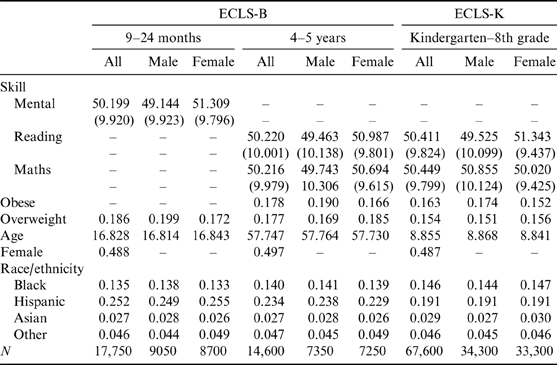
All estimation procedures included a set of basic controls given by age in months (ECLS-B) or years (ECLS-K), a quadratic specification for birth weight, indicator variables for race/ethnicity (black, Hispanic, Asian and other non-white), an indicator for whether the child was female, the logarithm of household size, an indicator for the presence of a resident mother, mother's age interacted with the indicator for her presence, an indicator for the presence of a resident father, father's age interacted with the indicator for his presence, a set of indicators for mother's and father's highest attained education (high school diploma, vocational/technical qualification or some college, bachelor's degree or postgraduate degree, reference category=not finished high school) interacted with indicators for their presence, and the logarithm of household income. Table 1 presents the means of selected analysis variables.
Means of selected analysis variables, 2001 ECLS-B and 1998 ECLS-K

Selected standard deviations in parentheses. Means (standard deviations) of skills scores do not exactly equal 50 (10) because standardization was applied to all assessed children at each wave regardless of missing information on height or weight.
Overweight at 9 and 24 months defined as at or above the 95th weight-for-length percentile. For all other waves: obese defined as at or above the 95th BMI percentile, overweight defined as between the 85th and 94th BMI percentile.
Mean age is in months for ECLS-B samples and in years for the ECLS-K.
Sex and race/ethnicity categories can be interpreted as proportions of each sample. Means calculated using sampling weights, as described in the text.
Estimation
The relationship of interest is given by:
 $$s_{it} = \Sigma ^2_{j=1} \gamma _{ijt} b_{ijt} + x_{it} \beta + \alpha _i + v_{it}$$
where sit is a skill assessment score for child i at time t, bijt for j=1, 2 are indicators for levels of weight status (j=1 for observations in the 9- and 24-month ECLS-B waves), xit values are the set of controls described above, αi are time-constant unobserved productivity factors that influence skill learning and vit∼N(0, σ2v) is an idiosyncratic disturbance term. The productivity factors could be at the individual, family or school/community level.
Estimation of equation (1) was performed under separate assumptions about the nature of αi. First, random effects models were estimated under the assumption that the αi values were uncorrelated with the observed explanatory variables bit and xit. Second, the assumption of uncorrelated αi values was relaxed in fixed effects models that eliminated unobserved factors from the estimated equation by time-demeaning the variables. Correlation between αi and body weight could occur at any level. At the individual level there may be a dimension of innate ability that fosters both healthy physical and cognitive development. Unmeasured parental factors such as their own skills and personality characteristics could also jointly affect their children's physical and cognitive development, for example through the quality of engagement that parents have with their children. Unmeasured school and neighbourhood quality may similarly affect children's development. Should a body weight association be found in the random effects models but not the fixed effects models then it would suggest that the association derives from the unobserved productivity factors that are common to both body weight and skills outcomes. The fixed effects approach is not failsafe with respect to addressing the endogeneity of birth weight. Caveats to the approach are discussed at the end of this paper.
Three pooled samples were constructed from the cohort data. The first sample included all observations across the 9-month and 24-month waves of the ECLS-B and defined sit as the mental skills assessment score. The second sample included all observations across the 4-year and 5-year waves of the ECLS-B and defined sit as the reading or maths skills assessment score (two equations). The final sample included all observations (kindergarten to eighth grade) in the ECLS-K and defined sit as the reading or maths skills assessment score (two equations). Sex subsamples were also evaluated.
Estimation of all models was performed in Stata/SE 12.1. Sampling weights were provided with each dataset that reflected the probability of inclusion in the original cohorts and these were applied to all models. This was particularly important for the ECLS-B given its oversampling of low and very low birth weight children. A disproportionate representation of the growth patterns distinct to these children may have biased the results. Random effects models were estimated with the ‘xtmixed’ command and fixed effects models were estimated with the ‘xtreg’ command. Both commands allowed the application of sampling weights to the respective models. Preference for random versus fixed effects was evaluated using the post-estimation ‘hausman’ command (Hausman, Reference Hausman1978).
Results
Main results
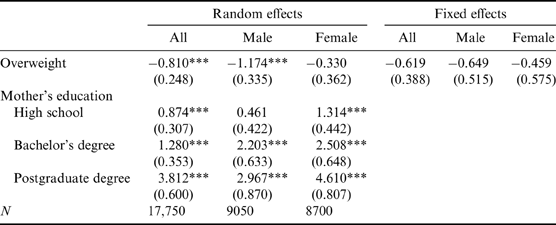
Table 2 shows the random and fixed effects estimates of the coefficients on overweight relative to the mental skills assessments in the 9- and 24-month ECLS-B waves. The random effects coefficients for mother's education are also shown as a basis for comparison. The random effects models suggest a negative association of high body weight with mental skills scores in males but not females. The coefficient suggests a 0.12 SD lower score in males associated with being overweight as defined by weight-for-length percentile. This magnitude is approximately 55% of the association of a mother having a bachelor's degree relative to not finishing high school. The coefficient for the female sample is small and estimated with high standard error. The fixed effects models show negative coefficients on overweight in both sexes but they are estimated with high standard error and fail to reach statistical significance at p<0.05. Hausman tests rejected the random effects specification in females at p<0.01 but could not reject it at p<0.05 in the male sample.
Random and fixed effects specifications for mental skills assessment, ECLS-B 9- and 24-month waves
Overweight defined as at or above the 95th weight-for-length percentile. Robust standard errors in parentheses. Other controls are described in the text. Reference category for mother's education is less than high school. Samples sizes are rounded to the nearest 50.
***p<0.01.
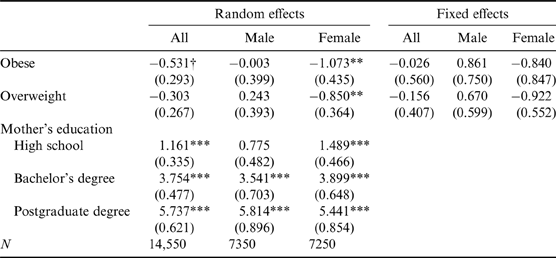
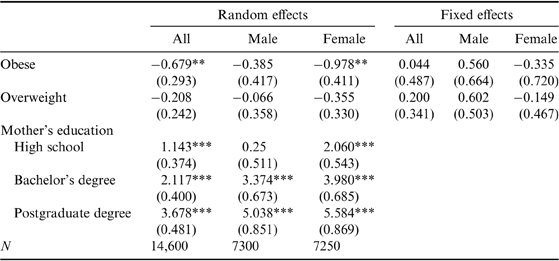
Tables 3 and 4 present the estimates on BMI categories of overweight and obesity relative to reading and maths assessments at the 4- and 5-year ECLS-B waves. The random effects models suggest negative associations of overweight and obesity with both reading and maths scores in the female sample but not in males. Obesity is associated with approximate 0.10 SD lower reading and maths scores. This is about 20–25% of the magnitude of the association with a mother having a bachelor's degree. The association with overweight is comparable to that with obesity on reading scores (0.09 SD) but smaller on maths scores (0.04 SD) and estimated with high standard error. The estimated coefficients in the fixed effects models remain negative in the female sample and for reading scores the coefficients are comparable in magnitude to the random effects models. However all coefficients are estimated with high standard error and fail to reach significance at p<0.05. Fixed effects coefficients for the male sample are all positive and also fail to reach significance. Hausman tests rejected all random effects specifications at p<0.01.
Random and fixed effects specifications for reading skills assessment, ECLS-B 4- and 5-year waves
Obese defined as at or above the 95th BMI percentile. Overweight defined as between the 85th and 94th BMI percentile. Robust standard errors in parentheses. Other controls are described in the text. Reference category for mother's education is less than high school. Samples sizes are rounded to the nearest 50.
***p<0.01; **p<0.05; †p<0.10.
Random and fixed effects specifications for maths skills assessment, ECLS-B 4- and 5-year waves
Obese defined as at or above the 95th BMI percentile. Overweight defined as between the 85th and 94th BMI percentile. Robust standard errors in parentheses. Other controls are described in the text. Reference category for mother's education is less than high school. Samples sizes are rounded to the nearest 50.
***p<0.01; **p<0.05.
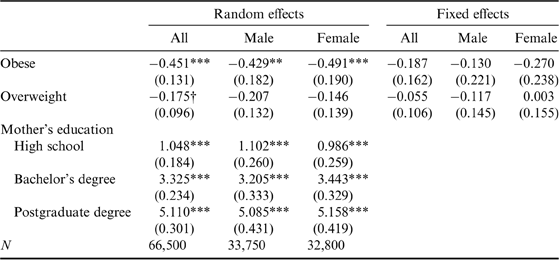
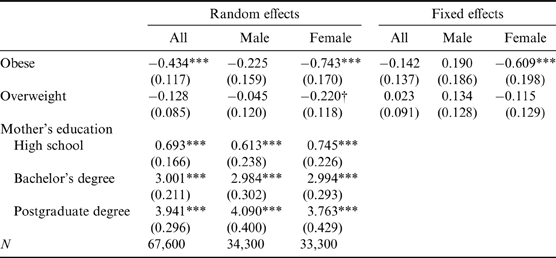
The random and fixed effects estimates for the ECLS-K sample are given in Tables 5 and 6. The random effects models suggest a negative association of obesity with reading scores in both sexes, and a negative association with maths scores in the female sample. Obesity is associated with 0.04 to 0.05 SD lower reading scores in males and females, a magnitude that is 13.5% of a mother having a bachelor's degree. Obesity in females is associated with a 0.07 SD lower maths scores, a magnitude that is about 25% of a mother having a bachelor's degree. For both sexes the coefficients on overweight are small relative to those on obesity and generally estimated with high standard error.
Random and fixed effects specifications for reading skills assessment, ECLS-K all waves
Obese defined as at or above the 95th BMI percentile. Overweight defined as between the 85th and 94th BMI percentile. Robust standard errors in parentheses. Other controls are described in the text. Reference category for mother's education is less than high school. Samples sizes are rounded to the nearest 10.
***p<0.01; **p<0.05.
Random and fixed effects specifications for maths skills assessment, ECLS-K all waves
Obese defined as at or above the 95th BMI percentile. Overweight defined as between the 85th and 94th BMI percentile. Robust standard errors in parentheses. Other controls are described in the text. Reference category for mother's education is less than high school. Samples sizes are rounded to the nearest 10.
***p<0.01; **p <0.05; †p<0.10.
The fixed effects models suggest a significant negative effect from obesity on maths scores in females. The coefficient suggests a 0.06 SD lower maths score associated with obesity. This magnitude is comparable to that from the random effects model. The obesity coefficient in the reading equation is smaller than in the random effects model and fails to reach significance. No other fixed effects estimates suggest significant associations from overweight or obesity on academic scores in either sex. Hausman tests rejected all random effects specifications at p<0.01.
Extensions
Three further analyses were performed. First, the ECLS-K sample was evaluated for age trends in the associations with overweight and obesity. This was done by interacting the indicators for overweight and obesity with the continuous age variable. There were no significant interaction coefficients in any random effects or fixed effects model. Age trends were not evaluated in the ECLS-B sample since the age range for each pooled sample was narrow.
A second analysis was performed to evaluate potential variations by race/ethnicity. The random and fixed effects models were re-estimated on each sex subsample further divided into categories of white, black and Hispanic race/ethnicity. It should be noted that the reduced sample sizes, particularly for the black and Hispanic groups in the ECLS-B samples, resulted in large standard errors that made comparisons between groups imprecise. Tabular results are not presented here and what follows are some comments based on observed rather than statistical comparisons.
First, the association between overweight and mental skills for males in the 9- and 24-month ECLS-B waves was reflected in white and black males. The estimated coefficients for these groups were close to the broader male sample. The coefficient estimated for Hispanic males was about half of the size of white and black males and estimated with high standard error. Second, white females exhibited a pattern most consistent with the random effects results on reading and maths assessments in the 4- and 5-year ECLS-B pooled sample. White females exhibited significant negative associations of overweight and obesity with reading scores and a significant negative association of obesity with maths scores, all of which were of similar magnitude to the broader female sample. Hispanic females showed coefficients on obesity that were close in magnitude to white females, while black females showed coefficients on overweight that were close in magnitude to white females. None of the coefficients for black or Hispanic females was significant. Third, white and black females exhibited the fixed effects negative association between obesity and maths scores that was found for the broader female ECLS-K sample. Black females exhibited coefficients that suggested a stronger effect from obesity (a 0.09 SD lower score versus a 0.05 SD lower score for white females). The coefficient for Hispanic females was near-zero and not significant.
A final analysis was performed to evaluate the robustness of the results to alternative definitions of overweight and obesity. Two international BMI references were evaluated: the 2006 World Health Organization (WHO) Growth Standards for children aged 0 to 5 years complemented with the 2007 WHO Growth Reference for children over 5 years, and the 2000 International Obesity Task Force (IOTF) classifications of overweight and obesity for ages 2 and older. Details on the WHO data can be found in de Onis & World Health Organization (Reference de Onis2006) and de Onis et al. (Reference de Onis, Onyango, Borghi, Siyam, Nishida and Siekmann2007). Details on the IOTF data can be found in Cole et al. (Reference Cole, Bellizzi, Flegal and Dietz2000) and Cole & Lobstein (Reference Cole and Lobstein2012). The cut-offs applied to these references were based on previous recommendations in the literature. Cut-offs for the WHO reference were divided by age group: for ages 0 to 5 the cut-offs were age- and sex-specific BMI z-scores of 2.0 and 3.0; for ages over 5 years the cut-offs were BMI z-scores of 1.0 and 2.0 (de Onis & Lobstein, Reference de Onis and Lobstein2010). The IOTF cut-offs were based on their age- and sex-specific BMI growth curves that link to conventional adult BMI cut-offs for overweight (BMI>25) and obesity (BMI>30) (Cole et al., Reference Cole, Bellizzi, Flegal and Dietz2000; Cole & Lobstein Reference Cole and Lobstein2012). Due to age constraints the IOTF categories were not assigned to observations in the 9- and 24-month pooled ECLS-B sample. WHO categories were identified using the user-written ‘zscore06’ command in Stata/SE 12.1 (Leroy, Reference Leroy2011). International Obesity Task Force categories were identified using the user-written ‘zanthro’ command in Stata/SE 12.1 (Vidmar et al., Reference Vidmar, Carlin, Hesketh and Cole2004).
The general results were robust to alternative references for overweight and obesity. Random effects models showed males with negative associations for WHO obesity with mental skills scores in the 9- and 24-month pooled ECLS-B sample, females with negative associations for WHO and IOTF obesity with reading and maths scores in the 4- and 5-year ECLS-B pooled sample, and generalized negative associations for WHO and IOTF obesity with reading and maths scores in the ECLS-K sample across sexes. The magnitudes of association were also comparable to those found using the CDC reference in the main analysis. Further, females exhibited significant fixed effects associations between WHO and IOTF obesity and maths scores in the female ECLS-K sample of the magnitude suggested by the CDC reference. The IOTF obesity also exhibited a negative association with reading scores in the fixed effects models for the female sample of a similar magnitude to the association found with maths scores (a 0.07 SD reduction).
Discussion
This study evaluated the associations between high body weight in proportion to height and skills assessments in large cohorts of US children followed from infancy to 5 years and from kindergarten (6 years of age) to the eighth grade (14 years). These data offer advantages over data used in previous work: the data are representative of US child populations, include pre-school ages and provide distinct assessment instruments. Random effects models that assumed no correlation between body weight and unobserved time-constant productivity factors suggested negative associations between high body weight and skills outcomes in several of the samples evaluated. The associations were observed for males in early life with respect to a mental skills assessment, for females during the pre-school years for reading and maths assessments, for both males and females during the schooling years for reading skills assessments and for females during the schooling years for maths skills assessments. The associations were generally strongest for the most extreme body weight category (e.g. obesity). Hausman tests rejected a random effects specification at p<0.05 in all but the first case. For the other cases a fixed effects specification was favoured that eliminated the unobserved factors to address correlation between those factors and the explanatory variables. Fixed effects models yielded a significant negative association only with respect to maths skills for the school-age female sample. This suggested that other random effects associations may have been reflective of unobserved productivity factors common to body weight and skills outcomes.
Much like previous work that attempted to correct for endogeneity problems, the results of this study do not support a generalized negative causal effect from high body weight on skills outcomes in US children. For males, though there was an indicated body weight effect on mental skills in early life, the estimated association with reading skills during the schooling years was suggested to reflect unobserved productivity factors common to both body weight and skill outcomes. These results might suggest that any potential effect from high body weight in males is confined to early life and does not persist to childhood. However, this cannot be evaluated in the present study given that the data do not allow a link between early-life and school-age outcomes. They could also reflect the possibility of the early-life mental test measuring a dimension of skills learning that is not predictive of reading and maths skills.
The most compelling evidence for a negative effect from high body weight was found in school-aged females for maths skills. The effect was present in the fixed effects model for the most extreme BMI category (obesity) and for white and black females. It was also robust for obesity defined by a number of growth references (CDC, WHO and IOTF). This detrimental effect of high body weight on maths skills may contribute to a double penalty on adolescent females' future earnings. A number of studies, perhaps not surprisingly, have suggested a causal link between the development of maths skills during the schooling years and future earnings (Joensen & Nielsen, Reference Joensen and Nielsen2009; Koedel & Tyhurst, Reference Koedel and Tyhurst2012). Added to this is a female-specific wage penalty associated with being overweight that previous analyses have found even when controlling for measures of cognitive skill (Cawley, Reference Cawley2004). Again, the age limits on the data do not provide for an evaluation of these potential connections.
There is also the matter of explaining the mechanisms of a body weight effect in females. There are plausible biological mechanisms, as noted in the Introduction (e.g. sleep apnoea), that may explain the effect. Those mechanisms are generally linked to obesity defined by direct measures of excess adiposity, and it is a limitation of BMI that it does not distinguish between fat mass and fat-free mass. This may explain why the relationship was found in females and not males. Females generally carry higher fat mass than males, and consequently high BMI may better indicate excess adiposity in the former (Freedman et al., Reference Freedman, Wang, Maynard, Thornton, Mei and Pierson2005). However, it still isn't clear why high body weight would differentially influence maths relative to reading skills. These issues are beyond the scope of the current study but can guide future work that corroborates a sex-specific negative body weight effect on academic skills. An emphasis on direct measures of adiposity may prove most helpful.
Fundamental to the preceding discussion is that the fixed effects estimates successfully identify the body weight effect on skills. Identification rests on several factors (for textbook treatment see Wooldridge, Reference Wooldridge2010). First, fixed effects models are appropriate when endogeneity concerns are specific to the influence of time-constant unobserved factors. Reverse causality may be another source of endogeneity if weight control is impeded by lower ability. The nature and results of this study do not support reverse causality. Much of the sampled children are at ages when parental control might be thought more important than self-control and there was no indication that the body weight associations became stronger as children entered into adolescence. Another potential problem with fixed effects estimation is the potential of exacerbated bias from measurement error in the explanatory variables. Again this is not a large concern in the present case since height and weight were not parent- or self-reported but were measured multiple times at each wave.
Three other limitations of a fixed effects approach are of more concern to this study. First, the approach assumes that endogeneity problems arise from unobserved productivity factors that do not vary over time. Omitted time-varying factors that are common to body weight and skills outcomes may also be a source of endogeneity and therefore bias the estimated coefficients. The ECLS-K sample may be more prone to this source of endogeneity given its broader age range. For example, a child's changing social/peer network through childhood and adolescence may influence his health and learning behaviours. Such factors are difficult to measure without error and the conventional solution would be the application of instrumental variables techniques. However, finding some variable that would correlate with body weight outcomes but be uncorrelated with time-varying productivity factors is a very difficult task. Therefore a caveat to the fixed effects estimates of this paper is that the coefficients may be biased to the extent that unobserved productivity factors are time-varying rather than time-constant.
A second limitation of fixed effects estimation is that it offers no guidance on what the relevant unobserved factors might be even if they are time-constant. Identifying these factors may be important to policy discussions. For example, the association between high body weight and reading skills in the ECLS-K sample was suggested to derive from time-constant productivity factors. Identifying these factors, and whether they exist at the individual-, family- or school-/community-level, would be critical in designing interventions designed to affect both physical and academic development in children.
A second source of concern is the degree of within-individual variation in body weight status between time periods on which the efficiency of fixed estimation rests. This is a more serious concern in the ECLS-B pooled samples since they are limited to two waves of relatively close ages. This study made no claims of inference from the fixed effects estimates of the ECLS-B samples given the high standard error on the coefficients. The lack of sufficient degree of variation in the ECLS-K sample is less of a concern given its age range, which includes common periods of body composition change, namely the late period of adiposity rebound and early- to mid-puberty.
Two further notes on the scope of this study are offered. First, direct skills assessments after infancy were limited to reading and mathematics. While these are fundamental academic skills that influence productivity in school, they are not the only skill types that may be affected by high body weight and have implications for future productivity. For example, despite a lack of association with academic-type skills, Palermo & Dowd (Reference Palermo and Dowd2012) did find evidence of a small negative effect of BMI-defined obesity on non-cognitive outcomes in their fixed effects models estimated for US girls. Recent work has stressed the productivity contribution of these non-cognitive skills that relate to psychology (e.g. self-efficacy and locus of control) and social interactions (e.g. hostility and communication ability) (Heckman & Rubinstein, Reference Heckman and Rubinstein2001; Heckman et al., Reference Heckman, Stixrud and Urzua2006; Cunha & Heckman, Reference Cunha and Heckman2008). Future work should consider multiple skills dimensions if data allow.
Second, the relative importance of the findings from this analysis should not rest on the premise that skill development is the direct aim of interventions that address high body weight in US children. Foremost in policy discussions on child overweight and obesity are the negative health effects that persist through adolescence and into adulthood (Philipson, Reference Philipson2001; Ebbeling et al., Reference Ebbeling, Pawlak and Ludwig2002; Cawley, Reference Cawley2006). The findings of this study suggest that a complementary benefit to reductions in the prevalence of high body weight may be an increased skill set in children. The magnitude of this benefit may relate to the manner of intervention. Interventions that target factors that are general to overall healthy development, such as those related to parents' productive engagement with their children, would be expected to yield a larger complementary benefit. Interventions that are more focused, such as influencing food choice at school, may yield a limited benefit to those skills that are directly affected by high body weight, which this study suggests are maths skills in school-aged females.
Conclusions
The trend of increasing BMI-defined obesity rates in US children has motivated research on the potential consequences. While the majority focus of such research has been on health effects, other work has evaluated the potential effect on child human capital development. This paper presents evidence of negative associations between high BMI and skill development in US children from infancy to adolescence. With the exception of school-aged females and maths skills, these associations are suggested to derive from unobserved productivity factors related to body weight outcomes. The implication of these findings is that any improvement in skills outcomes that may accompany reductions in obesity prevalence may depend on whether the interventions chosen, though likely to be motivated primarily by health concerns, are general to these productivity factors or whether they are specific to dietary and exercise behaviours.