Introduction
Metabolism of polyunsaturated fatty acids (PUFA) of the omega-3 (n-3) fatty acid (FA) family in animal models and human clinical studies are well reported in the scientific literature. Briefly, the results from these studies emphasise the role of n-3 PUFA for normal growth and development of central nervous system, immune functions and prevention and management of coronary heart disease (De Lorgeril et al., Reference DE LORGERIL, RENAUD and MAMELLE1994; Reference DE LORGERIL, SALEN, MARTIN, MAMELLE, MONJAUD, TOUBOUL and DELAYE1996; Simopoulos, Reference SIMOPOULOS2000; Griffin, Reference GRIFFIN2012; Calder, Reference CALDER2013). Human intake of n-3 FA are from plant (18°C) and marine sources (>20°C). However, modern lifestyle and agri-food production practices led to reduction in n-3 FA in the current western diets (Stark et al., Reference STARK, VAN ELSWYK, HIGGINS, WEATHERFORD and SALEM2016). Health agencies recommend increased consumption of n-3 FA, particularly long-chain (>20°C) n-3 PUFA. Marine sources of n-3 FA are limited in western diets due to cost, smell, taste, availability, sustainability, and other concerns such as allergy (Beheshti Moghadam et al., Reference BEHESHTI MOGHADAM, SHEHAB and CHERIAN2017; Cherian, Reference CHERIAN2016). Animal food products such as eggs and meat are targeted for enrichment with n-3 FA through diet manipulation. Poultry industry has been a pioneer in the production and marketing of eggs enriched with n-3 FA. This technology primarily utilises n-3 FA-rich feed sources in enhancing the nutritional value of food products. Flax (Linum usitatissimum L.) is an oilseed with 41-42% crude fat. The apparent metabolisable energy value of flaxseed is 3,957 kcal/kg (Lee et al.,1995) and the oil is rich in α-linolenic acid (ALA, 18:3 n-3) (40-50%), which makes it an attractive feed ingredient for n-3 FA enrichment in poultry diets. This review attempts to bring together the use of flaxseed (flax) in poultry diets to meet the human requirement of n-3 FA.
Omega-3 (n-3) and omega-6 (n-6) essential fatty acids
The two groups of FA that are of particular interest in animal and human nutrition are n-3 FA and n-6 FA (first double bond at position 3 and 6 relative to the methyl end). Monogastrics such as humans and poultry lack desaturase enzymes that can add double bonds at positions farther than ten carbons from the carboxyl group. Thus, these organisms are not able to synthesise linoleic acid (LA, 18:2 n-6) and ALA, and are considered as essential FA and must be consumed through the diet. Main dietary sources of LA include grains, vegetable oil (e.g. corn oil, safflower oil), and animal tissues, while sources of ALA include oil seeds and their oils, and leafy green vegetables. Although more than 50% of the total fat in leafy greens is ALA, the total fat is less than 2% on a dry matter basis so vegetable sources cannot provide a substantial amount of n-3 FA to the human diet (Poureslami and Batal, Reference POURESLAMI and BATAL2012). Dietary LA and ALA are elongated and desaturated by elongase and desaturase enzymes to produce 20- and 22-carbon long chain PUFA. The long chain PUFA are precursors to bioactive molecules called eicosanoids that are involved in immune and inflammatory processes (Calder, Reference CALDER2013). Eicosanoids derived from n-3 FA precursors promote resolution of inflammatory responses while those derived from n-6 FA precursors are associated with both pro- and anti-inflammatory responses (Calder, Reference CALDER2013). The dietary guidelines for Americans recommend 2.2 g of ALA and 0.65 g of long chain PUFA (EPA+ DHA) (Kris-Etherton et al., Reference KRIS-ETHERTON, TAYLOR and YU-POTH2000). The World Health Organisation recommends a lower daily intake of 0.8 to 1 g of ALA and 0.3 to 0.5 g of EPA + DHA and 10-12 g of LA (Barceló-Coblijn and Murphy, Reference BARCELÓ-COBLIJN and MURPHY2009). However, the current consumption in western countries is 1.5 g for ALA and 0.2-0.3 g for EPA+DHA with ratio of n-6 to n-3 over 10:1 (Kris-Etherton et al., Reference KRIS-ETHERTON, TAYLOR and YU-POTH2000). A common question is, can consumption of ALA provide the same health benefits to humans as direct consumption of long chain n-3 PUFA? This depends on the efficiency of converting of ALA to EPA and DHA. The efficiency of the conversion of ALA to EPA is about 0.2%, ALA to n-3 docosapentaenoic acid is about 0.13%, and ALA to DHA is about 0.05%. Nearly 60% of the EPA that is synthesised is converted to docosapentaenoic acid (DPA, 22:5 n-3), and about 40% of the DPA that is synthesised is converted to DHA (Brenna et al., 2009). Even these low conversion rates are sufficient to supply the necessary amounts of long chain n-3 PUFA (Burdge and Calder, Reference BURDGE and CALDER2005).
In comparison to humans, digestibility and availability of ALA in feed, and metabolic efficiency of hen in bioconversion of ALA plays an important role in long chain (EPA, DPA, DHA) fatty acid enrichment in poultry tissues. Using fatty acid balance study, Poureslami et al. (Reference POURESLAMI, RAES, TURCHINI, HUYGHEBAERT and DE SMET2010) reported that in broilers fed linseed oil, a total of 5-8% of the net intake of ALA was eventually converted to n-3 long chain PUFA and concluded that overall potential for elongation and desaturation of ALA was higher in poultry than in humans.
Flax as a source of n-3 fatty acids in poultry diets
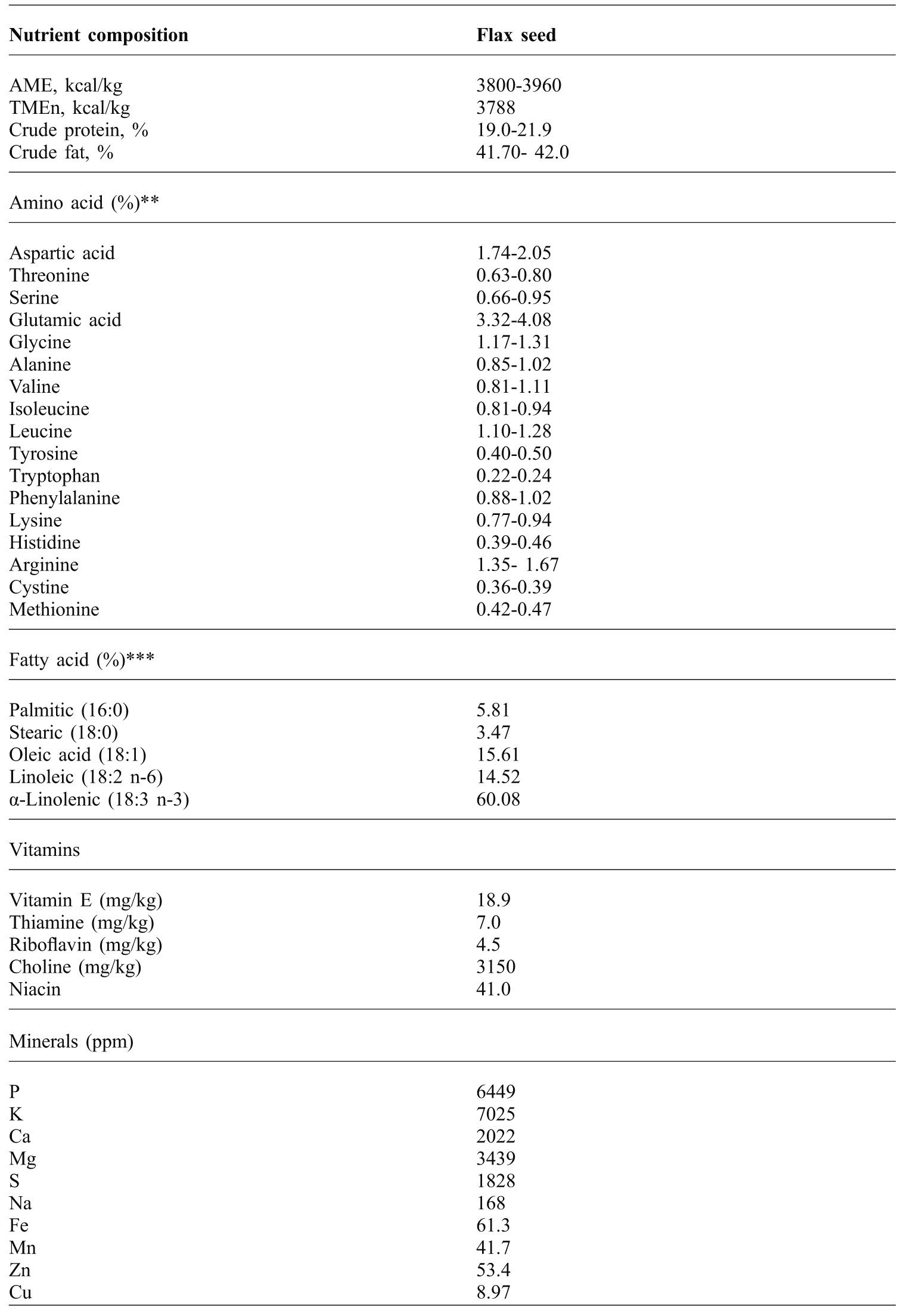
Flaxseeds are small with a flat to oval shape and are approximately 2-3 mm wide and 3-5 mm long. Based on proximate nutrient analysis, flaxseeds are comprised of 20 to 30% protein and around 30% nitrogen-free extract, corresponding to the carbohydrate fraction. The nutritional composition of flaxseed is shown in Table 1 .
Chemical composition and nutrient profile of flaxseed*.

*Adapted from Lee et al., Reference LEE, QI and SIM1995; Cherian and Quezada, Reference CHERIAN and QUEZADA2016.
** True amino acid availability of flax seeds are in the range of 70-87% (Lee et al., Reference LEE, QI and SIM1995).
*** Fatty acids are reported as percent of total fatty acid methyl esters.
Flaxseeds contain on average 41-42% oil, and are one of the riches source of 18°C n-3 fatty acid (ALA). Flaxseed has several other components such as soluble fibre, and lignans (water-soluble phenolic compounds, a class of phytoestrogens) (Oomah, Reference OOMAH2001). As a feed ingredient, flax can be used as a protein, energy and n-3 FA supplement in poultry diets. However, there are challenges associated with feeding flax to poultry and different strategies that could be adopted for enhancing nutritional value and n-3 FA incorporation are described below.
Anti-nutritional factors in flax
With respect to the use of flaxseed in poultry feeding, its anti-nutritional factors (ANF) make it always questionable as a functional feed ingredient for n-3 FA enrichment purposes. Cyanogenic glycosides, trypsin inhibitor, phytic acid, mucilage, and anti-pyridoxine factor are the different ANF present in flax (Bhatty, Reference BHATTY1995). Among these, cyanogenic glycosides (linustatin, neolinustatin and linamarin), the major one is linamarin and ranges from 0 to 300 mg/kg. Cyanogenic glycosides are degraded by ß-glucosidase in the large intestine releasing hydrogen cyanide, albeit in small amounts. Negative effect of hydrogen cyanide on growth, nutrient utilisation and blood indices in broilers have been reported. Mucilage is found in the outer hull of the seed and accounts for approximately 8% of the weight of the seed. Mucilages are water soluble, indigestible, carbohydrates that absorb water and increase intestinal viscosity leading to reductions in energy utilisation, fat digestibility and performance (Alzueta, et al., 2003; Slominski, Reference SLOMINSKI2011). Phytic acid present in flaxseed leads to formation of protein-mineral-phytic acid complexes that are not bioavailable, leading to impaired nutrient absorption and body weight gain. Flax also contains vitamin B6 (pyridoxine) antagonist called linatine (Bishara and Walker, Reference BISHARA and WALKER1977). The concentration of linatine typically ranges from 20-100 mg/kg. Occasionally symptoms of vitamin B6 deficiency can be observed in broiler chickens fed flax and, therefore, it is recommended that diets containing flax or seed meal be supplemented with additional pyridoxine to offset the potential negative effects of linatine on vitamin B6 (Ahmad et al., Reference AHMAD, KAMRAN and KOUTOULIS2016).
Mitigating the anti-nutritional factors in flax
feed processing
Processing of flax has been employed to minimise the negative effects of ANF. Processing methods employed are: heating, grinding, pelleting, crumbling, autoclaving and microwave roasting. Pelleting (4,578 kcal/kg) or crumbling (4,277 kcal/kg) significantly increases AMEn fed to roosters compared to mash (3,659 kcal/kg) (Gonzalez-Esquerra and Leeson, Reference GONZALEZ-ESQUERRA and LEESON2000). Extrusion processing of an ALA feed supplement containing 60% flaxseed improved AMEn by 18% (Bean and Leeson, Reference BEAN and LEESON2003). The pressure and heat of processing may release trapped oil from the matrix of the cell or the heat may destroy some of the ANF in the feed (Gonzalez-Esquerra and Leeson, Reference GONZALEZ-ESQUERRA and LEESON2000). Feed processing tends to denature the ß-glucosidase preventing the formation of hydrogen cyanide. Feeding broiler chickens diets containing 12% flax from 1-21 days and 15% from 22-40 days reduced body weight, feed intake and feed efficiency but feeding pelleted and mashed flax significantly improved body weight gain, feed conversion efficiency and feed intake (Shen et al., Reference SHEN, FENG, FAN and CHAVEZ2005a). These authors also reported that pelleting increased fatty acid retention by 29%, microwaving increased FA utilisation by 39%, and autoclaving increased fat utilisation by 20%. Nitrogen retention was also significantly improved by heat and/or physical processing (Shen et al., Reference SHEN, FENG, ORESANYA and CHAVEZ2005b).
use of exogenous enzymes
The use of dietary enzymes to target NSP of flax is a relatively new initiative. Potential beneficial effects of NSP-degrading enzymes in poultry nutrition has been reported (Slominski et al., Reference SLOMINSKI, MENG, CAMPBELL, GUENTER and JONES2006; Jia et al., Reference JIA, SLOMINSKI, GUENTER, HUMPHREYS and JONES2008). Enzyme cocktails were effective in cell wall polysaccharide depolymerisation, but they were not effective in reducing the viscosity of flax mucilage (Slominski et al., Reference SLOMINSKI, MENG, CAMPBELL, GUENTER and JONES2006). Recent research from author's laboratory has demonstrated that addition of NSP-degrading enzymes increases FA digestibility, retention of n-3 FA in tissues while enhancing the absorptive surface of foregut in broilers and layers (Apperson and Cherian, Reference APPERSON and CHERIAN2017; Head, Reference HEAD2016; Westbrook, Reference WESTBROOK2016).
use of sulphur amino acids
Cyanogenic glycosides are amino acid derived secondary plant metabolites present in flax and are degraded in the large intestine leading to the release of toxic hydrogen cyanide which can bind and inactivate various metallo-enzymes including cytochrome C oxidase involved in oxygen metabolism (Mosharov et al., Reference MOSHAROV, CRANFORD and BANERJEE2000; Rocha-e-Silva et al., Reference ROCHA-E-SILVA, CORDEIRO and SOTO-BLANCO2010). The detoxification of cyanide by conversion to thiocyanate requires sulphur donors, which by different metabolic pathways are provided from dietary sulphur amino acids (Bradbury and Holloway, Reference BRADBURY and HOLLOWAY1988). In addition, there are several minor reactions that detoxify ingested cyanide such as reaction of cysteine with the cyanide to form 2-imino-thiazolidine-4-carboxylic acid, which is excreted in the saliva and urine. In this context, a recent study by Beheshti Moghadam et al. (Reference BEHESHTI MOGHADAM, SHEHAB and CHERIAN2017) reported that methionine supplementation enhances n-3 FA deposition in the muscle tissue of broiler birds fed flax.
Effects on egg yolk fatty acids of eggs from hens consuming flax
Chicken eggs are one of the most highly researched food item for n-3 FA incorporation. Several authors reported successful enrichment of chicken eggs with n-3 FA by incorporating flax in the layer diets (Caston et al., Reference CASTON, SQUIRES and LEESON1994; Cherian, Reference CHERIAN2009; Reference CHERIAN2016). Overall, the greatest effect of feeding flax is the linear increase in ALA. Most studies reported 100 to 300 mg ALA in eggs from hens fed 5 to 15% flax. The dramatic increase observed in ALA was not visible in other long chain n-3 FA (e.g. DHA) (~50 to 60 mg) indicating a minimal influence of dietary ALA on hepatic desaturases in the hen (Cherian, Reference CHERIAN2016). However, flax feeding leads to significant reduction in n-6 FA (LA, arachidonic) and n-6:n-3 FA ratio. Flax feeding has limited effect on saturated FA, but most studies reported a decrease in oleic acids (18:1) upon inclusion of flax in layer diets. Addition of NSP-degrading enzymes has been attempted recently to increase n-3 FA incorporation. Increase in egg ALA, DHA and total n-3 FA were reported through addition of enzymes in layers fed diets containing 10% flax (Westbrook, Reference WESTBROOK2016). However, Jia et al. (Reference JIA, SLOMINSKI, GUENTER, HUMPHREYS and JONES2008) reported no difference in ALA but significant increase in egg DHA content of layers fed 15% flax with added enzymes. Several studies also reported using flax oil instead of flax for n-3 FA enrichment. Although encouraging, considering the cost, product sensory and lipid stability aspects, may not be economically feasible to include at levels above >2.5% to get a meaningful enrichment of n-3 FA. Feeding whole vs. ground flaxseed has been attempted to enhance n-3 FA in chicken eggs (Fraeye et al., Reference FRAEYE, BRUNEEL, LEMAHIEU, BUYSE, MUYLAERT and FOUBERT2012). Scheideler and Froning (Reference SCHEIDELER and FRONING1996) reported no effects of grinding flaxseed on egg n-3 FA enrichment in layer hens fed diets containing 5, 10 or 15% flaxseed. However, Aymond and Van Elswyk (Reference AYMOND and VAN ELSWYK1995) reported increase in ALA (163 vs. 212 mg/egg) and EPA+DHA (80.6 vs. 110 mg/egg) in hens fed 15% whole vs. ground flaxseed. Feeding whole flaxseeds may be advantageous in n-3 FA enriched egg production as it reduces processing costs and loss of nutrients, and might protect the lipids from oxidative problems resulting from grinding.
Effects of feeding flax on egg quality and hen production aspects
Published research data on the effect of flax on egg production parameters have been inconsistent. Jiang et al. (Reference JIANG, AHN, LADNER and SIM1991) and Caston et al. (Reference CASTON, SQUIRES and LEESON1994), Bean and Leeson (Reference BEAN and LEESON2003), Hayat et al. (Reference HAYAT, CHERIAN, PASHA, KHATTAK and JABBAR2009) reported no effect of flax on egg production, whereas Van Elswyk (Reference VAN ELSWYK1997) suggested that flax addition may have negative effects. Most reported studies on hen production aspects use 10% flax. A general belief within the feed industry is that egg production could be significantly reduced in layer flocks when the flaxseed inclusion rate is greater than 8% (Gonzalez-Esquerra and Leeson, Reference GONZALEZ-ESQUERRA and LEESON2001). Reduced production has been attributed to low nutrient utilisation or due to the presence of ANF as described earlier affecting feed utilisation. The decreased energy utilisation from flax-containing diets has been reported to result from incomplete rupture of the seed and nutrient encapsulation by the cell wall structure (Slominski et al., Reference SLOMINSKI, MENG, CAMPBELL, GUENTER and JONES2006). To address this problem multicarbohydrase enzyme has been added and shown to have positive effects on feed conversion ratio, egg production and egg specific gravity in layers fed 15% flax (Jia et al., Reference JIA, SLOMINSKI, GUENTER, HUMPHREYS and JONES2008). Westbrook (Reference WESTBROOK2016) reported significant increase in egg weight and yolk weight in layers fed 10% flax with 0.1% carbohydrase enzyme. Several researchers have reported that addition of flax in layer diets generally lead to a reduction in yolk weight. However, decrease in yolk weight was not associated with egg weight. Feeding diets containing 10% flax for 25 weeks, Bean and Leeson (Reference BEAN and LEESON2003) reported higher incidence of liver haemorrhage in brown and white hens compared to those birds fed the control diet. However, these results conflicted with those of Caston et al. (Reference CASTON, SQUIRES and LEESON1994), Schumann et al. (Reference SCHUMANN, SQUIRES and LEESON2000), and Cherian and Hayat (Reference CHERIAN and HAYAT2009), who reported no effect of long term feeding of flax on hen liver haemorrhage scores. However, to minimise variations in egg quality and hen health issues, it is a common practice to feed n-3 FA enriched diets during 30 -60 week of egg production (Bean and Leeson, Reference BEAN and LEESON2003).
Effects of feeding flax on production aspects in broiler birds
Compared to layer birds, feeding flax to broiler birds has been reported to have several negative effects on production performance. Flax contains several ANF that interfere with the utilisation of nutrients, affecting bird performance parameters such as average daily gain, final body weight, carcass weight and yield of cut-up parts. In this respect, different management and feed processing strategies were adopted to mitigate the ANF and its effect on bird growth. These include limiting the flax consumption to few days prior to slaughter, feed processing (pelleting) and use of exogenous enzymes. In this respect, feeding 10% flaxseed for 24 and 4.5 days before processing resulted in n-3 FA enrichment without affecting carcass weight (Zuidhof et al., Reference ZUIDHOF, BETTI, KORVER, HERNANDEZ, SCHNEIDER, CARNEY and RENEMA2009). Use of enzymes have been shown to enhance fat digestibility (3-6%) in broilers fed diets with 10% flax (Head, Reference HEAD2016), NSP digestibility, and TME in adult roosters (Jia and Slominski, Reference JIA and SLOMINSKI2010; Slominski, Reference SLOMINSKI2011). Apperson and Cherian (Reference APPERSON and CHERIAN2017) did not find any effect of enzymes on performance (average daily gain or body weight) in broilers fed 10 or 15% flax with or without enzymes. However, a significant impact of dietary NSP-degrading enzymes on gastro intestinal tract morphology was observed. Birds fed flax with added enzymes showed an increase in villi height, villi width and crypt depth in the jejunum (Apperson and Cherian, Reference APPERSON and CHERIAN2017; Westbrook, Reference WESTBROOK2016). Overall, enzyme addition and feed pelleting was reported to mitigate the ANF in broilers fed flax.
Supply of n-3 fatty acids from flax-fed poultry
Eggs are probably the first line of n-3 enriched food products launched successfully in the marketplace. Addition of one serving (two eggs) from hens fed diets with 10% flax to the daily diet could provide over 600-800 mg ALA,160-190 mg long chain n-3 FA (EPA+DHA) and 760-990 mg total n-3 FA (Cherian, Reference CHERIAN2016). Thus, including two eggs from flax-fed hens will meet over 65% of the extra ALA needed in a typical Western diet. Similarly, over 300-500 mg per 100g n-3 FA through skin-less white and dark meat in broiler birds fed 10% flax seeds compared to 20-40 mg in white and dark meat of birds fed corn and soy diets (Betti et al., 2009). Therefore, incorporating n-3 FA in poultry food products may be an alternative strategy to increase n-3 FA consumption without changing existing dietary habits. The success of this strategy would depend on developing ways to increase the n-3 FA content in eggs and meat above current levels without affecting bird production performance, health and food quality aspects.
Conclusions
Recommendations on n-3 FA consumption issued by different organisations target for a reduction in n-6 FA while increasing n-3 FA (ALA, EPA, DHA) intake. To achieve an over four-fold increase in daily consumption of n-3 FA, the consumer has limited options. As egg and poultry meat consumption is on the rise worldwide, poultry food products offer a good alternate and an excellent source for increasing the human daily intake of n-3 FA. Flax, owing to its metabolisable energy value, oil and n-3 FA content, is the most common feed ingredient used for n-3 FA enrichment. However, low energy utilisation and poor growth performance have been observed in birds fed flax-containing diets and are attributed to the different ANF in flax. Strategies to mitigate ANF in flax will enhance n-3 FA content poultry meat and eggs without affecting bird productivity. Targeting NSP degrading enzymes, feed processing methods (e.g. grinding, pelleting) and management aspects (e.g. timing the duration of feeding) have been attempted successfully to enhance poultry food n-3 FA content without affecting production performance. Results obtained through those studies are promising. Consumer demand for value-added n-3 FA enriched egg products from US egg producers has risen steadily and now captures 10% of the market share (USDA, 2016). Taking advantage of different dietary and management strategies may give poultry producers an opportunity to be part of a new industry with increased product marketability and economic returns, while providing people with healthy choices of novel food products.