Introduction
Assisted suicide (AS) is now legal in some countries in Europe, in certain US states, in Canada and Colombia, and, since 2019, in the Australian state of Victoria (Dyer et al., Reference Dyer, White and Rada2015; Emanuel et al., Reference Emanuel, Onwuteaka-Philipsen and Urwin2016). (In the course of legalization and depending on prevailing concepts, established terms differ; these include assisted suicide and [medically] assisted dying. Although we are aware of the controversy surrounding these different terms, the term assisted suicide is used here because it is commonplace in Switzerland.) Traditionally, AS has evolved as a medical intervention, performed by physicians, and confined to the terminally ill as a means of preventing unnecessary suffering and to respect patient autonomy.
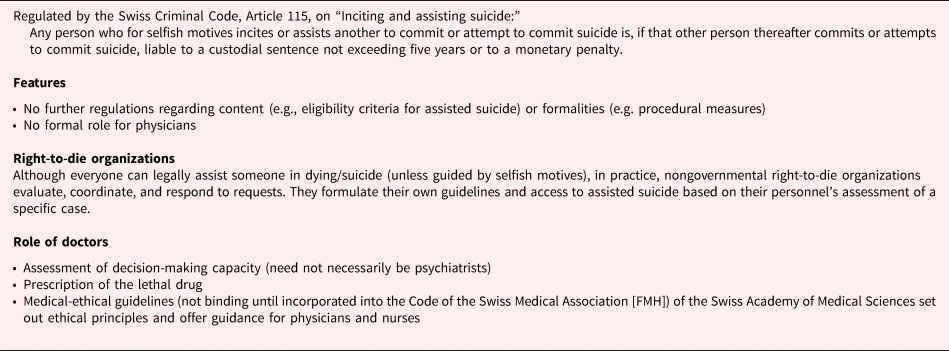
In Western societies, there is wide support for AS among both the public and medical professionals (Emanuel et al., Reference Emanuel, Onwuteaka-Philipsen and Urwin2016), but the degree of support is strongly dependent on the patient group. Specifically, surveys have shown that physicians, including psychiatrists, are generally more reluctant if the request for AS is based on suffering that relates to mental illness compared with suffering as a consequence of physical illness (Bolt et al., Reference Bolt, Snijdewind and Willems2015; Brauer et al., Reference Brauer, Bolliger and Strub2015; Kouwenhoven et al., Reference Kouwenhoven, Raijmakers and van Delden2013; Rousseau et al., Reference Rousseau, Turner and Chochinov2017). AS on the basis of a mental illness is legal in only a few jurisdictions and remains highly controversial (Appelbaum, Reference Appelbaum2016; Kim & Lemmens, Reference Kim and Lemmens2016; Miller & Appelbaum, Reference Miller and Appelbaum2018; Schuklenk & Vathorst, Reference Schuklenk and van de Vathorst2015; Vandenberghe, Reference Vandenberghe2018). However, the number of persons granted access to AS for a psychiatric disorder is increasing. In the Netherlands, 13 cases were reported in 2011, increasing to 60 in 2016 and 83 in 2017 (Regional euthanasia review committees, 2017). In the absence of a reporting system in Switzerland, there is a lack of information about cases of psychiatric AS. However, cases of AS are known to have increased since 2008, with an absolute increase in nonterminal patients seeking AS (Steck et al., Reference Steck, Junker and Zwahlen2018). The Swiss model differs significantly from other approaches in a number of ways (Table 1).
The Swiss model

Internationally, Switzerland is the only country whose legal framework requires neither a terminal (somatic) condition for patients requesting AS nor a specific role for physicians in the request process. Instead, the physician's involvement is confined to assessing decision-making capacity and prescribing the lethal drug, with no further legal regulations governing access and procedure (Gamondi et al., Reference Gamondi, Borasio and Oliver2017; Ziegler & Bosshard, Reference Ziegler and Bosshard2007). In practice, nongovernmental “right-to-die” organizations (RTDOs) evaluate, coordinate, and respond to AS requests (Ziegler, Reference Ziegler2009; Ziegler & Bosshard, Reference Ziegler and Bosshard2007). RTDOs define internal guidelines that specify necessary preconditions and procedural requirements, including whether requests can be made on the basis of suffering related to mental illness (Ziegler & Bosshard, Reference Ziegler and Bosshard2007).
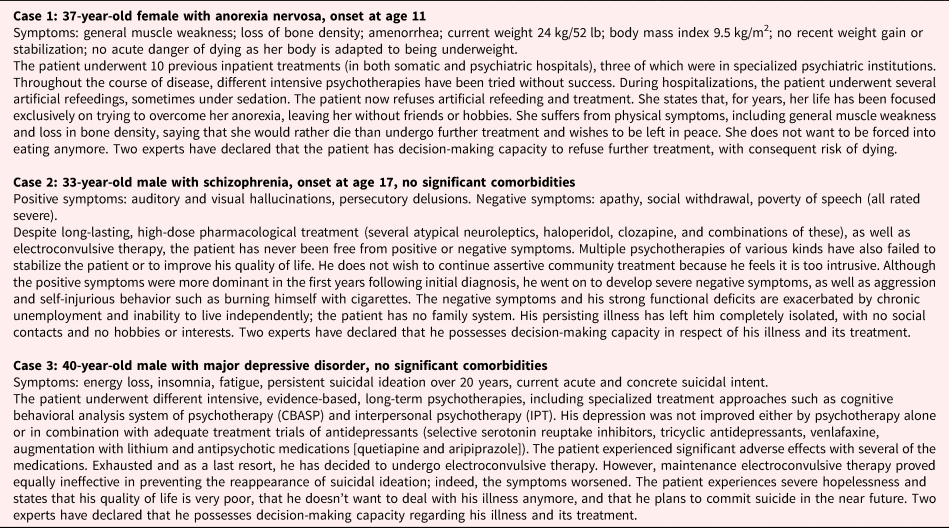
Criticism notwithstanding, the Swiss model has been described as demedicalizing AS and resolving some ethical dilemmas commonly faced by medical professionals (Ziegler, Reference Ziegler2009). Until now, AS in Switzerland has ostensibly been treated as a political and public concern rather than a medical one. Nevertheless, many of Switzerland's hospitals, nursing homes, hospices, and other institutions, involved in the care of seriously ill patients encounter AS requests. Some institutions have begun to develop their own internal guidelines for refusing or allowing AS in their wards (Harding, Reference Harding2005; Tuffs, Reference Tuffs2007). In cases where suffering caused by mental illness is the primary reason for requesting AS, psychiatrists and other mental health care staff are likely to be involved. In Switzerland, only one study to date has explored physicians’ support for AS in different medical scenarios, including dementia and mental illness that is refractory, chronic, and severe (Brauer et al., Reference Brauer, Bolliger and Strub2015). That study was commissioned by the Swiss Academy of Medical Sciences (SAMS) to obtain an overview of physicians’ views on AS and to inform new medical-ethical guidelines for “Management of dying and death” (SAMS, 2018). In the survey, 28% of all responding physicians supported the principle of AS, whereas 22% were clearly opposed. About 40% of respondents believed that physicians should be allowed to perform AS (Brauer et al., Reference Brauer, Bolliger and Strub2015). Although the survey sheds some light on the attitudes of physicians practicing in Switzerland, the low response rate of 34.9% and the wide variation of respondents from different professional specialties serve to limit the generalizability of the results. In addition, SAMS has recently revised its guidelines on physician-assisted suicide. The new guidelines propose circumstances in which physician-assisted suicide may be ethically justifiable but notably refrain from including terminal illness as a criterion for AS (SAMS, 2018). The present study explores psychiatrists’ general attitudes to AS in the context of severe and persistent mental illness (SPMI), with reference to three clinical scenarios presented as case vignettes (Table 1).
Research questions
To determine the attitudes of physicians with specialist training in psychiatry to AS requests from patients with SPMI and, specifically, their willingness to support a patient's decision to make such a request, two research questions were asked: (1) whether German-speaking psychiatrists in Switzerland support the possibility of AS in patients with SPMI in general and (2) whether they would be willing to play an active role in AS. Additionally, the participants were asked to evaluate three case vignettes: a patient with severe and enduring anorexia (vignette 1); a patient diagnosed with treatment-resistant depression (vignette 2); and a patient suffering from severe persistent schizophrenia (vignette 3). The third research question asked (3) whether their support would differ for the patients in the three case vignettes.
Methods
The quantitative cross-sectional survey was conducted in cooperation with the Swiss Society for Psychiatry and Psychotherapy (SSPP), based on a previously reported protocol (Trachsel et al., Reference Trachsel, Hodel and Irwin2019). The study fell outside the scope of the Swiss Human Research Act because no personal data related to human diseases or the structure or function of the human body were collected. However, the study was assessed according to the Checklist for the ethical evaluation of empirical studies that do not need mandatory authorization (No. CEBES-2016-04). Participants’ identities were anonymized, and the study was noninterventional in nature. All participants received a copy of the survey by mail with an enclosed prepaid return envelope, followed four weeks later by a postcard reminder.
Sample
The total sample (n = 1311) included all German-speaking members of the SSPP, corresponding to approximately 30% of psychiatrists in Switzerland. Data were collected during the period February–March 2016.
Survey and case vignettes
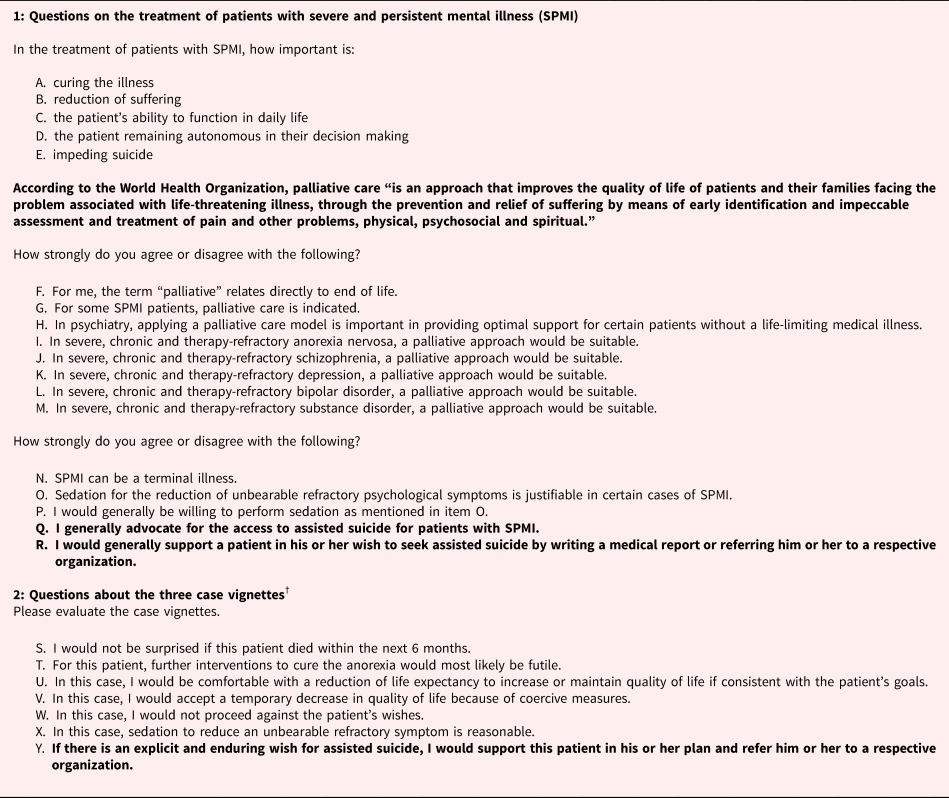
This article reports 5 of 42 items targeting different aspects of care for SPMI patients, with particular reference to the suitability of palliative care approaches for this group of patients (Trachsel et al., Reference Trachsel, Hodel and Irwin2019) (Tables 2 and 3). The two subsets of items (palliative care approaches and assisted suicide in the context of SPMI) are purposefully reported separately because they relate to two distinct topics. Participants were asked to respond to the statements on a 7-point Likert scale, ranging from completely disagree (–3) to completely agree (+3), with midpoint neutral (0). The case vignettes have previously been published in other contexts (Baweja & Singareddy, Reference Baweja and Singareddy2013; Brenner et al., Reference Brenner, Dencker and Goldstein1990; Trachsel et al., Reference Trachsel, Wild and Biller-Andorno2015) and were adapted to suit the purpose and format of the survey. Participants also had the option to make additional comments in a General Comments section; any such comments were translated into English.
Case vignettes based on modified versions of previously published cases

Statistical analysis
Arithmetic means were calculated for age and work experience, and descriptive statistics (percentages) were calculated for gender, as well as for the Likert scale items. IBM SPSS Statistics 24 was used to perform the analysis.
Patient and public involvement
Because the goal of the study was to investigate the attitudes of psychiatrists, there was no direct patient involvement in the survey's development. However, the survey design was informed by studies involving patients (as in the case vignettes). An advisory board of experts from psychiatry, psychology, and palliative care was involved in all steps of the study, and further research from the patient perspective is planned.
Results
Sample characteristics
The response rate was 34.9% (457 of 1,311 recipients). Respondents’ mean age was 57.8 years, 37% were female, and 4.2% did not indicate their gender. The gender distribution reflected the total sample of active SSPP members (62.9% male vs. 37.1% female). Mean work experience was 27.7 years (missing, n = 23).
Attitudes to assisted suicide on the basis of SPMI
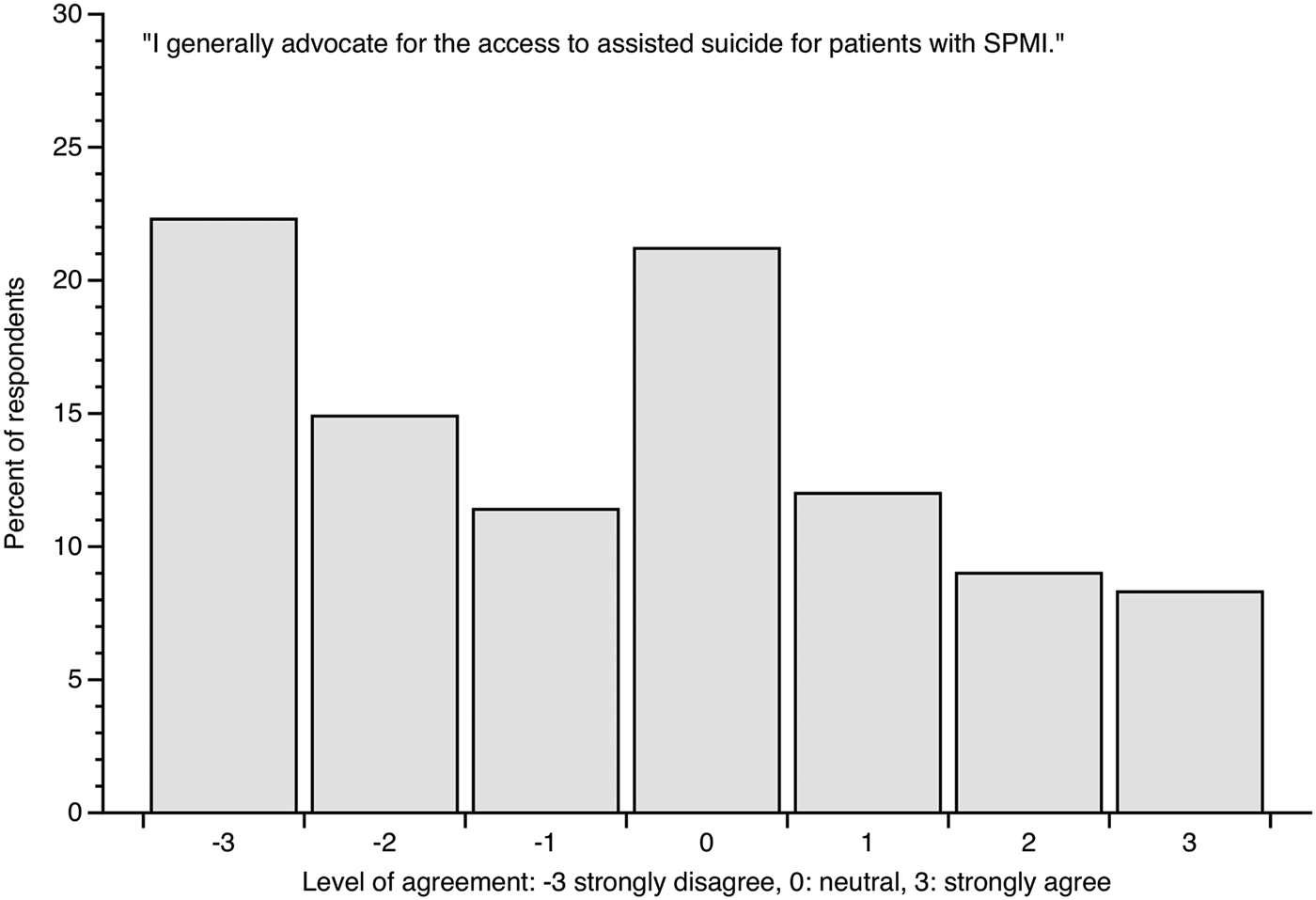
Overall, 48.6% of respondents stated that they did not generally support access to AS for persons diagnosed with SPMI (–1, –2, or –3, where –3 designates strongly disagree). A further 29.3% stated that they supported access to AS to some degree (1, 2, or 3, where 3 designates strongly agree), whereas 21.2% remained neutral (rating 0) (missing, n = 4 or 0.9%). There were no differences in age and work experience between those who remained neutral and the remainder.
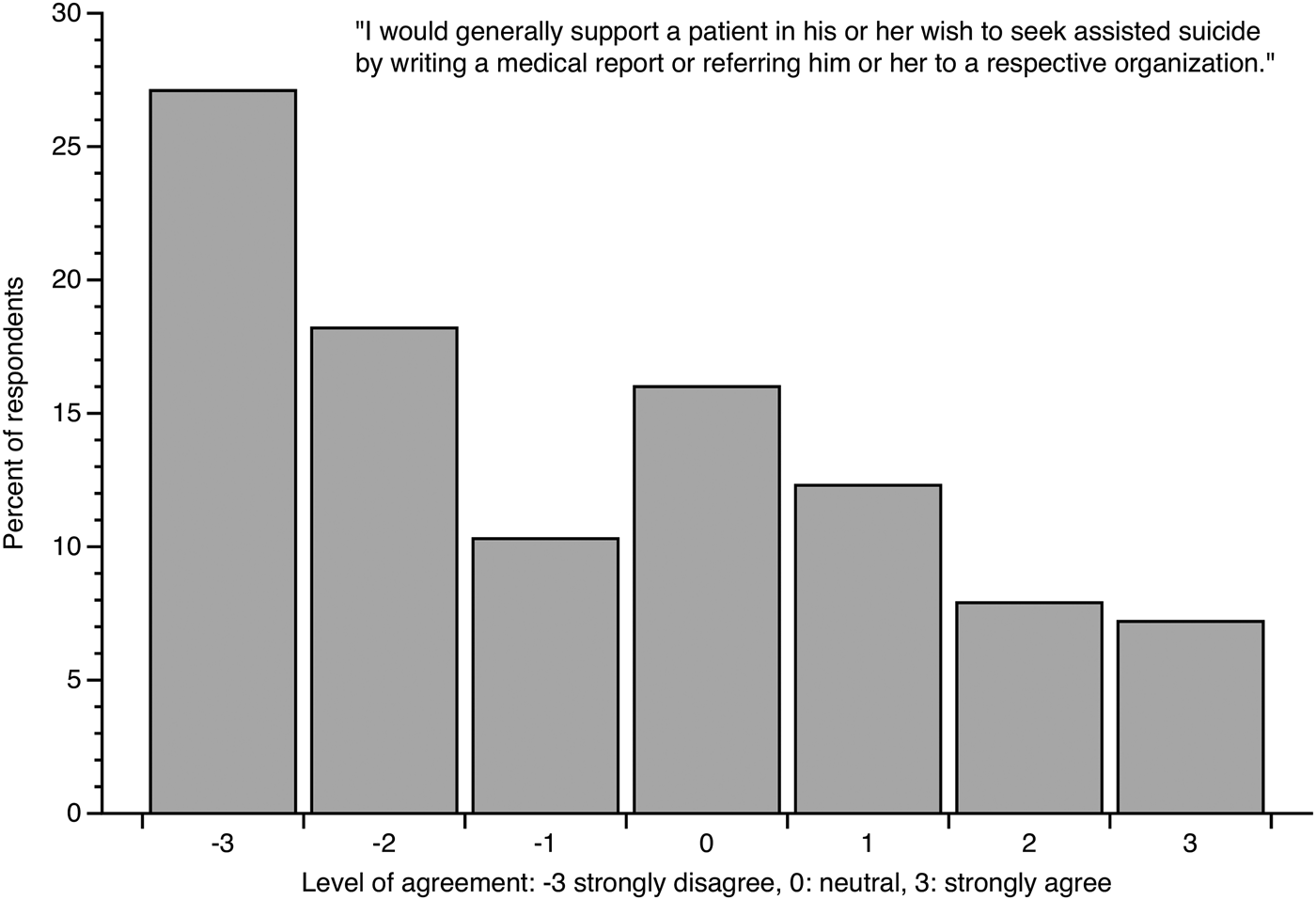
In total, 55.6% of respondents would not support an AS request from a patient with SPMI by writing a psychiatric report or referring them to an RTDO (–1, –2, –3, where –3 designates strongly disagree). A further 27.4% would provide support (1, 2, or 3, where 3 designates strongly agree), whereas 16.0% remained neutral (missing, n = 5 or 1.1%) (Figures 1 and 2).
Attitudes toward assisted suicide requests by patients with severe and persistent mental illness.

Support with regard to assisted suicide of patients with severe and persistent mental illness.

Responses to vignettes
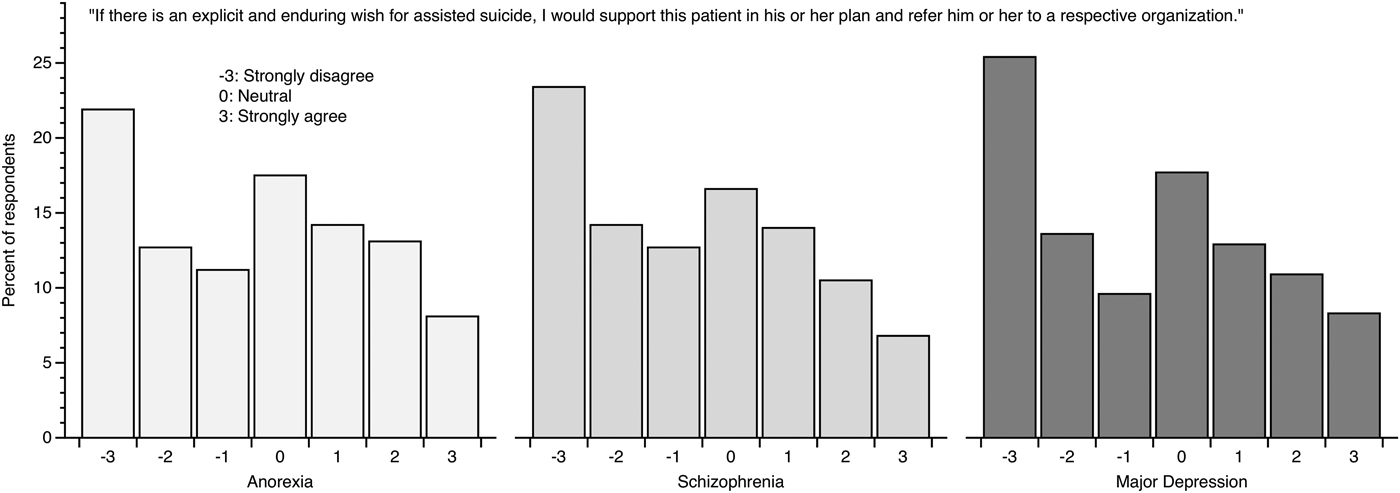
In total, 45.8% of respondents would not support the explicit and enduring wish for AS of the patient described in case vignette 1 by referring her to a relevant organization (–1, –2, or –3, where –3 designates strongly disagree). In contrast, 35.4% would provide support (1, 2, or 3, where 3 designates strongly agree), whereas 17.5% remained neutral (missing. n = 6 or 1.3%).
Support for assisted suicide by patients in case vignettes.

About one-half (50.3%) of respondents would not support the explicit and enduring wish for AS of the patient described in case vignette 2 by referring him to a relevant organization. A further 31.3% would provide support, whereas 16.6% remained neutral (missing, n = 8 or 1.8%).
Finally, 48.6% of respondents would not support the explicit and enduring wish for AS of the patient described in case vignette 3 by referring him to a relevant organization. However, 32.1% would provide support, and 17.7% remained neutral (missing, n = 7 or 1.5%) (Figure 3).
Comments section
Anecdotes recorded in the General Comments section of the survey indicated that psychiatrists may experience conflicts of interest when confronted with an AS request. One respondent wrote: “As a psychiatrist, I would help to abolish my own profession if I were to support suicide.” Another respondent stated:
I would only dare to make an assessment if I had known the patient over a longer period of time but not on the basis of a single cross-sectional consultation. Generally, I do not support suicide in my position as a treating physician, regardless of my personal stance. Reason: I believe that my own personal judgement is dangerous because the patient initially consulted me to improve his life. However, the patient has the possibility of being assisted to commit suicide independent of me.
Discussion
To our knowledge, this is the first study to systematically assess the attitudes of psychiatrists working in Switzerland to the practice of AS for psychiatric patients. In light of recent developments surrounding AS and psychiatry, this quantitative study makes an important contribution to current discourse.
General support for AS in patients with SPMI
Although almost one-half of the respondents opposed access to AS for patients with SPMI, more than one-fifth were neutral, and 29.3% agreed that patients with SPMI should have access to AS. These results correspond to the findings of another study of Swiss physicians of all subspecialties, in which about 32% of respondents considered AS to be justifiable for SPMI (Brauer et al., Reference Brauer, Bolliger and Strub2015). That study also revealed that acceptance of AS for psychiatric patients is no higher or lower among psychiatrists than among medical providers in general (Brauer et al., Reference Brauer, Bolliger and Strub2015). Similarly, a survey of Canadian psychiatrists’ attitudes to AS in the context of a primary psychiatric diagnosis found that 29.4% were supportive, with general support for AS in some circumstances (e.g., terminal illness) at 72% (Rousseau et al., Reference Rousseau, Turner and Chochinov2017).
In light of current scholarly debate and the multiple objections raised by many experienced clinicians, the level of support reported here for AS in patients with SPMI is significant, as is the high percentage of neutrals (ranging from 16% to 21.2% for different items). Importantly, there were no differences in age and gender between neutrals and the rest. Although interpretation of a neutral rating is speculative, it may reflect the ambivalence and role conflict currently experienced by psychiatrists in relation to AS (Miller & Appelbaum, Reference Miller and Appelbaum2018); indeed, this ambivalence was stressed by some respondents in the General Comments section. As several of those comments noted, the practice of AS is often thought to conflict with the high priority psychiatry assigns to suicide prevention (Hewitt, Reference Hewitt2013; Schuklenk & van de Vathorst, Reference Schuklenk and van de Vathorst2015). This is curious because AS and unassisted suicide have traditionally been viewed as distinct phenomena; only recently (and solely within psychiatry) have scholars begun to discuss a possible overlap. Specifically, it has been argued that psychiatric AS is difficult to distinguish from suicide because of certain shared characteristics, and this may ultimately affect societal commitment to suicide prevention (Kim et al., Reference Kim, Conwell and Caine2018).
Willingness to provide active support for psychiatric patients seeking AS
Of the responding psychiatrists, 27.4% would actively support SPMI patients in the event of a concrete AS request—for instance, by writing a psychiatric evaluation or referring the patient to an RTDO. Willingness to provide support was even higher for the specific case vignettes (35.4% for the patient with anorexia nervosa; 31.4% for the patient with schizophrenia; and 32.1% for the patient with depression). These findings contrast with a previous qualitative study of palliative care physicians in Switzerland, which found that establishing contact with the RTDOs was clearly perceived to be the patient's responsibility (Gamondi et al., Reference Gamondi, Borasio and Oliver2017).
Lack of variation in diagnoses
There is evidence that the source of a patient's suffering can determine the physician's willingness to grant an AS request, and that for a majority of physicians, physical symptoms are a prerequisite for “unbearable” suffering (Bolt et al., Reference Bolt, Snijdewind and Willems2015; Rietjens et al., Reference Rietjens, Van Tol and Schermer2009; Van Tol et al., Reference Van Tol, Rietjens and van der Heide2010). To our knowledge, no study to date has investigated the variation of physician support for different psychiatric diagnoses. In the present work, there was only a small degree of variation in support for the three different patients in the case vignettes. This is somewhat surprising because their prognosis varied, especially in relation to fatal outcomes. Although all three patients had an increased risk of death (Ivbijaro, Reference Ivbijaro2017; Laursen et al., Reference Laursen, Nordentoft and Mortensen2014), those with anorexia nervosa are known to have the highest mortality rate of all mental illnesses (Arcelus et al., Reference Arcelus, Mitchell and Wales2011). Additionally, the case patient suffering from major depressive disorder exhibited concrete suicidal intent, making a potentially fatal outcome more likely. Interestingly, this did not significantly influence the participating psychiatrists’ willingness to support the depressed patient in seeking AS, with 32.1% supporting access to some degree. The lack of variation in diagnoses may be linked to general underlying attitudes to AS in psychiatric patients—that is, the participating psychiatrists either generally approved or generally disapproved of the practice as a whole.
Strengths and limitations
The present study has several strengths. It is the first to specifically assess the largely unexplored attitudes of psychiatrists to AS in psychiatric patients in Switzerland using quantitative methods. Additionally, the inclusion of distinct case vignettes provides a more differentiated picture of psychiatrists’ support for AS in patients with SPMI.
The study also has several limitations. The nonresponse rate raises the possibility of nonresponse bias, although respondents’ age and gender correspond to the total population of SSPP members. We did not explore other possible confounding variables such as sector (e.g., private practice or hospital; adult or geriatric psychiatry) or personal experience of AS. Because only about 50% of all psychiatrists are members of the SSPP, there is a risk of sampling bias; additionally, only German-speaking psychiatrists were recruited for this survey, and it is known that attitudes to end-of-life practices differ across language regions in Switzerland (Fischer et al., Reference Fischer, Bosshard and Faisst2006). Nevertheless, our results correspond with those from a recent survey of Swiss physicians in all three language regions (Italian, French, and German), in which 33% of all respondents tended to support AS for patients with SPMI (Brauer et al., Reference Brauer, Bolliger and Strub2015). Finally, it is important to stress that Likert scale items shed no light on underlying concepts that may have influenced the psychiatrists’ responses. Additionally, the decision to include a neutral midpoint made interpretation more difficult. A neutral response might indicate indecision or ambivalence; on the other hand, respondents may have chosen the midpoint because they were not sufficiently concerned or engaged. The decision to offer this neutral option was deliberate because we considered it important not to force respondents to take a side to avoid possible frustration, especially in relation to such a controversial subject. In any event, it seems unlikely that respondents would not be sufficiently concerned to adopt a clear position, given that AS is a reality of increasing importance in Switzerland.
Future Directions and Implications for Clinical Practice
In the few countries where AS on the basis of a primary psychiatric diagnosis is legal, the number of patients seeking AS continues to increase (Dierickx et al., Reference Dierickx, Deliens and Cohen2017; Kim & Lemmens, Reference Kim and Lemmens2016). Given the ongoing global liberalization of AS practices and the likelihood of psychiatrists’ involvement—especially if the suffering relates to a mental illness—it is important to understand and take account of psychiatrists’ perspectives. More research (especially qualitative research) is needed to systematically assess the reasons underpinning psychiatrists’ views. That knowledge should in turn inform psychiatrists’ formal training in responding to requests and end-of-life issues in general, particularly where AS is a legal option for psychiatric patients.
In Switzerland, there is a particular urgency to develop a systematic approach to AS to adequately safeguard vulnerable patients with SPMI. The authors contend that psychiatrists who openly endorse the option of AS for some SPMI patients have an obligation to remain critical and to accept professional responsibility. To ensure adequate safeguards for SPMI patients, it is essential that psychiatrists are involved in the evaluation process (e.g., assessment of decision-making capacity and possible alternatives). Those psychiatrists who generally refuse access of AS for SPMI must remain committed to the care of any of their patients contemplating AS. To abandon any patient on the basis of divergent moral beliefs is unethical and ultimately harmful to chronically suicidal patients. Refusing to openly discuss the option of AS with SPMI patients in a value-neutral environment is clearly counterproductive in caring for suicidal SPMI patients.
Author ORCIDs
Martina A. Hodel, 0000-0003-1547-472X
Acknowledgments
The authors thank the Swiss Society of Psychiatry and Psychotherapy, and especially vice president Daniel Bielinski, MD, for support in the acquisition of data; they also thank Roland Kunz, MD, for his conceptual input.
Conflict of Interest
This work was supported by the Palliative Care Research funding program of the Swiss Academy of Medical Sciences; the Gottfried and Julia Bangerter-Rhyner Foundation; and the Stanley Thomas Johnson Foundation. F.R. received funding through Swiss National Science Foundation grant 406740_139363.
The views expressed in this paper are those of the authors and do not necessarily reflect those of the funder. The funding body in no way influenced the authors in writing the manuscript.
Authors’ Contributions
M.A.H. and M.T. constructed and conducted the survey; M.A.H. analyzed the data and drafted the manuscript; and all authors were involved in the study's conception and design, interpretation of the data, critical revision of the article, and final approval of the version submitted for publication.