Introduction
Serotonin, also known as 5-hydroxytryptamine (5-HT), is a critical monoamine neurotransmitter and modulator in both vertebrates and invertebrates. This neurotransmitter is synthesised from tryptophan through the enzymatic actions of tryptophan hydroxylase and aromatic L-amino acid decarboxylase (Movassaghi and Milasincic, Reference Movassaghi and Milasincic2024; Wang et al., Reference Wang, Chen, Zhang, Chen and Ouyang2023). Once synthesised, 5-HT is distributed in various systems, such as the central and peripheral nervous systems, digestive system, muscles, and sensory organs in insects (Blenau and Thamm, Reference Blenau and Thamm2011; Vleugels et al., Reference Vleugels, Verlinden and Broeck2015). 5-HT plays a crucial role in regulating and modulating a wide range of behaviours, developmental, and physiological processes in insects. These include circadian rhythms (Blenau and Thamm, Reference Blenau and Thamm2011), feeding (Falibene et al., Reference Falibene, Rssler and Josens2012; Gasque et al., Reference Gasque, Conway, Huang, Rao and Vosshall2013), learning and memory (Sitaraman et al., Reference Sitaraman, Laferriere, Birman and Zars2012; Zeng et al., Reference Zeng, Su, Liu, Li, Jiang, Lu and Qi2022). Additionally, 5-HT regulates growth and molting (Sato, Reference Sato2020), development (Apeksha et al., Reference Apeksha, Lathika, Nayana, Oishi, Praseeda and Kumar2018), and reproduction and energy metabolism (Ling and S, Reference Ling and Raikhel2018; Luo et al., Reference Luo, Becnel, Nichols and Nssel2012). The effects of 5-HT are mediated by its binding to specific membrane receptors, which activates various intracellular second messengers such as cyclic adenosine monophosphate (cAMP) and phosphoinositide turnover, thereby trigger a variety of cellular responses and behavioural outcomes (Millan et al., Reference Millan, Marin, Bockaert and Cour2008; Vleugels et al., Reference Vleugels, Verlinden and Broeck2015). These receptors are primarily classified into three types (5-HT1, 5-HT2, and 5-HT7) in most insects, based on their conserved amino acid sequence with their vertebrate counterparts. Notably, a novel 5-HT8 receptor was identified in Pieris rapae larvae, which differs significantly from other known receptor types and presents a unique pharmacological profile (Qi et al., Reference Qi, Xia, Wu, Stanley, Huang and Ye2014). These insect 5-HT receptors belong to the superfamily of G protein-coupled receptors (GPCRs), characterised by seven transmembrane domains that play a crucial role in signal transduction (Millan et al., Reference Millan, Marin, Bockaert and Cour2008; Vleugels et al., Reference Vleugels, Verlinden and Broeck2015).
Recent studies have further elucidated the molecular and pharmacological characteristics of 5-HT receptors in insects, encompassing various species such as Drosophila melanogaster (Blenau and Thamm, Reference Blenau and Thamm2011), Aedes aegypti (Li et al., Reference Li, Zhang, Wu, Li, Chen, Chen, Wang, Liao and Han2022; Pietrantonio et al., Reference Pietrantonio, Jagge and Mcdowell2001), Apis mellifera (Thamm et al., Reference Thamm, Balfanz, Scheiner, Baumann and Blenau2010), Manduca sexta (Dacks et al., Reference Dacks, Dacks, Christensen and Nighorn2006, Reference Dacks, Reale, Pi, Zhang, Dacks, Nighorn and Evans2013) and Rhodnius prolixus (Paluzzi et al., Reference Paluzzi, Bhatt, Wang, Zandawala, Lange and Orchard2015). These findings highlight the critical role of 5-HT in regulating insect growth, development and reproduction through its receptors. For instance, disrupting the 5-HT7A receptor in A. aegypti mutants leads to abnormal larval and pupal development, reduced motility and lower egg hatching rates in offspring (Li et al., Reference Li, Zhang, Wu, Li, Chen, Chen, Wang, Liao and Han2022). Moreover, 5-HT signaling governs developmental timing and progression by modulating hormonal pathways, particularly those involving insulin-like peptides and ecdysteroids. For example, Ling and Raikhel (Reference Ling and Raikhel2018) demonstrated that the fat-body-specific 5-HT2B receptor is essential for regulating body-size growth, lipid metabolism, and ovarian development in A. aegypti through interactions with insulin-like peptides. In addition to regulating development, 5-HT and its receptors also coordinate an insect’s physiological responses to environmental cues (e.g. food, light, temperature), ensuring normal development and survival in a way that maximises fitness. For example, serotonergic neurons in D. melanogaster can sense nutritional conditions, innervate the prothoracic gland (PG), and activate 5-HT7 receptor in the PG to regulate the timing of ecdysteriod biosynthesis, ultimately influencing the timing of pupariation (Shimada-Niwa and Niwa, Reference Shimada-Niwa and Niwa2014). Several studies have also highlighted the role of 5-HT signaling as a key regulator of diapause, a developmental arrest state triggered by adverse conditions. In Antheraea pernyi, the 5-HTB receptor may inhibit the synthesis or release of prothoracicotropic hormone (PTTH), thereby maintaining pupal diapause (Wang et al., Reference Wang, Mohamed and Takeda2013). Similarly, Andreatta et al. (Reference Andreatta, Kyriacou, Flatt and Costa2018) found that 5-HT1A receptor activity is linked to the induction of dormancy through modulation of insulin signaling pathways. Overall, understanding the functions of 5-HT receptors in insects, particularly their signaling transduction mechanisms, not only sheds light on their biological and ecological roles but also provides valuable insights into potential broader applications through targeted manipulation of these receptor-mediated pathways.
The green lacewing Chrysopa formosa Brauer (Neuroptera: Chrysopidae) is an effective predator of numerous agricultural and forestry pests, including aphids, thrips, whiteflies, and lepidopteran eggs and larvae (Li et al., Reference Li, Wang, Zhang, Zhang, Wang, Mao and Zhang2023). Due to its broad prey spectrum, high predation ability, strong reproductive capacity and wide adaptability, C. formosa has been recognised as a potential biocontrol agent. It has been widely used for pest management in field crops, greenhouse vegetables, and orchards in China, where it has demonstrated significant pest control efficacy (Li et al., Reference Li, Wang, Gao, Zhang, Chen, Wang, Liu and Zhang2018). Under natural conditions, C. formosa enters a prepupal diapause to overwinter, an important seasonal adaptation strategy. Diapause is a state of developmental arrest which is regulated by environmental and hormonal factors (Denlinger, Reference Denlinger2022a). For natural enemies, the feature of diapause offers a state that can be exploited to improve their shelf life, shipment and application in biological control (Denlinger, Reference Denlinger2022b). Our previous research has demonstrated that the environmental factors, such as photoperiod and temperature, play a significant role in regulating the induction, maintenance and termination of diapause in C. formosa (Li et al., Reference Li, Wang, Gao, Zhang, Chen, Wang, Liu and Zhang2018). However, the molecular mechanisms by which C. formosa integrates these environmental signals into its hormonal pathways to produce the diapause phenotype remain unclear. Previous studies in D. melanogaster, A. aegypti and A. pernyi have shown that the 5-HT signaling play a bridging role between environmental signal transduction and the endocrine system response during insect diapause and dormancy (Andreatta et al., Reference Andreatta, Kyriacou, Flatt and Costa2018; Liao et al., Reference Liao, Broughton and Nassel2017; Shimada-Niwa and Niwa, Reference Shimada-Niwa and Niwa2014; Takeda and Suzuki, Reference Takeda and Suzuki2022; Wang et al., Reference Wang, Mohamed and Takeda2013). Therefore, identifying and characterizing different 5-HT receptor subtypes and investigating their expression patterns and functions will provide valuable insights into the role of 5-HT signaling in regulating insect diapause.
The 5-HT7 receptor is the most recently identified member of the 5-HT receptor family and is characterized by positive coupling to cAMP through binding to Gs proteins (Huang et al., Reference Huang, Xu, Shen, Simon, Mao, Tan, Zhang, Harpsøe, Li, Zhang, You, Yu, Jiang, Zhang, Gloriam and Xu2022). Since its initial discovery in D. melanogaster (Witz et al., Reference Witz, Amlaiky, Plassat, Maroteaux, Borrelli and Hen1990), 5-HT7 receptor have been identified and characterised in several insects, including A. aegypti, A. mellifera, Tribolium castaneum, Mythimna separata and Polyrhachis vicina (Chen et al., Reference Chen, Gao, Wang, Xie, An, Du and Zhao2023; Pietrantonio et al., Reference Pietrantonio, Jagge and Mcdowell2001; Schlenstedt et al., Reference Schlenstedt, Balfanz, Baumann and Blenau2006; Vleugels et al., Reference Vleugels, Lenaerts, Broeck and Verlinden2014; Yang et al., Reference Yang, Xi and Wang2019). Current research suggests that 5-HT7 receptor is involved in the regulation of courtship and mating (Luo et al., Reference Luo, Becnel, Nichols and Nssel2012), appetitive olfactory learning (Ganguly et al., Reference Ganguly, Qi, Bajaj and Lee2020), growth and developmental metamorphosis (Li et al., Reference Li, Zhang, Wu, Li, Chen, Chen, Wang, Liao and Han2022; Shimada-Niwa and Niwa, Reference Shimada-Niwa and Niwa2014), and stress response (Vesala et al., Reference Vesala, Salminen, Laiho, Hoikkala and Kankare2012). However, the molecular and functional characteristics of the 5-HT7 receptor in economically important beneficial insects remain largely unexplored. The aim of this study was to investigate the molecular characteristics and expression pattern of the 5-HT7 receptor in C. formosa. We cloned the 5-HT7 receptor gene and analyse its sequence characteristics. Additionally, we determined its expression profiles across various developmental stages and during different phases of diapause in C. formosa. These findings may provide a valuable insight into the biological role of Cf5-HT7 receptor in regulating development and diapause, and could contribute to the identification of novel targets for manipulating the diapause process in the future.
Materials and methods
Insect rearing and sample collection
The colony of C. formosa was maintained under conditions of 26 ±1°C, 16 h light/8 h dark (16L:8D) and 70 ±5% relative humidity (RH) as described by Li et al. (Reference Li, Wang, Gao, Zhang, Chen, Wang, Liu and Zhang2018). Both larvae and adults of the lacewings were fed aphids Megoura japonica Matsumura. Normally developed lacewings (non-diapausing individuals) were reared in a climate chamber (RXZ-500B, Ningbo Jiangnan, China) at 20 ±1°C, 16L:8D and 70 ±5% RH. To determine relative mRNA expression of 5-HT7 at different developmental life stages, we sampled the newly hatched eggs within 24 hours; 3-day-old first (L1), second (L2) and third (L3) instar larvae; prepupae at 1-day (NDPP1), 3-day (NDPP3), 5-day (NDPP5) and 7-day-old (NDPP7); 1-day-old pupae (NDP1) and adult of non-diapausing C. formosa.
The diapausing prepupae of C. formosa were produced by continuously rearing eggs and larvae under diapause-inducing conditions of 20 ±1°C, 8L:16D and 70 ±5%RH, until they formed cocoons (Li et al., Reference Li, Wang, Gao, Zhang, Chen, Wang, Liu and Zhang2018). Cocoons were collected daily and transferred into a petri dish (9 cm × 1.5 cm) for the purpose of sampling prepupae at different stages of diapause. The diapause in prepupae of C. formosa can last from 60 days to 120 days as reported by Li et al. (Reference Li, Wang, Gao, Zhang, Chen, Wang, Liu and Zhang2018). To collect samples for diapause termination, prepupae that had been in diapause for 10 days were transferred to diapause-terminating conditions (5°C, 0L:24D) for 60 days, and then moved to the normal culturing conditions (20 ±1°C, 16L:8D) to promote their development. The pupae on the first day of pupation are considered as individuals that terminated diapause (DT). Eggs, larvae and prepupae of C. formosa reared under diapause-inducing conditions were collected for subsequent qRT-PCR experiments, and the sampling time points were identical to those of the non-diapause group. To characterize the expression pattern of 5-HT7 throughout diapause development, prepupae that had been in diapause for 1 day (D1), 10 days (D10), 30 days (D30), 60 days (D60) and 90 days (D90), as well as diapause terminated pupae (DT) were sampled. The collected C. formosa samples were cleaned and frozen with liquid nitrogen, and then stored in a refrigerator (−80°C) until analysis. Six biological replicates were used for each treatment, with each replicate containing three lacewings.
Cloning and sequencing of 5-HT7
Total RNA was extracted from adults of C. formosa using the TRIzol reagent method. The adults were ground into a powder in liquid nitrogen and then processed according to the instructions of the TransZol Up Plus RNA Kit (TransGen, Beijing, China). The concentration of isolated RNA was measured using a microvolume spectrophotometer (NanoPhotometer®NP80, Germany). First-strand cDNA was synthesised using the TransScript® One-Step gDNA Removal and cDNA Synthesis SuperMix kit (TransGen, Beijing, China), following the manufacturer’s protocol. The cDNA was stored at −80°C for subsequent experiments.
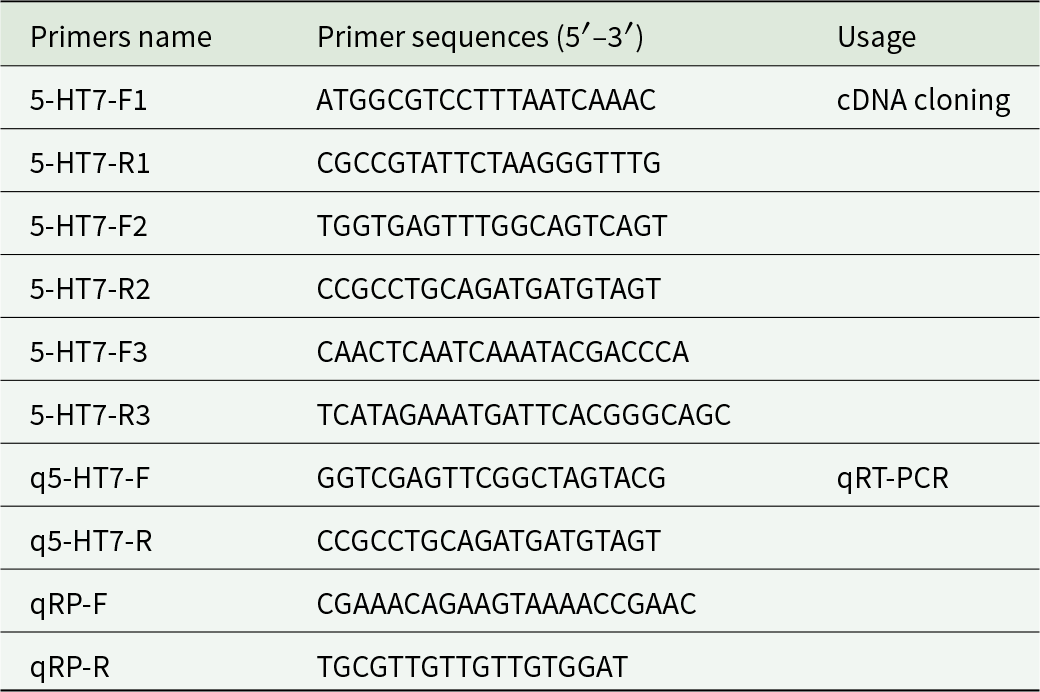
Based on the transcriptome database of C. formosa constructed in our laboratory, the nucleotide sequence of one putative 5-HT7 gene was identified for cloning and verification. Specific primers for three sub-fragments of the 5-HT7 were designed using the NCBI web-based Primer-BLAST tool, and synthesised by Tsingke Biotech Co., Ltd. (Beijing, China) (table 1). Using adult cDNA as a template, PCR amplification was performed with 2 × Phanta® Max Master Mix (Dye Plus). The PCR products were purified and recovered by 1% agarose gel electrophoresis using the EasyPure Quick Gel Extraction Kit (TransGen, Beijing, China). Cleaned PCR products were ligated into a pEASY®-T&B Zero Cloning vector (TransGen, Beijing, China), transformed into DH5α Chemically Competent Cells, and then sequenced by Tsingke Biotech Co., Ltd. (Beijing, China). The sequences of the three sub-fragments were assembled into a complete sequence using Vector NTI v11.5 software. The assembled complete sequence of 5-HT7 was aligned with the target gene sequence obtained from C. formosa genome for further verification. The coding region for 5-HT7 was identified by using the ORF Finder program (https://www.ncbi.nlm.nih.gov/orffinder/). Similarity between Cf5-HT7 and orthologs in other insect species was analysed by using the NCBI BLAST program (https://blast.ncbi.nlm.nih.gov/Blast).
Sequences of primers used for cDNA cloning and quantitative real-time PCR (qRT-PCR)

Sequence and phylogenetic analysis
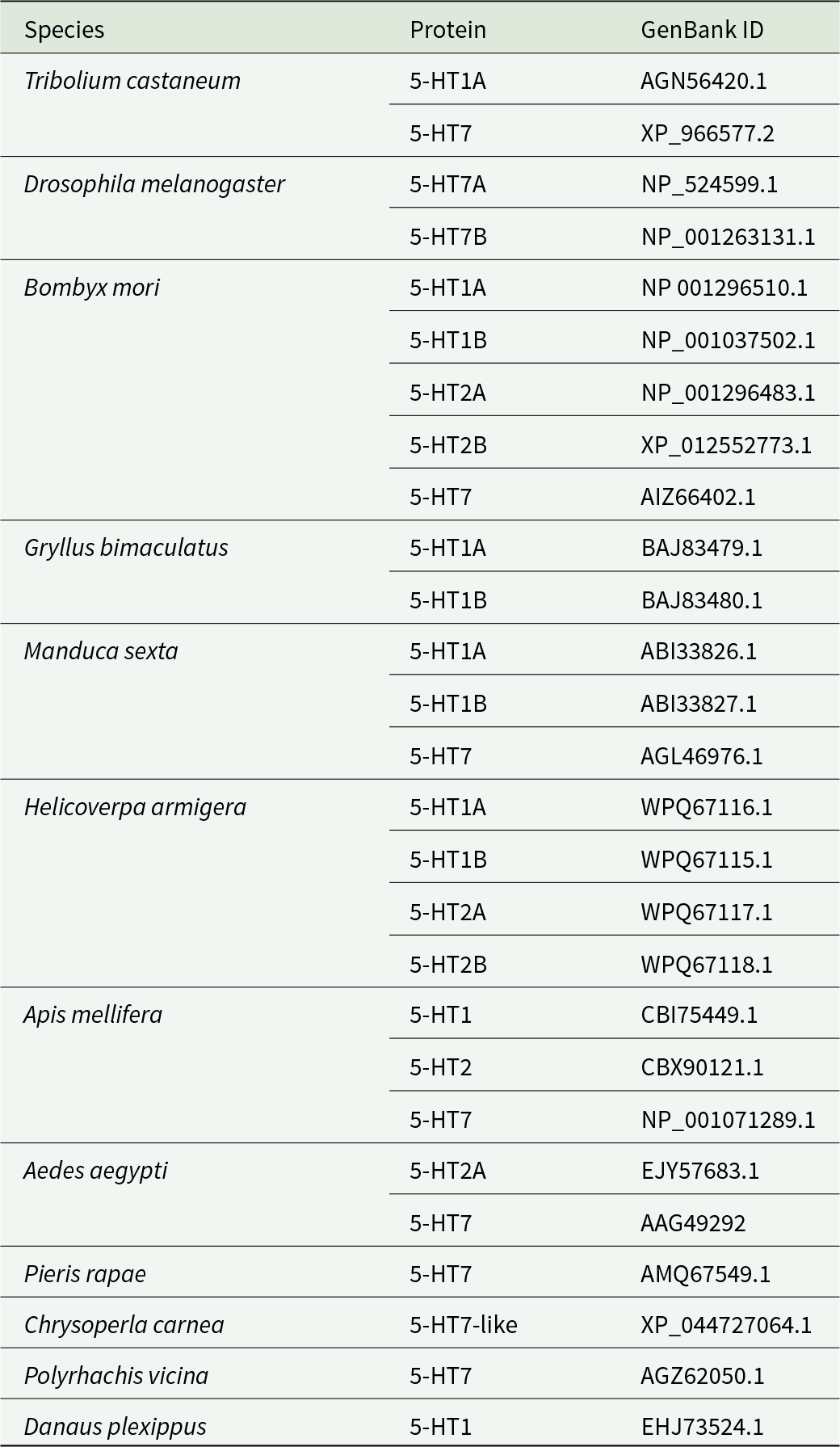
The amino acid sequence was deduced using DNAMAN v9 software, and the physical and chemical parameters of the protein were predicted with ExPASy ProtParam (https://web.expasy.org/protparam/). Conserved domain prediction was performed using the NCBI CD-Search program (https://www.ncbi.nlm.nih.gov/Structure/cdd/wrpsb.cgi). Functional analysis of the Cf5-HT7 receptor was carried out using the InterPro102.0 (https://www.ebi.ac.uk/interpro/), while putative signal peptides were identified using the SignalP 6.0 server (https://services.healthtech.dtu.dk/services/SignalP-6.0/). Phosphorylation and palmitoylation sites were predicted using the GPS 6.0 web server (https://gps.biocuckoo.cn/online.php). The secondary structure of the Cf5-HT7 receptor was predicted using the SPOMA tool (NPS@: SOPMA secondary structure prediction-NPSA-Lyon-France (inserm.fr)). Intrinsically disordered regions were predicted using the MobiDB-lite tool (https://caid.idpcentral.org/portal). The tertiary structure of Cf5-HT7 receptor was predicted using AlphaFold 2, which infers the protein’s 3D structure based on multiple sequence alignment (MSA) and structural templates. Default parameters were used during the prediction process unless specified otherwise. AlphaFold 2 generates multiple models, each associated with a corresponding confidence score, pLDDT (Predicted Local Distance Difference Test). To ensure the reliability of the structure, the model with the highest pLDDT value was selected for further analysis. The amino acid sequence of Cf5-HT7, along with orthologs from other insects, was aligned using ClustalW and MEGA v11. To explore the evolutionary relationships of Cf5-HT7, the deduced amino acid sequences of insect 5-HT1, 5-HT2, and 5-HT7 receptors were downloaded from NCBI (table 2), and a phylogenetic tree was constructed using the neighbour-joining method with a bootstrap value of 1000 in MEGA v11.
The protein sequences of 5-HT receptors used for phylogenetic analysis

Expression profiles of 5-HT7 determined by qRT-PCR
To investigate the potential functions of 5-HT7 gene in the growth and development of C. formosa, the expression profiles of 5-HT7 gene in different life stages (egg, L1, L2, L3, prepupae, pupae, adult) were analysed using qRT-PCR. The expression pattern of Cf5-HT7 at different diapause stages in C. formosa, including D1, D5, D10, D30, D60, D90 and DT, were also determined. Furthermore, to examine the differential expressions of Cf5-HT7 gene between the diapause-destined and non-diapause individuals of C. formosa, we compared the expression profiles across various life stages (egg, L1, L2, L3, prepupae at 1-day (PP1), 3-day (PP3), 5-day (PP5) and 7-day (PP7)) under these two conditions.
Different developmental stages of C. formosa were selected for total RNA extraction and the first-strand cDNA was synthesised using TransZol Up Plus RNA Kit and TransScript® One-Step gDNA Removal and cDNA Synthesis SuperMix Kit. The primers used for qRT-PCR are listed in table 1, and ribosomal protein gene was explored as the internal references. The qRT-PCR reactions were conducted using TOROGreen 5 G qPCR PreMix. All reactions were performed in triple in a total volume of 20 μl containing 10 μl Premix, 1 μl of each primer, 1 μl sample cDNA, and 7 μl nuclease-free water. The qPCR reaction conditions were set as follows: 95℃ pre-denaturation for 5 minutes; 95℃ denaturation for 10 s, and 58℃ annealing for 20 s for a total of 40 cycles; and finally, 95℃ for 10 seconds, 65℃ for 1 min, and 97℃ for 1 s (The increment is 0.2℃/s; Add 5 readings /°C). The relative expression level of 5-HT7 was calculated using the 2−ΔΔCt method (Li et al., Reference Li, Zhang, Wu, Li, Chen, Chen, Wang, Liao and Han2022). For each treatment, 6 independent biological samples were included, and three technical replicates of each biological sample were performed for all reactions.
Statistical analysis of data
Statistical data were analysed using GraphPad prism (GraphPad Software, San Diego, CA, United States). One-way analysis of variance followed by Tukey’s multiple tests was performed to identify significant differences of gene expression data among different developmental stages. The differences in gene expression between diapause and non-diapause sample were evaluated using Student’s t-test. All data are expressed as mean ± standard error (SE), and statistical significance was considered at p < 0.05 (*p < 0.05, **p < 0.01, ***p < 0.001).
Results
Molecular feature of Cf5-HT7
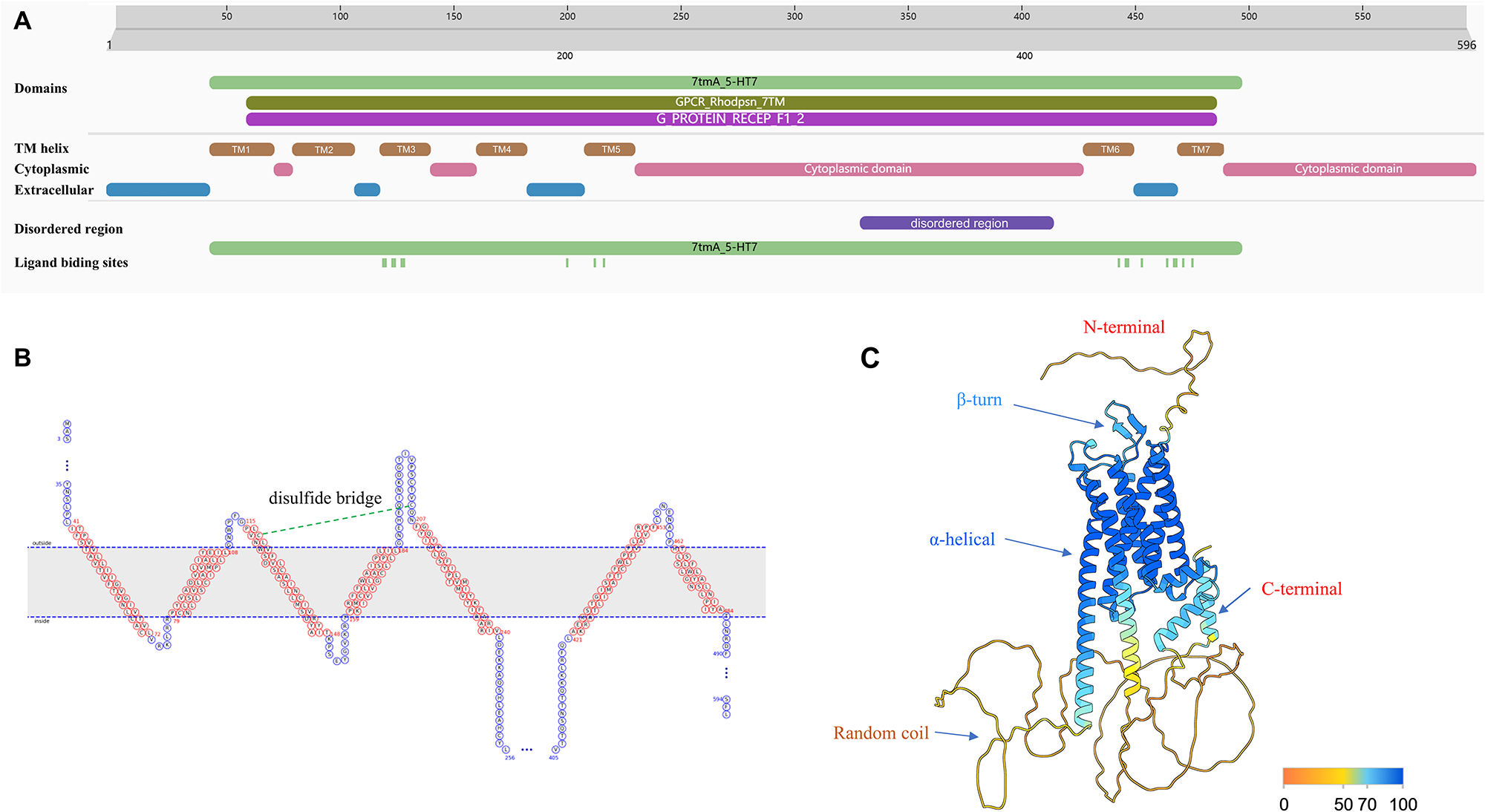
The candidate 5-HT7 gene identified from the C. formosa transcriptome was further validated through gene cloning. Sequence analysis revealed that the open reading frame of the C. formosa 5-HT7 gene (Cf5-HT7) was 1788 bp, encoding a protein of 596 amino acid residues in length (fig. 1). The predicted molecular weight of Cf5-HT7 protein was 66.08 kD, and its isoelectric point (pI) was 8.54. The Cf5-HT7 receptor comprises seven transmembrane domains (TM1-TM7), interspersed with three intracellular and three extracellular loops, supporting its classification within the typical class A family of GPCRs (fig. 2). There is no signal peptide present in Cf5-HT7. The Cf5-HT7 protein contains a disordered region spanning residues 329-412, which is located in intracellular loop 3 (fig. 2a). It is speculated that the 5-HT7 receptor contains 28 putative ligand-binding sites. Secondary structure analysis revealed that the Cf5-HT7 protein predominantly consists of alpha helices (29.70%), extended strands (25%), random coils (37.42%), and a smaller proportion of beta turns (7.89%). The disulfide bond between Cysteine residues118 (in extracellular loop 1) and Cysteine 204 (in extracellular loop 2) contributes to the structural stability of the protein, suggesting functional relevance (fig. 2b). The tertiary structure of the Cf5-HT7 receptor was modelled using AlphaFold 2, yielding an average pLDDT score of 64.662. The regions corresponding to the seven transmembrane domains were predicted with high pLDDT scores (>70), indicating high model confidence. However, the extracellular region at the N-terminus, the cytoplasmic domain between TM5 and TM6, and the extracellular region at the C-terminus, which all exhibit low pLDDT scores, suggest that these regions may be unstructured in isolation (fig. 2c).
Nucleotide and deduced amino acid sequence of Chrysopa formosa 5-HT7.

Molecular features and predicted structure of the Cf5-HT7 protein. (A) Predicted domains, TM helix, extracellular and cytoplasmic regions, disordered region, and ligand binding sites in the Cf5-HT7 protein. (B) Topology model of the secondary structure of the Cf5-HT7 receptor, and the disulfide bridge is labelled with dotted green line. (C) Tertiary structure model of the Cf5-HT7 receptor. The different colours indicate the pLDDT scores.

MSA and phylogenetic analysis of Cf5-HT7
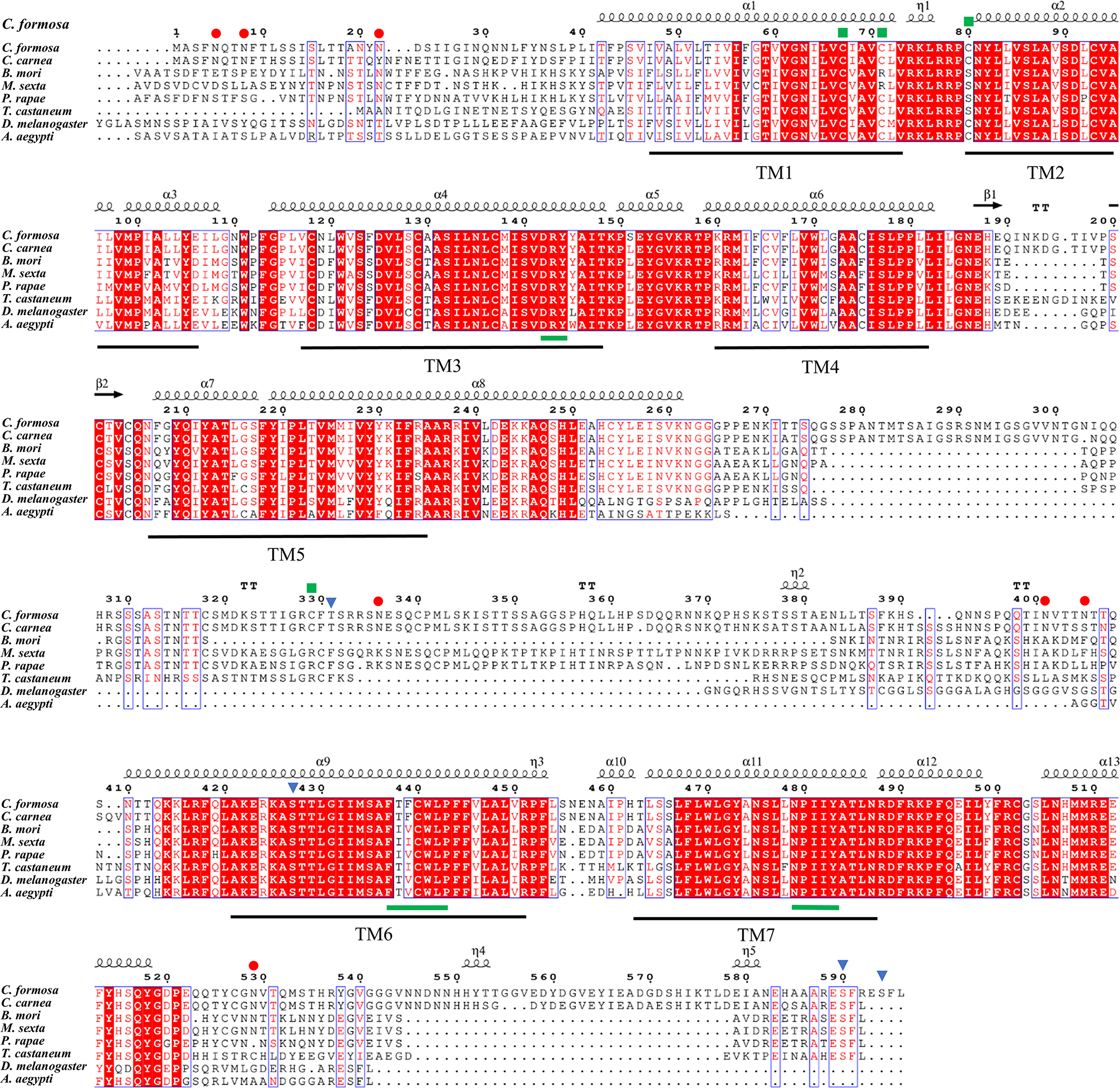
A comparison of the amino acid sequence of Cf5-HT7 with other insect 5-HT7 receptor orthologues revealed high degree of conservation (fig. 3). The Cf5-HT7 receptor shared the highest similarity to the Cc5-HT7 (Chrysoperla carnea), with the identity is 89.26%. The similarity between Cf5-HT7 and Tc5-HT7 (Tribolium castaneum) is 58.84%, followed by a 53.01% identity with the Bm5-HT7 (Bombyx mori), and 52.59% with the Aae5-HT7 (Aedes aegypti). MSA of Cf5-HT7 revealed two conserved motifs: ‘D-R-Y’ are located at positions Asp142-Arg143-Tyr144 in TM3, and ‘N-P-x-x-Y’ are located at positions Asp479-Pro480 -Tyr483 in TM7. The conserved consensus sequence ‘F-x-x-x-W-x-P’ is located at Phe437-Trp441-Pro443 within TM6, followed by two phenylalanine residues. The Cf5-HT7 receptor also has four palmitoylation sites, located at Cys67, Cys71, Cys80 and Cys329, as well as 7 N-glycosylation sites at Asn5, Asn8, Asn22, Asn336, Asn401, Asn405, and Asn529. Four consensus sites for phosphorylation by protein kinase C are located at positions Thr331, Ser427, Ser590, and Ser594 (fig. 3).
Multiple-sequence alignment of Cf5-HT7 with the corresponding proteins from other insect species. Alpha-helices, beta-helices, beta strands and beta turns are marked by α, η, β, and TT, respectively. The predicted protein of Cf5-HT7 contains seven transmembrane domains (TM1-TM7), as underlined in the figure. Three highly conserved motifs ‘DRY’, ‘npxxy’, and fxxxwxp in Cf5-HT7 is underlined. The n-glycosylation sites are labelled with red circle. The phosphorylation sites are labelled with blue inverted triangle. The palmitoylation sites are marked with green square. The 5-HT7 protein sequences used with the GenBank accession numbers are listed in the order illustrated: C. formosa (PQ394082), Ch. carnea (XP_044727064.1), B. mori (AIZ66402.1), M. sexta (AGL46976.1), P. rapae (AMQ67549.1), T. castaneum (XP_966577.2), D. melanogaster (NP_524599.1), A. aegypti (AAG49292).

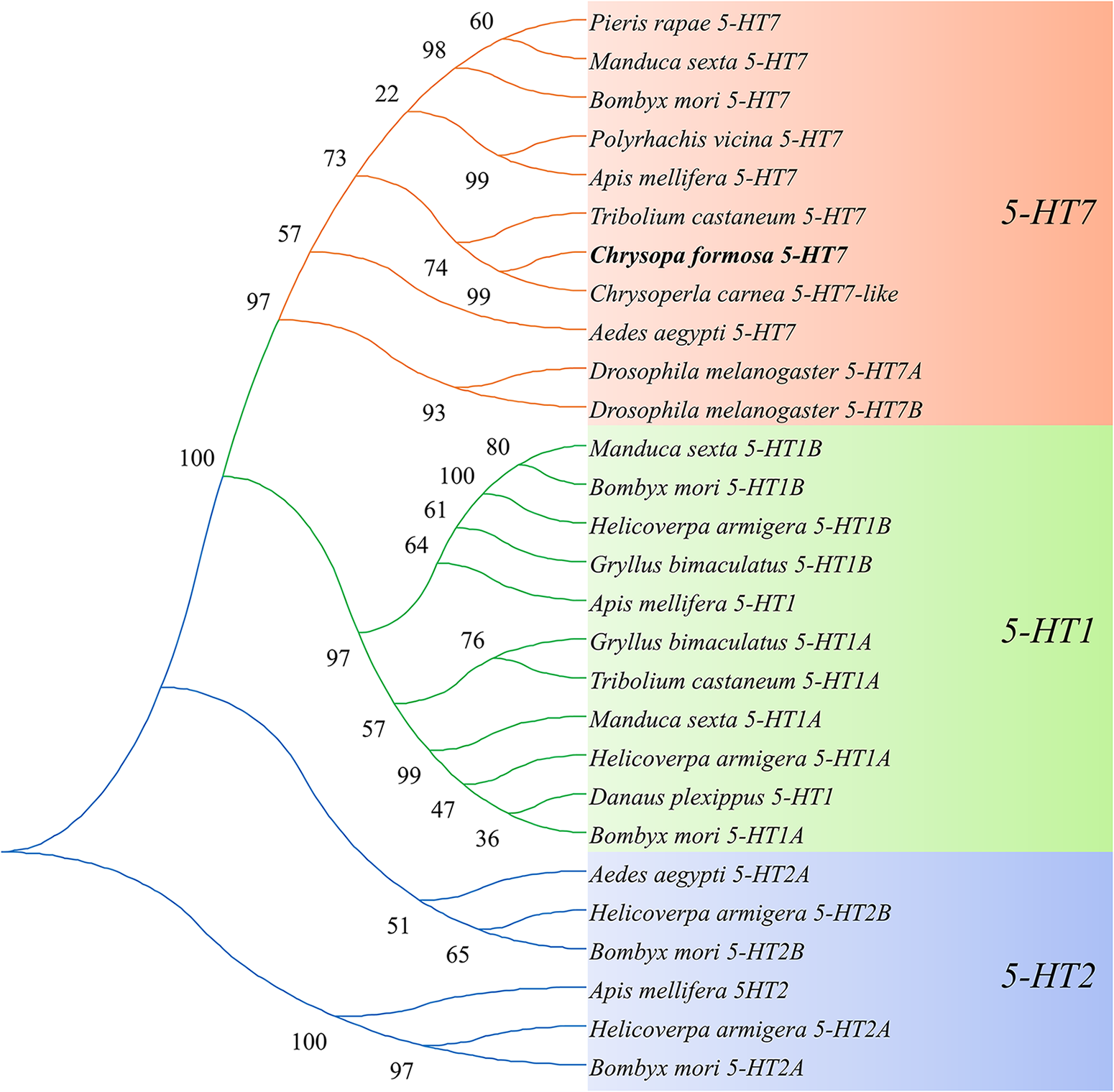
To investigate the phylogenetic relationships among 5-HTR subtypes, 5-HT1, 5-HT2 and 5-HT7 proteins from insects belonging to the orders Neuroptera, Lepidoptera, Coleoptera, Hymenoptera, Orthoptera and Diptera were downloaded from NCBI to construct a phylogenetic tree (fig. 4). These 5-HT receptors, belonging to various subtypes, each formed a distinct branch, leading to three main evolutionary family branches. The insects 5-HT7 family is more closely related to 5-HT1A family in evolutionary terms. Phylogenetic analysis indicated that Cf5-HT7 was classified within the 5-HT7 family clade, first clustering with 5-HT7 from Ch. carnea, in a shared branch, and subsequently clustering with 5-HT7 from T. castaneum. This is consistent with biological evolutionary relationships.
Evolutionary relationship of 5-HT receptors from C. formosa and other insects. A phylogenetic tree was constructed based on amino acid sequences of Cf5-HT7 and 5-HT receptor subtypes from different insect species using the neighbour-joining method with 1,000 bootstraps. The numbers at the forks indicates the bootstrap. The 5-HT receptor proteins, used for phylogenetic analysis, with their corresponding GenBank accession numbers, are listed in table 2.

Expression profile of Cf5-HT7 at different developmental stages of C. formosa
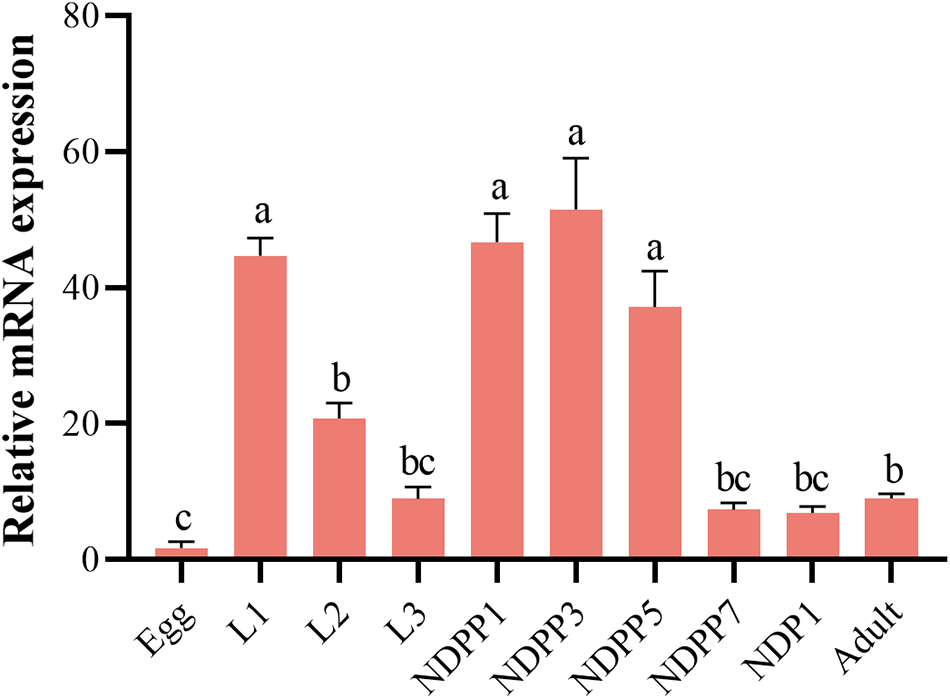
The transcript levels of Cf5-HT7 among different developmental stages of C. formosa are significantly different (F (9, 29) = 6.062, p < 0.0001) (fig. 5). Cf5-HT7 expression level in eggs was low, but drastically increased in the 1st instar larvae, 26 times higher than that in the eggs. As the larvae progressed from the first to the third instar, the expression level of Cf5-HT7 was consistently and significantly downregulated. Interestingly, the expression of Cf5-HT7 upregulated dramatically during the prepupal stage, and it remained at a high level from the first to the fifth day of the prepupal period, comparable to that of the first instar larvae. However, the mRNA abundance of Cf5-HT7 rapidly declined to a lower level in 7-day-old prepupae, showing no significant difference compared to that in newly emerged pupae and adults (fig. 5).
Relative expression levels of Cf5-HT7 at different normal developmental life stages of C. formosa. The mRNA abundance of Cf5-HT7 in eggs, larval stage (L1, L2 and L3), prepupal stage (NDPP1, 3, 5 and 7), pupae (NDP1) and adults were measured by qRT-PCR. Values are means ± SE (n = 6). Bars with different letters indicate significant differences (P < 0.05), as determined by one-way ANOVA followed by Tukey’s multiple comparison test.

Expression pattern of Cf5-HT7 throughout diapause development
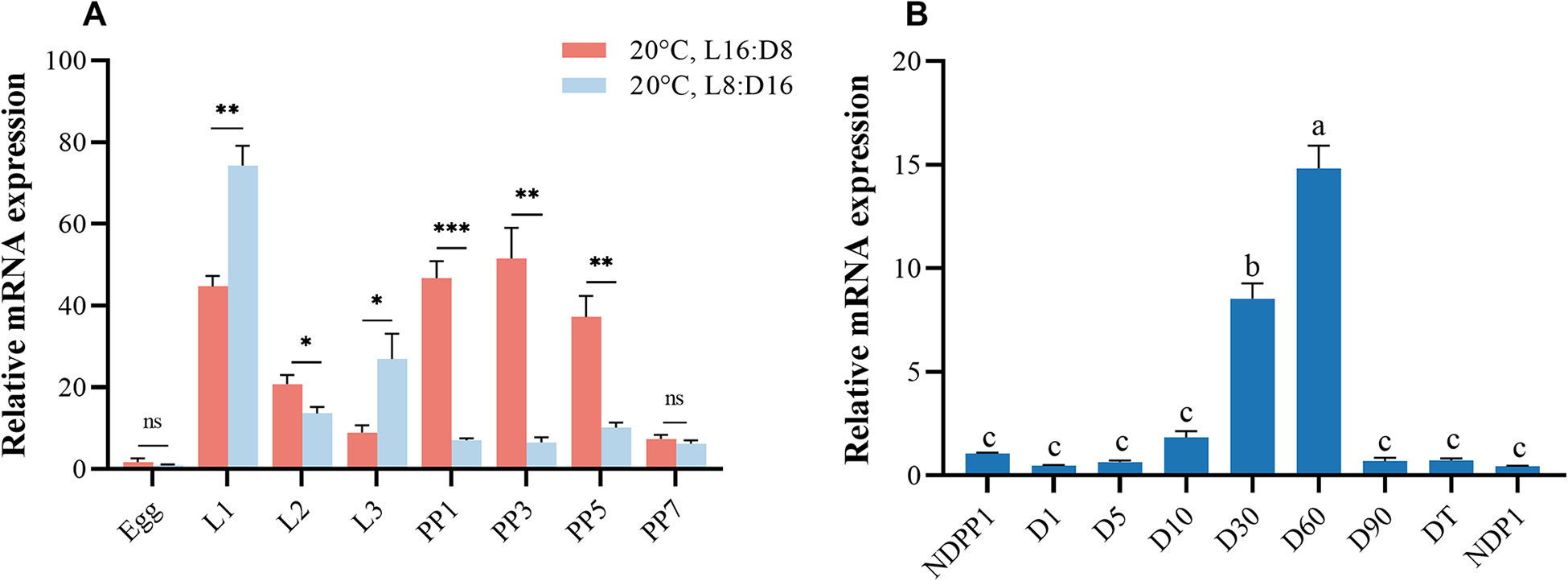
To investigate the transcriptional expression of Cf5-HT7 in response to stimuli inducing diapause, we determined the relative mRNA abundance of Cf5-HT7 in various developmental stages of C. formosa, including eggs, larvae, and prepupae, that were reared under both non-diapause and diapause-inducing conditions. In the preparation stage for diapause, the expression level of Cf5-HT7 in both the first instar and third instar larvae was significantly higher than that in their counterparts reared under non-diapause conditions. However, the expression of Cf5-HT7 was lower in the second instar larvae under diapausing conditions, suggesting stage-specific regulation (fig. 6a). Once diapause was initiated, the mRNA abundance of Cf5-HT7 in diapausing prepupae decreased dramatically, with the expression levels of Cf5-HT7 in prepupae from day 1 to day 5 all being significantly lower than those of non-diapause prepupae (fig. 6a). The expression of Cf5-HT7 in eggs and prepupae at day 7, reared under the two conditions, did not exhibit any significant difference (fig. 6a).
Expression pattern of Cf5-HT7 throughout diapause development of C. formosa. Changes in the mRNA expression levels of Cf5-HT7 in the eggs, larvae (L1, L2, and L3) and prepupae (PP1, PP3, PP5, and PP7) of C. formosa destined for diapause, as compared to their nondiapause counterparts (A). Asterisks (*) represent significant differences between the diapause-destined group and nondiapause group (Student’s t-test; *p < 0.05, **p < 0.01, ***p < 0.001). The relative expressions of Cf5-HT7 in nondiapausing prepupae (NDPP1), diapausing prepupae (enter diapause for 1, 5, 10, 30, 60, and 90 days), post-diapausing pupae (DT) and nondiapausing pupae (NDP) (B). Different letters indicate significant differences (one-way ANOVA followed by Tukey’s multiple comparations, p < 0.05). All the values are expressed as means ± SE based on six independent biological replicates.

During the diapause maintenance phase, the expression level of Cf5-HT7 remained at a low level for the first 10 days, showing no significant difference from the non-diapause group (fig. 6b). Notably, Cf5-HT7 expression increased significantly from day 30 to 60, up to 4–8 times higher than at day 10, before dropping again at day 90, and stabilising post-diapause termination (fig. 6b).
Discussion
The molecular characterization of the 5-HT7 receptor in C. formosa (Cf5-HT7) reveals key structural features that align with the known properties of GPCRs belonging to the class A family. This family of GPCRs include the typical seven transmembrane domains, with intracellular and extracellular loops interspersed between them, a hallmark of GPCRs involved in signal transduction across the cell membrane, as seen in other insect species (Chen et al., Reference Chen, Gao, Wang, Xie, An, Du and Zhao2023; Schlenstedt et al., Reference Schlenstedt, Balfanz, Baumann and Blenau2006). GPCRs are known to be the largest and most diverse family of signal transduction receptors in humans (Mykytyn and Askwith, 2017), playing essential roles as signaling molecules that regulate a wide range of physiological processes (Mykytyn and Askwith, 2017; Fried et al., Reference Fried, Hewage, Eitel, Struts, Weerasinghe, Perera and Brown2022). In insects, GPCRs are also critical membrane proteins that transmit environmental and physiological signals, including light, neurotransmitters, and hormones, into the cells (Zhao et al., Reference Zhao, Wang, Liu and Zhao2016). The absence of a signal peptide in Cf5-HT7 suggests that it may not be secreted, but instead function at the cell membrane or within intracellular compartments, where it can mediate local signaling events, as observed in D. melanogaster and Locusta migratoria (Van Bortle et al., Reference Van Bortle, Peterson, Takenaka, O’Connor and Corces2015; Veenstra, Reference Veenstra2017; Wu et al., Reference Wu, Yang, Chen, Majeed, Li, Gong, Wei, Yang, Tang, Wang, Toufeeq, Shaik, Huang, Guo and Ling2024). Disordered regions in GPCRs are known to contribute to receptor flexibility, enabling conformational changes that are essential for effective signal transduction (Venkatakrishnan et al., Reference Venkatakrishnan, Flock, Prado, Oates, Gough and Babu2014). In the case of the 5-HT7 receptor in C. formosa, the disordered region (residues 392–412) may facilitate its interaction with G-proteins or other intracellular signaling molecules, which is critical for the receptor’s role in modulating behaviour and physiological processes. The disulfide bridge connecting extracellular loop 1 and the bottom of extracellular loop 2 in Cf5-HT7 likely plays a key role in maintaining the receptor’s structural stability and conformation integrity, as it facilitates the correct folding and function of the protein (Iglesias et al., Reference Iglesias, Cimadevila, La Fuente, Martí-Solano, Cadavid, Castro, Selent, Loza and Brea2017). Post translational modifications are critical in modulating the function of GPCRs, including the 5-HT receptors. The presence of several posttranslational modifications, such as palmitoylation, N-glycosylation and phosphorylation sites in Cf5-HT7, is particularly interesting as these modifications are known to affect receptor localization, trafficking, stability and signal transduction (Duhr et al., Reference Duhr, Déléris, Raynaud, Séveno, Morisset-Lopez, Mannoury la Cour, Millan, Bockaert, Marin and Chaumont-Dubel2014; Patwardhan et al., Reference Patwardhan, Cheng and Trejo2021; Vuorio et al., Reference Vuorio, Škerlová, Fábry, Veverka, Vattulainen, Řezáčová and Martinez-Seara2021).
The MSA and phylogenetic analysis of Cf5-HT7 indicate that this receptor is evolutionarily conserved. The presence of highly conserved motifs, including ‘D-R-Y’, ‘N-P-x-x-Y’, and ‘FxxxWxP’, suggests their functional significance in receptor activation, ligand binding and signal transduction (Fritze et al., Reference Fritze, Filipek, Kuksa, Palczewski, Hofmann and Ernst2003; Venkatakrishnan et al., Reference Venkatakrishnan, Deupi, Lebon, Tate, Schertler and Babu2013). These findings are consistent with mechanisms of 5-HT7 receptors described in other insect models (Chen et al., Reference Chen, Gao, Wang, Xie, An, Du and Zhao2023; Pietrantonio et al., Reference Pietrantonio, Jagge and Mcdowell2001; Yang et al., Reference Yang, Xi and Wang2019). Phylogenetic analysis further confirms that Cf5-HT7 belongs to the 5-HT7 receptor family and exhibits a high degree of sequence similarity (89.26%) with the Neuropteran species Ch. carnea. The sequence identity between Cf5-HT7 and 5-HT7 receptors from other insect species, such as T. castaneum and B. mori, supports previous studies highlighting the functional conservation of 5-HT7 receptors across insect taxa (Rao et al., Reference Rao, Zhan, Pan, Liu, Yang, Yang and Yu2017; Schlenstedt et al., Reference Schlenstedt, Balfanz, Baumann and Blenau2006). This high conservation suggests that 5-HT7 receptor plays a critical and conserved role in insect physiological processes. The close phylogenetic relationship between the 5-HT7 receptor and 5-HT1A receptors observed in this study highlights the complexity of serotonergic signaling pathways in insects. It suggests a potential evolutionary trade-off between receptor subtypes that balance diverse physiological needs. However, the sequence of the third intracellular loop varies considerably across different insect species (fig. 2), which may reflect functional and evolutionary adaptations to specific physiological or behavioural demands. These results indicate that the 5-HT7 receptor evolved within a conserved functional framework across diverse insect orders, further emphasising its physiological importance.
In the current study, the expression profile of Cf5-HT7 across various developmental stages of C. formosa showed significant variability, underscoring its crucial role in regulating growth, development and other physiological processes. Notably, the significant upregulation of Cf5-HT7 during the first instar larval stage suggests its involvement in active feeding and rapid growth early in development. Similarly, high expression of the 5-HT7 receptor in the Malpighian tubes and guts of M. separata larvae highlights its role in digestion and metabolism (Chen et al., Reference Chen, Gao, Wang, Xie, An, Du and Zhao2023). Ganguly et al. (Reference Ganguly, Qi, Bajaj and Lee2020) demonstrated that knockdown of 5-HT7 receptor expression in mushroom body neurons impaired olfactory appetitive learning in D. melanogaster larvae, emphasising the receptor’s essential role in mediating olfactory neural circuits. The 5-HT7 receptor is also crucial for larval locomotion in Drosophila (Moncalvo and Campos, Reference Moncalvo and Campos2009; Silva et al., Reference Silva, Goles, Varas and Campusano2014). Furthermore, serotonin interacts with the 5-HT7 receptor in the salivary ligands of Calliphora vicina, promoting saliva secretion, which likely facilitates feeding (Röser et al., Reference Röser, Jordan, Balfanz, Baumann, Walz, Baumann and Blenau2012). Collectively, these studies support our findings, suggesting that the 5-HT7 receptor plays a vital role in various aspects of larval behaviour, growth and physiology. The observed decrease in Cf5-HT7 expression during later larval stages, followed by a dramatic increase during the prepupal stage, suggests its involvement in transition processes such as growth and developmental metamorphosis. As seen in A. aegypti, deletion of the 5-HT7A receptor resulted in larval and pupal abnormalities, reduced motor activity, increased mortality, delayed stimulus response, and lower egg hatching rates, demonstrating its critical role in development, metamorphosis, and physiological functions (Li et al., Reference Li, Zhang, Wu, Li, Chen, Chen, Wang, Liao and Han2022). Interestingly, the high expression of Cf5-HT7 during the prepupal stage of C. formosa suggests a functional role in initiating the metamorphosis from prepupa to pupa. This is consistent with findings in D. melanogaster, where serotonin signaling through the 5-HT7 receptor modulates nutrient-dependent ecdysteroid biosynthesis, controlling developmental timing (Shimada-Niwa and Niwa, Reference Shimada-Niwa and Niwa2014). In their study, inhibiting the 5-HT7 receptor delayed pupariation, reduced ecdysteroid levels, and downregulated steroidogenic gene expression in D. melanogaster. cAMP levels in the prothoracic gland also decreased upon 5-HT7 knockdown, linking serotonin to hormonal synthesis. These results establish serotonin signaling as a critical mediator connecting environmental nutrition to endocrine timing, ensuring adaptive developmental transitions through neuronal modulation of steroid hormone production. Additionally, the slightly higher expression of the 5-HT7 receptor in the pupae of the ant P. vicina may suggest its role in modulating adult formation (Yang et al., Reference Yang, Xi and Wang2019). Previous studies have also shown that 5-HT7 is involved in the normal courtship and mating behaviours of Drosophila adults (Luo et al., Reference Luo, Becnel, Nichols and Nssel2012), and higher expression of 5-HT7 is also observed in adults of Harmonia axyridis, P. vicina and M. separata (Chen et al., Reference Chen, Gao, Wang, Xie, An, Du and Zhao2023; Yang et al., Reference Yang, Xi and Wang2019; Zhang et al., Reference Zhang, Chang, Zheng and Sun2023). However, the transcriptional level of Cf5-HT7 in newly emerged adults is much lower than that in the larval and prepupal stages of C. formosa, suggesting that the role of this receptor may vary across different insect species.
The significant changes in Cf5-HT7 expression of C. formosa larvae in response to diapause-inducing conditions (short day-length and low temperature) highlight the receptor’s role in the physiological adaptations necessary to cope with altered environmental conditions (Ullah et al., Reference Ullah, Abbas, Gul, Güncan, Hafeez, Gadratagi, Ciceri, Ramirez-Romero, Desneux and Li2024). Diapause is triggered by environmental stimuli well before the onset of developmental arrest, and insects destined for diapause typically undergo physiological changes during the prediapause preparatory period. These changes include increased food intake, enhanced digestive efficiency, and the diversion of nutrients from somatic growth to storage (Hahn and Denlinger, Reference Hahn and Denlinger2011). The elevated expression of Cf5-HT7 in the first and third instar larvae is likely associated with feeding and digestion. Although we did not measure Cf5-HT7 level in the digestive system directly, the high expression of 5-HT7 in the midgut of H. axyridis, Gryllus bimaculatus and M. separata suggests a conserved role for this receptor in digestion and nutrition metabolism (Chen et al., Reference Chen, Gao, Wang, Xie, An, Du and Zhao2023; Watanabe et al., Reference Watanabe, Sadamoto and Aonuma2011; Zhang et al., Reference Zhang, Chang, Zheng and Sun2023). The third instar larvae of C. formosa is particularly sensitive to reduced day lengths, and the higher Cf5-HT7 expression observed may be involved in regulating neuronal sensitivity and circadian rhythms (Li et al., Reference Li, Wang, Gao, Zhang, Chen, Wang, Liu and Zhang2018). Previous studies have shown that serotonin signaling regulates the circadian pacemakers in G. bimaculatus (Saifullah and Tomioka, Reference Saifullah and Tomioka2002), and the 5-HT7 receptor is known to play a significant role in regulating sleep and circadian rhythms in animals (Sprouse et al., Reference Sprouse, Reynolds, Li, Braselton and Schmidt2004). The function of 5-HT7 receptor in modulating circadian systems in insects warrants further investigation. A decline in Cf5-HT7 expression following the initiation of diapause, followed by the gradual increase during the maintenance phase, aligns with the known role of serotonin in modulating the neurophysiological changes associated with diapause in insects (Denlinger, Reference Denlinger2022a). For example, serotonin levels in Chymomyza costata significantly rise during diapause (Kostal et al., Reference Kostal, Noguchi, Shimada and Hayakawa1999). In the diapausing pupae of Pieris brassicae, 5-HT levels are maintained at a high level, potentially inhibiting brain metabolism and endocrine activity to sustain diapause (Isabel et al., Reference Isabel, Gourdoux and Moreau2001). The 5-HTB receptor may induce or maintain diapause in A. pernyi pupae by preventing the synthesis or release of PTTH, and interference with 5-HTB can prematurely terminate diapause (Wang et al., Reference Wang, Mohamed and Takeda2013). However, Matsumoto and Takeda (Reference Matsumoto and Takeda2002) found that both 5-HT and ecdysteroid levels increase significantly during diapause termination in A. pernyi pupae, suggesting that 5-HT may promote the release of ecdysteroids, facilitating diapause exit. In this study, the dramatic increase in Cf5-HT7 expression in diapausing prepupae at 60 days coincides with the onset of diapause termination in C. formosa (Li et al., Reference Li, Wang, Gao, Zhang, Chen, Wang, Liu and Zhang2018). We speculate that the 5-HT7 receptor plays an important role in the termination of diapause in C. formosa, particularly in regulating the timing of ecdysteriod biosynthesis. As shown in D. melanogaster, serotonin signaling through the 5-HT7 receptor regulates the timing of ecdysteriod synthesis in the PG and determines the transition from larva to pupa (Shimada-Niwa and Niwa, Reference Shimada-Niwa and Niwa2014). Experiments currently underway seek to explore biological role of serotonin and its receptors in regulating the diapause process of C. formosa.
Conclusion
In conclusion, this study provides valuable insights into the molecular characteristics and functional dynamics of the Cf5-HT7 receptor in C. formosa. The receptor’s conserved structural features and its phylogenetic relationships with other insect species highlight its significance in serotonin signaling. The expression profiles demonstrate that the 5-HT7 receptor plays a crucial role in regulating developmental and physiological processes, particularly in response to environmental cues during diapause. These findings suggest potential strategies for manipulating insect populations, either by promoting or delaying development or diapause through targeted modulation of serotonin signaling pathways.
In the context of beneficial insects such as C. formosa, targeting the 5-HT7 receptor with RNA interference or small molecule agonists could delay or accelerate diapause termination, offering precise control over the diapause period. Such strategies would enhance the storage and rearing of natural enemies, improving their availability for biological control programs. Moreover, the ability to modulate diapause or development could be applied to pest management. Targeting the 5-HT7 receptor in pests could delay or prevent diapause, disrupt key developmental transitions, and thereby reduce pest survival. Compounds targeting the 5-HT7 receptor could be used as environmentally friendly insecticides or growth regulators, enhancing the ability to manage pest populations with higher precision and efficiency.
Future research should aim to elucidate the molecular mechanisms by which Cf5-HT7 influences diapause and development. Exploring the interactions between Cf5-HT7 and other signaling pathways, including hormonal and environmental factors, will be crucial. Investigating the role of serotonin and 5-HT7 in other life stages, such as reproductive behaviour and stress responses, will also broaden our understanding of its biological functions, paving the way for more effective natural enemy mass production or pest control strategies.
Acknowledgements
We thank Dr. Linhao Ge and Mingxuan Jia, Institute of Plant Protection, Chinese Academy of Agricultural Sciences, Beijing, for their assistance in helping us analyse protein structure by using AlphaFold 2. This research was financed by the National Natural Science Foundation of China (32372629) and National Key R&D Program of China (2023YFE0123000, 2023YFD1400600).
Conflicts of interest
The authors declare no conflict of interest.