1. Introduction
If success is about results, then the GATT/WTO is one of the most successful international organizations of the past century. In its 60-year history, it has stimulated multilateral trade liberalization, settled disputes, and provided a forum for ongoing trade talks. Under its aegis, trade has expanded dramatically throughout the world. The ratio of world exports of goods and services to GDP rose from 13.5% in 1970 to 32% in 2005. Almost every country that is not yet a member (such as Russia and the Ukraine) is clamoring for admittance to this 150 nation club.
But trade results are not the only criteria to assess the impact of the WTO. In recent years, some scholars, activists, and policymakers have suggested that the WTO agreements undermine the ability of member states to achieve other important policy goals (Consultative Board, 2005: 10). Some of the most forceful critics argue that that the WTO system of rules makes it harder for member states to meet their obligations to respect, protect and advance human rights as delineated in the Universal Declaration of Human Rights – the code of human rights developed by the members of the United Nations.Footnote 1 They note that while the WTO system has a strong system of dispute settlement, the international system of human rights does not have an effective universal mechanism to ensure the implementation of human rights norms and principles, to assess violations, or to punish violators (International Federation for Human Rights, 2001: 3). Other critics argue that WTO rules signal to market actors that trade is more important than specific human rights such as worker or indigenous rights.Footnote 2
As the debate has grown louder and more vigorous, some WTO advocates have tried to forcefully defend the WTO's rules-based system. They stress that the WTO governs trade and thus does not address these other policy objectives. Moreover, these WTO defenders note that the GATT and the WTO stipulate rules regarding what governments cannot do, not what they can do. Thus, they argue that it is not surprising that these agreements do not provide guidance on how WTO members can promote human rights without distorting trade (Vasquez: 2003: 803; Cleveland, Reference Cleveland2002: 188–189; and Lim, Reference Lim2001: 4–5).
Meanwhile, some WTO defenders turn this argument on its head. They claim the WTO in fact promotes human rights. They note that, over time, the GATT and the WTO have stimulated trade and improved governance. As nations learn the habits of good governance, they stress, policymakers learn not only to protect some rights such as property rights but also to protect other rights such as political participation and due process rights.Footnote 3 Other WTO proponents, for example, the WTO's Consultative Board, argued that by simply by promoting economic activity, the WTO enhances human welfare.Footnote 4 Other scholars argue that trade and human rights should exist in different policy realms. They stress that human rights issues are not trade issues and, therefore, the WTO has no authority to address them (Bhagwati, Reference Bhagwati1996: 1).
The debate over whether the WTO promotes or undermines human rights has been simplistic. Trade policies and agreements – and the trade they stimulate – can undermine some rights and enhance others. Because every country is different, there is no one set way that trade affects a basket of rights or a particular human right. Moreover, each country's human rights priorities and conditions may change over time, reflecting demographics, culture and the country's political, social, and economic situations. Rather than try to assess how the WTO undermines or advances human rights, this paper seeks to examine what policymakers think and do in response to pressures to promote human rights and to expand trade. What does policymaker behavior tell us about the relationship between human rights and trade? Do policymakers discuss human rights issues at the WTO? Do they find ways to reconcile their trade and human rights objectives within the framework of WTO rules? How do they talk about human rights as they try to expand trade?
This paper finds that WTO members increasingly seek to reconcile their trade and human rights objectives. Trade policymakers have introduced human rights concerns in trade policy reviews and trade disputes, negotiated waivers of WTO obligations to protect human rights, and discussed human rights issues during both the Doha and Uruguay Rounds of trade talks. At times, they have made it clear that they view particular human rights as a policy priority. In many other instances, they have struggled to find common ground between human rights and trade objectives.
The article begins with a short review of scholarship on the WTO and human rights. Then we examine the human rights obligations of UN member states. We next explore the channels through which members can voice human rights concerns within the organization. Finally we make some conclusions about governments, the WTO, and human rights.
The WTO includes many agreements which govern trade in goods and services, special arrangements for special sectors, and related agreements such as the Agreement on Sanitary and Phytosanitary Measures. For the purposes of simplicity, we limit our discussion in this article to GATT 1994, Annex 2 (the Dispute Settlement Understanding), Annex 3 (the Trade Policy Review Mechanism), and the Agreement on Agriculture. We focus on GATT 1994, which delineates the basic norms and obligations of the world trading system.Footnote 5
2. A review of trade, the WTO, and human rights
While the allegations about the relationship between WTO rules and human rights objectives are new, policymakers and activists have been debating the relationship between expanded trade, trade agreements, and particular human rights for centuries (Temin, Reference Temin2003: 8, 14–16 and Irwin, Reference Irwin1996: 14–21). The first trade sanction, the Pericles Megarian decree, was developed in 432 BC in response to the kidnapping of three Aspasian women (Hufbauer et al., Reference Hufbauer1990: 4). Irwin (Reference Irwin1996: 21) notes that Vitoria, one of the ‘founders of international law’, contended that the right to trade is ‘derived from the law of nations … Foreigners may carry on trade, provided they do no hurt to citizens.’
In the centuries that followed, policymakers around the globe developed a wide range of approaches to govern the behavior of states and citizens at the intersection of trade and human rights. Often one state would act and challenge (or inspire) others to follow. For example, after England banned the slave trade in 1807, it signed treaties with Portugal, Denmark, and Sweden to supplement its own ban. After the United States banned goods manufactured by convict labor in the Tariff Act of 1890 (section 51), Great Britain, Australia, and Canada adopted similar bans. Ever so gradually, these national laws inspired international cooperation. Thus after World War I, policymakers created the International Labor Organization to ensure that trade did not undermine ‘fair and humane conditions of labor’. One of the reasons US and British policymakers created the International Trade Organization and later the GATT was to ensure that nations did not ‘export their unemployment’ and thereby undermine the ability of workers to provide for their families (Aaronson, Reference Aaronson2001: 36, 44).
But policymakers often proceeded blindly at the intersection of trade and human rights. Scholars know very little about how trade affects particular human rights and how protecting particular human rights may affect trade (Richards et al., Reference Richards2001, Richards and Gelleny, n.d.). Scholars also don't know if promoting certain human rights could be trade-enhancing or if increased trade inspires policymakers to do more to protect specific human rights. In addition, researchers know little about the lines of causality. Do enhanced human rights protections lead to increased trade? Or does increased trade lead to improved human rights? Footnote 6 Finally, scholars don't know how trade policies may affect a particular human right over time.Footnote 7
However, researchers from a variety of disciplines are beginning to attempt to answer these questions.Footnote 8 Some political scientists have sought to statistically test the relationship between trade openness and various human rights categories such as labor rights, personal integrity rights (such as the right to liberty or security) or subsistence rights (such as the rights to water, food, and sanitation). Others have simply examined the relationship between trade and a particular human right. The more rigorous studies are finding a complex relationship.Footnote 9 These studies reveal that some rights (such as personal integrity rights) tend to improve, while others such as labor rights decline until the country achieves a certain level of democracy and the rule of law.Footnote 10 Some policymakers are starting to use these empirical studies to assess their foreign aid, trade and human rights policies (Finkel et al., Reference Finkel, Perez-Linan and Seligson2005 and Wurth and Frauke, Reference Wurth and Lisa Seidensticker2005).
Legal scholars are also tackling these questions. The American Society of International Law cooperated with the Max Planck Institute at Heidelberg, Germany, and the World Trade Institute at Bern, Switzerland, on a project designed to study the links between trade law and policy and international human rights law (Cottier et al., Reference Cottier Thomas and Burgi2005). Legal scholars such as Ernst-Ulrich Petersmann, Robert Howse, Thomas Cottier, and others have examined how specific WTO provisions (such as the exceptions or dispute settlement mechanisms) may be used to protect human rights or may undermine human rights (Petersmann: Reference Petersmann2001, Howse, Reference Howse2002, Cottier et al., Reference Cottier Thomas and Burgi2005). Scholars such as Joost Pauwelyn, Steve Charnovitz and Gabrielle Marceau have also offered insights into how WTO dispute settlement bodies may address human rights questions (Pauwelyn, Reference Pauwelyn2004; Charnovitz, Reference Cingranelli, McMahon and Sinclair2002: 797–839; and Marceau, Reference Marceau2002). Some scholars have suggested systematic reforms, such as making the human rights system more like the WTO (for example, with stronger dispute settlement and enforcement mechanisms) or alternatively making the WTO system more sensitive to human rights concerns (Lim, Reference Lim2001; and Cottier et al., Reference Cottier Thomas and Burgi2005). Still other academics have suggested bridging mechanisms to ensure better dialogue and coordination between trade and human rights officials.
Only one of these studies examined the effect of WTO membership and human rights. Cooper (Reference Cooper2003) tried to test the relationship between WTO membership and democratization (as opposed to protecting a particular human right) for the period 1947–1999. She could not determine whether democratic states were more likely to join the WTO or whether WTO membership makes countries more likely to become or remain democratic.
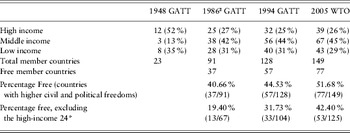
We also performed a cursory examination of GATT/WTO membership, income level, and political rights (noting that the GATT governed trade from 1948 to 1994; the WTO thereafter). Table 1 shows how the membership of the GATT/WTO has changed over time, particularly in regards to the percentage of free and democratic member states. We divided the countries by income levels and found that the percentages of income levels stayed mostly constant, although more developing countries joined the WTO and more countries moved to a higher income level. We note that, if we exclude the high-income Organization for Economic Cooperation and Development (OECD) countries, a growing percentage of WTO members are considered to be ‘free’ and democratic, using Freedom House's criteria. Here, too, however, the direction of causality is unclear. We don't know whether WTO membership is a factor moving states to become more democratic or whether more democratic states want to join the WTO.
Democratic and free nations in the GATT/WTOFootnote 1

Notes: 1 Information received from the World Bank website (www.worldbank.org), the Freedom House website (www.freedomhouse.org, and the WTO website (www.wto.org).
2 The income information given for the 1986 column is actually for 1987. Data for 1986 were not available from the World Bank website; however, the income status for a country generally does not change very drastically between years.
* Yearly totals vary because, for instance, some countries dropped out; some countries split (the Czech Republic and Slovakia); and the nations of the European Union agreed to negotiate trade policies at the European Community level.
According to Freedom House, democratic and free countries have a climate of respect for civil liberties, significant independent civic life, and independent media. In partly free countries, political rights and civil liberties are more limited, and these countries may also experience corruption, weak rule of law, and one dominant political party enjoys dominance. In countries that are not free, people are widely and systematically denied basic civil liberties and political rights.
Thus, although scholars are increasingly interested in these questions, we don't have a broad understanding about how trade affects human rights or how protecting human rights may affect trade. This gap signals that we need more information about how trade officials behave at the WTO when they perceive conflict between their human rights and trade obligations. As noted above, the WTO agreements say very little about what policymakers can do if they perceive they must distort trade in order to protect human rights. The next section describes these human rights obligations at home and abroad.
3. The human rights obligations of WTO member states
The words ‘human rights’ have different meaning to different people around the world. Every country has its own particular human rights objectives, priorities, policies, and expertise. However, in 1948, United Nations member states committed to promote and protect specific human rights, as outlined in the Universal Declaration of Human Rights (UDHR). This code of human rights responsibilities is truly universal in scope; it applies to everyone, regardless of whether or not individual governments have formally accepted its principles or ratified the Covenants. However, because it is not legally binding upon states, member states created covenants to put these human rights into effect. Most of the 151 WTO member states have ratified or signed the two UN Covenants on Human Rights. These Covenants require states to take or not take certain actions to promote, protect, or respect human rights. For example, states should not to interfere in the exercise of a wide range of rights such as the right to life or the right to privacy. But they also require governments to take affirmative steps to ensure that their citizens have access to education, to ensure that their citizens receive equal pay for equal work, and that policymakers protect the rights of intellectual property holders (Petersmann, Reference Petersmann2001: 15 and UDHR).Footnote 11
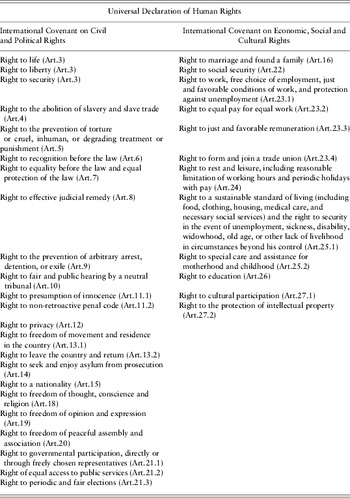
Since the covenants went into force, human rights objectives and laws have continued to evolve, reflecting changes in technology, politics, resources, and human understanding. Today many human rights activists have identified new human rights such as the right to development, the right to a healthy environment, or intergenerational rights. These newer rights, however, are not embodied in the Covenants and in general are thus far not binding on states. Thus, in this article, we generally limit our study to the specific human rights delineated in the UDHR and its Covenants. Table 2 delineates these rights.
What human rights are we talking about?

Source: Chart prepared by Philip Van der Celen based on UDHR at http://www.un.org/Overview/rights.html
In 1989, the members of the United Nations recognized that they needed to do more to ensure that international organizations, as well as nation states, collaborated to protect human rights; they worked to ensure that their activities did not make it harder for governments to promote human rights at home or abroad. At a historic meeting in Austria in 1993, UN members called on the world's international organizations to assess their impact on the enjoyment of human rights. However, the GATT members that signed the Vienna Declaration on Human Rights did not take steps to examine how the GATT agreements might affect specific human rights (UN General Assembly, 1993).
Today, although the WTO and the UN Commission on Human Rights are both in Geneva, they have not met to coordinate policies. In fact, WTO staff cannot simply ‘coordinate’ without a direct mandate from WTO member states. Nevertheless, officials from UN human rights bodies and WTO staff are beginning to communicate and occasionally to meet. In recent years, for example, the UN High Commissioner has issued several reports that provide ‘context’ for the interpretation of WTO rules.Footnote 12 These reports examined the effects of trade agreements on to broad panoply of rights, ranging from the right to health to gender rights.Footnote 13 But the reports do not appear to have had great influence upon the behavior of WTO members.
4. Avenues to discuss and act on human rights concerns within the WTO system
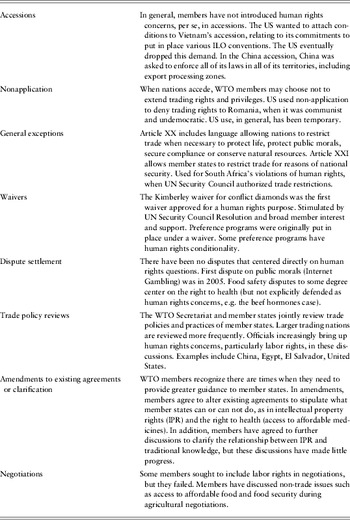
Despite the lack of clarity regarding the relationship between their WTO and human rights obligations, many WTO members use the workings of the WTO to discuss the human rights and trade intersection. Table 3 delineates these avenues.
The WTO system and where human rights may enter the discussion

On accession and nonapplication
Like the GATT, the WTO does not have any human rights or democracy criteria for membership. Any state or customs territory with full autonomy in the conduct of its trade policies may accede to the WTO. However, WTO members must agree on the terms of membership; as a result, these terms differ for each country.Footnote 14 Members have successfully pressed for policy changes within states that want to accede to the WTO, and some of these changes are not-strictly trade-related (Subramanian and Wei, Reference Subramanian2003; and Tomz, Goldstein, and Rivers, Reference Tomz, Goldstein and Rivers2005: 18). I examined all of the accessions (Armenia, Cambodia, Saudi Arabia, Macedonia, Nepal, and Vietnam) from January 2003 to April 2007 as well as the China accession documents (2001) to ascertain if existing WTO members expressed concerns about the potential acceding country's human rights practices. Interestingly, each of these states has difficulty protecting human rights.Footnote 15
When these countries applied for WTO membership, their applications (like those of all other countries seeking to accede) were reviewed by a working party comprised of existing WTO members. The deliberations always began with a discussion of how these countries made and promulgated public policy in general, and trade policies in particular. Members then focused on how the applicant nation protected the rights of citizens, as well as noncitizens, to participate in trade.Footnote 16
For example, as Cambodia sought to accede to the WTO in 2003, members of the working party on its accession noted that its legal system did not afford adequate protection for individuals or businesses. The representative of Cambodia promised that the country would establish a commercial court system with trained judges and staff. Working party member governments then reminded Cambodia that when it established standards or technical regulations, it was obliged to develop ‘mechanisms for publication and dissemination of draft legislation and standards for public comment; [and] the establishment of a TBT (technical barriers to trade) Inquiry Point’ where foreign and domestic producers could learn how to meet Cambodian standards.Footnote 17 After Cambodia agreed to these and many other changes, the WTO ministerial conference agreed to Cambodia's accession at the Cancun ministerial conference in September 2003.Footnote 18
Members also examined Saudi Arabia's adherence to the rule of law during deliberations on the accession of that Gulf state. Members spent hours asking questions about the rights of Saudis and non-Saudis to participate in various elements of the economy. They also urged the country to publish notices of proposed measures related to trade and to provide an opportunity for ‘interested persons’ to provide comments and views on such measures prior to their adoption and implementation.Footnote 19 In short, these officials were asking the Saudis for information about political participation in trade issues. Saudi Arabia agreed to establish an official website for trade policymaking and to ‘provide a reasonable period … for members, individuals, associations and enterprises to provide comments to the appropriate authorities before such measures were adopted’.Footnote 20 Nepal and Macedonia were required to address the same questions, and members of the working group seemed satisfied with the answers of the two governments.Footnote 21
Vietnam's adherence to international labor standards became an issue as it moved closer towards joining the WTO.Footnote 22 The United States wanted the Working Party report on Vietnam's accession to emphasize that Vietnam had not ratified eight of the International Labor Organization's conventions relating to core labor standards. The US also wanted Hanoi to provide information on how it was applying these standards nationally. Vietnam and other governments objected to such criteria.Footnote 23 The US, having made its point, dropped this proposed requirement, and labor issues were not mentioned in the Report of the Working Party on Vietnam's accession.Footnote 24 This strategy may have paid off. In documents prepared for the World Bank, the Vietnamese government admitted that it was under pressure to do a better job implementing ILO conventions and it acknowledged that such pressure could be useful to the government as it worked to improve social conditions.Footnote 25
WTO members attached stringent conditions for China's accession, which were quite different from other countries' accession agreements.Footnote 26 The agreement signaled members' concerns about labor rights and conditions in China's export processing zones (EPZs). China has used these zones (special economic zones) to experiment with market-based, outward-oriented policies. In many of these zones, the Chinese government ignores or flouts its own labor laws. Members of the WTO expressed concern that China might thus attract investment from countries that have more stringent workers' rights standards. They also noted that China lacked an impartial judiciary, an effective and transparent social and environmental regulatory system, and a strong central government capable of enforcing the law (Steinberg, Reference Steinberg1999). Reflecting these concerns, the 2001 Protocol on the Accession of the People's Republic of China is an unusual document. Unlike other Accession Protocols, it specifically comments on the effectiveness of the rule of law in China. It states that as a condition of accession, China must enforce ‘uniform administration of Chinese law’ throughout China. ‘The provisions of the WTO Agreement and this protocol shall apply to the entire customs territory of China, including … special economic zones … and other areas where special regimes for tariffs, taxes and regulations are established.’ The agreement also calls on China to ‘apply and administer in a uniform, impartial and reasonable manner all its laws, regulations and other measures of the central government as well as local regulations, rules and other measures … pertaining to or affecting trade … China shall establish a mechanism under which individuals and enterprises can bring to the attention of the national authorities cases of non-uniform application.’Footnote 27 The agreement requires China to notify the WTO about ‘all the relevant laws, regulations and other measures relating to its special economic areas’. Finally, it calls on China to ensure that ‘those laws, regulations and other measures pertaining to and affecting trade shall be enforced’.Footnote 28
Thus, members generally did not use the accession deliberations to push new entrants to change their human rights practices and attitudes. However, members have pressed for broad changes (such as improvements in the rule of law and greater transparency) that could facilitate human rights improvements over time. Thus, the China accession document did not address labor laws explicitly, but it reveals that members recognized that the failure to enforce human rights laws, whether labor law or intellectual property law, could distort trade. Moreover, the US action on Vietnam's accession could signal that some countries would be willing to use the opportunity posed by accession to obtain an acceding state's commitment to improve human rights governance.
WTO members not only decide which country can join the WTO, they can also decide to deny WTO benefits (known as nonapplication) to a potential member. Article XXXV allows members to deny application of WTO benefits to a new member, so long as they do so before the WTO Ministerial Council approves the member's accession agreement.Footnote 29 If countries use nonapplication under the WTO, they must use it for all of the WTO agreements.Footnote 30
In principle, members are free to use this process to punish WTO applicants for their human rights practices. In practice, only the United States, Peru, and El Salvador have ever used the provision. The United States is the only WTO member to use nonapplication as a strategy to punish other countries for human rights violations, but it has generally done so on a temporary basis. The United States relies on nonapplication to deny trading privileges to terrorist nations or former members of the Soviet bloc.Footnote 31 In the United States extension of MFN to Russia and several other economies in transition from Communism remains contingent on these countries' adherence to the provisions of the Jackson–Vanik amendment to the 1974 Trade Act regarding freedom of emigration, a basic human right.
On trade waivers, general exceptions, and the security exception
Waivers
WTO members cannot expel another member for any reason, including the failure to protect and promote human rights.Footnote 32 Thus, countries that have abused the human rights of their own citizens can remain members in good standing of the WTO. But WTO agreements do offer members some flexibility to use trade to address international human rights concerns in other countries. First, members can waive WTO obligations in cases where trade may exacerbate human rights abuses. Under GATT 1994, the members in attendance at a ministerial conference may waive an obligation imposed on a member, provided that any such decision is approved by three-quarters of the other members. (These waivers were supposed to be limited to exceptional circumstances and in fact such waivers are rare.)
For example, after the members of the United Nations called for a ban on trade in conflict diamonds, WTO member states called for and eventually agreed upon a waiver under the WTO for such a ban (Pauwelyn, Reference Pauwelyn2003: 1184–1191). Under the waiver, nations are allowed to trade only those diamonds certified under the Kimberley Process Certification Scheme. Members applying for the waiver had to commit to ensure that the measures taken were consistent with international trade rules. The Kimberley Process Certification Scheme is a way for consumers and producers to ensure that they do not trade diamonds that indirectly fund wars in Sierra Leone or the Democratic Republic of the Congo.Footnote 33 As of January 2005, 50 member states have applied for a waiver regarding their trade in conflict diamonds.Footnote 34 The Kimberley waiver sets an important precedent, because it is the first time that the WTO has approved a waiver to protect human rights.Footnote 35
The GATT/WTO has approved other waivers that could have an impact on human rights conditions, but these waivers were not designed specifically to protect human rights per se.Footnote 36 For example, many industrialized countries rely on waivers to provide preferential access to the trade of developing countries.Footnote 37 Under the Enabling Clause, WTO members can establish preferences for developing countries, but they must not discriminate among developing countries, except for the possibility of providing more generous preferences to all least-developed countries.Footnote 38 The Enabling Clause does not, however, cover specific preferences for limited groups of developing countries granted by individual developed countries, such as those granted by EU to ACP countries under the Lomé Convention.
In general, members did not object to these specific preferential schemes. But in 1993, a GATT panel found that the EU banana import scheme violated MFN. This meant that all preference schemes that provided benefits to some countries, rather than all developing countries, could violate GATT rules. Eventually, the EU requested a GATT/WTO waiver that would allow it to continue to provide the special trade preferences to the ACP countries. In June 2000, the EU developed a new approach to its preference scheme for ACP countries, the Coutonou Agreement.Footnote 39
Some of these preference programs have human rights conditionality clauses. The EU's Generalized System of Preferences–Plus (GSP-Plus), authorized under the Enabling Clause, provides additional market access to developing countries that support sustainable development and good governance policies. Specifically, these countries must have ratified key human rights conventions (as well as labor rights and environmental laws) and effectively implemented them through national law.Footnote 40 The labor standards include provisions of the ILO conventions on the abolition of forced labor, freedom of association, and the right to collective bargaining; nondiscrimination in employment and occupation; and abolition of child labor by the beneficiary country's national legislation.Footnote 41 Finally, the EU's Cotonou Agreement requires that recipients of preferential market access meet certain human rights obligations.Footnote 42 Across the pond, the United States GSP program requires GSP recipients to adhere to certain requirements related to workers rights and the protection of intellectual property rights.Footnote 43 Thus, while the US focuses on specific human rights, the EU uses GSP to promote its view that human rights are universal and indivisible.
Taken in sum, these waivers (and the enabling clause) demonstrate that WTO members acknowledge that there are times when members may waive WTO rules to ensure that member states do not undermine their human rights obligations. But trade waivers may not be the most effective tools to use at the intersection of trade and human rights. Waivers are temporary measures and human rights problems generally cannot be solved on a temporary basis (Pauwelyn, Reference Pauwelyn2003). Moreover, these waivers provide little guidance to trade policymakers on how to react to future conflicts between WTO rules and human rights objectives.
Exceptions
WTO members might find the foundation for a more effective approach to protecting human rights at home or responding to human rights abuses abroad in one of the GATT WTO's exceptions – Article XX and Article XXI. Article XX permits members to restrict trade when necessary to ‘protect human, animal or plant life or health; protect public morals; secure compliance with laws or regulations which are not inconsistent with the provisions of this Agreement', or to conserve natural resources (Lim, Reference Lim2001: 6; Jackson, Reference Jackson1998: 175–201).Footnote 44 Article XX paragraph (a) allows nations to ban trade under a public morals exception. Citizens in a WTO member state could be offended by human rights violations in another member state, but no nation has sought to justify a human rights ban on trade as an offense to public morals.Footnote 45 Article XX paragraph (e) covers measures directed at goods produced by prison labor. The paragraph explicitly refers to the products of prison labor rather then the labor conditions under which they are produced. Therefore it seems designed to protect domestic industries rather than workers from other countries that toil in unfair conditions. However, some scholars argue that governments might use paragraph (e) to ban trade from countries where workers toil in conditions of slave labor, forced labor, or child labor.Footnote 46
Brazil tried to use Article XX to justify a ban on imports of retreaded and used tires in the interest of protecting public health, a human right delineated in the Brazilian constitution. But a WTO dispute settlement panel was not convinced by this argument. The EU claimed that Brazil's import ban on retreaded and used tires were WTO inconsistent and treated retreaded and used tires differently. Brazil did not deny the WTO inconsistency of the targeted measures. Brazil held that the measures are justified under Article XX (b) as necessary to ‘protect human, animal, and plant life and health’ and that no alternative measures are reasonably available. The Brazilian government claimed that its measures are supported by its constitutional duty to ‘defend and preserve the environment for the present and future generations’ and to guarantee the right to health ‘by means of social and economic policies aimed at reducing the risk of illness’.Footnote 47 However, in a 241-page decision, a WTO investigative panel announced on June 12, 2007 that although Brazil had the right to restrict trade in certain goods on environmental or medical grounds, it could not be used as an excuse for trade discrimination or protectionism.Footnote 48
In 2005, the UN high commissioner for human rights noted that “member states’ obligations towards their own populations could fall within the compass of the ‘public morals’, ‘public order’ and human life and health exceptions of the WTO.”Footnote 49 However, in the 58 years of the global trading system, no GATT or WTO member has successfully used this article to ban trade explicitly in the interest of human rights (Marceau, Reference Marceau2002 and Bal, Reference Bal2001: 62–108). As a result, policymakers have little guidance from the Dispute Settlement Body or the Appellate Body regarding when and how these exceptions might be used to promote human rights.Footnote 50
The GATT/WTO provides another option to ban trade in the interest of protecting human rights. The Article XXI exception allows nations to take any action that a member deems necessary for the protection of its essential security interests or to pursue its ‘obligations under the United Nations Charter for the maintenance of international peace and security’, but there are some limitations to this article. The language allows members to take action for their own security. Members are not permitted, however, to take trade action to protect another member's security or the citizens of another member, unless the UN Security Council authorizes trade restrictions.Footnote 51 Member states have used this provision to put in place trade sanctions against nations such as South Africa and Somalia, which violated the human rights of their own people.Footnote 52 Although many nations commit such human rights violations, it is exceedingly difficult to get the members of the UN Security Council to agree that trade sanctions are an appropriate strategy to improve human rights conditions in other countries.
On dispute settlement
As noted above, the members of the WTO have never had a trade dispute that centered directly on human rights considerations. To some extent, this is because a WTO member that violates human rights is unlikely to challenge trade restrictions put in place to pressure that government to alter its behavior. Such a country, say Burma, with a record of human rights abuse, would probably not want these issues discussed at the WTO. Thus it is unlikely to challenge the United States, which has put in place trade sanctions to influence Burma's human rights practices.Footnote 53
India almost challenged the EU's labor rights clauses in its GSP program. As noted above, the EU's GSP program granted either duty-free access or a tariff reduction to certain imported products, depending on which of the GSP arrangements a country enjoys. But a beneficiary country was not automatically or unconditionally entitled to these benefits. The EU could withdraw trade preferences granted to developing countries under these arrangements if the beneficiary country systematically violated core UN and ILO conventions on human and labor rights or exports goods made by prison labor.Footnote 54 In recent years, the EU included additional preferences for countries engaged in efforts to combat drug production and trafficking. However, according to trade scholar Lorand Bartels, ‘there was no mechanism for a beneficiary country to apply for these special preferences. The EC decided on the beneficiaries based on its own criteria’ (Bartels in Cottier et al., Reference Cottier Thomas and Burgi2005: 468–472).
In late 2001, the EC added Pakistan to this list. The Indian government thought this was discriminatory and on 9 December 2002 India requested the establishment of a WTO panel to determine whether provisions under the EU's GSP program relating to labor rights, and the protection of the environment, and to combat drug production and trafficking, were compatible with WTO rules.Footnote 55 The request received wide attention, largely because it was the first to contest a trade measure used to promote respect for a particular category of human rights. However, in March 2003, India informed the EC that it was withdrawing its challenge on tariff preferences granted under the GSP's environmental and labor clauses (but maintaining the rest of its challenge on drug production and trafficking).Footnote 56 While India did not publicly explain its reasons for limiting its challenge, India had long been amongst the most vocal opponents of including labor rights in the purview of the WTO. To initiate a WTO dispute centered on labor rights would not only seem to directly contradict this position, but might also spur other members to bring labor issues into the WTO's purview (something India and many other nations would like to avoid).
In the absence of jurisprudence, prominent legal scholars have debated how the dispute settlement system could handle this type of dispute. WTO official and legal scholar Gabrielle Marceau has argued that WTO adjudicating bodies do not appear to have the competence to reach any formal conclusion that a non-WTO norm has been violated, or to require any action that would enforce a non-WTO norm over WTO provisions. By so doing, the WTO adjudicating body would effectively be adding to the member's WTO obligations without their assent (Marceau, Reference Marceau2002: 6–31). Law professor Joel Trachtman also notes that the WTO Appellate Body recently confirmed the principle that WTO adjudicating bodies do not have the competence to reach a formal conclusion that a non-WTO norm has been violated.Footnote 57 However, many scholars also believe that the WTO should give deference to human rights laws, which are perceived as jus cogens and thus have direct effect in WTO law (Marceau, Reference Marceau2002: 5, Trachtman, Reference Trachtman1998: 9, and Pauwelyn, Reference Pauwelyn2001).
On the other hand, a trade dispute centered on human rights questions might provide greater clarity as to whether the WTO agreements are superior to or of equal value to other international laws. Moreover, depending on the nature of the dispute, it could provide insights into whether conditioning of trade (as in the EU preferences noted above or in the Kimberley waiver) based on nontrade policies such as human rights violates MFN privileges.
On trade policy reviews
Every member of the WTO is required to present its trade policy at a formal session, where members openly debate that nation's trade conduct. The largest trading nations must be reviewed every two years, the next 16 are reviewed every four years, and others are reviewed every six years. The WTO system allows developing countries a longer period between reviews. According to the WTO Secretariat, ‘the reviews have two broad results: they enable outsiders to understand a country's policies and circumstances, and they provide feedback to the reviewed country on its performance in the system’ (Keesing, Reference Keesing1998: 1, 12). Thus, I sought to ascertain if members of the WTO considered human rights an important element of a member states' policies and circumstances. I examined a sample of recent trade policy reviews reflecting developing and middle-income countries: Egypt (2005), Morocco (2003), China (2006), Colombia (2006), Bolivia (2006), Romania (2005), El Salvador (2003), Gambia (2004), Brazil (2004), Slovenia (2002), Thailand (2003), and Malaysia (2005). I also examined reviews of the European Communities (2005, 2007) and the United States (2004, 2006). I found that WTO members occasionally discussed human rights as they provided feedback on member's trade performance.
In these reviews, some members acknowledged a relationship between economic growth, the rule of law, and human rights. The representative of Egypt stressed that it had put in place new laws to protect intellectual property rights and the rights of consumers. He added that ‘new laws had been enacted to foster political participation’ and to strengthen civil society. He argued ‘these landmark political reforms would enhance the trust in Egypt's commitment to the current economic and social reforms.’Footnote 58
The trade policy reviews also revealed that, while many countries were willing to change the various aspects of their legal systems to promote trade and investment, policymakers were also determined to preserve their social compact and their human rights priorities. For example, in its trade policy review, Romania stressed that it required investors to ensure that they would not violate environmental protection regulations, affect Romanian national security, or ‘affect the public order, health, or morality’.Footnote 59 In Bolivia's review, the representative from Bolivia stressed that Bolivia had made ‘considerable efforts to adapt to world trade rules [and] trusted that its trading partners would appreciate what had been done, and … make commitments … in order to enhance the economic and social welfare of their economies’.Footnote 60
Some members used their trade policy review as a platform to tout their activism on human rights issues. Ecuador's review noted that, ‘Ecuador had established specialized tribunals to defend children's and women's rights, for example to deal with child pornography. These were priority areas.’Footnote 61 With these assertions, Ecuador was trying to send a message about its human rights priorities and the role of the courts. While many people may not see these issues as trade related, Ecuador thought it important enough to discuss at its trade policy review.
China's trade policy review provided a particularly insightful window into how members view and act on the relationship between WTO obligations and human rights. Members did not specifically condemn or applaud Chinese human rights conditions or practices; yet some human rights concerns were clearly key elements of the discussion. The Chairperson (Claudia Uribe from Colombia) noted that China had dramatically reduced poverty from 73% of the population to 32% in 2003 and improved the rule of law to the benefit of its citizens and the global community.Footnote 62 China, in response, stressed it would do more at home and abroad to ‘lift others out of poverty’ such as expanding its aid and technical assistance programs and investing in rural education and infrastructural development at home and abroad.Footnote 63 The discussant noted for the first time that China was publicly debating ‘how to reform’, put in place property rights, create jobs and address income inequality, especially between rural and agrarian areas.Footnote 64 He seemed to be applauding China for inviting public comment on some of these issues. But developing and industrialized country members also expressed concern about China's commitment to the rule of law, the right to information (not a human right under the UDHR although instrumental to democracy and effective governance), and inadequate protections for public comment (right to political participation and due process rights) on issues such as food safety.Footnote 65 Moreover, the representative of the EC noted that China's trade policy ‘should contribute to a more sustainable production patterns, rather than to lower standards’ to meet new social and environmental challenges.Footnote 66 In response, the representative of Cuba expressed concern ‘over questions … which involved value judgments about China's political, legal or social structure, and were not subject to WTO obligations’.Footnote 67
Members from around the world complemented China on its efforts to comply with its WTO commitments but expressed concern regarding its enforcement of intellectual property rights.Footnote 68 WTO members also commended China for openly discussing its challenges, and the representative of China in turn stated, ‘It was also a very useful exercise for China.’Footnote 69
Some industrialized countries have also used the trade policy review process to press developing countries to improve their compliance with internationally accepted labor standards within export processing zones (EPZs). For example, the representative of the United States noted during El Salvador's trade policy review that there were reports of violations of workers' rights in the EPZs. The representatives of the United States and the European Union urged El Salvador to reconsider the use of these zones to stimulate growth.Footnote 70 The United States also used its own 2004 trade policy review to make a connection between labor rights and trade. The US government report noted, in the context of the Doha ministerial Declaration, that the subject of implementation of core labor standards was relevant for trade policy reviews.Footnote 71 However, some other WTO members were offended by this tactic. In the discussion of US trade policies that followed, India noted that the ILO, not the WTO, was competent to deal with labor issues. Moreover, the Indian representative stressed that these reviews should not deal with ‘non-trade’ issues. The government of Venezuela seconded these remarks.Footnote 72
Human rights concerns also seeped into the trade policy reviews of countries in the industrialized world. Both the European Union and the United States frequently talked about their commitments to promoting labor rights internationally (see below). The EU noted that one of the reasons for its expansion throughout Europe had been to advance human rights throughout Europe and to promote ‘decent work’ around the world.Footnote 73 But not everyone agreed with these strategies. For example, at the review of the European Community in 2004, Australia noted that ‘the EC's endeavor to pursue social and environmental objectives in its regional, bi-regional and bilateral trade arrangements raises some concerns’.Footnote 74 It didn't delineate what these concerns were, but the Australian representative went on to ask if the EC had any data on the effectiveness of its strategy. The European Community responded, ‘Trade policy is … an important vehicle for social and environmental objectives, alongside a range of other policy areas.’Footnote 75
With trade policy reviews, member states discuss the broad context in which trade occurs. Human rights concerns are a small but emerging component of these discussions.
On amendments and clarifications
From time to time, WTO members discover that they must either clarify or amend the language in particular WTO agreements. Such clarifications are rare, but when necessary, members can supplement, explain, or amplify upon existing language. While amendments and clarifications have generally not involved human rights questions, in recent years, WTO members found that they must clarify WTO rules in response to real-world conditions, such as the public health exceptions to the TRIPS agreement.
The TRIPS Agreement has always allowed nations to take an exception in times of public health emergencies, but some governments, such as South Africa, feared that if they took such steps they might alienate foreign investors. In 2001, when members of the WTO finally agreed to launch a new round of trade negotiations in Doha, countries such as Brazil, South Africa, and India and many others made sure that the relationship between TRIPS and access to affordable medicines were a key part of the discussion.Footnote 76 In the Doha Declaration, they stated that the WTO's IPR rules ‘do not and should not prevent countries from taking measures to protect public health’. The negotiators agreed to promote ‘both access to existing medicines and the creation of new medicines’.Footnote 77 They also agreed to permanently amend the TRIPS agreement to ensure that it is clear that countries can take a wide range of trade-related actions to protect public health.
Several countries, including Brazil, India, Bolivia, Colombia, Cuba, Dominican Republic, Ecuador, Peru, Thailand, and others, would like to amend TRIPS again to protect traditional or indigenous knowledge. Such knowledge is often passed from one family or tribal member to another and is not written down or protected under twentieth-century rules. Policymakers from these countries fear that industrialized country pharmaceutical and agricultural companies will adapt indigenous knowledge, such as that relating to medicinal plants (for example, aloe and taxol) without fairly compensating the true owners of such knowledge. As a result, they want to amend TRIPS to make it consistent with the Convention on Biological Diversity (CBD). They have proposed that TRIPS should require patent applicants to disclose the country of origin of genetic resources and traditional knowledge used in the inventions, evidence that they received ‘prior informed consent’ (a term used in the CBD), and evidence of ‘fair and equitable’ benefit sharing.Footnote 78
At the WTO ministerial, members of the WTO agreed to review Article 27.3(b) of the Agreement, which deals with patentability or non-patentability of plant and animal inventions, and the protection of plant varieties.Footnote 79 But these talks have made little progress. Bolivia expressed its concerns about this lack of progress during its trade policy review.Footnote 80
Trade negotiations
Trade negotiations offer the most direct route to resolving perceived conflict between WTO rules and the human rights obligations of member states. GATT and WTO members have long debated whether or not labor rights should become part of the global trading systems disciplines; but they have yet to find common ground. During the Uruguay Round, GATT members decided that non-trade issues, including food security and access to affordable food, should become part of negotiations on agriculture. However, WTO members have not yet agreed on how they can ensure that trade in food does not undermine food security (access for all people at all times to sufficient food for a healthy life).Footnote 81
Labor rights
Some policymakers and scholars posit that when governments undermine core labor rights (freedom of association and the right to organize and bargain collectively; nondiscrimination in the workplace; effective abolition of child labor; and freedom from forced labor), these governments are essentially allowing competition on the basis of unfair advantage. Thus, they conclude that the failure to protect core workers rights may distort trade (ILO Declaration, 1998 and Howse, Reference Howse1999: 2–3).Footnote 82 Reflecting that perspective, several countries from Europe, the US and Canada, tried to broaden the GATT's limited language on labor rights from 1948 to 1994. But policymakers from numerous developing countries often argued that these labor standards comprised de facto trade barriers. In the end, these countries were unable to broaden the GATT's limited references to labor rights.
With the creation of the WTO, labor activists, human rights activists, and many government officials wanted to make the negotiation of labor rights the first human rights issue directly discussed by WTO member states.Footnote 83 During the Marrakech ministerial conference of the GATT in 1994, the United States, Norway, and several other countries hoped to include labor standards (and environmental issues) in the final Declaration, but many developing countries again balked. The chair of the Trade Negotiating Committee referred to, but did not endorse, proposals for an examination of the relationship between labor standards and the trading system.Footnote 84 In 1996, at the Singapore ministerial, some members demanded negotiations on core labor standards, but several developing countries again objected.Footnote 85 In the Singapore Declaration, members re-stated their commitment to observe internationally recognized core labor standards. They affirmed that the International Labor Organization (ILO), rather than the WTO, was the competent body to discuss and address these standards and declared that governments must not use labor standards for protectionist purposes.Footnote 86 But some countries sought to continue the discussion about including labor rights in the WTO at Seattle. They failed to win approval, but that failure does not mean they won't try again.
Access to affordable food and food security
Farmers occupy a special place in many countries. Policymakers are understandably reluctant to undermine the ability of domestic farmers and agribusiness firms to make food available to their citizens. But under international law, policymakers are also supposed to comply with international law relating to food. The Universal Declaration of Human Rights does not explicitly delineate a right to food, but it states that everyone has the right to life and also states that ‘everyone has a right to a standard of living adequate for the health and well-being of himself and his family, including food’.Footnote 87 Therefore, states are not to take actions that deprive people of access to adequate affordable food.Footnote 88 Moreover, governments are obligated ‘to take into account … international legal obligations regarding the right to food when entering into agreements with other States or with international organizations’.Footnote 89 Thus, before they make trade deals, policymakers are supposed to weigh how such agreements may affect access to safe affordable food of citizens and non-citizens (food security). Policymakers are also supposed to examine how trade liberalization may affect the human rights of small farmers in the developing world.
But policymakers did not talk about food security or how trade liberalization affected small farmers at the GATT because agriculture was not part of the GATT's purview. Policymakers recognized such talks would bring up complex questions about the trade compatibility of domestic policies established to achieve objectives such as food security, food safety, rural development, and environmental protection.
However, at the conclusion of the Uruguay Round of trade talks from 1986 to 1993, officials finally agreed to discuss what they called ‘non-trade concerns’. when the parties again met to negotiate further agricultural liberalization.Footnote 90 The participants also agreed to try to cushion the effect of trade liberalization upon the poor and upon developing countries.Footnote 91 Finally, the participants acknowledged that trade liberalization in agriculture could make food more expensive for citizens in developing and food-importing countries and therefore undermine access to food. Thus, they agreed to ensure that food-importing nations and developing countries should be able to obtain both food aid and financial assistance to buy food if they needed.Footnote 92
In the years that followed, many countries sought to define these non-trade concerns and ensure that they remained central to the negotiations.Footnote 93 Some governments tried to make the case that they must subsidize the production of food in order to ensure that their consumers could easily get access to food (although the two are not the same).Footnote 94 But policymakers did not clarify how governments could ensure access to food at home and abroad under their WTO obligations.
When members agreed to agricultural trade negotiations at Doha in 2001, they proclaimed that they would work to establish a fair and market-oriented trading system with strengthened rules and specific commitments on government support and protection for agriculture. They also agreed to take non-trade concerns and the specific needs of developing countries into account as they proceeded with negotiations.Footnote 95 Despite this broad agreement, some six years later members have not found common ground on how to reduce subsidies (which many members justify as essential to food security) and maintain access to affordable food for all. The Agreement on Agriculture allows all WTO members (not just developing countries) to maintain support measures designed to meet non-trade concerns in a so-called ‘Green Box’. WTO members disagree as to what measures belong in the Green Box, as well as what measures are appropriate strategies to address food security and access to food.Footnote 96
According to the Institute for Sustainable Development (IISD), WTO members divided into three groups regarding the role of non-trade concerns. The first group included many industrialized and middle-income countries such as Norway, Japan, Switzerland, South Korea, as well as the EC. These countries argued that agriculture is unlike other traded goods and deserves special treatment and special rules. In position papers and negotiating documents, they occasionally made human rights arguments in defense of their position. But the human rights arguments they made focused on the rights of their citizens and not needy citizens abroad. The second group, comprised of developed and developing countries – Canada, Australia, South Africa, and the United States among other countries – oppose including other support measures in the Green Box. In general, this group argues that the best way to promote human rights is to let trade flow without trade supports such as subsidies, export credits, or payments. Footnote 97 (However, because of its own trade subsidies – for example, cotton – the United States was often accused of undermining the ability of small farmers to provide for their families.)Footnote 98 US policymakers found themselves in the odd position of calling for an end to trade-distorting practices and defending its own subsidies.)Footnote 99 Finally, the third group, made up of developing countries including India, Pakistan and many African countries, favors the use of measures to address non-trade concerns for developing countries, but argues against the use of any trade distorting measures in developed countries. According to IISD, these countries argue that their non-trade issues of food security, sustainable rural development, and poverty alleviation are more urgent than those of the industrialized world and thus they deserve special treatment.Footnote 100 Policymakers from this third group of countries argue that the agriculture sector is the lynchpin for economic growth and employment in many developing countries. These countries fear that if their agricultural sectors were weakened by new exceptions for industrialized countries, they would not be able to feed their people, ensure food security, create enough new jobs, and reduce poverty. This position has been seconded by many scholars of development.Footnote 101
Whatever the ultimate outcome of these talks on agriculture, the negotiations raised public awareness of how the right to food and food security affect the trade positions of all WTO members. Industrialized and developing countries alike were equally adamant about the need to protect the food security of their own citizens, but were unwilling to examine the consequences of their positions upon food security for humankind. This disconnect between WTO members' domestic trade obligations and their global human rights obligations ultimately led to gridlock at the WTO. Despite their obligations under international human rights law to take into account the right to food and food security for all people, participants developed their positions on these issues based on the domestic political concerns. For many countries, human rights obligations were not a central element of the decision-making process.
5. Conclusion
The WTO agreements constrain the behavior of governments at the intersection of trade and human rights. They require that member governments do not unnecessarily or unduly distort trade when they seek to promote human rights. This may make it harder for policymakers to use trade to protect human rights at home or to advance human rights overseas.
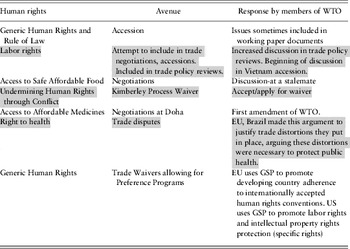
Yet human rights questions are seeping into WTO deliberations. As Table 4 illustrates, WTO members have relied upon several avenues to bring human rights concerns into the purview of the WTO. Human rights issues (in particular labor rights) have been discussed during accessions and trade policy reviews. While members did not call them human rights issues, members frequently called on their fellow WTO members to ensure public participation, due process rights, and protect intellectual property rights. At its first trade policy review, the representative of China discussed its concerns about equity, right to education and property rights. But WTO member states did not bring up key human rights issues directly affected by China trade such as labor rights.
Examples of human rights issues seeping into the WTO

Members have also amended the WTO to ensure that the right to protect intellectual property did not undermine the ability of WTO members to provide access to affordable medicine. In this regard, WTO members were able to find a new balance between two human rights objectives, while facilitating trade.
Several members have used waivers to promote particular human rights or adherence to internationally accepted human rights conventions. The US has used trade policy reviews and accessions to prod other countries to make particular human rights more of a priority. Finally, in several trade disputes, members have justified their trade-distorting policies by arguing that these measures are needed to protect public health. Taken in sum, these examples show that WTO members are working to find ways to balance their domestic (and at times) their international human rights obligations with their trade obligations.
Nonetheless, WTO member states must do more to ensure that the international system of trade rules does not undermine human rights. Policymakers must find ways to ensure that the deals they conclude do not make it harder for governments to ensure that their people have access to the resources they need (such as education or credit) to participate in local, national, and global markets. Moreover, they should find ways to examine how national policymakers, tasked to meet national trade needs, can reconcile that mandate with their international obligations to promote particular human rights such as the right to food. States are supposed to refrain from action that could interfere directly or indirectly with the enjoyment of human rights within their borders or in other countries. In 2007 Costa Rica became the first and only country that has examined a particular trade agreement (CAFTA) for its effects upon human rights in general.Footnote 102 We know of no country that has effectively attempted to ensure that its trade objectives are consistent with its human rights obligations and with the human rights obligations of its trading partners.
Although human rights concerns are being heard in the corridors of the grand palace housing the WTO, members do not have sufficient guidance regarding how they can address dissonance between their trade and human rights obligations. Perhaps such dissonance can only be addressed though a trade dispute that addresses whether the WTO should defer to human rights obligations. Alternatively, member states might achieve further clarity by authorizing the WTO secretariat to do a study of how trade rules may affect member states ability to advance human rights at home and abroad.
In sum, policymakers need to do more to clarify the relationship between their trade and human rights obligations. But policymakers do not have to rewrite the rules of the road (WTO rules) to accommodate human rights concerns in the global economy.