Introduction
Attempts to obtain fertilizable oocytes from in vitro cultured (IVC) preantral follicles have lead many research groups to test different compounds and systems on the follicular survival and development. Although live birth after IVC of mice preantral follicles followed by in vitro maturation/in vitro fertilization (IVM/IVF) and embryo transfer has been reported 20 years ago (Epping & Schroeder, Reference Eppig and Schroeder1989), such a protocol cannot be applied in large mammals due to physiological concerns (Van den Hurk & Santos, Reference Van Den Hurk and Santos2009). Therefore, IVC requirements may be more complex and a first step consists of a definition of which supplements may support follicular development in vitro.
Among the conventional supplements used in the culture medium of preantral follicles, FSH is known to maintain follicular viability (Adriaens et al., Reference Adriaens, Cortvrindt and Smitz2004), although stimulation of initial preantral follicular development is controversial (Braw-Tal & Yossefi, Reference Braw-Tal and Yossefi1997; Saha et al., Reference Saha, Shimizu, Geshi and Izaike2000). To potentially improve follicle-stimulating hormone (FSH) activity during IVC of preantral follicles, growth factors or other hormones should be added to the medium.
Combination of FSH with phytohormones, such as the auxin indole-3-acetic acid (IAA), has been shown to reduce follicular survival (Andrade et al., Reference Andrade, Marcondes Seneda, Alfieri, de Oliveira, Frederico Rodrigues Loureiro Bracarense, Figueiredo and Toniolli2005), even though IAA has been successfully used to protect follicles from chilling injury (Ferreira et al., Reference Ferreira, Brasil, Silva, Andrade, Rodrigues and Figueiredo2001). Nevertheless, in our previous IVC study (Andrade et al., Reference Andrade, Marcondes Seneda, Alfieri, de Oliveira, Frederico Rodrigues Loureiro Bracarense, Figueiredo and Toniolli2005), we tested a single concentration of IAA (40 ng/ml), perhaps one not suitable to enhance follicular development in presence of FSH. In addition, IAA encompasses antioxidant activity by inhibiting peroxidation (Cano et al., Reference Cano, Alcaraz and Arnao2003), which may be important to follicular survival throughout in vitro culture.
The aim of the present study was to determine the effect of IAA, either alone or in combination with FSH, on the viability and development of ovine preantral follicles during initial folliculogenesis in vitro.
Material and methods
Ovaries (n = 10) from five adult (1–2 years old), mixed-breed ewes were obtained at a local slaughterhouse. Immediately after slaughter, adhering tissues were removed from the ovaries, which were subsequently washed once in 70% alcohol and twice in 0.9% saline solution. The material was transported in thermos flasks at 37 °C to the laboratory within 1 h. At the laboratory, 31 cortical fragments of approximately 3 × 3 × 1 mm were removed from each ovarian pair and immediately submitted to follicular isolation and viability analysis using trypan blue stain (n = 1) or to in vitro culture (n = 30).
In vitro culture was performed for 1, 3 or 5 days, in 4-well culture dishes (Biosystems) with one fragment per well, in 1 ml of culture medium, at 39 °C, in a humidified chamber with 5% CO2 in air. The culture medium consisted of minimum essential medium (MEM; Sigma) supplemented with 100 μg/ml penicillin/streptomycin, 0.25 μg/ml amphotericin B, 10% of fetal calf serum, 5 μg/ml insulin, 5.5 μg/ml transferrin, 5 ng/ml selenium, 0.23 mM pyruvate, 2 mM glutamine and 2 mM hypoxanthine. To evaluate the effect of IAA and FSH on the follicular survival and development, the culture medium was either added to, or not, with 10, 20, 40 or 100 ng/ml IAA, combined, or not, with 100 ng/ml pFSH. The concentration of FSH was based on preliminary studies that cultured ovine preantral follicles (Andrade et al., Reference Andrade, Marcondes Seneda, Alfieri, de Oliveira, Frederico Rodrigues Loureiro Bracarense, Figueiredo and Toniolli2005). The culture medium was replaced every 48 h.
After the in vitro culture, each fragment was individually submitted to follicular isolation, applying a method described by Amorim et al. (Reference Amorim, Lucci, Rodrigues, Carvalho, Figueiredo, Rondina, Cecchi, Giorgetti, Martini and Gonçalves2000). The viability of the follicles was evaluated using trypan blue dye as described by Santos et al. (Reference Santos, Van Den Hurk, Rodrigues, Costa, Martins, Matos, Celestino and Figueiredo2007) and classified as viable (not stained) or non-viable (stained). In addition, follicles were classified as primordial (one layer of flattened granulosa cells around the oocyte) or developing follicles (one or more layers of cuboidal granulosa cells around the oocyte). To evaluate follicular activation, percentages of primordial and developing follicles were calculated before culture (Day 0) and after 1, 3 or 5 days of culture.
Analysis-of-variance (ANOVA) and Fisher PLSD tests (StatView for Windows) were used to compare the mean percentages of viable follicles as well as the percentages of primordial and developing follicles among treatments. Values were considered statistically significant when p < 0.05.
Results and discussion
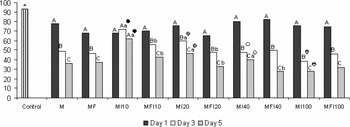
Figure 1 shows the viability rates of a total of 4030 evaluated follicles. In vitro culture of ovarian fragments reduced significantly the percentages of viable preantral follicles when compared with control. Such a reduction was progressively significant with the increase in the length of the in vitro culture, i.e. from 1 to 3 and from 3 to 5 days, except when in vitro culture was performed in the presence of IAA (10 ng/ml). In this case, follicular viability remained similar during the 5-day culture and was significantly higher than in the remaining treatments. When Andrade and co-workers (2005) previously in vitro cultured ovine preantral follicles in presence of IAA (40 ng/ml), there was no improvement on follicular survival when compared with non-supplemented medium. These findings are similar to our present results when IAA at concentrations of 20, 40 and 100 ng/ml was added to the culture medium. Addition of FSH alone to the culture medium did not improve follicular survival. However, increase in the IAA concentration resulted in a progressive reduction in the percentages of viable follicles unless FSH was present in the culture medium. Although IAA is known by its antioxidant activity (Cano et al., Reference Cano, Alcaraz and Arnao2003), this agent may also act as a pro-oxidant agent by accelerating lipid peroxidation (Candeias et al., Reference Candeias, Folkes, Porssa, Parrick and Wardman1995), when it is oxidized by a heme-containing peroxidase (Kim et al., Reference Kim, Jeon and Park2004), a common enzyme present in the serum. We suggest that, at concentrations of 20, 40 and 100 ng/ml, an increased amount of IAA was oxidized, increasing the amount of reactive oxygen species (ROS), which resulted in a progressive reduction of follicular viability. Oxidative stress has been related to apoptosis in many cells (Chandra et al., Reference Chandra, Samali and Orrenius2000), including ovarian follicles (Tsai-Turton & Luderer, Reference Tsai-Turton and Luderer2006; Zhang et al., Reference Zhang, Li, Ma, Wang, Lu and Guo2006). We have shown that the presence of FSH in the medium has avoided such a progressive reduction of follicular viability caused by the increasing concentrations of IAA. FSH not only stimulates granulosa cells proliferation, but also enhances glutathione peroxidase activity, an important suppressor of ROS and inhibitor of apoptosis (Tsai-Turton & Luderer, Reference Tsai-Turton and Luderer2006), explaining the maintenance of follicular survival by FSH in presence of high concentrations of IAA. There was no effect of the addition of IAA on the follicular development (i.e. growth of primary to secondary follicle stages), which was observed only when preantral follicles were in vitro cultured in the presence of FSH alone (16% developing follicles versus 5% in the control). Even though IAA induces cell division in plants, it seems that the main function of this phytohormone in mammalian cells is to act as an antioxidant or pro-oxidant, depending on the applied concentration. Although follicular activation can be obtained in vitro, follicular development from primary to secondary stages is still difficult to obtain, as a complex and optimal culture medium remains to be developed. In conclusion, IAA at a concentration of 10 ng/ml increases follicular survival in vitro. At high concentrations (20, 40 or 100 ng/ml), this auxin may be deleterious to preantral follicles, the addition of FSH being necessary to avoid the oxidative effect of the IAA. However, such a combination impairs follicular development in vitro.
Percentage of viable ovine preantral follicles non-cultured (control) and in vitro cultured for 1, 3 or 5 days in the presence or absence of follicle-stimulating hormone (FSH) or indole acetic acid (IAA) (10, 20, 40 or 100 μg/ml), alone or in combination. *Differs significantly from control (p < 0.05). Values with different upper-case letters (A–C) differ significantly among the in vitro culture period (1, 3 and 5 days) within the same tested medium (p < 0.05). Values with different lower-case letters (a, b) differ significantly between medium with or without FSH within the same IAA concentration (p < 0.05). Values with different circles (black, grey, white or black and white) differ significantly among the IAA concentrations within the same in vitro culture day (p < 0.05).

Acknowledgements
The authors thank the Fundação Cearense de Amparo à Pesquisa (FUNCAP) for their financial support (no. 8064/06).