Mitochondria are a major source of potentially harmful reactive oxygen species (ROS) when an organism experiences stress. However, in both animals and plants ROS formation can be reduced if stress-induced trans-membrane proton gradients can be dissipated harmlessly as heat. Here we used differential dark microcalorimetery to show that heat production during recovery from stress is a characteristic shared by both tolerant and sensitive lichens. However, desiccation tolerant lichens display smaller increases in heat production during rehydration following desiccation, and tended to recover their normal, unstressed rates of heat production more quickly. These differences probably reflect the possession by tolerant species of a diversity of mechanisms that reduce the desiccation-induced damage.
The life of most lichens is characterized by rapidly changing water contents, and correspondingly rapidly changing physiological activity such as respiration and photosynthesis (Kappen Reference Kappen and Galan1988). Providing that desiccation occurs reasonably slowly (over hours rather than minutes), most lichens can withstand drying to water contents of 5% or less, and most can remain viable for months (Kappen Reference Kappen, Ahmadjian and Hale1974). However, our understanding of exactly how lichens tolerate desiccation is still limited (Beckett & Minibayeva Reference Beckett, Minibayeva, Jenks and Wood2007; Beckett et al. Reference Beckett, Kranner, Minibayeva and Nash2008; Kranner et al. Reference Kranner, Beckett, Hochman and Nash2008). In all organisms, part of the general response to most stresses is the formation of potentially harmful reactive oxygen species (ROS), particularly in the membranes of the chloroplasts and mitochondria (Andreyev et al. Reference Andreyev, Kushnareva and Starkov2005; Szabo et al. Reference Szabo, Bergantino and Giacometti2005). To survive desiccation, lichens must be able to either reduce the formation of ROS, or detoxify them once formed. Lichens contain a variety of enzymatic and non-enzymatic antioxidants (Kranner & Birtic Reference Kranner and Birtic2005; Kranner et al. Reference Kranner, Beckett, Hochman and Nash2008), and higher plant mitochondria are known to possess particularly effective ROS scavenging systems (Navrot et al. Reference Navrot, Rouhier, Gelhaye and Jacquot2007). Mechanisms also exist to reduce ROS production at these sites. For the thylakoid membranes, these include non-photochemical quenching and “charge separation” (Heber et al. Reference Heber, Bilger and Shuvalov2006a, Reference Heber, Lange and Shuvalovb). For mitochondria, in other organisms controlled uncoupling of electron flow in mitochondrial membranes from phosphorylation can protect cells by reducing the formation of harmful ROS (Skulachev Reference Skulachev1998). Uncoupling can occur, firstly, via the alternative oxidase (AOx) that dissipates the redox potential, and, secondly, via uncoupling proteins (UCP) that dissipate the proton motive force (for reviews, see Jarmuszkiewcz 2001; Hourton-Cabassa et al. Reference Hourton-Cabassa, Matos, Zachowski and Moreau2004; Vercesi et al. Reference Vercesi, Borecky, Godoy Maia, Arruda, Cuccovia and Chaimovich2006). Fungi also contain special ‘class 2’ NAD(P)H dehydrogenases, which appear to be lower efficiency alternatives to the normal dehydrogenases that form the ‘complex 1’ in their mitochondrial membranes (Joseph-Horne et al. Reference Joseph-Horne, Hollomon and Wood2001). While these processes reduce ROS formation, they also reduce ATP formation, and the result is heat that can be monitored using microcalorimetry.
Almost nothing is known about heat production in lichens. Recently, Beckett et al. (Reference Beckett, Mayaba, Minibayeva and Alyabyev2005b) used microcalorimetry to show that desiccation followed by rehydration considerably stimulated heat production inthe desiccation sensitive lichen Peltigera polydactylon. The aim of the work presented here was to compare the patterns of heat production during stress in lichens differing in desiccation tolerance. In addition to P. polydactylon, heat production measurements were made in the lichen Pseudocyphellaria aurata, which grows on the bark of trees in moist Afromontane forests. These two lichens were compared with Parmotrema tinctorum and Ramalina celastri, lichens that grow more widely in southern Africa, particularly on the bark of trees in more exposed habitats.
To confirm that these lichens differ in tolerance, membrane damage during rehydration following desiccation was measured as the loss of cytoplasmic K using a modification of the method of Buck & Brown (Reference Buck and Brown1979). Peltigera polydactylon (Neck.) Hoffm. was collected moist from moss-covered boulders under a tree canopy in the Olandweni Valley, Cathedral Peak area, Drakensberg Mountains, KwaZulu-Natal Province, South Africa. Lichens were stored moist for 10 days before use at 15°C at a photosynthetic photon fluence rate (PPFR) of 75 µmol photons m−2 s−1. Parmotrema tinctorum (Despr. ex Nyl.) Hale, Pseudocyphellaria aurata (Ach.) Vain., and Ramalina celastsri (Spreng.) Krog & Swinscow were collected dry from the Doreen Clark Nature Reserve, Pietermaritzburg, KwaZulu-Natal Province, South Africa. Lichens were gradually rehydrated using air at a relative humidity of 100% for 48 h (over distilled water) at 15°C and a PPFR of 75 µmol m−2 s−1, followed by contact with wet filter paper for a further 24 h. Discs were then cut and stored fully hydrated overnight to remove any effects of wounding. Each replicate was derived from discs randomly sampled from this pool, and material prepared in this way was assumed not to be suffering from stress, and is referred to as ‘unstressed’. Four replicates of 100 mg of lichen tissue were desiccated at close to 0% relative humidity (above silica gel) for 48 h. Sudden re-wetting was simulated by gently shaking lichens in 10 ml of distilled water for 0·5 h. They were then transferred to 10 ml of 20 mM NiCl2 to displace K released from the cytoplasm that had become bound to the cell wall. Finally, they were shaken in 10 ml of 1 M HNO3 for 1 h to release intracellular K. The concentrations of K in each elution were determined by atomic absorption spectrophotometry, and the proportion of the total amount of K present in each fraction calculated. ‘K leakage’ was estimated as the sum of K lost into the initial rehydration solution and K displaced that subsequently became bound to the cell wall. In addition, the contribution of the cytoplasm to the dry mass was estimated as the reduction in mass when oven dried material was shaken for 1 h in 1 M HNO3 as described by Brown & Wells (Reference Brown and Wells1990).
For heat production measurements, lichens were collected as above, except that Peltigera polydactylon was allowed to dry slowly between sheets of newspaper. All species were stored dry and refrigerated for two weeks, except for the 48 h period in which they were transported to Russia, where they were rehydrated as described above. Heat production was measured using a differential dark microcalorimeter (LKB-2277 BioActivity Monitor, Thermometric AB, Jarfalla, Sweden) with an amplifier sensitivity of 0–100 µW in 3 cm3 glass vessels. The reference cell comprised either an empty vessel (for initial measurements of unstressed material, and measurements of desiccated material) or a vessel containing 0·5 ml of water (for measurements of rehydrated material). For each species, two to six replicates each comprising two to eight 6 mm discs (equivalent to a fresh mass of c. 40 mg) were used. Data were collected every minute as the average from 0·1 s measurements and analyzed using the “Spline” program of Hunt & Parsons (Reference Parsons and Hunt1974). For each replicate, microcalorimetric measurements were made in unstressed material, following desiccation over silica gel for 2·5 h (that reduced the amount of water in the lichens to 5% of its original content), and during rehydration following desiccation. Lichens were rehydrated by rapidly adding 0·5 ml of water to desiccated discs. Following insertion of specimen vessels, 30 min was needed for thermal stabilization. In practice therefore, microcalorimetric measurements were made from 0·5–1 h from the start of the experiment in hydrated, unstressed, material, from 5–6 h in desiccated material, and from 6·5 until 10 h following rehydration. Data for the following were statistically compared using t tests between each species: 1) rates of heat production in unstressed material; 2) the proportional increase in heat production from the normal, unstressed rate to the maximum rate; 3) the rate of decline during the first hour of rehydration.
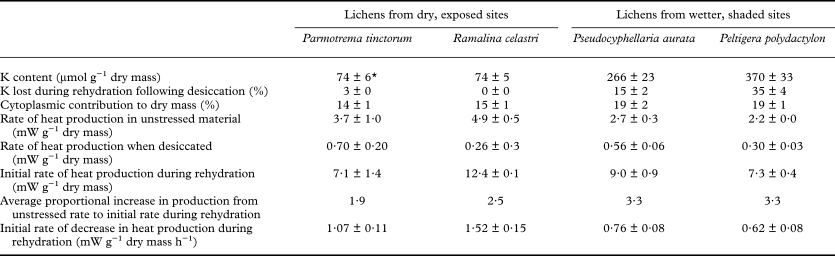
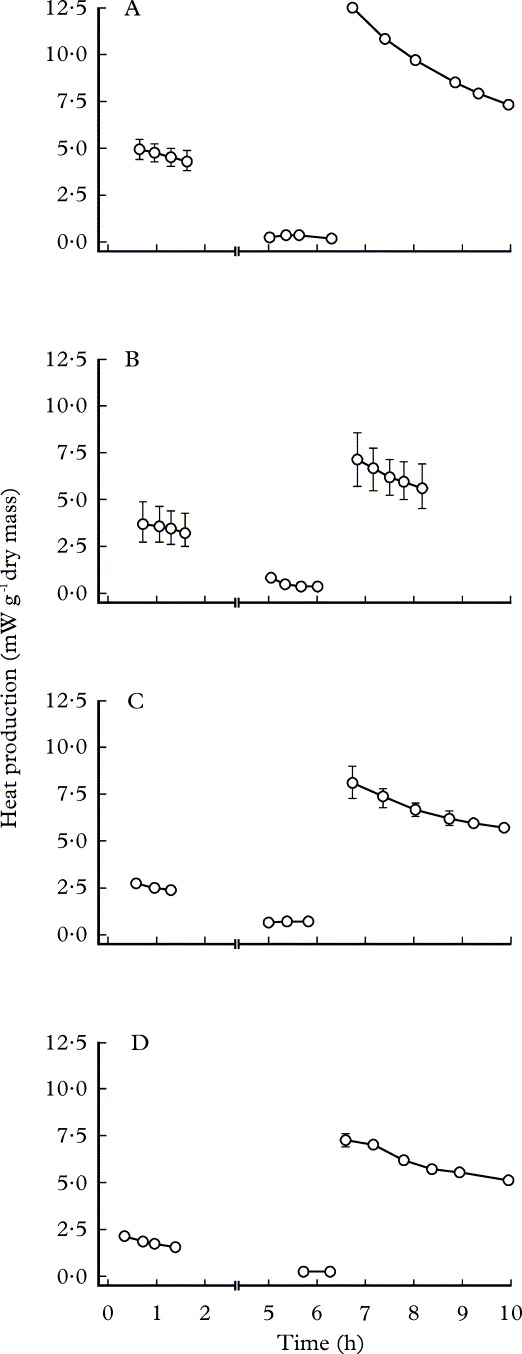
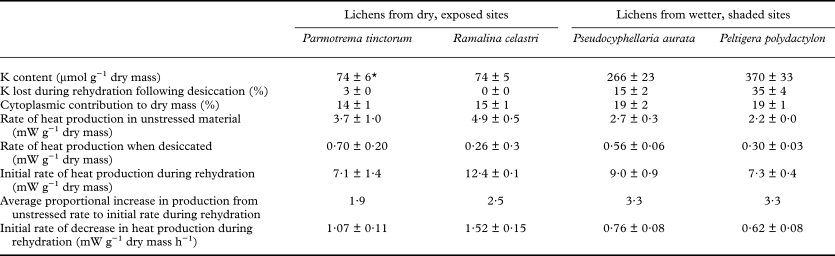
Results from measurements of K leakage confirmed that Peltigera and Pseudocyphellaria are relatively desiccation-sensitive lichens. These species typically grow in wetter microhabitats, and lost much more K during rehydration following desiccation than Parmotrema and Ramalina from dryer habitats (Table 1). Patterns of heat production during dehydration and wetting cycles in all species were superficially similar, although for no obvious reason results from Parmotrema were more variable than for other species (Fig. 1). The low rates of heat production in unstressed material represent the balance between normal endo- and exothermic reactions taking place in cells (Breidenbach et al. Reference Breidenbach, Saxton, Hansen and Criddle1997). As almost all metabolic activity ceases during desiccation, rates of heat production dropped to close to zero. Following rehydration, rates of heat production were initially strongly stimulated, and then gradually declined.
Desiccation tolerance, assessed by K lost during rehydration following desiccation, and the effect of desiccation and rehydration on heat production in lichens from contrasting microhabitats
* Figures are given ± standard deviation, n = 2 to 6.
Heat production by four species of lichens before desiccation (first segment), while desiccated (second segment) and during rehydration (third segment). A, Ramalina; B, Parmotrema; C, Pseudocyphellaria; D, Peltigera. Points represent selected fitted values with 95% confidence limits (where these exceeded the size of the symbols), calculated using the ‘Spline’ program of Hunt and Parsons (Reference Parsons and Hunt1974).
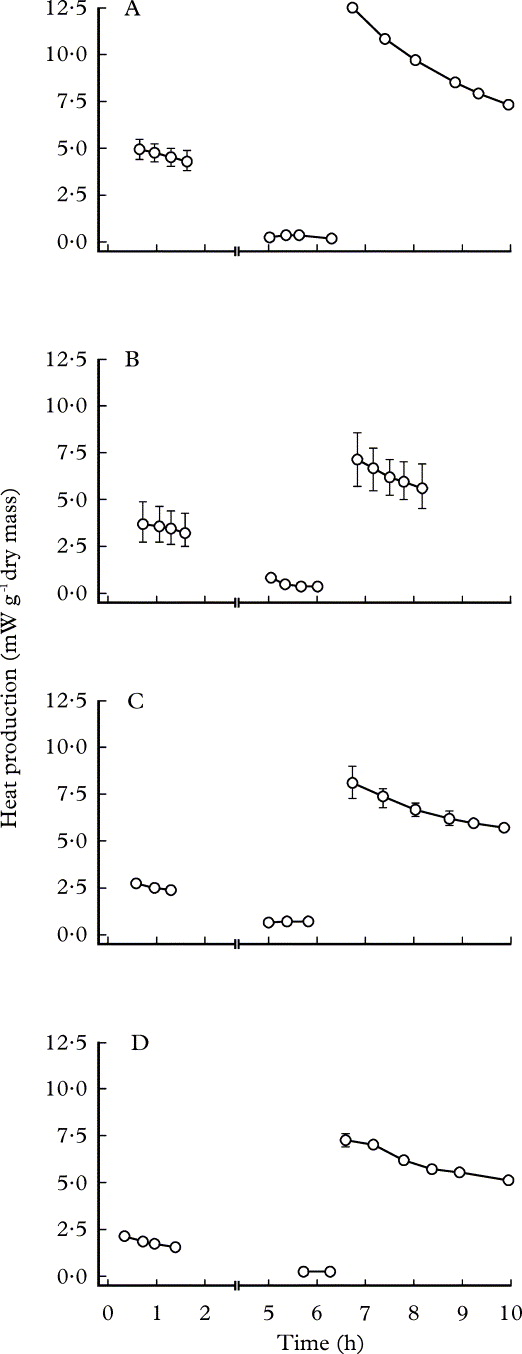
Careful analysis of the patterns of heat production revealed some interestingdifferences between sensitive and tolerant species. Firstly, rates of heat production in unstressed material were on average twice as high in the desiccation tolerant species, significantly so for Ramalina compared with both the sensitive species (Table 1, Fig. 1A,P <0·005). In this study, rates of heat production were expressed per unit dry mass. However, lichens show considerable variation in the cell wall thickness, and the cell wall is assumed to contribute little to heat production. In more tolerant species, the cytoplasm comprises a smaller proportion of the dry mass than in sensitive species (Table 1). Therefore heat production rates of unstressed tolerant species calculated per unit of cytoplasm mass would be even higher. Possibly, more desiccation tolerant species have mitochondria with strong AOx or UCP activity, and as a result respire less efficiently. This may be an example of a ‘cost’ that is involved in possessing desiccation tolerance. While there are few clear examples of such costs in lichens, in mosses increased desiccation tolerance can be associated with an increased non-photochemical quenching and thus less ROS formation in the chloroplasts, but at the same time, also a reduction in photosynthetic efficiency (Beckett et al. Reference Beckett, Marschall and Laufer2005a).
Second, the average proportional increase in heat production from the unstressed rate to the initial rate during rehydration was 50% lower in desiccation sensitive species, significantly so comparing Ramalina with Peltigera or Pseudocyphellaria (Table 1, Fig. 1C & D, P <0·005). Finally, linear regressions were carried out during the first hour of rehydration (corresponding to the start of the third segment of heat production measurements in Fig. 1) to estimate the rates at which heat production recovered to normal, unstressed values (Table 1). Rates from individual replicates were calculated, and t tests carried out to compare individual species. Results showed that desiccation tolerant species recovered on average twice as fast as sensitive species. The rate of recovery of Ramalina was significantly faster than that of Peltigera or Pseudocyphellaria (P < 0·01), but because heat production in Parmotrema was more variable, the difference was not quite significant. The most likely explanation for these results is that desiccation tolerant lichens suffered less damage during desiccation, and as a result had less need to dissipate potentially ROS generating gradients across the mitochondrial membrane as heat.
Differences in the patterns of heat production between species therefore cannot be explained simply by differences in photobionts. While the photobiont of the Peltigera species used was cyanobacterial, the photobionts of the other three species were green algae. Furthermore, lichen photobionts typically comprise less than 10% of thallus volume (Pintado et al. Reference Pintado, Valladares and Sancho1997), and therefore the mycobiont is probably responsible for most of the heat production.
While heat production and respiration both take place in the mitochondria, preliminary results suggest that no simple relationship exists between the rates and patterns of change with time of heat production and respiration. In both Peltigera and Pseudocyphellaria we measured heat production for 15 h following rehydration (data not shown), and even after this time heat production was significantly higher than in unstressed material. Beckett et al. (Reference Beckett, Mayaba, Minibayeva and Alyabyev2005b) found that even following desiccation of Peltigera over silica gel for 15 or 30 days (a much more severe desiccation treatment than that used here), after an initial burst of “resaturation respiration” rates returned to control levels within 4 h, typical for many species of lichens (Kershaw Reference Kershaw1985). Clearly, in lichens high rates of heat production continue for longer after stress relief than respiration. The normal rates of respiration that occur 4 h after rehydration, accompanied by elevated heat production, would imply that during recovery from stress, lichens receive less ATP for maintenance and growth. Such conditions may well occur fairly frequently in the life of a lichen, and may be an additional ‘cost’ of being desiccation tolerant.
In conclusion, heat production measurements suggest that both desiccation sensitive and tolerant lichens have effective mechanisms for dissipating potentially harmful proton gradients across their mitochondrial membranes. Presumably because desiccation damages them less, heat production in tolerant species is less stimulated by desiccation and rehydration, and tends to recover more quickly to rates found in unstressed lichens. In future work we hope to dissect the contribution of various energy dissipating systems in lichens, for example by testing the effects of the SHAM (an AOx inhibitor) or rotenone [an inhibitor of class II NAD(P)H dehyrogenases]. Future publication of the gene sequences of lichens will enable us to test whether lichens have the necessary genes to produce UCP or AOx proteins. It seems likely that the ability to effectively dissipate energy across mitochondrial membranes is an important component of desiccation tolerance in lichens.
The University of KwaZulu-Natal and the Russian Foundation for Basic Research (09-04-01394) are thanked for financial support. We also thank an anonymous reviewer for many helpful suggestions for improving our manuscript.