The viral footage was seen around the world: the frames of sixteen-year-old Ahed Tamimi, a prominent Palestinian activist from the West Bank village of Nabi Salih, slapping and kicking an Israeli soldier outside her home on 15 December 2017. The Israeli military presence had been sizable on that Friday, as it often was during the village's weekly anti-occupation demonstrations. Military reprisals were frequent, in the form of beatings and arrests of demonstrators. This footage, filmed by Tamimi's mother and livestreamed on Facebook, resulted in her subsequent arrest and detention in Israeli military court, charged with incitement and five counts of assault against the Israeli security forces.Footnote 1 The images would cement Tamimi's status as an international icon of the Palestinian anti-colonial struggle.Footnote 2 Social media campaigns called for her release, backed by celebrities and human rights organizations alike, while Tamimi's image proliferated on anti-occupation T-shirts, posters, and murals, including one painted on the separation barrier by Italian artists.Footnote 3 Global comparisons were voiced by many: “Is Tamimi the new Che Guevara?”
Inside Israel, the public conversation about Tamimi was no less active, but in a very different vein. Indeed, her distinctive visage was already infamous among the mainstream Jewish public following a set of earlier confrontations with the Israeli security service that also were filmed and widely distributed. As in 2017, these clips had been analyzed on the Israeli evening news by “experts in Arab affairs” with attention to matters of PR damage, coupled with obsessive attention to her blue eyes and blond hair, framed by Israeli commentators as a bewitching racial puzzle.Footnote 4 The 2017 footage, for its part, fueled a nationwide conversation about the dangers of Palestinian provocations in the smartphone age, with commentators lamenting the fate of their soldiers (“our boys”) in the grip of an increasingly well-oiled Palestinian incitement industry, supported by Israeli and international human rights organizations. “When you see an Arab [sic] girl hitting an Israeli soldier, and priding herself on her actions before the camera, don't be ashamed of our soldiers,” wrote a journalist from a prominent nationalist news outlet. “Be ashamed of those organizations that provide filming and editing services, which stand ready to catch a soldier [in the act if he] loses control.”Footnote 5 Other commentators focused their ire on the threatening digital tools in enemy hands: “The Nabi Salih incident has further clarified the main weapon in the exhausting security [batash] routine in the West Bank: the camera.”Footnote 6 The soldiers involved were roundly praised for maintaining “supreme restraint” in the face of this “media trap.”Footnote 7
The deck was stacked against the IDF, Israeli commentators agreed, and dangerously so. In an age of ubiquitous digital technologies, Palestinians were setting ambushes with their networked technologies, luring soldiers into provocations that were designed to defame. In these contexts, the military was destined to fail: in “the encounter between soldiers and civilians, as reflected in images on mass media, the soldier will rarely have the upper hand.”Footnote 8 It was widely agreed that these proliferating cameras with their inciting visuals posed a serious threat, at once binding the hands of the security forces and “delegitimizing Israel in the eyes of the world.”Footnote 9
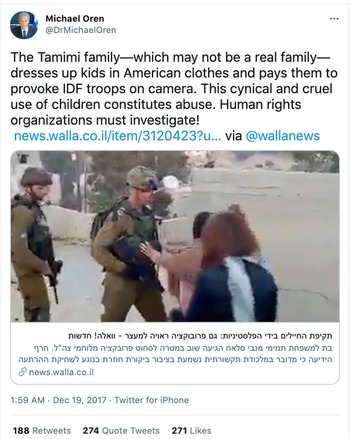
A month after Tamimi's arrest, Israel's former ambassador to the US and Israeli Knesset member Michael Oren would join the Israeli chorus of condemnation against Palestinian incitement. He went further than most other critics, employing Twitter to accuse Tamimi and her kin of a well-organized campaign of theatrics for political gain: “The Tamimi family—which may not be a real family—dresses up kids in American clothes and pays them to provoke IDF troops on camera. This cynical and cruel use of children constitutes abuse. Human rights organizations must investigate (Fig. 1)!”
Oren's social media campaign against the veracity of the Tamimi family. 2017. From: Twitter.com/drmichaeloren.

Oren's accusation was not merely a rhetorical joust. Rather, as he would explain to the Israeli media, his suspicions about Palestinian choreography for the camera had seeded a classified Knesset committee of inquiry in which “the issue of the family's credibility was raised.”Footnote 10 As Oren noted, the committee had been tasked with investigating whether “members of the family were chosen for their appearance.” Their clothing, he argued, raised particular concerns: “A real costume.” American dress in every respect, not Palestinian, with backward baseball caps. Even Europeans don't wear backward baseball caps. It was all prepared; after a provocation or a brawl the posters would come out. It was all prepared.”Footnote 11
Oren's claim was twofold: both an accusation of tactical Palestinian theatrics for political gain and an assertion that, despite the enemies’ best efforts, such theatrics had fallen short. That is, the Tamimi family members were not merely a collection of performers, but a collection of poor performers. They were shoddy mimics, attempting to woo their global audiences with performances of victimization, but failing due to imperfect choreography. The costumes, the gestures, the bodies—all had strained credulity.
The extremity of the claim, coupled with the details marshaled as alleged evidence, was chiefly met with scorn in the international media, which ridiculed the “bizarre claim.”Footnote 12 Oren would be “roundly mocked” for his commitment to an “internet conspiracy theory, which claims that [the Tamimis] are not a real family but a troupe of actors paid to pretend that the occupation of their land in the West Bank upsets them.”Footnote 13 Journalists also lambasted Oren's investment in the Tamimis’ physicality—namely, their blond hair and blue eyes—which, along with their “American dress,” he read as indices of their Palestinian inauthenticity. It was a narrative favored by the Israeli public, for whom snide comparisons to Shirley Temple would abound.Footnote 14 The Israeli left-wing media joined the chorus of ridicule: “How Much Idiocy Can Israeli Society Take?”Footnote 15 Hagai El-Ad, executive director of B'Tselem (Israeli human rights organization), went further, reading the incident as a clear index of the Israeli political landscape. “The conspiracy theory of suspecting whether the Tamimi family is ‘real’ is a particularly crazy moment of a much broader landscape,” El-Ad said, “one in which the occupation doesn't exist, government propaganda is the official truth, and those that offer actual facts or express opposition are either terrorists (if Palestinian) or traitors (if Israeli).”Footnote 16 Bassem Tamimi, Ahed's father, responded succinctly to the Israeli press: “How did such a fool get to be your ambassador to the United States?”Footnote 17
But in the shadow of Oren's “bizarre claim” was, as El-Ad intimated, a political narrative with a serious footing in Israeli society. Nor was it new. Rather, in the two decades prior, this accusation of Palestinian fakery had gradually migrated from the margins of the pro-Israel conspiratorial Internet to the Israeli political center. In this period, the charge of Palestinians “faking it” for the camera would receive no less than the imprimatur of the Israeli prime minister.
The Social Life of Repudiation
This essay tracks the social life of this conspiracy theory as leveled against Palestinians by the Israeli and pro-Israeli public during the first two decades of the 21st century. I am particularly interested in instances when this accusation of Palestinian fakery was attached to testimonial footage of Israeli state and settler violence as filmed by Palestinian eyewitnesses and human rights workers. This conspiracy theory was a product of its time. Right-wing nationalism and militant populism were on the rise in Israel during these decades, as they were globally, having progressively migrated from the social margins to the political mainstream.Footnote 18 In tandem, digital communications technologies and infrastructures were spreading across both Palestine and Israel, albeit in highly constrained ways for Palestinians living under occupation.Footnote 19 By the middle of the second decade, mobile digital technologies and social media tools were proliferating in both the Gaza Strip and West Bank, however unevenly. In turn, Palestinian populations living under occupation were generating a growing bystander archive of Israeli state violence, filmed on their mobile devices and shared with global publics in something close to real time, sometimes in the very midst of their assault or bombardment by the Israeli security forces.Footnote 20
Mainstream Jewish Israeli society observed these trends with growing concern. In their estimation, their enemies were dangerously well versed in the emerging media economy of the networked image—not only Palestinian activists and human rights workers but also their Israeli and international counterparts. The right-wing Israeli and pro-Israeli public would increasingly take political aim at these archives, directing their energies at so-called Palestinian incitement by means of digital tools and platforms. They used the charge of Palestinian fakery, or what I will call the “repudiation script,” as a strategy of political containment. I will propose that the accusation of fakery was an endeavor to re-narrate the videographic scenes of Israeli state violence by banishing Israeli perpetrators and Palestinian victims from the scene. The stakes were considerable. Through such labors of reconfiguration and the attendant cleansing of the visual field, the narrative's proponents sought to prevent Israel's defamation in the international theater of public opinion and forestall the existential crisis that such “bad images” could yield. Or so they saw it.
The parallels to concurrent populist trends in the United States were strong. Many elements of the repudiation script resembled the Trump-era accusation of “fake news”; both were employed to undercut critics and quell dissent by impugning veracity.Footnote 21 Both functioned as speech acts, by which the accusation of fakery was thought by its proponents to install the effects it named (“hoax!”), and both were, in the eyes of their supporters, impervious to countervailing evidence. The narrative also bore a family resemblance to conspiratorial narratives about “crisis actors” and “false flags” that would gather steam in the aftermath of the December 2012 Sandy Hook Elementary School shooting in Newton, Connecticut. Their social trajectories also were similar. Like its white supremacist cousin in the US, the repudiation script would progressively migrate from the margins of the conspiratorial Internet to the political center, buoyed by a wave of populist nationalism, although the Israeli variant would precede and anticipate the American narrative by over a decade.
But the repudiation script also had a set of much longer histories. As we know from postcolonial and settler studies, including the foundational work of Edward Said, the repudiation of indigenous claims of various kinds (to history, land, community, or humanity) was a foundational logic of all colonial projects, both in Palestine and elsewhere: namely, the charge that the indigenous claim was inauthentic or fabricated in some respect.Footnote 22 As Patrick Wolfe has reminded us, such forms of symbolic repudiation were crucial in enabling the material violence of colonialism, whereby colonial denial gave permission to colonial elimination in its myriad forms.Footnote 23 As an accusation against the veracity of the photographic image, the script also had roots in the 19th century history of photographic technologies, a history that was crosscut by social anxieties about authenticity.Footnote 24 Such anxieties would multiply in the digital age. Today such anxieties underwrite digital visuals at every point along their networked circuits, shadowing the images as an anticipated co-constituent.Footnote 25
This essay studies the ways such legacies intertwine; namely, how this now-ubiquitous global charge of fakery with its very long settler-colonial history was updated to meet the challenges of the smartphone age and the era of bystander videography.Footnote 26 In what follows, I will track the rise and normalization of the repudiation script among the right-wing Israeli public and its international supporters over the course of the first two decades of the 21st century, in the context of the concurrent changes in media and political landscapes in Palestine and Israel, to which, I will argue, the evolving script responded. At this paper's core are three viral cases of Israeli state violence on camera, occurring in 2000, 2008, and 2014. I conclude with a case that runs counter to these trends. By 2016, the point at which the essay ends, repudiation had become merely one tool among others by which the Israeli and pro-Israeli public managed the videographic spectacle of Palestinian injury. On the margins of this essay is an argument about the scholarly importance of attending to the ways new media forms enter social worlds. As media historians teach us, these entrances are sites of social promise and, at times, social crisis.Footnote 27 This essay tracks the latter, namely the perceived Israeli crisis born of the emerging Palestinian media ecosystem. The accusation of fakery was imagined as the fix.
This growth and normalization of the repudiation script took considerable time and labor. Israeli patriots had to be schooled in repudiation by the growing cadre of experts who taught them to view the visual field anew, to scrutinize the videography with a forensic sensibility, learning to perceive such footage as a locus of not merely possible but probable fakery. By the end of this two-decade period, the repudiation script had moved from the social margins to occupy the political center, becoming no less than the language of state. Taking aim at the visual field of testimonial videography, the script's proponents endeavored to remove Palestinian victims and Israeli perpetrators from the growing videographic archive of Israeli state violence that the changing media ecosystem had made possible. At least that was their fantasy.Footnote 28
Muhmamad al-Durrah: Pallywood Emerges (2000–2003)
The Israeli repudiation script had its roots in the first days of the second Palestinian intifada. The event in question was the infamous shooting of twelve-year-old Muhammad al-Durrah on 30 September 2000, who was trapped with his father in cross fire between Israeli troops and Palestinian gunmen in the Gaza Strip. This forty-five-minute incident was caught on video camera by French television and the images rapidly went viral, including still images of Muhammad crouching in terror with his father near a concrete barrier with the shooting underway around them, and the final images of the child's crumpled body lying in his father's lap. “Broadcast from Malaysia to Morocco, from Frankfurt to Tokyo,” the global circulation of these images in the days and decades that followed would dwarf all previous and subsequent viral incidents of Israeli state violence on camera. Most Israelis would read the al-Durrah killing through a public relations (hasbara) optic, focusing on the ways that the images had “fixed Israel's image as a brutal and bloodthirsty country, opposite whom weak and unfortunate Palestinians are struggling just to survive,” seriously damaging Israel's standing in the world.Footnote 29 The event was, most Israelis agreed, a crucial turning point in the Jewish state's media battle, one of the most damaging media episodes in Israel's history, causing “untold PR damage and inciting violence against both Israel and Jews.”Footnote 30 The Israeli postmortem of the event would be replayed over and over again, in popular and scholarly venues alike, continuing to the present.
The campaign to repudiate the al-Durrah footage would unfold gradually in the months and years that followed, waged chiefly from France and the US in both the courts and the media, championed by self-described defenders of Israel. Repudiators seized on key issues within the footage, and the management thereof, to make their case, raising suspicions about the volume of footage shot, the blurred frames at the moment of impact, the editing done by the French team, and so on. At its core was a group of self-styled forensic experts: an American academic, Richard Landes, an “expert in Palestinian media manipulation,” and an Israeli, Nahum Shahaf, a physicist and “forensic expert” who would lead the military's investigation of the incident. To mount their charge, they worked closely with the videographic material, studying it frame by frame for evidence of manipulation. Here is Landes describing his first encounter with the raw footage in 2003 (a screening he conducted with an Israeli cameraman who had worked with the original French TV crew):
Much of the footage had a familiar quality: it resembled the footage I had seen in Shahaf's studio, either boring or staged. At one point a Palestinian adult grabbed his leg as if he'd been shot and limped badly. Here, for the “scene” to work, a half-dozen others should have picked him up and run him past cameras to an ambulance. But only kids gathered around him who were too small to pick him up. The man shooed them away, looked around, realized no one's coming, and walked away without a limp. [The] Israeli cameraman laughed. When I asked why, he said, “It seems staged.” I replied, “Everything seems staged.” And then the other shoe dropped. . . . At that moment I realized the full-double-extent of the problem: Palestinians stage all the time, and Western journalists have no trouble with that.Footnote 31
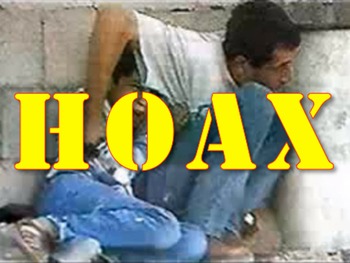
In Landes's telling, as narrated on his blog, this moment set the stage for the campaign that would become his life's work, of which the al-Durrah incident was merely one instance. It took aim at “Pallywood,” a term he coined to describe “the Palestinian national film industry in which ‘militant’ journalists and street actors produce staged news as propaganda.”Footnote 32 Pallywood would gradually consolidate as a road map of sorts for the patriotic, pro-Israel public, a guide for identifying and repudiating Palestinian “staged news.” The al-Durrah case would set the stage for all subsequent repudiation campaigns, functioning as a how-to manual that could be employed by the layman when need demanded, and particularly when viral footage of Israeli state violence mounted its inciting threat (Fig. 2).
Part of the international conspiracy campaign against the veracity of the al-durrah footage. No date. From: Breitbart News.

Ni'lin: Early Forensic Arts (2008)
In May 2008, Israel renewed construction of the separation barrier in the West Bank village of Ni‘lin, threatening large tracts of its agricultural land. The community responded with a wave of protests that drew hundreds of unarmed local and international activists into its fields.Footnote 33 The military response was swift and harsh: tear gas and rubber bullets, beatings and arrests, curfew, and closure of the village, sealing its entrances and preventing the movement of its residents in an effort to curb the popular mobilization. It the midst of the protests, a bound and blindfolded Palestinian activist, Asraf Abu Rahma, was shot at close range by an Israeli soldier. The events were captured on film, shot clandestinely by Palestinian teenager Salam Kana‘an on a rudimentary cassette camcorder.Footnote 34 Salam would drop her camera in shock at the time the soldier's shot was fired, its fall registered visually on the frames as a series of rapid movements. When filming resumed, Abu Rahma could be seen lying on the ground, still bound and blindfolded, as members of the Israeli security services bent over his injured body; he sustained a foot injury and was released.
Although the Ni‘lin protests and harsh army response had received little coverage in the Israeli media, Salam's footage would captivate the Israeli public. Because Palestinian testimonial footage of this kind, with its distinctive visual grammar of amateurism, was still something of a rarity, it still had the capacity to arrest a mainstream Israeli audience. What emerged was a nationwide conversation about the incident, chiefly focused on the question of responsibility for the shooting.Footnote 35 Against the background of this conversation, the fraudulence charge loomed as a persistent minority discourse. The accusation took a somewhat amorphous form in the early stages of this public conversation, focused chiefly on the proposition that the footage had been doctored in some way to produce the damning images. On television talk shows, commentators addressed military suspicions about the “the element of video editing,” coupled with recurrent questions about the seconds following the shooting when the camera was dropped in shock by the videographer, registering as a black spot on the video. “What happened in the second after the camera blacked out?”Footnote 36
The fraudulence charge also would find its way into the military courtroom during the trial and sentencing of the soldier and officer involved.Footnote 37 The defense drew heavily on the expertise of Nahum Shahaf, who cast doubt on the “the geometry of the path of the bullet” and argued for the possibility that “sounds of gunshots were produced in post-editing.”Footnote 38 He claimed “forgery” of two distinct kinds: both videographic doctoring and false claims made by the detainee regarding his injury. Drawing on a script honed during the al-Durrah investigation, Shahaf turned his forensic-like attention to the body of Abu Rahma, the detainee:
I examined the video frame by frame . . . [and] he did not fall immediately to the ground as you might expect from a man with an injured foot. He turned away. You can see him standing on two legs and resting precisely on the left “injured” [sic] leg. Then, the film was cut with apparently deliberate editing and you see him lying down on the sidewalk. I want to stress that there is no photographic evidence of the alleged left toe injury.Footnote 39
Abu Rahma's injury was a physical impossibility, he argued, a videographic fiction produced by editing software and multiple cameras.Footnote 40 Two of the three military judges would side with the prosecution, ruling that that the defense had presented insufficient evidence to support claims that the “video was deliberately changed.”Footnote 41 But the third judge dissented, opining that the material was likely manipulated.
During the course of the Ni‘lin incident, from the time of the video's initial exposure through the course of the military trial three years later, the fraudulence accusation would develop and mature. By the time of the trial's conclusion, this accusation had received legal imprimatur from the Israeli military court, albeit in the form of a minority opinion.Footnote 42
The Endurance of al-Durrah (2011)
In May 2011, I visited the Jerusalem offices of the Israeli military's social media team, housed within the division of the military spokesperson's unit, the unit tasked with the military's official public relations work. This was only their third year working with social media, a project that had begun improvisationally during the 2008–9 Israeli incursion into the Gaza Strip.Footnote 43 I had come to their offices to interview the head of their social media team, but I'd arrived early and was invited to join their team's consultation session with Richard Landes. They sought his wisdom on matters of anti-Israeli media bias and Palestinian media manipulation, the focus of the English language blogs that he maintained.
I was led to a small conference room where Landes's informal lecture was already underway. The room was crowded, with a dozen uniformed soldiers, men and women, seated on chairs and tabletops as Landes lectured in English on what he termed “cognitive warfare.” Landes began with the al-Durrah incident, the case that defined his multiyear crusade. He walked them through his findings with the aid of a small television and VCR, showing clips from the eleven-minute film he had produced on the subject. The boy wasn't really killed by the Israeli military as Palestinians and the international media claimed, he contended. “You see this blood? It should be darker.” The whole thing was a setup, he argued, an elaborate staging for the international camera. Landes explained that he had been attempting to make inroads with the Israeli government on such issues, working with military spokesmen to advance his message.
He had a rapt audience, eager for his input on media matters. Landes urged them not to lose sight of history as they did their work—namely, those prior media events when false Palestinian accusations gained international traction. He provided a list of some notable instances: the Jenin massacre of 2002, the Israeli military interception of the Mavi Marmara in 2010. These and others, he said, required careful scrutiny by their unit. “Documenting the past is very important. Go back and ask, did the media get it right?”
Those in the room had many comments and questions. The head of the social media team noted the numerous “false accusations” from Palestinians during the 2008–9 operation. Landes concurred, recalling an Israeli mortar strike in the Gaza Strip that killed 43 people inside a United Nations school in 2009—or so Palestinians claimed.Footnote 44 In reality, he told his audience, the strike had landed outside the school, a fact uncovered by scrupulous journalists and bloggers, and the UN was forced to make a retraction. A soldier chimed in, noting the supposed IDF killing of a Palestinian girl in 2006. But her death, he reminded us, was later attributed to injuries from falling off a swing.Footnote 45 “Pallywood is everywhere,” added Landes. “There is a serious price to pay for telling the truth about Palestinians, but no price to pay for lying about Israel.” The IDF's media team needed more victories like these, he said, more debunking and more retractions.
Landes was proposing a new kind of communications offensive focused on repudiation. And the response, at least within this military crowd, was charged. They listened closely, raising questions and sharing ideas about media strategy, implementation, and narrative focus. Landes recommended working with bloggers to spread the military's narratives: “They will be a magnifier for your story. Use them to amplify your media reach.”
A question from his audience: “But should our focus be empirical refutation of these events, or spinning new stories?”
Landes: “Depends. What do you have in mind?”
The soldier's response: “Like, the goods going to Gaza through Israeli checkpoints. We could play up that stuff.” It was a story line in which the Israeli government had already invested considerable energy, a narrative about the extent of Israel's state-sponsored humanitarianism to temper all the bad press from Israel's Gaza blockade.
Landes liked the idea. “When you emphasize the good stuff, we [bloggers] can help you. You provide the stats, we can do the work.” He spoke about the overblown nature of the Israeli occupation in the international media, their failure to cover Israeli military restraint. This, too, should be the subject of their work. “Show just how disciplined the Israeli army is. Document it. And if there are some articles you need written, we would be happy to write them.”
A suggestion from the crowd: “What about going out in the territories and filming photographers, watching what they are doing?”
Landes agreed, this was a crucial element of their media strategy. “Pay attention to the NGOs. They are also cognitive warriors.” It's a phrase he returns to frequently over the course of his lecture and his numerous blog posts on Palestinian media manipulation. “You should go to the weekly demonstrations at Bil‘in and see what the photojournalists are doing.”Footnote 46 He repeated his Pallywood argument, reminding his audience about the ways Arabs “stage scenes of people being shot in cold blood.” As a corrective, he proposed employing a “team of forensic experts” to examine all video evidence published by Palestinians and the Israeli NGOs that support them.
“Journalism is a theater of war,” he said, wrapping up. “And Western journalists are being manipulated to tell the story that Palestinians want to hear. They are being intimidated to tell this story, but they can't admit it.” The military team must be ready to counter these stories, to discredit Palestinian staging and outright lies. And timing was crucial. Their response had to be immediate.
“Think of it like a chess game,” he said, concluding. “You have to imagine what their next move will be.”
Landes's work would pay off. A year later, a government review committee would be convened by Prime Minister Benjamin Netanyahu “to examine the Al-Durrah affair in light of the continued damage it has caused to Israel.”Footnote 47 The committee's expertise, “comprised of numerous specialists,” would be praised by the Israeli media.Footnote 48 In the lengthy report they produced the following year, they concluded that the Israeli military was not responsible for the incident and cast doubt on Palestinian claims: “The review revealed that there is no evidence that Jamal [the father] or the boy were wounded in the manner claimed . . . and that the footage does not depict Jamal as having been badly injured. In contrast, there are numerous indications that the two were not struck by bullets at all.”Footnote 49 The state committee did more than exonerate the Israeli security services in al-Durrah's death; they argued that he was not actually dead. Right-wing Israeli newspapers put it succinctly in their headlines “Mohammed al-Dura: The Boy Who Wasn't Really Killed.”Footnote 50 The committee would not heed the family's calls to exhume the body.
Settler Media and “What Came Before” (2013)
Jewish settlers living in the occupied Palestinian territories and the media organizations that represented them were relative latecomers to the political theater of visual politics.Footnote 51 The settler media organization Tazpit (Observation Post) sought to correct that. In their estimation, their job was twofold: to contest the false images generated by the enemy (Palestinian, Israeli, and international activists and human rights workers) and to produce truer images of their own, thereby challenging dominant media representations of “Judea and Samaria” (the biblical terminology for the West Bank and Gaza favored by settlers). The organization's name told their story succinctly, referencing the history of settler territorial practices designed to maximize surveillance capacities. They sought an alternative vantage.
Sitting with their chief editor and members of their staff, they told a story of an “Arab” enemy bent on falsification of the visual field for political gain (they would not use the term “Palestinian”).Footnote 52 The Arabs’ tools were varied: image repurposing, caption manipulation, theatrics for the camera. The organization's founder, Amotz Eyal, illustrated the latter through the example of a prominent Israeli activist who also was a seasoned film producer. “It's all a setup,” he told me, referring to eyewitness footage of soldier violence against Palestinians in Hebron. “He's a professional and he directs the whole thing.”
In their rendering, the toolbox for falsification also hinged on calculated Arab practices of omission. “They show only the Palestinian side, only what they want to see.” One variant of this story line was repeated to me by one their most experienced photojournalists. He showed me a set of recent photographs he shot during a Palestinian demonstration near the Ofrah settlement, where he lived, and compared them to the footage shot concurrently by Israeli human rights workers. “So, if I stand next to a B'Tselem photographer, we would take pictures of the same object, but he would definitely show something different than what I show.Footnote 53 In their footage, the soldiers never look good. Never. You never see them giving someone water or something.” For him, Palestinian children were a central locus of Arab omission practices. “Look here!” He pointed to a photo he took of a Palestinian child brandishing a slingshot. This kind of image, he said, is never captured by his detractors, who insisted on only rendering the child as a victim. “Those images,” he said, “look good for the camera, but it's not the truth. B'Tselem won't show you this picture. And why not? It's also part of the story.”
In their telling, the most recurrent form of Arab omission concerned what came before any particular videographic clip of ostensible death or injury. This was a favorite accusation of the moment, one frequently repeated by the military and right-wing Israeli public in these years, taking aim at what was excluded from the frame through a fictive (in their eyes) foreshortening of an event's duration, manipulation that either happened on site or in the editing room after the fact. Sitting together, a number of us watched footage of a violent beating of Palestinian shepherds by masked settler youths in the West Bank town of Susiya, shot by a Palestinian volunteer working with an Israeli human rights organization in 2008. The footage had been shown widely on Israeli television at the time and was one of the first to expose masking practices to avoid camera detection, a settler tactic of camouflage that was in its early days and usually associated with the Palestinian enemy. Amos weighed in: “I can promise you that the Arabs started it [the confrontation] by shouting and cursing. It's just that no one showed them on film.” Another photojournalist chimed in, as we moved to another video: “‘Palestinian Boy Injured by Israeli Army.’ Ok, but what did he do before?” Had the videographer turned on the camera earlier, the argument went, a very different picture would have emerged, one which would wholly repudiate the Arab or activist claim against the alleged Israeli aggressor (settler or soldier).
As is evident here, the narrative of what came before was highly flexible and could be employed in almost every videographic case. And what came before was invariably Arab provocation or incitement of some kind. It was a readily available argument, not predicated on any visible evidence. The invisible evidence could simply be surmised, presumed less on the basis of visual clues than ontological ones (“it's just the way they are,” the argument goes). The claim merely required a reassertion of a foundational truism on which all agreed: the lying nature of the Arab. In this sense, the discourse of repudiation functioned as a performative speech act, one that installed the effects it named.
Beitunia: Repudiation and the State Imprimatur (2014)
Over the course of its work with video, the Israeli human rights organization B'Tselem grew accustomed to public suspicion. It was the rare eyewitness video of settler or soldier violence against Palestinians that was not tarred by a charge of doctoring or manipulation, either in the court of Israeli public opinion or in the legal arena in those rare cases when such incidents went to trial. In 2014, the organization would face a particularly well-organized suspicion campaign. The events in question occurred in the Palestinian town of Beitunia on 15 May 2014 and involved the fatal shooting by the Israeli border police of two Palestinian youths, Nadim Nawara and Muhammad Salama, during the annual demonstration commemorating the Palestinian Nakba. Their killings were captured on multiple cameras: four stationary security cameras installed at a Palestinian-owned business (a woodworking shop), the video camera of a CNN cameraman who had been filming the demonstrations that day, and the still camera of a Palestinian photojournalist. By 2014, the presence of cameras at the scene of an alleged military shooting was no longer a rarity, but what made this case different was the sheer number of cameras on the scene. The volume of resultant images was unprecedented for an event of this kind: three hours of video and 21 gigabytes in total.Footnote 54 One Israeli journalist, responding to the cries of repudiation that followed, would call this “the most documented and forensically corroborated murder in [the] IDF's history.”Footnote 55
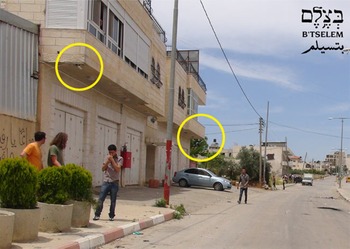
B'Tselem took on the case. The Israeli authorities had denied responsibility for the deaths, insisting that its security services had followed extant rules of engagement, using only “nonviolent” crowd control measures (i.e., rubber bullets, rather than live ammunition).Footnote 56 B'Tselem refuted these claims. Based on eyewitness testimony, autopsy reports, and associated footage, the organization accused the Israeli security services of responsibility for the incident.Footnote 57 As B'Tselem wrote in their first press release, some five days after the killings, their findings provided “strong evidence that live ammunition was used” by the military and “raise grave suspicion that the killing was willful.”Footnote 58 The CCTV footage also disproved the military's claim that Palestinians had staged a threatening provocation: “Security camera footage of the incident proves that at no stage were security forces endangered by any of the four victims, or by anyone close to them at the time of the shooting” (Fig. 3).Footnote 59
Image from the B'Tselem dossier documenting the lethal shootings of Nadeem Nuwara and Mohammad Abu Daher by the Israeli security services. Circles identify two CCTV cameras. 15 May 2014. From: B'Tselem.

But the large volume of visuals did not still Israeli public debate about the terms of the killings.Footnote 60 Rather, it seemed to fuel it.Footnote 61 Unlike suspicion campaigns of the past, the Ni‘lin case, for example, state actors and institutions would be among the first to join the chorus. Israeli Defense Minister Moshe Ya'alon assured the Israeli public that, although he had not yet seen the footage, its fraudulence was foretold: “I've seen lots of films that were edited [to distort what had happened]. This film I've not yet seen, but I know the system.”Footnote 62 The Israeli foreign minister, Avigdor Lieberman, insisted there was no need to investigate the incident, casting familiar doubts on matters of timing: “Why the delay in video release?”Footnote 63 Official military spokesmen spoke less equivocally: “The film was edited and does not reflect the reality of the day in question.”Footnote 64 Their assertions were parroted by military correspondents who spoke of the probability of “forgery” and speculated that “the film may have been staged and faked.”Footnote 65 On the evening news, cameras were trained on the Israeli ballistic expert sitting before a television monitor, reviewing the footage in question. He worked slowly, moving frame by frame, directing the public eye toward the path of the bullet or the suspicious body.Footnote 66 The military correspondent corroborated the expert's claims, helping the Israeli viewing audience see the forgery: “Notice how he [the Palestinian victim] reaches his hand forward to counteract the fall—something that looks like it just might—maybe—be a fake.” Footnote 67 This focus on the inauthenticity of the falling body, rendered suspicious by the outreached arm, was recurrent among the range of experts called upon to assess the videographic materials. They confirmed its impossibility: “A person who is hit by a high velocity bullet . . . does not have this reflex. . . . In my opinion, it is a complete staging, that aims to demonize the IDF and the State of Israel.”Footnote 68
Many media pundits and state spokesmen found themselves reciting the terms of the al-Durrah repudiation. Indeed, the parallels would be made explicit.Footnote 69 Israeli Ambassador Michael Oren, citing the al-Durrah precedent, went further than others to cast doubts on the very fact of the boys’ deaths, even after medical evidence had been produced and footage of their funerals aired: “We don't know that for certain. The pictures are very disturbing. . . . But again looking at those pictures, and Israeli investigators will look at them very closely, again, the way the bodies fall, the fact that there's no blood, someone who was hit in the back and a bullet has an exit wound, there is a tremendous amount of bleeding. There's no bleeding in the picture. There are many, many inconsistencies.”Footnote 70 The suspicion charge was familiar, but the degree of such assertions was unprecedented.Footnote 71
The border policeman involved in the shooting, Ben Deri, would eventually plead guilty to a reduced charge of “negligent manslaughter” in one of the killings, and be sentenced to a mere nine months in prison. Due to the plea deal, to which the family of the dead youth objected, the court did not have the opportunity to “rule based on the plethora of video and forensic evidence against Deri.” Some would accuse the court of advancing the Israeli colonial denial project in legal form.Footnote 72
Rule of Experts
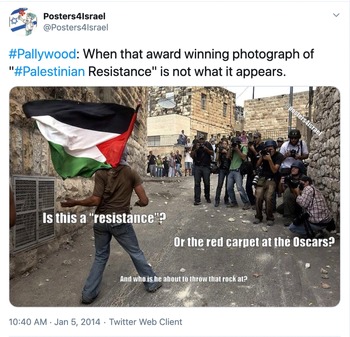
In 2008, amidst the Ni‘lin trial, the repudiation script was a relatively minor discourse, chiefly deployed on the margins of the Internet. But by 2014, at the time of the Beitunia killings, the accusation had grown and consolidated, having progressively gained mainstream Israeli legibility and urgency. Prime Minister Netanyahu would famously employ this grammar during the bloody Israeli bombardment of the Gaza Strip, when he responded to images of Palestinian carnage that were circulating globally, and to damaging effect: “They [Hamas] want to pile up as many civilian dead as they can, because somebody said they use—it's gruesome—they use telegenically dead Palestinians for their cause. They want the more dead [sic] the better.”Footnote 73 Netanyahu's story of Palestinians playing dead for the camera, with its insistence on their media-driven fraudulence in the theater of war, drew directly on Landes's narrative. And here, another shift was evident in the discourse of social life, first visible following the state commission of inquiry into the death of Muhammad al-Durrah. By 2014, the Pallywood grammar not only had acquired widespread Israeli legibility, it had become the language of state (Fig. 4).
Meme accursing Palestinians of “Pallywood”: namely, staging their victimization, injury or death for the media. 5 January 2014. From: Twitter.com/posters4israel.

The normalization of repudiation as political discourse, during the years studied here, took considerable work. As a social script, it had to be cultivated, taught, and learned before it acquired its broad intelligibility and political utility, requiring schooling from the new cadre of self-styled experts in the military and private sector that were emerging, those trained in Palestinian media manipulation and the associated forensics. Each repudiation campaign functioned as a pedagogic project at the national scale through which Israeli citizens were instructed on best practices for hoax detection and repudiation. Recall the Beitunia case, when experts appeared on the evening news to substantiate claims of fraudulence through a series of close readings of the videographic field, working frame by frame, with cameras assisting by zooming in to provide close-ups to viewers at home. Their intervention provided the Israeli public with the analytic and conceptual skills needed to repudiate effectively, to invalidate videography with precision and conviction, and to read the visual field of Israeli state violence generated by Palestinians armed with cameras as a locus of not merely possible but probable fraudulence. Thanks to these experts, ordinary repudiators also would take on the mantle of forensic analysts, having received instruction on the signs of a Palestinian body about to die, on how the arm responds to the force of a bullet, on the volume of blood spilled on impact. Only through this teaching and learning could the discourse achieve its mainstream legibility and functionality as a political tool.
At first glance, the repudiation campaigns of these decades are striking for their highly repetitive nature, reliant on relatively stable narrative. In part, this regularity was the by-product of the small cadre of experts at the campaign's core, chiefly Richard Landes and Nahum Shahaf. As noted, their playbooks would set the terms for all subsequent repudiation campaigns. More than merely repetitive, the repudiation script was performative, populated with a set of central narratives and tropes that required perpetual iteration to be nurtured and sustained as a legible social script.
Yet at the same time their scripts were flexible, shifting over time as need demanded, often in accordance with changes in the media ecosystem. In the early years of the repudiation project, before the rise of social media, when image manipulation technologies were relatively new and seemed to mount the foremost threat, the accusation of malicious editing predominated, taking aim at the videographic material itself and operating at the level of the image, as was evident in the al-Durrah case (and this despite the fact that the “Pallywood” neologism emerges here). Later, amid the rise and spread of cameras and social media within the Palestinian territories, as the visual archive of Israeli state violence grew in volume and perceived threat, the charge of image manipulation was no longer adequate to the job. Now, the object of the accusation would shift from the visual field to the event itself, from a story of postproduction editing to an account of fraudulence at the site of the alleged injury.
The repudiation script also fluctuated in other ways, particularly when the Pallywood narrative was concerned. In some instances, the charge of theatricality was leveled in a highly literal sense, with accusations of malicious Palestinian dramaturgy in the form of paid actors, directors, and even costuming (as in Oren's account of the Tamimi family). In other cases, “staging” was employed a bit more loosely (a term that appears no less than nine times in the state commission report on al-Durrah), implying lies or fakery of various kinds, but not necessarily organized theatrics. Both variants took aim at Palestinian practice, at the cunning toolbox employed to deceive the Israeli and global public. But there was a second recurrent narrative within the script that shifted the locus of fakery from practice to body, and so from Palestinian doing to Palestinian being. Recall Shahaf's attention to the body of Abu Rahma during the Ni‘lin case, with his focus on both his falling body and injured foot: “. . . he did not fall immediately to the ground as you might expect from a man with an injured foot.”
A similar set of accusations would be made in the Beitunia case. Again, suspicions were raised regarding bodies that did not fall as they should. But now, concerns also were raised regarding the volume of his blood: “. . . the fact that there's no blood, someone who was hit in the back and a bullet has an exit wound, there is a tremendous amount of bleeding. There's no bleeding in the picture.” Here, the staging accusation redirects from theatrical ruse to bodily manipulation of the dead or wounded. In the process, an ontology is installed (one also evident in the story of “what came before,” gesturing toward the truth of Palestinian essence beyond the frame). It is a story line rooted in the Pallywood charge from its very early days. Recall Landes's comments after screening the al-Durrah rushes in 2000: “Much of the footage had a familiar quality: it resembled the footage I had seen in Shahaf's studio, either boring or staged. . . . At that moment I realized the full-double-extent of the problem: Palestinians stage all the time. . . .” For Landes, then, the repetitive nature of the Pallywood discourse was no accident; rather, it was an attempt to describe the repetitive terms of Palestinian practice. “That's just how they are.” The hoax was rooted in Palestinian nature. Later, this story of Palestinian nature would be fleshed out, lodged in their feet and their blood.Footnote 74
But there was a catch. For despite Palestinians’ best efforts to defraud the public by playing dead, their bodies perpetually gave them away with blood that did not flow as it should, or that fell the wrong way. Yes, they were con men, and essentially so. But, even so, they could not pull it off. Their flailing limbs gave them away, time and again. This is where the expert came in, reading the signs of fraudulent injury for the public. Edward Said famously remarked that Orientalism, although repetitive and “citational” as a narrative strategy, also was changeable: that is, it “depend[ed] for its strategy on [a] flexible positional superiority, which puts the Westerner in a whole series of possible relationships with the Orient without ever losing him the relative upper hand.”Footnote 75 This same oscillation was evident in the repudiation script. Although repetitive, it also was a flexible story line with the capacity to bend and adjust as need demanded.
Conclusion: Colonial Logics of the Digital Age
In the spring of 2016, another lethal act of soldier violence would be caught on camera, filmed by a Palestinian resident of Hebron from the balcony of his home.Footnote 76 In the video frames, soldier Elor Azaria could be seen methodically cocking his weapon as he approached his Palestinian target, an assailant who had already been “neutralized” (in military language) and was lying injured on the ground. Azaria walked toward his target, raised his weapon and fired a single bullet, executing Abdel al-Sharif at close range. The footage quickly went viral in Israel, played and replayed on the nightly news and dominating social media.
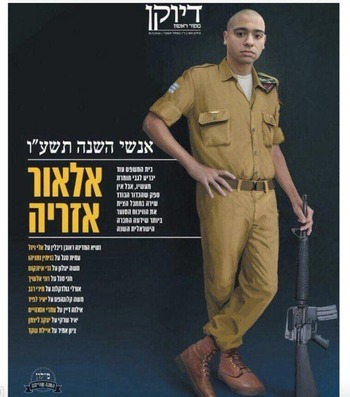
Azaria's trial in Israeli military court captivated and polarized the Jewish Israeli public, a national media spectacle that many likened to the O. J. Simpson case in scale and symbolic import.Footnote 77 Military leadership supported the legal process in the name of their “ethical code.”Footnote 78 But in an unprecedented break with their military, most Jewish Israelis disagreed.Footnote 79 Thousands demonstrated in solidarity with Azaria in Tel Aviv's Rabin Square, demanding his exoneration in the name of “everyone's child.”Footnote 80 “If we don't protect our soldiers,” their posters read, “who will protect us?” One prominent Israeli magazine named Azaria “man of the year,” decorating its cover with his portrait (Fig. 5).Footnote 81 Azaria would be convicted of manslaughter in Israeli military court in 2017—the first such conviction of an Israeli soldier in more than a decade—but would be released from prison after serving ninth months of his sentence.Footnote 82 He was greeted with a hero's welcome.Footnote 83 Azaria's celebrity status would grow in the following months and years; he was coveted for election endorsements and welcomed in Tel Aviv nightclubs and West Bank settlements by cheering crowds.Footnote 84
Makor Rishon magazine names Elor Azaria “man of the year.” The photo caption reads: “Sparked the stormiest argument in Israeli society this year.” 2016. From: Makor Rishon magazine.

The case was deemed a landmark for the ways it pitted the Jewish Israeli public against the military, the nation's most sacred institution. Yet it also was something of a landmark in the social life of the repudiation script. Although the accusation of videographic falsification was voiced in the early days of the footage's viral circulation within Israel, this story line did not seize national imaginations. The mainstream Jewish public did not question the veracity of the footage. On the contrary, they celebrated the portrait of Azaria as executioner.
This was not the end of the repudiation script. The conspiracy theory would remain an available political alibi in years that followed when images of state violence became virally visible. During the 2018–19 Great March of Return, for example, the script would be called upon when images of Gazan protestors and charges of Israeli brutality would once again dominate global social media feeds and screens. In their midst, Israeli military spokesperson Ronen Manelis took to the Israeli media airwaves to decry Hamas “theatrics”:
Hamas hired them as extras, paying $14 a person or $100 a family for attendance—and $500 if they managed to get injured. Hamas forced all of their commanders and operatives to go to the border dressed as civilians, each serving as a director of an area—as if to direct their own stage of the operation.
It need hardly be remarked that the narrative hewed closely to the central tenets of the Pallywood playbook, from al-Durrah, to Beitunia, to Nabi Salih. Its citational quality was the script's signature.
Despite this conformity, the Hebron 2016 execution marked a shift in the social life of repudiation. In large measure, the shift was born of the ever-rightward movement of the Israeli political landscape and popular opinion, amid the Jewish public's increasingly brash and bold embrace of racist populism. But in no small measure it also was due to the changing terms of the digital media ecosystem within the occupied Palestinian territories. Here, the work of media historians can assist. Lisa Gitelman and Geoffrey Pingree argue that periods of media emergence into social worlds in new forms or degrees are often periods of social crisis, as populations adjust to the meanings, functions, and everyday usages of the media forms in their midst. In these “novelty years,” the attendant senses of both social promise and social risk are often considerable.Footnote 85 “The uncertain status of the given medium,” they propose, often functions as a staging ground for the most pressing social questions and social crises of the moment.
So, too, in the Israeli context. The rise and normalization of the repudiation occurred in years in which the Jewish Israeli public was adjusting to the changes occurring within Palestinian digital ecosystems. The pace of change was rapid. In 2008–9, for example, during the Israeli Cast Lead operation in the Gaza Strip, Palestinians living in Gaza had lacked widespread social media literacy, Internet connectivity, and access to mobile technologies—lacked, that is, the means to produce a visual archive to counter the military message. But by 2014 digital technologies were proliferating in the West Bank and Gaza Strip. During that year's bloody Israeli aerial bombardment of the Gaza Strip, Palestinians under attack were filming the Israeli military assault and sharing their footage in something close to real time. There was now a greater volume of videographic evidence of excessive military force against Palestinians, shot with greater clarity and precision. In the intervening years, between 2008 and 2014, Israeli audiences had been forced to contend with the rise and normalization of Palestinian smartphone witnessing, and with the growing visual archive of state violence that it generated.
I propose that the repudiation script matured alongside these changes in the Palestinian media ecosystem and was an attempt to manage their threats. The accusation was deemed particularly urgent during the emerging years of Palestinian bystander videography, when the Jewish Israeli public was first contending with the social effects of these threatening visuals. This essay concludes at a time when the Palestinian-produced archive of state violence no longer surprised Israeli audiences. By the time of the Azaria shooting in 2016, both cameras and social media usage had become widespread within the occupied territories. Where once network-enabled cameras were a rarity and the ensuing visual archives a threatening surprise, they were now commonplace and widespread Palestinian political tools of anti-occupation protest and documentation. After smartphone normalization, repudiation was no longer urgent, at least not to the same degree. Its urgency and prominence as an explanatory narrative would subside. Other explanatory narratives could step into the breach. After Azaria, there were other political means of contending with this visual field: the stance of total embrace.
It can be argued that there was nothing new at work in these years. Namely, that the growth and normalization of the repudiation script was merely reanimating the colonial ideology of denial and dehumanization at the heart of the Zionist project.Footnote 86 And yet I want to propose that the tethering of this ideology to the shifting global media ecology of the moment marked a distinctive shift. In the first two decades of the 21st century, commensurate with shifts in both the political and media landscapes, repudiation was seizing on new objects, employing new analytic techniques and technologies for ferreting out fraud, and inaugurating new modes of expertise. In the process, Israeli colonial ideologies of denial and disavowal (of Palestinian land, history, and personhood) were being updated, brought into line with the digital media ecology of the moment. Colonial denial was given a new digital dressing.
Acknowledgments
An earlier version of this essay appeared in Screen Shots: State Violence on Camera in Israel and Palestine (Stanford, CA: Stanford University Press, 2021). My thanks to Stanford University Press for providing permissions. Additional thanks to Rachel Ariel, three anonymous readers for IJMES for insightful feedback, and Joel Gordon for his astute engagement.