


Introduction
Health resource scarcity poses a significant challenge to health service delivery to target populations, whether scarcity is relative or absolute. The availability of a specific resource, compared to faced demand, is an environmental factor that both directly and indirectly influences resource allocation practices, particularly recognized in specialist health service research in intensive care and emergency medicine.Reference Bai, Fugener and Gonsch 1 –Reference James, Power and Laha 4 Discussions of clinical resource scarcity, particularly related to delivering specific capabilities, often incorporate concepts of surge capacity which emphasize optimizing or bolstering resource availability to address increases in demand for care.Reference Adams 5 –Reference Kelen and McCarthy 7 However, discussion is often centered on addressing a surge in demand above an operational baseline in reasonably well-resourced settings.
Health care delivery in humanitarian settings faces complex and context-specific challenges that are often completely foreign to operational health systems facing a short-term surge in demand. While the role of factors including health economics, finance rationing, and policy are understood to impact resourcing and health system operation,Reference Keliddar, Mosadeghrad and Jafari-Sirizi 8 , Reference Scheunemann and White 9 characteristics associated with the need for humanitarian assistance include potentially complete political degradation and collapse of governance. 10 Health responses to complex humanitarian emergencies must then also address a variety of health needs stemming from multi-factorial and dynamic combinations of often concurrent poverty, conflict and extreme violence, and natural or anthropogenic hazards. 10 , Reference Spiegel, Le and Ververs 11 By influencing the broader operational context, these factors thus not only generate massive demand for specific health services and interventions, but concurrently threaten or destroy the ability of native health services to operate. These significant contextual factors and characteristics therefore erode key assumptions of an operational baseline existing in current surge capacity concepts and understanding of scarce health resource allocation, highlighting the need to understand resource scarcity as experienced in these settings.
As in-field operators, humanitarian health care workers (HCWs) become practitioners of scarce health resource allocation decision-making. In a recent systematic review marked scarcity of existing literature capitalizing on the lived experience of humanitarian health care workers in relation to scarce health resource allocation was identified.Reference Horn, Ranse and Marshall 12 Existing literature pointed to the challenge of resource allocation decision-making but, as mostly descriptive accounts, this literature lacked the methodological structure and scope to build a robust conceptual understanding of these complex contexts.Reference Horn, Ranse and Marshall 12 Given the potential downstream effects of factors specific to the humanitarian response context through to the clinical frontline, this existing lack of exploration and contextual understanding threatens effective and evidence-based care delivery in these settings. Thus, there exists a critical opportunity to utilize the experiences of humanitarian health care workers to develop and advance understanding of resource scarcity and the impact of contextual factors faced in humanitarian response settings.
The aim of this research was therefore to identify contextual factors that impact resource availability and scarce health resource allocation in humanitarian response settings by analyzing lived experiences of humanitarian HCWs.
Methods
A cross-sectional exploratory qualitative design was used within the Scarce Health Resource Allocation in Humanitarian Response Settings (SHARE-HRS) research study. In this project, three unique approaches to data analysis were used; this article reports on a unique layer of analysis applied to data generated in this larger body of research.
Participant Sample
Purposive sampling was used to recruit individuals with relevant first-hand experience in scarce health resource allocation in humanitarian response settings. Participant identification relied upon individuals making relevant participation known publicly, either through academic output, media appearances, professional profiles, or secondary referral. Individuals were sent invitations to participate and to schedule an interview time. Maximum variation sampling was used to achieve the broadest possible sampling characteristics. Participant recruitment was terminated upon achieving adequate participant power and information power, in that the sample and data were sufficient to support the emerging findings, a more robust and reflective means of driving recruitment termination than data saturation alone.Reference Thorne 13 –Reference Suri 16
Data Collection
Individual semi-structured interviews were hosted and recorded via Microsoft TeamsTM. Interview recordings were manually transcribed into written transcripts and reviewed for accuracy. The act of transcription and repeated reading of the transcripts provided the familiarity with the data required to perform analysis.
Data Analysis
The approach to inductive phenomenological analysis was described by ColaizziReference Colaizzi, Valle and King 17 and operationalized by BeckReference Beck 18 and Wirihana et al.Reference Wirihana, Welch and Williamson 19 Once relevant exemplar narratives were extracted into data tables for analysis, derived meanings were produced for each extracted statement by considering the key meaning and contribution of the statement as it related to the phenomenon. Emerging derived meanings were grouped according to similarities and relationships between them to allow clusters and then themes to emerge de novo from the data. Identified themes were used to inform the production of a thematic description of contextual factors shaping or defining decision-making.
Ethical Considerations
Informed consent was required prior to voluntary participation. There was no offer of financial compensation or reward. Anonymity was supported by pseudonyms and redaction of statements or characteristics to avoid inadvertent identification. Ethical approval was provided by the Human Research and Ethics Committee of Griffith University (Ref: 2023/281).
Results
A diverse sample of 17 individuals participated in semi-structured interviews, with participant characteristics summarized in Table 1. In keeping with the maximal variation recruitment strategy, participants came from a range of clinical and management positions, bringing experiences from many of the modern major humanitarian response events and a broad international perspective. A total of 887 minutes of data was generated, with a mean interview time of 52 minutes.
Summary of participant characteristics

Table 1. Long description
The table consists of two columns titled Characteristic and Details.
* Profession: Includes doctor (physician, pediatrician), doctor (proceduralist), manager (clinical), manager (non-clinical), nurse, paramedic, and pharmacist.
* Region of origin: Lists Africa, Asia, Central America, Europe, Oceania, and United States of America.
* Response Trigger: Lists armed conflict, earthquake, famine, flood, infectious disease outbreak, poverty, tsunami, and typhoon.
* Response location: Lists a wide range of global locations including Afghanistan, Angola, The Balkans, Cameroon, Central America, Colombia, Democratic Republic of Congo, Ethiopia, Gaza (historic, present as of 2024), Greek Islands, Haiti, Indonesia, Iraq, Jordan, Kenya, Lebanon, Liberia, Yemen, Mediterranean region, Mozambique, Myanmar, Nepal, North Korea, Pakistan, Palestine, Philippines, Somalia, Sudan and South Sudan, Thailand, Turkey, Uganda, Ukraine, and Yemen.
Through thematic analysis, 5 key themes emerged which shaped the decision-making space: scope, relationships, adaptation, power, and security. Each theme was informed by several subthemes emerging from analysis of the data (Table 2), and collectively the emerging themes conceptually define the scarce health resource allocation decision-making space.
Subthemes that informed emerging themes

Table 2. Long description
The table consists of two columns titled Theme and Subthemes.
* The first theme, Scope, includes four subthemes: Scope defined by sustainability, Scope defined by need, Scope defined by workforce, and Confined by scope.
* The second theme, Relationships, includes four subthemes: Leveraging relationships in-field, Relationships and co-existence in-field, Relationships within teams, and Navigating relationships with patients.
* The third theme, Adaptation, includes three subthemes: Adaptation in clinical practice, Adaptation of response, and Adaptation of mechanisms.
* The fourth theme, Power, includes four subthemes: Territorial power and sovereignty, Political and bureaucratic power, Financial power, and Organizational power.
* The fifth theme, Security, includes three subthemes: Security is non-universal, Acceptance of security risk, and Security and behavior.
Scope
The theme of Scope arises from participants’ recall of operating to deliver specific capabilities according to a defined or imposed objective. This extends beyond what is considered a “scope of practice” but rather why a scope emerged and what defined the scope of capabilities or services deliverable.
Participants were perceptive of limitations imposed on the scope of services deliverable by sustainability owing to a lack of guarantee of supply.
Often … it initially starts from a medical perspective because that’s the easiest and fastest way, the first thing to do. … then it’s like “okay, we have a hospital, we have resources, we can actually start doing surgeries and operating” – so by the time team two, team three, [arrive] it’s all set up for that. (P7)
If the supplies don’t come … you try to restructure your strategy according to the resources that you have and continue to advocate for the lack of resources. (P16)
Throughout participant reflections, there was recurring emphasis and reference to the role of “needs.” Assessed needs were considered important for informing and guiding the scope of services to be delivered, as well as a requirement to remain responsive to needs as they evolved.
You say “okay, these are the most common conditions that I’m seeing … this is the epidemiological profile of the country … so, can I cover it?, and if not, which are the most common conditions that I should certainly be able to treat no matter what?” (P3)
Everything is based on the needs. You know the needs, it’s based on the analysis of needs so then supply comes after because you request supply based on needs. (P16)
Participant narrative reflected implications of a “scope” becoming defined. In defining what is within the scope of a response, there is an inherent determination of what is not within the scope of the response and thus what was determined not to be addressed by the response.
But in that moment [we were] working only emergencies, … the amount of non-communicable diseases in the [outpatient department] consultations were huge, but our mandate was only to treat emergencies … (P2)
A big group of patients that was impossible to treat with the setup that we had was patients with complex wounds … requir[ing] surgery. (P3)
Relationships
The theme of Relationships arises from participants’ recall of interactions and transactions within the humanitarian response space. These relationships can be subject to power differentials; however, the theme of Relationships explores the key interactions, and with whom they occur, that define the decision-making space.
Relationships with other humanitarian teams were experienced in which individuals or entire teams were leveraged to achieve specific objectives.
We existed in this sort of environment where these larger NGOs would operate and then every now and then … they would reach out to us and ask us to do something that maybe they couldn’t do. And then if they gave us resources with that, then there would be strings attached … (P8)
Relationships could foster productivity or challenges related to co-existence within humanitarian response environments. Some relationships were therefore experienced as cooperation and others as competition.
You might have a different NGO and you might need an oxygen mask and … they’ve got the mask, but they’re like “no, we’re not handing over a mask; we’ll take the patient and take over the care of the patient”. So just really silly games that NGOs, different medical teams, play for ownership of a patient … (P1)
There’s a camaraderie. … we work together a lot and sometimes we will all work for a similar consortium, for example, where we may share funding, we may link up with other NGOs if there is a donor that wants to cover three different things and we can do one and they can do two. (P9)
Relationships also exist between individuals, including within humanitarian response teams and with patients. Relationships with patients were seen as needing navigation, whether it be clinically, ethically, or due to religious differences.
In the other situation, all of us in the clinical team were in agreement – the difficulty was in how to communicate this in a way that was acceptable to the family. You have cultural differences, but also religious differences, in what is acceptable … (P10)
Adaptation
The theme of Adaptation arises from participants’ recall of the changing nature of humanitarian responses and the flexibility demanded of HCWs. The theme emerged as Adaptation, as many of the changes were highly dynamic, recurrent, and rarely toward definitive improvement, suggesting an emphasis on changing in response to the environment rather than true “evolution.”
Participants found it necessary to remain adaptable in how they deliver care to ensure they remained effective where the alternative or inaction would have resulted in harm.
We used an air hockey table, and I used ketamine. … You know, you would not do an amputation on just ketamine alone probably anywhere in the world … But we did that, and we saved the patient’s life … (P7)
… we had one who clearly was in extremis and I ended up putting in a chest drain using my Leatherman … basically pouring over a little bit of disinfectant, using the Leatherman, putting in that tube. (P10)
… we didn’t have a lot of tools. A patient comes in with peritonitis but I don’t know what it is [from] – let’s go, let’s open. We were not … asking what it is, we went to [action]. (P14)
In some instances, the need for non-health care assistance was perceived as greater, which, even if for a short period of time, can drive HCWs to adapt and direct resources from a health response to address non-health needs.
… the health care side of things, or medical side of things, wasn’t as urgent or paramount as getting blankets and food up to people. So, we helped that first day stock these [helicopters] up and go and do drop offs and then load the bus up and then head up … to set up camp. (P1)
Finally, participants were perceptive of the implications of changes at the level of the humanitarian industry, including those associated with increased regulation and standardization, seemingly prompting HCWs and teams to adapt their practices in response.
… what is happening with the EMT (Emergency Medical Team) initiative is that access is being granted only through the WHO (World Health Organization) which is good because … the organisations comply with the standards of the EMT initiative, and Member States are assured that these facilities … can really provide the care that they are saying … (P2)
Power
The theme of Power arises from participants’ recall of how responses and decisions were shaped or influenced by the exercise of power or direct control. Power here specifically reflects an emphasis on the “who” and “how” of the exercise of power.
Clinicians and managers alike reflected on being subject to several powers over their presence and practices, including power exercised by local officials on the ground, such as those who had been officially elected, empowered by their community, and those who experienced power through force or violence.
To preserve access there, you had to talk to [the governor] all the time. In fact, he expelled nearly every NGO apart from [one] within a couple of weeks of us being there for reasons that I still can’t explain. (P5)
… it took 48 hours for them to be shut down by the Ministry of Health. … they were like … “you can’t just come here and set up where we’re already working and without asking permission.” (P17)
Politics and bureaucracy from both host and home governments influenced responses. This power manifested through direct control over deployment permissions and mandates, but also indirectly through regulations that impacted the availability of specific resources such as particular medications.
The exception being tricky medication – opiates …, we actually ran out at one point, and it is because of all of the importation regulations, nothing to do with the logistics chain and lack of resources. We simply were not allowed to import it into the country … (P10)
The major difference when you’re on a government deployment is the government tells you when to go and when to stop…. In government, it’s a lot more dependent on the flag-flying element of it than clinical need. (P5)
Power over the response was also experienced as being exercised through control of funding. The ability to provide, withhold, or earmark funding as a non-clinical or indirect participants empowers individuals with marked power over the care delivered.
This is disappointing and sometimes, particularly with the donor funding, they’ll specify they want you to be in a certain area, but we know through conversations and assessments there are hospitals that are in the area that needs us the most. (P9)
… you are not able to plan properly because you have the money just up to December and then … the donor might say “we won’t give any more money for that project”. You then say “… I have three months to develop an exit strategy” (P11)
Security
Finally, the theme of Security arises from participant experiences of threats to security, whether perceived or actual and whether intentionally posed for gain or those inherent in the humanitarian response environment. Importantly, a targeted threat toward an individual or team may be underpinned by the intent to exercise “power”; however, in such circumstances “security” is manipulated as a mechanism by which the exercise of “power” is achieved.
The experience of security can differ between teams or even within a team at the individual level, highlighting that security is not experienced equally by all. Additionally, security can be experienced differently due to affiliation or role, but security risk can also be experienced differently among individuals or organizations due to perceived or actual behavior.
… [local staff] expose themselves constantly to risks because they work for international organisations or because they are forced to treat, with priority, one person above another … and that makes them feel at risk, even though they might not be directly threatened. You have different shades of insecurity that play out and affect different components of the system in different ways. (P3)
… I was trained in nonsecure environment so my perception of risk was different, but it also allowed me to be more cautious in how I moved, how I relate with different actors, and how I negotiated access. … colleagues of mine that came to replace me, they had to be evacuated because they didn’t behave in the same way. (P2)
To participate in a humanitarian response entails willingness to accept or reject a certain threshold of security risk. At times, it may be up to the individual to decide if they accept a specific threshold of risk, while at other times it is up to an organizational assessment and determination regarding what risk is accepted.
Another major difference between … governments and the NGO sector is that despite the fact [the government] could potentially offer you more protection, oftentimes you don’t go anywhere near the action in the same way that [major NGOs] do. (P5)
There is just the acceptance that we need to take some risk for us to be of most help to the country. The front-line changes and … sometimes we need to be flexible and move to where we are of most benefit, which can be more directed towards the conflict. (P9)
The SHARE-HRS ScRAPS Model
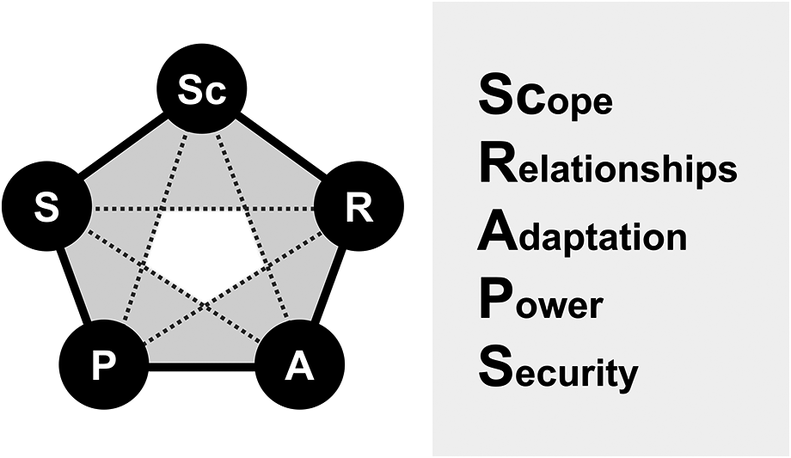
The close interconnectivity between the themes identified in this research, and their influence on defining the decision-making space, supported the production of the SHARE-HRS ScRAPS Model (Figure 1), named after the key themes of Scope, Relationships, Adaptation, Power, and Security. Structurally, these themes are interconnected, each being able to influence resource allocation decision-making independently and in combination with other factors depending on the specific resource allocation decision or broader context. Importantly, the model, in its current form, makes no assertion as to the hierarchy of the relevant factors, nor does it quantify influence; rather, the model provides a common nomenclature and an evaluative lens through which decision-making in scarce resource allocation in humanitarian response settings may be understood and described.
SHARE-HRS ScRAPS model.

Given a specific resource scarcity and decision-making context, the ScRAPS Model can be applied proactively as a framework or schema for assessing and planning potential humanitarian health responses; for example, guiding identification of key relationships to support, and key powers likely to challenge, a proposed scope of operations within a proposed humanitarian health response. The potential applications of the ScRAPS Model also extend to retroactive application to identify and describe relevant contextual factors, as demonstrated with examples in Figure 2.
SHARE-HRS ScRAPS model—example applications.

Figure 2. Long description
The table is divided into two horizontal sections, each with three columns.
Top Row:
1. Graphic Presentation: A pentagon with vertices labeled Sc, R, A, P, and S. Sc, R, and A are light gray; P and S are black. Solid lines connect Sc to S, S to P, P to A, A to R, and R to Sc. Dotted lines connect S to R, P to R, and P to Sc.
2. Factors: A list where Scope, Relationships, Adaptation, Power, and Security are written. Power and Security are in bold black text, while the others are in light gray.
3. Example from Lived Experience: A paragraph describing humanitarian health responders from N G O A who have permission (power) to deliver healthcare in a conflict region (security). It contrasts their productive relationships with local leaders against N G O B and N G O C, who lacked cooperation and faced expulsion (power) or loss of protection (security).
Bottom Row:
1. Graphic Presentation: The same pentagon structure, but Sc, P, and A are black, while S and R are light gray. Solid lines connect Sc to S, S to P, P to A, A to R, and R to Sc. Dotted lines connect Sc to P, Sc to A, and Sc to R.
2. Factors: The same list of five factors, but Scope, Adaptation, and Power are in bold black text, while Relationships and Security are in light gray.
3. Example from Lived Experience: A paragraph describing N G O D responders providing care for non-communicable diseases (scope). They identify a need outside their mandate (scope) and assess their ability to redirect resources (adaptation). However, due to funding constraints on their defined scope, they reject the proposal to extend operations (power).
Discussion
The SHARE-HRS ScRAPS Model promotes a paradigm shift from individual clinicians allocating resources (micro-allocation) to meso- and macro-level factors that shape the context within which clinicians operate. The model expands focus beyond challenges of logistics and supply alone and promotes consideration of resource scarcity broadly and through the lenses of the identified ScRAPS themes. These themes advance a collective understanding of the challenging work of humanitarian HCWs in resource allocation, with applications for proactive planning and retroactive evaluation. There is increasing awareness of the challenges associated with resource scarcity and sustaining required humanitarian supply chains, including logistical complexities, asset uncertainty, rapid and unpredictable demand fluctuations, and security contribute to supply challenges.Reference Negi 20 , Reference Polater 21 The SHARE-HRS ScRAPS Model considers the impact of such resource scarcity uncovered through the lived experiences of HCWs.
The SHARE-HRS ScRAPS Model highlights the relevance of regulatory frameworks and conventions which shape the environment within which HCWs operate. Humanitarian action involves an inherent ethical and moral requirement to adhere to the four humanitarian principles (humanity, neutrality, impartiality, and independence) and an overarching regulatory requirement to demonstrate respect for sovereignty and self-governance. 22 Additionally, the Sphere Handbook, 23 the World Health Organization Emergency Medical Team, 24 and the Cluster System 25 are formalized examples of organizations seeking to enhance and optimize responses through the provision of regulatory frameworks. The themes of the ScRAPS Model recognize and conceptualize that these and similar frameworks influence the humanitarian landscape via various paths, particularly via interactions between Scope, Relationships, and Power, thus offering mechanisms for how these influences filter to the frontline of resource scarcity. Additionally, the ScRAPS Model draws attention to the influence of such regulatory frameworks on the delivery of a humanitarian health response from macro-allocation through to the micro-allocation level. Another implication is thus that these and similar regulatory frameworks, and their respective sponsors, must be acknowledged and remain accountable for their influence.
This research also highlights the ways in which resource scarcity can be influenced by various stakeholders. The model draws attention to those who exercise influence, or power, and attributes accountability to their actions even if primarily facilitative. In particular, the theme of power draws attention to the influence of donors and organizational managers who act at the macro-allocation or meso-allocation level. There is recognition in the literature that there is a connection and range of engagement between business and humanitarian action,Reference Hotho and Girschik 26 as well as a growing understanding of the various factors and motives that impact financial support from donors.Reference Dreher, Lang and Reinsberg 27 While the humanitarian principle of independence requires humanitarian actors to operate according to humanitarian objectives without interference, such as from economic and political motivations, 22 , 28 donors are influenced by factors such as recipient need and merit, donor interests, and politics.Reference Dreher, Lang and Reinsberg 27 This research casts a spotlight on donors and managers, highlighting that their actions and response to various influences significantly impact downstream resource allocation and the delivery of humanitarian assistance, and broadens consideration beyond the provision of financial sponsorship alone.
Attention is also drawn to the influence of relationships, partnerships and other operators within response settings. The humanitarian principle of neutrality imparts an obligation to deliver humanitarian assistance without favoring one side or affiliation, 28 while the nature of delivering humanitarian aid simultaneously requires cooperation, compliance and the careful maintenance of relationships. Participant narrative identified the influence of relationships and security, both facilitative and prohibitive, that must be navigated in the delivery of a humanitarian health response. This includes fostering relationships which respect local customs and practices in ordering to provide appropriate care within the clinician-patient dyad but also to promote acceptance and security within the humanitarian response at all levels. 22 This research contributes that the impact and significance of these relationships is felt through to the clinical frontline and upon the humanitarian response environment, emphasizing the impact of and relationship between resource allocation and relationships and the tension that can arise with neutrality.
Finally, this research highlights the impact of security and safety on health resource allocation. The 2024 Aid Worker Security ReportReference Breckenridge, Czwarno and Duque-Diez 29 highlights the overall trend of increasing numbers of victims and fatalities among deployed humanitarian actors, identifying 2023 as the deadliest year for humanitarian aid workers at the time. The perpetrators of violence against humanitarian aid workers come from a wide array of actors, including state actors, non-state actors, and criminal groups.Reference Breckenridge, Czwarno and Duque-Diez 29 The ScRAPS Model explicitly recognizes changing and increasing threats to security and, in some cases, the blatant disregard for the protections afforded to humanitarian actors due to resource scarcity, resource allocation, and the delivered humanitarian response. In doing so, this research extends accountability to those who alter the security landscape, whether intentionally or by collateral consequence of other actions, for their impacts on resource availability and the effectiveness of humanitarian responses.
Limitations
Identified themes and the resulting model are made significant by their commonness across highly diverse experiences. This research is primarily hypothesis generating and thus future work is needed to evaluate how the model ought to be operationalized in real-world settings. This research is situated within a broader body of research with findings produced and integrated through abduction and pragmatist perspectives, which means valid outputs are those which are impactful and representative of the best possible explanation.
Conclusion
Lived experiences of HCWs in humanitarian response settings reveal that resource scarcity and health resource allocation in humanitarian response settings are shaped by scope, relationships, adaptation, power, and security. These factors, which informed the SHARE-HRS ScRAPS Model, represent a common and consistent nomenclature and schema for the planning and evaluation of humanitarian health responses. The ScRAPS Model therefore has both proactive and retroactive applications, as well as proposing a language and structure that can be shared in operation and research. This research therefore represents an important advancement in understanding the complexities of this phenomenon while also illuminating a potential path for future research and communication of lessons learned through a common language.
Author contribution
Dr Zachary Horn—conceptualization; methodology; investigation (data collection, interview transcription); formal analysis; visualization (production of graphics and tables); writing (original draft); and writing (review and editing).
Prof Andrea Marshall—writing (review and editing); and supervision.
Prof Jamie Ranse—writing (review and editing); and supervision.
Funding statement
This research was supported by an Australian Government Research Training Program (RTP) scholarship.
Competing interests
None.
Artificial intelligence
No artificial intelligence tools were used in the conduct of this research or for constructing this manuscript.




 Open access

