“The mists – and the sun – and the first streaks of yellow in the beeches – beautiful! – beautiful!”
—Mary Augusta Ward, Marcella
The very first line of Mary Augusta Ward's novel Marcella ends with the word “beautiful,” repeated twice, the second time in italics. In this paper I will argue that this symbolizes the central role of aesthetics in the novel in a discourse that engages the social criticism of John Ruskin and William Morris. Some scholars have assessed Marcella (1894) as having a retrograde ending of Marcella marrying a Tory politician and landowner. Judith Wilt's critical study of Ward is entitled Behind Her Times, an indication of the general view of Ward as a political conservative, although Wilt argues that she was also progressive in many ways, and Ward has enjoyed other nuanced, sensitive re-readings and assessments (Argyle; Sutton-Ramspeck). I, too, am arguing that Ward's political and social views in this novel are complex and mixed and that examining the novel's Victorian cultural discourses can illuminate complex socio-political content that draws on late-century art world debates. The very texture of Marcella belies an unstable view of class and social problems, as the eponymous protagonist goes through several stages of thinking and trial-and-error solutions, some socialist, to problems of poverty and class disparity.
These social and political issues are strained through aesthetic debates of the late-century Victorian art world whose influence on this novel have generally been ignored. Marcella's social ideas draw on John Ruskin's attack on the picturesque, Morris's notions of placing beauty in everyday life, the rise of portraiture as emblematic of English cultural achievement, the changing status of the country manor house, and an emerging view of private art collections as national heritage. In this novel, art, whether material objects or aesthetic theories, functions diegetically to define a character's point of view, consciousness, values and transformations. My focus will be on three areas of cultural change that intersect to illuminate characters' identities, relationships and motives: picturesque style and Ruskin's attack on it, portraiture, and the country house. In examining Marcella’s layered integrations of contemporary art world topics, I wish, too, to argue that Marcella's marriage to Raeburn is a more complex endeavor than simply giving in to the Tories, whom Ward describes in the novel as a “degenerate party” (121; bk. 1, ch. 10). The novel problematizes class and gender in ways that are not simply resolved or erased by the final marriage that Marcella, in fact, insists be a marriage between equals.
Gender and class inconsistencies signal the dense intricacies of Ward's own decision to lead the anti-suffrage movement, while also advocating for women's education and participation in social change. Marcella joins other women's novels that “theorize female subjectivity through art” and use the woman painter to explore “radical female subjectivity, at once engaged in the production, reception, and judgment of art,” according to Antonia Losano (15-16). Although not a painter, Marcella has extensive art training, and at every stage of her life, art spurs her to rethink and change her behavior and her assessment of other characters. An aesthetically driven character, she is actively engaged in the production, reception, and judgment of art's vital role in social change, as was Ward in her life, as well.
Mary Augusta Ward was active in the late Victorian art world, friends with prominent artists and critics, and knowledgeable about British and French art and art criticism.Footnote 1 Her husband Humphry Ward was the art critic for the Times from 1881 through the 1890s and reviewed the Royal Academy, the more avant Grosvenor Gallery and its offshoot, the New Gallery.Footnote 2 His taste was often populist and sentimental.Footnote 3 But he was also highly critical of the Royal Academy,Footnote 4 and his criticism reflected the changing artistic milieu in the 80s and 90s, as the art world broke up into cliques and market niches (Codell 169–87). In his reviews he discussed artists cited in Marcella, such as Old Masters like Ghirlandaio and Victorians like Burne-Jones, one of the Wards' friends.Footnote 5
Ward also believed in art as utopian, what Morris called “the true ideal of a full and reasonable life”Footnote 6 that guides Marcella (348; bk. 3, ch. 4). This view of art is not unrelated to Ward's uncle Matthew Arnold's vision of art as a replacement for religion, a repository of spiritual values. Ward herself worked on behalf of the working classes in the Settlement in the St. Pancras area of London, establishing educational settlements at Marchmont Hall and then at Tavistock Place, Bloomsbury, a model for Marcella's work in the novel.
Judith Wilt sees the novel as a combination of current matters with older conventions, a staging of 1880s debates over “land and work reform, the necessary violence of progress and the maneuverings of political parties” in a romantic structure “from Scott and Austen” (Wilt, “‘Transition Time’” 230). Wilt claims the novel is a Romance of Property, “a laying hold on, a defining and transmission of, an endangered national and racial inheritance” in a transition time of “new concepts of ownership, stewardship, of land, work, wealth, influence” (Wilt, “‘Transition Time’” 225–26). Personal property in the novel moves from a feudal order to national property, conversant with contemporary cultural debates about art collections and country manor houses as national property, as I will argue.
Marcella's resolution is “to the middle of the road,” “a combination of the new scientific and political research with the old empathetic vision” (Wilt, ”‘Transition Time’” 230). Her self-defined purpose is “to see more” and “to force the governing classes to see more” (Wilt, “‘Transition Time’” 228). Certainly seeing more, a Ruskinian mantra, becomes a process in the novel, but what Marcella needs, too, is to see better, to combine seeing and feeling, a Ruskinian ideal she approaches in the city where, caring for the poor, she becomes “informed with all the pathos and the pain of growth” (355; bk. 3, ch. 4). Described by Ward as “having the seeing faculty which goes with such quick, nervous natures” (250; bk. 2, ch. 9), Marcella does not see deeply at first. Beth Sutton-Ramspeck describes the novel as a series of compromises through a vision that reads tradition as a form of progress: the country house as an evocation of the past and of the future through preservation (Raising the Dust 129), Ruskin and Darwin united (132), and privilege with responsibility for the villagers (133), balancing the individual with the community.
As Ruth Hoberman observes, writers c1900 saw the encounter with art in museums “as an opportunity. . . to dramatize moments of introspection in the life of a character. . . to explore the relation between individuals and such larger forces as the state, the past” (Hoberman 7). Marcella's encounters with art provide such dramatization and exploration. Art history, art objects and art philosophies provide a complex texture for Marcella's convoluted, unstable character: socialist but socially ambitious, serving the urban poor but marrying a Tory politician, Lady Bountiful but forced to respect the villagers' autonomy.
Marcella's changing views reflect art world changes to which Ward was sensitive. Beginning in the 1860s, John Ruskin's influence on artists and novelistsFootnote 7 was weakened by an aestheticism that rejected a moral purpose for art and embraced art for art's sake. The genres privileged in the novel also had recently become identified with Englishness. The lowly but always popular landscape, once at the bottom of the Academy's hierarchy of genres, had become elevated as a distinctly English national art of greatness. Portraiture, an aristocratic genre limited to the interest of sitters' families, was becoming representative of British history and national identity; the National Portrait Gallery was created in 1856 and opened in 1859 amid debates on what constituted a worthy portrait – an important sitter or an important artist – and who was worthy of inclusion (Perry, “Looking Like a Woman”; Perry, History's Beauties).
Recent studies of the relations of Victorian visual culture and novels have generally focused on either the artist protagonist or painting genres, such as portrait miniatures in Jane Austen's novels, among others.Footnote 8 The relationship between George Eliot's novels and Pre-Raphaelitism was among the first such connections explored by scholars. George Eliot in her novels engages with art practice and theory, such as with Gottfried Lessing's Laocoon. Through Lessing's ideas, Eliot in Daniel Deronda portrays Gwendolen's introspective, gradual change “that partakes metaphorically of the stillness of the tableau, of statuary, and of painting, but which pushes past stasis and translates immobility into subtle advancement” (Rainof 895). Like Eliot's use of Lessing, Ward integrates the visual arts as means for characters' slow changes and gradual realizations.
According to Alison Byerly, the paradox of the Victorian realist novel is that many novels deploy the arts to expose the “disjunction between art and life” and “deplore and exploit the idea of the aesthetic” (2), often embedded in novels' descriptions and citations of art works in Byerly's examples from Charlotte Bronte, William Makepeace Thackeray, George Eliot, and Thomas Hardy. Art referenced in these novels “achieves a kind of independence from the narrative as a whole,” an alterity that underscores these novels' realism by contrast (4). Ward's novel presents the art world as part of a realistic world and its very lens, not an alternative to realism. Ruskin and Morris, Ward's mentors, believed art had vital social and economic functions in society that were integral to class relations and social equality. Taste was not fictive or framed for either of them. Like them, Ward did not view art as “ontologically different from the world” of the novel (Byerly 4).
The Social Morality of Picturesque Landscape
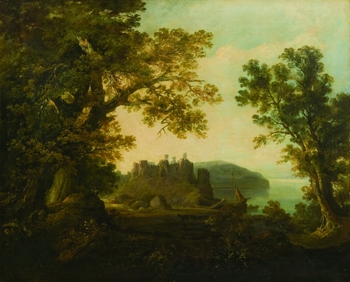
Looking out on the manor house that her family has inherited, Marcella perceives this run-down manor and its environs in a formulaic picturesque description.Footnote 9 William Gilpin in An Essay on Prints (1768) defined the picturesque, derived from French and Italian terms for “painterly style,” as “expressive of that peculiar kind of beauty, which is agreeable in a picture” (Gilpin Reference Gilpin1802, xii). Gilpin then shifted the term from pictures to landscape itself through his series of guidebooks that encouraged Britons to take grand tours of their own countryside and to sketch, experience and capture its picturesque beauty. In the eighteenth century, the picturesque became associated with an idealized countryside, idyllic yet contemporary, open yet domesticated, and wild yet inhabitable. It was often contrasted with Edmund Burke's aesthetic of the sublime that evoked fear and terror through views of nature's awesome power. The picturesque was also associated with pictorial ruins from the past (Figure 15). Enthusiasm for the picturesque's irregular patterns and evocation of mood evolved partly as a reaction against eighteenth-century Neo-classicist formality, proportion, order, and exactitude.
John Thomson (1778-1840), Conway Castle, early 19th century. Oil on canvas. 62.8 cm X 85.7 cm. © Victoria and Albert Museum, London.

The picturesque in painting was constituted by several conventions drawn from Claude Lorraine's paintings: winding paths from the frontal plane into the distance to invite the beholder into the pictorial space; a framing device of feathery trees on either side of the image; uneven terrain inhabited by rural residents and farm animals, often seen in the distance; idyllic and richly fertile plant and animal life, often with a water feature. The prophets of the picturesque, Uvedale Price and Richard Payne Knight, considered Claude almost equal to Nature, and, inspired by him, they elevated mood, ruins, decay, and nostalgia as aesthetic values. Knight's view of Claude's art as exemplary of the picturesque continued into the nineteenth century.Footnote 10
These conventions are invoked in a recipe of the picturesque's late eighteenth-century, pre-industrial aesthetic in Marcella's first view of Mellor:
She looked out upon a broad and level lawn, smoothed by the care of centuries, flanked on either side by groups of old trees – some Scotch firs, some beeches, a cedar or two. . . developing here the delightful roundness of quiet mass and shade, and there the bold caprice of bare fir trunks and ragged branches, standing black against the sky. Beyond the lawn stretched a green descent indefinitely long, carrying the eye indeed almost to the limit of the view, and becoming from the lawn onwards a wide irregular avenue, bordered by beeches of a splendid maturity. . .. the autumn sun pouring steadily through the vanishing mists, the green breadth of the vast lawn, the unbroken peace of wood and cultivated ground, all carried with them a confused general impression of well-being and of dignity. She noticed involuntarily the gateless gap at the end of the avenue, the choked condition of the garden paths on either side of the lawn. (35; bk. 1, ch. 1; emphasis mine)
This passage contains many picturesque conventions: “roundness of quiet mass and shade, . . . bold caprice. . . ragged branches. . . wide irregular avenue, bordered by beeches of a splendid maturity,” internal framing trees (“flanked on either side by groups of old trees“), a warm pink or golden cast of sunset (“the autumn sun pouring”), the uneven drama of light and shade, the irregular avenue, ragged branches and dilapidation evoking the melancholy of ruins, a popular picturesque subject of “something forlornly lovely” (57; bk. 1, ch. 3). Marcella's picturesque description is merely visual, not empathetic, but a distant seeing devoid of humans or labor, while merely making her aware that she was the ”inheritress of one of the most ancient names in Midland England. . . a life which. . . promised the highest possible degree of interest and novelty" (36; bk. 1, ch. 1).
Marcella must learn to see the picturesque critically with the humans in it. Ruskin's view of the picturesque sustained its eighteenth-century conventions: irregularity, variety, “complex light and shade, varied colour, undulatory form” associated with ruins or natural decay (Works 6: 15). For Ruskin, roughness and irregularity in human objects or architecture recalled natural forms like mountains or ravines (8: 237; 6: 10). But his concept of the “noble picturesque” in the fourth volume of Modern Painters attempted to modernize the concept (Landow 221–22). He criticized the picturesque for its self-conscious display of artistic tour de force, failure to reveal nature simply and directly (8: 237) and disguise of social conditions beneath the pleasure of the picturesque (6: 9) that “encourages the artist and spectator to delight in sad, painful things for the sake of interesting lines and colors to the neglect of the human significance of the scene depicted” (6: 19), so that misery served mere visual interest. By the 1850s Ruskin had become increasingly aware of “how many suffering persons must pay for my picturesque subject, and my happy walk.”Footnote 11 In the last volume of Modern Painters, his description of a picturesque scene is overtaken by his social conscience:
I can just see over a knoll, the green and damp turf roofs of four or five hovels, built at the edge of a morass, which is trodden by the cattle into a black Slough of Despond. . .. I see a man fishing, with a boy and a dog – a picturesque and pretty group enough certainly, if they had not been there all day starving. . .. I know the dog's ribs also, which are nearly as bare as the dead ewe's; and the child's wasted shoulders, cutting his old tartan jacket through, so sharp are they. (7: 268–69)Footnote 12
Ruskin never condemns the picturesque entirely, because it reflects a healthy need for beauty and is not driven by evil motives (6: 21). He wishes to stimulate and combine both seeing and feeling, to move people to change the economic system (Landow 236).
In another description Marcella encounters the picturesque with suffering humanity, but still fails to make the Ruskinian leap to empathize with the sufferers:
Just below them, beyond a stubble field in which there were a few bent forms of gleaners, lay the small scattered village, hardly seen amid its trees, the curls of its blue smoke ascending steadily. . .. The stubble field was a feast of shade and tint, of apricots and golds shot with the subtlest purples and browns;. . . a cloudless sun poured down on field and hedge, and on the half-hidden medley of tiled roofs, sharp gables, and jutting dormers which made the village. (68; bk. 1, ch. 4)
Architectural forms (roofs, gables, and dormers) are those Ruskin defined as picturesque. However, in Marcella's perception villagers are reified and aestheticized as forms of gleaners, not as gleaners. At this moment, she clasps her hands excitedly, in her distanciation of the human subjects, and in so doing she appears to Raeburn as “a young Victory poised upon a height,” a work of art herself (68; bk. 1, ch. 4).
Another landscape description demonstrates how aware Ward was of Ruskin's critique of the picturesque as masking human suffering:
the ponds on Mellor common, and the stagnant pool in the midst of the village, whence it drew its main water supply, were frozen hard. But the ploughed chalk land itself lay a dull grey. . . and the woods. . . pass once more with the deadly cold of the night under the fantastic empire of the frost. . .. the branch work of the trees. . . lay reflected clean and sharp on the whitened ground. . .. The bitter cold stole into the cottages, marking the old and feeble with the touch of Azrael [Angel of Death in the Hebrew Bible and in Islam]; while without, in the field solitudes, bird and beast cowered benumbed and starving in hole and roosting place. (147; bk. 1, ch. 1)
The aesthetics of the whitened landscape struggle with the realities of the animals and people suffering in this cold, a suffering that crescendos at the end of the passage, but is foreshadowed in the beginning by words like “frozen hard,” “deadly cold” and “stagnant.”
Paralleling Marcella's Book I landscape description, this view opens Book II in which the omniscient narrator imagines unseen human suffering. Out of this scene emerges Jim Hurd, husband of the family Marcella has taken under her wing, poised to complete his poaching expedition with another laborer. Contrasting with Marcella's description in Book I, this description embraces Ruskin's critique of the picturesque by adding the troubling figure of the poacher, as much a part of the landscape as trees or birds.
Marcella ends Book I with a visit to the cottages in an attempt to understand the villagers' lives, but her naive query about poaching only intensifies their desire not to reveal themselves to her. The omniscient narrator, however, reveals their inner thoughts and the depths of their suspicions, beginning with the above description of landscape that incorporates their suffering. Hurd poaches not only for food, but also out of atavistic, “Celtic” (153; bk. 2, ch. 1) instincts, and class loyalty that resists Marcella's help. Marcella, too, sees class in operation here and blames game preserving that turns nature into property only for the upper classes, widening class differences and intensifying class hostilities (172; bk. 2, ch, 3).
Earlier, Raeburn, beginning to feel a “new and surging emotion” for Marcella, looks over the landscape and “drew the solemnity of the forest blades and of the rolling distances into his heart,” while viewing “the central plain of England. . . symbolic, all of it, to an English eye.” In Ward's words, “Aldous Raeburn was a man to feel these things. . .. most manly, most English, most strenuous” (73; bk. 1, ch. 5). He sees and feels together. Unlike Marcella, when he views the landscape, he sees more than his property; he sees the churches, the villagers, “toilers in these endless fields, the farms and the tree; the cottages,” and their dependence on “his one man's brains and conscience, the degree of his mental and moral capacity” (73-74; bk. 1, ch. 5). His seeing is much more Ruskinian and socially intertwined. Raeburn, who will “find a scruple in every bush” (263; bk. 2, ch 10), has had a “long wrestle of the heart” over “the ethical relation of the individual to the World's Fairs and its vanities,” but Marcella hears only his “tame” comments and misses his conviction and struggle (203; bk. 2, ch. 5). Her aesthetic impulse is still an obstacle to understanding the villagers, Aldous, and even her own purpose, and at this point in the novel, she is still not ready to be Raeburn's mate.
Ward's picturesque descriptions of landscapes suggest both Marcella's character and her limited awareness of her new environment, as well as Raeburn's consciousness. Looking over the spot where he proposed to Marcella, Raeburn recognizes “sounds of labour. . . of winter birds,” in a moment of “the intensest powers of consciousness” (278; bk. 2, ch. 12). In The Stones of Venice Ruskin defined the artist as “a seeing and feeling creature. . . of such tenderness and sensitiveness" as to miss “no shadow, no hue, no line, no instantaneous and evanescent expression of the visible things around him, nor any of the emotions which they are capable of conveying” (11: 49). For Ruskin, as George Landow argues, “taking delight in figures in rags corrupted the artist and audience alike” (Landow 232), Marcella's corruption by virtue of her prioritizing aesthetics over empathy.
The landscape that breaks through Marcella's reification of the poor is the landscape she and liberal politician Henry Wharton see outside the library window; into this view Hurd with his gun appears in the distance, a scene that Wharton had picturesquely called “the very poetry of night and solitude” (236; bk. 2, ch. 8) just before Hurd's appearance in the scene. In contrast to Wharton's aestheticizing of this view's “infinite grace and strength in the line work of the branches. . . every conceivable harmony of upward curve and sweep. . . of a master artist,” Hurd however “saw nothing” (151; bk. 2, ch. 1), driven by dire economic and atavistic forces.
The poacher is not simply a character, but a theme as well. As Wilt notes, poaching was an increasing problem in the 1880s and 90s, generating twice as many gamekeepers as police officers in rural England (Wilt, Behind her Times 89). She calls Wharton a political poacher and some characters see Marcella as a poacher, taking a social status that does not belong to her impoverished family. Poaching was a popular subject in social realist paintings, as in Hubert von Herkomer's Bavarian watercolor series The Arrest of a Poacher (in the Graphic 17 May 1873, 465; later a watercolor, 1874, and printed in the Art Journal ns 19 (1880): 109), and The Poacher's Fate, an 1879 mezzotint engraved for the Art Journal in 1880 (Figure 16), widely disseminated popular prints of gruff, angry peasants poaching to feed their families who sometimes appear nearby.
The Poacher's Fate. Engraving by R. and E. Taylor, from James Dafforne, “The Works of Hubert Herkomer, A. R. A.” Art Journal ns 19 (1880): 110.

At this point, Marcella's seeing begins to blend with feeling. Book IV opens with another autumn landscape two years after the very first one in Book I, but this landscape description, with its simple, thinning trees and straight lines of sight, is not picturesque: “High up on the distant hill to the left, beyond the avenues, the pale apricots and golds of the newly-shorn stubbles caught the mounting light. The beeches of the avenue were turning fast, and the chestnuts girdling the church on her right hand were already thin enough to let the tower show through” (479; bk. 4, ch. 1). She hears the bell and the pheasant's call; all of her senses are engaged, not just her eyes. This view is “purely, cleanly beautiful,” tied to the upcoming Harvest Festival, a celebration of nature and community (479; bk. 4, ch. 1). Her view synthesizes history (the bell given by her ancestor), nature (the pheasant) and community (the village Harvest Festival). This festival is reminiscent of the haymaking festival in William Morris's News from Nowhere, in which everyone partakes of an event associated with Morris's own Kelmscott Manor, in a new unity of villagers and landowners, a class alliance heralded by Marcella’s character Edward Hallin, Raeburn's socialist-leaning best friend.Footnote 13
While Raeburn's landscape views are more critical than Marcella's, he, too, must learn to see more critically with regard to Marcella. He sees her as art and through art, comparable to figures in works by Ghirlandaio or Andrea del Sarto. Her face is “of the Renaissance, extraordinarily beautiful. . . in colour and expression; imperfect in line. . . the meeting point between antique perfection and modern character. . .. It has morbidezza – unquiet melancholy charm. . .. I am told that Burne-Jones drew her several times. . .. It is the most artistic beauty, having both the harmonies and the dissonances” (91; bk. 1, ch. 6). Despite the aesthetic sophistication in this description, later reflected in his family's art collection, he sees only her surface, unlike the deeper appreciation of her that he gains by the end of the novel when she has become more experienced and profound, too. Ward suggests that aesthetic appreciation must fit a more realistic and critical view of others, whether local peasants or a lover.
Inside the Manor: Portraiture, Interior Design, and Identity
In addition to landscape, Ward draws on portraiture and interior design as resources for Marcella's aesthetic reflection and self-fashioning. Earlier the gothic novel had already reinvented the portrait. In her study of portraiture and gothic fiction Kamilla Elliott calls picture identification “a cultural use of portraiture: an intersemiotic practice that most commonly matches an embodied, presented face to a named, represented face to verify social identity” (Elliott 2). Marcella's effusive descriptions of, and identifications with, portraits are attempts to first find and then shape her identity in both aristocratic history and modern society.
Portraits open “identificatory spaces” (Elliott 16) in which Marcella articulates imagined relations to aristocratic portrait subjects; her self-inscription makes her a producer of these images, as well their consumer. An identity created out of resemblance can also undermine hierarchies and reflect multiple identities through “an affiliative relationship that positions the image as both the link to and the point of rupture from other identities” (Elliott 30). In this process, I argue, Marcella creates identities for herself that are not only aristocratic or nostalgic fantasies, but which are also matriarchal to counter balance the patriarchal thrust of Raeburn's heritage. Marcella's imaginings articulate battles “between names and faces, battles between narratives and portraits and battles between symbolic and mimetic modes of representation” that “enter the larger class war over iconologies of identity,” that Elliott describes in gothic novels (Elliott 187).
Picture identification is a form of consuming the past to enter it. In the beginning of the novel, the portrait of “the beautiful Alexandra” (38; bk. 1, ch. 1) in a small country shop “governed her dreams” (39; bk. 1, ch. 1) and mediated Marcella's unhappy childhood to become a mother substitute and to redeem her low position at school. Marcella also delighted in the portrait of a great-uncle, one of “Boyces of Brookshire” and a Speaker of the House of Commons (40; bk. 1, ch. 1), repeatedly adulated by her father who encouraged her pride in the great-uncle's status. The “cherub-crowned tomb” of a Parliamentarian Boyce who fought in the Civil War and other tombs in the family church chancel record Marcella's domestic and imperial family history (e.g., Quebec and “Plassy” [sic], 59; bk. 1, ch. 3) and partake of her construction of an aristocratic ancestry and identity imbued with fantasies of class power.
Portraits also serve as signs of lineage and status and as metaphors for appearance and inner character. Wharton describes the portrait of Lady Selina as if it were a fashionable portrait by Anthony van Dyck or Hans Holbein:
She had a long, rather distinguished face, with a marked nose and a wide thin-lipped mouth. Her plentiful fair hair, a little dull and ashy in colour, was heaped up above her forehead in infinitesimal curls and rolls which did great credit to her maid, and gave additional height to the head and length to a thin white neck. Her light blue eyes were very direct and observant. (320; bk. 3, ch. 1)Footnote 14
Mrs. Boyce with an “obstinate mouth," on the other hand, is likened to a “grim contemporary portrait of Mary Tudor” who persecuted Protestants (92-93; bk. 1, ch. 7). She and Marcella are contrasted by dress: Mrs. Boyce wears “soft and costly silks, generally black, closely and fashionably made, and completed by various fanciful and distinguished trifles” of jewelry recalling seventeenth-or eighteenth-century portraits; Marcella's dress is “of the ample ‘aesthetic’ type. . . ‘art serges’ and velveteens” (96; bk. 1, ch. 7), the dress of the Aesthetic Movement.
Marcella's family's fortunes rose for a time when a Boyce married an Italian named Marcella, the eponymous protagonist's namesake and look alike. Although her namesake's portrait is “a dark blurred picture by an inferior hand,” her legacy to Marcella is clear: “artistic aptitudes. . . not hitherto conspicuous in her respectable race” (60; bk. 1, ch. 3), and a passionate nature, unlike her mother's coldness. Marcella hungrily consumes this portrait that validates her looks and her nature. As Dehn Gilmore notes, Victorian novelists explored new ways of consuming, as well as of seeing, art. Art in novels interrogated not only notions of originality and expression but also “modes of consumption, of popular reproduction, and of dissemination” (Gilmore 21).
Ward's descriptions of portraits contain sophisticated art historical references that shape and define social relations among characters and their acts of consuming culture. Marcella's tour of Maxwell Court echoes Elizabeth's tour of Pemberley and her views of portraits of Darcy in his family's portrait gallery in Pride and Prejudice. While Elizabeth's tour helps her change her view of Darcy toward a more favorable image of him, Marcella's portrait encounters serve rather to imagine and invent her view of herself and her entitlement.
Art history is both seductive and epistemological. Raeburn leads Marcella to the family's picture gallery, beginning with two Holbein portraits that Marcella admires “in spite of herself, by some trained sense which could not be silenced” (135; bk. 1, ch. 11). He then shows her works by Velasquez, a “great” Titian, a “priceless” Rembrandt, as well as beautiful objets d'art – “a chair of carved steel” unequalled in Europe and “brocade draping the deep windows” made for Charles II's state visit to Maxwell Court (136; bk. 1, ch. 11). Asking whether Titian “sweated” his workers, she answers that he probably did, but this likelihood does not detract from the “joy” of seeing his painting. Glancing around the gallery, she realizes that if she marries Raeburn, she will be a descendent of the females in the portraits with their “jewelled necks. . . embroidered dresses. . . lace ruffs. . . gleaming satin of the Caroline beauties” (137; bk. 1, ch. 11), and portraits harking back to the Tudors. Marcella imagines herself “as the young peeress” dressed in diamonds and “making law in this splendid house. . . what a romance!” (137; bk. 1, ch. 11).
Here is the seduction of art – its promise of power, taste, lineage, and the beauty of everything. Later in the novel, when “those same Caroline and early Georgian beauties. . . so flashingly suggested her own future rule,” Marcella feels “very shrinking and lonely” (292; bk. 2, ch. 13). She must find a way to reconcile her love of beauty with her commitment to social activism. Ultimately she will not simply consume portraits as aristocratic indulgences, but also produce them for the villagers, remaking their meanings and purpose within Maxwell Court as gifts from the past, embodiments of histories of both aristocratic families and of the villagers.
Counteracting her consuming fantasies inspired by portraits is a photograph of Edward Hallin whose work she admires and whose politics rebuke the aristocratic material world, despite his deep friendship with Raeburn. The photograph, unlike portrait paintings, offers not only a sharp realism, but also an image of a modest identity, unflattered and direct. Similarly, Lady Selina believes she can judge Marcella by a photograph of her (319; bk. 3, ch. 1), implying that the “truth” of photography offers a counterclaim to the seductive spectacle of aristocratic portraiture. The photograph opens up alternative visualities and modernities for Marcella.
In addition to portraits, Marcella is overwhelmed by furnishings and objets d'art. Mellor Park embodies a condensed British history of taste. Its original structure was Tudor with an extensive garden (57; bk. 1, ch. 3). Marcella and her parents breakfast in the “Chinese room” whose images of mandarins recall eighteenth-century Chinoiserie. A later Boyce “thrust a crudely Gothic sideboard” into this room, marking the Gothic revival (50; bk. 1, ch. 3). After her father restored Mellor, removing the picturesque irregular lines and ruins, the library, repaired but “in no sense modernized,” appeared “simple yet refined” (519; bk. 4, ch. 4). In her dying father's old bedroom, she notes with pleasure the wallpaper “of branching trees and parrots and red-robed Chinamen. . . a grate adorned with purplish Dutch tiles, an array of family miniatures over the mantelpiece, and. . . a rack of old swords and rapiers” (486; bk. 4, ch. 1) of pre-industrial ancestors. Her father, with a complexion “as yellow as that of the typical Anglo Indian” (51; bk. 1, ch. 3), possibly a nabob whose personal wealth came from the East India Company civil servants' legally questionable manipulations, alludes to empire to complete the references to Britain's history.
In Maxwell Court, Raeburn takes Marcella to see his family's art treasures, beginning with “a famous piece of Italian Renaissance tapestry” which she greatly admires:
the most adorable medley of forms, tints, suggestions, of gods and goddesses, nymphs and shepherds, standing in flowery grass under fruit-laden trees and wreathed about with roses. Both colour and subject were of fairyland. The golds and browns and pinks of it, the greens and ivory whites had been mellowed and pearled and warmed by age into a most glowing, delicate, and fanciful beauty. It was Italy at the great moment – subtle, rich, exuberant. (126; bk. 1, ch. 10)
This tapestry of classical subjects depicts a world of ease, pleasure, fertility, and riches, the world of Raeburn and his ancestors. The flowers in the tapestry touch “the artistic sensitive chord in her,” and Raeburn assures her she will like his family's collection “because you are an artist” (126; bk. 1, ch. 10). Maxwell Court's “Tudor ceiling, its fine pictures, its combination of every luxury with every refinement” give her “a certain thrill, a romantic drawing towards the stateliness and power which it all implied” (122-23; bk. 1, ch. 10).
Marcella's subsequent meeting with Raeburn's grandfather Lord Maxwell is in a special interior, a room that Raeburn sees anew through Marcella's responsiveness:
The room, with its carved and gilt cedar-wood panels, its Vandykes, its tall windows opening on the park, the autumn sun flooding the gold and purple fruit on the table, and sparkling on the glass and silver, the figures of his aunt and Lady Winterbourne, the moving servants, and dominant of it all, interpreting it all for him anew, the dark, lithe creature beside his grandfather. (128; bk. 1, ch. 10)
The room and its people become aesthetic, a dramatic conversation piece by William Hogarth.
Manors, Museums, and Exhibition Culture: From Private to Public to Nation
Portrait galleries were located in country mansions from the sixteenth century on with rows of portraits of ancestors and classical philosophers that provided inspiration and moral guidance to the living (Voyles 143; Girouard 101). Ward takes up the late-century discourse about aristocratic country homes that moved these homes from the private to the public sphere as they became icons of British history, aesthetic taste, and nationhood. She also alludes to late-century debates over the functions of museums that country houses were partially resembling in relation to both national culture and class. Marcella's opening her country house as a palace of art is a troubled and contradictory resolution, since the novel's class conflicts over poaching and property are not fully or easily resolved in this way. Aesthetic values appear to elide with social values, as they did for Ruskin and Morris, Ward's aesthetic mentors, in Marcella's decision to share her country house and turn its possessions into national treasures. Ward's descriptions of scenery around Mellor Park and the manor are based on the Elizabethan Hampden House where Ward and her family spent a summer in 1889 (547, Appendix A, Ward's introduction to the 1911 Marcella).
The loosening of the aristocracy from the court with the establishment of both a constitutional monarchy and the move of the seat of political power from the court to Parliament at the turn of the eighteenth century permitted aristocrats to move to the country (MacGregor 74). This move, in turn, initiated much re-building and remodeling of estates' landscapes and homes, usually in the neo-classical style. The sons of these first generation rebuilders then furnished the homes with sculpture, painting and objets d'art, like Raeburn's inherited “Graeco-Roman statuary and sarcophagi” (80; bk. 1, ch. 6). Some collectors felt “the first stirrings of an awareness that their collections had the potential to participate in a broader art-historical discourse” (MacGregor 77). The process of aristocratic country homes and collections moving from private to public to nation began in the eighteenth century. Frederick Augustus Hervey, 4th Earl of Bristol and Bishop of Derry (1730-1803), aspired to hang his paintings to demonstrate historical development in Germany and Italy. Charles Townley's (1737-1805) collection of sculptures was purchased by the British Museum for £20,000 (MacGregor 77–79). Horace Walpole's (1717-1797) gothic Strawberry Hill, a departure from neoclassical palaces and acquired in 1747, was opened to the public. Walpole issued tickets liberally and had rules for his many visitors (MacGregor 82).
Economics, however, forced the dissemination of these collections. The agricultural depression from 1873 due to the influx of cheap cereals from the US led many aristocrats to sell collections, a trend that raised outcries from the press and the public over what appeared to be a loss of English heritage. The Settled Land Act of 1882 made it easier to sell art collections if profits remained in trust. In the 1880s works of art flowed out of Hamilton House, Blenheim, Stourhead, Haigh Hall, Althorp, Ashburnham Place, and Longford Castle (Harris 195–208). Foremost among them were portraits. Typically aristocrats, who collected art for personal and dynastic reasons, were more likely to sell than to donate their collections, unlike middle-class collectors who donated works to the nation (Cannadine 12).
Starting in the 1880s, aristocrats' art collections increasingly constituted a national patrimony in the public's eyes. Those losing money to poor investments, death duties, and agricultural depression were attacked for selling their art to foreigners, reflecting “new definitions of and contests over cultural property, intensified by ongoing gender, class and ethnic strife,” culminating in the creation of the National Art Collections Fund in 1903 to raise money to purchase British art on sale (Harris 195). The selling of aristocratic collections is alluded to in the novel: Wharton, thinking about his acceptance of bribery, likened it to “the sale of an ‘old master’” (457; bk. 3, ch. 14).
Understanding the discourse around country houses and their collections makes clearer what is at stake in Marcella's decision to share Mellor. In the late 1860s the Art Journal ran a series entitled “The Stately Homes of England,” detailing such places as Knole House in Sevenoaks.Footnote 15 In the late 1870s the Magazine of Art had a multi-part series, “The Treasure Houses of Art,” and another series on Country Houses,Footnote 16 including Syon House, Hardwick Hall in Derby, Hatfield House, and others. Themes in this series were the grand spaciousness of these mansions, their vast collections of objects, and aristocratic celebrities whose visits to these houses constructed British history. Accompanying illustrations depicted spacious, high-ceiling rooms filled with centuries-old art objects, a kind of para-museum. Readers, repeatedly told that manor owners had impeccable taste, were served detailed descriptions of the lush furnishings and invocations to historic figures who dwelt in or visited the manors.
One theme of these series was the superiority of Elizabethan architecture and aristocratic life. In the Magazine’s two–part series on architect Robert Adam's work on Syon House in 1884 (Figure 17), the mansion was described as perfect in taste: “chaste and pure,. . . rich and sumptuous” (II, 302), praised for ascetic purity and sumptuousness, qualities not easily yoked together. The essay ends with a lament over the passing of this “age of suburban villas,” now replaced by “semi-detached dolls' houses, which are ‘villas’ only by the grace of their own impertinence.” Author architect Eustace BalfourFootnote 17 urged readers to “save from destruction every specimen of a lovelier age than ours,” invoking Syon's aesthetic superiority and historical associations from 1431: “The pious devotion of kings, the vices of the later monastic life,. . . court favourites.”Footnote 18 Hardwick Hall in Derby embodied “the vitality of the Elizabethan age,. . . the home of a statesman worthy at once by his novel ancestry and national service,”Footnote 19 whose portraits represented “a galaxy of rank and beauty” (252). Marcella's view of Maxwell Court echoes these sentiments.
“Syon House: The Gallery,” Magazine of Art 7 (1884): 301.

Country house wealth and decoration became a model for galleries, exemplified by London's Grosvenor Gallery in 1877 whose architecture, interior decoration and art display mimicked a country estate in design, amenities and hanging of works. Mellor Park and Maxwell Court in Marcella resonate with this elision of manor and museum. The Boyce family, too, embodies British history: e.g., a Whiggish religion and imperial battles (“Quebec, and Plassy, and Trafalgar”), making them a contradiction: “a tedious race perhaps and pig-headed, tyrannical too here and there, but on the whole honourable English stuff” that sustains “the fabric of a great state” (59; bk. 1, ch. 3) alongside their friends Horace Walpole and Thomas Gray.
Raeburn presciently anticipates a time when “the State is ready to take over the historical houses and their contents,” so that caring for these things becomes a moral responsibility (136; bk. 1, ch. 11) to keep them in good condition for the nation. Marcella must determine what to do with her family's manor when she marries Raeburn; by opening it up to the villagers she underscores her home's status embodying British history and culture while also keeping the manor's art from the market. On one level her decision to share Mellor is a decision about property, what is public and private, and perhaps both. Hallin suggests that property is self-realization for the sake of shared wealth and “for the soul's sake, and for the sake of that continuous appropriation by the race of its moral and spiritual heritage” (411; bk. 3, ch. 10). Such language – race, moral and spiritual heritage – is the language of the nationalization of the country manors and their art collections, whose ancestral portraits changed in the nineteenth century from references to aristocratic ancestors to the genius of their artist creators (e.g., Gainsborough, Reynolds) as part and parcel of the nation's wealth and inheritance.
Yet, Marcella does not simply transform the manor house into a museum, but also partakes of a wider Victorian exhibition culture, initiated by the 1851 Great Exhibition, enlarged in world's fairs held every two to three years and codified in museums springing up throughout the country. Between 1890 and 1914, 215 museums were created in Britain, their funding, construction and attendance enabled by the Museums and Gymnasiums Act of 1891 and the Public Libraries Act of 1892, which facilitated the establishment of museums. The Day School Code of 1894 gave every schoolchild the opportunity of museum going (Hoberman 13). This exhibition culture, furthermore, embraced shop windows, rampant advertising, and interior decoration. Display itself became “the primary site of exchange in the political economy of art, where signification is constructed, maintained, and occasionally deconstructed. Part spectacle, part socio-historical event, part structuring device, exhibitions. . . establish and administer the cultural meanings of art” (Greenberg, Ferguson, Nairne 1–2). Museums determined spectators' behavior and ways of seeing, creating rituals and a decorum of viewing, transforming both urban life and spectators' identities: the museum-goer internalized decorum and viewing behaviors and, in turn, was hailed as an “ideal citizen – a member of an idealized ‘public’ and heir to an idealized, civilized past” (Duncan and Wallach 48). This decorum spread to late-century East End art exhibitions for the poor arranged by Reverend and Mrs. Samuel Barnett that capped years of debates over whether workers would appreciate museums or should even be admitted.
Marcella's awareness that the rural poor can laugh and enjoy a social life, an awareness that at first “struck her dumb” (112; bk. 1, ch. 8), and that the urban poor appreciate nice things expand her notion of those she did not at first think could appreciate beauty. As Andreas Huyssen argues, despite the museum's attempt to control spectating, “there is always a surplus of meaning that exceeds set ideological boundaries, opening spaces for reflection and counter-hegemonic memory,” for spectators' independent reflections and subjectivities (Huyssen 15–16). Opening Mellor for the villagers mimics the urban museum encounter and signals that Marcella has accepted spectators' right to interpret Mellor's art. Marcella repurposes her own collection for entirely new spectators with new inscriptions. Having learned that villagers have their own views and can rebuff her attempts to help them, she is willing to leave their understanding of manor art to their own experiences and interpretations.
While exhibition culture is invoked in the novel's country house galleries, the great house display is markedly different from commercial gallery and museum venues. Unlike manor art objects, art in museums is commodified, separated from its sources of production and subject to the commerce of the art market. To avoid the specularity and commercial interests of exhibition culture, Mellor Park's display must remain local and in place – not re-arranged in glass cases or subjugated to the classification systems of Victorian museums (historical, formal, typological, etc.). In this way, Mellor Park's collection can uplift the villagers by generating an overarching local identity that transforms class differences into “class alliance,” the goal for Arnold Toynbee, the model for the character of Edward Hallin (574, Appendix E).
The manor's objects gathered over centuries remain affective by staying within the mansion's rooms in situ so the collection's new purpose does not erase, but expands upon its past purpose. Mellor's art can thus retain its aura, left where it was collected and arranged. In the city, too, Marcella wants to interject beauty into individual rooms and flats for individuals she knows and with whom she shares spaces. So things in both the urban spaces and the country house remain affective, within networks of acquaintances and friends, and non-commercial, retaining ties to, and enhancing, the community from which these things derive their value.
The museum devalues the local by juxtaposing geographically or historically diverse objects in deraciné arrangements that deny the ways they were produced, collected, displayed and made meaningful. Marcella's decision keeps Mellor Park's art from commodification, even if the meaning of this art will not be solely determined by Marcella or Raeburn. Hoberman points out that much late Edwardian fiction recognized the incongruities between commerce and aesthetics in the museum's approximation to the shop that underscored and sustained social hierarchies. Morris in News from Nowhere (1890) rejects the museum; in utopia, art is integrated into daily life and no longer a special “art” category. Victorian architect John D. Sedding insisted that art museums did not help the poor and reduced art to its surface by removing it from use and locale, connecting museums to industrialization and mass production. Yet many, like Barnett, saw the museum as a means to pacify the working classes through art's middle-class family life subjects and advocated that museums be opened on Sundays.Footnote 20 By opening up the manor's collections, Marcella links these debates and nationalizes these objects to assure they will remain in Britain, but not become deraciné commodities in museums. Her final decision blends Morris's view of museums and the importance of local control over historic objects with the realities of art market conditions and the widespread opening of manor houses at the end of the century.Footnote 21 The manor house became able to confer citizenship on its spectators just as the museum could.
The Socialism of Art: Aesthetics of Character and the Character of Aesthetics
Marcella hoped to restore straw plaiting to improve villagers' wages, about which the villagers had reservations, as they did about most of her interventions into their lives.Footnote 22 She believed leading them was a natural consequence of her class and theirs, she possessing the “power of good” (101; bk. 1, ch. 7). Morris restored medieval crafts and methods, but he worked alongside his workers, not apart from them. Marcella's obstacle in the early part of the novel is her reification of the villagers whom she understands through the mediation of literature and art: “these village people affected her like figures in poetry or drama. She saw them with the eye of the imagination through a medium provided by Socialist discussion, or by certain phases of modern art; and the little scene of Mrs. Hurd's tea-party took for her in an instant the dramatic zest and glamour” (103; bk. 1, ch. 8). Mrs. Hurd's “tea-party,” a phrase that transforms this working-class event into a genteel one, parallels David Wilkie's popular paintings of an idealized country village life (“certain phases of modern art”), that harkened back to Dutch seventeenth-century paintings that playfully stereotyped the lower classes and were so popular in Britain.Footnote 23 As Wilt notes, “the people” are always a “scene” to Marcella (Wilt, Behind her Times 90). As Ruskin argued, beauty can get in the way of seeing social injustices and sufferings. In the city, Marcella lives with the workers and the poor and sees their ragged children up close without the mediation of art.
The connection between art and socialism originated in Marcella's London art student days (47ff; bk. 1, ch. 2). The Cravens, her Venturist artist friends, “lived as workmen; and both the luxuries and the charities of the rich were equally odious to them” (47; bk. 1, ch. 2). Again in the city after leaving Mellor Park, Marcella's urban nursing venture returns her to these socialist days. In one tenement, once a fashionable eighteenth-century house, “still showing in its chimney-piece or its decaying staircase signs of the graceful domestic art,” she is repelled by her own aesthetic preference for the original house, until she “had no eye whatever at the moment of the panelling on the staircase, or the delicate ironwork of the broken balustrade" and was overwhelmed by “the dirt and dilapidation of the stairs, and the evil smells of the basement” beneath the eighteenth-century building's worn beauty (341; bk. 3, ch. 3).
In the city, Marcella's flat is brightly decorated in good, but inexpensive objects:
Her art-student's training showed itself. The cheap blue and white paper, the couple of oak flap tables from a broker's shop in Marchmont Street, the two or three cane chair with their bright chintz cushions, the Indian rug or two on the varnished boards, the photographs and etchings on the walls, the books on the table. . . a pleasure to her young senses.Footnote 24 (348; bk. 3, ch. 4)
Unlike country house heirlooms, these things bought from shops are commercial imitations but are elevated by her tasteful combinations by which she re-produces things she consumes. The room's flowers sent to her from her mother link this flat to Mellor Park, a connection maintained through a love of beauty shared between Marcella and her mother.Footnote 25
Living among the poor makes her life “freer, more elastic; allowed room at last to self-consciousness” (342; bk. 3, ch. 3). While recuperating at Lady Winterbourne's fashionable flat from her encounter with one client's brutal husband, Marcella describes her new aesthetic appreciation to Lady Winterbourne:
It comes, I suppose, of going about all day in those streets and houses, among people who live in one room – with not a bit of prettiness any where – and no place to be alone in, or to rest in. I come home and gloat over all the beautiful dresses and houses and gardens I can think of!. . . I only want to be sure that the beauty, and the leisure, and the freshness are somewhere – not lost out of the world. (431; bk. 3, ch. 11)
Her association of the country house with leisure resonates with Morris's own view of the domestic interior as a place of rest and reprieve from the struggles of labor and conflicts among classes, “since even rebels desire to live, and. . . crave for rest and peace.” Decoration comforts people by surrounding “our common workaday or restful times.”Footnote 26 Marcella, like Morris, sees decoration and art as solace from labor and class conflict.
Therefore, her solution is to bring beauty to everyone, to keep Mellor Park beautiful for subsequent generations of villagers, to “make it a social centre for all the people about – for everybody of all classes. . . a place of amusement and delight,” since “everybody on the estate, in their different degree, has contributed to this house” (522; bk. 4, ch. 5). Mellor Park is the product of their labor, and she wants them to own their product, as well as their means of production. Marcella will help the workers “take for themselves” (532; bk. 4, ch. 5), recognizing, however, that her help is less important than their agency. Ruskin argues in the “A Joy Forever” that private collections of paintings in the home had more moral force and influence than in any other space (Works 16: 80–81). Marcella appears to put this view into practice.
Marcella's initial vision of Mellor Park through a picturesque lens is decidedly eighteenth-century, a sign of her own dreams of partaking of an aristocratic heritage. Her relationships to the villagers and to her own idealism are theatrical, as Wilt notes.Footnote 27 The gateless gap she sees is a picturesque ruin but also a sign of a decayed social order. Marcella's artistic distancing is likewise a gap to be repaired. Wharton is a more severe negative artistic type “in quest of sensations” (235, bk. 2, ch. 8). His view of Marcella in her room, “you – and the fire – and the room. . . like a bit of music” (163; bk. 2, ch. 2), recalls Pater's dictum that all art should aspire to the condition of music in The Renaissance (1873), marking Wharton as an Aesthete. Marcella compliments the paper animals he makes for the dying Hurd boy as “so artistic!” (192; bk. 2, ch. 4), but his gifts are wasted in the end; as “a man in quest of sensations,” he is the opposite of Raeburn, the man of feeling.Footnote 28 Wharton's speech in the Commons stirs Marcella's “dramatic and aesthetic instinct” (394; bk. 3, ch. 8), but not her moral sense.Footnote 29 His epicurean nature leads him to affairs, gambling, and political ruin.Footnote 30
Ward tried to embody, as she says, the old and newFootnote 31 in transforming Marcella's defining aesthetic nature from a dehumanized picturesque to landscapes with humans seen empathetically, from a love of beauty itself to sharing beautiful things with the larger community, just as Ward herself was determined that the Settlement House she helped create for the urban poor would be beautiful.Footnote 32 Toynbee explains that “a great building was really the infinite made visible” to be enjoyed by all (574, Appendix E).Footnote 33 Morris claimed that “If I were asked to say what is at once the most important production of Art and the thing most to be longed for, I should answer, A beautiful House.”Footnote 34
Another object of importance to Morris was the beautiful book, and throughout the novel Ward describes books on tables, in libraries, and being read. For Morris “good houses and good books” were pleasurable ends for everyone. Jonathan Freedman argues that Aestheticism's dilemma and contribution both lay in attempts to embrace socialism or social consciousness and the pleasures of beauty, rather than treat these as incompatible dichotomies. Such intentions did not result in any facile synthesis in terms of class and economic hierarchies (Freedman 3). Indeed, the space Marcella and Raeburn come to inhabit is the middle. Raeburn's consciousness reveals a middle way synthesizing labor, nature and self-knowledge: “Sounds of labour came from the distant fields; sounds of winter birds from the branches around him. He saw himself as the man standing midway in everything” (278; bk. 2, ch. 12), between his socialist friend Hallin and his Tory grandfather. As Wilt argues, Marcella's resolution, too, was “to the middle of the road, politically, socially, and to the conventional mate of birth and wealth” (Wilt, “‘Transition Time’” 230) in several senses. Marcella synthesizes her passionate nature and her self-consciousness, her empathy and her self-dramatization, her thrill over wealth and power and her alienation from these in turning to the dispossessed. Both characters exist ideologically midway between landed traditions and a fluid modernity.
Marcella accepts the beauty of the country houses without her earlier hostility toward landowners, and comprehends the agency and autonomy of the villagers whose embrace of beauty endorses their claims of autonomy and agency (“take for themselves”) with none of the curtsying that Venturist Louis Craven despises. Marcella and Raeburn both experience moments of self-knowledge when viewing landscape or interior decoration; beauty provokes their internal self-examination, as well as their plans for social action. But they must also learn to avoid reading life through art to recognize the villagers' contributions to landowners' wealth and co-ownership of their manors and furnishings. Marcella must turn a reified “beauty of the spectacle” (233; bk. 2, ch. 8) into a living beauty that transforms others’ ordinary livesFootnote 35 because “everybody on the estate, in their different degree, has contributed to this house, in some sense, for generations. I want it to come into their lives – to make it their possession, their pride, – as well as mine” (522; bk. 4, ch. 5).
Both Ruskin and Morris sought solutions in communalism. Ruskin's St. George's Guild, however, maintained the social hierarchy in a feudal-like arrangement, while Morris's community of artisans was more egalitarian. Focusing on development and conversion that is social and political (Wilt, “‘Transition Time’” 229), the novel's vehicle for change is art that provokes Marcella's transformations and awakenings and expresses Raeburn's empathy. Turning villagers into owners and the countryside into community re-reads institutions of “the State. . . of every great civilisation, whether it be property, or law, or religious custom, as necessarily, in some degree, divine and sacred” (538; bk. 4, ch. 6). Marcella returns to sentiments uttered early in the novel: Privileged land ownership keeps the poor “from the land which they ought to be sharing with us” (69; bk. 1, ch. 4).
Marcella invents her own political economy of art out of conflicted and unstable aesthetic tensions as she moves through identities as parvenu, aesthete, New Woman, socialist idealist and privileged wife of a landowning Tory politician whom she admonishes to “cherish her own individuality” (145; bk. 1, ch. 11). She embodies “that altered position of the woman in our moving world which affects so many things and persons in unexpected ways” (294; bk. 2, ch. 13) that meant for Ward that “the woman's impression and the woman's report are no less vital, no less necessary to the utterance of a generation than the man's” (549, Appendix A, Ward's introduction to the 1911 edition). Ward lines up with women novelists who assert female autonomy and who use art to explore and develop subjectivity.
Marcella's contradictory, incompletely synthesized goals mirror two generations of discourses on art's unresolved social, economic and political functions from the commercial to the utopian. The wildly proliferating visual culture at the end of the 19th century contributed to the shifting boundaries of nation, region, class and gender through new values applied to museums, manors, hybrid private/public spaces, citizenship, gender, and national heritage. As Talia Schaffer points out,
female aesthetes were constantly trying to reconcile competing notions of identity – being female yet being aesthetic; living like New Women while admiring Pre-Raphaelite maidens; trying to be mondaines (Ouida's term for cosmopolitan female dandies) but also emulating Angels in the House. The conflicting roles were staged in their novels and manifested in their public reputations. (4-5)Footnote 36
Marcella embodies these contradictions that are shaped and reshaped by the aesthetic imperative that drives all of her contradictory activities and decisions. Ward's deep, professional knowledge of fin de siècle art discourses expressed in the novel make art a vital force that reflects her characters' conflicted consciousness, shapes their social ethics, and gives them a non-political platform with which to extend local social, classed communities through cultural consensus and changes into an imagined national community.