Introduction
Delirium is a neuropsychiatric syndrome characterized by disturbances in consciousness and cognition, an abrupt onset and fluctuating course commonly caused by underlying etiologies (American Psychiatric Association, 2013). Delirium is common across healthcare settings (Bucht et al., Reference Bucht, Gustafson and Sandberg1999; Inouye et al., Reference Inouye, Westendorp and Saczynski2014). Delirium occurs in up to 70% in inpatients undergoing cardiac surgery procedures (Norkiene et al., Reference Norkiene, Ringaitiene and Misiuriene2007; Gottesman et al., Reference Gottesman, Grega and Bailey2010) and in 80% in mechanically ventilated intensive care patients (Pun and Ely, Reference Pun and Ely2007). Delirium is associated with significant adverse short-term (Rosen et al., Reference Rosen, Clagett and Valentine2002; Santos et al., Reference Santos, Velasco and Fraguas2004) and long-term outcomes for patients and increased healthcare costs (Koster et al., Reference Koster, Hensens and van der2009). Important patient outcomes include prolonged length of stay in the ICU and hospital (Ely et al., Reference Ely, Shintani and Truman2004; Ouimet et al., Reference Ouimet, Kavanagh and Gottfried2007), prolonged mechanical ventilation or more frequent ventilation (Heymann et al., Reference Heymann, Radtke and Schiemann2010), increased morbidity, as evidenced in nosocomial infections, pneumonia, or respiratory complications increased mortality rates (Balas et al., Reference Balas, Happ and Yang2009; Heymann et al., Reference Heymann, Radtke and Schiemann2010), and in the longer-term decline in functionality and cognitive abilities (Bickel et al., Reference Bickel, Gradinger and Kochs2008), with increased rates of institutionalization (Ouimet et al., Reference Ouimet, Kavanagh and Gottfried2007).
Nursing assessments have been proposed as screening tools for delirium. One major advantage is their daily clinical implementation and a wide range of documented parameters. A nursing study identified areas of care in patients with delirium as follows: Dyspnea, problems with nutrition and elimination, self-care and mobility, communication, relationships, and physical safety (Sola-Miravete et al., Reference Sola-Miravete, Lopez and Martinez-Segura2018). Further, lacking regular activity has been identified as a potential risk factor for delirium (Yang et al., Reference Yang, Inouye and Fearing2008). For patients with delirium superimposed on dementia, both impaired mobility and balance helped identify delirium (Gual et al., Reference Gual, Richardson and Davis2019). In addition, nutritional status and nutrients have been hypothesized to contribute to delirium (Sanford and Flaherty, Reference Sanford and Flaherty2014).
The electronic Patient Assessment-Acute Care (ePA-AC) (Hunstein, Reference Hunstein2012) includes various domains assessing activity, mobility, grooming, nutrition, elimination, cognition and consciousness, communication and interaction, sleep, breathing, pain, and wounds. Since these domains are likely to be altered by delirium, they may carry potential in assessing delirium. Further, this instrument attempts to signal an increased risk for confusion, delirium, or dementia. However, this risk assessment has been arbitrarily defined based on items reflecting cognition, behavior and sleep–wake cycle, although this construct has never been validated.
Thus, the present study aimed to assess the utility of the ePA-AC for profiling patients at risk for delirium in the intensive care setting, a highly vulnerable population, in addition to further explore the potential of this instrument for the daily determination of delirium in addition to established instruments
Methods
Patients and procedures
All patients in this prospective, descriptive cohort study were recruited at the University Hospital Zurich, a tertiary care center managing 39,000 admissions yearly. The study was conducted on a 12-bed, intensive care unit serving primarily cardiovascular–surgical patients admitted between May 1, 2013 and April 30, 2015. Inclusion criteria were a minimum age of 18 years and intensive care management for more than 18 h. Exclusion criteria were drug, alcohol, or medication use disorders in an effort to exclude delirium caused by withdrawal. In this study, 277 patients were included, of which 118 were delirious and 159 non-delirious patients.
As part of the inclusion process, patients were informed about the study rationale and procedures and an initial attempt to obtain written informed consent was made. In those patients who were unable to provide written consent at that time, either due to severe delirium, critical medical conditions, sedation, or frailty, proxy assent from the next of kin or a responsible caregiver was obtained. After stabilization — in accordance with the ethical standards of the Declaration of Helsinki — retrospective consent was obtained from these patients. Patients were excluded when they refused to participate or consent at the initial attempt or after they had clinically improved. The study was approved by the ethics committee of the Canton Zurich, Switzerland (KEK-ZH-Nr: 2012-0263).
The baseline assessment included an interview, the determination of delirium according to the Diagnostic and Statistical Manual of Mental Disorders, Fourth Edition, Text Revision (DSM-IV-TR) criteria (American Psychiatric Association, 2000) by psychiatrists, the acquisition of the ePA-AC (Hunstein, Reference Hunstein2012) on the same day, and completion of socio-demographic, medical, and psychiatric variables. Assessments were based upon all available sources of information, including collateral information from nursing, medical–surgical staff, the electronic medical record system (Klinikinformationssystem, KISIM, CisTec AG, Zurich), and family/caregivers.
Measurements
Diagnostic and Statistical Manual IV: Text Revision
Representing the gold standard, delirium was diagnosed with DSM-IV-TR (American Psychiatric Association, 2000) by psychiatrists. Criteria represent: (A) a disturbance of consciousness, with reduced ability to focus, sustain, or shift attention; (B) altered cognition (memory, orientation, and language disturbance) or the development of a perceptual disturbance (delusion or hallucination or illusion) that is not better accounted for by pre-existing dementia; (C) the disturbance develops over hours or days and tends to fluctuate during the course of the day; and (D) there is evidence of an etiological cause.
Electronic Patient Assessment-Acute Care
The ePA-AC (Hunstein, Reference Hunstein2012) is a nursing instrument administered in the daily clinical routine summarizing 11 domains and 56 items (Table 2). The first domain aims to provide 1: risk assessments for (a) self-care, (b) decubital ulcers, (c) falls, and (d) pneumonia, confusion/delirium/dementia, nutrition, and malnutrition. Further domains describe 2: activity, 3: grooming and dressing, 4: nutrition, 5: elimination, 6: cognition and consciousness, 7: communication and interaction, 8: sleep, 9: respiration, 10: pain, and 11: wounds. Items are rated on scales from either 0 — absent to 1 — present, or from 1 to 4, most commonly representing 1 — no ability, 2 — substantial impairment, 3 — mild impairment, and 4 — full ability; or for consciousness 1 — comatose, 2 — soporose, 3 — somnolent, and 4 — awake and alert; or for orientation, 1 — no quality, 2 — single quality, 3 — two qualities, and 4 — fully oriented. For most items, the inability to assess is coded as 9.
Statistical methods
All statistical procedures were conducted using the Statistical Package for Social Sciences (SPSS) version 25. Description of the sample in terms of socio-demographic and clinical variables was by means and standard deviations or medians and interquartile ranges, depending on parametric properties, and percentages for categorical variables. The data were tested with Shapiro–Wilk's for distribution of normality, and the respective tests were chosen. Intergroup comparisons were calculated for patients with delirium vs. those without. Mann–Whitney U test was computed for interval or ordinal variables, for categorical variables, Pearson's χ 2 or Fisher's exact test were chosen depending on sample sizes, and simple logistic regressions were performed to determine the effect sizes expressed as the respective odds ratio (OR) with 95% confidence interval (CI). All tests were two-tailed, and the significance level was set at 0.05.
Results
Characteristics of the patient sample
The delirious patients were older, stayed longer on the ICU and in the hospital, were more severely ill as indicated by the simplified acute physiology scores (SAPS), were more commonly under intermittent and continuous sedation during the assessment (OR 1.54 and 3.72, respectively). Conversely, non-delirious patients were less commonly under any sedation during assessment (OR 0.26) and discharged home more often. Neither gender distribution, discharge from the ICU, final discharge to institutions, nor mortality was different (Table 1).
Socio-demographic and medical variables of the patient sample

ICU, intensive care unit; OR, odds ratio; CI, confidence interval; SD, standard deviation.
a Mann–Whitney U test.
b Pearson's χ 2 test.
Impact of delirium on the functional domains: self-initiated mobility, nutrition, and elimination
Self-initiated activity/mobility
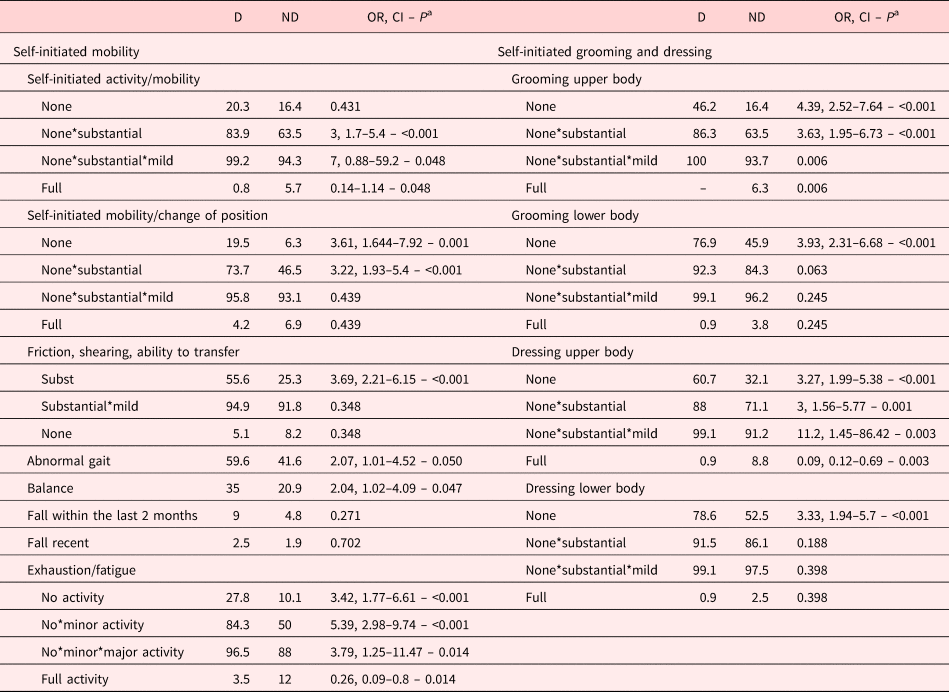
This domain describes self-initiated behavior including activity and mobility, gait, balance and falls, as well as exhaustion and self-initiated grooming and dressing. Generally, delirium caused functional impairment as evidenced by the loss of abilities (Table 2).
ePA-AC items of the mobility domain

D, delirious patients; ND, non-delirious patients; OR, odds ratio; CI, confidence interval.
a Pearson's χ2 test.
Whereas the lack of ability for self-initiated activity or full inactivity was not affected by delirium, at the lower levels of activity impairment — substantial and more (substantial+), as well as mild and more (mild+), or conversely full activity, effects were noted. Delirium was associated with a loss of activity (substantial+ OR 3 and mild+ OR 7) and substantially lower ability for full activity (OR 0.14). With respect to mobility within the bed or change of position, delirium was associated with substantial+ impairment and no activity (OR 3.61 and 3.22). Substantial impairment in the ability to transfer was associated with friction and shearing (OR 3.69).
Further, both abnormal gait and impaired balance were seen more commonly in the delirious (OR 2.07 and 2.04), whereas falls — either recent or prior — were not. In particular, exhaustion or fatigue was documented at any level of activity in the delirious (OR 3.42–5.39), and conversely, full activity appeared to be protective of delirium (OR 0.26).
Delirium affected the abilities of grooming and dressing, and the impairment seen was greater in the upper rather than lower body. For the grooming and dressing of the upper body, any impairment was more common in the delirious (grooming OR 3.63–4.39 and dressing 3–11.2, respectively), whereas full activity was associated with the non-delirious (dressing OR 0.09). For the lower body, no ability was more commonly seen within the delirious (grooming OR 3.93 and dressing 3.33).
Nutrition
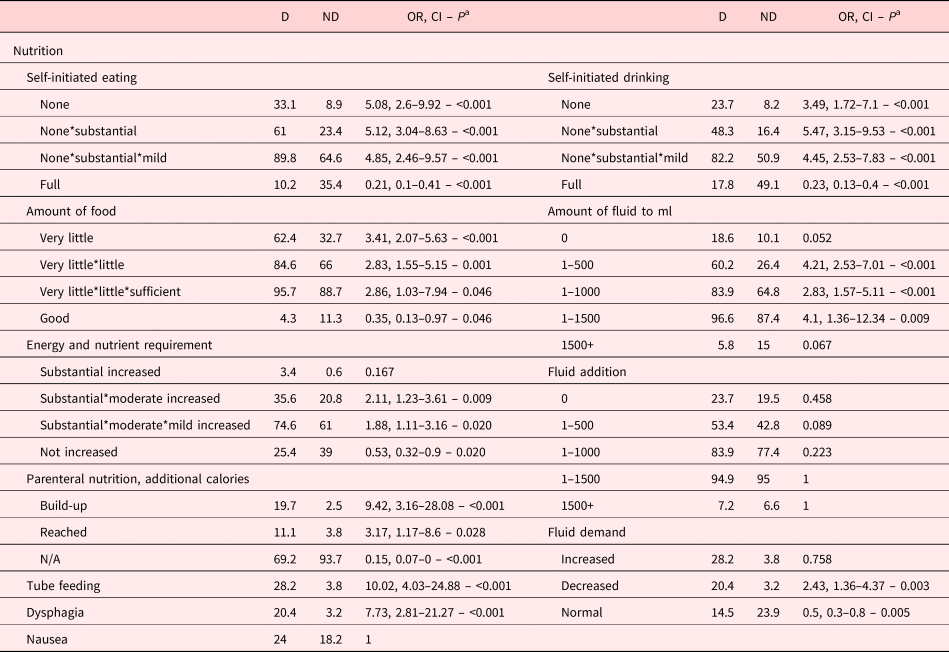
The nutritional domain included self-initiated eating and drinking, energy requirement, the amount of food, fluid, fluid addition, and fluid demand, as well as tube feeding, dysphagia, and nausea. Generally, greater impairment was noted in the delirious (Table 3).
ePA-AC items of the nutritional domain

OR, odds ratio; CI, confidence interval.
a Pearson's χ 2 test.
Any impairment in self-initiated eating and drinking was associated with delirium (eating OR 4.85–5.12 and drinking 3.49–5.47), and conversely, the delirious patients were less commonly able to attend to these activities (OR 0.21–0.23). With respect to the amount of food and fluid intake, a similar pattern emerged. Any reduction in the amount of food was characteristic for the delirious (OR 2.83–3.41), whereas regular portions were rarely noted (OR 0.35). For the amount of fluid intake, any reduction from 1 to 1500 cm3 was also characteristic for the delirious. Generally, the fluid was rather increased in the delirious (OR 2.43) than decreased (OR 0.5); however, the requirement for intravenous fluid addition was similar.
For nutritional requirements, a mild to substantial increase in energy and nutrient requirement was noted in patients with delirium (OR 1.88–2.11), whereas on the contrary the lack of additional energy and nutrients was less common (OR 0.53). Similarly, with respect to parenteral nutrition and additional calories, the delirious were substantially more often in the build-up phase (OR 9.42) or reached their requirement (OR 3.17). Conversely, the lack of requirement for parenteral nutrition was rarely seen (OR 0.15).
Elimination
The domain of elimination describes urination, defecation, elimination urge, urinary catheterization, colonic stoma, and skin humidity, and overall, it was less affected by delirium except for defecation (Table 4).
ePA-AC items of the elimination domain

OR, odds ratio; CI, confidence interval.
a Pearson's χ 2 test.
Neither the abilities for self-initiated urination nor for control urination were affected by delirium; however, most patients — delirious and not — were catheterized. Contrarily, any impairment in self-initiated defecation (OR 2.26–5.29) or ability to control defecation (OR 4.64–6.02) was associated with delirium, whereas full control of these abilities was less common (OR 0.44 and 0.22, respectively). Elimination urge and colonic somatization were rare and not different, as was an increase in skin humidity.
Discussion
Summary of main findings
The patient population in this study was characteristic of a delirious sample: patients were older, more severely ill, stayed longer on the ICU and in the hospital, and returned less frequently home at discharge. The nutritional domain was the most affected by delirium followed by activity and mobility, and last, elimination. The general pattern was a loss of functioning. For the nutritional domain, both self-initiated eating and drinking were impaired, as well as the amount of food and fluid intake. The energy and nutrient requirement, as well as the requirement for parenteral nutrition and additional calories, were increased. Although there was no need for additional fluids, generally, the fluid demand was rather increased. Patients with delirium had more dysphagia and required tube feeding.
For self-initiated mobility, exhaustion and fatigue were the most prominent in the delirious. Mobility was reduced both out of bed and in bed. Furthermore, outside bed an abnormal gait and balance occurred, while in bed substantial impairment in ability to transfer caused friction and shearing. For self-initiated grooming and dressing, the impairment was greater in the upper body. For the elimination domain, urination was not problematic for the delirious, whereas defecation, either self-initiated or ability to control, was.
Comparison to the existing literature
Surprisingly, the literature on functional status in the delirious is rare and studied regular floors rather than the intensive care setting. As summarized in the Introduction, there is vague evidence for activity (Yang et al., Reference Yang, Inouye and Fearing2008), mobility and balance in delirium superimposed on dementia (Gual et al., Reference Gual, Richardson and Davis2019), and nutritional status and nutrients in delirium contribution (Sanford and Flaherty, Reference Sanford and Flaherty2014).
The most comprehensive study to date assessed nursing tools for delirium identification and showed the following domains relevant to this study: Problems with nutrition and elimination, as well as self-care and mobility (Sola-Miravete et al., Reference Sola-Miravete, Lopez and Martinez-Segura2018). This study was performed on elderly patients on regular surgical and medical floors. Although regular floors and intensive care units represent different settings, this study showed similar results. For the nutritional domain, delirious patients required more frequently fluid therapy; for the mobility domain, more frequently rested in bed, as well as the level of self-care and dependence; for the elimination domain, more frequently urinary, fecal incontinence and the use of urinary catheters.
From the univariate model, in that study, delirious patients had more comorbidities (OR 1.88), whereas our intensive care patients were more severely ill as documented by the SAPS. In the self-care domain, regular inpatients featured a medium to high dependency (OR 4.62) or inability of care (OR 8.54), as well as resting in bed, inability to get up (OR 1.5). For the elimination domain, urinary and fecal incontinence were more common (OR 13.5 and 17.1), as well as an increased use of urinary catheters was (OR 2.6). From the more specific multivariate model, the inability to get out of bed (OR 2.51), urinary incontinence (OR 4.25), and the use of urinary catheters (OR 3.9) emerged. Although settings vary and mobility is generally more restricted in the intensive care setting, the level of dependency and mobility were comparable, while on regular floors the inability to care for themselves was greater (OR 8.54 vs. ORs between 2 and 4 on average) and rather met the odds of the multivariate model. In the intensive care setting, most patients were catheterized; thus, urinary incontinence was not relevant, and with respect to fecal incontinence, intensive care patients were less affected by delirium (OR 17.1 vs. OR 4–6). A novelty in this study was the documentation of the decline of full abilities, which reached 50–90%.
Although evidence for activity (Yang et al., Reference Yang, Inouye and Fearing2008), mobility and balance (Gual et al., Reference Gual, Richardson and Davis2019), as well as nutritional status and nutrients (Sanford and Flaherty, Reference Sanford and Flaherty2014) is vague on regular floors, this study confirmed gait and balance disturbances as well as nutritional aspects. Regarding the former, we have to assume that delirium caused gait and balance disturbances, and for latter, the energy and nutrient requirement, as well as parenteral nutrition and additional calories were increased. Another considerable aspect was the lack of discrimination of the level of attribution of the common underlying causes the severity of illness and delirium to the functional domains: nutrition, mobility, and elimination.
Implications of this study
Beyond confirming previous results of the impact of delirium on the level of functioning (Sola-Miravete et al., Reference Sola-Miravete, Lopez and Martinez-Segura2018), numerous new aspects of functional impairment have been elucidated in this study. This study helps to better understand delirium in the intensive care setting and could aid in profiling patients at risk for delirium and direct interventions.
Functional impairment regarding actions of daily living (grooming and dressing) might embody apraxia since motor planning and task performance require skills of high-order thinking, which are disturbed during delirium (Baranowski and Patten, Reference Baranowski and Patten2000). Understanding functional impairment as the type of apraxia seems conclusive and implicates that screening for apraxia might warrant new possible diagnostics for delirium. Naturally, delirium and the severity of illness are inseparable (Voyer et al., Reference Voyer, McCusker and Cole2007); however, the assumption has to be made that delirium superimposes functional impairment on dysfunction and addressing these impairments could aid the patient. For example, a common intervention, the early mobilization of patients, has been shown to reduce the incidence of delirium (Brummel and Girard, Reference Brummel and Girard2013). Similarly, risk reduction and management guidelines also outline early mobilization, maintaining optimal hydration and nutrition, as well as regulation of bowel and bladder function (Scottish Intercollegiate Guidelines Network (SIGN), 2019). Thus, known interventions attempt to target specific impairments shown in this study. Within the described remaining functional impairments, further modifiable factors could be identified as possible dimensional delirium symptom patterns across interdisciplinary settings.
Strengths and limitations
Although this study has numerous strengths including the comprehensive daily nursing assessment with the ePA-AC, delirium determined with the gold standard, at that time DSM-IV-TR, by psychiatrists and the inclusion of a sizable patient sample, few limitations have to be noted. Both delirium and severe illness cause functional impairment, and it was not possible to truly separate their effects. Although patients were daily screened for eligibility, enrollment was not consecutive, rather depended on the ability of patients to participate in the psychiatric assessment. Thus, a potential bias to those able to engage in the interview was created, excluding those with limited communication abilities, i.e., the more delirious, and over representing the less delirious and non-delirious.
The design did not allow for the assessment of premorbid cognitive impairment, which was only screened for by chart review. Mostly cardiovascular surgery patients notable for high delirium risk were included and the generalizability to other intensive care settings could be limited. Furthermore, the design was cross-sectional, so it is necessary to replicate these findings in a longitudinal study capturing the incidence and resolution of delirium.
This analysis only included the ePA-AC domains of activity, grooming and dressing, nutrition, and elimination. The remaining domains such as cognition and consciousness, communication and interaction, sleep, respiration, pain, and wounds still have to be evaluated.
Conclusion
Delirium was associated with substantial functional impairments in the nutritional, activity–mobility, and elimination domain. Characterizing these impairments allows a better understanding of their dimensional prevalence in delirium in the cardiovascular intensive care setting. Moreover, these findings will facilitate developing adapted risk and treatment profiles that target the underlying risk constellations in medical and nursing procedures in the future. Furthermore, these results can contribute to future studies investigating the co-occurrence and relatedness of possible dimensional delirium symptom patterns across a wider range of interdisciplinary settings. Since the ePA-AC is usually obtained via nurses, our findings strengthen the position of nursing in the process of delirium diagnosis and management. We suggest to pay attention if nursing is adequately integrated into the process of delirium diagnosis. By simplified identification of dimensional delirium symptoms, the disseminated application of the ePA-AC may eventually help clinicians and nurses to improve the quality of life in patients.
Conflicts of interest
There are no conflicts of interest.