Introduction
Active Ageing is a contemporary theoretical concept introduced by the World Health Organization (WHO) and derived based on the Activity Theory of Ageing (Lemon, Bengtson and Peterson Reference Lemon, Bengtson and Peterson1972). The term ‘Active Ageing’ is often used interchangeably with similar definitive terms regarding ageing well, but Active Ageing may be conceptually distinct from these terms (Boudiny Reference Boudiny2013; Paul, Ribeiro and Teixeira Reference Paul, Ribeiro and Teixeira2012). The Active Ageing concept is now used to guide policy for the ageing Singaporean population and is measured for this purpose using the Active Ageing Index (AAI; Thanakwang and Soonthorndhada Reference Thanakwang and Soonthorndhada2006). However, the existence of any relationship between the AAI and actual activity level has not been established, although activity participation is crucial in Active Ageing. Similarly, the connection between Spirituality and Active Ageing has not been explored empirically even though it is theoretically included within the Active Ageing framework (Buys and Miller Reference Buys and Miller2006). Furthermore, as age and ethnicity are influential on activity level and quality of life (Chen and Fu Reference Chen and Fu2008; Thumboo et al. Reference Thumboo, Fong, Machin, Chan, Soh, Leong, Feng, Thio and Boey2003; Tuna et al. Reference Tuna, Edeer, Malkoc and Aksakoglu2009), these might affect how one is ageing actively as well. Therefore, validation of the AAI would address the theoretical issue by further substantiating the Active Ageing concept so that the AAI could be used to assess the state of Active Ageing among ageing populations and to address the knowledge gaps regarding spirituality, age and ethnicity in relation to the AAI.
Conceptual similarities and differences of Active Ageing
WHO defines Active Ageing as ‘the process of optimizing opportunities for health, participation and security in order to enhance quality of life as people age’ (WHO 2002: 12). Together with other terms to describe the process of ageing well, such as ‘Healthy Ageing’, ‘Successful Ageing’, ‘Productive Ageing’ and ‘Positive Ageing’, these terms stem from the Activity Theory of Ageing (Lemon, Bengtson and Peterson Reference Lemon, Bengtson and Peterson1972; WHO Reference Walker2002), where there is a positive relationship between activities and life satisfaction in later life (Davey and Glasgow Reference Davey and Glasgow2006). Activity Theory posits that with higher frequency of activities, older adults enjoy better life satisfaction and, thus, greater wellbeing (Menec Reference Menec2003). In contrast, Disengagement Theory (Cumming and Henry Reference Cumming and Henry1961) posits that older adults withdraw from activities in order to retain a sense of self-worth and this voluntary passiveness benefits both the individual and the society (Diggs Reference Diggs, Loue and Sajatovic2008).
The various names used for theories of ageing well all highlight the importance of staying actively engaged in old age (Davey and Glasgow Reference Davey and Glasgow2006) but an important conceptual difference differentiates Active Ageing from these other terms. Healthy Ageing tends to focus on the absence and prevention of illnesses and diseases to allow older people to continue to be active members of society and to enjoy independence and quality of life (Fernandez-Ballesteros et al. Reference Fernandez-Ballesteros, Robine, Walker and Kalache2013; Hansen-Kyle Reference Hansen-Kyle2005; Oxley Reference Oxley2009). However, this conceptualisation of Healthy Ageing has been criticised as being superficial, with emphasis solely on the preventive actions and use of medical interventions to alleviate health issues related to ageing (Davey and Glasgow Reference Davey and Glasgow2006; Oxley Reference Oxley2009; Walker Reference Walker2015). Productive Ageing predominantly looks at both paid and unpaid productive labour activities that older adults engage in during later life (Murphy Reference Murphy2011), again being a limited model as it considers the ageing process in instrumental and economic terms (Walker Reference Walker2015).
Successful Ageing is the ‘low probability of disease and disease-related disability, high cognitive and physical functional capacity and active engagement with life’ (Rowe and Kahn Reference Rowe and Kahn1997: 433). Although used interchangeably at times with Active Ageing in literature – the Successful Ageing concept is used more frequently to describe ageing well in the United States of America (USA) while Active Ageing is used in Europe (Foster and Walker Reference Foster and Walker2015; Walker Reference Walker2015); both concepts describe the ageing process in a broad and multifaceted manner (Fernandez-Ballesteros et al. Reference Fernandez-Ballesteros, Robine, Walker and Kalache2013; Paul, Ribeiro and Teixeira Reference Paul, Ribeiro and Teixeira2012) and stress that older adults should be actively engaged in life (Boudiny Reference Boudiny2013; Walker Reference Walker2015). However, there is also a key conceptual difference between the two terms, where Successful Ageing tends to focus on the absence of diseases and disabilities in order to be actively engaged in life while Active Ageing acknowledges the active contributions of ageing people in the community even with the presence of diseases and disabilities (Boudiny Reference Boudiny2013; Paul, Ribeiro and Teixeira Reference Paul, Ribeiro and Teixeira2012; Fernandez-Ballesteros et al. Reference Fernandez-Ballesteros, Robine, Walker and Kalache2013).
Importantly, Active Ageing looks at ageing from the lifecourse perspective where it recognises that the ageing process is not homogenous and that different preventive measures to stay active and healthy should be adopted in different life stages, which is usually not emphasised in Successful Ageing (Stowe and Cooney Reference Stowe and Cooney2015; WHO 2002). Furthermore, the semantic meaning of ‘successful’ could be perceived as holding connotations that there are winners and losers in the ageing process, whereas Active Ageing is inclusive of older adults with illness or disability (Foster and Walker Reference Foster and Walker2015; Walker Reference Walker2015). Likewise, Positive Ageing, which is in more common usage in Australia and New Zealand, stresses the importance of physical, intellectual, emotional and spiritual wellbeing, taking into consideration psychological adjustment, autonomy and the rights of older adults to age well (Diggs Reference Diggs, Loue and Sajatovic2008). However, the term ‘positive’ could be perceived as implying ageing is a ‘negative’ to be overcome (Diggs Reference Diggs, Loue and Sajatovic2008; Walker Reference Walker2015).
Boudiny (Reference Boudiny2013) recently noted it is the multifactorial nature of the Active Ageing concept that lessens its focus on physical health and ‘employability’, and highlights instead the engagement with life in general. Although the Active Ageing concept started with the emphasis of being active in order to maintain health and productivity (Walker Reference Walker2015), this model advocates that older adults have the rights to retain their autonomy to make personal daily decisions, remain independent and not compromise their quality of life (Paul, Ribeiro and Teixeira Reference Paul, Ribeiro and Teixeira2012; WHO Reference Walker2002). Thus, older people are seen as active contributors in every aspect of their lives, to people and communities around them, even if they are not active in the labour force and encouraged to maximise activity participation in varied areas of interests (Arifin, Braun and Hogervorst Reference Arifin, Braun and Hogervorst2012; WHO 2002).
Active Ageing in Singapore and the AAI
The Active Ageing concept is adopted at the policy level to encourage the benefits of an active lifestyle among older people in Singapore (Ministry of Community Development, Youth and Sports (MCYS) 2008). Despite being a relatively young nation, Singapore's ageing population (aged 65 and above) is growing rapidly, increasing from 7.8 per cent in 2002 to 12.4 per cent in 2014 (National Population and Talent Division 2014) and is projected to increase to 18.7 per cent by the year 2030 (Committee on Ageing Issues 2006). With the aim of promoting Active Ageing, various local community-based organisations such as the Council for Third Age and the People's Association have been established to provide an avenue for older Singaporeans to engage through activity programmes.
Amid these efforts to promote Active Ageing, the Singapore Institute of Policy Studies (IPS) used the AAI (Thanakwang and Soonthorndhada Reference Thanakwang and Soonthorndhada2006) to measure the Active Ageing level of Singaporeans who were 55 years old and above in Singapore and examined the Active Ageing level (MCYS 2008). Although the official age of classification as an older person is 65 years old and above (Singapore Department of Statistics 2007), the study included Singaporeans who were between 55 and 64 years old because they were perceived as the incoming batch of elderly into the ageing population (MCYS 2005, 2008). Results from the study found that these Singaporeans were ‘moderately’ ageing actively (MCYS 2008).
The IPS study was the first to measure Active Ageing in Singapore, using AAI. The AAI reflects the multifactorial nature of Active Ageing (Boudiny Reference Boudiny2013), consisting of three components: Health, Community Participation and Security. Health consists of six indicators: self-assessed health, psychological wellbeing, disabilities, limitations in activities of daily living (ADLs), functional limitations and exercise behaviours. Community participation has three indicators: participation in workforce, interaction with family members and participation in clubs/groups. Security has six indicators: income, sufficiency of income, sources of income, home ownership, living arrangement and safety facilities, giving the AAI a total of 15 indicators (Thanakwang and Soonthorndhada Reference Thanakwang and Soonthorndhada2006). Two indicators, disabilities and safety facilities, were removed in the Singaporean IPS study due to the absence of existing data that could match the indicators (MCYS 2008).
However, the validity of the AAI was not established in the IPS study and no attempt was made to examine if the AAI was actually associated with, or could predict, the activity level of older persons. Being active and involved are conceptually central to Active Ageing and this link between the AAI and actual activity levels needs to be empirically established. Should AAI predict activity level, it would be a valuable instrument to help monitor the Active Ageing level among older persons and assess the utility of policy and service changes being implemented to encourage Active Ageing in Singapore and elsewhere.
Active Ageing and spirituality
The Active Ageing concept also encourages older persons to be active in the spiritual aspect of their lives (Buys and Miller Reference Buys and Miller2006). Spirituality is defined as the search for meaning and purpose in an individual's life, unlike religiosity, which is the practice of beliefs, worship and rituals (Moxey et al. Reference Moxey, McEvoy, Bowe and Attia2011). This was not specifically measured by the AAI, and there is little research associating spirituality with Active Ageing, aside from Buys and Miller (Reference Buys and Miller2006), who specifically asked about spirituality in their qualitative study of Active Ageing. Spirituality has, however, been linked to Successful Ageing (Crowther et al. Reference Crowther, Parker, Achenbaum, Larimore and Koenig2002) and a positive health influence from spirituality has been identified, where spirituality is positively associated with social support, emotional health, and lower levels of mortality and hypertension among older persons (Kirby, Coleman and Daley Reference Kirby, Coleman and Daley2004; Koenig, George and Titus Reference Koenig, George and Titus2004; Moxey et al. Reference Moxey, McEvoy, Bowe and Attia2011). If spirituality is associated with Active Ageing, then the addition of the construct to the AAI should increase the utility of the AAI.
Effects of age and ethnicity on Active Ageing
Chronological age-related changes also affect activity level in older persons and age has been shown to be the most significant factor predicting the type, variety and level of social and physical activity engaged in. Research evidence clearly shows that individuals aged 90 and above performed less social and physical activity than those aged between 60 and 90 years (Horgas, Wilms and Baltes Reference Horgas, Wilms and Baltes1998; Johannsen et al. Reference Johannsen, DeLany, Frisard, Welsch, Rowley, Fang, Jazwinski and Ravussin2008). This was likely due to the decrease in physical health functioning when one grows older (Chen and Fu Reference Chen and Fu2008; Tuna et al. Reference Tuna, Edeer, Malkoc and Aksakoglu2009). Conversely, a study of Taiwanese elders found that participants in their seventies engaged in more physical activities, and enjoyed activities more, than those in their sixties (Chen and Fu Reference Chen and Fu2008). Therefore, chronological age is an important consideration in the measurement of Active Ageing. It is crucial to determine whether the AAI actually measures anything beyond chronological age.
As a multi-ethnic country, ethnic differences in health-related quality of life have been observed in a local study, suggesting Chinese-Singaporeans experience the highest health-related quality of life, followed by Malay-Singaporeans then Indian-Singaporeans (Thumboo et al. Reference Thumboo, Fong, Machin, Chan, Soh, Leong, Feng, Thio and Boey2003), yet no research has examined the influence of these ethnicities on Active Ageing levels. Moreover, differences in activity levels among older persons of varying ethnicities within the USA have been reported (Dergance et al. Reference Dergance, Mouton, Lichtenstein and Hazuda2005; He and Baker Reference He and Baker2005; Hughes, McDowell and Brody Reference Hughes, McDowell and Brody2008). As AAI is about being active and engaged, it is probable that ethnic differences in Active Ageing would replicate the pattern found among Singaporeans for quality of life.
Hypotheses
This present study will firstly attempt to validate the relationship between Active Ageing, as measured by the AAI, and investigate to what extent it is associated with, or predictive of, cognitive, physical and social activity levels of older persons and, additionally, whether spirituality improves the predictive power of the AAI with regards to actual activity levels of older persons. Additionally, effects of age and ethnicity on Active Ageing will be explored. We hypothesise that (a) the AAI predicts the activity level of older persons; (b) spirituality improves the predictive power of the AAI; (c) age differences would be observed where those younger in chronological age would have higher Active Ageing levels than older ones; and (d) ethnic differences in Active Ageing levels would be consistent with the quality of life data (Thumboo et al. Reference Thumboo, Fong, Machin, Chan, Soh, Leong, Feng, Thio and Boey2003), thus Chinese would be the most active ethnic group, followed by Malays and then Indians.
Method
Participants
A total of 120 Chinese, Malay and Indian older persons participated, aged from 55 to 93 years (mean = 65.86, standard deviation (SD) = 8.05) and were classified into a group aged 55–64 years (n = 58) and a group aged 65 years and above (n = 62). Sample size and cell size were based on a priori power and effect size calculation. Participants were purposively sampled from personal networks and neighbourhood locations around Singapore that older persons frequently visit. Examples of these locations include, but were not limited to, common areas in public housing, food centres, community centres and seniors’ activity centres. Participants were recruited until equal numbers of males and females (n = 60 for each) of each ethnicity (n = 40 per group) within each age group were obtained.
Materials
AAI
The current study reconstructed the 13 indicators and their respective measurement scales used in the 2008 study (MCYS 2008) but used a modified measure of income within the security index where participants rated themselves as having no income, low income, average income or high income.
To obtain the AAI scores, the raw scores were first transformed into composite scores using the formula cited in Thanakwang and Soonthorndhada (Reference Thanakwang and Soonthorndhada2006: 118), whereby component indices fall between 0 and 1, with equal variance across the indicators. The average of the sum of the component indices is the AAI scores. AAI scores less than 0.5 are considered a low level of Active Ageing; scores between 0.5 and 0.79 are considered a moderate level of Active Ageing; and AAI scores of 0.8 or above are considered a high level of Active Ageing. The Cronbach's α of the AAI in this study was 0.62 which is acceptable considering the diversity of constructs measured by the AAI.
Spirituality Index of Well-Being (SIWB)
The SIWB has 12 items that measure spirituality as a separate construct from religiosity (Frey, Daaleman and Peyton Reference Frey, Daaleman and Peyton2005). Spirituality in the SIWB consists of two dimensions: Life Scheme and Self-efficacy. Life scheme is the ability to view life as meaningful and self-efficacy is the ability to create goals and overcome obstacles in life (Frey, Daaleman and Peyton Reference Frey, Daaleman and Peyton2005). An abbreviated version was used in this study, as the purpose was to add a brief measure to the AAI. Four SIWB items were selected (two items each from the Life Scheme and Self-efficacy components), based on the strongest reliability loadings on the full SIWB. The SIWB has good internal consistency with Cronbach's α = 0.91 (Daaleman and Frey Reference Daaleman and Frey2004).
Activity level
A questionnaire from the study by Verghese et al. (Reference Verghese, Lipton, Katz, Hall, Derby, Kuslansky, Ambrose, Sliwinski and Buschke2003) measured cognitive, physical and social activities. Cognitive activity was based on the frequency of 13 activities, rated on a five-point Likert scale (1 = ‘not at all’ to 5 = ‘everyday or almost everyday’). Some examples of the 13 activities listed included listening to music, reading a magazine, watching movies, and being able to speak or read a second language. An additional point was given for each new cognitive activity learnt after 55 years old. The total cognitive activity score range was from 13 (minimum) to 70 (maximum). The total mean score was 38.3 (SD = 9.6). Physical activity was based on the duration (minutes per month) and frequency of the eight physical activities performed (e.g. jogging, dancing, swimming and aerobics exercises). On average, participants spent 471.2 minutes (SD = 811.8) per month on physical activities. Social activity was based on the frequency and number of social meetings with friends and relatives, and if they have anyone to confide in. The total mean social activity score was 12.6 (SD = 9.6). All scores from the cognitive, physical and social activity measures were transformed to z-scores and the sum of the z-scores for cognitive, physical and social activities provided the total activity level score.
Demographic questions about age, gender, ethnicity, marital status, education level, housing type and employment status were included. The first author translated the questionnaire from English to Mandarin and two independent translators translated it into Tamil and Malay. The translated versions of the questionnaire were back-translated by another three independent translators into English. The second author subsequently compared the translated and back-translated versions of the questionnaire to examine the accuracy of the translations. The resulting versions were considered ‘close’ but not ‘literal’ translations, which is ideal for this type of measure (Harkness and Schoua-Glusberg Reference Harkness, Schoua-Glusberg and Umfragen1998).
Procedure
Approval of the James Cook University Human Research Ethics Committee was obtained prior to any data collection. Researchers would approach participants to obtain their permission to complete the questionnaire. If the participants agreed, they were free to choose to: (a) self-complete the questionnaire; (b) request the researchers read the questions and options but they self-indicate their answers on a separate answer sheet; (c) request the researchers read the questions and options, and record the participant's verbal answers on their behalf. Participants who were literate chose to complete the questionnaire on their own, while illiterate participants asked the researchers to read the questions and options and to record their verbal answers on the questionnaire. The process took approximately 15 minutes. Each questionnaire was placed in a sealed envelope upon completion to ensure the maintenance of anonymity for the participants. No incentives were offered.
Results
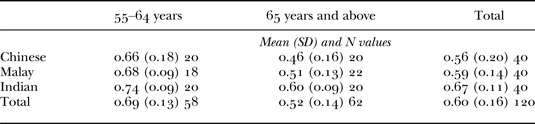
Demographically, most (79.2%) of the participants were married, had completed at least some secondary education (60.8%), were living in three- or four-room social housing (55%) and were working full-time or part-time (54.1%). Two-thirds (67.5%) of participants scored a moderate level of Active Ageing (AAI scores between 0.5 and 0.79), with 15 per cent scoring high (0.8 and above) and the remaining 17.5 per cent scoring a low level of Active Ageing (below 0.5). The means and standard deviations of AAI scores across ethnicity and age group are presented in Table 1.
Means and standard deviations (SD) of Active Ageing Index scores for age group and ethnicity

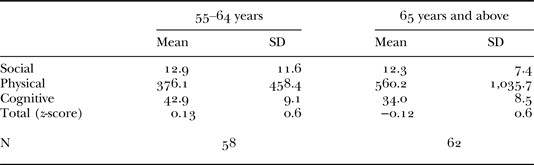
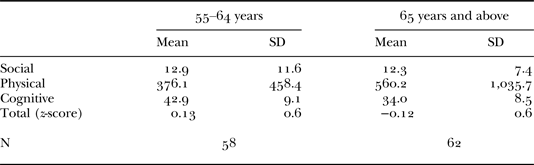
An independent samples t-test found significant differences between mean z-scores of the total activity levels of those aged 55–64 (mean = 0.13, SD = 0.57) compared with those aged 65 and above (mean = −0.12, SD = 0.60), t(118) = 2.32, p = 0.02. However, across the three types of activities, a significant mean difference was only found for cognitive activities (55–64: mean = 42.9, SD = 9.1; 65 and above: mean = 34.0, SD = 8.5); t(118) = 5.6, p < 0.001. Table 2 shows that the mean scores of activity levels for the group aged 55–64 were higher than those of the group aged 65 and above.
Means and standard deviations (SD) of activity levels between age groups
A two-way between-groups Analysis of Variance (ANOVA) was performed to assess differences in age (those aged 55–64 versus 65 and above) and ethnicity (Chinese, Malay, Indian) on AAI scores. No significant interaction effect between age and ethnicity was found, F(2, 114) = 0.63, p = 0.54. The main effect of age was significant, F(1, 114) = 49.2, p < 0.001, η = 0.30, with the mean AAI scores of the group aged 55–64 (mean = 0.72, SD = 0.14) being significantly higher than the 65 and above group (mean = 0.55, SD = 0.15). There was also a significant main effect of ethnicity, F(2, 114) = 7.6, p = 0.001, η = 0.12. Post-hoc Tukey's HSD tests showed that the mean AAI scores of the Indian participants were significantly higher than the Chinese (p < 0.001) and Malay (p = 0.013) participants, while the mean AAI scores between the Chinese and Malay participants were not significantly different.
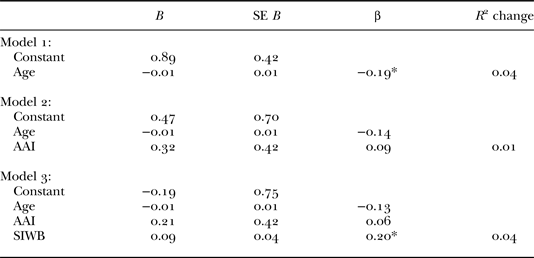
Hierarchical multiple regression was performed to analyse the predictive power of the AAI and SIWB scores as predictors for total activity level as the criterion. Given the main effect for age found in the ANOVA, and a high correlation of AAI scores and age (r = −0.59, p < 0.001), age was controlled for in the first step, followed by AAI entered in the second step and SIWB-measured spirituality in the third step. Preliminary analyses showed that the data complied with the assumptions of normality, linearity, homoscedasticity and absence of multicollinearity. Age explained a small but significant proportion of variance (3.7%) of total activity scores, R 2 = 0.04, F(1, 118) = 4.6, p = 0.04 (see Table 2). In Model 2, controlling for age, the AAI did not significantly predict activities, R 2 change = 0.01, F(2, 117) = 2.6, p = 0.08. In Model 3, controlling for age, the AAI and SIWB predicted a significant although small total proportion of variance (8.1%) of total activity scores, R 2 = 0.08, F(3, 116) = 3.4, p = 0.02. In this model, only the SIWB had a significant beta weight (see Table 3).
Hierarchical multiple regression analysis of Active Ageing Index (AAI) and Spirituality Index of Well-Being (SIWB) scores as predictors of total activity level

Note: SE: standard error.
Significance level: * p < 0.05.
For the specific domains of activity (physical, social and cognitive) analysed separately, Model 3 did not significantly predict physical or social activity, however, Model 3 (age, AAI, SIWB) predicted a significant proportion of variance (24.4%) in cognitive activities score, R 2 = 0.24, F(3, 116) = 12.5, p < 0.001 (results not shown).
Discussion
Our first hypothesis was not confirmed: the AAI alone did not predict the activity level of participants and thus did not support the validity of the AAI. However, the second hypothesis was supported, with the predictive power of the AAI being improved with the addition of spirituality (represented by SIWB) into the model. The third hypothesis was also supported, with age differences detected in Active Ageing, where 55–64-year-old participants had higher AAI scores than participants aged 65 and above. Moreover, the 65 and above group appeared to be less active (across all three activity types and total activity level) than those aged 55–64, and particularly so in cognitive activities. The fourth hypothesis was partially supported: significant differences in AAI scores between ethnicities were detected but contrary to our hypothesis, Indians participants had higher scores than the other two ethnic groups. These results strongly suggest that Active Ageing remains an insufficiently defined concept and more empirical evidence is needed to develop a model of the construct. The high correlation of age with AAI scores in this study meant that the existing model of AAI did not make much contribution beyond simply measuring age as a predictor of activity participation.
In contrast, the measurement of spirituality seems to make a unique contribution, and is perhaps related to the idea of being ‘engaged with life’ (Buys and Miller Reference Buys and Miller2006) that is central to the construct of Active Ageing. It is possible that spirituality offers a sense of control or purpose in one's life (Konopack and McAuley Reference Konopack and McAuley2012). This possibility is consistent with Tornstam's Theory of Gerotranscendence (Jewell Reference Jewell2014), in that the later life period is a time where there is a renewed understanding of the relationships between activities, self and others; where one would become less individualistic, with reduced interest in material things but increased awareness on how one could contribute to society to bring about life satisfaction (Jewell Reference Jewell2014; Kruse Reference Kruse2012; Lewin Reference Lewin2001). Individuals who are more spiritual may have greater motivation to make meaning of their lives (Kruse Reference Kruse2012; Ramsey Reference Ramsey2012). Thus, participants who are higher in spirituality might seek out and participate in activities to contribute to society and in doing so, maintain their own quality of life. This has important implications for the theoretical conceptualisation of Active Ageing, not only supporting the idea that participation is an essential element of Active Ageing, but further, that the concept does not just encompass the quantity of participation but also about the quality and meaning of the activities that keep older adults engaged with life (Boudiny Reference Boudiny2013; Buys and Miller Reference Buys and Miller2006).
The AAI, with spirituality included, predicted levels of cognitive activity specifically, rather than physical and social activities. This might be a reflection of the importance of cognition in planning and carrying out activities; preserving cognitive function could help maintain autonomy, and consequent level of engagement of the older person, which is the essential component of Active Ageing. A post-hoc examination of the data distributions suggested that there was much greater variability of the distribution of cognitive activity than social or physical activity. One possibility was that older people were aware of the importance of maintaining levels of cognitive activity, but not as aware of the importance of physical or social activity in reducing the risk of dementia, an interpretation which is consistent with data from Australia showing that people were more aware of the importance of cognitive activity than physical or social activity in preventing dementia (Low and Anstey Reference Low and Anstey2009).
Furthermore, cognitive activities might be under greater control of the individual, thus contributing to the greater variability, compared to social and physical activities which might be organised for older people. This is consistent with the findings from Verghese et al. (Reference Verghese, Lipton, Katz, Hall, Derby, Kuslansky, Ambrose, Sliwinski and Buschke2003), that participation in cognitive activity was associated with decreased risk of development of dementia, whereas no such effect was found for physical activity. In addition, greater individualistic control over the cognitive activities could also mean that participants were able to use these activities to make meaning of their lives which could account for the reason behind the predictive power of AAI, with spirituality, on cognitive activity level.
The effect of age is unsurprising, given the extant data on the association of age and activity (Horgas, Wilms and Baltes Reference Horgas, Wilms and Baltes1998; Verghese et al. Reference Verghese, Lipton, Katz, Hall, Derby, Kuslansky, Ambrose, Sliwinski and Buschke2003). However, the possibility of physical frailty limiting the Active Ageing of older people must be considered. Nonetheless, it would still be beneficial to encourage older people to participate in activities even in later life because activity participation encourages survival and improves life expectancy (Agahi, Silverstein and Parker Reference Agahi, Silverstein and Parker2011).
There is no clear theoretical or empirical basis for interpreting the finding that the Indian participants were the ethnicity with highest AAI scores, particularly as the purposive sampling was non-random, meaning that a host of unidentified factors could contribute to this result. Although there are no previous studies specifically comparing levels of Active Ageing between ethnicities within Singapore, AAI scores were associated with education level in Thailand (Thanakwang and Soonthorndhada Reference Thanakwang and Soonthorndhada2006) and one study of health-related quality of life in Singapore showed socio-economic status to be a mediating factor (Thumboo et al. Reference Thumboo, Fong, Machin, Chan, Soh, Leong, Feng, Thio and Boey2003). Across all age groups, Indians are more highly educated than other ethnic groups in Singapore (Singapore Department of Statistics 2010). Nevertheless, there were no differences between ethnic groups in level of education in the present study.
Limitations and future directions
Some limitations of this study must be acknowledged, meaning that these results should be interpreted with caution. The sample size used in the study to validate the AAI was relatively small, but was based on calculation of the power of the study to detect significant effects in the data. However, the non-random sampling method presents a limitation to the external generalisability of results. Importantly, some of our sampling locations, such as food centres and common areas in public housing, are frequented by older people of limited resources who may be otherwise isolated. Ideally, future research could address this by obtaining a truly random sample, or by ensuring that all elements of the population of interest are representatively sampled, for example proportionately including older adults who are isolated. The self-report methodology could also allow the possibility of social desirability affecting the data. Despite the significant results, only four items of SIWB were used to limit test fatigue. Yet, it could have weakened the reliability of the results. Therefore, future studies could replicate the current study with a larger and representative sample, target the isolated older adults, administer the full SIWB and further explore the link between Active Ageing and spirituality, specifically exploring the mechanism whereby spirituality encourages older adults to age actively.
From a theoretical viewpoint, this study seeks to contribute to the developing consensus on the meaning and operationalisation of Active Ageing (Boudiny Reference Boudiny2013). The study linked spirituality with Active Ageing and demonstrated the importance of spirituality in the Active Ageing concept empirically. In doing so, we demonstrate the importance of the element of engagement with life that is central to the theoretical model of Active Ageing but also highlight the importance of the personal meaning found in such engagement.
However, this is also a very practical study with real-world implications. The empirical results from this study could give insights to the kind of the activities that should be introduced to encourage and promote Active Ageing to the older adults where the quality of the activities could be more beneficial to the older adults, particularly, engaging them to make meaning of their lives. Thus, policy makers and eldercare-related agencies could introduce Active Ageing programmes of such a nature.
It also seems that different countries in the world have endorsed the Active Ageing concept to drive and evaluate their ageing-related policies for the older adults, not just in Singapore (Du and Yang Reference Du and Yang2010; Lin, Chen and Cheng Reference Lin, Chen and Cheng2014; Tomasik and Silbereisen Reference Tomasik and Silbereisen2014; Vertejee and Karamali Reference Vertejee and Karamali2014). It would be advantageous to have a common assessment tool to gauge the level of Active Ageing in the various countries, and at the policy-making level, each country could compare with one another to see how well their older adults are ageing actively. Should the AAI be validated, it could be the assessment tool used to measure Active Ageing. Furthermore, eldercare-related organisations in each country could use the AAI to monitor Active Ageing as a guide to service provision for older people. It is therefore important that the AAI continues to develop and improve, including the incorporation of additional components such as spirituality where research evidence suggests such additions may improve the utility of the AAI.
Acknowledgements
The authors would like to thank Dhevani Ramachandran and Donna Claire David for their contributions to the research, including translation of the questionnaires and data collection. The authors would also like to thank the volunteers who back-translated the questionnaire. No funding was provided for this study. Both the authors have provided substantial contributions to the conception, design, analysis and data interpretation, and have shared the writing of this article. There was no conflict of interest. Approval for this research was obtained from the James Cook University Human Research Ethics Committee (approval number H4832).