




No CrossRef data available.
Article contents
Comorbidity: Cognition and biology count!
Published online by Cambridge University Press: 29 June 2010
Abstract
We agree with Cramer et al. that pure cases of behavioral disorders with no symptom overlaps are rare. However, we argue that disorders do exist and the network idea is limited and limiting. Networks of symptoms are observed mainly at behavioral levels. The core deficit is commonly at the cognitive or brain levels, and there the story is completely different.
Information
- Type
- Open Peer Commentary
- Information
- Copyright
- Copyright © Cambridge University Press 2010
References
American Psychiatric Association (APA). (1994) Diagnostic and statistical manual of mental disorders, 4th edition, (DSM-IV). American Psychiatric Association/APA Books.Google Scholar
Barkley, R. A. (1997) Behavioral inhibition, sustained attention, and executive function: Constructing a unified theory of ADHD. Psychological Bulletin
121:65–94.CrossRefGoogle Scholar
Bush, G. (2010) Attention-deficit/hyperactivity disorder and attention networks. Neuropsychopharmacology
35:278–300.CrossRefGoogle ScholarPubMed
Cantlon, J. F., Platt, M. L. & Brannon, E. M. (2009) Beyond the number domain. Trends in Cognitive Sciences
13:83–91.CrossRefGoogle ScholarPubMed
Castellanos, F. X., Sonuga-Barke, E. J. S., Milham, M. P. & Tannock, R. (2006) Characterizing cognition in ADHD: Beyond executive dysfunction. Trends in Cognitive Sciences
10:117–23.CrossRefGoogle ScholarPubMed
Cohen Kadosh, R., Cohen Kadosh, K., Schuhmann, T., Kaas, A., Goebel, R., Henik, A., & Sack, A. T. (2007) Virtual dyscalculia induced by parietal-lobe TMS impairs automatic magnitude processing: A combined fMRI and neuronavigated TMS study. Current Biology
17:689–93.CrossRefGoogle Scholar
Dehaene, S. (2009) Origins of mathematical intuitions: The case of arithmetic. Annals of the New York Academy of Sciences
1156:232–59.CrossRefGoogle ScholarPubMed
Eger, E., Sterzer, P., Russ, M. O., Giraud, A. L. & Kleinschmidt, A. (2003) A supramodal number representation in human intraparietal cortex. Neuron
37:719–25.CrossRefGoogle ScholarPubMed
Frith, U. (2001) What framework should we use for understanding developmental disorders?
Developmental Neuropsychology
20:555–63.CrossRefGoogle ScholarPubMed
Holloway, I. D. & Ansari, D. (in press) Developmental specialization in the right intraparietal sulcus for the abstract representation of numerical magnitude. Journal of Cognitive Neuroscience. (Epub ahead of print: November 23, 2009.).Google Scholar
Isaacs, E. B., Edmonds, C. J., Lucas, A. & Gadian, D. G. (2001) Calculation difficulties in children of very low birthweight: A neural correlate. Brain
124:1701–07.CrossRefGoogle ScholarPubMed
Karmiloff-Smith, A. (2006) The tortuous route from genes to behavior: A neuroconstructivist approach. Cognitive, Affective, and Behavioral Neuroscience
1:9–17.CrossRefGoogle Scholar
Kaufmann, L., Vogel, S., Starke, M., Kremser, C., Schocke, M. & Wood, G. (in press) Neural correlates of number processing in developmental dyscalculia: Evidence from fMRI. Cognitive Development.Google Scholar
Kucian, K., Leoenneker, T., Dietrich, T., Dosch, M., Martin, E. & von Aster, M., (2006) Impaired neural networks for approximate calculation in dyscalculic children: A functional MRI study. Behavioral and Brain Functions
5:31. [Online journal. DOI: 10.1186/1744-9081-2-31.]CrossRefGoogle Scholar
Landerl, K., Fussenegger, B., Moll, K. & Willburger, E. (2009) Dyslexia and dyscalculia: Two learning disorders with different cognitive profiles. Journal of Experimental Child Psychology
103:309–24.CrossRefGoogle ScholarPubMed
Lindsay, R. L., Tomazic, T., Levine, M. D. & Accardo, P. J. (2001) Attentional function as measured by a Continuous Performance Task in children with dyscalculia. Journal of Developmental and Behavioral Pediatrics
22:287–92.CrossRefGoogle ScholarPubMed
Mayes, S. D., Calhoun, S. L. & Crowell, E. W. (2000) Learning disabilities and ADHD: Overlapping spectrum disorders. Journal of Learning Disabilities
33:417–24.CrossRefGoogle Scholar
McCandliss, B. D. & Noble, K. G. (2003) The development of reading impairment: A cognitive neuroscience model. Mental Retardation and Developmental Disabilities Research Reviews
9:196–205.CrossRefGoogle ScholarPubMed
Mussolin, C., De Volder, A., Grandin, C., Schlögel, X., Nassogne, M. C. & Noël, M. P. (2010) Neural correlates of symbolic number comparison in developmental dyscalculia. Journal of Cognitive Neuroscience |v22:860-74.CrossRefGoogle ScholarPubMed
Price, G. R., Holloway, I., Vesterinen, M., Rasanen, P. & Ansari, D. (2007) Impaired parietal magnitude processing in developmental dyscalculia. Current Biology
17
(24):R1024-3.CrossRefGoogle ScholarPubMed
Rosselli, M., Matute, E., Pinto, N. & Ardila, A. (2006) Memory abilities in children with subtypes of dyscalculia. Developmental Neuropsychology
30:801–18.CrossRefGoogle ScholarPubMed
Rotzer, S., Kucian, K., Martin, E., von Aster, M., Klaver, P., & Loenneker, T. (2008) Optimized voxel-based morphometry in children with developmental dyscalculia. NeuroImage
39:417–22.CrossRefGoogle ScholarPubMed
Rubinsten, O. & Henik, A. (2009) Developmental dyscalculia: Heterogeneity may not mean different mechanisms. Trends in Cognitive Sciences
13:92–99.CrossRefGoogle Scholar
Rutter, M. & Sroufe, L. A. (2000) Developmental psychopathology: Concepts and challenges. Developmental Psychopathology
12:265–96.CrossRefGoogle ScholarPubMed
Shaywitz, S. E. & Shaywitz, B. A. (2008) Paying attention to reading: The neurobiology of reading and dyslexia. Development and Psychopathology
20:1329–49.CrossRefGoogle ScholarPubMed
von Aster, M., & Shalev, R. S. (2007) Number development and developmental dyscalculia. Developmental Medicine and Child Neurology
49:868–73.CrossRefGoogle ScholarPubMed
Wilson, A. J. & Dehaene, S. (2007) Number sense and developmental dyscalculia. In: Human behavior, learning and the developing brain: Atypical development, ed. Coch, D., Dawson, G. & Fischer, K., pp. 212–38. Guilford Press.Google Scholar
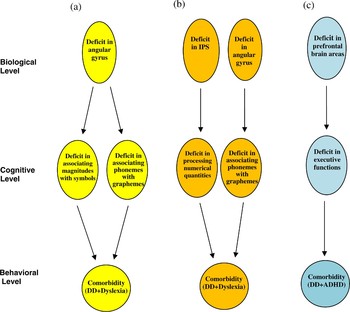
Figure 1. Three alternative frameworks for the origins of comorbidities. IPS, intraparietal sulcus. (a) A unique pathophysiology resulting in a network of behavioral symptoms. (b) Multiple brain dysfunctions resulting in a network of behavioral symptoms and (c) A unique pathophysiology resulting in a behavioral disorder that is a risk mechanism for another disorder.
 You have
Access
- 3
- Cited by
We argue that latent variables, argued against by Cramer et al. in the target article, exist at the cognitive and biological levels. Interestingly, when we searched Cramer et al.'s article, the word brain was not mentioned even once, the words gene and cognitive were mentioned twice, and the word cognition was mentioned only once. If only the behavioral level is taken into account, the suggested network model may be correct. However, core features of mental disorders are best understood in terms of deficits at the cognitive and the biological levels (e.g., Frith Reference Frith2001). Specifically: (1) Core (“common cause”) deficits at the cognitive or brain level may show up as a network of symptoms similar to that suggested by Cramer et al., even when there is a single deficit. (2) A single deficit at the behavioral or cognitive level may produce, through development, a cascade of difficulties (Rutter & Sroufe Reference Rutter and Sroufe2000) that may end up as comorbidity (i.e., look like a network of symptoms at the behavioral level). (3) Revealing the core deficit will lead to a more exact diagnosis, which would encourage specific intervention programs.
We discuss developmental learning and behavioral disorders. A most remarkable finding is the specificity of these disorders: highly intelligent children who excel in many different ways, have a specific cognitive disability. This one specific cognitive gap may hamper, through development, many types of behaviors, including those that are relevant to other abilities, resulting in comorbidity or in “a network of symptoms.” Here we give examples of mathematics disorder, reading disorder, and attention-deficit hyperactivity disorder (ADHD) to further strengthen our argument.
Mathematics and reading disorders
Five to seven percent of children experience difficulties in learning mathematics and/or reading though they are not of low intelligence and do not suffer from educational deprivation (von Aster & Shalev Reference von Aster and Shalev2007; Wilson & Dehaene Reference Wilson, Dehaene, Coch, Dawson and Fischer2007). Current research suggests that these learning disabilities, known as developmental dyscalculia (DD) and dyslexia (for reading), are due to underlying brain dysfunctions (see, e.g., Cohen Kadosh et al. Reference Cohen Kadosh, Cohen Kadosh, Schuhmann, Kaas, Goebel, Henik and Sack2007; Kucian et al. Reference Kucian, Leoenneker, Dietrich, Dosch, Martin and von Aster2006; Shaywitz & Shaywitz Reference Shaywitz and Shaywitz2008). Similar to depression and generalized anxiety, DD and dyslexia, recognized psychiatric disorders (under different terms such as mathematics disorders or reading disorders; American Psychiatric Association 1994) are appropriate to test Cramer et al.'s main arguments.
It has been suggested that DD reflects deficiency mainly (but not only) in brain regions of the parietal cortex, along the intraparietal sulcus (IPS). IPS deficiencies can be found at the structural level (Isaacs et al. Reference Isaacs, Edmonds, Lucas and Gadian2001; Rotzer et al. Reference Rotzer, Kucian, Martin, von Aster, Klaver and Loenneker2008) and the functional level (e.g., DD in adults [Cohen Kadosh et al. Reference Cohen Kadosh, Cohen Kadosh, Schuhmann, Kaas, Goebel, Henik and Sack2007; Holloway & Ansari, in press]; DD in children [Kaufmann et al., in press; Kucian et al. Reference Kucian, Leoenneker, Dietrich, Dosch, Martin and von Aster2006; Mussolin et al., Reference Mussolin, De Volder, Grandin, Schlögel, Nassogne and Noël2010; Price et al. 2007]). The IPS is considered to be involved with an abstract, amodal representation of numbers (Cantlon et al. Reference Cantlon, Platt and Brannon2009; Dehaene Reference Dehaene2009). The IPS is also activated by numbers presented in symbolic notations such as Arabic numerals and spoken number words (Eger et al. Reference Eger, Sterzer, Russ, Giraud and Kleinschmidt2003). Despite indecisiveness in existent developmental imaging studies (e.g., Kucian et al. Reference Kucian, Leoenneker, Dietrich, Dosch, Martin and von Aster2006; Price et al. Reference Price, Holloway, Vesterinen, Rasanen and Ansari2007), deficiency in the IPS functioning is the best-validated core deficit or, in Cramer et al.'s terminology, the common cause of DD (Wilson & Dehaene Reference Wilson, Dehaene, Coch, Dawson and Fischer2007). This in itself does not fit the description of multiple behavioral symptoms organized in a connected network with no latent variable.
Importantly, the unique pathophysiology of DD is frequently accompanied by heterogeneous behavioral deficits. Moreover, this is the case in many other developmental disorders (Karmiloff-Smith Reference Karmiloff-Smith2006) – multiple problems are the rule, and pure disorders apply only to a minority of cases. Twenty to sixty percent of children with DD have associated learning problems such as dyslexia (von Aster & Shalev Reference von Aster and Shalev2007). What is the reason? We (Rubinsten & Henik Reference Rubinsten and Henik2009) have suggested two main alternative hypotheses for the origin of comorbidity of DD and dyslexia: (1) A single brain injury may cause DD and include a risk mechanism for dyslexia (see our Fig. 1, panel a). For example, a deficient ability to automatically associate written symbols with mental representations such as quantities or phonemes may lead to math and reading difficulties. In this case, a specific brain lesion produces a cognitive difficulty, and a network of symptoms may appear at the behavioral level but not necessarily at the cognitive or biological levels. (2) DD+dyslexia could be due to several brain dysfunctions – for example, one in the IPS (Price et al. Reference Price, Holloway, Vesterinen, Rasanen and Ansari2007) resulting in DD, and the second in the left peri-sylvian brain areas (McCandliss & Noble Reference McCandliss and Noble2003) resulting in dyslexia (see Fig. 1, panel b). Landerl et al. (Reference Landerl, Fussenegger, Moll and Willburger2009) have suggested that dyslexia and dyscalculia have separable cognitive profiles (i.e., a phonological deficit in dyslexia and a deficient number module in DD) that simply appear together. This does not support Cramer et al.'s network theory.
Three alternative frameworks for the origins of comorbidities. IPS, intraparietal sulcus. (a) A unique pathophysiology resulting in a network of behavioral symptoms. (b) Multiple brain dysfunctions resulting in a network of behavioral symptoms and (c) A unique pathophysiology resulting in a behavioral disorder that is a risk mechanism for another disorder.
Attention-deficit hyperactivity disorder (ADHD)
One developmental disorder may be a risk mechanism for another; an example follows. ADHD is a neuropsychiatric disorder that is characterized by inattention, impulsivity, and motor restlessness (American Psychiatric Association 1994; Bush Reference Bush2010). Individuals with ADHD manifest unexpected problems in mathematics that cause impairments in academic achievement and daily functioning, with estimates ranging from 10% to 60% (Mayes et al. Reference Mayes, Calhoun and Crowell2000). Some attribute the significant mathematical delays in children with ADHD to attention-based impairments (Lindsay et al. Reference Lindsay, Tomazic, Levine and Accardo2001) or working memory (Rosselli et al. Reference Rosselli, Matute, Pinto and Ardila2006). These general cognitive impairments (i.e., not specific to mathematics) are considered to be integral features of the ADHD syndrome and, hence, may cause mathematical difficulties in some of these children (i.e., DD+ADHD) (Barkley Reference Barkley1997; Castellanos et al. Reference Castellanos, Sonuga-Barke, Milham and Tannock2006) (see Fig. 1, panel c).
To summarize, DD, dyslexia, and ADHD are specific neuro-developmental psychiatric disorders, but they are rooted at the biological and cognitive levels, and are only indicated by behavioral signs. Therefore, even if at present research regarding such biological and cognitive deficits is not always conclusive, it can better serve as a basis for testable predictions.
ACKNOWLEDGMENTS
Work by Orly Rubinsten and Avishai Henik was conducted under the auspices of the Center for the Study of the Neurocognitive Basis of Numerical Cognition, supported by the Israel Science Foundation (Grant No. 1664/08) in the framework of their Centers of Excellence.