


Introduction
Determining climatic variations through the study of marine sediment cores in the Antarctic region, and in particular in the Ross Sea, is one of the aims of the ‘Glaciologia e Paleoclima’ project within the framework of the Italian ‘Programma Nazionale di Ricerche in Antartide’ (PNRA). During the last decade, several sediment cores have been collected in the central and western continental shelf of the Ross Sea which, together with the Weddell Sea, has been the object of numerous studies in recent years since the Late Pleistocene and Holocene sediments are well represented here and more widespread than in other Antarctic areas. Moreover, it is known that high-latitude areas, such as the Antarctic continent, are more sensitive to climatic changes because of their extreme environmental conditions (Reference Frignani, Giglio, Langone, Ravaioli and ManginiFrignani and others, 1998). The Ross Sea has long been recognized as a crucial area for testing glaciological models of ice-sheet dynamics and stability because a significant component of the West and East Antarctic ice sheet drains into the Ross Sea. The Ross Sea continental shelf has a mean depth of about 500m and is characterized by deep troughs (up to 1500 m) and banks that document advance and retreat of ice streams coming from the Transantarctic Mountains and Marie Byrd Land (Reference HughesHughes, 1977; Reference Anderson, Shipp, Bartek, Reid and ElliotAnderson and others, 1992).
Here we present geochemical (organic carbon) and sedimentological (grain-size analyses) data from sediment cores collected in the northern part of the Joides basin, which is located in the central sector of the Ross Sea. In particular, this study concerns two gravity cores selected from those collected during the 6th (1990/91) and 14th (1998/99) PNRA oceanographic cruises: cores ANTA91-19 and ANTA99-cJ5. Previous studies showed that the northern part of the Joides basin was free of grounded ice (Reference Anderson, Shipp, Bartek, Reid and ElliotAnderson and others, 1992; Reference Licht, Jennings, Andrews and WilliamsLicht and others, 1996; Reference DomackDomack and others, 1999; Reference Shipp, Anderson and DomackShipp and others, 1999; Reference Brambati, Corradi, Finocchiaro and GiglioBrambati and others, 2002b), with undisturbed sedimentary sequences, in particular for the Late Pleistocene and Holocene sediments (Reference Brambati, Faranda, Guglielmo and IanoraBrambati and others, 1999, Reference Brambati, R., Quaia and Salvi2002a).
The variations of organic carbon content in the cores, being related to the marine palaeoproductivity (Reference Licht, Jennings, Andrews and WilliamsLicht and others, 1996; Reference MeyersMeyers, 1997; Reference Frignani, Giglio, Langone, Ravaioli and ManginiFrignani and others,1998; Reference Cremer, Gore, Melles and RobertsCremer and others, 2003), may be an indicator of past climatic variations (sea-ice extent). For this reason, useful information can be derived from the comparison between this parameter and the stable-isotopic profiles from Antarctic ice cores. The high resolution of the organic carbon record in the Joides basin enables us to compare it with the high-resolution climate information preserved in the ice cores.
Materials and Methods
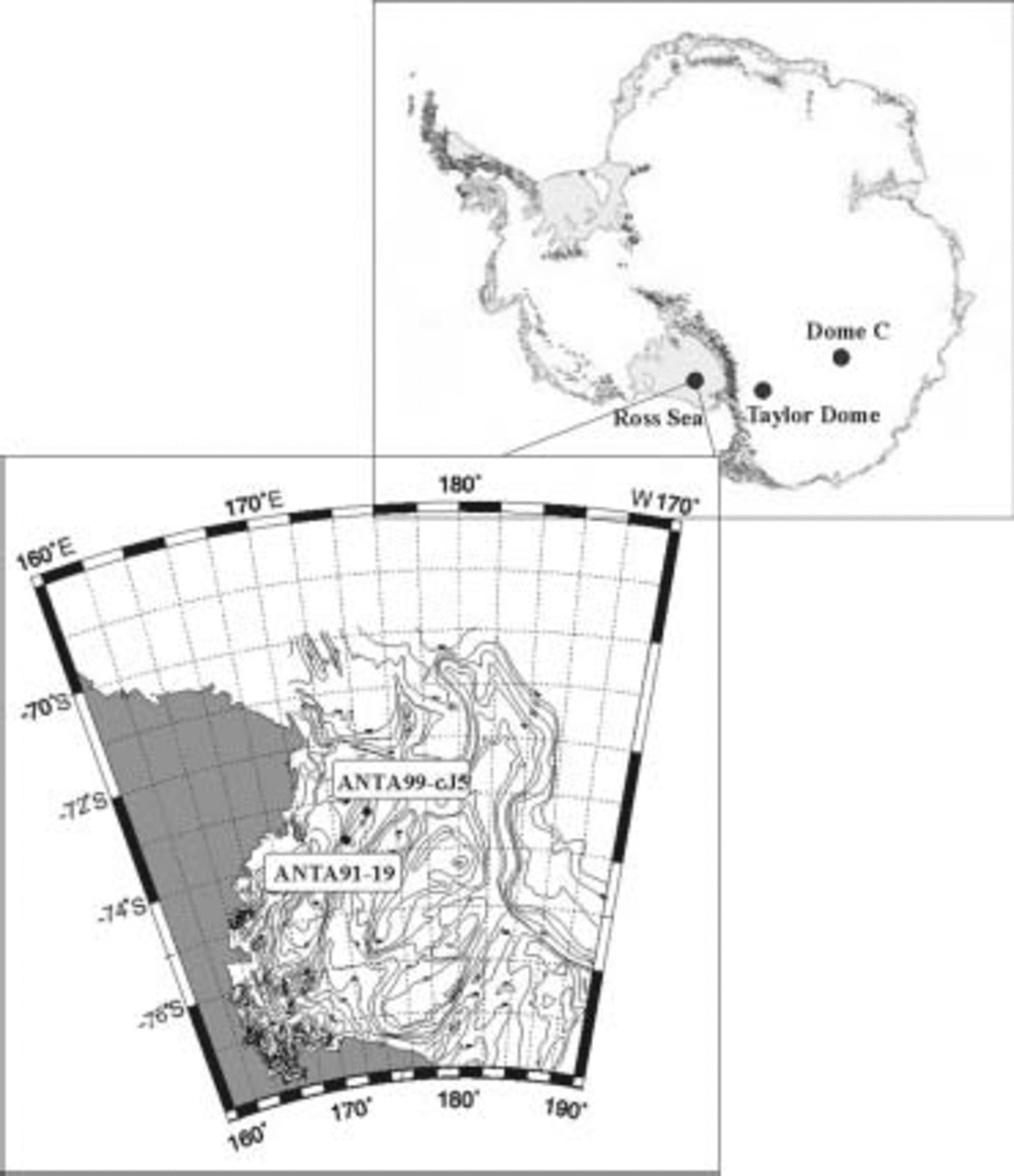
The Joides basin has an elongate shape, with two troughs divided by a sill located near the 74˚30' parallel. The northern area of the basin, with a depth of 600 m, extends near to the continental-shelf break, while the southern part of the basin is deeper. During the 6th oceanographic cruise (1990/91) the 575 cm long gravity core ANTA91-19 (diameter of 10 cm) was collected (74˚26' S, 173˚6' E) at a water depth of 592 m, while during the 14th oceanographic cruise (1998/99) the 553 cm long gravity core ANTA99-cJ5 (diameter of 10 cm) was collected (73˚49.42' S, 175˚39.01' E) in the northern area of the Joides basin at a water depth of 598m (Fig. 1).
Map of Antarctica, showing the location of the EPICA DC and Taylor Dome ice cores and the position of sedimentary cores in the Ross Sea.
The sediment cores were X-rayed, split, described and photographed. Subsamples, taken every centimetre, of about 10–15 g were used for grain-size analysis. Samples were rinsed with distilled water and wet-sieved to separate gravel (>2 mm), sand (2000–63 μm) and pelite (<63 μm) fractions (Reference WentworthWentworth, 1922). The sand fraction was analyzed on a Macrogranometer settling tube, and the mud fraction on a Sedigraph 5100 particle-size analyzer, using a 0.5% sodium hexametaphosphate dispersing solution. The total organic carbon (TOC) content was determined every cm in the uppermost part of both cores (up to 240 cm) and every 10cm in the lower part. The organic carbon measurements were carried out using a Perkin–Elmer 2400 CHN Elemental Analyzer. About 10–20mg of sediment was used and the carbonate fraction was previously eliminated using hydrochloric acid in silver capsules (Reference Hedges and SternHedges and Stern, 1984).
The chronology of both cores is based on accelerator mass spectrometry (AMS) radiocarbon analyses (Table 1). These analyses were made on either foraminifera calcite or bulk organic carbon, depending upon the presence/absence of calcareous foraminifers within different intervals in the cores.
Radiocarbon ages and sedimentation rates for each gravity core

For core ANTA99-cJ5, four AMS 14C age determinations were made on bulk organic carbon at the Geochron Laboratories, Massachusetts, USA. For core ANTA91–19, five 14C ages were determined on both bulk organic carbon and foraminiferal specimens (level 376–382 cm) using the AMS facility at the University of Groningen, The Netherlands.
Ages and sedimentation rates of the cores are reported in Table 1. The 14C ages from the top of the cores are 4470 ± 70 years BP for core ANTA91-19 and 5000 ± 30 years BP for core ANTA99-cJ5. Such high values are common for Antarctic marine surface sediment (Reference Domack, McClennen, Ross, Hofmann and QuentinDomack and others, 1989; Domack, 1992; Reference DeMaster, Ragueneau and NittrouerDeMaster and others, 1996; Reference Licht, Jennings, Andrews and WilliamsLicht and others 1996; Reference Brambati, Barker and CooperBrambati and others, 1997; Reference Frignani, Giglio, Langone, Ravaioli and ManginiFrignani and others, 1998; Ingόlfsson and others, 1998; Reference DomackDomack and others, 1999). Old surface ages may be due to different factors such as the loss of the core top during sampling, especially using gravity corers (Reference Brambati, Barker and CooperBrambati and others, 1997; Reference Frignani, Giglio, Langone, Ravaioli and ManginiFrignani and others, 1998), or the reservoir effect, which is related to the antiquity of the carbon pool within the Southern Ocean (Reference Domack, McClennen, Ross, Hofmann and QuentinDomack and others, 1989, 1999; Reference Bird, Chivas, Radnell and BurtonBird and others, 1991; Reference Gordon and HarknessGordon and Harkness, 1992; Reference Leventer, Dunbar and DeMasterLeventer and others, 1993). The value of the reservoir effect in the Ross Sea is estimated to be 1200–1300 years (Reference Licht, Jennings, Andrews and WilliamsLicht and others 1996; Reference DomackDomack and others, 1999; Reference Goodwin and ZweckGoodwin and Zweck, 2000; Reference Cremer, Gore, Melles and RobertsCremer and others, 2003) but can also be higher (Reference Taylor and McMinnTaylor and McMinn, 2001, Reference Taylor and McMinn2002).
In addition, significant reworking complicates the interpretation of radiocarbon dates derived from organic matter despite the absence of land-based organic detritus (Reference Domack, Jull, Anderson, Linick and WilliamsDomack and others, 1995; Reference Domack, Ishman, Stein, McClennen and TDomack and McClennen, 1996; Reference Leventer, Domack, Ishman, Brachfield and McClennenLeventer and others, 1996). However, previous micropalaeontological study of foraminifers taxa, on sediment cores collected in the Joides basin, and in particular on cores ANTA91-19 and ANTA99-cJ5 (Reference Kellogg, Osterman and StuiverKellogg and others, 1979; Reference Melis, Salvi, Dini, D'Onofrio and PuglieseMelis and others, 1998; Reference Brambati, Faranda, Guglielmo and IanoraBrambati and others, 1999), highlighted the presence of calcareous autochthonous foraminifers in the lower part of the cores. By contrast, the upper part of both cores is characterized by the occurrence of arenaceous foraminifers and the absence of calcareous faraminifers. These results, together with the qualitative and quantitative analyses of diatom associations (Reference Bonci, Corradi, Ivaldi and PiriniBonci and others, 2000), highlighted the absence of reworking phenomenon in both cores.
The conventional ages were corrected using a conventional reservoir age of 1230 years and the calibration program CALIB 4.3 (Reference Stuiver and ReimerStuiver and Reimer, 1993) with ΔR = 830 ± 40 (Reference DomackDomack and others, 2001; Table 1). Calibrated ages are used below unless otherwise specified.
The sedimentation rate was calculated using a linear interpolation between 14C dated levels (Table 1), and assuming a constant sedimentation rate between them. The sedimentation rate of core ANTA99-cJ5 shows similar values from ~4200 to ~8200 years BP and lower values for older sediments. Core ANTA91-19 shows an abrupt decrease in sedimentation rate for the period between ~8800 and ~13 1001 years BP (Table 1). On the basis of these sedimentation rates and adopted sampling frequency, we obtained an age resolution of 26–64 and 33–171 years for cores ANTA99-cJ5 and ANTA91-19 respectively. Because of the low sedimentation rate found in core ANTA91-19, for ages older than ~8800 years BP, a high-resolution comparison with the ice-core records is not possible in this interval.
Results
Previous sedimentological and micropalaeontological studies and δ13C and δ18O measurements (Reference Brambati, Faranda, Guglielmo and IanoraBrambati and others, 1999, Reference Brambati, R., Quaia and Salvi2002a, Reference Brambati, Corradi, Finocchiaro and Gigliob) showed that the core ANTA91-19 sequence can be divided into three units. From the bottom to the top, the sedimentary section is formed by a fossiliferous diamicton, followed by a thin horizon of glacial marine sediment, with a marine siliceous mud in the topmost part of the core.
The fossiliferous diamicton of cores ANTA91-19 and ANTA99-cJ5 is characterized by the occurrence of quite well-preserved calcareous benthonic and planktonic foraminifers (Reference Kellogg, Osterman and StuiverKellogg and others, 1979; Reference Melis, Salvi, Dini, D'Onofrio and PuglieseMelis and others, 1998; Brambati and others, 1999) generally considered autochthonous. In both cores, the overlying deposits record the disappearance of the foraminifers; the beginning of such an event is contemporaneous. The uppermost part of both cores is characterized by the occurrence of agglutinated foraminifers. These findings indicate that the oceanic water circulation is more corrosive during the Holocene than the Last Glacial Maximum period, due to the rise of the carbonate compensation depth (CCD) level.
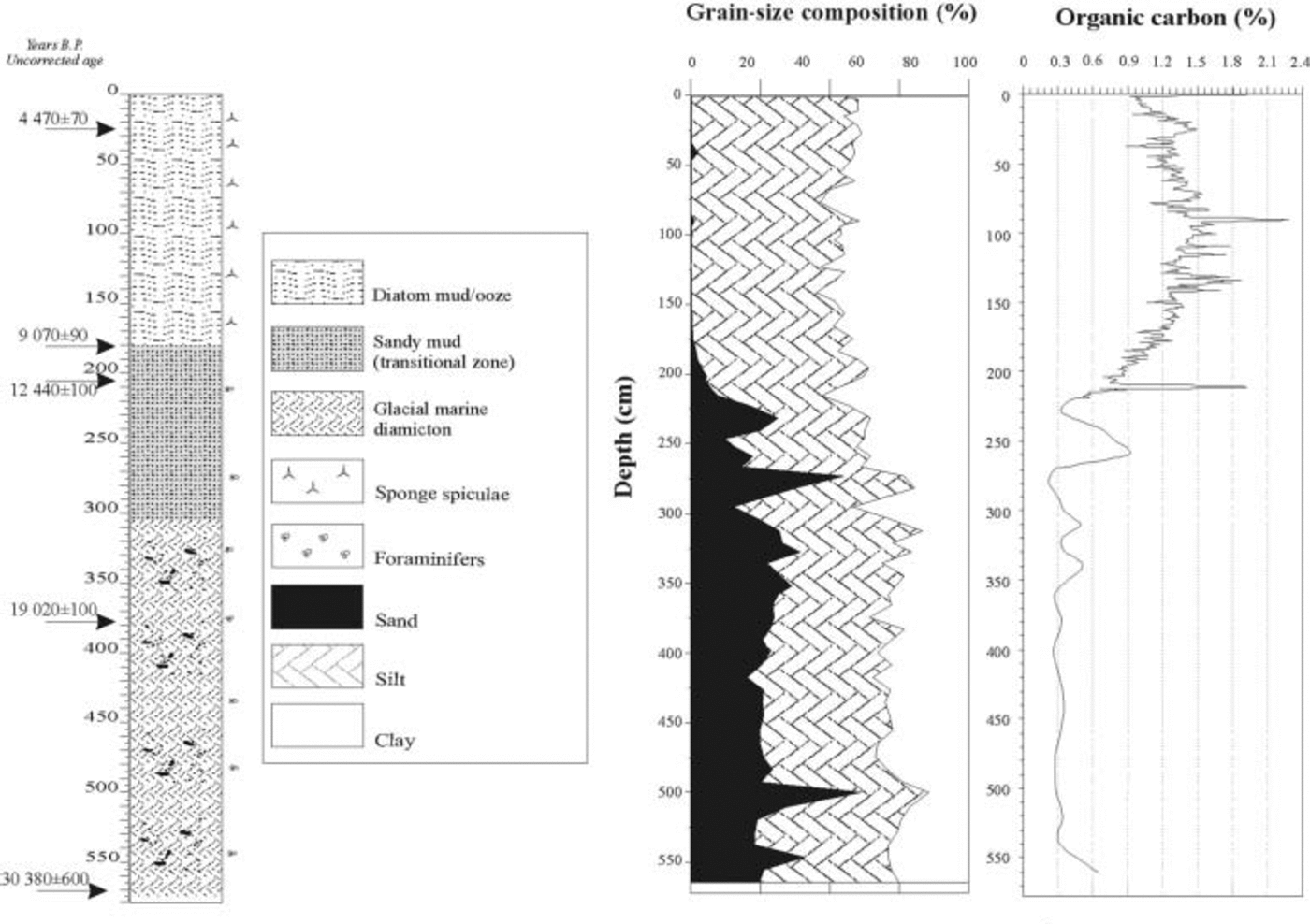
From a sedimentological point of view, core ANTA91-19 (Fig. 2) presents a lower unit (575–300 cm), characterized by a fine-grained matrix with the inclusion of gravel-sized clasts. The central unit, from 300 to 180 cm, shows a decrease in sand fraction while the mud component increases. The upper unit, from 180cm to the top, is constituted by fine grain-size sediment with a low sand fraction.
Textural (a) and organic carbon (b) vertical distribution vs depth in the core ANTA91-19. Reported 14C data are uncorrected.
Using textural analysis (Fig. 3), core ANTA99-cJ5 was also subdivided into three units. The lower unit (553–340 cm) is a homogeneous diamicton with gravel in a clay–silt matrix; the sediment has almost equal proportions of sand, silt and clay. A sharp contact marks the base of a central unit, characterized by variable percentages of sand; pebbles of ~1cm are present in this unit. The upper part of the core (180cm to the top) is characterized by the highest mean percentage of silt, while the sand fraction is very low and the gravel component is absent.
The organic carbon contents of both cores (Fig. 2 and 3) are in the range of those observed in other Antarctic sediments (Reference DomackDomack and McClennen, 1996; Reference Brambati, Barker and CooperBrambati and others, 1997; Reference Licht, Dunbar, Andrews and JenningsLicht and others, 1999). In particular, the TOC content for core ANTA91-19 (Fig. 2) is generally low (<0.5%) from the bottom to 270 cm, with a mean value of 0.34 ± 0.10%; between 220 and 270 cm the mean value is 0.56 ± 0.25%, with a maximum of 0.91% at 260 cm and a minimum of 0.33% at 230 cm. The level from 220cm to the top of the core is characterized by an increase in carbon content, with values generally >1% (mean value of 1.25 ± 0.27%). There are three peaks of 1.91%, 2.27% and 1.92% at 211 cm, 90 cm and the top respectively.
The organic carbon content in core ANTA99-cJ5 (Fig. 3) is also highly variable. From the bottom (553 cm) to 340 cm the values are generally low and relatively constant, with a mean value of 0.47 ± 0.06%. A minimum value of 0.30% is observed at 299 cm. Above this, there is an increase of TOC, with a mean value of 1.11 ± 0.21%, followed by another decrease at 197.5 cm with a value of 0.55%. From this level to the top of the core, the carbon values are generally >1% (mean of 1.11 ± 0.17%).
Textural (a) and organic carbon (b) vertical distribution vs depth in core ANTA99-cJ5. Reported 14C data are uncorrected.

Discussion
The study of sediment cores from the Joides basin highlights the environmental evolution of this area during the late Quaternary. Previous studies (e.g. Reference Brambati, Faranda, Guglielmo and IanoraBrambati and others, 1999, Reference Brambati, R., Quaia and Salvi2002a, Reference Brambati, Corradi, Finocchiaro and Gigliob) on core ANTA91-19 and unpublished data on core ANTA99-cJ5 show that the Joides basin had a different history to other basins in the Ross Sea such as the Drygalski basin. In both cores the basal unit is characterized by a glacial marine diamicton (sensu Reference Licht, Jennings, Andrews and WilliamsLicht and others, 1996) with the presence of well-preserved foraminifers (both benthonic and planktonic).
It is hypothesized that in the deepest part of the basin, the West Antarctic ice sheet was not grounded during the LGM, but probably was grounded on the flanks of the basin (Reference Corradi, Fierro, Mirabile, Ferrari, Ivaldi and RicciCorradi and others, 1997; Reference DomackDomack and others, 1999; Reference Shipp, Anderson and DomackShipp and others, 1999; Reference Brambati, Corradi, Finocchiaro and GiglioBrambati and others, 2002b).
The TOC content in the two cores is useful for palaeoenvironmental information, because, in Antarctic marine sediments, this is more closely related to productivity in the marine realm than to terrestrial sources of plant debris and of reworked organic particulates (Reference Domack, Jull, Anderson, Linick and WilliamsDomack and others, 1995; Reference Leventer, Domack, Ishman, Brachfield and McClennenLeventer and others, 1996; Reference Licht, Jennings, Andrews and WilliamsLicht and others, 1996; Reference MeyersMeyers, 1997; Reference Frignani, Giglio, Langone, Ravaioli and ManginiFrignani and others, 1998). The variation of organic carbon content may be an indicator of past climatic variations (sea-ice extent: Reference Domack, Ishman, Stein, McClennen and TDomack and others, 1995; Reference DomackMeyers, 1997).
The palaeoclimatic information obtained from the organic carbon records was compared with two ice cores, one from the East Antarctic plateau located at Dome Concordia (DC) (European Project for Ice Coring in Antarctica (EPICA)), and one from a more coastal site, Taylor Dome, facing the Ross Sea (Fig. 1). The time period considered spanned the last 15 000 years BP.
The climate interpretation based on ice-core stable-isotope profiles relies on the empirical relationships between either δD or δ18O and the condensation temperature (Reference DansgaardDansgaard, 1964; Reference PetitPetit and others, 1999). The Dome C core provides a new high-resolution climate record for East Antarctica. We used EPICA DC δD data from Reference JouzelJouzel and others (2001), and Taylor Dome δD data from Reference SteigSteig and others (1998a, Reference Steigb, Reference Stenni2000).
The data obtained from analyses of the organic carbon content of cores ANTA91-19 and ANTA99-cJ5 are reported in Figure 4 along with the δD stable-isotope profiles of Taylor Dome and EPICA DC ice cores. All the records are reported on their own time-scale for the time interval covering the last deglaciation and the Holocene. Figure 4 also shows the temperature anomalies ΔT site (as deviations from the present-day values; 50 year data) calculated using the method of Stenni and others (2001). These authors combined measurements of stable isotopes (δD and δ18O) from the EPICA DC ice core with a simple isotopic model, to reconstruct the variability of both the site temperature (East Antarctica) and the moisture source temperature (mainly the sub-Antarctic Indian Ocean) over the last 27 000 years. Reference JouzelJouzel and others (2001) suggested that all East Antarctic ice cores, including Taylor Dome, appear to have a similar deglaciation history characterized by a long gradual warming interrupted, between ~14 000 and 12 500 years, by the Antarctic Cold Reversal (ACR; Reference JouzelJouzel and others, 1995). The estimated surface temperature difference between the LGM and the early-Holocene optimum, calculated on the basis of the EPICA DC isotopic data (Reference StenniStenni and others, 2001), is around 9˚C.
Carbon content of cores ANTA91-19 (a) and ANTA99-cJ5 (b), δD of Taylor Dome (c) and EPICA DC (d), and ΔTsite of EPICA DC (e) vs age; the ages of the sedimentary records are calibrated 14C data. The Taylor Dome data were obtained from the website http://www.sas.upenn.edu/~esteig/taylor.html.

The comparison between the organic carbon content and isotopic profiles, derived from the ice cores (Fig. 4), shows a high similarity, especially for core ANTA99-cJ5. Around 14 500–14 000 years BP, the high carbon contents observed in core ANTA99-cJ5 show values similar to those obtained during the middle Holocene (~7500–5500 years BP) in the same core. From 14 000 to 12 000 years BP, a dramatic decrease in the carbon content occurred. This decrease in productivity parallels a similar decrease in the δD values corresponding to the ACR period.
In core ANTA91-19 the organic carbon trend is different from that observed in core ANTA99-cJ5 for the lower part, whereas from ~8500 to ~4000 years it is similar. This discrepancy has not been explained. However, as stated above, the strong decrease in the sedimentation rate calculated between ~8800 and ~13 100 BP does not allow any comparison.
After the ACR, the TOC values gradually increase during the warming observed in the ice archive leading to the early-Holocene optimum. The high values observed between ~10 500 and 9000 years BP in core ANTA99-cJ5 are again in agreement with the high δD values. The small negative peak around 8500–8200 years BP in the TOC profile seems to correspond to a similar cold peak in the isotopic profile of EPICA DC. Afterwards, the isotopic profile of EPICA DC shows a slight increasing trend ending around 4500 years BP. By contrast, the organic carbon content in core ANTA99-cJ5 shows an increase up to ~7000 years BP and a decrease towards the top of the cores (up to 4500 years BP). A similar decreasing trend is well documented in the isotopic profile of the Taylor Dome ice core, which is located in a more coastal area than the EPICA DC ice core.
The isotopic record at Taylor Dome and diatom assemblages from Ross Sea sediment cores led Reference SteigSteig and others (1998b) to suggest: (i) warm climate conditions during the early Holocene; (ii) a rapid cooling at about 6000 years BP followed by continued cooling during the late Holocene; (iii) an increase in sea-ice cover at about 6000 years BP. This cooling is not evident in the more inland sites at EPICA DC, but seems to be restricted to coastal regions. Reference MassonMasson and others (2000) showed that the Holocene temperature trends inferred from Antarctic ice core might have been influenced by changes in both local ice-sheet elevation and climate.
The variations of the organic carbon content observed during the last deglaciation and the Holocene, pointed out in this study, suggest similar variations in productivity in this sector of the Southern Ocean, probably linked to sea-ice extent changes as suggested by Reference SteigSteig and others (1998b). Furthermore this study shows a dramatic decline in the Ross Sea productivity related to the cooling occurring during the ACR. It also confirms the cooling in the second half of the Holocene observed in the Taylor Dome ice core. Several studies have already highlighted the importance of the climate changes during the middle Holocene, recognizing a widespread climatic decline in the Southern Hemisphere, starting around 5000–6000 years BP (Reference HeusserHeusser, 1998; Reference SteigSteig and others, 1998b; Reference PorterPorter, 2000; Reference Hodell, Kanfoush, Shemesh, Crosta, Charles and GuildersonHodell and others, 2001).
Conclusion
The variations of organic carbon content in the sediment core ANTA99-cJ5 collected in the Ross Sea embayment show a marked decrease during the ACR, a subsequent increase during the early-Holocene optimum and a decrease in the second part of the Holocene. These variations are probably linked to oceanic productivity fluctuations in the Ross Sea induced by variation in sea-ice extent. The correlation established between the climatic information obtained from the ice cores and ocean productivity from the sediment cores underlines the importance of the TOC as an indicator of palaeoclimatic and palaeoenvironmental changes.
The high-resolution TOC analyses carried out in this study allowed comparison of climatic events recorded in different climatic proxies such as ice and sediment cores. In particular, this methodology seems able to extract and at the same time explain Late Pleistocene and Holocene palaeoenvironmental and/or climatic variations which have occurred in the sedimentary sequences in the Ross Sea continental shelf.
Acknowledgements
This work was carried out with the financial support of the Italian ‘Programma Nazionale di Ricerche in Antartide’ (PNRA), research project ‘Glaciologia e Paleoclima’. The authors thank J. Jouzel for providing the δD data of the EPICA DC ice core.



