One-third to one-half of children in the U.S. unfortunately experience one or more types of adversity prior to reaching adulthood (Finkelhor et al., 2005, 2009), with 13.7% experiencing maltreatment by a caregiver (Finkelhor et al., Reference Finkelhor, Turner, Shattuck and Hamby2013). Childhood maltreatment is a major public health and social welfare problem (Gilbert et al., Reference Gilbert, Widom, Browne, Fergusson, Webb and Janson2009) and is defined as acts of commission or omission by a caregiver that result in harm, potential for harm, or threat of harm to a child, regardless of whether harm was the intended consequence (Leeb et al., Reference Leeb, Paulozzi, Melanson, Simon and Arias2008). Maltreatment in childhood exhibits multifinality (i.e., diversity of outcomes); that is, although youth who have experienced maltreatment may demonstrate positive long-term outcomes, studies have identified associations between childhood maltreatment and a variety of behavioral difficulties (Heleniak et al., Reference Heleniak, Jenness, Vander Stoep, McCauley and McLaughlin2016; Maniglio, Reference Maniglio2009; McLaughlin et al., Reference McLaughlin, Greif Green, Gruber, Sampson, Zaslavsky and Kessler2012). These include increased risk for externalizing problems in childhood (VanMeter et al., Reference VanMeter, Handley and Cicchetti2020) and impulsivity in adolescence (Heleniak et al., Reference Heleniak, Jenness, Vander Stoep, McCauley and McLaughlin2016), increased likelihood of arrest in adolescence and adulthood (Gilbert et al., Reference Gilbert, Widom, Browne, Fergusson, Webb and Janson2009), and increased reactive aggression among those who go on to engage in violent crime (Kolla et al., Reference Kolla, Malcolm, Attard, Arenovich, Blackwood and Hodgins2013). Additionally, a meta-analysis of studies investigating risks associated with adverse childhood experiences, including multiple forms of childhood maltreatment, found that a greater number of adverse childhood experiences is associated with higher risk for multiple health conditions and health risk behaviors, including cancer, heart disease, respiratory disease, sexual risk-taking, problematic substance use, and self-directed and interpersonal violence (Hughes et al., Reference Hughes, Bellis, Hardcastle, Sethi, Butchart, Mikton, Jones and Dunne2017).
Confirmatory factor analyses have indicated a five-factor model of childhood maltreatment (including physical abuse, sexual abuse, emotional abuse, physical neglect, and emotional neglect) to be the best fit (Bernstein et al., Reference Bernstein, Ahluvalia, Pogge and Handelsman1997; Scher et al., Reference Scher, Stein, Asmundson, McCreary and Forde2001). One large, nationally representative study (Keyes et al., Reference Keyes, Eaton, Krueger, McLaughlin, Wall, Grant and Hasin2012) investigating associations between retrospective reports of childhood maltreatment and externalizing outcomes found significant associations between all forms of abuse (i.e., physical, sexual, emotional), but neither form of neglect (i.e., physical, emotional), with externalizing psychopathology. However, there are discrepancies across studies regarding which types of childhood maltreatment are most strongly associated with externalizing symptoms, with some studies finding that physical abuse holds the strongest association (Price et al., Reference Price, Chiapa and Walsh2013; Yoon et al., Reference Yoon, Yoon, Pei and Ploss2021), and others highlighting the roles of emotional abuse (van Duin et al., Reference van Duin, Bevaart, Zijlmans, Luijks, Doreleijers, Wierdsma, Oldehinkel, Marhe and Popma2019), sexual abuse (Barboza et al., Reference Barboza, Dominguez and Pinder2017), and neglect (McGuire et al., Reference McGuire, Cho, Huffhines, Gusler, Brown and Jackson2018). Variable findings across studies may stem from differences in types of maltreatment measured; methods of measurement (e.g., child protective services (CPS) reports, retroactive coding of case files, youth self-report on questionnaires, probation officer interviews, retrospective self-report in adulthood); and samples (including developmental period in which externalizing symptoms were assessed). These mixed findings suggest that examination of different subtypes of maltreatment may better inform etiological and prevention models. Importantly for the present study, although youth samples with a history of contact with CPS may have a greater frequency or longer duration of maltreatment compared to community-based samples, accurate assessment of maltreatment in community samples may be challenging as youth may be less able to identify abusive behavior because of limited awareness of appropriate caregiver-child relationships, or may be less willing to disclose information that could negatively impact themselves, caregivers, or family members. Thus, further research among community-based samples is crucial.
The relation between maltreatment and externalizing behaviors, seen early in development (Chandler et al., Reference Chandler, Shanahan and Halpern2021), may escalate during adolescence. Adolescence represents a distinct period of development in which the child undergoes rapid cognitive maturation and changes in emotion regulation and vulnerability, including heightened sensation-seeking and reactivity (Steinberg, Reference Steinberg2008). During adolescence and emerging adulthood, youth who may already be at risk for externalizing behaviors (e.g., because of exposure to maltreatment) may become more vulnerable to replicating an impulsive response style seen in the home (Heleniak et al., Reference Heleniak, Jenness, Vander Stoep, McCauley and McLaughlin2016). This possibility may emerge partly because of the increase in reward-seeking behavior, peer influence, and physical maturation that occurs with puberty (Steinberg, Reference Steinberg2008). Thus, those adolescents with potential self-regulation difficulties due to environmental stressors and without adaptive coping methods may be at risk for externalizing problems, including defiance, aggression, impulsivity, and antisocial behaviors (Steinberg, Reference Steinberg2008).
Not all youth who have endured childhood maltreatment develop externalizing behaviors in adolescence and adulthood; indeed, many achieve positive mental health outcomes, including subjective wellbeing. Wellbeing is a construct that encompasses higher levels of positive affect and life satisfaction, as well as lower levels of negative affect (Diener et al., Reference Diener, Oishi and Lucas2003). Unfortunately, little research has focused on the presence of positive adjustment and wellbeing as outcomes, as opposed to considering the absence of psychopathology or risk behaviors (Bird & Markle, Reference Bird and Markle2012; Pluess, Reference Pluess2015). Because the absence of psychopathology does not necessarily imply the presence of subjective wellbeing, studies on the determinants of mental health should include both factors (Keyes, Reference Keyes2005, Reference Keyes2007). Given the importance of wellbeing among adolescents and young adults who are developing individual identities and making crucial decisions about their future (e.g., careers, relationships), the examination of individual and contextual factors (as well as their potential interactions) that contribute to wellbeing is critical for bolstering mental health (Myerberg et al., Reference Myerberg, Rabinowitz, Reynolds and Drabick2019).
The developmental psychopathology framework conceptualizes psychopathology as a deviation from normative or typical development, and seeks to elucidate risk and protective factors (ranging from biological processes to social and cultural influences) that contribute to various developmental pathways to maladjusted behavior (Cicchetti & Rogosch, Reference Cicchetti and Rogosch1996; Cicchetti, Reference Cicchetti1993). Investigations into resilience (i.e., thriving despite adversity) processes associated with developmental trajectories are a key aspect of developmental psychopathology research (LaGasse et al., Reference Lagasse, Conradt, Karalunas, Dansereau, Butner, Shankaran, Bada, Bauer, Whitaker and Lester2016). Luthar et al. (Reference Luthar, Cicchetti and Becker2000) describe the extensive and somewhat controversial history of the study of resilience, concluding that despite the varied criticisms and challenges inherent to this work, continued investigation into how and when individuals positively adapt within the context of adversity is of substantial value to the field of psychology. Despite this call to action, there has been relatively limited attention to factors that bolster positive adjustment among particularly vulnerable children, potentially limiting our ability to identify youth at risk for externalizing problems and to design effective prevention programs that strengthen adaptive skills (Frick & Morris, Reference Frick and Morris2004). The array of emotional and behavioral health outcomes exhibited by adolescents and young adults who have experienced childhood maltreatment suggests the presence of other mechanisms that might foster resilience from negative outcomes, as well as facilitate positive adjustment, among subsets of these youth (McRae et al., Reference McRae, Stoppelbein, O’Kelley, Fite and Smith2022).
Prior studies have investigated externalizing problems and subjective wellbeing using variable-centered approaches and cross-sectional designs; however, given the likelihood of heterogeneous pathways to externalizing symptoms and wellbeing in adulthood, longitudinal research that considers factors associated with both positive and negative adjustment among individuals who have experienced childhood maltreatment is needed. Research in resilience following maltreatment has historically considered factors that might mitigate the negative impact of maltreatment (e.g., associated with lower rates of behavioral problems or mental health disorders), but this area of developmental research has subsequently broadened to include positive adaptation and adjustment (Bonanno & Diminich, Reference Bonanno and Diminich2013). Researchers moreover have called for longitudinal studies spanning more than one developmental period to better capture changes in levels of positive functioning across time points, given that resilience, like risk, is a dynamic, non-static construct (Luthar et al., Reference Luthar, Cicchetti and Becker2000; Sabina & Banyard, Reference Sabina and Banyard2015).
There is much interest in childhood maltreatment research in identifying individual-level factors that may differentiate youth likely to thrive despite adversity versus those in need of greater support, and that may serve as targets of intervention programs (Sabina & Banyard, Reference Sabina and Banyard2015). The diathesis-stress model proposes that individuals may possess attributes that place them at greater risk for adverse effects (e.g., psychopathology, problem behaviors) in response to stressful experiences (Salmon & Bryant, Reference Salmon and Bryant2002). Importantly, guiding principles for resilience-focused interventions include having a strong developmental focus, as well as directing efforts toward both the reduction of maladjustment and the promotion of dimensions of positive adaptation (Luthar & Cicchetti, Reference Luthar and Cicchetti2000). One such factor that may play a role in psychosocial positive adjustment and maladjustment is executive functioning (EF; LaGasse et al., Reference Lagasse, Conradt, Karalunas, Dansereau, Butner, Shankaran, Bada, Bauer, Whitaker and Lester2016). EF includes processes that optimize behavior when the environment changes (Schoemaker et al., Reference Schoemaker, Mulder, Deković and Matthys2013), including inhibition (i.e., ability to withhold a prepotent response; Miyake et al., Reference Miyake, Friedman, Emerson, Witzki, Howerter and Wager2000), working memory (i.e., ability to temporarily store and manipulate information for use in some mental task; Aronen et al., Reference Aronen, Vuontela, Steenari, Salmi and Carlson2005), and flexibility (i.e., ability to flexibly shift between tasks or mental sets to adapt to environmental changes; Nigg, Reference Nigg2006; Schoemaker et al., Reference Schoemaker, Mulder, Deković and Matthys2013). Importantly, although one must be mindful of task impurity when measuring EF processes (i.e., that EF and non-EF processes are shared in tasks intended to index specific EF skills; Friedman & Miyake, Reference Friedman and Miyake2017; van der Sluis et al., Reference van der Sluis, de Jong and van der Leij2007), these core EF domains have been disambiguated in the literature and have different timing of emergence, correlates, and predictive utility (e.g., to externalizing and internalizing problems, particularly at earlier stages of development; Huang-Pollock et al., Reference Huang-Pollock, Shapiro, Galloway-Long and Weigard2017; Martel et al., Reference Martel, Nigg, Wong, Fitzgerald, Jester, Puttler and Zucker2007; Ogilvie et al., Reference Ogilvie, Stewart, Chan and Shum2011; Riggs et al., Reference Riggs, Blair and Greenberg2004; Schoemaker et al., Reference Schoemaker, Mulder, Deković and Matthys2013; Wang et al., Reference Wang, Chassin, Lee, Haller and King2017). The “unity and diversity” model posits that EF performance is partially dependent on a common EF factor, but that some outcomes are tied to specific EF domains, with studies highlighting specific EF abilities in the prediction of various emotional and behavioral difficulties (Friedman & Miyake, 2017). A recent meta-analysis investigated whether subtype of EF moderated the relations between EF and broad externalizing problems in later developmental stages, but could not draw conclusions because of the paucity of studies that prospectively examine whether child baseline EF could predict such outcomes in adulthood (Yang et al., Reference Yang, Shields, Zhang, Wu, Chen and Romer2022). In addition to helping with short-term (proximal) decision-making, EF is needed to prioritize long-term (distal) goals; thus, it is important to further understand how EF is related to internal self-control of thoughts and behaviors (e.g., abilities to inhibit habitual yet incorrect responses, maintain and work with information to achieve a goal, and flexibly switch to more adaptive cognition and behavior; Tillman et al., Reference Tillman, Brocki, Sørensen and Lundervold2015). These differential aspects of core EF domains are described further below.
As poor self-regulation is reliably associated with behavior problems, understanding individual differences in cognitive development that allow for successful self-regulation is critical to address why some individuals are particularly vulnerable to externalizing symptomatology (Brieant et al., Reference Brieant, King-Casas and Kim-Spoon2022). Individuals with higher levels of EF (e.g., well-developed inhibitory control, working memory, flexibility) may behave more adaptively in stressful situations, as they ostensibly can better regulate emotions and flexibly shift from provocative or threatening stimuli. In the context of such stimuli, an individual who can withhold an initial, automatic response in favor of integrating relevant information in the environment may be more likely to react adaptively and with long-term goals in mind. Differential benefits may emerge based on the subtype of EF ability employed as well. For example, greater inhibition may allow one to control the impulse to engage in risky behaviors or choose maladaptive coping strategies that are rewarding in the short-term (e.g., releasing aggression through violence); greater working memory may allow one to successfully consider norms, rules, and likely consequences when weighing the choice to engage in risk behaviors (e.g., defiance of parents, escalation of peer conflict); and greater flexibility may allow one to more easily shift to alternative, potentially adaptive, behavior options in response to stimuli (Fleming et al., Reference Fleming, Stevens, Vivero, Patwardhan, Nelson, Nelson, James, Espy and Mason2020).
As mentioned above, multiple studies and meta-analyses have found associations between EF deficits, including problems with inhibition, working memory, and cognitive flexibility or set-shifting, and externalizing behavior problems at different stages of development. Consistent with the Social Information Processing model (Crick & Dodge, Reference Crick and Dodge1994), youth with deficits in EF may have a more limited ability to detect subtle features of stimuli and to determine which features are relevant in a given situation, as well as a narrower repertoire of social knowledge to guide ways of responding; thus, when overwhelmed by multiple stimuli, they may be less likely to choose efficient and appropriate (e.g., less aggressive) responses. Externalizing symptoms also may lead peers and caregivers to be less likely to engage in and practice adaptive self-regulation skills with youth who exhibit these behaviors, further contributing to youth’s maladaptive coping strategies and use of externalizing behaviors to achieve goals (Eisenberg et al., Reference Eisenberg, Cumberland, Spinrad, Fabes, Shepard, Reiser, Murphy, Losoya and Guthrie2001). Although inhibitory control comes “online” in early childhood, the development of working memory and flexibility during middle childhood and adolescence is thought to enable youth to meet the demands of more complex emotional and behavioral problems (LaGasse et al., Reference Lagasse, Conradt, Karalunas, Dansereau, Butner, Shankaran, Bada, Bauer, Whitaker and Lester2016). EF constructs are often associated with each other, leading to interest in studying EF as a unitary construct; however, researchers have generally acknowledged the separability of these three central EF constructs by middle childhood (Brydges et al., Reference Brydges, Fox, Reid and Anderson2014; Wiebe et al., Reference Wiebe, Sheffield, Nelson, Clark, Chevalier and Espy2011) and there are theoretical reasons to posit differential predictive utility for externalizing problems from these EF constructs (Fleming et al., Reference Fleming, Stevens, Vivero, Patwardhan, Nelson, Nelson, James, Espy and Mason2020). Thus, studies examining the relations between core EF components, separable during childhood, and externalizing problems in late adolescence and early adulthood may increase our understanding of differential predictive utility of particular EF domains for externalizing problems over time.
Contextual factors in childhood, such as maltreatment, may affect cognitive development (Eddy & Chamberlain, Reference Eddy and Chamberlain2000). Neural development in the prefrontal cortex is tied to growth in self-regulation abilities, and is sensitive to environmental influences such as emotional climate in the home or community (Frick & Morris, Reference Frick and Morris2004). For example, among youth experiencing victimization in their community, higher levels of working memory were associated with lower levels of proactive aggression (Jakubovic & Drabick, Reference Jakubovic and Drabick2020). A study by Vučković et al. (Reference Vučković, Ručević and Ajduković2021) found that youth inhibition partially accounted for the relation between authoritarian, hostile, and aggressive parenting with youth externalizing behavior problems. Among youth who have experienced maltreatment, there may be domain-specific associations with EF abilities that could have differential prediction to psychosocial outcomes. For example, higher levels of (a) inhibitory control may enable them to avoid escalating physical altercations or re-enacting violent or demeaning behaviors in interactions with others, (b) working memory may enable them to consider goals and consequences when faced with these choices, and (c) flexibility may enable them to pivot from emotionally arousing stimuli or shift to different and more adaptive modes of relating to others. Thus, EF abilities may contribute to resilience and subjective wellbeing through different mechanisms or processes as well among youth who experience maltreatment. To better understand the enduring effects of childhood maltreatment and identify targets of early intervention among youth, more research (particularly longitudinal) is needed to understand the different facets of EF that may predict externalizing symptoms and wellbeing in the context of multiple types of childhood maltreatment (McNeilly et al., Reference McNeilly, Peverill, Jung and McLaughlin2021; Mothes et al., Reference Mothes, Kristensen, Grassi-Oliveira, Fonseca, de Lima Argimon and Irigaray2015; Spann et al., Reference Spann, Mayes, Kalmar, Guiney, Womer, Pittman, Mazure, Sinha and Blumberg2012).
The current study examined associations among initial levels (i.e., intercepts) and trajectories (i.e., slopes) of externalizing symptoms and subjective wellbeing from late adolescence through young adulthood with EF abilities and experiences of childhood maltreatment. Specifically, aims of this exploratory study included (a) identifying latent growth curve trajectories of externalizing symptoms or subjective wellbeing over time, (b) determining associations between childhood maltreatment experiences with initial levels and trajectories of externalizing symptoms and subjective wellbeing, (c) determining associations between levels of EF abilities with initial levels and trajectories of externalizing symptoms and subjective wellbeing, and (d) investigating whether levels of EF abilities moderate relations between childhood maltreatment experiences and initial levels and trajectories of externalizing symptoms and subjective wellbeing.
To address gaps in the existing literature, we investigated symptoms of a broader externalizing spectrum dimensionally given the likelihood of subthreshold symptom presentations among a community-based sample of youth, the potential for impairment resulting from subthreshold symptoms, and shared negative long-term consequences among externalizing problems (Beauchaine & McNulty, Reference Beauchaine and McNulty2013; Keyes et al., Reference Keyes, Eaton, Krueger, McLaughlin, Wall, Grant and Hasin2012). We also explored a variety of maltreatment experiences (i.e., physical abuse, sexual abuse, emotional abuse, neglect) to examine whether type of maltreatment experience was differentially associated with the outcomes of interest. and domains of EF (i.e., inhibition, working memory, flexibility) using performance-based laboratory tasks and caregiver- and self-report questionnaires. Given differences in onset, correlates, and predictive utility among EF abilities, as well as posited differential relations between maltreatment and these domains, we also investigated EF domains separately to evaluate whether there is disparate predictive utility of particular EF domains for externalizing problems and subjective wellbeing through young adulthood. With regard to latent growth curve trajectories, we hypothesized that there would be variability in terms of intercepts and slopes among participants and consequently that a random slope model would be the best fit to the data. Given the paucity of research predicting broad externalizing symptoms or subjective wellbeing in these adolescent and young adult developmental periods from EF and maltreatment, the current study can be considered exploratory and we did not make hypotheses specific to particular EF domains or maltreatment types. However, more broadly, we hypothesized that higher levels of childhood maltreatment would be associated with higher levels of externalizing symptoms and lower levels of subjective wellbeing at age 16 (intercept), as well as increasing externalizing symptoms and decreasing subjective wellbeing over time (slope). Similarly, we hypothesized that higher levels of EF would be associated with lower levels of externalizing symptoms and subjective wellbeing at age 16, as well as decreasing externalizing symptoms and increasing subjective wellbeing over time. Finally, we hypothesized that EF would moderate the relation between maltreatment and externalizing symptoms and subjective wellbeing such that participants with higher levels of maltreatment and lower levels of EF would exhibit greater risk at age 16 and through young adulthood (i.e., initially higher and increasing externalizing symptoms, initially lower and decreasing subjective wellbeing), whereas participants with lower levels of maltreatment and higher levels of EF would exhibit greater resilience or positive adjustment at age 16 and through young adulthood (i.e., initially lower and decreasing externalizing symptoms, initially higher subjective wellbeing).
Method
Participants
Participants were 775 families recruited between 1990 and 2009 by the Center for Education and Drug Abuse Research (CEDAR) at the University of Pittsburgh as part of a National Institute on Drug Abuse (NIDA)-funded longitudinal study. This project assessed children at differential risk for substance use disorder (SUD) based on the presence or absence of a lifetime diagnosis of SUD or other mental health disorder in the biological father per the Diagnostic and Statistical Manual of Mental Disorders, 3rd Edition-Revised (DSM-III-R). The primary aim of this project was to identify pathways to substance use using a prospective design. Families were recruited through substance dependence treatment programs, social service agencies, newspaper and radio advertisements, public service announcements, and random digit telephone calls.
Families who had a child aged 10 to 12 years (“index youth”) were deemed eligible to be screened for inclusion and exclusion criteria. At baseline (Time 1), participants were index youth (M = 10.95 ± 0.88 years; 69% male, 31% female; 76% Caucasian, 21% Black/African American, 3% “multiracial”) and their mothers (M = 38.61 ± 5.07 years; 78% Caucasian, 21% Black/African American, less than 1% Asian or “Other”). Follow-up assessments include data collected from index youth when they were 16 years old (Time 2; n = 622; 72% male, 28% female), 19 years old (Time 3; n = 562; 69% male, 31% female), 22 years old (Time 4; n = 482; 67% male, 33% female), 25 years old (Time 5; n = 497; 68% male, 32% female), and 28 years old (Time 6; n = 365; 73% male, 27% female). The imbalance of participants’ sex assigned at birth resulted from recruitment of female participants beginning 4 years after study initiation. At Time 1, mothers reported living with the biological parent of the index youth an average of 14.74 years (SD = 2.53; range = 0–30 years) and co-parenting an average of 10.46 years (SD = 5.51; range = 0–17 years). With regard to the amount of time rearing children, mothers reported an average of 12.33 years (SD = 3.45; range = 0–19 years). Families were excluded from the study based on a history of neurological disorders, schizophrenia, or uncorrectable sensory incapacity in the father; or neurological injury requiring hospitalization, IQ less than 70, chronic physical disability, uncorrectable sensory incapacity, or psychosis in the index youth. More detailed information about recruitment sources and procedures, as well as inclusion and exclusion criteria, can be found in previous work (Clark et al., Reference Clark, Moss, Kirisci, Mezzich, Miles and Ott1997; Tarter & Vanyukov, Reference Tarter and Vanyukov2001).
Procedure
Procedures were approved by the Institutional Review Board at the University of Pittsburgh. In terms of informed consent, the goals, procedures, risks, and benefits of the research protocol were explained to all adult participants. Of the fathers recruited who met criteria to participate, 87% consented. Participants were informed that their privacy was protected by a Certificate of Confidentiality issued to CEDAR from NIDA and were financially compensated for participation. All minor children provided assent. Mothers completed questionnaires at Time 1 and youth completed laboratory-based tasks of their EF at Time 1. Questionnaires also were completed by index individuals at Times 2 through 6.
Measures
Executive functioning
Verbal inhibition
Index youths’ ability to inhibit a prepotent response (Miyake et al., Reference Miyake, Friedman, Emerson, Witzki, Howerter and Wager2000) at Time 1 was assessed via the Stroop Color Word Test (SCWT; Stroop, Reference Stroop1935), a three trial laboratory-based computer task. In the first trial (Word Trial), youth were asked to read stimuli (e.g., the word “blue” presented in blue font). In the second trial (Color Trial), youth were asked to state the ink color of the items (e.g., stimulus was presented in red font). In the third trial (Color-Word Trial), youth responded to the colors of word stimuli while ignoring the word name (e.g., the correct response is “blue” when the word “red” is printed in blue font). An interference score was calculated as the difference between the score for the Color-Word Trial and the Color Trial (i.e., the delay in naming the color in an incongruent color-word pair compared to naming the color alone). Higher interference scores representing poorer performance on this task and lower verbal inhibition abilities.
Non-verbal inhibition
At Time 1, index youth were administered the Porteus Maze Test – The Vineland Revision (Porteus, Reference Porteus1965). Youth were asked to solve a series of mazes of increasing difficulty by drawing a continuous line from a start to a goal point (Krikorian & Bartok, Reference Krikorian and Bartok1998). The variable of interest for the current study was the Qualitative Score (Q-score), which is calculated by considering the number of errors in style and strategy (e.g., entering a blind alley, cutting corners, crossing lines, lifting the pencil), which is meant to reflect behavioral disinhibition. A higher Q-score represents lower non-verbal inhibition abilities.
Working memory
To assess youth’s verbal working memory, index youth were administered the Digit Span subtest of the Wechsler Intelligence Scale for Children, 3rd Edition (WISC-III; Wechsler, Reference Wechsler1991) at Time 1. This test requires the assessor to verbally present digits at a rate of one per second, with the number of digits increasing by one over several trials. Index youth were instructed to repeat the digit sequences as presented (forward test) and then backward (backward test). The test is discontinued when the youth fails two consecutive trials of the same digit span length. For the purposes of the current study, the Digit Span scaled score was used, with higher scores representing greater working memory abilities.
Flexibility
To assess index youths’ real-world flexible set-shifting abilities, mothers completed the 5-item Flexibility-Rigidity subscale (α = .77) of the Dimensions of Temperament Scale-Revised (DOTS-R; Windle, Reference Windle1989) at Time 1 (sample item: “It takes my child a long time to adjust to new schedules” [reverse-coded]). Items are rated from 1 = usually false to 4 = usually true, with higher scores indicating a more flexible behavioral style. Studies have indicated that the internal consistency, test-retest reliability, and convergent validity with other indices of youth temperament for the DOTS-R are acceptable (Carson et al., Reference Carson, Council and Volk1989; Rabinowitz et al., Reference Rabinowitz, Drabick and Reynolds2016; Windle, Reference Windle1989, Reference Windle1991, Reference Windle1992).
Childhood maltreatment
Index individuals reported retrospectively on their experiences of childhood maltreatment using the Childhood Trauma Questionnaire (CTQ; Bernstein et al., Reference Bernstein, Fink, Handelsman, Foote, Lovejoy, Wenzel and Ruggiero1994) at age 25 (Time 5). The CTQ is a 28-item scale that assesses “experiences growing up as a child and a teenager,” including subscales for physical abuse (α = .75; sample item: “People in my family hit me so hard that it left me with bruises or marks”); sexual abuse (α = .84; sample item: “Someone tried to touch me in a sexual way, or tried to make me touch them”); emotional abuse (α = .80; sample item: “People in my family called me things like ‘stupid,’ ‘lazy,’ or ‘ugly’”); and neglect (α = .85; sample items: “I didn’t have enough to eat,” “I felt loved” [reverse-coded]). Items are rated from 1 = never true to 5 = very often true. The CTQ has excellent internal consistency, test-retest reliability, and convergent and discriminant validity with interviews and clinician reports of maltreatment (Bernstein et al., 1994, 1997). Retrospective assessment of maltreatment using the CTQ is considered appropriate (Berman et al., Reference Berman, McLaughlin, Tottenham, Godfrey, Seeman, Eric and Sheridan2021) as it is significantly correlated with prospective assessment of violence exposure during childhood (Liebschutz et al., Reference Liebschutz, Buchanan-Howland, Chen, Frank, Richardson, Heeren, Cabral and Rose-Jacobs2018). All original subscales contained 5 items; however, we removed one item from the physical abuse subscale (“I was punished with a belt, a board, a cord, or some other hard object”) based on examination of item and scale properties. Specifically, the distribution for this item was highly positively skewed, the correlations with other items from this subscale were low in magnitude (M = .20, SD = .11), the item-total correlation was .13, and α was reduced to .60 when this item was included. The sexual abuse score was dichotomized (0 = no sexual abuse reported, 1 = at least one sexual abuse symptom endorsed) because of low base rates (n = 24 participants endorsed any sexual abuse) and highly positive skew. Further, two subscales (emotional neglect and physical neglect) were summed to create one neglect scale because of low internal consistency of the physical neglect subscale (α = .60) and a high a priori correlation between the two subscales (r = .57; p < .001). This decision is consistent with prior studies of childhood maltreatment that do not differentiate between forms of neglect (e.g., Norman et al., Reference Norman, Byambaa, De, Butchart, Scott and Vos2012) and recommendations to combine emotional and physical neglect subscales on retrospective self-report measures when examining experiences of deprivation among youth (Berman et al., Reference Berman, McLaughlin, Tottenham, Godfrey, Seeman, Eric and Sheridan2021).
Externalizing problems
Index individuals completed the Externalizing scale of the Youth Self-Report (YSR; Achenbach, Reference Achenbach1991) at Time 2 (α = .86) and the Young Adult Self-Report (YASR; Achenbach, Reference Achenbach1997) or the Adult Self Report (ASR; Achenbach & Rescorla, Reference Achenbach and Rescorla2003) at Times 3 through 6 (αs = .83–.86 for YASR; αs = .82–.92 for ASR). Sample items include “I get in many fights” and “I destroy things belonging to others.” Items are rated from 0 = not true to 2 = very true or often true, with higher scores indicating higher levels of externalizing symptoms. The present study used Externalizing scale T-scores (M = 50, SD = 10). Validity and reliability of the YSR broadband scales (including the Externalizing scale) have been documented, with extensive normative data available for youth ages 11–18 (Achenbach & Rescorla, Reference Achenbach and Rescorla2001). Other studies have demonstrated good internal consistency for the YSR, YASR, and ASR across developmental periods (αs = .84–.89; de Vries et al., Reference de Vries, van de Weijer, Ligthart, Willemsen, Dolan, Boomsma, Baselmans and Bartels2020; Ebesutani et al., Reference Ebesutani, Bernstein, Martinez, Chorpita and Weisz2011; Pargas et al., Reference Pargas, Brennan, Hammen and Le Brocque2010).
Subjective wellbeing
Index individuals completed the 24-item Subjective Wellbeing subscale of the Multidimensional Personality Questionnaire (MPQ; Tellegen, Reference Tellegen2000) at Times 2 through 6 (αs = .86–.88). Items (samples: “Most days I have moments of real fun or joy,” “I feel pretty optimistic about the future”) are rated 0 = false or 1 = true. Scores are summed with higher scores indicating greater subjective wellbeing, defined as having a happy, cheerful disposition; feeling good about oneself; seeing a bright future ahead; and living an exciting, active life. Lower scores reflect fewer reported experiences of joy and excitement. The MPQ has demonstrated good convergent and discriminant validity with indices of positive and negative affect and activation (Patrick et al., Reference Patrick, Curtin and Tellegen2002).
Analytic plan
Preliminary descriptive and correlational analyses were conducted in SPSS 26.0. These analyses also assessed whether data distributions were appropriate for the proposed analyses (e.g., frequencies, outliers, sufficient variability among data points). Due to high positive skew of maltreatment variables, three maltreatment variables (i.e., physical abuse, emotional abuse, and neglect) were log-transformed to bring distributions within normal limits. All dimensional predictor variables were z-scored before inclusion in the analyses. Outliers greater than ±3.00 SDs were recoded to ±3.00 as appropriate to limit the range; this z-score approach has demonstrated good precision for outlier detection (Chikodili et al., Reference Chikodili, Abdulmalik, Abisoye and Bashir2021). In addition, outliers of this magnitude would be indicative of scores greater than the 99th percentile or less than the 1st percentile, which is unlikely to generalize to other samples and could unduly influence and potentially provide biased estimates (and thereby Type I or false positive errors) because of their extreme values (Valentine et al., Reference Valentine, Buchanan, Cunningham, Hopke, Wikowsky and Wilson2021). Nineteen outliers were recoded to +3 for the physical abuse subscale (range: 3.17–7.56; M = 4.09, SD = 1.21), nine outliers were recoded to +3 for the emotional abuse subscale (range: 3.01–3.96; M = 3.45, SD = .38), and three outliers were recoded to +3 for the neglect subscale (range: 3.12–3.71; M = 3.41, SD = .30). In addition, we conducted analyses with the original outliers included; these results are presented in a footnote.Footnote 1
The primary analyses involved identification of growth trajectories for the risk (i.e., externalizing symptoms) and resilience (i.e., subjective wellbeing) outcome variables over time. Following identification of the best-fitting model for each outcome, we examined the associations between the intercepts and slopes for each outcome variable with (a) each childhood maltreatment variable, (b) each EF variable, and (c) the interaction between EF abilities and childhood maltreatment experiences in predicting intercepts and slopes. Interaction terms were created by multiplying the z-scored predictors.
Using Mplus (version 8; Muthén & Muthén, Reference Muthén and Muthén1998-2017) statistical software, we conducted a Growth Curve Modeling (GCM) analysis to model each of the outcomes (externalizing problems or subjective wellbeing) separately over time. GCM is ideal for these analyses because it can accommodate missing data, unequally spaced time points, and non-normally distributed outcomes. To address missing data, Full Information Maximum Likelihood (FIML) estimation was used, which conducts parameter estimation and estimates standard errors all in one step using all available data (Graham, Reference Graham2009). Given that other strategies for managing missing data (e.g., listwise or pairwise deletion, mean imputation) may bias an analytic sample (Graham, Reference Graham2009; Newman, Reference Newman2003), FIML was used to avoid excluding participants with missing data. Specifically, FIML assumes that missing data are either missing completely at random or missing at random and thus parameters can be estimated using available data. FIML fits the covariance structure model directly to the observed (and available) data for each participant (Enders, Reference Enders2001) and yields smaller errors in parameter estimates and standard errors relative to other strategies (Enders, Reference Enders2001; Graham, Reference Graham2009; Newman, Reference Newman2003).
GCM analyses were fit within a structural equation modeling framework; as such, the observed repeated measures for either externalizing symptoms or subjective wellbeing were used as indicators of latent factors that characterize the unobserved growth trajectories for each outcome. Specifically, we modeled intercepts (initial levels) and slopes (rate of change over time) for externalizing problems and subjective wellbeing. As there is no “gold standard” for determining best model fit, the optimal growth curve model was selected based on typical fit indices (e.g., comparative fit index (CFI) and Tucker-Lewis index (TLI) > .90, root mean square error of approximation (RMSEA) and standardized root mean square residual (SRMR) < .08; Bentler, Reference Bentler1990). We tested each of the eight variables (four maltreatment and four EF variables), as well as sex assigned at birth and race/ethnicity, individually, one at a time, as potential predictors of intercept and slope for either externalizing symptom or subjective wellbeing outcomes. Given expected correlations among maltreatment variables and our interest in predictive utility of the different types of childhood maltreatment, we examined all four childhood maltreatment variables concurrently in one model to allow them to compete against each other for prediction of outcomes. Although the maltreatment and EF variables were also included as separate predictors in analyses involving interaction effects, we did not interpret main effects in the context of interaction analyses as these may be misleading given difficulties with identifying interactions more generally (Lorah, Reference Lorah2020; McClelland & Judd, Reference McClelland and Judd1993; Vize et al., Reference Vize, Baranger, Finsaas, Goldstein, Olino and Lynam2023).
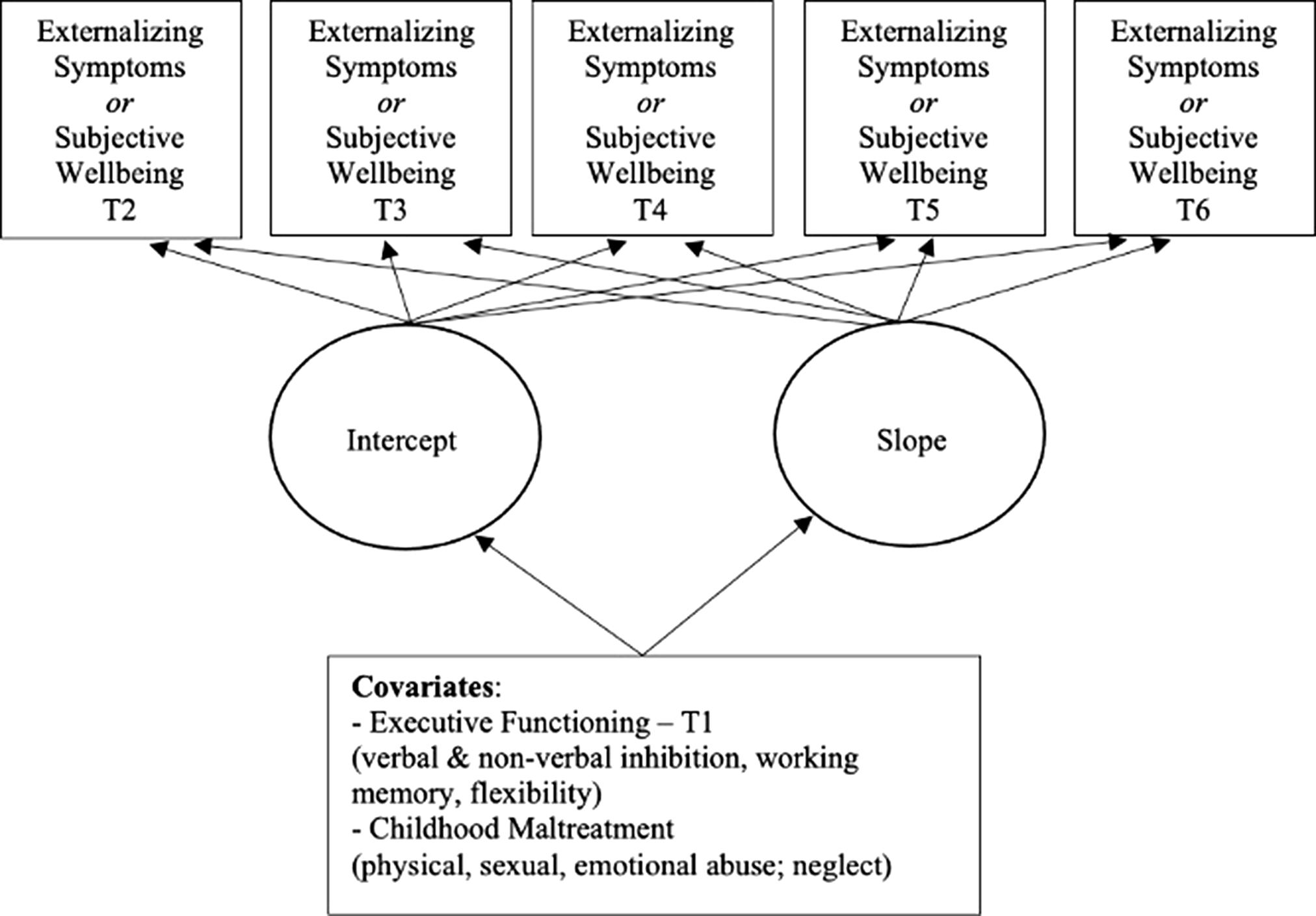
Next, we examined each of the possible combinations of childhood maltreatment × EF interactions individually to test whether EF moderates the relation between childhood maltreatment and either externalizing or subjective wellbeing outcomes. To test moderation while controlling for main effects, we conducted separate analyses for each EF and maltreatment combination by entering one of the childhood maltreatment variables, one of the EF variables, and the corresponding childhood maltreatment × EF interaction terms (see Figure 1 for the conceptual model). For significant childhood maltreatment × EF interactions, we conducted post-hoc probing using methods described by Aiken and West (Reference Aiken and West1991) and Holmbeck (Reference Holmbeck2002). Specifically, we created new conditional moderator variables (±1 SD from the z-scored values for EF variables) to reflect higher and lower EF scores. New interaction terms were created that included the conditional moderator. Post-hoc regressions involved simultaneous entry of the childhood maltreatment variable, the conditional EF variable, and the childhood maltreatment × conditional EF variable in predicting externalizing symptoms or subjective wellbeing. From these analyses, we derived unstandardized betas (slopes) and constants (intercepts). To graph, we included the unstandardized betas and intercepts in regression equations that are ±1 SD from the EF variable means, consistent with recommendations by Holmbeck (Reference Holmbeck2002). Despite the large sample size, we examined interactions in separate analyses given that moderation effects are notoriously difficult to detect and because small moderation effects may still be clinically significant (e.g., Dick et al., Reference Dick, Lopez, Watts, Heeringa, Reuter, Bartsch and Thompson2021; McClelland & Judd, Reference McClelland and Judd1993). Reasons for this difficulty include reduced efficiency compared to main effect analyses, measurement error and reduced reliability with interactions, and distribution of variables (McClelland & Judd, Reference McClelland and Judd1993; Vize et al., Reference Vize, Baranger, Finsaas, Goldstein, Olino and Lynam2023). In the present sample, these possibilities may be exacerbated by differences in developmental periods and assessment strategies for EF and maltreatment variables and the use of a community-based sample for which reports of maltreatment have a relatively low base rate.
Conceptual model for analysis of externalizing symptoms and subjective wellbeing across time points. T1 = time 1 (ages 10–12); T2 = time 2 (age 16); T3 = time 3 (age 19); T4 = time 4 (age 22); T5 = time 5 (age 25); T6 = time 6 (age 28).

Results
Descriptive statistics
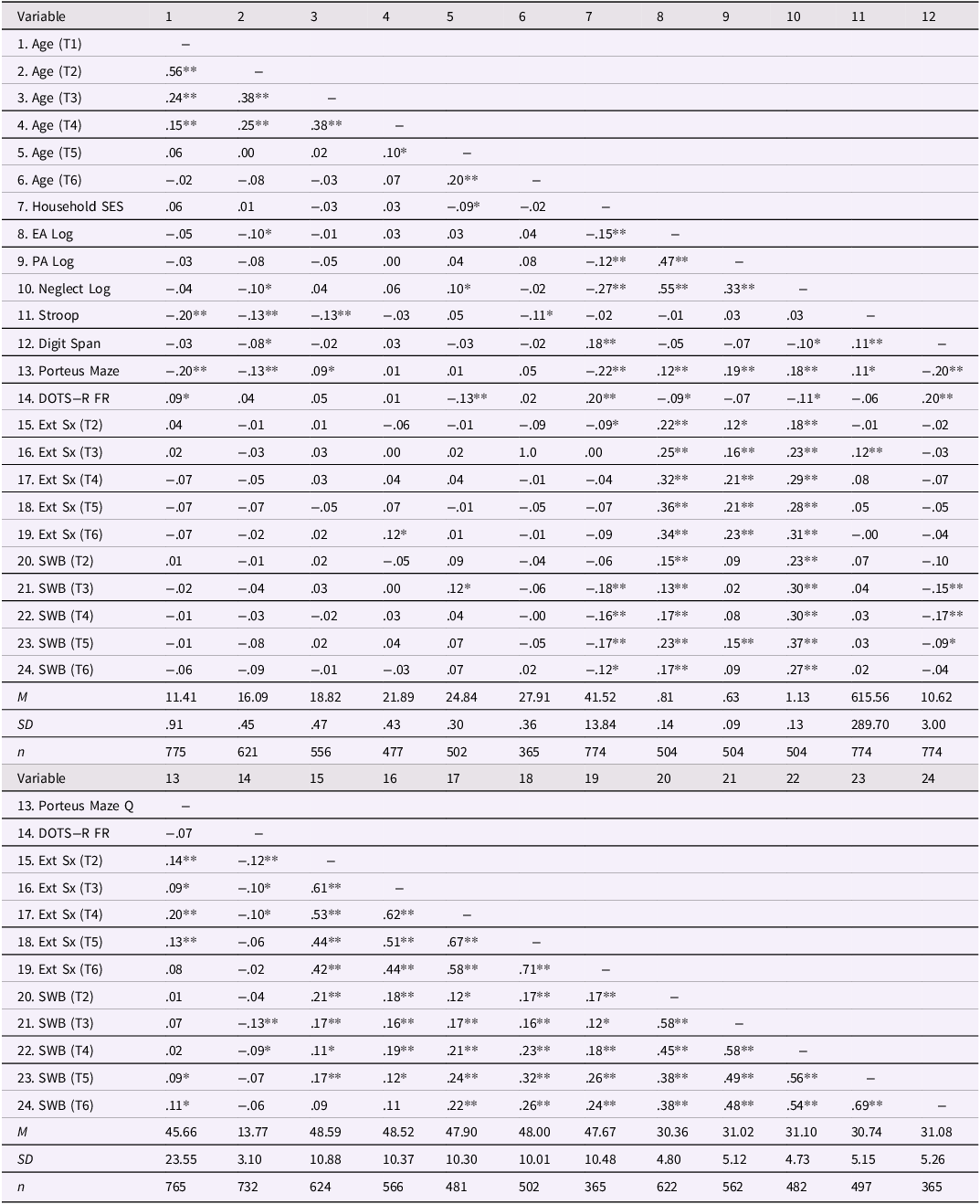
Table 1 presents means, standard deviations, ns, and intercorrelations for all study variables. There were moderate-to-high correlations between subjective wellbeing scores and between externalizing symptoms scores across time points. Childhood emotional abuse was moderately positively correlated with externalizing symptoms at Times 4 through 6. Childhood neglect was moderately positively correlated with externalizing symptoms at Time 6 and subjective wellbeing at Times 3 through 5. Emotional abuse, physical abuse, and neglect variables were moderately-to-highly positively correlated with each other, and several EF variables had low correlations in expected directions (e.g., associations between working memory and inhibition, working memory and flexibility). Emotional abuse, physical abuse, and neglect had low positive correlations with non-verbal disinhibition, though ability to assess associations between childhood maltreatment and EF was limited by differences in timing of the assessments. Given the sample size, many other correlations were significant as well; however, most significant correlations were of low magnitude (r < .20).
Bivariate correlation coefficients, means, standard deviations, and ns of continuous study variables

Note. T1 = Time 1 (ages 10−12); T2 = Time 2 (age 16); T3 = Time 3 (age 19); T4 = Time 4 (age 22); T5 = Time 5 (age 25); T6 = Time 6 (age 28); SES = socioeconomic status; EA Log = Childhood Trauma Questionnaire Emotional Abuse scale, log transformed; PA Log = Childhood Trauma Questionnaire Physical Abuse scale, log transformed; Neglect Log = Childhood Trauma Questionnaire Neglect scale, log transformed; Stroop Interference = Stroop Color−Word Test interference score; WISC Digit Span = Wechsler Intelligence Scale for Children, 3rd Edition Digit Span subscale score; Porteus Maze Q = Porteus Maze Qualitative Score; DOTS−R FR = Dimensions of Temperament Survey−Revised Flexibility−Rigidity scale; Ext Sx = Youth Self Report Externalizing Symptoms scale (Time 2) or Young Adult Self Report and Adult Self Report Externalizing Symptoms scales (Times 3−6); SWB = Multidimensional Personality Questionnaire Subjective Wellbeing scale.
* p < .05; **p < .01.
Results of unconditional latent growth curve models
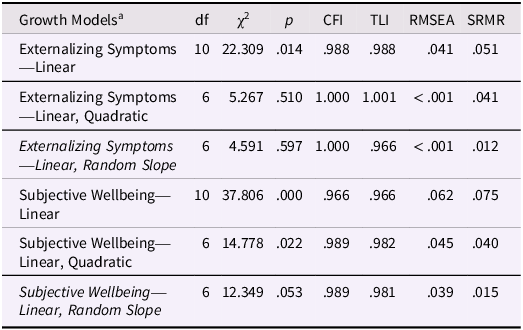
As an initial step, participants’ externalizing symptoms and subjective wellbeing scores were plotted across Times 2 through 6. Upon visual inspection, the plots suggested linear trajectories for both outcomes, but individual trajectories varied in shape. Thus, we first tested a linear growth model with outcomes set in the models to account for differences in ages across measurement timepoints (i.e., age 16 (Time 2) set @0, age 19 (Time 3) set @3, age 22 (Time 4) set @6, age 25 (Time 5) set @9, and age 28 (Time 6) set @12). The linear model for externalizing symptoms was a good fit to the data, χ 2(10) = 22.309, p = .014; CFI = .988; TLI = .988; RMSEA = .041 [90% CI: .018, .064]; SRMR = .051. Similarly, model fit was good for subjective wellbeing, χ 2(10) = 37.806, p < .001; CFI = .966; TLI = .966; RMSEA = .062 [90% CI: .042, .084]; SRMR = .075. We next tested the linear model with a freed parameter at Time 2 given variability in duration between the Time 1 (ages 10–12) and Time 2 (age 16) assessments (i.e., 4–6 years). To test whether model fit improved, we calculated 2*difference between log likelihood (LL) values for each model and compared this value to the chi-squared distribution to determine whether the model fit significantly differed (and thus improved with the freed parameter) between these models (Muthén & Muthén, Reference Muthén and Muthén1998-2017). Model fit for externalizing symptoms remained good, χ 2(9) = 17.172, p = .046; CFI = .992; TLI = .991; RMSEA = .035 [90% CI: .005, .061]; SRMR = .053. In addition, this model fit was an improvement over the linear model based on 2*LLdiff test, χ 2(1) = 5.138, p = .023. For subjective wellbeing, model fit remained good, χ 2(9) = 37.746, p < .001; CFI = .964; TLI = .961; RMSEA = .067 [90% CI: .045, .089]; SRMR = .075. However, this model fit was not an improvement from the linear model, 2*LLdiff test, χ 2(1) = 0.060, p = .807.
Next, a quadratic term was added to the model that included both the linear slope and intercept. This model showed a good fit for externalizing symptoms, χ 2(6) = 5.267, p = .510; CFI = 1.000; TLI = 1.001; RMSEA = .000 [90% CI: .000, .045]; SRMR = .041; this model was a better fit than the linear model with Time 2 freed, 2*LLdiff test, χ 2 (3) = 11.904, p = .008. For subjective wellbeing, the fit of the model adding the quadratic term to the intercept and linear slope was good, χ 2(6) = 14.778, p = .022; CFI = .989; TLI = .982; RMSEA = .045 [90% CI: .016, .075]; SRMR = .04. This model fit was also an improvement beyond the linear model with Time 2 freed, 2*LLdiff test, χ 2(3) = 22.968, p < .001. Last, we tested whether a model with a linear and random slope was a better fit to the data than the model with the linear and quadratic slopes, as the random slope model permits each individual’s slope to vary as opposed to potentially constraining slopes as with the quadratic term. The model fit remained good for externalizing symptoms, χ 2(6) = 4.591, p = .597; CFI = 1.000; TLI = 1.003; RMSEA < .001; SRMR = .012; and for subjective wellbeing χ 2(6) = 12.439, p = .053; CFI = .989; TLI = .981; RMSEA = .039; SRMR = .015. The LL for the models with quadratic and random slopes was the same; thus, these models did not differ in terms of their fit. However, because the random slope model includes the linear slope and allows each person to have a unique trajectory, it captures the specification associated with the quadratic term; thus, the random slope model was selected as the best fit for these data. See Table 2 for model comparisons.
Fit indices for linear latent growth curve models for externalizing symptoms and subjective wellbeing

a Models selected as best fitting to the data are italicized.
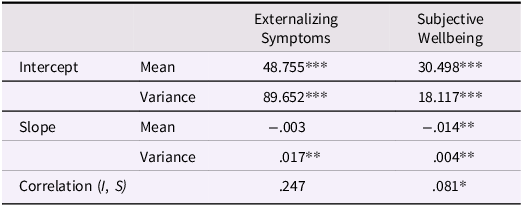
The parameter estimates for the growth factors are shown in Table 3. The slope factor mean for externalizing symptoms was not significant, meaning that on average, there was not systematic change in externalizing symptoms across time points (μ = −.003, p = .746). There was, however, a significant slope factor mean for subjective wellbeing, indicating that wellbeing decreased across time points on average (μ = −.014, p = .003). The slope variance was significant for both externalizing symptoms (σ = .017, p = .001) and subjective wellbeing (σ = .004, p = .001), indicating individual differences in change over time. In terms of the intercepts, there were significant individual differences in the status of both externalizing symptoms and subjective wellbeing at age 16. The significant positive correlation between levels of subjective wellbeing at age 16 and change in subjective wellbeing over time indicates that the higher the level of subjective wellbeing at age 16, the faster the rate of increase across time points (see Table 3). Given the differences in initial levels and developmental trends over time, this pattern of findings suggests that considering predictors that could account for the variance in these estimates would be useful.
Parameter estimates for latent growth curve models for externalizing symptoms and subjective wellbeing

* p < .05; **p < .01; ***p < .001.
Results of conditional latent growth curve models
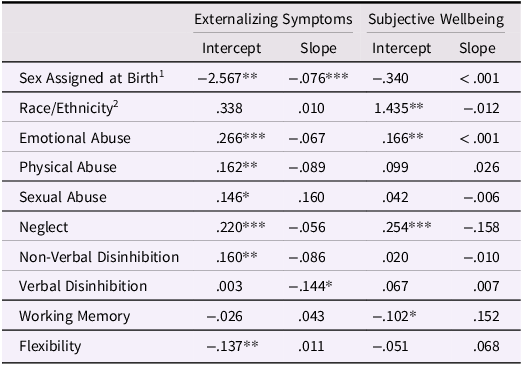
We next tested whether the intercepts and slopes of externalizing symptoms and subjective wellbeing were predicted by sex assigned at birth, race/ethnicity, experiences of childhood maltreatment, and EF performance (see Table 4 for standardized regression coefficients derived from separate consideration of each variable). Counter to expectation and previous research (e.g., Merikangas et al., Reference Merikangas, He, Burstein, Swanson, Avenevoli, Cui, Benjet, Georgiades and Swendsen2010; Rescorla et al., Reference Rescorla, Achenbach, Ivanova, Dumenci, Almqvist, Bilenberg, Bird, Wei Chen, Dobrean, Döpfner, Erol, Fombonne, Fonseca, Frigerio, Grietens, Hannesdottir, Kanbayashi, Lambert, Larsson, Leung, Xianchen Liu, Minaei, Mulatu, Novik, Oh, Roussos, Sawyer, Simsek, Steinhausen, Weintraub, Weisz, Metzke, Wolanczyk, Yang, Zilber, Zukauskiene and Verhulst2007), participants with female sex assigned at birth reported higher levels of externalizing symptoms at age 16, as well as a higher rate of change in externalizing symptoms over time. However, it should be noted that males far outnumber females in the present sample, and that externalizing symptom scores at this time point were below clinical threshold for both males and females (average Ts = 47.9 and 50.4, respectively). Results indicated that non-White participants (including participants identifying as Black/African American and multiracial) reported higher levels of subjective wellbeing at age 16. Though the majority of the present sample identified as White, this result suggests that youth identifying as Black/African American and multiracial may report higher levels of positive adjustment in mid-adolescence.
Standardized regression weights for individual prediction of intercepts and slopes for externalizing symptoms and subjective wellbeing

* p < .05; **p < .01; ***p < .001.
1 Coded as 0 = female, 1 = male.
2 Coded as 1 = White, 2 = Non−White (Black/African American, multiracial).
When examined in separate analyses, emotional abuse, physical abuse, sexual abuse, and neglect were all positively associated with levels of externalizing symptoms at age 16. Emotional abuse and neglect were also positively associated with levels of subjective wellbeing at this age. However, maltreatment variables were not significant predictors of growth in externalizing symptoms or subjective wellbeing over time. In terms of EF variables, higher levels of flexibility and non-verbal inhibition were associated with lower levels of externalizing problems at age 16. Working memory was negatively associated with levels of subjective wellbeing at age 16. Contrary to expectation, higher levels of verbal disinhibition (i.e., lower levels of verbal inhibition; indexed by the Stroop) were associated with a higher rate of decrease in externalizing symptoms over time. EF variables did not predict change in subjective wellbeing over time.
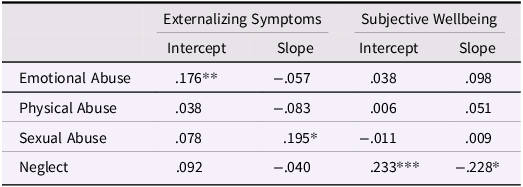
When all four childhood maltreatment variables were included in one regression analysis, emotional abuse remained positively associated with externalizing symptoms at age 16 and neglect was still positively associated with subjective wellbeing at age 16 (Table 5). However, the significant associations between physical abuse, sexual abuse, and neglect with externalizing symptoms at age 16, as well as the significant associations between emotional abuse and subjective wellbeing at age 16, were no longer significant. Although maltreatment variables were not significant predictors of growth in externalizing symptoms or subjective wellbeing over time when considered separately, sexual abuse significantly predicted the change in externalizing symptoms over time and neglect significantly predicted subjective wellbeing over time when controlling for other forms of childhood maltreatment.
Standardized regression weights for individual prediction of intercepts and slopes for externalizing symptoms and subjective wellbeing by childhood maltreatment variables when examined simultaneously

* p < .05; **p < .01; ***p < .001.
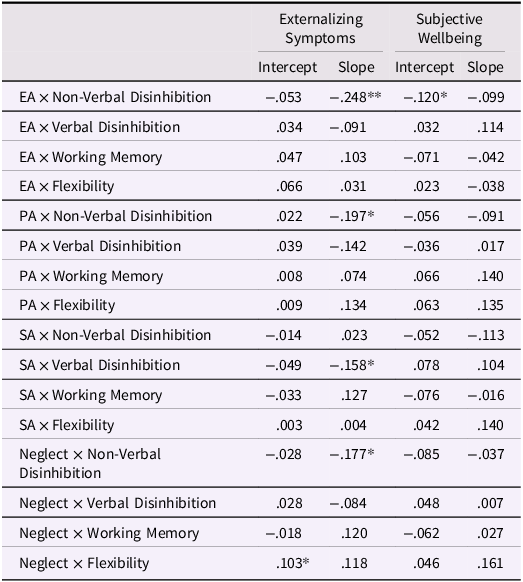
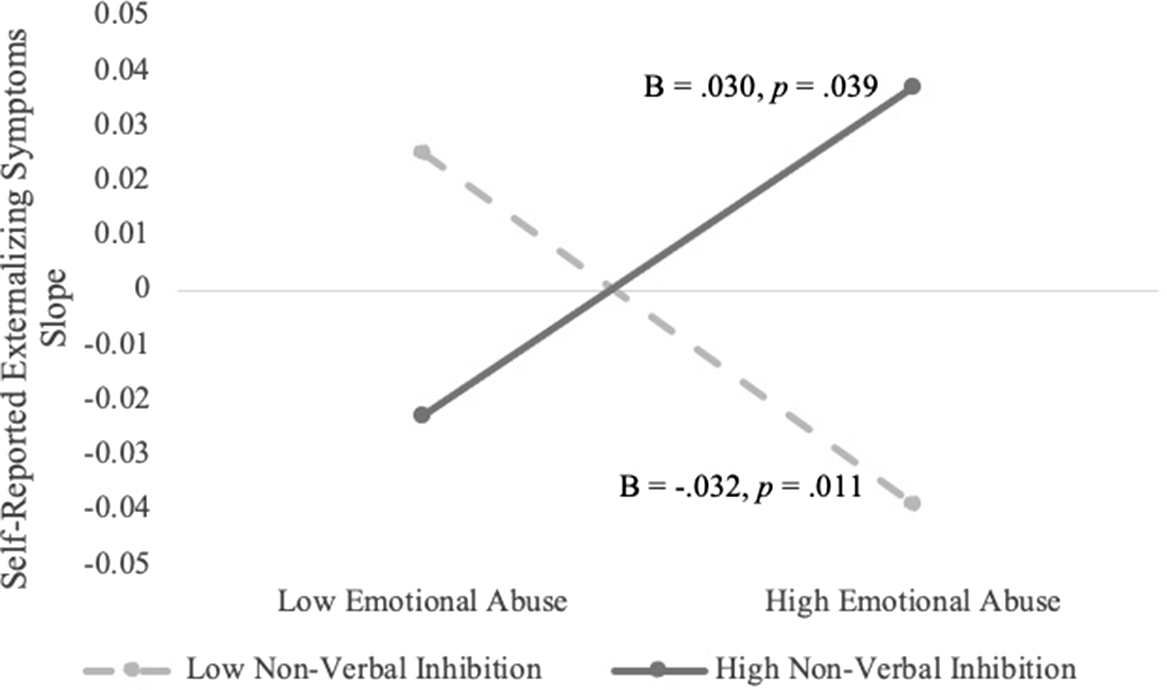
When separate analyses were run for each possible combination of one EF variable, one maltreatment variable, and their childhood maltreatment × EF interaction terms as predictors of the intercept and slope of the externalizing symptom and subjective wellbeing outcome variables, several significant findings emerged (see Table 6). The level of externalizing symptoms at age 16 was predicted by the Neglect × Flexibility interaction term (β = .103, p = .042). The level of subjective wellbeing at age 16 was predicted by the Emotional Abuse × Non-Verbal Inhibition interaction term (β = −.120, p = .015). Change in externalizing symptoms was predicted by the Sexual Abuse × Verbal Inhibition interaction term (β = −.158, p = .039); and Emotional Abuse (β = −.248, p = .002), Physical Abuse (β = −.197, p = .039), and Neglect (β = −.177, p = .038) × Non-Verbal Inhibition interaction terms. Although this study was exploratory, we note that after applying a Bonferroni correction with a threshold of .0125 (to account for 16 comparisons for each outcome), the only significant interaction remaining was the Emotional Abuse × Non-Verbal Inhibition predicting change in externalizing symptoms over time, β = −.248, p = .002.
Standardized regression weights for childhood maltreatment × executive functioning interaction terms in prediction of latent growth curve models for externalizing symptoms and subjective wellbeing

Note. EA = emotional abuse; PA = physical abuse; SA = sexual abuse.
* p < .05, **p < .01.
Post-Hoc probing findings for externalizing symptoms
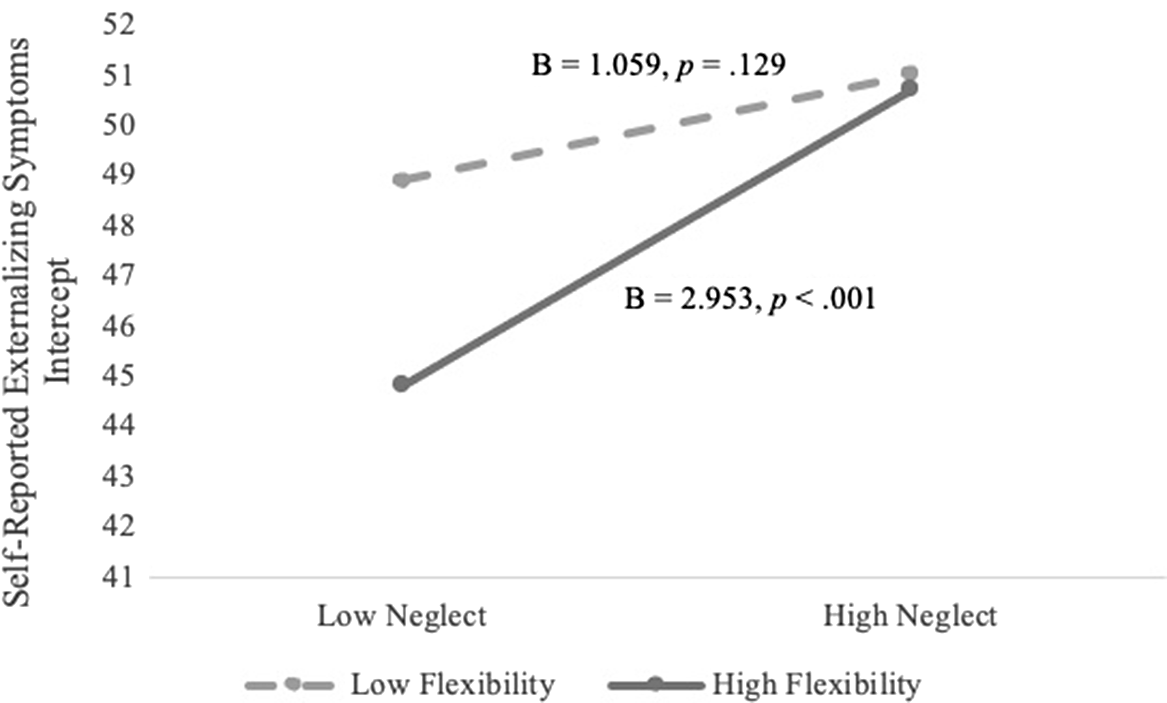
With regard to the relation between neglect and externalizing symptoms, post-hoc probing indicated that the level of flexibility predicts externalizing symptoms at age 16, such that individuals with lower levels of neglect in childhood and higher levels of flexibility report lower levels of externalizing problems (B = 2.953, p < .001). Those individuals with lower levels of flexibility have similar levels of externalizing symptoms at age 16 regardless of experiences of neglect (B = 1.059, p = .129; see Figure 2).
Interaction between neglect experiences and flexibility in the prediction of externalizing symptoms intercept (age 16).

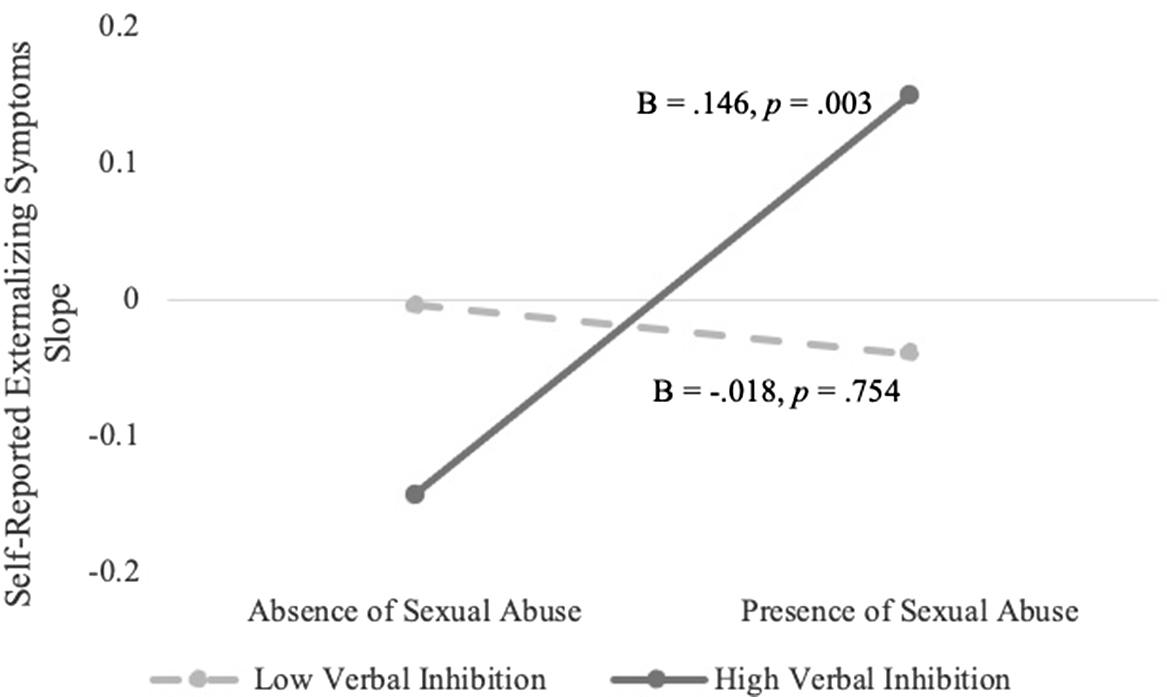
Regarding the relation between emotional abuse and externalizing symptoms, post-hoc probing revealed significant slopes at both high (B = −.032, p = .011) and low (B = .030, p = .039) levels of non-verbal disinhibition, indicating that a combination of higher levels of emotional abuse and (a) higher levels of non-verbal disinhibition (i.e., lower levels of non-verbal inhibition) were associated with decreasing externalizing symptoms over time, and (b) lower levels of non-verbal disinhibition (i.e., higher levels of non-verbal inhibition) were associated with increasing externalizing symptoms over time (see Figure 3). Finally, with regard to the relation between sexual abuse and externalizing symptoms, post-hoc probing revealed a significant slope at lower levels of verbal disinhibition (B = .146, p = .003), such that a combination of endorsed sexual abuse and lower levels of verbal disinhibition (i.e., higher levels of verbal inhibition) is associated with increasing externalizing symptoms over time. Participants who have higher levels of verbal disinhibition (i.e., lower levels of verbal inhibition) reported similar rates of change of externalizing symptoms regardless of whether sexual abuse was present (see Figure 4).
Interaction between emotional abuse experiences and non-vebal inhibition in the prediction of slope of externalizing symptoms.

Interaction between experience of sexual abuse and vebal inhibition in the prediction of slope of externalizing symptoms.

The slopes derived from post-hoc probing of the two remaining significant interaction terms (Physical Abuse × Non-Verbal Inhibition and Neglect × Non-Verbal Inhibition) were not significant; thus, these findings were not explored further.
Post-Hoc probing findings for subjective wellbeing
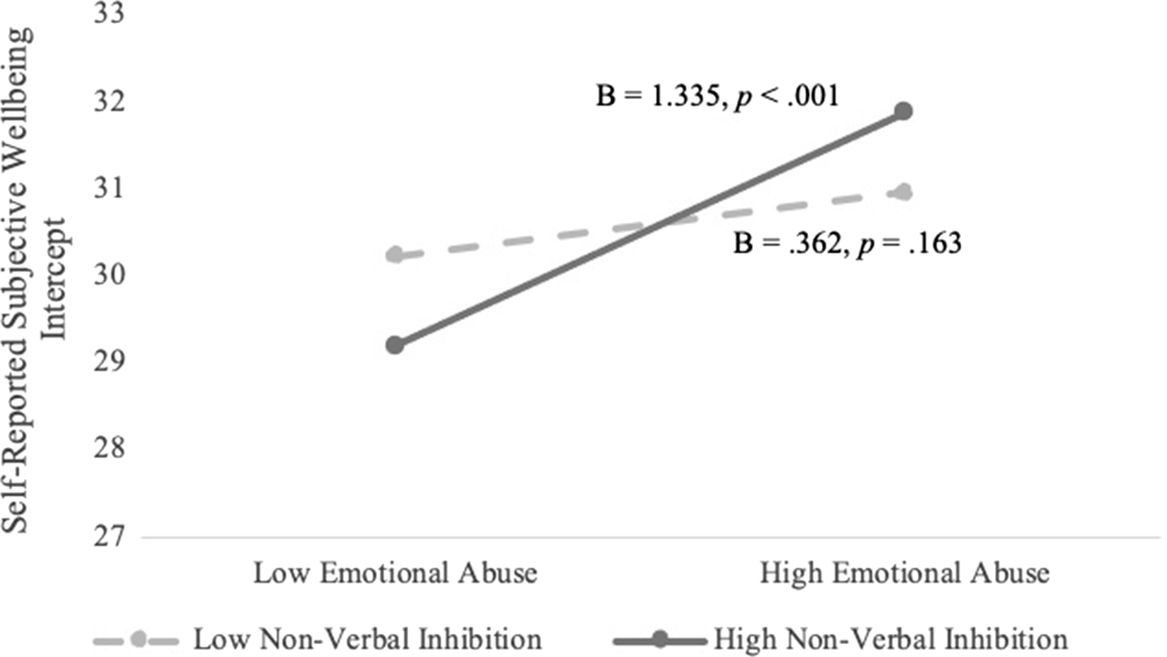
With regard to the relation between emotional abuse and subjective wellbeing, post-hoc probing revealed that level of non-verbal inhibition predicted the level of subjective wellbeing at age 16 (B = 1.335, p < .001), such that individuals with lower levels of non-verbal disinhibition (i.e., higher levels of non-verbal inhibition) report greater subjective wellbeing at this age in the context of higher levels of emotional abuse. Individuals with higher levels of non-verbal disinhibition (i.e., lower levels of non-verbal inhibition) reported similar subjective wellbeing at age 16 regardless of levels of experience of emotional abuse (see Figure 5).
Interaction between emotional abuse experiences and non-vebal inhibition in the prediction of subjective wellbeing intercept (age 16).

Discussion
Although youth who have experienced maltreatment are at risk for a range of negative mental and physical health outcomes, childhood maltreatment demonstrates multifinality, as these youth may experience not only low or absent behavioral difficulties during the transition to adulthood, but potentially higher or increasing levels of subjective wellbeing over time. Nevertheless, there is a paucity of research considering risk and resilience among individuals who have experienced childhood maltreatment using a prospective design, and even less attention to the potential role of EF in terms of risk or resilience for externalizing behaviors and subjective wellbeing across developmental periods. The current study identified externalizing symptom trajectories and subjective wellbeing trajectories among individuals who were assessed from adolescence to young adulthood. Results provide evidence that childhood maltreatment and EF variables are predictive of externalizing problems and subjective wellbeing at age 16, though not in the expected direction for subjective wellbeing. Verbal inhibition was predictive of change in externalizing symptoms over time. EF variables also moderated childhood maltreatment variables in the prediction of externalizing symptoms and subjective wellbeing at age 16, as well as change in externalizing symptoms over time.
In identifying latent growth curve trajectories for both externalizing symptoms and subjective wellbeing, we found that models that included a linear slope with either a quadratic or random slope term provided a similarly good fit to the data. Externalizing symptoms and subjective wellbeing remained generally stable across study time points (ages 16 to 28), though there was variability among individuals. In line with hypotheses, the present study found that all forms of childhood maltreatment examined (emotional abuse, physical abuse, sexual abuse, and neglect) were positively associated with externalizing symptoms at age 16, though at varying magnitudes ranging from B = .146, p = .012 (sexual abuse) to .266, p < .001 (emotional abuse) when considered in separate equations. These results are consistent with previous findings suggesting that youth who are exposed to maltreatment, which often involves coping with uncertainty, are more alert to potentially threatening stimuli in their environments and have greater difficulty modulating emotional responses to threat (Gee et al., Reference Gee, Gabard-Durnam, Flannery, Goff, Humphreys, Telzer, Hare, Bookheimer and Tottenham2013; Heleniak et al., Reference Heleniak, Jenness, Vander Stoep, McCauley and McLaughlin2016; Pollak & Tolley-Schell, Reference Pollak and Tolley-Schell2003). Per Social Learning Theory (Bandura, Reference Bandura1977), it may also be that youth who are exposed to adults’ demonstrating violent or aggressive behavior will model that behavior in their interactions with others. Consistent with this possibility, the present findings are in line with previous work among youth exposed to marital violence (McCloskey & Lichter, Reference McCloskey and Lichter2003) and physical abuse (Dodge et al., Reference Dodge, Bates and Pettit1990). Of note, when forms of maltreatment competed against each other in the same model, only emotional abuse was positively associated with externalizing symptoms at age 16, though intercorrelations between maltreatment types may have resulted in shared variance and thus reductions in predictive power when examined jointly.
Mounting evidence indicates that the long-term consequences of childhood neglect, the most common form of maltreatment recorded by CPS (i.e., more than 4 times more common than the next highest category of physical abuse; U.S. Department of Health & Human Services et al., 2022), is as impactful as various forms of abuse in terms of mental and physical health outcomes (Gilbert et al., Reference Gilbert, Widom, Browne, Fergusson, Webb and Janson2009; McGuire et al., Reference McGuire, Cho, Huffhines, Gusler, Brown and Jackson2018). However, a large nationally representative study found that among the various forms of maltreatment, neglect was the only form of childhood maltreatment that was non-significant in the prediction of externalizing psychopathology (Keyes et al., Reference Keyes, Eaton, Krueger, McLaughlin, Wall, Grant and Hasin2012). In the present study, neglect was predictive of externalizing symptoms at age 16 along with other forms of maltreatment. In addition, the neglect variable was highly correlated with emotional abuse and moderately correlated with physical abuse, indicating that individuals report co-occurrence of these maltreatment experiences, at least in the present sample. It may be that youth who experience neglect do not receive as many opportunities to learn and practice prosocial behaviors with caregivers or have adapted to be more aggressive and impulsive (e.g., to gain access to limited material or emotional resources) as a mechanism of survival.
Interestingly, contrary to hypotheses, the present study also found that emotional abuse and neglect were significant predictors of greater subjective wellbeing at age 16. It may be that at this point in mid-adolescence, which is often associated with greater freedom and independence from caregivers, as well as increasing focus on peers and identity development (Branje et al., Reference Branje, De Moor, Spitzer and Becht2021; Steinberg, Reference Steinberg2008), youth who experienced less emotional support or positive reinforcement at home experience a greater sense of wellbeing (e.g., positive affect, optimism about the future) because of increased opportunities to autonomously form more intimate peer relationships, extend their support network beyond the home, succeed in school and future-oriented planning, and/or potentially earn income. Although the study design precludes determination of the timing of onset of maltreatment experiences, it is possible that youth who experienced emotional abuse or neglect in early life may have made a concerted effort to find connection and opportunities for establishing self-esteem or self-confidence outside of the home. The emotional rewards of increased freedom and independence among adolescents with a history of lower levels of support and fewer resources may also explain the unexpected moderate positive correlations (r ≥ .30) between neglect in childhood and subjective wellbeing between ages 19 and 25. Of note, when considering childhood maltreatment variables together in one model, only neglect was a significant predictor of subjective wellbeing at age 16. Nevertheless, given the low magnitude of betas, low base rates for maltreatment, and the exploratory nature of the study, more research will be needed to determine the generalizability of these results.
The present study did not find that experiences of childhood maltreatment influenced change in externalizing symptoms or subjective wellbeing over time when maltreatment variables were examined separately, meaning that levels of externalizing problems and wellbeing did not differ across late adolescence and young adulthood based on self-reported maltreatment experiences. It may be that the assessment period between 16 and 28 years of age captures a period of time characterized by autonomy and identity-forming transitions, with greater shifts in subjective wellbeing and externalizing symptoms potentially occurring prior to this assessment period. Alternatively, the lack of prediction may be due to the limited growth in externalizing symptoms and subjective wellbeing over time, which constrained the variability that predictor variables could account for in slopes. However, when considering childhood maltreatment variables together in one model, presence of sexual abuse was predictive of increases in externalizing symptoms, and neglect was predictive of decreases in subjective wellbeing, over time. Despite low base rates of sexual abuse reported in the present sample, this finding suggests that sexual abuse may confer greater risk for externalizing problems over time than other forms of maltreatment. As discussed further below, these findings may reflect the deleterious impact of sexual abuse on the ability to develop trust and manage boundaries in interpersonal relationships, and of neglect on sense of security and ability to initiate and maintain emotional connections, during the transition to adulthood.
Consistent with prior studies (see Yang et al., Reference Yang, Shields, Zhang, Wu, Chen and Romer2022, for a meta-analysis), the present study found that flexibility and non-verbal inhibition (but not verbal inhibition or working memory) were negatively associated with externalizing symptoms at age 16. Thus, youth whose parents report that they behave in a more rigid manner and have greater difficulty adapting to new environments in middle childhood also endorsed greater struggles with temper outbursts and aggressive or impulsive behaviors several years later. It has been suggested that youth who experience externalizing symptoms may not utilize opportunities to foster greater flexibility when they arise because of limited or challenging social interactions with parents and peers, which may disrupt development of this skill (Brieant et al., Reference Brieant, King-Casas and Kim-Spoon2022). In light of the gap of time between assessment of flexibility (ages 10−12) and assessment of externalizing symptoms (age 16), this finding highlights the potential utility of assessment of flexibility and inhibition in middle childhood for identifying youth at risk for externalizing symptoms in mid-adolescence.
Contrary to expectations, working memory was negatively associated with subjective wellbeing at age 16, such that higher levels of working memory were associated with lower levels of subjective wellbeing. However, literature assessing these processes concurrently is mixed (Brose et al., Reference Brose, Lövdén and Schmiedek2014). For example, some studies have found that greater positive affect is associated with greater task engagement (Salanova et al., Reference Salanova, Llorens and Schaufeli2011), which may suggest more optimal working memory (Brose et al., Reference Brose, Lövdén and Schmiedek2014). However, other experimental studies have found the opposite (Mitchell & Phillips, Reference Mitchell and Phillips2007), which may reflect a mismatch between the broader repertoire of thoughts and creative problem-solving that accompanies positive affect, and the narrowing of attention and low distractibility required to succeed in a working memory laboratory task (though this may be counteracted by high motivation; Brose et al., Reference Brose, Lövdén and Schmiedek2014). Additional research is needed to clarify this finding and the potentially unique role of working memory among the various domains of EF.
Unlike prior longitudinal studies that have found that improvement in externalizing symptoms across childhood is associated with higher inhibitory control and lower impulsivity (Eisenberg et al., Reference Eisenberg, Valiente, Spinrad, Cumberland, Liew, Reiser, Zhou and Losoya2009; Perry et al., Reference Perry, Calkins, Dollar, Keane and Shanahan2018), findings from the main effect analyses in the present study indicated that higher verbal disinhibition (i.e., lower verbal inhibition as measured by the Stroop task) was predictive of greater decreases in externalizing symptoms over time. Of note, because the slope of externalizing symptoms was relatively stable across time points and not significant, the decrease in symptoms predicted by verbal inhibition is relatively minor in magnitude. Nevertheless, youth who have difficulties with inhibition in middle childhood may be more likely to be identified and receive intervention, or develop their own coping strategies, resulting in gradually decreasing externalizing symptoms over time as they learn to manage challenges across various settings. We did not find support for other domains of EF as predictors of change in externalizing symptoms over time, perhaps because of the low base rates of and nonsignificant slope for externalizing problems (e.g., Brieant et al., Reference Brieant, King-Casas and Kim-Spoon2022; King et al., Reference King, Lengua and Monahan2013; LaGasse et al., Reference Lagasse, Conradt, Karalunas, Dansereau, Butner, Shankaran, Bada, Bauer, Whitaker and Lester2016).
Analyses exploring childhood maltreatment × EF interaction terms as predictors of the levels of externalizing symptoms and subjective wellbeing at age 16 elucidated two significant results. First, higher levels of flexibility were predictive of lower externalizing symptoms at age 16 in the context of lower levels of neglect, but level of flexibility did not influence externalizing symptoms at age 16 in the context of higher levels of neglect, suggesting a potentially protective association of flexibility among youth experiencing more emotionally and/or materially supportive home environments. This result is in line with a recent study finding that cognitive flexibility in childhood was a particularly important factor among EF domains for attenuating risk for psychopathology, including externalizing symptoms, in emerging adulthood (Orm et al., Reference Orm, Andersen, Teicher, Fossum, Øie and Skogli2023). Indeed, this association may be because rigidity (i.e., low flexibility) reduced the likelihood of goal attainment and thus increased anger and frustration (Morris & Mansell, Reference Morris and Mansell2018). It should be noted that inflexibility is also associated with an “overcontrolled” presentation, which, particularly in combination with greater attunement to threat in the context of maltreatment, may be a risk factor for internalizing symptoms (Gilbert et al., Reference Gilbert, Sudit, Fox, Barch and Luby2022). To evaluate this possibility, future studies should investigate whether lower flexibility is a risk factor specific to externalizing behaviors, internalizing symptoms, or a shared process that may account for their frequent co-occurrence.
Second, higher levels of non-verbal inhibition were associated with higher subjective wellbeing at age 16 in the context of higher levels of childhood emotional abuse. Adolescents who are provided with less positive reinforcement at home but are able to employ effortful control may present as highly functional in school and social settings. As such, they may form positive, affirming relationships and build hopeful expectations for the future as they achieve greater independence and approach adulthood. This finding is interesting to consider in the context of the emerging body of human research on specialization and sensitization hypotheses, which propose that early life stress exposure may regulate the development of cognitive skills to promote survival and achieve success within an adverse environment (Ellis et al., Reference Ellis, Bianchi, Griskevicius and Frankenhuis2017). For example, studies have demonstrated enhanced performance in non-verbal inhibition tasks among individuals with low subjective perception of social class (Na & Chan, Reference Na and Chan2016). Thus, non-verbal inhibition may be further explored in future research as a domain of EF that confers resilience in the context of higher levels of emotional abuse.
Analyses investigating the interactions between childhood maltreatment and EF in the prediction of slopes over time revealed two significant findings. In the context of greater childhood emotional abuse, lower levels of non-verbal inhibition were associated with decreasing externalizing symptoms across time points, and higher levels of non-verbal inhibition were associated with increasing externalizing symptoms across time points. Youth with lower inhibition living in home environments in which they feel verbally demeaned and provoked by family members may react by exhibiting greater externalizing symptoms in adolescence, but have fewer difficulties once they achieve greater distance and autonomy from these family members over the young adulthood period. Past research has described a “vicious cycle” toward adolescent externalizing problems that stems from interactions between lower levels of response inhibition in the adolescent with negative parenting practices (e.g., maternal inconsistency in discipline; Wang et al., Reference Wang, Chassin, Lee, Haller and King2017), which may wane with the transition to novel contexts in young adulthood. In contrast, youth with higher inhibition may be able to suppress aggressive or impulsive reactions while in this home environment (and avoid detection and referral for intervention within a structured school environment), but exhibit more externalizing symptoms once they experience fewer interactions with emotionally threatening figures during young adulthood. As noted, some youth who have experienced maltreatment may develop adaptive skills to manage adverse or threatening environments (Ellis et al., Reference Ellis, Bianchi, Griskevicius and Frankenhuis2017), such as inhibiting actions that may prompt an abusive response; however, these individuals may struggle once the immediate threat has passed. This outcome may be because of an inability to effectively maintain use of suppression and avoidance strategies, or potentially a general disruption to emotion regulation processes secondary to early maltreatment experiences (Gruhn & Compas, Reference Gruhn and Compas2020).
Similarly, the combination of presence of childhood sexual abuse and higher levels of verbal inhibition was associated with increasing externalizing symptoms across time. Youth who experience sexual abuse and demonstrate higher levels of inhibitory control may not present as outwardly aggressive or impulsive during mid-adolescence. Instead, they may still benefit from the structure and support of the school environment, yet gradually exhibit greater difficulties negotiating and managing boundaries in interpersonal relationships (including romantic and sexual relationships) over the transition to adulthood. There is evidence for a deleterious long-term impact and risk for externalizing behaviors in adolescence and early adulthood among individuals who experienced childhood sexual abuse prior to adoption (Crea et al., Reference Crea, Easton, Florio and Barth2018), consistent with findings that sexual abuse was the only maltreatment variable to predict the slope of externalizing problems when considered in the context of the other forms of maltreatment. This association suggests the need for preventive interventions to focus on honing coping strategies that will be adaptive in the long-term (Gruhn & Compas, Reference Gruhn and Compas2020). Of note, given the low base rate of endorsement of child sexual abuse (n = 24 participants), interpretations should be made with caution and future research into risk, resilience, and mechanisms would be necessary to test these possibilities.
Strengths, limitations, and future directions
The present study has several strengths. One is the large and diverse sample who participated at time points spanning from middle childhood to young adulthood, which allowed us to prospectively consider processes of interest (externalizing symptoms, subjective wellbeing) across key developmental periods. By examining externalizing symptoms dimensionally as opposed to particular diagnostic categories, we also captured variation at the subclinical level (Fleming et al., Reference Fleming, Stevens, Vivero, Patwardhan, Nelson, Nelson, James, Espy and Mason2020). Further, we were able to examine both child-specific (EF) and contextual (maltreatment) factors as predictors of the intercepts and slopes of developmental pathways, and differentially consider various domains of EF and forms of maltreatment. Previous work has been hampered by reliance on single informants or EF tasks assessing only single EF domains, for example; thus, the present study’s use of multiple levels of analysis (neuropsychological tasks, caregiver and self-report questionnaires) addresses these issues and attenuates potential confounds associated with mono-method and mono-reporter biases.
The present study has several potential limitations. Overall, the use of an existing dataset introduces constraints regarding variables and participants that can be included in analyses. For example, EF factors were not assessed prior to age 10 and thus could not be examined prior to this point or consistently over time, which limits our ability to understand developmental changes in these factors, their functioning in earlier childhood, or transactional relations between EF and externalizing problems and wellbeing. However, given that a key aim was to identify a temporal predictor of long-term psychosocial adjustment that may be identifiable during school-aged years and amenable to intervention, examining EF at one time point is considered beneficial for this purpose. We chose to use multiple levels of analysis to approximate the construct of EF given that laboratory tasks and questionnaires are unlikely to be correlated and thus can provide differential understanding of the domains of EF that may be associated with externalizing behaviors and subjective wellbeing; nevertheless, the inconsistency in method of assessing EF domains (i.e., caregiver-report measure for flexibility vs. neuropsychological task for working memory and inhibition) may also be considered a limitation. More specifically, the caregiver-report measure captures flexibility as it presents behaviorally as observed by others, as opposed to the task-based measures that capture inhibition and working memory in a manner that potentially reduces observer bias, but may have differential external validity in terms of day-to-day impact in functioning. In addition, we were unable to determine whether the caregiver who reported on youth flexibility at ages 10 to 12 may have perpetrated maltreatment that was endorsed by the participants retrospectively at age 25, and whether this may have influenced the finding that lower level of caregiver-reported flexibility was associated with higher levels of reported emotional abuse and neglect.
Given the dearth of research that has concurrently examined effects of EF and maltreatment on these outcomes and documented difficulties in identifying moderation effects that may be clinically significant (e.g., related to reduced efficiency, measurement error, reduced reliability, low base rates, and distribution of variables; Dick et al., Reference Dick, Lopez, Watts, Heeringa, Reuter, Bartsch and Thompson2021; McClelland & Judd, Reference McClelland and Judd1993; Vize et al., Reference Vize, Baranger, Finsaas, Goldstein, Olino and Lynam2023), we did not initially employ corrections for the number of interactions considered in this exploratory study with a non-clinical sample. Interaction effects are a cornerstone of resilience research (Roosa, Reference Roosa2000); particularly given the large sample included in the present study, we chose to be inclusive of potentially important moderators that could serve as targets of prevention and intervention and thus foci for future research. Additionally, we note that it is important to consider the difference between statistical versus clinical significance. Despite low base rates of certain variables of interest (e.g., sexual abuse experiences), we were nevertheless more likely to detect statistically significant findings given the large sample size, but statistical significance does not necessarily signify clinically meaningful scores or changes over time (Dick et al., Reference Dick, Lopez, Watts, Heeringa, Reuter, Bartsch and Thompson2021; Ranganathan et al., Reference Ranganathan, Pramesh and Buyse2015). However, we highlight that when applying a Bonferroni correction with a threshold of .0125 (to account for 16 comparisons for each outcome), the only significant interaction remaining was the Emotional Abuse × Non-Verbal Inhibition predicting change in externalizing symptoms over time, β = −.248, p = .002. This finding is potentially important for increasing attention to individuals whose suppression or avoidance strategies may be effective in mitigating externalizing problems while in negative home environments during adolescence, but who may nevertheless be at risk for increases in externalizing symptoms in young adulthood. However, it is noteworthy that other significant findings may be less robust, and potentially resulting from Type I error associated with multiple tests. Despite these reductions in significant findings, we emphasize the utility of exploratory studies of non-clinical samples in elucidating directions for future research.
Further, the utilization of self-reported childhood maltreatment data (e.g., as opposed to official records/CPS data) introduces the possibility that participants may avoid recounting painful experiences. Although using a retrospective report at age 25 may reduce the likelihood of underreporting because of fears of direct consequences for oneself and one’s family, it is possible that participants may have forgotten or misremembered aspects of experiences of maltreatment, particularly events that occurred at a young age. Participants’ perception and labeling of the relevant event(s) may also have changed as a result of time or therapeutic experiences. Participants were not asked to specify the timing of maltreatment experiences, and thus additional maltreatment may have occurred following the Time 1 assessment of the outcome variables at age 16 and the Time 2 assessment at age 19. Also, no data were collected on other experiences that may contributed to resilience in the context of maltreatment, such as formal or informal transitions to non-biological parent caregivers, participation in therapy, or other close relationships with adults during adolescence. Finally, certain types of maltreatment may be less frequent in a sample not specifically recruited based on maltreatment experience. Sexual abuse, for example, was examined as a categorical variable because of low base rates in the present sample.
Future research should aim to examine the generalizability of findings. For example, researchers may explore whether the present results extend to later developmental periods (e.g., middle and late adulthood). Although it was beyond the scope of the present study, future research may investigate internalizing symptoms as an outcome given its relevance to both childhood maltreatment and EF. It may also be informative to explore alternative methods for assessing maltreatment, including CPS documentation or other informant reports (e.g., by non-perpetrating caregivers, clinicians). Considering participants selected for higher rates of maltreatment experiences may also elucidate interesting results related to these psychosocial outcomes and potential moderators. Future research may also benefit from assessing these core EF domains at multiple levels of analysis or perhaps expanding to other cognitive processes that may reflect EF (Yang et al., Reference Yang, Shields, Zhang, Wu, Chen and Romer2022). Finally, it is unclear whether findings are specific to maltreatment or may reflect the impact of other forms of childhood adversity. Examining other forms of potentially traumatic (e.g., exposure to community or domestic violence, other exposure to actual or threatened death or injury) and adverse experiences in childhood may enrich our understanding of risk and resilience for externalizing problems and subjective wellbeing. Although different forms of maltreatment were correlated in the present sample, base rates varied. Person-centered approaches may be used in future research to examine profiles of maltreatment and adverse childhood experiences to better understand individual differences in relation to externalizing problems and subjective wellbeing.
Conclusions and clinical implications
The present findings suggest that all forms of maltreatment are predictive of higher levels of externalizing symptoms in mid-adolescence, and that emotional abuse and neglect are associated with greater subjective wellbeing in mid-adolescence. Two domains of EF (flexibility and non-verbal inhibition) were negatively associated with levels of externalizing symptoms at age 16, and working memory was negatively associated with levels of subjective wellbeing at age 16. Specific types of maltreatment interacted with certain domains of EF to predict levels of externalizing symptoms and subjective wellbeing at age 16, as well as change over time in externalizing symptoms, suggesting that it is useful to consider both contextual and child-specific factors when attempting to predict these outcomes. Further research is needed to clarify relations among variables that were not in the expected direction (e.g., negative association between working memory and wellbeing) and, given the paucity of prospective studies examining these variables during this developmental period, to replicate these findings.
In light of findings that youths’ experience of maltreatment is associated with externalizing symptoms in mid-adolescence, a critical period for establishing oneself on a healthy and adaptive path for adulthood, early and regular screening and intervention for youth experiencing childhood maltreatment are critical. Given that findings suggest potential benefits of increased levels of flexibility and inhibition among adolescents, these may serve as potential targets of treatment. Cognitive behavioral therapy (CBT)-based prevention and intervention programs targeting youth externalizing problems focus on bolstering emotion regulation skills, including skills that enable youth to flexibly adapt to new contexts and inhibit maladaptive impulses (Riise et al., Reference Riise, Wergeland, Njardvik and Öst2021). Interventions that support youth in practicing utilization of coping skills in vivo when faced with new situations or changes in plans may be particularly useful. Trauma-focused CBT, which has amassed a strong evidence base among youth who exhibit posttraumatic stress and co-occurring symptoms stemming from maltreatment experiences (Mannarino et al., Reference Mannarino, Cohen, Deblinger, Runyon and Steer2012; de Arellano et al., Reference de Arellano, Lyman, Jobe-Shields, George, Dougherty, Daniels and Delphin-Rittmon2014), incorporates activities to build affect regulation and cognitive flexibility, as well as practice tolerating trauma reminders via in vivo exposure. Further, given that participants with higher inhibition who reported childhood sexual or emotional abuse exhibited increasing externalizing symptoms, broader prevention frameworks may be useful for identifying youth at longer-term risk for externalizing problems due to difficult contextual circumstances but who nevertheless appear well-behaved in school environments. However, as prevention and intervention programs often require caregiver involvement, it is important that mental health staff assess the youths’ home environments and are thoughtful about how to recruit and retain youth who experience neglect and emotional mistreatment by caregivers, as findings suggest that these youth are at risk for externalizing symptoms. Given that lower levels of flexibility and non-verbal inhibition were associated with externalizing symptoms at age 16, additional randomized controlled trials are needed to examine long-term impact of EF training among children and whether such training can mitigate clinical symptoms, including externalizing symptoms (Yang et al., Reference Yang, Shields, Zhang, Wu, Chen and Romer2022). Critically, those designing and implementing interventions would benefit from constant consideration of contextual relevance, including consulting and collaborating with key stakeholders such as community members, caregivers, teachers, and the youth receiving the interventions to ensure that aims and strategies are meaningful, feasible, and sustainable (Luthar & Cicchetti, Reference Luthar and Cicchetti2000).
Taken together, the current findings highlight the importance of taking a developmental psychopathology approach in prospectively examining both risk and resilience in mid-adolescence and the transition to young adulthood, as well as the influence of child-specific and contextual factors, among individuals with different levels of maltreatment experiences. Findings have implications for understanding how to best support young people across key developmental transition periods, identify processes associated with different trajectories, and intervene with individuals to promote positive psychosocial adjustment.
Acknowledgments
We would like to thank Drs. Michael McCloskey, Tania Giovannetti, Philip Kendall, Ronald Taylor, and Sandra Sepulveda-Kozakowski for their thoughtful feedback on this manuscript. We are grateful to Dr. Maureen Reynolds, who was essential in assisting with preparation of the data.
Funding statement
This research was supported in part by the National Institute on Drug Abuse (grant number P50 DA 005605 awarded to Ralph E. Tarter).
Competing interests
None.