Introduction
One of the leading causes of disability, morbidity, and mortality among community-dwelling older people (aged 65 years and over) is falls (Department of Health, 2001). Falls risk is considered multi-factorial, involving extrinsic factors, such as environmental hazards, and intrinsic factors, such as age, gender and medication (Gillespie et al., Reference Gillespie, Gillespie, Robertson, Lamb, Cumming and Rowe2003). However, psychological variables associated with falls also require attention (Jung et al., Reference Jung, Lee and Lee2009), and understanding these could inform fall-prevention interventions (Tanner, Reference Tanner2007).
A key psychological concept is falls-related psychological concerns (FrPC), which encompasses: “fear of falling” (Tinetti and Speechly, Reference Tinetti and Speechly1989),“falls-related self-efficacy” (FSe) (Tinetti et al., Reference Tinetti, Richmond and Powell1990), “balance confidence” (BC) (Powell and Myers, Reference Powell and Myers1995), and “outcome expectancy” (Yardley and Smith, Reference Yardley and Smith2002). Up to 83% of community-dwelling older people experience FrPC (Zijlstra et al., Reference Zijlstra, van Haastregt, van Eijk, van Rossum, Stalenhoef and Kempen2007). FrPC have been found to predict falls (e.g. Chou et al., Reference Chou, Chi and Chiu2005).
A cognitive-behavioral model relating FrPC and falls has been developed by Hull and Kneebone (Reference Hull and Kneebone2007; Lincoln et al., Reference Lincoln, Kneebone, Macniven and Morris2012). One prediction made by this model, that has yet to be the subject of empirical evaluation, is that FrPC lead to maladaptive coping strategies, which in turn increase the risk of falling. If empirical support could be found for such a pathway, and if research could elucidate the specific nature of the maladaptive coping strategies, then interventions could be developed to reduce falls risk by targeting these coping strategies.
Coping has been defined as “constantly changing cognitive and behavioral efforts to manage specific external and/or internal demands that are appraised as taxing or exceeding the resources of the person” (Lazarus and Folkman, Reference Lazarus and Folkman1984, p.141). Coping strategies are considered to have two major functions: to deal with the problem causing distress (problem focused) or to deal with the distressing emotion (emotion focused) (Lazarus and Folkman, Reference Lazarus and Folkman1984).
Some coping responses used by community-dwelling older people (e.g. problem focused-coping, religious engagement, and using social support) have been found to predict good emotional and physical health (e.g. Catanzaro et al., Reference Catanzaro, Horaney and Creasey1995; Koenig et al., Reference Koenig, George and Peterson1998). In contrast, emotion-focused coping (e.g. escape/avoidance and distancing) is associated with increased distress (Hsu and Tung, Reference Hsu and Tung2011).
Community-dwelling older people with FrPC tend to use more coping responses than those without (Filiatrault and Desrosiers, Reference Filiatrault and Desrosiers2011). In addition, qualitative findings suggest that at least some older people cope with FrPC by exercising caution, assigning blame for and minimizing their FrPC (e.g. Ward-Griffin et al., Reference Ward-Griffin, Hobson, Melles, Kloseck, Vandervoort and Crilly2004). However, to date, no research has examined the mediating role that coping may play between FrPC and falls incidence. The aim of the current study was to begin the process of investigating this using a cross-sectional design.
Following Moore and Ellis' (Reference Moore and Ellis2008) recommendation that research studies specify the type of FrPC that they examine, we focussed on FSe, because this is a key part of Hull and Kneebone's model (Hull and Kneebone, Reference Hull and Kneebone2007; Lincoln et al., Reference Lincoln, Kneebone, Macniven and Morris2012). Drawing on this model, coping theory (Lazarus and Folkman, Reference Lazarus and Folkman1984), and the empirical literature (e.g. Hughes et al., Reference Hughes, Kneebone, Jones and Brady2015), we hypothesized that poorer FSe would be associated with higher incidence of falls (Hypothesis 1), and that coping method would statistically mediate this association; more specifically, we expected that poorer FSe would be associated with higher levels of emotion-focused and avoidant coping and lower levels of problems focussed coping (such as problem solving), which in turn would be associated with higher falls incidence (Hypothesis 2). Given that this was an initial, exploratory study, we also included measures of other forms of coping, such as religious engagement, about which we did not have clear hypotheses.
Method
Design
A cross-sectional design was employed, using measures of FSe, coping, and falls.
Participants
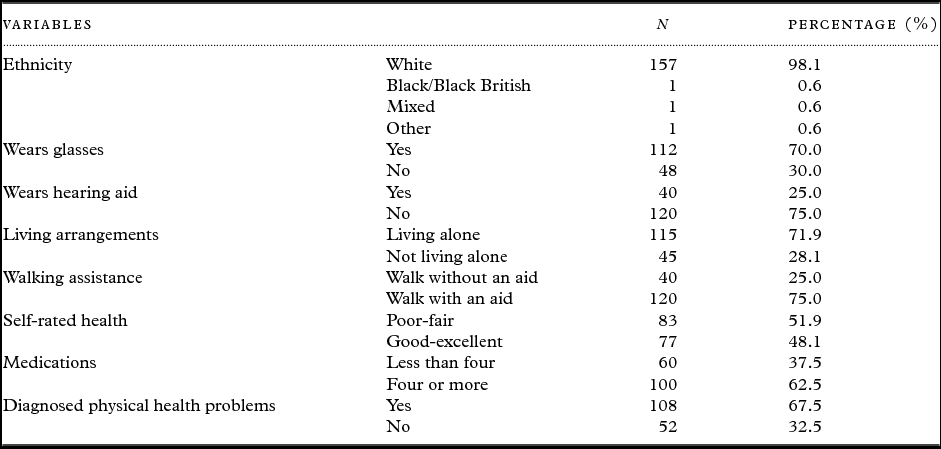
One hundred ninety-eight participants from 21 day-centers within a semi-rural UK county were approached, of whom 160 were recruited. The main reasons given by people who chose not to participate were lack of time and scheduling conflicts with other activities. All of the recruited participants met the inclusion criteria of (i) being aged 65 years or older, (ii) being community dwelling, (iii) being able to complete measures in English, and (iv) scoring at least 20 on the measure of FSe (to make it meaningful to measure coping in response to low FSe; cf. Delbaere et al., Reference Delbaere, Close, Mikolaizak, Sachdev, Brodaty and Lord2010). Therefore, no participants had to be excluded. The male:female ratio was 31:129, with a mean age of 83.47 years (SD = 7.16, range = 65–101). Ninety-three participants reported having fallen in the past 12 months, 45 of these had required medical attention following falling. Further demographic information is presented in Table 1. All participants provided written informed consent, and the study was approved by a university ethics committee.
Participant demographics

Measures
Falls Efficacy Scale–International (FES-I) (Yardley et al., Reference Yardley, Beyer, Hauer, Kempen, Piot-Ziegler and Todd2005). This 16-item, self-report measure of FSe assesses respondents’ confidence in avoiding falling when undertaking activities. Scores range from 16 (high FSe) to 64 (low FSe). It has good psychometric properties (Yardley et al., Reference Yardley, Beyer, Hauer, Kempen, Piot-Ziegler and Todd2005), and internal consistency in the current sample was good (α = 0.89).
Revised-Ways of Coping Questionnaire (WAYS) (Folkman and Lazarus, Reference Folkman and Lazarus1989). This 66 item, self-report questionnaire measures coping in relation to a specific stressor. It has eight subscales: “confrontive coping”, “distancing,” “self-controlling,” “seeking social support,” “accepting responsibility,” “escape-avoidance,” “planful problem-solving,” and “positive reappraisal.” It has previously demonstrated adequate psychometric properties (Folkman et al., Reference Folkman, Lazarus, Dunkel-Schetter, DeLongis and Gruen1986), and is viewed as the standard in the field (Schwarzer and Schwarzer, Reference Schwarzer, Christine Schwarzer, Zeidner and Morris1996). Furthermore, while this measure was developed for the general population, when it has been used with older people, concerns have not been raised about its psychometric properties (e.g. Vitaliano et al., Reference Vitaliano, Russo, Carr, Maiuro and Becker1985). However, in order to achieve an adequate internal consistency in the current sample, the number of items included in the “self-controlling,” “accepting responsibility,” and “positive reappraisal” subscales were reduced, following Anderson and Gerbing's (Reference Anderson and Gerbing1988) guidance. The original and new Cronbach's α values can be found in Tables S1 and S2 published as supplementary material online attached to the electronic version of this paper at http://journals.cambridge.org/ipg. The “confrontive” subscale was excluded due to poor internal consistency that could not be sufficiently improved by this approach. Following these changes, the included subscales had the following ranges; distancing: 0–18; self-controlling: 0–6; seeking social support: 0–18; accepting responsibility: 0–9; escape-avoidance: 0–24; planful problem-solving: 0–18; and positive reappraisal: 0–15. In all cases, higher scores indicated greater use of that form of coping. Distancing, self-controlling and escape-avoidance can be viewed as forms of emotion-focussed coping, whereas planful problem-solving can be viewed as a type of problem-focused coping.
COPE “turning to religion” subscale (Carver et al., Reference Carver, Scheier and Weintraub1989)
This subscale was used as evidence suggests that community-dwelling older people can use religion to cope with health and life stressors (Koenig et al., Reference Koenig, George and Peterson1998), and this was not adequately measured by the WAYS. The COPE has previously shown promise as a measure of coping in older people (Fisher et al., Reference Fisher, Segal and Coolidge2003), and the internal consistency of its “turning to religion” subscale, as reported by its authors (α = 0.92; Carver et al., Reference Carver, Scheier and Weintraub1989) and within the current sample (α = 0.96), was good. This subscale produces a score between 4 and 16, with higher scores indicating greater use of this form of coping.
Falls questionnaire
Following the approach adopted routinely in other studies (e.g. Shumway-Cook et al., Reference Shumway-Cook, Ciol, Hoffman, Dudgeon, Yorkston and Chan2009; Filiatrault and Desrosiers, Reference Filiatrault and Desrosiers2011), falls incidence was assessed via a self-report questionnaire. A fall was defined as “an unexpected event in which the participant comes to rest on the ground, floor, or lower level” (Lamb et al., Reference Lamb, Jorstad-Stein, Hauer and Becker2005, p. 1619). Participants were asked if they had fallen in the last 12 months and how many times they had fallen, along with questions relating to the fall(s) (e.g. time to rise). Recall of falls within 12 months has good specificity, though lower sensitivity (Ganz et al., Reference Ganz, Higashi and Rubenstein2005).
Demographics questionnaire
A self-report questionnaire measured demographics and variables identified in the literature as being falls risk factors (Hughes et al., Reference Hughes, Kneebone, Jones and Brady2015). These included age, sex, ethnicity, current living arrangements, use of glasses, use of a hearing aid, use of a walking aid, number of different medications taken, physical health, and physical health diagnoses.
Data analysis
Hayes’ (Reference Hayes2013) bootstrapping approach to mediation analysis, utilizing the PROCESS macro for SPSS, was adopted, given that it is more robust in the face of deviations from the normal distribution and frequently more powerful than alternative approaches (Fritz and MacKinnon, Reference Fritz and MacKinnon2007). FES-I score was the predictor and the number of falls (measured as a continuous variable) the response, with the coping subscales entered as parallel mediators. One thousand bootstrap samples were generated and bias corrected 95% confidence intervals calculated.
Results
Descriptive statistics
Ninety-three participants (58.1%) reported having fallen in the past 12 months, with a median number of falls of 1 (IQR = 2; range = 0–20). The median FES-I score was 37 (IQR = 16), representing low/moderate FSe (Yardley et al., Reference Yardley, Beyer, Hauer, Kempen, Piot-Ziegler and Todd2005). The median scores for the coping measures were as follows: turning to religion 5 (IQR = 7); distancing 14 (IQR = 5); self-controlling 4 (IQR = 3); seeking social support 3 (IQR = 6); accepting responsibility 1 (IQR = 1); escape-avoidance 2 (IQR = 3); planful problem-solving 9 (IQR = 5); and positive reappraisal 2 (IQR = 3).
Mediation analysis
In this section, we use the standard terminology from the mediation literature of total, direct and indirect effects (cf. Hayes, Reference Hayes2013). The word “effect” is meant in the statistical sense, as per the mediation literature, and should not be taken to imply causation.
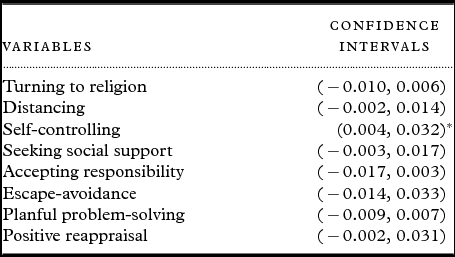
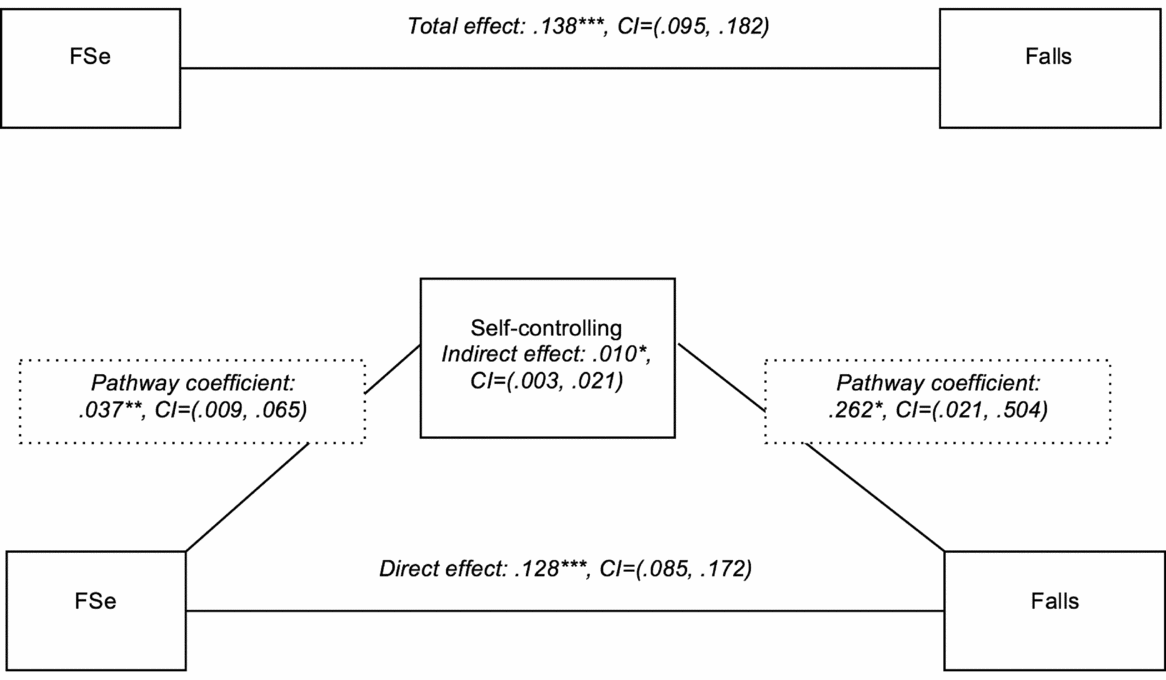
In line with Hypothesis 1, poorer FSe (i.e. higher FES-I scores) was significantly associated with a higher numbers of falls, as indicated by a 95% confidence interval for the ‘total effect’ in the mediation model that was entirely positive (0.095, 0.182). With regard to Hypothesis 2, when all the coping variables were included as parallel mediators of the FSe/falls association, the only significant mediating pathway was via the self-controlling sub-scale, as evidenced by a 95% bootstrapped confidence for its indirect effect that did not include zero (0.004, 0.032). This indicated that poorer FSe was associated with high self-controlling coping, which in turn was associated with more frequent falling. Self-controlling coping was measured by two items: “I tried to keep my feelings to myself,” and “I kept others from knowing how bad things were.” Higher self-controlling scores indicated greater reported use of these strategies.
The confidence intervals for the indirect effects for all the other potential mediators included zero (Table 2). In addition to the indirect effect, there was a significant “direct effect” between FSe and falls, as indicated by a confidence interval that did not cross zero: (0.064, 0.156). This “direct effect” was that part of the FSe-falls association that was not mediated by any of the included mediating variables. In other words, the total FSe/falls association comprised both a direct association between FSe and falls, and an indirect association between the two via self-controlling coping.
The 95% bias-corrected bootstrapped confidence intervals for the indirect effects for the variables that were included as potential mediators

* = Significant indirect effect.
In order to determine whether self-controlling coping remained a significant mediator when potential confounding variables were controlled for, the above analysis was repeated excluding the non-significant mediators, while the following variables were included as covariates: age (in years), sex (male vs. female), ethnicity (white vs. non-white), current living arrangements (alone vs. not-alone), use of glasses (yes vs. no), use of a hearing aid (yes vs. no), use of a walking aid (yes vs. no), number of different medications (less the four vs. four or more), physical health (poor vs. fair), and whether they reported having been diagnosed with any current physical health problems (yes vs. no). None of these potential confounders made a significant contribution to the model (all p > 0.15), and the significant total, indirect and direct effects found in the previous model remained significant, with respective confidence intervals of (0.083, 0.193), (0.002, 0.025), and (0.073, 0.185), none of which crossed zero.
In order to estimate the strengths of the various paths, a final bootstrapped mediation analysis was run that included only those variables that made a significant contribution in the previous models; namely FSe as the predictor, self-controlling coping as the mediator and number of falls as the response. Unsurprisingly, the total, indirect and direct effects remained significant. These, along with the strengths of the paths, are illustrated in Figure 1. The effect size for the indirect effect was κ 2 = 0.035, with a confidence interval of (0.003, 0.021). Thus, the indirect effect was in the small to medium range.
The final mediation model and associated 95% confidence intervals (CIs). Top panel: the total effect when no mediator is included. Bottom panel: the indirect and direct effects when self-controlling coping is included as a mediator. *p < 0.05, **p < 0.01, ***p < 0.0001.

Discussion
In this cross-sectional study, we sought to begin the process of exploring whether coping responses statistically mediate an association between FSe and falls incidence in community-dwelling older people, as predicted by Hull and Kneebone's (Reference Hull and Kneebone2007; Lincoln et al., Reference Lincoln, Kneebone, Macniven and Morris2012) model. To the best of our knowledge, this is the largest study to date exploring coping with FSe in this population, and the first to test for a mediating relationship (Hughes et al., Reference Hughes, Kneebone, Jones and Brady2015).
In line with our Hypothesis 1 and consistent with Hull and Kneebone's (Hull and Kneebone, Reference Hull and Kneebone2007; Lincoln et al., Reference Lincoln, Kneebone, Macniven and Morris2012) model, we found that lower FSe was associated with a higher number of falls. This finding fits with other studies that have found a similar association (for a review see Hughes et al., Reference Hughes, Kneebone, Jones and Brady2015). However, Hypothesis 2 was only partly supported. Specifically, self-controlling coping, which is a form of emotion-focused coping, was found to be a partial statistical mediator of the FSe-falls association, with a small to medium effect size. However, none of the other measured forms of coping were significant mediators.
Considering the self-controlling finding first, lower levels of FSe were associated with higher levels of self-controlling coping, which included participants attempting to hide their feelings, and “how bad things were” for them, from others. In turn, higher levels of self-controlling coping were associated with more frequent falling. While the cross-sectional nature of the design prevents us from drawing causal conclusions, this finding is nevertheless consistent with Hull and Kneebone's (Hull and Kneebone, Reference Hull and Kneebone2007; Lincoln et al., Reference Lincoln, Kneebone, Macniven and Morris2012) model, which suggests that poorer FSe will lead to maladaptive coping, which in turn will lead to increased falls risk.
It is possible that community-dwelling older people with poor FSe may use self-controlling coping because they may fear embarrassment, confirmation of perceived inefficacy, or loss of independence if others were aware of their low FSe. Furthermore, it is possible that hiding low FSe from others may mean that they are less likely to receive advice about how to reduce the risk of falling, placing them at higher risk of this than would otherwise have been the case. These hypotheses could be examined in future research, which might employ a longitudinal design, to enable conclusions in relation to prediction to be drawn.
When self-controlling coping was included in the model as a mediator, a significant direct association between FSe and falls remained. This suggests there are additional variables that mediate the FSe-falls association. However, contrary to our expectations, none of the other measured coping responses were significant mediators. It is possible that this may have been due to a lack of power, though the relatively large sample size (N = 160) makes it unlikely that the study was underpowered to detect reasonably sized mediation effects (cf. Fritz and MacKinnon, Reference Fritz and MacKinnon2007).
This study has a number of limitations. As implied earlier, the cross-sectional design means that it is not possible to draw causal conclusions from the data, nor establish the direction or hierarchy of association. Also, falls incidence was measured retrospectively. While this is common in many falls studies (Hauer et al., Reference Hauer, Lamb, Jorstad, Todd and Becker2006), it did mean that we were reliant on the accuracy of participants’ memory and that the temporal ordering of variables was opposite to that which would be ideal, with the “response” variable (number of falls) temporally preceding the “predictor” variable (falls self-efficacy). That said, past falls have been shown to predict future falls (Oliver et al., Reference Oliver, Daly, Martin and McMurdo2004) and recall of falls within the past 12 months has been shown to have good specificity (Ganz et al., Reference Ganz, Higashi and Rubenstein2005). A further limitation is that the sample was not representative of the general population of community dwelling older people in some respects, most notably ethnicity, meaning that the findings should be generalized to other ethnic groups with caution. Three of the eight measures of coping employed also had to be amended in order to improve their internal consistency, reducing the applicability of their validation data, and only one of the eight measures of coping showed a significant mediation effect. Regarding the latter, explanations for the seeming limited finding include the obvious, namely that there is only one type of coping that is of importance in the association we have explored. Other explanations relate to the possibility that our measures did not fully cover all the coping strategies of potential relevance and to the temporal aspect of coping. It is possible, for instance, that some coping strategies might be only of importance at a particular stage or stages after a fall, so their significance is unable to be captured in studies in which this is not considered. Finally, some variables that may play important roles in the associations under consideration were not measured; for example, cognitive status.
A number of these limitations stem from resources constraints, and we would argue that the primary value of this work lies in setting the groundwork and establishing the case for investing in a more resource intensive, longitudinal study that addresses these limitations. We acknowledge our understanding in this area remains limited and our findings preliminary.
In conclusion, this research has tentatively implicated a specific coping response to low falls self-efficacy as potentially having an impact on falls incidence. If future longitudinal studies, that address the limitations outlined earlier, confirm that self-controlling coping mediates an FSe-falls relationship, then self-controlling coping could become an additional target for interventions designed to reduce the incidence of falls in community dwelling older people.
Conflict of interest
None.
Description of authors’ roles
C. C. Loft designed the study, collected and analyzed the data and wrote the initial draft of the paper. I. I. Kneebone and F. W. Jones advised on study design and data analysis, and assisted with writing the paper.
Acknowledgment
We would like to thank Sarah Strohmaier for her assistance with referencing.
Supplementary material
To view supplementary material for this article, please visit https://doi.org/10.1017/S1041610217002319.