Introduction
It is now well established that the phenotype of an individual can be driven by in utero environmental conditions. This has given rise to the concept of the ‘developmental origins of health and disease’ (DOHaD) hypothesis, which implies that a stimulus or insult acting during critical periods of growth and development may result in permanent alteration of the structure, physiology and metabolism of the offspring. Maternal nutritional status has been recognized as a prominent cause of programming. To date such nutritional programming effects have been largely characterized in terms of susceptibility to non-communicable diseases and there have been outstanding reviews that summarize the existed evidence and provide background on the developmental origin of cardiovascular disease, insulin resistance and type-2 diabetes, obesity and metabolic syndrome.Reference Armitage, Khan, Taylor, Nathanielsz and Poston 1 – Reference Ojeda, Grigore and Alexander 3
As reproductive axis and its hormonal control systems are largely established in fetal life, they represent a target for developmental programming. Therefore, in the last years the DOHaD approach has been extended to encompass programming of reproductive axis and function and related data have been presented in recently published reviews.Reference Gardner, Ozanne and Sinclair 4 – Reference Dupont, Cordier and Junien 6 Specific outcomes depend on the severity, duration and stage of development when nutritional perturbations are imposed, while sex-specific effects are also manifested. Apart from undernutrition, effects of relative overnutrition, as well as the complex interactions between pre- and postnatal nutrition is of high importance, especially in the context of our days obesity epidemic.
To date the majority of data refer to the effects of undernutrition imposed during early or mid to late gestation, but it has recently been recognized that peri- and even preconceptional period may represent one of the most critical developmental windows, characterized by dynamic changes affecting future phenotype.Reference Fleming, Velazquez, Eckert, Lucas and Watkins 7 The most widely used animal models in developmental programming studies have been rodents and sheep. Although rodents offer significant advantages with respect to their short gestation period and availability of molecular tools, sheep studies provide power for translation to human pregnancy, as sheep has the advantage of a long gestation period, enabling targeting of specific developmental windows and produces a fetus comparable in size to humans.
The present review critically presents the existed evidence and reviews the available data from numerous animal experimental and human retrospective cohort studies, on the effects of early life nutritional environment on reproductive axis development and adult reproductive function. Mechanisms underlying reproductive programming and transgenerational effects are also presented.
Early life nutrition and programming of puberty onset
Neuroendocrine control mechanisms
From a neuroendocrine perspective, puberty is the reactivation of the gonadotropin-releasing hormone (GnRH) secretory system, leading to a sustained increase in pulsatile GnRH release, which stimulates the release of gonadotrophins and in turn gonadal activity.Reference Ebling 8 Several neurotransmitters and neuromodulators have been shown to control pulasatile GnRH release, among them kisspeptin plays a significant role in puberty. In fact humans with mutation in the kisspeptin receptor GPR54 exhibit delayed puberty, not puberty at all or precocious puberty.Reference Seminara, Messager and Chatzidaki 9 – Reference Semple, Achermann and Ellery 11 Following the recognition of its fundamental role in puberty onset, this peptide is now recognized as an essential endogenous regulator of the GnRH system.Reference Pinilla, Aguilar, Dieguez, Millar and Manuel Tena-Sempere 12 Although mechanisms leading to the timing of puberty differ between species, in that a gonadal steroid-independent mechanism is operative at the pubertal transition in primates (decreased tonic inhibition), whereas gonadal steroid-dependent mechanisms (decreased sensitivity to estradiol negative feedback) are involved in rodents and sheep,Reference Fink, Pfaff and Levine 13 it is now well recognized that both GnRH and kisspeptin neurons are major regulators of the preovulatorty GnRH surge in rat, sheep and human.Reference Gottsch, Cunningham and Smith 14 – Reference Dhillo, Chaudhri and Patterson 16 The most consistent population of kisspeptin neurons identified across different mammalian species is the group located in the arcuate (ARC) nucleus (infundibular nucleus in humans), but kisspeptin cell bodies have also been identified in the preoptic hypothalamic region.Reference Lehman, Merkley, Coolen and Goodman 17 Moreover, strong evidence suggest that the overall organization of the of the kisspeptin neuronal system in mammals is fairly consistent, and direct anatomical projections to GnRH neurons, at the level of both cell bodies and terminals are a common feature in mammals.Reference Goodman and Lehman 18
A tight coupling between energy homeostasis and puberty onset is well recognized and metabolic signals play a significant role in puberty.Reference Roa, García-Galiano and Castellano 19 However, in addition to postnatal nutrition, accumulating evidence indicate that nutrition during pregnancy is also an important determinant for postnatal hypothalamic regulation and subsequent function. Maternal malnutrition can influence puberty and later fertility through changes in hypothalamic circuits controlling reproduction and in most species studied so far the distribution pattern of GnRH neurons is already established before birth.Reference Caron, Ciofi, Prevot and Bouret 20 There is strong evidence to suggest that direct metabolic regulation of the GnRH secretory activity is via KiSS-1/GRP54 system, because GRP54 receptors are present on GnRH neurons,Reference Messager, Chatzidaki and Ma 21 implying that this hormone operates as a neuroendocrine conduit for conveying metabolic information onto brain reproductive centers (likely, GnRH neurons), thereby contributing to the well-known coupling between body energy status and puberty onset.Reference Gamba and Pralong 22 , Reference Castellano, Bentsen, Mikkelsen and Tena-Sempere 23 Moreover, in studies investigating the effects of maternal care on the programming of hypothalamo–pituitary–gonadal (HPG) axis, a role of kisspeptin neurons in mediating these effects has been suggested, as low licking/grooming rats exhibit an earlier vaginal opening, indicative of puberty onset, compared with high LG offsprings.Reference Cameron, Del Corpo and Diorio 24 , Reference Cameron 25
Animal experimental data
Maternal protein restriction during pregnancy and/or lactation has been reported to delay puberty onset in both male and female progeny, in rats.Reference Engelbregt, Houdijk, Popp-Snijders and Delemarre-Van de Waal 26 , Reference Leonhardt, Lesage and Croix 27 A role for kisspeptin in mediating this effect is highly likely, as the delay in vaginal opening in undernourished rats was accompanied by significantly lower hypothalamic Kiss1 mRNA expression.Reference Iwasa, Matsuzaki and Murakami 28 Recently its role was further confirmed in studies implying nutritional perturbations during postnatal period (to mimic conditions of metabolic disturbance during late gestation in humans), in which maternal underfeeding resulted in a decrease in Kp-positive neurons in the ARC nucleus, whereas overfeeding caused accelerated puberty onset and higher expression levels of Kiss1 mRNA in the anterior periventricular area of the hypothalamus of the offspring.Reference Castellano, Bentsen and Sánchez-Garrido 29 Opposite effects have also been reported, with maternal undernutrition resulting in an advanced attainment of puberty, but a reduction in progesterone levels in later life, whereas offspring exposed to maternal high-fat diet during pregnancy and lactation exhibited earlier puberty onset and enhanced ovarian function, as evident by higher progesterone levels.Reference Sloboda, Howie, Pleasants, Gluckman and Vickers 30 The reasons for these contrasting results are not clear, but it appears that in rats lactation period is more critical in determining a delay in puberty onset, since in these artricial species significant maturation occurs early in life.
In sheep, moderate maternal undernutrition was not detrimental to the onset of puberty (defined as first ovulation) in female lambs,Reference Rae, Palassio and Kyle 31 but in males experienced placentally mediated fetal growth restriction, a delay in puberty onset and sexual activation, as measured by mean testosterone concentration and testis size, was detected.Reference Da Silva, Aiken, Rhind, Racey and Wallace 32 Studies from our laboratory involving sheep offspring underfed in utero during two developmental windows, early (0–30) and mid to late (30–100) days of gestation, revealed no differences in the timing of endocrine puberty compared with normal fed ones, further strengthening the role of critical body weight for the onset of sexual maturation.Reference Kotsampasi, Chadio and Papadomichelakis 33 , Reference Kotsampasi, Balaskas, Papadomichelakis and Chadio 34
Collectively, early nutritional perturbations exert sex- and window of exposure-specific effects on the attainment of sexual maturity in offspring. The severity, as well as the duration of the insult, may also affect the outcome and most importantly an interplay between pre- and postnatal nutrition may be a significant determinant of the timing of puberty onset. The impact of early nutrition on puberty onset and the potentially associated health problems represents an issue of translational interest, especially in case of overfeeding, given the rising incidence of gestational and childhood obesity in human.
Human epidemiological data: the role of birth body weight
In humans, birth weight (BW) was used as a proxy for fetal development, since small weight at birth may arise from maternal undernutrition or reduced nutrient delivery to the fetus due to different placental insufficiency.
A secular trend toward an earlier age at menarche was documented during the last decades, both in United States and Europe.Reference Chumlea, Schubert and Roche 35 – Reference Papadimitriou, Fytanidis and Douros 37 On the other hand, growing evidence is accumulated on the relationship between early life events and an increased risk of premature adrenarche, early puberty and associated fertility problems. To this respect, early life events and particular weight at birth have been reported to affect sexual maturation and a number of excellent reviews summarize the existed evidence.Reference Hernández and Mericq 38 , Reference Sloboda, Hickey and Hart 39 Data on the relationship between BW and age at menarche are controversial, possibly because of the heterogeneity in the study designs. Cohort studies in United Kingdom,Reference Cooper, Kuh, Egger, Wadsworth and Barker 40 SpainReference Ibanez, Ferrer, Marcos, Hierro and de Zegher 41 and IsraelReference Lazar, Pollak, Kalter-Leibovici, Pertzelan and Phillip 42 reported an association between low BW and timing of puberty or menarche, suggesting an effect of BW per se, but others have pointed out that an interplay between low BW or accelerated weight gain in infancy is more important in determining the timing of puberty. In particular, the significance of the interaction between pre- and postnatal nutrition has nicely been highlighted in studies demonstrated that both lower BW combined with higher body mass index during childhood predict early age at menarche.Reference Sloboda, Hart, Doherty, Pennell and Hickey 43 In addition, in both boys and girls a relatively low BW and rapid weight gain between birth and 24 months were independently associated with an earlier age in onset of puberty.Reference Karaolis-Danckert, Buyken, Sonntag and Kroke 44 Similarly, data from a large sample of young adult men highlighted that the rate of weight gain from birth to 6 months of age, coincident with early postnatal critical period for HPG axis development in human, predicts early maturation and higher testosterone levels, although the contribution of the prenatal nutrition has not been ruled out.Reference Kuzawa, McDade, Adair and Lee 45 In children born small, but gaining weight rapidly central and total adiposity has been reported to increase,Reference Ong, Ahmed, Emmett, Preece and Dunger 46 thus, elevated insulin-like growth factor-1 (IGF1) concentrations and insulin resistance, as well as higher leptin levels following rapid infancy weight could contribute to the trigger for earlier pubertal development, by promoting the activity of the GnRH pulse generator.Reference Dunger, Ahmed and Ong 47 Treatment of low BW girls with metformin, an antibiatetic drug, resulted in a delay in their pubertal development up to menarche along with a decrease in leptin and IGF1 levels.Reference Ibanez, Valls, Ong, Dunger and de Zegher 48 , Reference Ibanez, Lopez Bermejo, Diaz, Marcos and de Zegher 49 All together the above data point out that the higher incidence of early menarche in low BW girls reflects alterations of the adipoinsulinar axis, thus linking early growth restrictions, postnatal adiposity and reproductive development. However, more detailed data on pre- and postnatal growth are required in order to evaluate the complex interactions between size at birth, infancy growth trajectory and timing of sexual maturation, especially when considering the association of pre- and postnatal interactions to the later onset of metabolic disease.Reference Hales and Ozanne 50
Early life nutrition and programming of the reproductive axis development and function
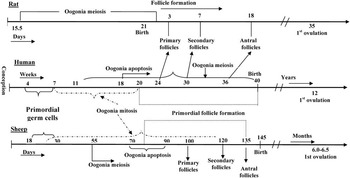
Animal models represent important tools for investigating the DOHaD hypothesis. However, there are a number of limitations, which makes extrapolation back to human questionable. Highlighting the key differences between rat, sheep and human with respect to reproductive maturation will help to better understand and interpret the data presented in this review. Normal ovarian development during embryogenesis determines the fertility and reproductive capacity later in life.Reference Sarraj and Drummond 51 Important landmarks of ovarian development are similar between precocious (human, sheep) and altricial species (rat), however, variations exist in the timing of each step (Fig. 1). Primordial germ cells (PGCs) migrate to the gonadal ridge at about 12–13 days post coitum (dpc) in rat,Reference Eddy, Clark, Gong and Fenderson 52 whereas in sheep and human migration occur at about 3 and 5 weeks of gestation, respectively.Reference Eddy, Clark, Gong and Fenderson 52 , Reference Sawyer, Smith and Heath 53 Shortly after the sex-specific differentiation of the gonad, PGCs start transforming into oogonia increasing steadily in number, until they enter meiosis, becoming oocytes.Reference Suh, Sonntag and Erickson 54 Onset of meiosis occurs at 15.5 dpc in rat,Reference Merchant-Larios 55 whereas in sheep and human at weeks 8 and 11–12, respectively.Reference Juengel, Sawyer and Smith 56 , Reference Francavilla, Cordeschi and Properzi 57 As a consequence of initiation of meiosis, multiplication is prohibited and the store of female gametes is set definitively at that stage of life. Initial folliculogenesis represents the last step of ovarian differentiation. It takes place during the fetal life in human (20 weeks to birth),Reference Bayne, Martins da Silva and Anderson 58 in sheep (11–14 weeks)Reference Juengel, Sawyer and Smith 56 and within the first week of postnatal life in rat.Reference Rajah, Glaser and Hirshfield 59 In human and sheep, the recruitment of resting primordial follicles into the growing follicle population starts in fetal life and it is only after puberty that cyclic increases in serum gonadotropins stimulate the antral follicles to become preovulatory follicles during each menstrual cycle in human and estrus cycle in sheep. In contrast, in rats, the majority of follicles form and are recruited to grow after birth and the first wave of follicles develop intro antral follicles over the next 3 weeks.Reference McGee and Hsueh 60 Puberty or first estrus occurs around day 34 in rat, whereas in sheep at ∼6 months of age, depending on breed and season. In both human and rodent species follicle growth continues until the primordial follicle population is depleted.Reference Gougeon 61
Milestones of ovarian development in rat, sheep and human.

Unlike oogenesis in females, whose oocyte population is determined at birth, in males spermatogonia act as stem cells and constantly divide to produce gametes spermatogenesis relies on the establishement of a normal adult Sertoli cell number, as they are the primary determinant of sperm production capacity in adulthood.Reference Sharpe, McKinnell, Kivlin and Fisher 62 It is now well accepted that Sertoli cells proliferate during two periods in life, fetal and neonatal and in peripubertal period in all species.Reference Plant and Marshall 63 Therefore, cell proliferation in the embryonic and early postnatal periods is crucial for establishing the mature adult size of the testis and maintains a sufficient population of sperm-producing Sertoli cells during adulthood.
Animal experimental data
Studies restricted to fetal or/and neonatal life
Evidence in males supports a negative impact of early life undernutrition on testicular structure and function. Maternal undernutrition imposed during both gestation and lactation or during lactation in rats led to drastic reduction in gonadal weight and structure in progeny, indicating a potential influence on later reproductive function.Reference Leonhardt, Lesage and Croix 27 Indeed, exposure to low-protein diet (LPD) during gestation reduced sperm count and influenced male's ability to impregnate female rats in the F1 male offspring.Reference Zambrano, Rodriguez-Gonzalez and Guzman 64 In sheep, data on males are controversial and range from no effects in fetal testis weight and Sertoli cell number after nutritionally mediated placental growth restriction,Reference Da Silva, Aitken, Rhind, Racey and Wallace 65 to 20% reduction in the number of Sertoli cells in newborn lambs undernourished in utero.Reference Bielli, Perez and Pedrana 66 Sertoli cells could provide a target for programming, as their number per testis is the most important factor that determines the ceiling of sperm production and output.Reference Orth, Gunsalus and Lamperti 67 On the other hand, maternal undernutrition in early gestation in sheep led to increased expression of steroidogenic acute regulatory protein (StAR) mRNA in the fetal testes, and increased plasma testosterone concentrations.Reference Rae, Rhind and Fowler 68 A number of data also indicate effect of maternal undernutrition on the fetal hypothalamo–pituitary axis function. In particular, in male sheep fetus maternal undernutrition has been shown to influence the pituitary response to GnRH challengeReference Rae, Rhind, Kyle, Miller and Brooks 69 and altered pituitary sensitivity has also been observed in 55-day-old lambs, born to mothers undernourished from 30 days of gestation to term.Reference Deligeorgis, Chadio and Menegatos 70
In rat, offspring of dams undernourished during gestation and/or lactation exhibited impaired folliculogenesis, reflected by a greater number of small size antral follicles and reduced number of large size graafian folliclesReference Leonhardt, Lesage and Croix 27 or impaired follicular maturation.Reference da Silva Faria, de Bittencourt, Sampaio and da Fonte Ramos 71 A significant reduction in all types of follicles (primordial, secondary, antral) along with changes in key ovarian gene expression and increased ovarian oxidative stress has been demonstrated in ovaries of rats born to dams undernourished during specific developmental windows.Reference Bernal, Vickers, Hampton, Poynton and Sloboda 72 On the other hand, prenatal exposure to high-fat nutrition and exposure from weaning alters estrous cyclicity in adult rats, exhibiting also prolonged or persistent estrus.Reference Connor, Vickers, Beltrand, Meaney and Sloboda 73 These results clearly indicate that adverse effects can be manifested at both ends of nutritional spectrum.
In sheep, oogonial meiosis and follicular development were found to be delayed in fetuses undernourished during early gestation, indicating that undernutrition imposed even before differentiation of the ovary can compromise subsequent follicular development.Reference Rae, Palassio and Kyle 31 Maternal undernutrition has been reported to affect the rate of cell atresia causing a delay in the fetal germ cell degeneration,Reference Borwick, Rhind, McMillen and Racey 74 whereas later studies pointed out to the changes in apoptosis-regulating genes, thus altering the balance of apoptosis and proliferation in the developing follicles and surrounding ovarian cells, leading to reduced follicle number postnatal.Reference Lea, Andrade and Rae 75
Effects persisting in adulthood
The studies mentioned above are mostly limited to the late gestation fetus or young animals. However, it is well accepted that alterations in the developmental process of the HPG axis generally are perceived only at puberty or in adult reproductive lifeReference Pereira 76 and more likely after the gonadal feedback is set up.Reference Kotsampasi, Chadio and Papadomichelakis 33 This is also the case with the reproductive consequences of early glucocorticoid or androgen exposure, which are only evident after puberty, when many of the sex-linked differences in developmental programming appear for the first time with the onset of gonadal steroidogenesis.Reference Grigore, Ojeda and Alexander 77 A number of studies have been set up in our laboratory to examine the effects of maternal undernutrtion, during different developmental windows on adult reproductive axis and function, as early perturbations could be of significance only if long-lasting effects are considered. In male sheep, maternal undernutrition during the first month of pregnancy did not affect pituitary response to GnRH in 10-month-old offspring, but when it was imposed during mid to late gestation (30–100 days) resulted in an enhanced luteinizing hormone (LH) and follicle-stimulating hormone (FSH) response and increased basal FSH levels.Reference Kotsampasi, Balaskas, Papadomichelakis and Chadio 34 In addition, undernutrition during this specific window resulted in reduced seminiferous tubule diameter and decreased number of Sertoli cells, accompanied by a higher proportion of cells with apoptotic nucleus in the testes of the offspring, indicating a direct gonadal effect.Reference Chadio, Balaskas, Kotsampasi, Papadomichelakis and Kalogiannis 78 Lower Sertoli cell number and changes in testicular structure have also been reported recently for adult rats born to dams undernourished during gestation and lactation.Reference Genovese, Núñez, Pombo and Bielli 79
Female sheep offspring, born to mothers undernourished during the 1st month of gestation exhibited an enhanced pituitary sensitivity in terms of FSH response and were also presented with an increased number of small follicles, whereas maternal undernutrition from mid to late pregnany resulted in decreased number of corpora lutea in their ovaries.Reference Kotsampasi, Chadio and Papadomichelakis 33 Immunohistochemical studies showed a significantly lower number of Ki67 immunoreactive cells, whereas TUNEL staining did not reveal any differences in the number of apoptotic granulosa cells of graafian follicles in both groups animals undernourished from mid to late gestation.Reference Chadio, Balaskas, Kotsampasi, Papadomichelakis and Kalogiannis 78 Thus, an early exposure to feed restriction may alter the central/peripheral FSH regulation and consequently higher FSH response in these animals may be associated with an attenuated feed back signal on the pituitary, mainly from inhibin. In addition, the lower number of corpora lutea detected in these animals may potentially affect the establishment of pregnancy, since corpus luteum provide steroid hormonal support essential for the establishment and maintenance of early pregnancy,Reference Niswender, Juengel, Silva, Rollyson and McIntush 80 explaining probably the increased embryonic loss reported in ewes undernourished as fetuses.Reference Gunn, Sim and Hunter 81 , Reference Rhind, Elston and Jones 82 Taking together, the above data point out to window-of-exposure and sex-specific effect of undernutrition on hypothalamo–pituitary axis function and gonadal development.
In a separate sheep model of intrauterine growth retardation (IUGR), involving overnourished adolescent ewes, more compelling reductions in the size of the ovarian follicular pool of female offspring was reported.Reference Da Silva, Aitken, Rhind, Racey and Wallace 83 There is now compelling evidence to suggest that in both overnourished and undernourished ovine pregnancies, fetuses experience a period of nutrient restriction as a result of alterations in placental delivery of maternal nutrients, making similar in utero reallocations of energy and nutrients to favor organs and tissues, critical to survival, at the expense of other organs and tissues of lesser significance to maintain competitive fitness.Reference Ford and Long 84
Human studies: the role of birth body weight
Studies examining the follicular growth in normal and growth restricted human fetuses reported either a reduction in the volume percentage of follicles in the growth-restricted fetuses or no difference between groups.Reference de Bruin, Dorland and Bruinse 85 , Reference de Bruin, Nikkels and Bruinse 86 In a number of studies, involved adolescent girls born small for gestational age (SGA) reduced ovarian and uterine size and a low ovulation rate, accompanied by elevated serum FSH levels have been reported.Reference Ibanez, Potau, Enriquez and de Zegher 87 – Reference Ibanez, Valis and Cols 89 However, as treatment with metformin induced ovulation and normalize both abdominal fat and lean body mass, it is more likely that reduced ovulation is a secondary effect, due to deranged metabolism, accompanied by hyperinsulinism, central adiposity and dyslipidemia.Reference Ibanez, Potau and Ferrer 90
Regarding males, results on long-term effects of IUGR on the HPG function are controversial. Reduced testicular volume, along with lower testosterone and higher LH levels were detected in males born SGA, indicating a different setup of the HPG axis with a tendency to hypogonadism in the SGA subjects.Reference Cicognani, Alessandroni and Pasini 91 These results, with increased levels of gonadotropins, are similar to those in females, pointing out a peripheral partial insensitivity to gonadotropins.Reference Ibanez, Potau and de Zegher 92 A permanent disturbance in the steroid biosynthesis with elevated levels of estradiol, dihydrotestosterone and inhibin B was observed in SGA males, that could be part of the explanation to testicular dysgenesis syndrome.Reference Allvin, Ankarberg-Lindgren, Fors and Dahlgren 93 However, data from a prospective study in adolescent men found no differences for testicular volume or the secretory pattern of gonadotrophins between (SGA) and adequate for gestational age (AGA) males.Reference Jensen, Vielwerth and Larsen 94 Overall, despite the methodological inadequacies of individual study results, accumulating evidence from animal and human studies points toward a subtle impairment of both Sertoli and Leydig cell function caused by perinatal growth restriction, probably associated with increased risk of male reproductive health.Reference Main, Jensen, Asklund, Høi-Hansen and Skakkebaek 95
Do effects translate into compromised fertility?
A common finding among studies in rodents, sheep and humans is the disrupted follicular development following maternal feed restriction. As it is well documented that effects on oocyte number will determine the span of female reproductive life, these effects are most likely to impact on subsequent fertility. Therefore, it is of significant importance to determine if this prenatal compromise in the development of reproductive axis translates into any significant functional deficit in subsequent reproductive performance and particular fertility, representing the main outcome of reproductive function. Follow-up studies of historical cohort of Dutch famine women, based on a number of fertility markers such as age at first pregnancy, completed family size and inter-pregnancy interval do not support a detrimental effect on fertility of women exposed to famine in utero.Reference Lumey and Stein 96 , Reference Lumey 97 The same authors also demonstrated no association between BW and fertility of both men and women and, furthermore, although subjects born SGA were more insulin resistant than AGA ones, yet no evidence of any relation between insulin resistance and reduced fertility was observed. A French cohort study also reported no evidence of any relation between BW and fertility of both men and women.Reference Meas, Efgmoun, Levy-Marchal and Bouyer 98 Regarding effects on the onset of menopause in women, most studies do not provide evidence of an association between size at birth and age at menopause,Reference Leidy Sievert 99 whereas others reported a U-shaped relationship between BW and time of menopause.Reference Tom, Cooper and Kuh 100 Studies in sheep also indicate that apart from small size at birth, large size is also associated with lower fertility.Reference Gardner, Ozanne and Sinclair 101 In the same species, a bout of maternal nutrient restriction from early to mid gestation resulted in marked reduction in the fertility of the offspring, in association with decreased progesterone concentrations in maternal blood.Reference Long, Nijland, Nathanielsz and Ford 102 In males conflicting results have been reported, ranging from no effect of BW on semen qualityReference Ramlau-Hansen, Hansen and Jensen 103 to a significant association between BW and testosterone levels, independent from adult weight.Reference Vanbillemont, Lapauw and Bogaert 104 Moreover, previous studies reported lower BW in subfertile men of unknown etiology, supporting the concept of in utero programming across the range of BW.Reference Francois, De Zegher, Spiessens, D’ Hooghe and Vanderschueren 105 Although experimental and epidemiological data link the BW to postnatal adverse effects, it is also apparent that programming effects may be expressed in the absence of any changes in BW.Reference Gluckman 106 It is also widely accepted that the catch-up growth that follows in utero growth restriction, underlies many of the adverse effects occurring during adulthood,Reference Singhal and Lucas 107 , Reference Cameron 108 and more importantly in case of mismatch between the predicted and actual mature environment, as has been proposed for metabolic outcomes.Reference Gluckman and Hanson 109 The impact of catch-up growth on fertility in humans, however, is largely unknown, but it certainly complicates interpretation of the effects of nutrient restriction during pregnancy per se on physiological function in the offspring. Whether associations documented in experimental and epidemiological studies between early life nutrition history and later reproductive outcomes reflect a developmental impairment or an adaptive capacity to adjust reproductive strategy is still uncertain and a matter of debate.Reference Ellison and Jasienska 110 , Reference Jonathan 111 Data from Polish women provide support for predictive adaptive theory,Reference Jasienska, Inger and Ellison 112 as differences in nutritional status at birth showed to predict ovarian sensitivity, as determined by estradiol levels, to energetic stress in adulthood. In particular, women with a high ponderal index (PI) at birth did not exhibit ovarian steroidogenesis suppression to moderate levels of physical activity, whereas women who had a lower PI at birth showed ovarian suppression in association with moderate energetic stress. As it is nicely pointed out by Kuzawa and Quin,Reference Kuzawa and Quin 113 outcomes related to physiologic and endocrine systems are more prone to developmental plasticity paradigm and propose that apart from documented downstream effects, the study of the regulatory changes that underline them is crucial in distinguishing between developmental impairment or a regulatory adjustment in system settings. However, from a life history perspective, these adaptations would optimize lifetime resource allocation, enhance survival, and maintain fitness.Reference Ellison 114
Periconceptional nutrition and the impact of obesity
The periconceptional period is recently gaining a crucial role to programming since it is characterized by extensive reorganization of cellular phenotype during oocyte maturation, fertilization and embryonic genome activation.Reference Fleming, Velazquez, Eckert, Lucas and Watkins 7 Oocyte acquires developmental competence mainly during the terminal steps of folliculogenesis and meiotic maturation and it depends on the establishment of a fruitful molecular dialog between the oocyte and surrounding follicular cells.Reference Mermillod, Dalbiès-Tran and Uzbekova 115 Changes to the immediate environment surrounding oocytes, probably resulting from nutritionally induced changes in hormone and metabolite levels can alter the pattern of genes expressed by ovarian follicles, impacting immediate and longer-term development.Reference Ashworth, Toma and Hunter 116 On the other hand, as oocyte quality influences early embryonic, fetal and postnatal developmentReference Sirard, Richard, Blondin and Robert 117 it is widely accepted that oocyte development represents a critical feature in developmental programming hypothesis. Moreover, preimplantation embryo has been shown to be sensitive to environmental perturbations with long-term consequences.Reference Fleming, Kwong and Porter 118 The vital role of periconceptional nutrition has been highlighted in studies involved in diet manipulation of donor animals.Reference Sinclair, Kuran, Gebbie, Webb and McEvoy 119 – Reference Borowczyk, Caton and Redmer 121 In particular, studies in sheep clearly indicate that both under and overfeeding during pre-mating period result in reduced oocyte quality and embryonic development.Reference Grazul-Bilska, Borowczyk and Bilski 122 Interestingly, short-term underfeeding before conception influenced the expression of a number of genes related to oocyte metabolic activity. However, factors such as time of nutritional treatment, composition of the diet and most importantly duration of nutritional manipulation determine final outcomes.Reference Pisani, Antonini and Pocar 123
Increasing evidence also suggest that obesity negatively impact the developmental competence of the oocyte, affecting its ability to be fertilized and support embryo development.Reference Purcell and Moley 124 Animal models of induced obesity represent a nice example of how nutritional status before conception affects subsequent oocyte quality and embryonic development. In the diet-induced obesity mouse model, an increase in apoptotic cells has been detected in the preovulatory ovarian follicles leading to smaller oocytes displaying decreased maturation, reduced blastocyst survival rates and abnormal embryonic cellular differentiation.Reference Minge, Bennett, Norman and Robker 125 Increased apoptosis in the preovulatory follicles and decreased oocyte maturation along with increased placental IGF2r expression and smaller pups have been reported in similar models of induced obesity before conception.Reference Jungheim, Schoeller and Marquard 126 Ovarian regulation disturbances may also be due to higher concentration of IGF1 in obese conditions, which has been reported to decrease embryo quality, by increasing the levels of apoptosis and impairing cell allocation at the blastocyst stage.Reference Velazquez, Hermann, Kues and Niemann 127 Recently results from an intriguing experiment, elegantly outlined a role of compromised mitochondrial activity and impaired antioxidant capacities in mediating the adverse effects of obesity on reproductive outcomes.Reference Igosheva, Abramov and Poston 128
Apart for female obesity, there is now mounting evidence to suggest that male obesity is also implicated in reducing fertility and impaired reproductive outcomes. Paternal obesity at the time of conception showed compromised gamete health in F1 offspring, increased oxidative stress in male offspring and changes to mitochondrial function in female offspring,Reference Palmer, Bakos, Fullston and Lane 129 indicating a role for paternal transmission of diminished reproductive health to future generations. There is now accumulating evidence to support that obese condition and over rich diet disturbs ovarian regulation and function, causing fertility perturbations as well as adverse developmental programming into adulthood. The most well characterized effects are associated with metabolic and behavioral outcomes in adult life,Reference Jungheim, Schoeller and Marquard 126 , Reference O'Reilly and Reynolds 130 – Reference Alfraradhi and Ozanne 132 but data related to reproductive outcomes are almost missing. Intervention studies with follow-up of the offspring will help in clarifying the role of obesity or overfeeding before and during pregnancy in causing adverse reproductive outcomes in the offspring.
Underlying mechanisms: the role of epigenetics
The way through which environmental insults, such as nutrition contribute to the onset of later detrimental outcomes likely involves a complex interaction between the maternal environment, placental changes, and epigenetic programming of the embryo. However, the mechanisms through which early life events are transmitted to the target organs are complex and still poorly understood. They may include structural changes, altered cell proliferation/apoptosis, changes in hormone levels and receptor abundance. Maternal endocrine milieu is crucial in mediating the effects of nutrition, as hormones can directly or through changes in placenta phenotype act on the fetal tissues to alter cell growth and differentiation, consequently affecting their function later in life.Reference Fowden, Li and Forhead 133 , Reference Fowden, Giussani and Forhead 134 Endocrine programming has recently been highlighted as mediating such effects, since undernutrition disrupts a wide range of endocrine pathways, including HPG axis, resulting in long-term effects on offspring's health.Reference Harding, Derraik and Bloomfield 135 The effects on fetal endocrine development may be mediated, at least in part, by exposure of the developing fetal organs to altered circulating or tissue concentrations of glucocorticoidsReference Seckl 136 and prenatal nutrient restriction has been shown to alter HPA axis function in young and adult offspring, suggesting that HPA programming may be a common outcome of prenatal environmental challenge.Reference Bloomfield, Oliver and Hawkins 137 – Reference Oliver, Bloomfield and Jaquiery 141 However, direction of changes depends on developmental step and age of the offspring.Reference Seckl 136 , Reference Chadio, Kotsampasi and Papadomichelakis 139 Molecular mechanisms underlying the effects of glucocorticoids probably include epigenetic changes in target gene promoters, including the GR,Reference Harris and Seckl 142 thus affecting persistently glucocorticoid signaling in certain tissues. Pituitary gonadotrophs,Reference Killen, Szabo and Strasser 143 as well as ovary,Reference Michael, Pestet and Curtis 144 are all glucocorticoid targets in the adult. Furthermore, the coexistence of progesterone, estrogen and the type II glucocorticoid receptor reported in the ovine preoptic area and ARC nucleus, further support a role for glucocorticoids in mediating effects on reproductive axis, suggesting that all three steroids may influence the activity of the same neurons to modulate both reproductive and stress axes.Reference Dufourny and Skinner 145 Together these data provide strong evidence that glucocorticoids represent an important developmental trigger and that their effects are mediated at the level of DNA methylation.Reference Crudo, Petropoulos and Moisiadis 146
Epigenetic modulation of gene transcription provides the most plausible mechanism through which fetal nutrient supply can alter gene expression in the developing fetus, leading to later permanent effects. There have been outstanding reviews on how the concept of epigenetics has been applied to the developmental programming hypothesis, mainly related to metabolic and cardiovascular outcomes.Reference Sinclair, Lea and Rees 147 – Reference Hochberg, Feil and Constancia 151 Regarding epigenetic mechanisms underlying programming of reproductive function evidence comes from the field of assisted reproductive technologies (ARTs). Studies on reproductive outcomes after in vitro fertilization strongly support the well-recognized concept that alteration of biochemical and biophysical conditions at conception and during early embryonic life associated with ARTs, may result in changes in epigenetic processes and lead to short- and long-term effects on development and health.Reference Mukhopadhaya and Arulkumaran 152 , Reference Thompson, Kind, Roberts, Robertson and Robinson 153 Although a variety of mechanisms may associate preimplantation environment with future developmental changes, the aberrant expression of imprinted genes has been proposed to play a significant role.Reference Young and Fairburn 154 , Reference Fleming, Kwong and Porter 155 Several studies have identified changes in imprinted gene expression throughout the development associated with culture composition during the preimplantation period when the DNA methylation pattern may be sensitive to environmental conditions.Reference Doherty, Mann, Tremblay, Bartolomei and Schultz 156 , Reference Thompson, Konfortova and Gregory 157 DNA methylation and histone modifications have been implicated as the most prominent process to alter gene expression and which can be altered by the availability of amino acids or micronutrients during pregnancy.Reference Sinclair, Allegrucci and Singh 158 – Reference Kwong, Miller and Ursell 160 Interestingly, similar alterations in the expression of the imprinted genes H19 and IGF2 has also been reported to occur in fetal sheep due to maternal LPD during the preimplantation period.Reference Naimeh, Schutte, Hamilton and Tsalikian 161 Given that maternal undernutrition can lead to alteration in steroid hormone levels,Reference Gonzalez, Garcia, Fernandez and Patterson 162 , Reference Fernandez-Twinn, Ozanne and Ekizoglou 163 this may in turn affect H19 and/or IGF2 gene expression. Fowden and ForheadReference Fowden and Forhead 164 highlighted the potential role of hormones as epigenetic signals in determining the phenotypical outcome of environmental cues acting during intrauterine development, as hormones signal the type, severity and duration of the environmental cue to the developing feto-placental tissues.
Studies have also shown that a high number of genes in the blastocyst exhibit sexual dimorphism with an extensive transcriptional regulation led by the sex chromosomes, both for in vivo and in vitro-derived embryos and that changes in postnatal growth induced by a maternal LPD at the time of conception, may be resulted partly from the sex-specific programming of imprinted gene expression within the preimplantation embryo itself.Reference Bermejo-Alvarez, Rizos, Lonergan and Gutierrez-Adan 165 The sex-specific effects observed for several programming outcomes, as a result to early nutritional perturbations, could also be explained in the light of the well-documented sexual dimorphism in environmental epigenetic programming. As dimorphic genes’ expression might be under the control of sex-specific epigenetic marks, environmental factors, including nutrition, can influence, in a sex-specific manner these flexible epigenetic marks, mainly during critical windows of development.Reference Gabory, Attig and Junien 166 The concept of epigenetic modulation underlying sexual dimorphism is further enhanced by recent results showing that both promoters of androgen and estrogen receptor genes, and the expression of their target genes, are regulated by epigenetic mechanisms.Reference Foecking, McDevitt, Acosta-Martinez, Hortpn and Levine 167
There is now strong evidence to support that environmental influences including maternal nutrition during embryonic and early life development can permanently alter epigenetic gene regulation, which in turn can result in imprinting and reprogramming of the epigenome, impacting on detrimental reproductive outcomes in later life.
Transgenerational effects
One of the most crucial features of developmental programming is that epigenetic modifications may be expressed in subsequent generations. Accumulating evidence from studies in humans and animal models support nongenomic transmission between generations of induced phenotypic traits mainly associated with metabolic programming and disease risk.Reference Roseboom and Watson 168 Insights into transgenerational effects related to reproductive systems come from studies with endocrine disrupting chemicals (EDCs). For example, exposure of pregnant rats to the endocrine disruptor vinclozolin caused decreased spermatogenic capacity in the F1 generation that was transferred through the male germline to the fourth generation.Reference Anway, Cupp, Uzumcu and Skinner 169 Results from a number of elegant experiments by GoreReference Gore 170 investigating the effects of prenatal EDCs exposure on reproductive neuroendocrine functions in two generations, clearly indicate that perinatal EDCs impact reproductive neuroendocrinology function at several levels, by exerting detrimental effects on neuroendocrine circuits including GnRH neurons and their regulatory inputs and altering reproductive behaviors. In particular, F2 adult females exhibited suppressed progesterone and LH concentrations on proestrus, whereas males and females from both generations showed altered expression of neuroendocrine genes in the preoptic area of the hypothalamus. More interestingly, they showed trangenerational effects of EDCs on reproductive systems, probably including neuroendocrine targets. The way through which EDCs can induce epigenetic transgenerational phenotypes is probably a nice paradigm of how nutritional perturbations during preconception might also, through germline reprogramming, impact on subsequent generations’ reproductive function. Given the fact that endocrine disrupting compounds can act as hormone agonists or antagonists and that nutritional mediated hormonal alterations act probably as imprinting factors, it is of interest to examine if similar mechanisms operate in mediating effects of early life nutrition on neuroendocrine circuits governing reproduction or on any other features of the reproductive axis. Both nutritional perturbations and exposure to EDCs can affect hormonal regulation and metabolic pathways. Indeed, hormones and nutritional components can both directly activate receptors or modulate pathways responsible for gene expression control. Thus, as it has been stated recently, ‘The developmental disruption effects associated with nutrients and environmental chemicals are likely two sides of the same coin and epigenetic regulatory pathways are likely sites for effects of both nutrient and environmental toxicant effects’.Reference Barouki, Gluckman, Grandjean, Hanson and Heindel 171
There is also emerging evidence for transgenerational transmission down the paternal line.Reference Mitchell, Fullston and Palmer 172 Female progeny of obese males demonstrated subfertility phenotypes that were transmitted to both sexes of the F2 generation via F1 males and to F2 males via the F1 maternal lineage.Reference Fullston, Palmer and Owens 173 The altered sperm epigenome observed in obese males epigenome via increased acetylationReference Palmer, Fullston, Mitchell, Setchell and Lane 174 and differential microRNA contentReference Ohlsson Teague, Fullston and Palmer 175 probably implies transgenerational epigenetic inheritance. Epigenetic modifications, due to fetal EDCs exposure have also been shown to pass up to four generations of offspring via the male germline, linked to altered sperm epigenome.Reference Clement, Savenkova, Settles, Anway and Skinner 176 , Reference Guerrero-Bosagna and Skinner 177
Conclusions and future implications
Epigenetic modulation of critical genes involved in the control of reproductive function and potential intergenerational effects represent an exciting area of interdisciplinary research toward development of new nutritional approaches during pre- and postnatal periods to ensure reproductive health in later life. The challenge will be to determine whether interventions can prevent, or modify, these effects, thereby resulting in a healthier start to life and optimizing both later metabolic and reproductive outcomes. In between, there are emerging areas of critical interest including the extension of studies of the nutritional environment of the early embryo to include a better understanding of the impact of the perturbations of the environment of the gametes and embryo during both physiological process and a range of ARTs on reproductive health of next generations. Although the existence of sexually dimorphic phenotypes is rather obvious, the mechanisms that underlie this process still remain a matter of interest. Finally, the contribution of paternal lineage to the intergenerational transmission of detrimental outcomes and especially of a decline in fertility remains to be elucidated.
Acknowledgments
Authors acknowledge permission from Nova Science Publishers to reproduce part of the article ‘Reproductive Programming: The Role of Early Life Nutrition’ in ‘Undernutrition: Causes and Consequenses’, 2011, Ed. Jason Lee, Nova Science Publishers Inc., NY.
Financial Support
This research received no specific grant from any funding agency, commercial or not-for-profit.
Conflicts of Interest
None.