Introduction
Suicide is a major public health problem worldwide. More than 1 million people die from suicide every year (Bailey et al. Reference Bailey, Patel, Avenido, Patel, Jaleel, Barker, Khan, Ali and Jabeen2011), with similar rates occurring in developed and developing countries (Borges et al. Reference Borges, Nock, Haro Abad, Hwang, Sampson, Alonso, Andrade, Angermeyer, Beautrais, Bromet, Bruffaerts, de Girolamo, Florescu, Gureje, Hu, Karam, Kovess-Masfety, Lee, Levinson, Medina-Mora, Ormel, Posada-Villa, Sagar, Tomov, Uda, Williams and Kessler2010). Despite evidence that preventive interventions can reduce suicide rates, identifying the most effective strategies remains controversial (Mann et al. Reference Mann, Apter, Bertolote, Beautrais, Currier, Haas, Hegerl, Lonnqvist, Malone, Marusic, Mehlum, Patton, Phillips, Rutz, Rihmer, Schmidtke, Shaffer, Silverman, Takahashi, Varnik, Wasserman, Yip and Hendin2005). It is still unclear which high-risk populations are optimal for interventions, or whether broader population interventions targeting access to lethal means or socio-economic factors such as unemployment are more effective (Lewis et al. Reference Lewis, Hawton and Jones1997; Mortensen et al. Reference Mortensen, Agerbo, Erikson, Qin and Westergaard-Nielsen2000; Mann et al. Reference Mann, Apter, Bertolote, Beautrais, Currier, Haas, Hegerl, Lonnqvist, Malone, Marusic, Mehlum, Patton, Phillips, Rutz, Rihmer, Schmidtke, Shaffer, Silverman, Takahashi, Varnik, Wasserman, Yip and Hendin2005). A more comprehensive understanding of sociodemographic, psychiatric and somatic risk factors is needed to clarify the optimal populations for intervention and to facilitate more effective prevention strategies.
Several risk factors for suicide have been consistently identified, including male sex, low socio-economic status, previous suicide attempts and psychiatric disorders (Harris & Barraclough, Reference Harris and Barraclough1997). Recent studies have also identified a diagnosis of cancer as an important risk factor (Fall et al. Reference Fall, Fang, Mucci, Ye, Andren, Johansson, Andersson, Sparen, Klein, Stampfer, Adami and Valdimarsdottir2009; Fang et al. Reference Fang, Fall, Mittleman, Sparen, Ye, Adami and Valdimarsdottir2012). However, the relative importance of these factors and of other somatic disorders remains unclear. No studies to date have examined these factors using comprehensive out-patient and in-patient health data for a national population. Such information would advance our understanding of suicide risk factors through more complete ascertainment and by avoiding bias that may result from the sole use of hospital-based or case–control data.
We conducted a national cohort study of ∼ 7.1 million Swedish adults to examine sociodemographic, psychiatric and somatic risk factors for suicide during 8 years of follow-up. Detailed sociodemographic factors were identified from national census data, and psychiatric and somatic conditions were ascertained using out-patient and in-patient diagnoses from all health care settings nationwide.
Method
Study population and suicide ascertainment
The study population consisted of all adults aged ⩾ 18 years who were living in Sweden on 1 January 2001 (n = 7140589). The outcome of interest was death from suicide (ICD-10 codes X60–X84) during 8 years of follow-up (from 1 January 2001 to 31 December 2008). This was identified using the Swedish Death Registry, which is maintained by the National Board of Health and Welfare and is estimated to include ∼ 99.5% of all deaths nationwide (National Board of Health and Welfare, 2011). This registry includes the date and cause of death of all Swedish residents, regardless of whether the person was a citizen or was present in Sweden at the time of death. It does not include undocumented migrants or those who died while seeking asylum or visiting Sweden. This study was approved by the Regional Ethical Review Board of Lund University, Sweden.
Sociodemographic, psychiatric and somatic variables
Sociodemographic characteristics that may be associated with suicide risk were identified using national census data from 2000 to 2001, and were linked to the death registry using an anonymous personal identification number (Crump et al. Reference Crump, Winkleby, Sundquist and Sundquist2010, Reference Crump, Sundquist, Sundquist and Winkleby2011a ,Reference Crump, Sundquist, Sundquist and Winkleby b ). The following variables were obtained from the Swedish Population Registry maintained by Statistics Sweden and examined as predictor and adjustment variables: sex (women or men), age [modeled simultaneously as a continuous variable by birth date and a categorical variable by age at study entry (18–24, 25–34, 35–44, 45–54, 55–64, 65–74 and ⩾ 75 years) to allow for a non-linear effect]; marital status (married/cohabiting, never married, divorced, widowed, or unknown); country of birth [Sweden, other Nordic countries (Denmark, Finland, Iceland, Norway), non-Nordic countries, or unknown]; education level [compulsory school or less (⩽ 9 years), practical high school or some theoretical high school (10–11 years), theoretical high school and/or college (⩾ 12 years), or unknown]; employment status (employed or non-employed; ‘non-employed’ includes students and homemakers); income (categorical variable in quartiles, or unknown); and urban/rural status (large cities, medium-sized towns, small towns/rural, or unknown).
The Swedish health-care system has universal access and is mainly government funded through taxes levied by county councils and municipalities (Anell et al. Reference Anell, Glenngard and Merkur2012). Psychiatric disorders were identified by any primary or secondary diagnosis in the Swedish Out-patient Registry or the Swedish Hospital Registry from 1 January 2001 to 31 December 2008. The Swedish Out-patient Registry contains primary and secondary out-patient diagnoses from all out-patient settings nationwide starting in 2001 (including private and public out-patient departments and also psychiatric clinics), and the Swedish Hospital Registry contains all primary and secondary hospital discharge diagnoses with nationwide coverage since 1987. These registries are estimated to be > 99% complete (Ludvigsson et al. Reference Ludvigsson, Andersson, Ekbom, Feychting, Kim, Reuterwall, Heurgren and Olausson2011). Psychiatric disorders were classified according to ICD-10 codes and examined in the following categories: any psychiatric disorder (F00–F69), alcohol use disorder (F10), other substance use disorders (F11–F19), schizophrenia (F20), bipolar disorder (F31), depression (F32–F33), anxiety disorders (F40–F41), and personality disorders (F60–F61). Alcohol and other substance use disorders were ascertained using ICD-10 codes from all out-patient and in-patient diagnoses nationwide in the same manner as other psychiatric disorders. ‘Other substance use disorders’ included mental or behavioral disorders due to opioids, cannabinoids, sedatives/hypnotics, cocaine, other stimulants, hallucinogens, tobacco, volatile solvents, or other psychoactive substances.
Selected somatic disorders were also identified by any primary or secondary diagnosis in the Swedish Out-patient Registry or the Swedish Hospital Registry from 1 January 2001 to 31 December 2008, and were classified by the following ICD-10 codes: any cancer (C00–C97), diabetes mellitus (E10–E14), ischemic heart disease (IHD) (I20–I25), stroke (I60–I66), chronic obstructive pulmonary disease (COPD) (J41–J44), asthma (J45–J46), and spine disorders (M45–M54, which included spondylopathies, disc disorders, and neck or back pain).
Statistical analysis
The Kruskal–Wallis non-parametric test and the binomial test for equality of proportions were used to test for differences between sociodemographic, psychiatric or somatic factors comparing persons who died from suicide with the rest of the population. Cox proportional hazards regression was used to estimate hazard ratios (HRs) and 95% confidence intervals (CIs) for the association between sociodemographic factors, psychiatric disorders or somatic disorders, and suicide mortality. Psychiatric and somatic disorders were modeled as time-dependent variables in all models, so that a person contributed to ‘non-exposed’ person-time before and ‘exposed’ person-time after the first diagnosis of the respective disorder. Individuals were censored at the time of death from any cause other than suicide (n = 724053; 10.1%), or at emigration as determined by the absence of a Swedish residential address in census data (n = 197247; 2.8%). First-order interactions between sex and other variables were assessed using likelihood ratio tests (LRTs). All analyses were subsequently stratified by sex because of significant differences found in risk estimates. Two different adjusted models were used: the first was adjusted for sociodemographic factors (age, marital status, country of birth, education, employment status, income, and urban/rural status), and the second was adjusted for the same sociodemographic factors plus specific psychiatric and somatic disorders. We also examined the risk of suicide in specific time intervals (1–2, 3–4, 5–13, 14–26, 27–52, ⩾ 53 weeks) after a first diagnosis of depression (modeled as a time-dependent variable) in 2002–2008, after excluding persons who were diagnosed with depression in 2001 so as to remove prevalent cases (n = 22871; 0.3%). The proportional hazards assumption was evaluated by graphical assessment of log-log plots (Garrett, Reference Garrett1997) and was met in each of the models. All statistical tests were two-sided and used an α level of 0.05. All analyses were conducted using Stata version 11.2 (StataCorp, 2010).
Results
Univariate analysis
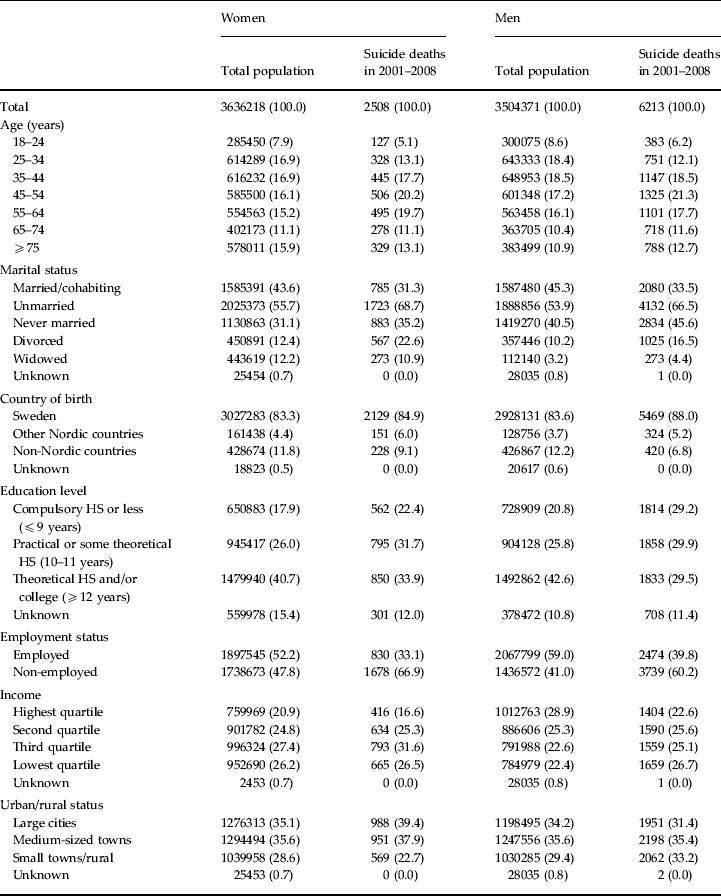
In this population of 7140589 Swedish adults, 2508 women (0.07% of all women) and 6213 men (0.18% of all men) died from suicide during 2001–2008. Most women and men who died from suicide were between 35 and 64 years old (Table 1). Compared with the rest of the population, they were more likely to be unmarried, have the lowest educational attainment, be non-employed and have lower incomes (p < 0.001 for each comparison using the Kruskal–Wallis test). Women who died from suicide were slightly more likely to live in large cities whereas men who died from suicide were more likely to live in small towns or rural areas, compared with other women or men (p < 0.001 using the Kruskal–Wallis test).
Sociodemographic characteristics at baseline (2000–2001)

HS, High school.
Values given as n (%).
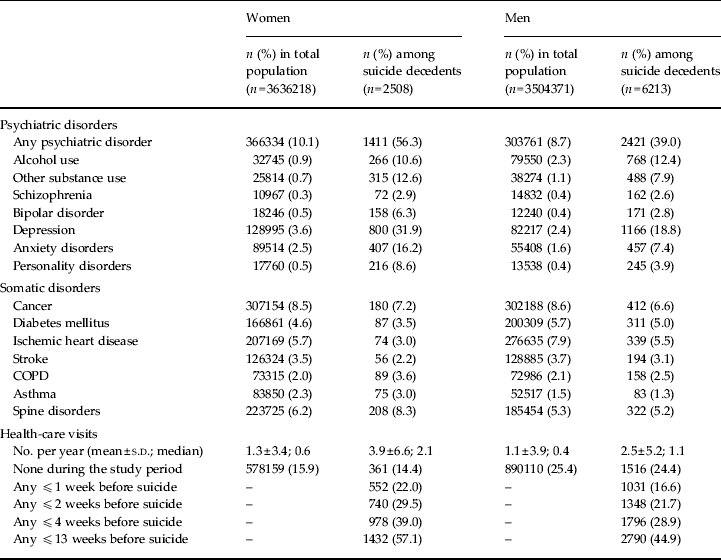
All psychiatric disorders were more common among persons who died from suicide than in the rest of the population (p < 0.001 for each using binomial test for proportions). The prevalence of any psychiatric diagnosis was 56.3% and 39.0% among women and men who died from suicide respectively, compared with 10.1% and 8.7% among other women and men (Table 2). The most common psychiatric disorder was depression, which had been diagnosed in 31.9% and 18.8% of women and men who died from suicide respectively, compared with 3.6% and 2.4% of other women and men. Among all persons diagnosed with depression, 0.6% of women and 1.4% of men died from suicide during the follow-up period.
Psychiatric and somatic disorders and health-care system utilization (2001–2008)

COPD, Chronic obstructive pulmonary disease; s.d., standard deviation.
Among somatic disorders (Table 2), COPD was more prevalent among women or men who died from suicide (p < 0.001 using the binomial test for proportions), and asthma (p = 0.02) or spine disorders (p < 0.001) among women who died from suicide, compared with the rest of the population. Other disorders were significantly less prevalent among women or men who died from suicide, including cancer (p < 0.001), diabetes (p = 0.01), ischemic heart disease (p < 0.001), and stroke (p = 0.02).
Persons who died from suicide had been seen for health-care visits ∼ 2–3 times more often on average than the rest of the population (Table 2; p < 0.001 for both women and men using the Kruskal–Wallis test). Among those who died from suicide, 29.5% of women and 21.7% of men had a health-care visit within 2 weeks before the suicide, and 57.1% of women and 44.9% of men had a health-care visit within 13 weeks before the suicide (Table 2).
Multivariate analysis
Men had nearly a 3-fold risk of suicide mortality relative to women, after adjusting for all other sociodemographic and health variables [adjusted hazard ratio (aHR) 2.94, 95% CI 2.79–3.10; not shown in the tables]. There were significant interactions between sex and other factors with respect to suicide risk. Specifically, young age, unmarried status and low educational attainment were stronger risk factors for suicide among men than women (p < 0.001 for each interaction using LRTs). Any psychiatric disorder, however, was a stronger risk factor for suicide among women than men (p < 0.001). The associations between somatic disorders and suicide had no significant or clinically meaningful differences by gender.
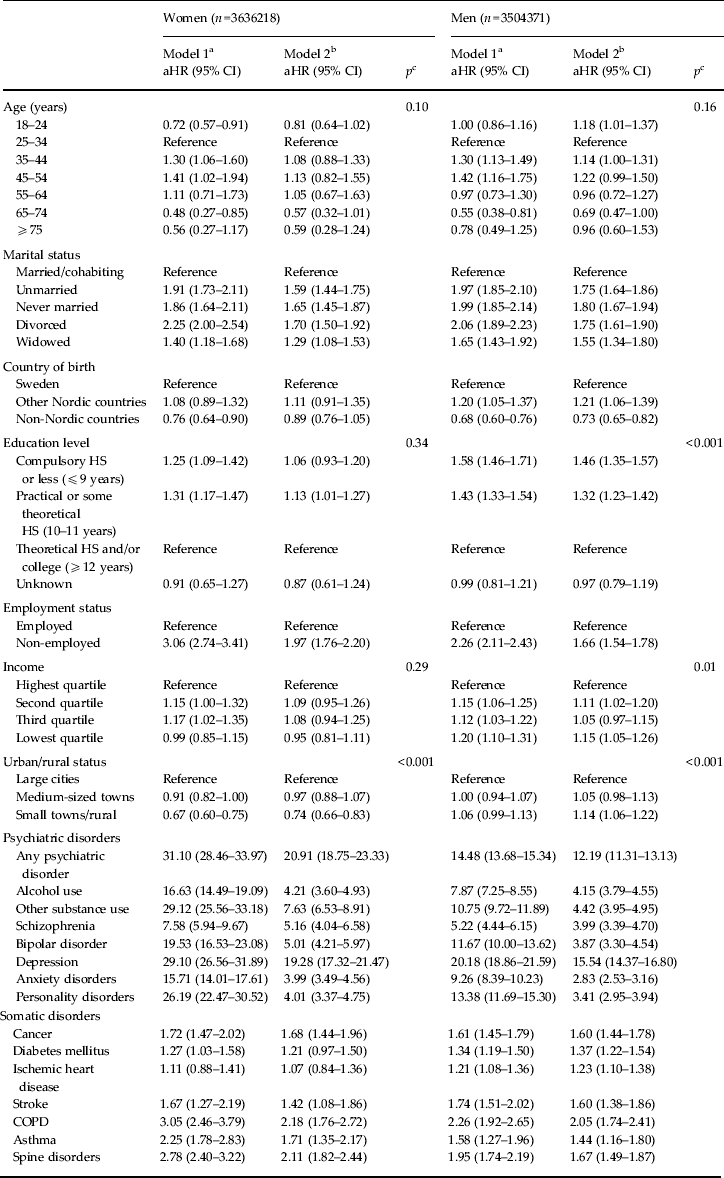
All subsequent analyses were stratified by sex (Table 3). Among other sociodemographic factors in the fully adjusted model (model 2), the strongest risk factors were non-employment among women (aHR 1.97) or men (aHR 1.66), unmarried status among women (aHR 1.59) or men (aHR 1.75), and low education level among men (aHR 1.46 for ⩽ 9 v. ⩾ 12 years, p trend < 0.001). Age was not a significant risk factor for suicide among women (aHR for each 10-year increment 0.99, 95% CI 0.97–1.00, p trend = 0.10) or men (aHR for each 10-year increment 0.99, 95% CI 0.98–1.00, p trend = 0.16). Men who had immigrated from other Nordic countries (Denmark, Finland, Iceland or Norway) had a modestly increased risk of death from suicide (aHR 1.21) whereas men who had immigrated from non-Nordic countries had a decreased risk (aHR 0.73), relative to Swedish-born men. Low income was associated with a modestly increased suicide risk among men (aHR 1.15 for lowest v. highest quartile, p trend = 0.01) but not among women (p trend = 0.29). Relative to those who lived in large cities, living in a small town or rural area was associated with a significantly decreased risk of suicide among women (aHR 0.74, p trend < 0.001) and a modestly increased risk among men (aHR 1.14, p trend < 0.001).
Adjusted hazard ratios (aHRs) for associations between sociodemographic or health factors and suicide (2001–2008)

COPD, Chronic obstructive pulmonary disease; HS, high school; CI, confidence interval.
a Model 1 is adjusted for age, marital status, country of birth, education, employment status, income and urban/rural status.
b Model 2 is adjusted for the same variables as in model 1, plus psychiatric and somatic disorders.
c p for linear trend for ordered polytomous variables in the fully adjusted model.
The strongest overall risk factor for suicide was depression, which was associated with a 19-fold risk among women (95% CI 17.32–21.47) and a 15-fold risk among men (95% CI 14.37–16.80), after adjusting for other sociodemographic and health variables. All other psychiatric disorders examined separately were also significant independent risk factors, with fully adjusted HRs ranging from 2.8 to 7.6 (see Table 3). Any psychiatric diagnosis (ICD-10 codes F00–F69) was associated with a 20-fold risk of suicide among women (95% CI 18.75–23.33) and a 12-fold risk among men (95% CI 11.31–13.13), relative to those never diagnosed with any psychiatric disorder. Alcohol or other substance use disorders were associated with a greater than 4-fold risk of suicide after adjusting for depression and other psychiatric disorders (Table 3), and similar risk estimates were found after stratifying by depression (data not shown).
Among somatic disorders, COPD, cancer, spine disorders, asthma and stroke were significant risk factors for suicide among both women and men (aHRs ∼ 1.4–2.1), whereas diabetes and ischemic heart disease were modest risk factors only among men (aHRs ∼ 1.2–1.4) (Table 3).
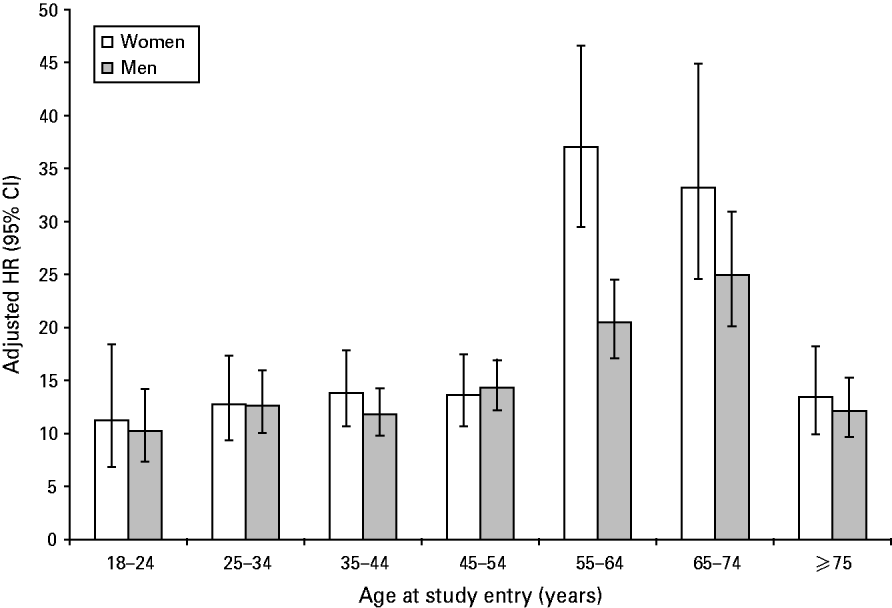
We further examined the association between depression (the strongest identified risk factor) and suicide after stratifying by age at study entry and sex (Fig. 1). The association between depression and suicide was stronger among older compared with younger adults, and among women compared with men (p < 0.001 for interaction between depression and either age or sex using the LRT). As Fig. 1 indicates, depression was strongly associated with suicide across the full range of adult ages, but this association was strongest at age 55–74 years, and reached a higher peak among women. The adjusted HRs for women ranged from 11.2 at age 18–24 years to 37.1 at age 55–64 years, and for men ranged from 7.3 at age 18–24 years to 24.9 at age 65–74 years.
Adjusted hazard ratios (HRs) for association between depression and suicide mortality (2001–2008), stratified by age at study entry and sex, relative to persons without depression. CI, Confidence interval.

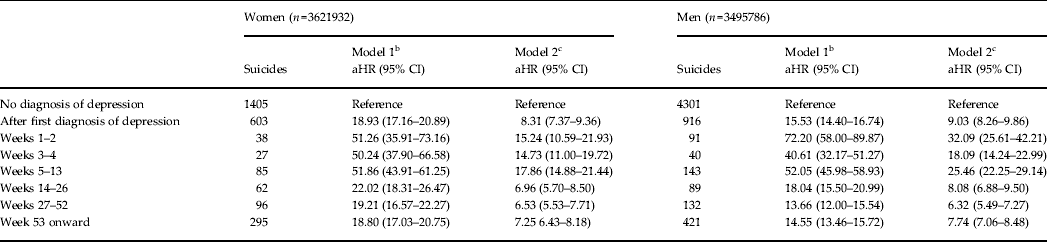
We also examined the risk of suicide in specific time intervals after a first diagnosis of depression in 2002–2008, after excluding persons diagnosed with depression in 2001 so as to remove prevalent cases. The risk of suicide was consistently highest in the first 13 weeks after a diagnosis of depression. Throughout this time, the unadjusted HRs exceeded 50 for women and 40 for men, and the fully adjusted estimates ranged from ∼ 14 to 17 for women and ∼ 18 to 32 for men, relative to persons never diagnosed with depression (Table 4). Beyond 13 weeks after diagnosis, the fully adjusted HRs were in the ∼ 6 to 8 range for both women and men. The strongest adjustment variables were other mental disorders (which had been diagnosed in ∼ 50% of women and men with depression who died from suicide), whereas adjustment for somatic disorders had almost no effect on risk estimates. In addition, depression was more strongly associated with suicide in each time interval among persons not treated with antidepressants compared with those who were (p < 0.001 for this interaction among women or men using the LRT).
Adjusted hazard ratios (aHRs) for association between a first diagnosis of depression and suicide (2002–2008) a

CI, Confidence interval.
a Excluding persons diagnosed with depression during 2001 (n = 22871; 0.3%).
b Model 1 is adjusted for age, marital status, country of birth, education, employment status, income and urban/rural status.
c Model 2 is adjusted for the same variables as in model 1, plus psychiatric and somatic disorders.
Discussion
To our knowledge, this is the first study to examine suicide risk factors using sociodemographic and out-patient and in-patient health data for a national population. All psychiatric disorders were strong risk factors for suicide during 8 years of follow-up, especially depression. COPD, cancer, spine disorders, asthma and stroke were also significant independent risk factors among both women and men, whereas diabetes and ischemic heart disease were modest risk factors only among men. The strongest sociodemographic risk factors were male sex, unmarried status and non-employment.
Suicide is a tragedy not only for the victim but also for family members and society. We found that the majority of suicides occurred during the most productive working years of adulthood (ages 35–64 years), and thus represent a tremendous loss to society. Our findings are consistent with previous evidence that mental disorders are the strongest risk factors for suicide in the general population (Cheng, Reference Cheng1995; Foster et al. Reference Foster, Gillespie and McClelland1997; Harris & Barraclough, Reference Harris and Barraclough1997; Saha et al. Reference Saha, Chant and McGrath2007; Hawgood & De Leo, Reference Hawgood and De Leo2008; Osborn et al. Reference Osborn, Levy, Nazareth and King2008; Qin, Reference Qin2011). Most earlier evidence for this was derived from hospital-based (Osby et al. Reference Osby, Brandt, Correia, Ekbom and Sparen2001; Qin et al. Reference Qin, Agerbo and Mortensen2003; Qin, Reference Qin2011) and/or case–control (Cheng, Reference Cheng1995; Qin et al. Reference Qin, Agerbo and Mortensen2003; Qin, Reference Qin2011) data. A recent Danish cohort study reported increased absolute risks of suicide among persons with unipolar depression, bipolar disorder or schizophrenia ascertained from psychiatric in-patient admissions and out-patient psychiatric department visits (Nordentoft et al. Reference Nordentoft, Mortensen and Pedersen2011). An earlier Swedish study of psychiatric in-patients reported unadjusted standardized mortality ratios for suicide of 27 among women and 20 among men with unipolar depression, and 22 among women and 15 among men with bipolar disorder (Osby et al. Reference Osby, Brandt, Correia, Ekbom and Sparen2001). We report relative risks of suicide in this national population based on more completely ascertained psychiatric diagnoses, in-patient and out-patient, and with more thorough adjustment for potential confounding.
With the possible exception of certain substance use disorders, depression is the mental disorder that has been most strongly and consistently associated with suicide (Harris & Barraclough, Reference Harris and Barraclough1997). We further showed that the risk of suicide was consistently highest in the first ∼ 3 months after a first diagnosis of depression. This was consistent with previous evidence that suicide risk peaks either immediately after psychiatric hospitalization for depression (Qin & Nordentoft, Reference Qin and Nordentoft2005) or during major depression episodes compared with partial or full remission (Holma et al. Reference Holma, Melartin, Haukka, Holma, Sokero and Isometsa2010). We also found that the effect of depression on suicide risk was strongest among older adults. This needs further elucidation in other studies but is consistent with previously reported higher rates of suicide or self-harm among older adults in most countries (Conwell et al. Reference Conwell, Van Orden and Caine2011; Murphy et al. Reference Murphy, Kapur, Webb, Purandare, Hawton, Bergen, Waters and Cooper2012). Also consistent with previous studies (Osby et al. Reference Osby, Brandt, Correia, Ekbom and Sparen2001; Qin et al. Reference Qin, Agerbo and Mortensen2003), we found that psychiatric disorders overall had a stronger relative effect on suicide risk among women than men.
COPD, cancer, spine disorders, asthma and stroke were associated with an increased risk of suicide in this population. Few studies have examined the link between COPD and suicide. Some have suggested a positive association (Juurlink et al. Reference Juurlink, Herrmann, Szalai, Kopp and Redelmeier2004; Goodwin, Reference Goodwin2011) that may be explained or mediated by co-morbid depression (Webb et al. Reference Webb, Kontopantelis, Doran, Qin, Creed and Kapur2012). We found that COPD was independently associated with an increased risk of suicide among women or men after adjusting for out-patient- and in-patient-diagnosed depression and other mental disorders. Consistent with other studies, cancer (Fall et al. Reference Fall, Fang, Mucci, Ye, Andren, Johansson, Andersson, Sparen, Klein, Stampfer, Adami and Valdimarsdottir2009; Fang et al. Reference Fang, Fall, Mittleman, Sparen, Ye, Adami and Valdimarsdottir2012), spine disorders (Lofman et al. Reference Lofman, Rasanen, Hakko and Mainio2011), asthma (Goodwin et al. Reference Goodwin, Demmer, Galea, Lemeshow, Ortega and Beautrais2012) and stroke (Stenager et al. Reference Stenager, Madsen, Stenager and Boldsen1998) were also significant risk factors for suicide among both women and men. Diabetes and ischemic heart disease were associated with modestly increased risk of suicide among men, compared with higher risks previously reported among women with diabetes (Batty et al. Reference Batty, Kivimaki, Park and Jee2012), women with ischemic heart disease (Webb et al. Reference Webb, Kontopantelis, Doran, Qin, Creed and Kapur2012) and women or men with cardiovascular disease risk factors (Jee et al. Reference Jee, Kivimaki, Kang, Park, Samet and Batty2011). Specific modifying factors and their relative importance are still not well established and warrant further elucidation in other large cohort studies.
Several sociodemographic risk factors for suicide were confirmed in this cohort, including male sex (Lawrence et al. Reference Lawrence, Holman, Jablensky and Fuller1999), unmarried status (Heikkinen et al. Reference Heikkinen, Isometsa, Marttunen, Aro and Lonnqvist1995; Kposowa, Reference Kposowa2000), non-employment (Johansson & Sundquist, Reference Johansson and Sundquist1997; Lewis & Sloggett, Reference Lewis and Sloggett1998) and low educational attainment (Johansson et al. Reference Johansson, Sundquist, Johansson and Bergman1997). Most socio-economic factors had a stronger effect among men, consistent with previous evidence that men respond more adversely to poor economic conditions than women (Crombie, Reference Crombie1990; Qin et al. Reference Qin, Agerbo and Mortensen2003). We also confirmed findings from Denmark that living in urban areas is associated with a higher risk of suicide among women and a lower risk among men, relative to living in rural areas (Qin et al. Reference Qin, Agerbo and Mortensen2003). These relationships are still not well understood but may involve relatively lower employment of women in urban areas, and greater social isolation of men in rural areas.
Although depression was the strongest risk factor for suicide in this cohort, only a minority of women (32%) and men (19%) who died from suicide had previously been diagnosed with depression. A majority (56%) of women, however, and 39% of men who died from suicide had a prior diagnosis of any psychiatric disorder. Accounting for other major risk factors, > 90% of women or men who died from suicide had been diagnosed with a psychiatric disorder, COPD or cancer, or were unmarried or non-employed. A large proportion also had had recent contact with the health-care system (57% of women and 45% of men within the previous 3 months). These findings suggest that effective prevention requires a multifaceted approach in both psychiatric and primary care settings, including all mental disorders (especially depression) and certain somatic disorders as targets for intervention, together with key measures of social isolation such as unmarried status and non-employment. Among persons with depression (the strongest identified risk factor), antidepressant medication treatment was associated with a lower suicide risk in this cohort as in other forensic toxicological studies (Isacsson et al. Reference Isacsson, Holmgren, Osby and Ahlner2009, Reference Isacsson, Reutfors, Papadopoulos, Osby and Ahlner2010). Appropriate pharmacological treatment of depression is a crucial component of suicide prevention.
The current study has several limitations, including the inability to examine psychiatric or somatic disorders that were undiagnosed, hence the reported prevalence of these disorders probably underestimated the true prevalence in the general population. However, because Sweden has universal health-care access and diagnoses were obtained from all health-care settings nationwide, ascertainment was probably improved compared with most previous large studies. Psychiatric and somatic disorders that were diagnosed prior to but not during the follow-up period (2001–2008) were not ascertained, nor were we able to identify severity or remission of specific disorders. The true prevalence of psychiatric disorders at the time of death cannot be determined using registry data, but psychological autopsy studies have consistently reported a ∼ 90% prevalence among suicide victims in Western populations (Waern et al. Reference Waern, Runeson, Allebeck, Beskow, Rubenowitz, Skoog and Wilhelmsson2002; Cavanagh et al. Reference Cavanagh, Carson, Sharpe and Lawrie2003; Arsenault-Lapierre et al. Reference Arsenault-Lapierre, Kim and Turecki2004). Information was not available on suicide methods or non-fatal suicide attempts, which are known risk factors for subsequent completed suicide (Harris & Barraclough, Reference Harris and Barraclough1997; Tidemalm et al. Reference Tidemalm, Langstrom, Lichtenstein and Runeson2008). It is also unclear to what extent these findings from Sweden are generalizable to countries with different socio-economic conditions and health-care systems.
Study strengths include the ability to examine suicide risk factors for the first time using nearly complete sociodemographic and out-patient and in-patient health data for a national population. This study design enables more reliable risk estimates and inferences by more complete ascertainment of psychiatric and somatic disorders in an unselected population, thereby avoiding bias that may potentially result from the sole use of hospital-based or case–control data, and by more complete adjustment for confounding.
In summary, this large national cohort study found that all psychiatric disorders, COPD, cancer, spine disorders, asthma, stroke, diabetes, ischemic heart disease and specific sociodemographic factors (including unmarried status and non-employment) were independent risk factors for suicide during 8 years of follow-up. These findings indicate that effective prevention requires a multifaceted approach in both psychiatric and primary care settings, including mental disorders (especially depression), specific somatic disorders and lack of social support as targets for intervention. Better awareness of these risk factors among physicians, patients and family members is essential for reducing mortality from suicide.
Acknowledgments
This work was supported by grants from the National Institute of Drug Abuse (R01DA030005), the Swedish Research Council and an ALF project grant, Lund, Sweden. The funding agencies had no role in the design and conduct of the study; in the collection, analysis and interpretation of the data; or in the preparation, review or approval of the manuscript.
Declaration of Interest
None.