INTRODUCTION
Weeds are a major constraint limiting crop yields in conventional and mainly in organic agricultural systems (Bertholdsson, Reference Bertholdsson2004). Milberg and Hallgren (Reference Milberg and Hallgren2004) reported that the mean yield loss of cereals due to weeds in Sweden over the previous 40 years was 5.4%. However, Watson et al. (Reference Watson, Derksen and Van Acker2006), who studied the competitive ability of 29 barley (Hordeum vulgare) cultivars, found that yield loss due to interference by oats (Avena spp.) ranged from 6 to 79%. In conventional farming systems, weeds are routinely controlled by herbicides, but this practice has now been questioned because of environmental and human health concerns (Lemerle et al., Reference Lemerle, Gill, Murphy, Walker, Cousens, Mokhtari, Peltzer, Coleman and Luckett2001). Also, the widespread and continuous use of herbicides has created new weed problems, such as shifts in weed populations and emergence of herbicide-resistant weeds (Heap, Reference Heap2006).
Competition is the major component of weed–crop interference. Previous studies have indicated that competition for environmental resources between weeds and cereals can be attributed mainly to morphological and physiological traits of plants (Balyan et al., Reference Balyan, Malik, Panwar and Singh1991; Dhima et al., Reference Dhima, Eleftherohorinos and Vasilakoglou2000; Didon, Reference Didon2002). Important traits, primarily affecting photosynthetic active radiation interception, are leaf inclination, early vigour, plant height, tillering capacity, seed size, and initial shoot and root growth rates (Balyan et al., Reference Balyan, Malik, Panwar and Singh1991; Bertholdsson, Reference Bertholdsson2004; O'Donovan et al., Reference O'Donovan, Harker, Clayton and Hall2000). Early biomass development of barley (in particular a high initial growth rate of the shoots) was also found to be an important morphological character for enhanced crop competitiveness against weeds in both conventional and organic trials (Jönsson et al., Reference Jönsson, Bertholdsson, Enqvist and Ahman1994). Satorre and Snaydon (Reference Satorre and Snaydon1992) found that oat (A. sativa) and barley were generally more competitive than wheat (Triticum aestivum) due to their greater rate of root or shoot growth, but there were significant differences in competitive ability among the cultivars tested. O'Donovan et al. (Reference O'Donovan, Harker, Clayton and Hall2000) found that semidwarf and hull-less cultivars of wheat were generally less competitive than full height and hulled cultivars, respectively. Didon and Bostrom (Reference Didon and Bostrom2003) found that two out of six barley cultivars tested with low competitive ability against weeds were associated with the highest weed biomass and the lowest crop biomass in competition with weeds.
Allelopathy is another component of weed–crop interference, but is less studied than competition. Most cereals have been reported to be allelopathic (Baghestani et al., Reference Baghestani, Lemieux, Lemieux, Baziramakenga and Simard1999; Bertholdsson, Reference Bertholdsson2004; Borner, Reference Borner1960; Dhima et al., Reference Dhima, Vasilakoglou, Eleftherohorinos and Lithourgidis2006; Kudsk et al., Reference Kudsk, Olsen, Mathiassen, Brandt and Christensen2001; Liu and Lovett, Reference Liu and Lovett1993). In particular, Borner (Reference Borner1960) found that cold water extracts of barley, rye (Secale cereale) and wheat straw, as well as alcoholic extracts of roots, contained phenolic compounds toxic to plant growth. Liu and Lovett (Reference Liu and Lovett1993) found that hordenine and gramine, alkaloids released from germinating seeds of barley, are allelochemicals. In addition, Baghestani et al. (Reference Baghestani, Lemieux, Lemieux, Baziramakenga and Simard1999) reported that barley germplasm contained higher phenolic concentrations than wheat germplasm. However, Kudsk et al. (Reference Kudsk, Olsen, Mathiassen, Brandt and Christensen2001) found only minor differences in hordenine and gramine concentrations among the wild types and cultivars of barley tested, which could not explain the observed variations in allelopathic activity. Bertholdsson (Reference Bertholdsson2004) found that a vigorous growing root system may exude more phytotoxic allelochemicals, although no clear correlation between root size and allelopathic activity in barley was found. In addition, Lemerle et al. (Reference Lemerle, Gill, Murphy, Walker, Cousens, Mokhtari, Peltzer, Coleman and Luckett2001) reported that allelopathy is receiving increasing attention, although its importance is still questioned because it is difficult to separate it from exploitation competitive traits. A single trait may not be sufficient to increase competitiveness but integrating a number of traits, such as competition for light and nutrients, and allelopathy, may offer the potential to make use of inherited competitive ability (Bertholdsson, Reference Bertholdsson2005).
Barley competitiveness and phytotoxic (allelopathic) potential vary among cultivars (Baghestani et al., Reference Baghestani, Lemieux, Lemieux, Baziramakenga and Simard1999; Bertholdsson, Reference Bertholdsson2004; Didon, Reference Didon2002; O'Donovan et al., Reference O'Donovan, Harker, Clayton and Hall2000). Barley cultivars with great competitive and/or allelopathic ability would be most appropriate for situations where herbicide usage may be limited, such as organic or integrated production systems. However, very little plant breeding has been carried out with the objective of improving the competitive and/or allelopathic ability of crops, while selection and breeding over the past century have resulted in declining allelopathic ability of barley varieties (Bertholdsson, Reference Bertholdsson2004). So, old barley varieties with great allelopathic ability could be useful to breeders in developing new commercial cultivars. Published data for the competitive ability of barley cultivars against common poppy (Papaver rhoeas) and ivy-leaved speedwell (Veronica hederifolia), two of the most important broadleaf weeds in Greek cereal fields (Damanakis, Reference Damanakis1983), are also limited.
The objectives of this research were i) to assess, under field conditions in east Albania, the competitive ability of 10 old winter barley varieties against common poppy and ivy-leaved speedwell, and ii) to screen, in the laboratory, their phytotoxic potential using barnyard grass (Echinochloa crus-galli), a species that is very sensitive to cereal allelochemicals (phenolic compounds) as an indicator (Barnes and Putnam, Reference Barnes and Putnam1987; Chon and Kim, Reference Chon and Kim2004, Dhima et al., Reference Dhima, Vasilakoglou, Eleftherohorinos and Lithourgidis2006).
MATERIALS AND METHODS
Field experiment
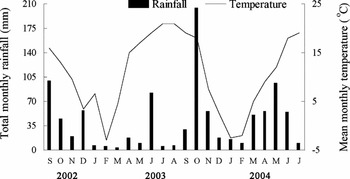
A field experiment was conducted in 2002/2003 (year 1) and repeated in 2003/2004 (year 2) at the Experimental Station Farm of Korca in eastern Albania. The site was located at 20°47′13″E, 40°37′01″N and at an altitude of 902 m asl. The soil was a clay loam whose physicochemical characteristics were: clay 390 g kg−1, silt 210 g kg−1, sand 400 g kg−1, organic matter 11 g kg−1 and pH (1:2 H2O) 8.1. Mean monthly temperature and rainfall data recorded near the experimental area are shown in Figure 1.
Total monthly rainfall and mean monthly temperature during the experiment (2002–2004).

Nitrogen and phosphorus were applied as ammonium sulpho-phosphate (20-10-0) at 100 and 50 kg ha−1, respectively, and incorporated into the soil before barley planting. Also, 50 kg N ha−1 as ammonium nitrate (33.5-0-0) was applied in early April. All barley cultivars were planted at a seed rate of 170 kg ha−1 on 15 October 2002 and 20 October 2003. A split-plot arrangement of treatments was used with four replicates in a randomized complete block design. The plot size was 3 × 7 m. In each plot, two subplots of 3 × 3 m were created, and all subplots were separated by a 1-m wide alley. Barley varieties (eight two-row cultivars, Alfa, Aspen, Esterel, Platine, Scarleta, Tersey from France, Goldmarker from England, and Terova from the Czech Republic, as well as two six-row varieties, Lignee 640 from France and Galt Brea from México) were the main plot factor. The varieties selected provided acceptable grain yield during preliminary tests at the experimental site. Chemical weed control (with or without herbicide application 18 weeks after barley planting) was the subplot factor. In the subplots broadleaf weed control was achieved with 0.9 + 0.3 kg active ingredient (a.i) ha−1 of bromoxynil + mecoprop (Brominal H EC, 120 + 360 g a.i. l−1; Bayer CropScience) applied post-emergence, or by hand-weeding. The experiment was conducted in an area with naturally occurring common poppy and ivy-leaved speedwell populations. Other broadleaf weed species were observed at very low densities but are not reported, and there was no infestation by grass weeds. Other cultural practices were carried out according to the recommended production practices for the area.
At completion of barley emergence (in late January of each growing season), an area of 1 m2 was marked in the centre of each subplot and crop seedlings were counted. In addition, in late May of both growing seasons (at the ear emergence growth stage (Zadoks growth stage 50) (Zadoks at al., Reference Zadoks, Chang and Konzak1974)), in the marked area of 1 m2, tillering ability and plant height of barley varieties as well as biomass of common poppy and ivy-leaved speedwell were determined. In early July, barley plants from the previously marked areas in all subplots were harvested by hand, and ear number, 1000-grain weight and grain yield of the barley varieties were determined.
Laboratory experiments
Plants of each barley variety were harvested at ear emergence. The harvested plants were chopped into 5-cm long pieces, dried in an oven at 70 °C for 48 h and ground in a Wiley mill through a 1-mm screen. Then, aqueous extracts were prepared in 400-ml glass jars by adding 4 or 8 g from each plant sample in 200 ml of deionized water and shaking in a horizontal shaker for 4 h at 200 rpm. The solutions were filtered through four layers of cheesecloth to remove fibre debris, centrifuged at 1750 g for 1 h and the supernatants were then filtered through a layer of filter paper (Whatman No. 42). The extracts were stored at 4 °C until bioassayed. The two extract concentrations (2 g 100 ml−1, 4 g 100 ml−1) for each barley variety were chosen in accordance with those studied by Ben-Hammouda et al. (Reference Ben-Hammouda, Ghorbal, Kremer and Oueslati2001) and Chung et al. (Reference Chung, Ahn and Yun2001). There were three replicate extracts for each plant material × extract concentration treatment.
The phytotoxic activity of the barley varieties on barnyard grass was investigated. Barnyard grass was used as a plant indicator in the bioassays because previous studies showed that seeds of this grass had very good germination ability and were very sensitive to barley allelochemicals (Chon and Kim, Reference Chon and Kim2004; Chung et al., Reference Chung, Ahn and Yun2001; Dhima et al., Reference Dhima, Vasilakoglou, Eleftherohorinos and Lithourgidis2006).
Petri dish bioassays were carried out to compare germination, root length and fresh weight of barnyard grass in perlite treated with each of the barley cultivar extracts. Fifty barnyard grass seeds were placed in 8.5-cm diameter plastic petri dishes and were covered with 6 g of perlite. The open dishes were moistened with 15 ml of barley extract per dish from each of the barley variety extracts. Deionized water was used in control dishes. There were two petri dishes for each replicate extract and the dishes were arranged in a completely randomized design. The dishes were stored on shallow trays and were placed inside a plastic bag to retain moisture. The trays were then placed in an illuminated (16 h light:8 h dark) growth chamber at 27 ± 2 °C for 8 d. At the end of the incubation period, plants were removed from the dishes, carefully washed free of perlite, and average (mean of the two dishes used for each replicate extract) germination, total fresh weight and root length (of the germinated seeds only) were calculated. Inhibition percentage was calculated using Equation 1, from Chung et al. (Reference Chung, Ahn and Yun2001). The experiment was repeated in time. Fungal contamination was not observed during these experiments.

Statistical analyses
For the barley field data (tillering ability, plant height, ear number, 1000-grain weight and grain yield) a combined over growing season analysis of variance (ANOVA) was performed using a split-plot approach (barley variety × herbicide application). Weed fresh weight data were also analysed across growing seasons. Barley data were not transformed before the ANOVA as it was not necessary, but weed data were log10(x)-transformed to reduce their heterogeneity. Single degree of freedom contrasts comparing the main effects of the two barley groups (two-row and six-row) on the weed fresh weight and barley yield were also performed.
For the laboratory data (germination, root length or total fresh weight inhibition), a combined over repetition time ANOVA was performed using a factorial approach (barley variety extracts × extract concentration). Data before the ANOVA were log10(x)-transformed in order to reduce their heterogeneity. Also, single degree of freedom contrasts comparing the main effects of the two barley groups on germination, root length and total fresh weight inhibition of barnyard grass were performed.
The MSTAT program (MSTAT-C, 1988) was used to analyse variance.
RESULTS
Field experiments
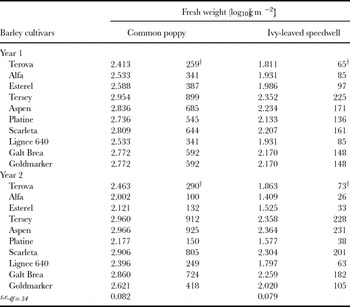
The ANOVA for both weeds indicated that their fresh weight was significantly affected by growing season (p < 0.001), barley variety (p < 0.001) and their interaction (p < 0.001). So, the growing season × barley variety interaction means are presented in Table 1.
Fresh weight of common poppy and ivy-leaved speedwell (at barley ear emergence growth stage) grown in 10 winter barley cultivars during the 2002/2003 (year 1) and 2003/2004 (year 2) growing seasons.

†Back-transformed values.
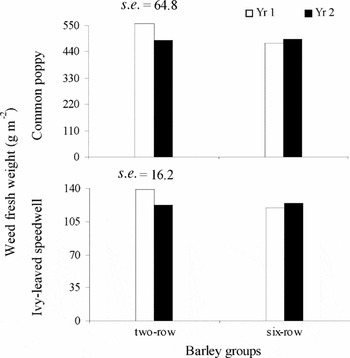
In both growing seasons, the fresh weight of ivy-leaved speedwell grown in competition with barley varieties was significantly lower than that of common poppy. Both weeds grown in competition with Tersey, Aspen, Scarleta, Galt Brea, Goldmarker and Platine produced significantly greater biomass than with other varieties (Table 1). Also, both weeds grown in competition with Terova, Alfa, Esterel, and Lignee 640 produced the lowest fresh weights in year 1, but this was not the case in year 2, where the lowest weed biomass was recorded only in competition with Alfa and Esterel. However, in year 2, ivy-leaved speedwell and common poppy grown in competition with Platine produced low fresh weight. The single degree of freedom contrasts showed that the fresh weight of both weeds was decreased more by competition with the six-row than the two-row barley varieties in year 1. However, in year 2, both barley groups caused similar weed fresh weight reduction (Figure 2).
Fresh weight of common poppy and ivy-leaved speedwell as affected by barley groups during the 2002/2003 (year 1) and 2003/2004 (year 2) growing seasons.

In both herbicide-treated and untreated plots, Scarleta, Terova and Goldmarker showed the greatest tillering ability, and Lignee 640 and Galt Brea the lowest (data not shown). However, Tersey, Aspen, Galt Brea and Goldmarker produced more tillers in the herbicide-treated plots than in the corresponding untreated plots, while the number of tillers produced by Terova, Alpha, Esterel and Lignee 640 was similar in treated and untreated plots. In addition, Terova, Platine and Alfa were tallest (90–100 cm), and Goldmarker and Tersey the shortest (75–78 cm) (data not shown).
Barley ear number and grain yield were significantly affected by growing season (p < 0.001), barley variety (p < 0.001) and herbicide application (p < 0.001), as well as by the growing season × barley variety (p < 0.001) and barley variety × herbicide application (p < 0.001) interactions. As the ANOVA indicated no significant growing season × barley variety × herbicide application interaction, the means presented are averaged across growing seasons (Figure 3).
Ear number (A) and grain yield (B) of 10 barley cultivars or two barley groups (C) grown in competition with common poppy and ivy-leaved speedwell. TER, cv. Terova; ALF, cv. Alfa; EST, cv. Esterel; TES, cv. Tersey; ASP, cv. Aspen; PLA, cv. Platine; SCA, cv. Scarleta; LIG, cv. Lignee 640; GAL, cv. Galt Brea; GOL, cv. Goldmarker.

In herbicide-treated plots, barley varieties Scarleta, Terova and Platine produced the greatest ear numbers, and Lignee 640 the least. In herbicide-untreated plots, ear numbers of Scarleta, Goldmarker, Platine, Galt Brea, Aspen and Tersey varieties were reduced by 22–34% due to weed competition, while the corresponding ear number reduction for Lignee 640, Esterel, Alfa and Terova was 4–12% (Figure 3a).
Grain yields of most barley cultivars were greater in herbicide treatments (grown without weed competition) than in the corresponding untreated plots. In herbicide-treated plots, the varieties Goldmarker and Galt Brea produced the greatest grain yield and Lignee 640 the least (Figure 3b). In particular, grain yield of Lignee 640 in herbicide-treated subplots was about 27% less than that of Goldmarker and Galt Brea and about 20% less than that of the other barley varieties, which produced similar grain yields.
In untreated plots, varieties Goldmarker and Galt Brea again produced the greatest grain yields, and Lignee 640, Aspen and Tersey the least (Figure 3a). Comparing grain yields in herbicide-treated plots, yield reductions due to weed competition for Tersey, Aspen, Galt Brea and Goldmarker were 29, 25, 16 and 15%, respectively, while the corresponding reductions for Platine or Scarleta were 11%. However, grain yields of Terova, Alpha, Esterel and Lignee 640 were not significantly affected by the presence of weeds (Figure 3b). In both herbicide-treated and untreated plots, greater grain yields were produced by the two-row than the six-row barley varieties, based on the single degree of freedom contrasts (Figure 3c).
Laboratory experiments
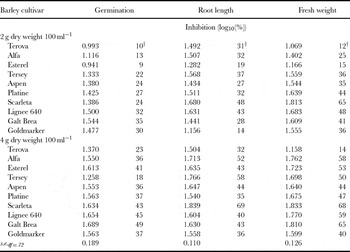
Barnyard grass germination, root length and total fresh weight were significantly affected by extract concentration (p < 0.01). Root length and total fresh weight were also affected by barley variety (p < 0.05). As the ANOVA indicated no significant repetition time × treatments interaction, the repetition time × barley varieties × extract concentration means are presented (Table 2). Barnyard grass germination, root length and total fresh weight inhibition increased in most cases with increasing extract concentration. However, at both extract concentrations barnyard grass germination was affected less than root length or total fresh weight (Table 2). Barley varieties Galt Brea and Lignee 640 at both extract concentrations caused the greatest germination inhibition of barnyard grass (35–49 and 32–45%, respectively) and Terova the least (10–23%).
Inhibitory effect (% of water-control) of 10 barley extracts on germination, root length and total fresh weight of barnyard grass. Values are means from two experiments.

†Back transformed values.
Root length inhibition of barnyard grass in the higher concentration extract ranged from 32 to 69%, while the corresponding inhibition by the lower extract concentration ranged from 14 to 48% (Table 2). The greater extract concentration of Scarleta and Tersey caused the greatest root length inhibition of barnyard grass (69 and 58%, respectively), and Terova and Platine the least (32 and 35%, respectively). At the lower extract concentration, the greatest root length inhibition of barnyard grass was caused by Scarleta and Lignee 640 (48 and 43%, respectively), and the least by Goldmarker and Esterel (14 and 19%, respectively).
Total fresh weights of barnyard grass at both extract concentrations were affected most by Scarleta (65–68%) and least by Terova (12–14%). The total fresh weight inhibition caused by the extracts from the other barley varieties ranged from 15 to 48% at the lower extract concentration and 40 to 65% at the higher.
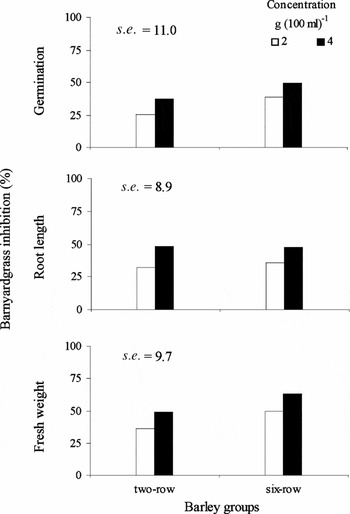
The single degree of freedom contrasts between barley groups showed clearly that extracts from the six-row barley varieties caused greater germination or total fresh weight inhibition of barnyard grass than those of the two-row varieties (Figure 4). However, both barley groups caused similar barnyard grass root length inhibition. In particular, germination, root length and total fresh weight inhibition of barnyard grass caused by extracts of the six-row barley varieties were 44, 42 and 56%, respectively, and the corresponding reductions caused by extracts of the two-row varieties were 31, 40 and 43%.
Inhibitory effect (% of water control) of two barley group extracts on germination, root length and total fresh weight of barnyard grass. Means are averaged over two experiments.

DISCUSSION
Field experiments
The greater biomass reduction of both weeds grown in competition with barley varieties Terova, Alpha, Esterel and Lignee 640 could be explained by the greater competitive ability of these cultivars due to their greater tillering ability and plant height, compared with the other varieties. Other studies (Balyan et al., Reference Balyan, Malik, Panwar and Singh1991; Dhima et al., Reference Dhima, Eleftherohorinos and Vasilakoglou2000; Didon and Bostrom, Reference Didon and Bostrom2003) showed that the competitive ability of cereal varieties against weeds was associated with canopy height, early dry matter production, tillering ability and light interception. Also, the allelopathic ability of crop plants could be another factor in their interference against weeds. Therefore, the greater biomass reduction of both weeds grown with Lignee 640 could be attributed to the increased competitiveness of this variety along with its possibly higher phytotoxic ability. This explanation is the most likely one for these findings, since the tillering ability of this cultivar and the plant height, both of which are a measure of competitive ability, were the lowest recorded among the varieties tested.
Grain yield differences among the varieties tested when grown with weeds may have resulted from their different competitive ability against weeds. These results are in agreement with those reported by Dhima et al. (Reference Dhima, Eleftherohorinos and Vasilakoglou2000) who found that barley varieties with low suppressive ability against grass weeds had a lower crop biomass and grain yield than more competitive varieties. Dhima and Eleftherohorinos (Reference Dhima and Eleftherohorinos2005) found that the grain yields of poorly competitive wheat and triticale were reduced to 26 or 27%, respectively, by competition from wild mustard (Sinapis arvensis), while the corresponding reduction for the most competitive barley was only 3.5%. In contrast to these findings, Didon and Bostrom (Reference Didon and Bostrom2003) found no consistent relationship between the assumed competitive ability of the varieties and the observed yield reduction by weeds.
Ear number followed in most cases a similar trend to that of grain yield. This indicates that reduction due to weed competition resulted mostly from ear number reduction and less from 1000-grain weight agreeing with results reported by Dhima et al. (Reference Dhima, Eleftherohorinos and Vasilakoglou2000).
Laboratory experiments
The different inhibitory effects caused by the extracts of barley varieties on barnyard grass germination, root length and total fresh weight could be explained by differences in the total amount and physicochemical characteristics of allelochemicals found in varietal extracts. Similar results have been reported for experiments using extracts of rye, barley, wheat, triticale and rice (Oryza sativa) varieties (Burgos et al., Reference Burgos, Talbert and Mattice1999; Chung et al., Reference Chung, Ahn and Yun2001; Dhima et al., Reference Dhima, Vasilakoglou, Eleftherohorinos and Lithourgidis2006; Hanson et al., Reference Hanson, Traynor, Ditz and Reicosky1981; Lemerle et al., Reference Lemerle, Verbeek, Cousens and Coombes1996). Bertholdsson (Reference Bertholdsson2004) in a study of barley germplasm from different countries found that there were great differences in allelopathic activity on ryegrass among them. Ben-Hammouda et al. (Reference Ben-Hammouda, Ghorbal, Kremer and Oueslati2001) reported that extracts of barley plants did not significantly affect seed germination of either durum (Triticum durum) or bread wheat cultivars. The increased inhibition of barnyard grass germination, root length and total fresh weight with increasing extract concentrations agrees with results reported by Burgos and Talbert (Reference Burgos and Talbert2000), Chon and Kim (Reference Chon and Kim2004) and Dhima et al. (Reference Dhima, Vasilakoglou, Eleftherohorinos and Lithourgidis2006).
The greater germination or total fresh weight inhibition of barnyard grass by extracts of the six-row than the two-row barley varieties is in contrast to the results of Bertholdsson (Reference Bertholdsson2004), who found that both two- and six-row Finnish barley varieties were tested with similar results.
CONCLUSIONS
The results of this study indicated that the Alfa, Terova, Esterel and Lignee 640 barley varieties had great competitive ability against common poppy and ivy-leaved speedwell. Variety Lignee 640 had also increased phytotoxic (allelopathic) potential and possibly this may contribute to its increased competitive ability. Barley varieties with great competitive ability could be used for effective, economical and environmentally friendlier suppression of both weed species in winter cereal areas eliminating the herbicide usage.
Acknowledgements
This research was supported financially by the European Commission and the Greek Ministry of Development, General Secretariat for Research and Technology (Joint Research and Technology Programmes).