Introduction
Tobacco use is one of the most important public health challenges of the modern era (Alberg, Shopland, & Cummings, Reference Alberg, Shopland and Cummings2014). Some of the most effective interventions to reduce tobacco use in the United States (US) have focused on public policy, such as restricting smoking in public areas, rather than soliciting individual motivation to avoid or quit tobacco based on adverse health effects (Brownson, Haire-Joshu, & Luke, Reference Brownson, Haire-Joshu and Luke2006; Cummings, Fong, & Borland, Reference Cummings, Fong and Borland2009; Hyland, Barnoya, & Corral, Reference Hyland, Barnoya and Corral2012; McGoldrick & Boonn, Reference McGoldrick and Boonn2010; Warner & Mendez, Reference Warner and Mendez2010). The state of California has been at the forefront of legislative and public policy efforts to reduce tobacco use (Lee et al., Reference Lee, Goldstein, Kramer, Steiner, Mathew and Ezzell2010; Lightwood & Glantz, Reference Lightwood and Glantz2013; Satterlund, Cassady, Treiber, & Lemp, Reference Satterlund, Cassady, Treiber and Lemp2011). Workplace policies have had an especially powerful impact on reducing tobacco use among adults (Hughes et al., Reference Hughes, Yette, Hannon, Harris, Tran and Reid2011; US Centers for Disease Control, 2011b). While occupational policies may be implemented to protect non-smoking workers and clients from second-hand smoke exposure, the effects of such policies have extended outside of the workplace and translated into reduced tobacco use in home and other environments (Cheng, Glantz, & Lightwood, Reference Cheng, Glantz and Lightwood2011; Ham et al., Reference Ham, Przybeck, Strickland, Luke, Bierut and Evanoff2011; Zablocki et al., Reference Zablocki, Edland, Myers, Strong, Hofstetter and Al-Delaimy2014).
The US military represents a somewhat unique working population, with regard to tobacco use (Hermes et al., Reference Hermes, Wells, Smith, Boyko, Gackstetter and Miller2012; Jahnke et al., Reference Jahnke, Hoffman, Haddock, Long, Williams and Lando2011b; Olmsted, Bray, Reyes-Guzman, Williams, & Kruger, Reference Olmsted, Bray, Reyes-Guzman, Williams and Kruger2011; Smith et al., Reference Smith, Ryan, Wingard, Patterson, Slymen and Macera2008). Despite the success of other workplace tobacco policies, and the importance of tobacco avoidance to military health and readiness, the US military includes a substantially higher percentage of tobacco users than other adult populations. Based on data from 2011–2012, the prevalence of cigarette smoking in US adults is approximately 18% (Agaku, King, & Dube, Reference Agaku, King and Dube2014a), while the overall rate of smoking among military members is 24% (US Department of Defense, 2013). Current rates of any tobacco use, including smokeless products, are estimated at 25% among all US adults and 35% among military members (Agaku et al., Reference Agaku, King, Husten, Bunnell, Ambrose and Hu2014b; US Department of Defense, 2013). Within the military, rates of smoking and smokeless tobacco use have been consistently highest in the Marine Corps, under the Department of the Navy, when compared to other services (US Department of Defense, 2009; 2013). The US military and the Office of the Navy Surgeon General have recognised this challenge and worked to promote policy changes in the recent years, not just to limit tobacco use in workplaces, but to evolve into a workforce that will eventually be completely tobacco free (US Department of Defense & Office of the Navy Surgeon General, 2012; US Department of Defense & Secretary of the Navy, 2008; US Institute of Medicine, 2009).
Healthcare workers also represent a unique population with regard to tobacco use. National surveys suggest that rates of cigarette smoking are substantially lower in this occupational group when compared to other US working adults (US Centers for Disease Control, 2011a). Notably, within the healthcare sector, there are marked differences in tobacco use by different types of professionals. The prevalence of cigarette smoking in the healthcare industry overall is estimated at 15%, while less than 5% of physicians report current smoking, and as many as 24% of licensed practical nurses and support staff report current smoking (Sarna, Bialous, Nandy, Antonio, & Yang, Reference Sarna, Bialous, Nandy, Antonio and Yang2014; Shahbazi, Arif, Portwood, & Thompson, Reference Shahbazi, Arif, Portwood and Thompson2014; US Centers for Disease Control, 2011a). Atypical healthcare workers, such as home health providers, may use tobacco at even higher rates (Hoffman & Mendez-Luck, Reference Hoffman and Mendez-Luck2011). The potential stigma associated with tobacco use in the healthcare professions, and the importance of tobacco avoidance among healthcare champions, make analyses of these occupational groups of special interest to public health.
Given this background, healthcare workers at a military command in the state of California represent a population with many unique and important characteristics. This California-based Navy community hospital recognised the importance of workplace tobacco control and implemented a new policy in 2011 (US Naval Hospital Camp Pendleton, 2011). While already a tobacco-free indoor workplace, the new policy eliminated the only smoking-permissible outside patio from the hospital compound. The restriction included tobacco use in vehicles in hospital parking lots. In addition, the 2011 policy specifically prohibited the command's military healthcare workers from using tobacco products while in uniform, even when outside the hospital compound. The impact of this kind of policy change on tobacco use among healthcare workers has not been previously evaluated.
Methods
The primary objective of this project was to describe the prevalence of tobacco use and the experience of tobacco users at a military community hospital in California in relationship to a tobacco-restrictive worksite policy. All work was performed under IRB-approved protocol NHCP.2012.0034.
The population was defined in July 2012, one year after the implementation of a new policy that prohibited tobacco use on any part of the hospital compound (US Naval Hospital Camp Pendleton, 2011). Occupational health records were reviewed to define the basic demographic characteristics of the workforce, including sex, age, and worker type (military officer, military enlisted, or civilian). Since the occupational health record system was linked to the personnel system, it completely represented military and civilian workers; volunteer workers (less than 1% of the workforce) were not represented or included in these analyses. These electronic medical records also defined current tobacco use among staff members. Because hospital policy required updates to occupational health records at least annually, the extracted data represented worker-reported tobacco use within the past year. Multivariable logistic regression analysis defined demographic factors that were statistically significantly associated with current tobacco use.
Also in the summer of 2012, healthcare staff members were invited to complete an anonymous survey on their tobacco use and their impressions of the command's tobacco policy. The survey was introduced via an email to all staff, and locked survey boxes were made available at multiple sites to collect anonymous paper responses. Respondents were instructed to remain anonymous but asked to share basic demographic information (worker type, sex, and age, within the categories shown in Table 2). The survey instrument assessed past and current tobacco use, including type and amount of products used, drawing several questions from standard instruments that have been used to assess military tobacco use (US Department of Defense, 2009; 2013). Ever-smoking was defined by endorsing a history of smoking at least 100 cigarettes (five packs) in one's lifetime; current smoking was additionally defined by use of any cigarettes in the past 30 days. These definitions were identical to the definitions of ever-use and current-use in standard military surveys (US Department of Defense, 2009; 2013). Similar questions assessed smokeless tobacco use. Respondents were asked to quantify their average daily tobacco use, and to identify whether their use had increased, decreased, or remained unchanged in the past 12 months. Tobacco users were further asked if they had ever used any resources, such as healthcare providers, counsellors, classes, or medications, in attempts to decrease or quit tobacco use. The survey assessed potential motivations to quit tobacco use, including personal health, personal fitness, children, family, friends, tobacco prices, or tobacco policies. The instrument described the worksite policy that became effective one year prior, prohibiting tobacco use by anyone anywhere on the hospital compound and prohibiting tobacco use by military workers in uniform even when outside the hospital compound. All survey respondents were asked the degree to which they agreed with the policy, and the degree to which they thought the policy was effective in reducing tobacco use. Response options on motivation to quit and impressions of policy included 5-level scales (e.g., ‘strongly disagree’, ‘somewhat disagree’, ‘neutral/unsure’, ‘somewhat agree’, ‘strongly agree’). Respondents were asked whether they had personally observed violations of the policy. Tobacco users were further asked if they had changed any habits in direct response to the policy, including changing the timing or duration of their work breaks, changing locations of tobacco use, or changing the type of tobacco they used. Response options to the latter questions were ‘yes‘ or ‘no’ with a small open text space for ‘other’ comments.
A multivariable logistic regression model was developed to determine factors statistically significantly associated with decreased tobacco use in the past year. Variables in the model included age, sex, worker type, resources used to support tobacco cessation, factors reported as motivating tobacco cessation, and self-reported changing habits in response to the worksite tobacco policy change. Analyses were performed using SAS 9.0 (Carey, NC).
Results
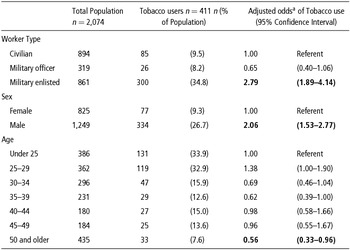
The workforce at this military community hospital included 2,074 staff members. More than 43% of the population were civilians, 15% were military officers, and 42% were military enlisted members. Nearly 60% of the workforce was male and their mean age was 38 years old. Table 1 shows the demographic features of the entire workforce, as well as the 411 workers identified as current tobacco users. Tobacco use was much more prevalent among military enlisted members (34.7%) than among civilians (9.5%) or military officers (8.2%). Tobacco use also appeared to be more common among men, and the subset of male military enlisted workers used tobacco at a rate of 37%. In multivariable logistic regression analysis, factors strongly associated with tobacco use included military enlisted worker type (odds ratio [OR] 2.79, 95% confidence interval [CI] 1.89–4.14), and male sex (OR 2.06, 95% CI 1.53–2.77). Age was less strongly associated with tobacco use in the adjusted model, although workers over age 50 years were less likely to use tobacco than those under 25 years old (OR 0.56, 95% CI 0.33–0.96).
Tobacco use among healthcare workers at a military community hospital

a Odds ratios represent results of multivariable logistic regression.
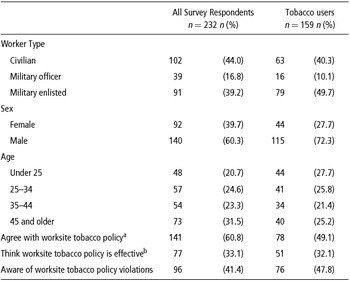
The survey on tobacco use and policy was completed by 232 staff members, representing a response rate of just over 11%. The majority of survey respondents were tobacco users; these 159 participants represented 38.7% of tobacco users in the workforce. Table 2 shows the demographic features of the survey respondents. Respondents were very similar to the entire workforce with regard to worker type (44.0% of respondents and 43.1% of the workforce were civilians) and sex (39.7% of respondents and 39.8% of the workforce were female). Respondents were slightly less likely than the total workforce to be in the 25–34 year-old age group (24.6% of respondents and 31.7% of the workforce were in this age group, chi-square p-value 0.03).
Responses to an anonymous tobacco policy survey of healthcare workers at a military community hospital

a Response options included a 5-level scale from ‘strongly disagree’ to ‘strongly agree’. Respondents who ‘somewhat agreed’ or ‘strongly agreed’ with policy were much more likely to be non-users of tobacco (Chi-square odds ratio 6.54, 95% confidence limits 3.13–13.66).
b Response options included a 5-level scale from ‘not at all effective’ to ‘very effective’. Respondents who believed the policy was ‘somewhat effective’ or ‘very effective’ were no more likely to be non-users than users of tobacco.
Responses to the primary survey questions on worksite tobacco policy are also shown in Table 2. More than 60% of respondents agreed with the policy that prohibited all tobacco use of the hospital compound. In contrast, only 31% of respondents thought the policy was effective in reducing tobacco use among workers. More than 41% of respondents reported personally witnessing violations of the policy; most violations were described as smoking in parking lots or vehicles on the hospital compound. Tobacco users significantly differed from non-users regarding agreement with worksite tobacco-restrictive policy. While 63/73 (86%) of respondents who did not use tobacco agreed with the policy, only 78/159 (49%) of tobacco users agreed with the policy. Tobacco users responded similarly to non-users with regard to agreeing that the policy was effective in reducing tobacco use (32% and 36%, respectively).
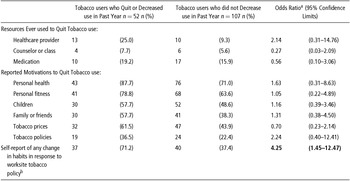
Among surveyed tobacco users, 52/159 (32.7%) reported decreasing use or quitting within the previous year. Factors potentially associated with decreasing tobacco use in the past year are shown in Table 3. Any past consultation with a healthcare provider as a tobacco cessation resource was slightly more common among those who decreased tobacco use; however, neither this resource nor any past use of classes, counsellors, or medications was significantly associated with decreased tobacco use in the past year. Similarly, none of the factors reported as motivators for quitting tobacco – including health, fitness, children, family, friends, costs, or policies – was significantly associated with decreased tobacco use in the past year. The factor least often identified as a motivator to quit tobacco use was tobacco-restrictive policy. Among all tobacco users surveyed, 77/159 (48%) reported changing their personal habits in direct response to the workplace policy that was implemented one year prior. Changing habits were defined as changing the timing or duration of work breaks, changing the location of tobacco use, or changing the type of tobacco used. When incorporated in multivariable modelling, changing habits in response to worksite policy was the only factor strongly and significantly associated with successfully decreasing tobacco use in the past year (OR 4.25, 95% CI 1.45–12.47).
Adjusted odds of reporting decreased tobacco use by healthcare workers at a military community hospital

a Results of multivariable logistic regression analysis; model included age, sex, and worker type.
b Self-reported changes in habits included change in timing or duration of work breaks, change in location of use, and/or change in type of tobacco used, because of worksite policy.
Discussion
Among this population of healthcare workers at a military community hospital in California, the overall rate of tobacco use (19.8%) was consistent with rates among civilian working adults (Agaku et al., Reference Agaku, King, Husten, Bunnell, Ambrose and Hu2014b; US Centers for Disease Control, 2011a). The overall prevalence, however, does not reflect marked differences in tobacco use by different types of workers. Military enlisted members, also known as Navy hospital corpsmen, were almost three times more likely to use tobacco than other workers. In addition, men were more than twice as likely to use tobacco compared to women. Overall, 37% of male hospital corpsmen used tobacco, compared to less than 10% of all other workers. Heterogeneity of tobacco use by healthcare worker type is consistent with findings from other studies (Sarna et al., Reference Sarna, Bialous, Nandy, Antonio and Yang2014; Shahbazi et al., Reference Shahbazi, Arif, Portwood and Thompson2014; US Centers for Disease Control, 2011a).
The high rate of tobacco use among hospital corpsmen may not be surprising when one considers their very close alignment with the Marine Corps at this command. Almost all Navy hospital corpsmen had deployed to war, or trained to deploy, with the Marine Corps (US Department of Defense & Office of the Chief of Naval Operations, 2010). Their rate of tobacco use was nearly identical to rates reported by Marines in large military surveys (US Department of Defense, 2009; 2013). While the influence of peers on tobacco use has been well established in young adults (Kirst, Mecredy, Borland, & Chaiton, Reference Kirst, Mecredy, Borland and Chaiton2014), it may be very important for public health professionals to recognise that hospital corpsmen identify more closely with their Marine Corps brethren (O'Donnell, Reference O'Donnell2006) than with other healthcare professionals.
Most surveyed workers agreed with a local policy that prohibited tobacco anywhere on the hospital compound. Consistent with other studies of workers (Hehir, Indig, Prosser, & Archer, Reference Hehir, Indig, Prosser and Archer2013; Unrod, Oliver, Heckman, Simmons, & Brandon, Reference Unrod, Oliver, Heckman, Simmons and Brandon2012), tobacco users were significantly less likely than non-users to support restrictive policies. Nonetheless, nearly 50% of tobacco users still agreed with the policy of this military worksite. Increasing levels of support for tobacco bans, even among populations with historically high rates of smoking, have been reported by other investigators (Maguire, Brinkley, & Mansfield, Reference Maguire, Brinkley and Mansfield2010). Some have hypothesised that smokers support smoke-free laws in order to help themselves quit smoking (Nagelhout, Zhuang, Gamst, & Zhu, Reference Nagelhout, Zhuang, Gamst and Zhu2014).
Despite support for tobacco-restrictive worksite policies, less than one-third of survey respondents thought these policies were effective in reducing tobacco use in this healthcare worker population. This perception was consistent between tobacco users and non-users. Similarly, more than 40% of survey respondents reported being aware of policy violations. The local policy was introduced with very little pre-ban publicity and multiple post-ban announcements explaining the closure of the hospital's smoking area. Enforcement of the tobacco-free facility was performed by simple reminders from command staff on the premises; enforcement of tobacco-free vehicles in parking lots was less consistently enforced. Some investigators have suggested that workplace smoking bans, even when strongly supported, may have the unintended consequence of increasing stress among workers (Azagba & Sharaf, Reference Azagba and Sharaf2012). Others have explored whether workplace smoking bans push tobacco users to increase smoking in other venues; but such increases have not been found (Martinez-Sanchez et al., Reference Martinez-Sanchez, Blanch, Fu, Gallus, La Vecchia and Fernandez2014). When a cancer care centre in Florida recently implemented an outdoor smoking ban, employees’ pre-ban expectations of negative impacts on job performance and increases in smoking outside of work were not consistently found in post-ban surveys (Unrod et al., Reference Unrod, Oliver, Heckman, Simmons and Brandon2012).
The most interesting, and perhaps most important, finding of this project was that the tobacco-restrictive workplace policy did appear to impact tobacco use in this healthcare worker population. Among the 33% of tobacco users who successfully decreased their use between 2011 and 2012, only changing habits in response to worksite policy was significantly associated with success. Prior access to tobacco cessation resources, and being motivated by other personal and external factors, were not associated with successful reduction in tobacco use in multivariable models. Notably, use of cessation resources in the past year might have been considered an outcome of policy change, but the construct of this question (i.e., ‘ever’ use) made it more appropriate as a descriptor of tobacco users’ histories. While all factors that may have influenced behaviour change could not be addressed, only changing behaviour in response to the workplace tobacco ban was strongly associated with reduced tobacco use.
Paradoxically, those who decreased tobacco use were not more likely to cite tobacco policy as a motivation to quit, yet they were more than four times more likely to report changing their tobacco habits in direct response to policy. This apparent disconnect between tobacco users’ perception of what drives their behaviour and what actually drives their behaviour is consistent with research that automatic, cognitive-perceptual processes are responsible for many behaviours which occur outside of conscious awareness (Huang & Bargh, Reference Huang and Bargh2014). By extension, it is common for individuals to fail to recognise the determinants of their behaviour (Schall, Reference Schall2005), and this can be especially true with regard to determinants of tobacco use (Song, Brown, & Glantz, Reference Song, Brown and Glantz2014). Findings are also consistent with other studies of tobacco policy, demonstrating that many policies perceived as ineffective are actually impactful (Cummings et al., Reference Cummings, Fong and Borland2009; Hyland et al., Reference Hyland, Barnoya and Corral2012; Unrod et al., Reference Unrod, Oliver, Heckman, Simmons and Brandon2012; US Institute of Medicine, 2009).
Tobacco policies in the military have been a topic of much public health debate (US Institute of Medicine, 2009). The tobacco industry has historically, and successfully, promoted tobacco use among service members (Jahnke, Haddock, Poston, Hyder, & Lando, Reference Jahnke, Haddock, Poston, Hyder and Lando2011a; Offen, Arvey, Smith, & Malone, Reference Offen, Arvey, Smith and Malone2011). High rates of tobacco use among experienced service members, as well as new military recruits, show that the culture of tobacco use remains strong in this population (US Department of Defense, 2013). Despite overwhelming evidence that tobacco use degrades military health and readiness, well-meaning policymakers have historically protected the ‘rights’ of military members and veterans to easily and inexpensively use tobacco (Offen, Smith, & Malone, Reference Offen, Smith and Malone2013; Smith & Malone, Reference Smith and Malone2012; Reference Offen, Smith and Malone2013). Public health professionals have recently challenged these perceptions and suggested that it is time for the military to make tobacco use incompatible with service, in the same way that obesity and poor physical fitness are incompatible with service (Smith et al., Reference Smith, Jahnke, Poston, Williams, Haddock and Schroeder2014; US Institute of Medicine, 2009). Findings from this project would support the concept that strong tobacco restrictions are both acceptable and effective in a military healthcare workforce.
Tobacco policies in the healthcare industry have also been subject to some debate. While tobacco use among healthcare workers in the US is much lower than in many European countries (La Torre, Reference La Torre2013), some argue than any tobacco use by healthcare providers is unacceptable. The basis for such arguments includes the concepts of providers modelling healthy behaviour and maintaining personal health for good work performance. Some private healthcare employers have recently excluded tobacco users as new-hires, although such policies are unlikely to readily achieve public and legal support throughout the US (Asch, Muller, & Volpp, Reference Asch, Muller and Volpp2013; Huddle, Kertesz, & Nash, Reference Huddle, Kertesz and Nash2014). Findings from the current project may be important in illustrating that healthcare workers, including civilians, at a military command appear to support and accept fairly strong tobacco restrictions at work.
Several limitations should be considered when interpreting the results of this project. Because findings are based on one military healthcare institution in southern California, results may not be generalisable to other populations. Assessments of tobacco use in the workforce were based on occupational health records. Although these records covered the full population, they could not define worker types more distinctly than military officer, military enlisted, and civilian personnel. Similarly, while records comprehensively recorded up-to-date tobacco use as a ‘vital sign’, the type, quantity, and duration of tobacco use was not consistently found in health records. Health records may under-represent true tobacco use since, when stigma is perceived, up to 10% of smokers will non-disclose their smoking history to their healthcare providers (Curry, Richardson, Xiao, & Niaura, Reference Curry, Richardson, Xiao and Niaura2013). In this project, surveys evaluated tobacco use in more detail but were subject to their own limitations. Response bias may have been important, especially with the very low response rate among tobacco non-users. Tobacco users, perhaps understandably, showed much higher interest in the survey, with a response rate closer to 40%. Recall and reporting biases may have been minimised by the anonymous nature of the survey. Finally, survey construct features should be considered when evaluating the relationship between responses to different questions. Notably in this project, questions on tobacco use, including increases or decreases in use, were found on the first page of the survey instrument, and questions on changing habits in response to policy were found on the last page of the survey. This may have mitigated the potential for an association based on survey construct alone.
In summary, this project demonstrated a moderate level of tobacco use among healthcare workers at a military community hospital. Tobacco use varied markedly by demographic characteristics; male hospital corpsmen used tobacco at very high rates that paralleled tobacco use among Marine Corps members with whom they served. Implementation of strong tobacco-restrictive worksite policies was well accepted in this workforce. And, although most workers did not believe restrictive policies would reduce tobacco use, survey findings suggested a strong and statistically significant association between worksite policy and decreased tobacco use. In an era of increasing focus on tobacco use in the military, tobacco use in the healthcare profession, and disparities in tobacco use in the US overall (Warner, Reference Warner2011), these findings may be valuable to public health professionals and policymakers committed to eliminating tobacco-related health challenges.
Acknowledgements
The authors gratefully acknowledge the support of Dr. Besa Smith and the staff of Naval Hospital Camp Pendleton, as well as Brittany Basora and Jennifer Bachand of California State University, San Marcos.
Financial Support
No external funding was received for this project.
Conflicts of Interest
The authors report no conflicts of interest nor financial disclosures related to this work. Views expressed in this manuscript are those of the authors and do not reflect any official policy or position of the US Navy, Department of Defense, or US Government.
Ethical Standards
The authors assert that all procedures contributing to this work comply with the ethical standards of the relevant national and institutional committees on human experimentation and with the Helsinki Declaration of 1975, as revised in 2008. All work was performed under US Navy IRB-approved protocol NHCP.2012.0034.