

Introduction
When evaluating the economics of precision agriculture technologies (hardware, software or services), the results are as site-specific as the technology. A precision agriculture technology that is profitable for one producer may not be profitable for another. Even further, what is profitable on one parcel of land, may not be profitable on another parcel. However, producers face economic information from the agribusiness industry that: 1) provides a return on investment that is universal and 2) provides a return on investment calculated incorrectly. That is why it is important to go through the proper decision-making process when considering investing in any new precision technology. The purpose of this study is to educate producers and agribusinesses on the proper economic techniques for evaluating investments in precision agriculture technologies.
The first question to consider is, “Does this technology support the goals and mission of the business?” A mission or value statement defines why the business exists. A mission statement describes what the business is, its values, and what it is trying to accomplish. An example mission statement would be “Our farm is committed to land stewardship and sustainable agricultural practices to ensure soil health for generations to come.” In addition to a mission statement, business goals are specific, measurable, attainable, relevant, and timed (S.M.A.R.T. goals). An example S.M.A.R.T. goal would be “We will reduce chemical application 5% by adopting automatic section control on the sprayer by the end of next cropping season.” If the new investment supports he mission and goals of the business, following the decision-making process outlined below is crucial to making the most informed decision possible.
According to Kay et al. (Reference Kay, Edwards and Duffy2004), there are seven steps to the decision-making process:
-
1) Identify the problem or opportunity,
-
2) Identify the alternative solutions,
-
3) Collect all data and information,
-
4) Analyze the alternatives and make a decision,
-
5) Implement the decision,
-
6) Monitor the results of the decision,
-
7) Accept responsibility for the decision.
When evaluating precision agriculture technologies, Step 3 – Collecting all data and information and Step 4 – Analyzing the alternatives and make a decision can be challenging.
Economic considerations
From an economic perspective, identifying all costs and benefits of the technology results in a robust analysis to determine if the investment will be economically feasible. Direct costs of precision agriculture technologies include, but are not limited to, the initial investment cost (equipment cost, training, installation, etc.), annual subscription(s), maintenance costs and operating costs. Potential economic benefits of precision technologies include, but are not limited to, direct input savings through a reduction in inputs, yield increases, quality improvements, increase in production efficiency, an increase in machinery efficiency (e.g. fuel savings from reduced overlap), and the value of improved management/marketing decisions. When speaking in regards to nutrient management and precision agriculture technologies, the 4Rs typically drive the economic benefits listed above. Utilizing technologies to apply the right nutrient source, at the right rate, at the right time, and in the right place can be economically optimal compared to the uniform application of nutrients. Other benefits may not have a direct dollar figure attached to them, but are a benefit from using the technology. An example would be the ability of auto-guidance systems to allow an operator to conduct other activities while driving machinery and reduce operator fatigue.
When collecting data and information in Step 3, look deeper than the obvious economic cost and benefits stated above. The adoption of precision agriculture technologies can have impacts throughout an entire farming operation. Also, site-specific characteristics will determine the magnitude of benefits from adopting precision agriculture technologies. Investigating the following questions could bring to light additional costs and benefits that often go ignored.
-
° Will the technology increase efficiency to complete other time-sensitive production practices? Competition for resources is especially critical when there are multiple enterprises in a cropping season competing for the same scarce resources (e.g. land, labor, and capital).
-
° Can machinery size be reduced and still get the same job done in a timely and accurate manner due to an increase in machinery efficiency? Shockley et al. (Reference Shockley, Dillon and Stombaugh2012) illustrate that adopting auto-steer can allow for the purchase of smaller machinery while increasing net returns and lowering machinery costs.
-
° Is land expansion viable with the current set of machinery due to an increase in machinery efficiency with precision technologies? Shockley et al. (Reference Shockley, Dillon and Stombaugh2012) and Griffin et al. (Reference Griffin, Lowenberg-DeBoer and Lambert2005) illustrate that auto-guidance systems can be purchased instead of larger machinery to support land expansion.
-
° How does land topography influence the magnitude of precision technology benefits? Research indicates that automatic section control is more profitable on smaller fields and fields that are irregular in shape whereas auto-steer on a sprayer is more profitable on large square fields (Shockley et al., Reference Shockley, Dillon and Stombaugh2012; Smith et al., Reference Smith, Dhuyvetter, Kastens, Kastens and Smith2013; Smith and Dhuyvetter, Reference Smith and Dhuyvetter2016)
-
° Will the precision technology be compatible with current technologies or will there be an incurred cost to make them compatible?
-
° What is the learning curve associated with the new technology (e.g. cost for training and human capital development)? Time is valuable and learning a new technology can be costly to implement successfully.
-
° If the precision technology is data intensive, is there a cost for storing data or putting data in a usable form? Is there a cost for management or analysis of the data? When initially evaluating a precision technology investment do not ignore the cost to produce quality data.
Tools for analyzing the economics of precision agriculture technologies
Organizing the costs and benefits identified is critical to analyzing the feasibility of the investment. However, economic feasibility and financial feasibility are two different concepts. A new investment is economical feasible if it generates sufficient income to meet the additional cash requirement over the life of the investment. A new investment is financially feasible if the operator is able to cash flow the investment given their financial structure. An investment can be economically feasible and financially infeasible. For example, an investment that requires a substantial capital outlay (e.g. vineyard, perineal crops, orchards, tile drainage, irrigation, etc.) without generating income in the first year of operation could be financially infeasible due to cash flow for the investor yet be economically feasible. A cash flow of an investment summarizes all the estimated cash inflows (additional economic benefits) and cash outflows (additional economic costs) for the economic life of the investment to determine the financial feasibility (Kay et al., Reference Kay, Edwards and Duffy2004). Cash flows for analyzing precision technologies are typically summarized for each year of the investment. Also, a cash flow outlines an investment so that the time value of money can be incorporated into the return on investment which is illustrated in the next section. Time value of money is the concept in which an individual would prefer a $1 today verses $1 five years from now. When an individual receives $1 today, he/she can invest that dollar and earn interest. Also, there is an element of risk attributed to $1 five years from now.
Once a cash flow is outlined, there are various tools for analyzing the economic feasibility of a precision agriculture technology. The most common suite of tools comes from investment analysis. Investment analysis includes such financial measures as simple rate of return, payback period, net present value (NPV), and internal rate of return (IRR). The simple rate of return used by industry to determine the return on investment (ROI) which is incorrect. Albeit simple, this measure ignores the time value of money resulting in an inflated ROI and is not recommended. Instead, use net present value (preferred method) or internal rate of return measures to determine the ROI. The net present value of a precision technology determines the value created by investing in the technology. It determines the difference between the present value of benefits and the cost of the technology. If the net present value is positive, it is a good investment. If the net present value were negative, one would reject the investment. To calculate the net present value, the following formula is used:
 $$NPV\, {\equals}\, \mathop{\sum}\nolimits_{t\, {\equals}\, 1}^n {{{NCF_{t} } \over {\left( {1{\plus}i} \right)^{t} }}{\minus}NCF_{0} } $$
where,
NCFt=Net Cash Flow at time t
NCF0=Net Cash Flow at time 0 or the initial investment in the precision technology
i=interest rate.
Unlike the net present value, IRR cannot be calculated easily by hand. However, with computer spreadsheets, calculating IRR can be relatively straightforward. If the IRR of the precision agriculture technology is greater than the cost of capital (i.e. interest rate or hurdle rate), then it is a sound investment. If comparing multiple alternative precision agriculture technologies to invest in, the one with the greatest IRR is the best investment (as long as it is still higher than the interest rate). If the precision agriculture technology being considered is automatic section control or auto-guidance systems, Kansas State University has a profit calculator that will determine the ROI automatically with the correct information (Dhuyvetter et al., 2016).
Other economic tools include partial budgeting or whole farm planning. Partial budgeting is relatively easy to use, requires minimal data and is readily adaptable to many types of management changes. Partial budgets reflect the expected average annual changes in economic revenues and expenses. Any change in management requiring substantial investments and income over time can be analyzed using the measures above. Unlike partial budgeting, whole farm planning can examine the impact of precision technologies across all enterprises in the farming operation. This method would be used to capture the impacts of the precision technology on scarce resources. Whole farm planning requires the most information and is a complex economic modeling process. Therefore, seek expert advice if whole farm planning is the preferred tool.
Beyond profitability
Precision agriculture goes beyond the costs and benefits stated above, and inherently, goes beyond profitability. Research has shown that precision agriculture can be used as a risk management tool (Shockley et al., Reference Shockley, Dillon and Stombaugh2011; Dillon et al., Reference Dillon, Stombaugh, Kayrouz, Salim and Koostra2007; Lowenberg-DeBoer, Reference Lowenberg-DeBoer1999). There are five main risks producers face: production risk, price/market risk, legal risk, personal risk, and financial risk. When collecting information as part of the decision-making process, consider how the precision technology can reduce the above risks faced in agriculture. Below are some examples to think about regarding risk management and precision agriculture:
Production Risk: Can crops be planted or harvested in a more optimal timeframe with the precision agriculture?
Price/Market Risk: Can precision agriculture software or services be used to hedge against market volatility?
Legal Risk: Can legal risks be reduced with site-specific documentation with as applied data?
Personal Risk: Does this precision agriculture hardware or software make the job safer?
Financial Risk: Will this investment reap profits in an acceptable timeframe?
In addition to utilizing precision agriculture technologies as a risk management tool, there is the potential for environmental benefits as well. With technologies such as automatic section control, chemical application can be eliminated in undesirable areas such as waterways or conservation areas. Also, precision technologies that increase machinery efficiency can realize a reduction in total fuel consumption, hence a reduction in carbon emissions (Schieffer and Dillon, Reference Schieffer and Dillon2015). Furthermore, utilizing precision technologies to aid in implementing the 4Rs of nutrient management can reduce the potential for nutrient runoff and leaching.
Example analysis using high-speed planting
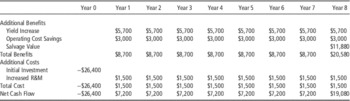
A producer is interested in investing in a new planter in the USA and is deciding between a new traditional planter or upgrading the new traditional planter with high-speed planting capabilities. The additional cost for high-speed planting technology would require an initial investment of $2 200 (median price reported by Scott, Reference Scott2015) per row to equip a 12-row planter and have an economic life of 8 years and salvage value of 45% (Dillion et al., Reference Dillon, Shockley and Mark2017). While unknown, high speed planting is anticipated to increase repairs and maintenance (R&M) on the planter compared to planting without the technology so an additional $1500 per year was assumed. However, the producer expects to save money on operating costs in the amount of $3 000 per year due to labor savings from conducting planting operations faster than with the new traditional planter. In addition to operating savings, high speed planting allows for planting more acres than possible with a traditional planter when constrained by weather events. This result in a yield benefit valued at $5 700 per year (Dillion et al., Reference Dillon, Shockley and Mark2017). Table 1 illustrates the information above within a cash flow.
Example cash flow for investing in high-speed planting.

Using the net cash flow in Table 1 and Equation 1, the net present value can be determined. If the interest rate for this example is 6.75%, the net present value calculation is as follows:
 $$\eqalignno{ & {\rm NPV}\, {\equals}\, {{\,\$\,7,\!200} \over {1.0675}}{\plus}{{\,\$\,7,\!200} \over {1.0675^{2} }}{\plus}{{\,\$\,7,\!200} \over {1.0675^{3} }}{\plus}{{\,\$\,7,\!200} \over {1.0675^{4} }} \cr & {\plus}{{\,\$\,7,\!200} \over {1.0675^{5} }}{\plus}{{\,\$\,7,\!200} \over {1.0675^{6} }}{\plus}{{\,\$\,7,\!200} \over {1.0675^{7} }}{\plus}{{\,\$\,19,\!080} \over {1.0675^{8} }}{\minus}\,\$\,26,\! 400 $$
 $${\rm NPV}\, {\equals}\, \,\$\,50,\!458\,{\minus}\,\$\,26,\!400$$
 $${\rm NPV}\, {\equals}\, \,\$\,24,\!058$$
Since the NPV is greater than $0, the present value of benefits exceeds the cost today so a high-speed planter would be a good economic investment for this producer. If a percentage is preferred to reflect a return on investment, the IRR can be calculated using computer spreadsheets or a financial calculator. Using the cash flow in Table 1 and a computer spreadsheet, the IRR for high-speed planting is 24%. Since the IRR is greater than the interest rate, or 6.75% for this example, high-speed planting would be a good economic investment based on IRR. On the other hand, if the simple rate of return was used instead of the preferred IRR method, it would have resulted in a return on investment of 33%. Therefore, the simple rate of return method overstates the actual return on investment. The magnitude of inflation represented by utilizing the simple rate of return method is dependent on the specific net cash flows of the investment and the length of time the investment is elevated. If the above example indicated an IRR of 4.5% and the simple rate of return was 8.5%, the resulting investment decision would be (accept the investment if greater than the interest rate of 6.75%) different and incorrect if only using the simple rate of return method. This also becomes an issue when comparing and having to choose between two different investments. Therefore, NPV and IRR are the preferred methods for determine the return on investment of precision agriculture technologies.
Conclusions
Precision agriculture technologies can be economically profitable but may not support the mission and goals of the business or be financially feasible to the investor. In addition, it may require thinking deeper than the direct input savings and investment cost of the technology to maximize benefits that a precision technology has to offer. Following the appropriate decision-making framework and analyzing the technology for each unique circumstance and farm characteristics is imperative to making the correct investment decision. Using the correct investment analysis techniques such as NPV and IRR to consider the time value of money for precision agriculture technologies is preferred so that the return on investment is accurate and not over inflated. Finally, there is opportunity to utilize precision agriculture as a risk management tool.