Service learning in higher education is an American creature. But outside the U.S., practices that resemble American service learning or that have begun self-consciously to describe themselves as “service learning” may also be found. In this article, I will reflect on an undergraduate course entitled Civil Society: Theory & Practice offered from 2001 to 2005 at the National University of Singapore's (NUS) University Scholars Programme (USP), an elite program that is structurally and conceptually similar to U.S. honors colleges. Students in the course were required to dialectically engage the theoretical and comparative case-study materials discussed in class with experiences gained during semester-long practical attachmentsFootnote 1 to civil-society organizations. During these attachments, students worked with the organizations to identify real community needs and co-execute projects that could authentically and realistically address these needs. Students were assessed on their writing assignments and seminar leadership, both designed to provoke sustained critical reflection on their experiences and theoretical knowledge; their actual service projects were not assessed.
After a couple of years of teaching this course, I became aware of the service-learning paradigm and debates within the U.S. and realized that, without even knowing it, we had designed a proto-service-learning course in Singapore. Today, the language of service learning has started to take root in Singapore, where one can find occasional workshops and conferences on the practice. In 2008, a Fulbright Visiting Researcher Award gave me an opportunity to be attached to the Center for Social Justice Research, Teaching and Service at Georgetown University, where I was able to become more familiar with the U.S. literature on service learning—or in some cases community-based learning, a term that emphasizes an egalitarian partnership between university and community (Center for Social Justice Research, Teaching and Service 2008, 3)—and its evolving discourse and practice. I will discuss in this article some similarities and differences between the U.S. and Singapore contexts in which the practices of service learning have evolved, identifying how the Civil Society course in particular was both a product of as well as a challenge to Singapore's somewhat different priorities in higher education, political culture, and attitudes to social justice and cultural diversity.
CIVIL SOCIETY: THEORY AND PRACTICE
In 2001, my colleague Philip Holden and I decided to create a new course on civil society for students enrolled in a new program at NUS called the USP, which today describes itself as facilitating learning that “extends beyond the classroom through a wide range of research, internship, community involvement, and study abroad opportunities … [producing] graduates with the intellectual rigour, initiative, and innovational spirit to make significant contributions to society” (emphasis added) (http://www.usp.nus.edu.sg/aboutusp/index.html). Internships were commonplace in NUS, but what we wanted to do was novel: create opportunities for students to enter into the life of civil-society (or non-profit, non-governmental) organizations in Singapore during the entire semester while co-conceptualizing and co-executing projects that would add real value to their learning, to the work of the organizations, and to the communities that benefited from it.
Since we were starting from scratch, we had to fully engage our pedagogical intuitions, personal and professional networks, and stamina to be physically involved in our students' attachment activities without the benefit of administrative support that some U.S. universities now enjoy. More familiar with the conventional internship model and more knowledgeable (though often skeptical) about its practical benefits, the organizations in civil society had to be convinced that what we were pioneering—a much more nebulous proposition—was indeed worth their while. Some of these organizations, in certain ways enfeebled by a strong state, felt they could only afford to deploy their limited time and resources in daily uphill struggles. Rightly, they were cautious about welcoming liberal-arts-type students who did not necessarily possess relevant technical skills and training to make authentic or even useful contributions, students who might in fact turn out to be a nuisance if they required extensive supervision and monitoring.
From the students' point of view, a course like this was going to be exciting, but in the context of already demanding schedules at NUS, it was also frightening and not the most practical choice for students who wanted to optimize their time and avoid unpredictable grades. Just as we spent a great deal of time in conversation with the organizations, we also had extensive discussions with prospective students. For example, we invited a focus group to dinner at my home where we discussed the course and the problems that students were likely to face. Based on these conversations, we came up with guidelines for students and organizations as part of the ongoing process of harmonizing the needs and expectations of all stakeholders.
The course itself aimed to integrate three levels or sources of learning: theoretical, empirical, and practical. Culturally, we had to overcome an anti-intellectual machismo valorized nationally in terms of a pragmatic outlook that declares “do what works,” an approach that denies how theory is inextricably embedded in practice and that too easily dismisses anything explicitly theoretical to a debased ivory tower. Singapore's first prime minister Lee Kuan Yew, for instance, explained how he had “read up the theories and maybe half-believed in them. But we were sufficiently practical and pragmatic enough not to be cluttered up and inhibited by theories” (quoted in Han, Fernandez, and Tan Reference Han, Fernandez and Tan1998, 109). We needed a dialectical and interpenetrating approach that took seriously not only practical experience (that was bound to be popular), but also the theoretical sources (shunned by many students) that were crucial for developing a critical and self-reflective understanding of civil society and one's place in it. U.S. service learning also firmly recognizes the importance of preventing students from becoming “mere tourists in their learning experience” (Dicklitch Reference Dicklitch2003, 776). Susan Dicklitch asserts that “service, without a connection to theory or facts (for example, on poverty, the cause of human rights abuses, or the structure of social service bureaucracies) simply tends to reinforce prejudice and the gap between the students and the ‘other’” (Dicklitch Reference Dicklitch2003, 773).
In practice though, this ideal is a struggle to achieve: even basic academic, civic, and democratic skills may not be developed. A study of three West Virginia institutions conducted by Susan Hunter and Richard Brisbin, Jr., indicates that, although service helped in some ways to increase political knowledge and foster civic responsibility, “most service experiences students had did not require them to use a variety of skills. A majority of students reported using many academic skills infrequently or not at all during their service experiences” (Hunter and Brisbin Reference Hunter and Brisbin2000, 625). Mary Kirlin explains how “many service and volunteer programs have failed to sufficiently address development of fundamental civic skills such as expressing opinions and working collectively to achieve common interests as part of their design” (Kirlin Reference Kirlin2002, 571).
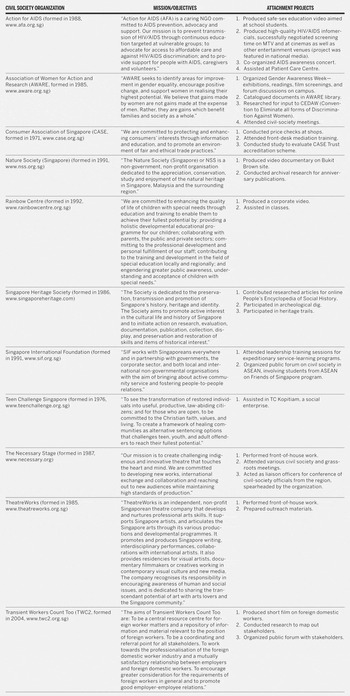
We were determined to prevent our course from becoming intellectually shallow and superficially gratifying. We expected students to attend carefully designed two-hour seminars every week for 12 weeks with sessions on theoretical perspectives, civil society in Singapore, and substantive issues and causes relevant to the semester's attachments—for instance, in one semester, the issues were youth (Teen Challenge Singapore), disability (Rainbow Centre), HIV/AIDS (Action for AIDS), nation building (Singapore Heritage Society), and women and nation (Transient Workers Count Too). We also had a session on methodology for students to think self-reflectively about the positive, normative, and critical dimensions of understanding civil society through service learning. We expected students to be attached to their organizations from weeks 2 to 11, taking a total of 60 hours as a very rough guideline of their expected level of commitment. Predictably, the actual time they voluntarily spent usually exceeded the guideline. Each semester, students partnered with five organizations. During the first weekend of the semester, we bussed the entire class to the organizations' premises, giving students the opportunity not only to learn about the organizations' histories, structures, missions, programs, activities, and future plans, but also to decide which of these organizations they felt most equipped and excited to work with. Taking into account their preferences, we tried to assign a roughly equal number of students to each organization. Over 10 weeks, students worked through their attachments, often tackling projects, conducting research work and organizational analysis, organizing events, or simply participating in the life of the organization by attending private and public discussions or training sessions. Table 1 gives an idea of the partner organizations and some of the projects students have done.

Every week, we posed open-ended questions on the university's online discussion platform that required students to apply ideas and concepts from the readings and classroom discussion for that week to their own experiences in civil society. These weekly reflections were assessed. In the concluding week, student teams led seminars to consolidate and share what they had learned on attachment. The students were discouraged from making passive presentations; instead, they were expected to generate active discussion and trigger critical thinking through such stimuli as role-play activities and scripted (and often multi-mediated) performances followed by facilitated discussion. For this activity students were peer assessed.
As they shifted from classroom, to community, to cyberspace, and back, students were required to deal with often contradictory sources of knowledge from their practical experiences in civil society, the theoretical literature (liberal/libertarian, communitarian/civic republican, and radical traditions), and comparative case studies such as the National Rifle Association of America to think about legitimacy and activist techniques, The Big Issue in the UK (a social enterprise for the homeless) to think about struggles with and against the free market, and Narmada Bachau Andolan in India (an organization that mobilizes against the building of dams) to think about human rights and environmentalist activism. Having to deal with “Western” theory on the one hand and local writings and experiences on the other was another productive complication that we introduced in the course. Holden (a literature and cultural studies professor) and I (a political scientist) made it a point to react to each other in class to foreground the interdisciplinary nature of our interrogations.
Although some of the attachment projects had a charitable or direct-service character, we were determined to get these students—who, as part of an elite program, were likely to become leaders in their fields—to develop a more critical outlook and sensitivity towards matters of social justice in affluent Singapore, where comfort for the many is often enjoyed by not asking the difficult but important questions about the few. For instance, one group of students was attached to a new advocacy group called Transient Workers Count Too (TWC2), which organizes low-skilled foreign workers in Singapore and advocates for their welfare and rights. Since the 1970s, Singapore's impressive economic growth has been supported by the inflow of relatively cheap foreign workers. Today, Singapore hosts almost a million migrant workers, 180,000 of whom are female domestic workers from developing Asian countries like Indonesia, the Philippines, Sri Lanka, Thailand, Myanmar, and India. These “maids” are not only excluded from protection under Singapore's Employment Act, but are also objects of abuse: the local media regularly report cases of physical injury, sexual offenses, overwork, and non-payment of salaries. Some Singaporeans, having become very dependent on foreign maids, smugly explain that these women should count themselves fortunate to be able to work in Singapore, where their low salaries are still higher than anything they can earn in their home countries. Instead of being sensitive to their vulnerable condition and the strain of being away from family and home, some Singaporeans instead adopt a particularly racist notion of foreign maids as unintelligent, dishonest, oversexed, and even dangerous. Many aspects of the plight of the foreign domestic worker in Singapore are documented in Dignity Overdue, a book authored by current president of TWC2 John Gee and Elaine Ho (Reference Gee and Ho2006).
During the attachment, students worked with members of TWC2 to map the complicated set of relations involving the foreign maid in Singapore in order to understand the nature and structure of exploitation, comparing these to theoretical knowledge gained from reading about Marxist theory and other critical approaches, and then asking why exploitation of low-status women from overseas appeared to have gained such social and political acceptability in Singapore. The students also made a short film out of recorded interviews (with maids, their agencies, and the few organizations set up to look after their welfare) as well as textual references to readings from the course. The film was screened at a public forum that the students organized to generate open discussion with a panel of experts. Students not only learned about a silent and vulnerable community in Singapore and how some Singaporeans have been working with them to make things better, but also had to confront their own assumptions and practices that were possibly complicit with the problem. One of our goals, which we pursued mainly through the questions that we posed in class discussion, was to get the students to reflect critically on whether it was an elitist understanding of their role in society that motivated their actions; and, if so, then what the implications of this were. Elite USP students, like students from prestigious U.S. honors colleges, were inclined to regard their contributions to society in terms of noblesse oblige; and we wanted them to become self-conscious of that and possibly to challenge it. Actively applied theoretical knowledge offered one way of thinking through this.
SIMILARITIES BETWEEN THE U.S. AND SINGAPORE CONTEXTS
Although service-learning courses like this may be found in various parts of the world, service learning itself is still a predominantly American practice on so many levels. Nearly every book with “service learning” in its title has been authored by a U.S. academic or practitioner, brought out by a U.S.-based publisher, and addressed to U.S. readers.Footnote 2 Numerous American organizations and programs—including the National Society for Experiential Education, the Council for Adult and Experiential Learning, Campus Compact, Corporation for National and Community Services, and Learn and Serve America—have been deeply responsible for promoting, reviving, or shaping the practice. Debates within the discourse of service learning, whose formation can be traced to the late-1980s, have also revolved around U.S. terms of reference. Proponents of service learning often describe their struggles within the hegemony of American social science—Tony Robinson (Reference Robinson2000), for example, describes the struggles against scientism, positivism, and neutrality. Service-learning proponents also describe their struggles against the perverse incentive and disincentive structures that the U.S. tenure system is said to have created.
As the history of service learning is constructed and contested, attempts have been made to connect contemporary practices with deeper historical roots located in the founding myths of the nation and of its early universities whose mission was an essentially civic one. The philosophical roots of service learning have also been linked to that quintessentially American icon, the pragmatic philosopher and educational activist John Dewey, as well as the progressive educational experiments associated with his philosophical outlook. Melvin Dubnick, for instance, identifies service learning with a “developmentalist approach” that was “reinforced in the United States by Dewey's influential views on democratic education that regarded schools as a place where children are taught ‘how to think’ rather than ‘what to think’” (Dubnick Reference Dubnick2003, 253). Through efforts to identify contemporary service learning with American history, philosophy, and culture, proponents of service learning struggle to legitimize and valorize its practice within a system that sometimes militates against it.
And yet, these historically American struggles against the rigidities of positivist social science and a bureaucratized academy have, largely through neoliberal globalization, also become the struggles of academics around the world who find themselves increasingly constrained by academic structures that mimic American institutions of higher education (and often their least progressive features) in a race to the top of international university rankings. Additionally, the student-centered, experiential, and interdisciplinary pedagogical approaches—even as they struggle within a result-driven bureaucracy and scientism in the U.S.—have nevertheless emerged as instruments of American soft power that have encouraged many educators around the world to shed their authoritarian image and move away from content-heavy teaching by rote, favoring instead approaches that try to inculcate independent and critical thinking that, if done correctly, always require more preparation, skill, humility, and courage.
The Civil Society course was born in a time of millennial pessimism as Asia slowly recovered from the economic contagion of 1997. At this time too, Singaporeans were sensitized to the problem of a new generation of affluent young citizens who did not seem to appreciate the hard work and determination of earlier generations of Singaporeans in the national effort to survive premature political independence in 1965 and to achieve accelerated success in a matter of decades. Many of these concerns were conveyed quite explicitly in political speeches such as the National Day Rally speech of 1999, when the prime minister explained that
Commitment is especially needed from those Singaporeans who have done well. They must feel an obligation to contribute something back to society, to help give others the same opportunities that they themselves benefited from. Only then can we become a close-knit civic society with volunteer groups, community leaders, grassroots leaders, MPs and Ministers, motivated by a sense of duty and responsibility to their fellow citizens. Otherwise we will just be so many individual Singaporeans, no more than loose sand in a bucket.
(Goh Reference Goh1999)Americans, too, often worry about a perceived decline in levels of civic knowledge, interest, and engagement, particularly among their youth. The more communitarian and civic republican approaches to service learning are driven by such national anxiety. Kathleen Maas Weigert identifies, in the new millennium, an urgency in the critique of a culture that legitimizes the transformation of community-minded neighbors and citizens into individualistic consumers lacking family values and neighborhood ties. She notes how “in speeches of political leaders, in commentaries of public opinion analysts, or in conversations around the family table, we worry together about who we are as a nation, what is happening to us, and what needs to be done to ensure that in the twenty-first century we have greater vision, energy, and unity than we now have” (Weigert Reference Weigert, Rhoads and Howard1998, 3). Sharing Weigert's faith in service learning's ability to stem this negative cultural tide, Dicklitch explains how “in an age where America questions its citizen's civic engagement, [service learning] offers hope and a vehicle for students to become more involved and engage in life-long learning and activism” (Dicklitch Reference Dicklitch2003, 776). It is easy to appreciate post-9/11 America's renewed enthusiasm for civic education and service learning.
In spite of its size (4.8 million people on a little over 700 square kilometers) and lack of natural resources, Singapore is known to be one of the wealthiest and most modern (many would say Westernized) countries in Asia, an anomaly among the developing countries of Southeast Asia. In 1997, just before the region was hit by an economic contagion, Singapore's per capita GDP made it the fourth wealthiest country in the world in terms of purchasing power parity. Today, Singapore's national self-image is decorated by its top global ranking in a variety of economic and social indicators. Delegations from around the world visit in order to learn some aspect or other of what could be called “the Singapore model.” But this material success is one side of the coin that has, on its other side, a culture of affluence and comfort that has given rise to a negative image of Singapore as an “air-conditioned nation” (George Reference George2000), where people consent to having their lives finely controlled by a strong state with an exclusive track record of delivering material success. Since the 1980s, amidst celebratory descriptions of Singapore as one of the four “Asian tiger” economies experiencing double-digit growth, its government—as the rally speech extract above indicates—has been increasingly conscious of how its industrialization and socialization policies could turn Singaporeans into highly productive automatons and obsessive consumers, a mass society of self-centered individuals who have no sense of responsibility for others in their community and nation, and a people without a soul. The relationship between the people and their government, if based almost entirely on such a transactional basis, can be fragile. Should the government fail to live up to its own high standards, the people will not hesitate to withdraw their support and perhaps even to leave the country. The brain drain has been a constant source of national anxiety since the 1980s.
Over the decades, Singapore's many experiments with moral, civic, and religious education in its national curriculum are clear examples of how the government has responded to these national anxieties and political fragilities. In the mid-1990s, Singapore students were given a written test: the results indicated high levels of ignorance about matters of national importance. Singapore's youth—often portrayed as soft, apathetic, and indifferent—were targeted for socialization. In 1997, National Education (NE) was formally introduced to disseminate historical knowledge and national values through the curricula of the entire school system. In the same year, Singapore's Ministry of Education launched the Community Involvement Programme to encourage students to provide at least six hours of community service each year. The National Volunteer and Philanthropy Centre now provides an online resource for matching students with meaningful service opportunities. In 2000, generous state funding became available for students to go on overseas community-service expeditions through the Youth Expedition Project (YEP) housed in the Singapore International Foundation, a non-profit organization whose mission is “to nurture active global citizens and friends for Singapore.” And in 2008, REACH (Reaching Everyone for Active Citizenry @ Home)—the government's “lead agency for engaging and connecting with citizens”—selected 70 students aged 15–20 for its new Junior REACH Ambassadors program, aimed at cultivating active citizenship among youth who are expected to “spearhead feedback activities in their schools to encourage youth engagement and cultivate a feedback culture among their peers.” Since the late-1990s, the language of “active citizenship” has become increasingly pronounced in government speeches and news reports. In this climate, Singapore appeared to be ready for more sophisticated approaches to cultivating loyal, conscientious, and motivated citizens through the education system. Taking the initiative to propose, devise, and teach the Civil Society course was, to a degree, part of this current.
DIFFERENCES BETWEEN THE U.S. AND SINGAPORE CONTEXTS
However, while the birth of service learning in Singapore was induced by a millennial mood of national introspection set against a slow recovery from the Asian economic crisis, our attempts to introduce service learning were also motivated by a desire to challenge what continued to be obstacles to more progressive social transformations. These included Singapore's educational priorities, awareness of social justice issues, attitudes to cultural diversity, and political culture that, in some important ways, differed from the U.S. case.
R. Claire Snyder presents a historical outline of U.S. higher education, highlighting the essentially civic mission of early congregational colleges and civic universities that somehow transformed in the transition to modern research universities. The cold war, Snyder observes, turned the focus of universities onto serving the nation's economic and military needs. Today's research universities, Snyder argues, produce public leaders who are “now understood as primarily experts and professionals, rather than moral leaders or active citizens.” Similarly, the political and social sciences have moved away from “the ‘advocacy’ of social reforms that would improve public life—and toward the twentieth century ideal of social scientific ‘objectivity’” (Snyder Reference Snyder2001, 303, 304). Ira Harkavy exhorts American universities to “return to their core mission—effectively educating students to be democratic, creative, caring, constructive citizens of a democratic society” (Harkavy Reference Harkavy2008). An inspection of U.S. universities' Web sites will more often than not reveal vision and mission statements that do reflect this core mission, often containing strong expressions of civic consciousness and a duty to community, society, and nation. At the very least, there will be prominent descriptions of their various local and international community partnerships. Georgetown University's four-paragraph mission statement, for example, concludes with a strong assertion that “Georgetown educates women and men to be reflective lifelong learners, to be responsible and active participants in civic life, and to live generously in service to others” (http://president.georgetown.edu/sections/governance/missionstatement/). But even beyond institutional rhetoric, one can find concrete examples of state support for service learning in higher education. The U.S. Department of Housing and Urban Development (HUD), for instance, offers competitive two- to three-year grants of up to US$400,000 to higher education institutions to set up and operate Community Outreach Partnership Centers (COPCs) to “help colleges and universities apply their human, intellectual, and institutional resources to the challenge of revitalizing distressed communities.”
There are three universities in Singapore. An inspection of their Web sites reveals that only one—the National University of Singapore—makes explicit mention, in a three-part mission statement, of its service to society:
(1) Transformative education that nurtures thinking individuals who are alive to opportunities to make a difference, are valued members and leaders of society, and global citizens effective in diverse settings. (2) High-impact research that advances the boundaries of knowledge and contributes to the betterment of society. (3) Dedicated service, as a national university, that adds to social, economic and national development. (http://www.nus.edu.sg/aboutus/vision.php)
Although this very recently reformulated mission is an improvement over its predecessor that only briefly mentioned “the betterment of society,” NUS's priorities are generally different from U.S. universities that cannot completely ignore their historical roots and civic/democratic embedding, even though the cold war experience has made it more challenging to be faithful to such purposes. As one of the top universities globally,Footnote 3 NUS celebrates as milestones its numerous achievements in scientific research, technological breakthroughs, and strategic industrial partnerships. In Singapore, higher education—in fact education in general—is regarded chiefly and openly as training for the economy, an approach that is historically rooted in the country's post-colonial determination to succeed as a nation against the odds.Footnote 4
The relatively weaker presence of community service in the formal self-image of Singapore's three universities does not mean that it is absent in university life: faculty and students do engage with local and even regional communities on the ground level, but these efforts are mostly privately pursued, intrinsic in their rewards, and—beyond a cursory level—unacknowledged as central to the universities' roles and aspirations. Through the YEP, the state has funded numerous overseas community-service expeditions for students, but these projects—impressive in number—have not generally been well integrated with the curriculum and pedagogy of higher-education institutions. The projects remain largely ad hoc and are rarely sustained even in the medium term. The Civil Society module and a handful of other modules that deliberately bring academic learning into community engagement and that draw complex learning out of service experience are still exceptional.
A second difference between the U.S. and Singapore contexts for service learning involves the level of awareness of social justice in each society. In Singapore, meritocracy is—sometimes uncritically—upheld not only as a pillar of governance, but also as an organizing principle of society. Although the American value of rugged individualism had been a historical inspiration for Singapore's practice of meritocracy and anti-welfare ideology, the more explicit and seemingly permanent divisions in contemporary American society between the haves and the have-nots—and how these seem also to be aligned with racial differences—have weakened faith in U.S. meritocracy and provoked conscientious citizens to want to address this problem squarely. Georgetown University, for example, seems to be acutely sensitive to the contradiction of Washington, D.C., as a political center of the world and yet also the site of inequality, poverty, racism, and crime. Its Center for Social Justice endeavors to integrate its research, teaching, and service efforts through community partnerships that focus on the disadvantaged and underserved.
In Singapore, poverty is certainly not entirely absent, but it is less easy to locate. Singaporeans think of themselves as middle class, even though more than 80% of them live in public housing. Perhaps it is because the standards of public housing—indeed of public services in general—have been so high that its citizens only seem to complain about rising costs of living and the “relative poverty” that some Singaporeans may feel as they witness a widening income gap in a global city that endeavors to attract global capital and talent. Though its rhetoric is stridently against comprehensive state welfare, the government nevertheless provides public assistance for the bottom strata in muted ways designed—according to its assumptions about human motivations—not to discourage self-reliance (Tan Reference Tan2008). Since the ideology of meritocracy has been firmly ingrained in the culture, individual “failures” are almost never attributed to structural inequalities. Singapore's anti-ideology ideology of “pragmatism” (or “doing what works”) has also rendered incomprehensible the Left-Right spectrum that continues to shape American public discourse. The social justice basis of service learning, therefore, has to be driven by a different impulse in a city where visible examples of exclusion, homelessness, poverty, and serious crime are exceedingly rare and where citizens are not accustomed to (or do not have a language for) critiquing underlying structures.
This is why we insisted that the Civil Society course needed to impress upon students the importance of theory as a language for critical thinking. We needed to get beyond the easy explanations and comforting shibboleths of the public sphere that have obscured real tensions and injustices in society and that have obstructed the capacity to imagine better worlds than that of the present. By getting students to think through a diverse range of theoretical (and ideological) concepts and frameworks, we hoped to give students multiple perspectives for deeply understanding complex situations, not to dogmatically ground them in one way of thinking. For students attached to TWC2, the course sought not only to make the plight of the foreign domestic worker more visible (in itself a serious challenge), but also to encourage students to engage the complex situation through liberal, communitarian, and radical perspectives, so that they would at least appreciate the importance of telling many sides of the same story, and then be able to judge for themselves whether society, their peer groups, their families, and they themselves have acted in a way or been part of a system that is fair, equitable, and just; and, if not, then what they could do about it.
A third difference between the U.S. and Singapore contexts for service learning lies in their respective attitudes to cultural diversity. In the U.S. (and more so in the UK), theorists and activists have advanced a more radical critique of multiculturalism, which is regarded as a superficial celebration of diversity that distracts public attention away from structural racism and inequalities. Controversies surrounding race and racism are discussed freely and debated fiercely in the U.S. public sphere. In many ways, the question of race is often at the heart of social-justice approaches to service learning in the U.S. In Singapore, however, not only are race issues kept at the superficial level of multiculturalism—known locally as “multiracialism”—but racial differences are also commodified to produce an “instant Asia” tourist experience. With four races represented—Chinese (75%), Malays (14%), Indians (9%), and others (2%)—Singapore showcases its multiracialism to entice tourists, investors, and talent who may value the convenience of experiencing Asia by visiting one of its most “modern” microcosms, where English is used effectively and the streets are safe, clean, and green. At the other end of the spectrum, multiracialism is also articulated with a history of race riots in the 1950s and 1960s (nowhere near the extent of violence in the U.S. experience during the same period) to produce a contemporary fear of things racial and religious. David Gillborn argues that citizenship education in the U.K. and U.S. has often been a “placebo” that can entrench institutional racism (Gillborn Reference Gillborn2008); in Singapore, any critical public discussion of race and religion (beyond simplistic expressions of multiracial harmony) is already taboo and, if found to be inflammatory, punishable by law.
The Civil Society course aimed, in this regard, to get students to think beyond the official model of Singapore society, to become critically sensitive to the implicit and often unconscious racism that may underpin it, and to think about what they can do about stereotypes and the often hidden exclusionary practices and institutions in society. Students attached to TWC2 understood clearly the inadequacies of the Chinese-Malay-Indian-Other model, which renders resident foreigners invisible except when smug, resentful, or insecure Singaporeans negatively stereotype them. Almost one-quarter of the population in Singapore consists of foreigners, most of whom are low-skilled migrant laborers including male workers in construction and female workers in domestic service. The limited awareness of Singapore's real cultural diversity has made the public discourse, until recently, indifferent to questions about the dignity and rights of migrant workers, the cultural and economic recognition that they deserve, and the considerable contributions that they have made to the Singapore nation's well-being. In the U.S., even though the question of immigrants has provoked some sharply racist views, at least it features as a central debate within the public sphere.
Political culture is a fourth difference. Unlike the liberal democratic tendencies of U.S. political culture (and its equally pronounced civic republican opposition), Singapore's political culture can be described as soft-authoritarian, not only because the People's Action Party (PAP) has been in power since the nation's independence, but also because the people—who compulsorily vote in regular multi-party elections—appear to want the PAP to continue in government, even as they call for more opposition voices in parliament. This is often explained in terms of an ideological hegemony that depoliticizes the Singaporean polity under the sign of an Asian communitarianism set in artificial opposition to so-called Western democracy (Chua Reference Chua1995). To a significant degree, this hegemonic endorsement of the PAP government has also been a result of real advantages that the incumbent party enjoys, including the power to gerrymander and the informal but deep influence it exercises over the mass media, civil administration, and para-statal grassroots network. The national sense of permanent vulnerability also serves to justify the extensive powers of the state, not unlike the more authoritarian strains that emerged in the Bush administration's response to the events of September 11, 2001. Public protests have also been severely restricted by law; and the Internal Security Act (a colonial inheritance) that allows for detention without trial continues to sustain a climate of apprehension that supports practices of self-censorship.
While the 1960s counterculture in the U.S. continues to inspire a sense of efficacy in the socially conscious individual's capacity to change the world for the better, student demonstrations in Singapore in the 1950s to 1970s are portrayed in textbooks and NE efforts not in terms of youthful idealism, but as entirely destructive. It is not surprising therefore to witness how Singaporean students today are expected to come forward to volunteer in the community, but are sternly cautioned against politicizing their service. Schools and universities are keen on internship and industrial attachment programs; almost completely absent, though, are the more politically risky social-justice-based service-learning opportunities. Generally, the approved vision of active citizenship in Singapore looks more like charity work and does not really include advocacy or organizing the community in the name of social justice.
Students in the Civil Society course who were attached to TWC2 learned how to go about doing constructive advocacy work that did not antagonize the state. As recent as 1987, 22 Singaporeans were detained under the Internal Security Act for trying to advance the rights of migrant workers: they were accused of a Marxist conspiracy to take over the state. Clearly, we needed to start getting students to think seriously about the political conditions of possibility within Singapore, how they could maneuver around these conditions through a wider range of techniques for engaging the state, and how they might successfully negotiate the expansion of legitimate political space and not jeopardize its existence. Interestingly, a similar observation has been made in the U.S. case, where volunteerism is observed to be at a very healthy level, but it is depoliticized. In particular, service-learning work that is directly funded by the state—such as HUD's COPC program—is very likely to face some informal restraints when it comes to politicizing their work. Nevertheless, state prohibition (as might be observed in the Singapore case) is not as serious a problem as the sense of political disenchantment and disillusionment that young people in the U.S. are said to be experiencing. Diana Owen, for example, argues that “young people are fed up with government and politics as usual, especially at the national level … There is some evidence that they are engaged in community-level volunteerism even as they avoid the political mainstream” (Owen Reference Owen2000, 629). Michael Carpini and Scott Keeter observe that “young people want to help solve society's problems, but most … lack the practical knowledge of the issues, players, and rules to be able to participate in politics effectively” (Carpini and Keeter Reference Carpini and Keeter2000, 636). Describing service learning as a “glorified welfare system,” Robinson argues that it should instead promote “Socratic challenges to power … without embarrassment” (Robinson Reference Robinson2000, 607, 610).
The Civil Society course—a proto-service-learning course in Singapore—was motivated by our conviction to promote active citizenship, riding on the momentum of national efforts to address the widely perceived problem of a new generation of citizens who appeared to be too apathetic and disengaged from matters of public and national importance. Yet, we were determined to distance ourselves from propagandistic approaches to national education, by designing an intellectually, morally, and politically challenging curriculum and pedagogy. We believed that students who were invited to participate in the life of civil society through practical projects as well as intellectually informed critical reflection would be better equipped with civic, democratic, and leadership skills. We believed that such an approach could gradually enable Singaporeans to transcend the dominant culture of apprehension and materialism, and to become more constructively sensitive and critical towards questions of social justice and towards Singapore's political culture.