Authoritarian regimes are confronted with formal and informal organizations in society with potential to defy their rule, and seek to prevent them from engaging in mobilized dissent (Acemoglu and Robinson Reference Acemoglu and Robinson2006; Bratton and van de Walle Reference Bratton and van de Walle1997; Gandhi Reference Gandhi2008; Gandhi and Przeworski Reference Gandhi and Przeworski2006; Kim and Gandhi Reference Kim and Gandhi2010; Slater Reference Slater2009). How they do so depends on the extent to which state actors think they are already threatening. According to the literature, this is a function of their ideological proximity to the regime, and group strength (Bueno de Mesquita et al. Reference Bueno de Mesquita, Smith, Siverson and Morrow2003; Gandhi Reference Gandhi2008; Gandhi and Przeworski Reference Gandhi and Przeworski2006; Kim and Gandhi Reference Kim and Gandhi2010; Lust-Okar Reference Lust-Okar2005, Reference Lust-Okar and Schlumberger2007; Svolik Reference Svolik2012). Most analyses are designed to explain variation in two outcomes, as authoritarian rulers are assumed to silence opponents by either repressing or coopting them. Repression includes ‘repressive legislation … policing their obedience, and … punishing their offenders’ (Wintrobe Reference Wintrobe1998: 46). It is mixed with the term ‘coercion’, and studies often do not distinguish the use of force to suppress an organization from the one aimed at confining and deterring a group from pursuing sensitive political activities. At the collective level, cooptation refers to the ‘encapsulation’ of organizations by the government (Collier and Collier Reference Collier and Collier1979). The literature nevertheless commonly treats cooptation as an individual-level strategy, involving giving actors jobs in the state or a voice in legislatures and state-approved parties (Boix and Svolik Reference Boix and Svolik2013; Gandhi Reference Gandhi2008; Gandhi and Przeworski Reference Gandhi and Przeworski2006; Kim and Gandhi Reference Kim and Gandhi2010; Lust-Okar Reference Lust-Okar2005; Magaloni and Kricheli Reference Magaloni and Kricheli2010). Cooptation aims to get actors to commit to remaining loyal to a regime (Boix and Svolik Reference Boix and Svolik2013; Gandhi Reference Gandhi2008; Gandhi and Przeworski Reference Gandhi and Przeworski2006; Magaloni and Kricheli Reference Magaloni and Kricheli2010). Jennifer Gandhi (Reference Gandhi2008: 115) highlights that ‘When dictators do not need cooperation … they do not need to coopt’. While cooptation is often treated as synonymous with cooperation, it is only one form of cooperation autocrats can use (Gandhi Reference Gandhi2008; Magaloni and Kricheli Reference Magaloni and Kricheli2010).
That cooperation and cooptation are conflated is unsurprising given the literature's interest in elite politics. Possible rival elites are considered one of the greatest threats to authoritarian regime resilience (Bueno de Mesquita et al. Reference Bueno de Mesquita, Smith, Siverson and Morrow2003: 346; Gandhi and Przeworski Reference Gandhi and Przeworski2007: 1288; Geddes Reference Geddes1999; Schwedler Reference Schwedler2006; Way and Levitsky Reference Way and Levitsky2006).Footnote 1 Many autocracies between 1945 and 1990 were military dictatorships that ended as a result of elite factionalism rather than social revolutions (Boix and Svolik Reference Boix and Svolik2013; Geddes Reference Geddes1999: 122). Studies thus analyse the mechanisms autocrats use to avoid disruptive opposition among elites (Gandhi Reference Gandhi2008; Gandhi and Przeworski Reference Gandhi and Przeworski2006, Reference Gandhi and Przeworski2007; Levitsky and Way Reference Levitsky and Way2012; Magaloni and Kricheli Reference Magaloni and Kricheli2010; Svolik Reference Svolik2012; Schwedler Reference Schwedler2006). In a formal institutional setting, cooperation between the state and elites is unlikely to take a form other than cooptation. Yet if one looks at the way regimes get organizations in society to comply with their rule, one observes cases of informal cooperation that differ from cooptation (Albrecht Reference Albrecht and Schlumberger2007; Mainwaring and Pérez-Liñan Reference Mainwaring and Pérez-Liñan2013; Staniland Reference Staniland2012, Reference Staniland2015). In non-democratic systems with gaps between formal policy and local practice, many groups operate outside the reach of the state. States do not ignore those groups and may seek to prevent dissent from emerging among them. Yet if they cooperate with them, they do not consistently do so by coopting them. Informal groups may not want to be coopted, and states might not want to do so either: legalizing them is costly and might involve changing policies that sustain authoritarianism. Autocrats may thus contain them.
Parting with the literature, I observe that there are four mechanisms state actors in autocracies use to control societal organizations. Intentions underlying control vary from one strategy to another. Repression intends to suppress an organization and leaves no room for it to continue operating. Coercion intends to confine and deter an organization from pursuing its activities. Targeted organizations continue working under highly constrained conditions: they are limited in their ability to organize collectively with other groups around common claims. Cooptation is the integration of organizations into state institutions, while containment is the conditional toleration of groups outside such institutions. Both strategies intend to neutralize organizations.
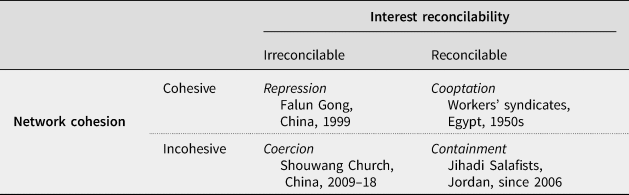
What explains state actors’ strategy choices vis-à-vis societal organizations? I posit that how states control organizations depends on whether they think groups undermine political stability or might do so in the future. Two factors inform that assessment. First is whether societal organizations have reconcilable interests with a regime. Second is whether groups are in national or international networks that are either cohesive or incohesive. While interest reconcilability influences whether state actors see groups as subversive, network cohesion shapes groups’ capacity for large-scale mobilization. Organizations with irreconcilable interests and in cohesive networks are repressed. Groups with irreconcilable interests and in loose networks are coerced. Organizations in cohesive networks with compatible interests are coopted. Because they have significant mobilization potential, autocrats want to ensure their interests are reconcilable with regime resilience over time. Finally, groups in loose networks and with reconcilable interests are contained. They are less capable of organizing large-scale militancy and do not aim to challenge the leadership, yet autocrats want to ensure they remain depoliticized.
My framework is limited in scope. First, the groups under study are formal and informal organizations, including religious and non-religious groups. Not all civil society organizations would fit into this analysis: those lacking a network would not qualify as possible empirical illustrations of the theory. Second, I do not explain why a strategy fails or succeeds to yield its intended outcomes, or its impact on contention. My dependent variable is autocrats’ strategy choice. Third, states might impact the cohesion of networks in which societal organizations are or the nature of groups’ interests. Ellen Lust-Okar (Reference Lust-Okar2005: 35) claims that ‘ruling elites create institutions that influence when opponents unite and when they divide’. Mark Beissinger (Reference Beissinger2002: 23) suggests state response to activism might ‘affect the prisms through which individuals relate to authority’. I do not explore the interactive effect between my dependent and independent variables. Fourth, states sometimes cooperate with organizations to clamp down more effectively on others. This phenomenon is best represented by Lust-Okar's (Reference Lust-Okar2005: 1; Reference Lust-Okar and Schlumberger2007: 40) concept of ‘divided structure of contestation’. I do not study the simultaneous use of multiple strategies towards different organizations. Fifth, states might target an organization by coercing its leadership and containing its members. My theory does not account for this. When groups are targeted, it is often their leadership that is on authoritarian states’ radar rather than the membership as a whole. Lastly, I do not trace the evolution of a regime's tactics towards an organization. I explain why state actors target an organization at a particular point in time. The theory nevertheless implies that strategy shifts towards a group would result from either changes in the reconcilability of its interests with a regime, or the cohesion of a network of which it is part.
The analysis presents a review of the literature. I define my independent variables and introduce a theoretical framework to explain why state actors in autocracies either repress, coerce, coopt or contain societal organizations. I conceptualize those strategies and present case studies supporting my argument. I also show that alternative explanations emphasizing group strength and ideology either do not account or do not account fully for why state actors choose either strategy.
Extant causal stories
In its attempt to explain why autocrats repress or coopt actors, the literature emphasizes two categories of factors. First is whether autocrats and possible regime challengers share some ideological affinity. Milan Svolik (Reference Svolik2012: 183) claims that autocrats ‘co-opt those who are ideologically close and repress those who are more distant’. Similarly, for Lust-Okar (Reference Lust-Okar2005: 77), the individuals autocratic regimes coopt are moderates, as ‘opponents whose policy preferences are close to the status quo are less costly for the ruling coalition to absorb’. Those interpretations focus on a single dimension of cooperation (i.e. cooptation) and the lack thereof (i.e. repression). They obscure situations where regimes bargain with societal actors through means other than cooptation and clamp down on others through means other than repression.
Paul Staniland suggests there is more than one way a state can cooperate or not cooperate with non-state actors with compatible or incompatible ideologies, particularly militias. Regardless of whether they are autocratic or democratic, regimes are likely to cooperate with ideologically proximate strong militias through strategies of either ‘incorporation’ or ‘collusion’, and not cooperate with ideologically distant and weak groups through strategies of either ‘suppression’ or ‘containment’ (Staniland Reference Staniland2015: 776). Ultimately, Svolik, Lust-Okar and Staniland's focus on ideology can hardly account for counterfactual case scenarios where a state shares common interests with ideologically distant actors whom it would not coopt (Schwedler Reference Schwedler2011: 371). While ideology often shapes groups’ interests, group leaders sometimes leave ideology aside and allow their interests to be defined by pragmatism. Ideology is therefore not always a good indicator of states and organizations’ cooperative potential. While interests encompass ideology, the reverse might not be consistently accurate.
The second explanations emphasize group characteristics that make societal actors stronger, and therefore likelier to challenge autocrats. For Bruce Bueno de Mesquita et al., autocrats oppress non-ruling elites (the ‘selectorate’) or the ‘disenfranchised’ in society when either's incentives to defy the regime increase. Both have more incentives to defy the regime when ruling elites are fewer. Yet, for non-ruling elites to have incentives to defy autocratic rule, the ‘selectorate’ must also grow (Bueno de Mesquita et al. Reference Bueno de Mesquita, Smith, Siverson and Morrow2003: 342). Incentives to defy may be understood as manifestations of interest irreconcilability, depending on what citizens are defying, and in this sense, Bueno de Mesquita et al.’s perspective might be reconcilable with the theory presented in this study. Yet the authors’ broad conceptualization of ‘oppression’ capturing both coercion and repression does not help account for why groups with such incentives might be suppressed or not. An organizational factor is necessary to account for this variation. Group size might have helped explain it, but it is presented in their study as a variable that feeds interest irreconcilability. It makes elites likelier targets of oppression, but does not explain variations in forms of oppression. Ultimately, large groups might want to unsettle authoritarian rule but if they are part of a network lacking internal cohesion, they are unlikely to act upon their motivation as effectively. Autocrats are thus less likely to supress them.
Jennifer Gandhi and Adam Przeworski (Reference Gandhi and Przeworski2007), as well as Gandhi (Reference Gandhi2008), take the emphasis on group strength in a different direction: autocrats coopt the leaders of big organizations to prevent them from becoming threats. Opposition strength influences regimes’ probability of cooptation. Strength is a function of four conditions. First is whether a group is connected to networks of political parties that pre-dated the autocracy. Networks influence an opposition's mobilization capacity and ability to extract concessions from autocrats. Second is the frequency of past leadership changes, influencing regime stability. The opposition has more leverage in an unstable autocracy. Third, a dictator's propensity to repress may reduce the opposition's chances of challenging his rule. Lastly, the opposition might be strengthened if a regime faces external pressure to liberalize (Gandhi Reference Gandhi2008: 96–97; Gandhi and Przeworski Reference Gandhi and Przeworski2007: 1285–1286). The last three factors are structural and cannot account for why organizations vary in strength. The first factor, although not empirically relevant to all autocracies, would qualify as a kind of network to which organizations are linked. Yet the theory obscures the possibility that ties to parties may be loose or cohesive. Most importantly, it omits the question as to whether societal organizations’ motivations are reconcilable with regime interests. Autocrats would not coopt groups whose interests would undermine regime resilience.
Finally, the size of societal groups influences state actors’ inclination to coopt them, depending on regime type. Wonik Kim and Jennifer Gandhi (Reference Kim and Gandhi2010) claim that states coopt large labour movements where they have nominally democratic institutions, suggesting regimes without those institutions are less likely to do so. Park Chung Hee's South Korea, which lacked those institutions, repressed a large population of workers (Kim and Gandhi Reference Kim and Gandhi2010: 48). This argument leaves aside an important dimension of the causal story underlying what seems to have been coercion rather than an attempt to eradicate labour: state perceptions of interest irreconcilability with the opposition. Park's regime was a right-wing anti-communist military dictatorship closely linked to capital and based its appeal on economic growth (Evans Reference Evans1995: 53; Kohli Reference Kohli1994: 1286; Yang Reference Yang2013: 466). Park personally admired Japan's colonial model of development, which had been repressive of the proletariat (Kohli Reference Kohli1994: 1286). Labour was coerced because its interests were conflicting with capital, it was ideologically at odds with the regime's pursuit of a developmental economic policy, and in a Cold War context, the regime feared mobilized labour might be linked to communism (Bellin Reference Bellin2000: 200; Kohli Reference Kohli1994: 1288).
Like most of the above explanations, I observe that authoritarian regimes respond to societal organizations based on how threatening they think they are. Where I move away from these analyses is on the characteristics of groups that inform autocrats’ strategy choices. I believe there are two dimensions of organizations that determine how autocrats respond to them. These are the reconcilability of groups’ interests with regime resilience, impacting whether regimes view them as subversive, and whether organizations are in a cohesive national or international network, shaping organizations’ capacity for large-scale militancy.
Varieties of societal groups in autocratic polities
Interest reconcilability
Regime survival is the main priority for autocrats (Bueno de Mesquita et al. Reference Bueno de Mesquita, Smith, Siverson and Morrow2003). State actors working in their interests seek to maintain their control over organizations in society to prevent them from becoming politicized (Linz Reference Linz2000). They assess the reconcilability of groups’ objectives with regime resilience. Autocrats coerce or repress actors they perceive as having irreconcilable interests, and cooperate with those they think have reconcilable ones. The leaders of societal organizations may have latent and manifest interests. As Jillian Schwedler (Reference Schwedler2006: 19) observes, individuals or societal organizations might be ‘playing by the rules of the game, but secretly harboring radical agendas’. I define latent interests as the ones groups choose not to voice or act upon, while manifest interests are the ideas and objectives they make central to their agenda. Differentiating latent and manifest interests is important as institutional and ideological limits posed by authoritarian regimes often constrain societal actors to self-censor (Hildebrandt Reference Hildebrandt2013). What the leaders of organizations openly voice and advocate might not be entirely representative of their interests at large. Because they are observable, autocrats assess how compatible groups’ manifest interests are with regime goals. Organizations with irreconcilable priorities are those whose manifest interests require reforms that would abolish the state's control over political and social life. This is a case of ‘issue indivisibilities’, where actors’ conflictual priorities ‘simply will not admit compromise’ (Fearon Reference Fearon1995: 382). A group calling for the sovereignty of a country's region would threaten a government's ability to dominate that subnational area. Similarly, a movement pushing for an independent civil society would challenge an authoritarian state's monopoly over social control.
Organizations have reconcilable priorities when their manifest interests do not challenge a regime's survival. Those groups do not question the state's control over political institutions and society. They may oppose policies in the system, or the lack thereof, and push for solutions that are compatible with regime interests. An organization in China pressing for gender equality in occupational settings would have reconcilable interests with the regime, as the promotion of gender equality is unlikely to undermine Chinese Communist Party (CCP) rule.
What are irreconcilable issues in one regime might not be so in another, and issues that are incompatible today may become compatible over time, or the reverse (Mainwaring and Pérez-Liñan Reference Mainwaring and Pérez-Liñan2013; Wood Reference Wood2003). Context awareness matters for determining which societal interests conflict with regime resilience. Three factors account for variation in interest reconcilability across authoritarian regimes: whether regimes are closed or competitive, the ideology of a political leadership, and societal actors’ ability to frame their activities relative to regime priorities. The range of irreconcilable issues between societal and state actors is likely to be wider in closed autocracies than in competitive ones. An organization fighting for an independent civil society in a closed setting will likely be framed as having irreconcilable interests with autocrats, but a group pressing for more political freedoms in a competitive authoritarian regime might not. While closed regimes depend on highly restricted freedom of speech, competitive regimes have already gone some way towards institutionalizing those liberties (Levitsky and Way Reference Levitsky and Way2010; Schedler Reference Schedler2006). To remain popular, leaders in competitive systems necessitate ‘claiming the mantle of democracy … and avoid[ing] explicit … political restrictions’ (Robertson Reference Robertson2009: 546). In policy areas where closed regimes refuse to negotiate with a group, competitive ones might have no choice but to settle.
A regime's ideology also influences what issues autocrats perceive as irreconcilable. Gender equality is compatible with communist or post-communist authoritarian systems, yet leaders in regimes following conservative interpretations of religion like Iran's theocracy would view it as an ideological challenge to their rule. Domestic and regional security considerations also shape what issues political leaders consider ideologically tolerable and reconcilable with regime resilience. The Jordanian regime has tolerated Salafism, provided that it remains low profile.Footnote 2 In China, Salafism would likely be associated with Uyghur ‘separatism’, and suppressed (Bovingdon Reference Bovingdon2010).
Finally, societal organizations may strategically frame their interests in ways that are not incompatible with regime priorities in spheres where there is room for irreconcilability (Hildebrandt Reference Hildebrandt2013; Wickham Reference Wickham2013). Timothy Hildebrandt's research reveals that NGOs working in sensitive policy areas in China are ‘self-limiting’ in the way they frame their objectives. Rather than viewing themselves as fighting flaws in the system, like discrimination against gays and lesbians, LGBT organizations frame their work as oriented around health issues. HIV/AIDS organizations, similarly, present their work as focused on fighting the disease rather than assisting victims in seeking justice from local governments for the epidemic that happened in the 1990s (Hildebrandt Reference Hildebrandt2013: 14, 84).
Autocrats consider societal groups with incompatible interests more threatening if they have large-scale mobilization capacity. Subversive grievances that are not openly voiced are less threatening than the ones that are acted upon. Collective mobilization brings public attention to a system's inherent problems and can prompt societal interest in regime change.
Network cohesion
The organizations that are central to this study are part of networks that are either cohesive or incohesive. Network cohesion refers to an institutional structure that vertically binds a central leadership to local organizations. It does not refer to the way an organization in a network works internally. My understanding of network cohesion is organizational, and it is that dimension the theory assumes primarily preoccupies autocrats. Yet organizational cohesion comes with non-organizational forms of cohesion. Organizations in cohesive networks often share common beliefs, norms and goals. Networks emphasize conformity with these norms and obedience to a central leadership. In contrast, groups in a loose network lack a vertical structure tying them to a leadership. They may also lack common beliefs, norms and objectives.
Autocrats worry about groups in cohesive networks as their capacity to organize collectively around common claims is greater. A central leadership facilitates the coordination of collective action among local groups. This is not to say cohesive networks necessarily organize large-scale collective action, and fragmented networks cannot. Yet loose networks lack the vertical structure that enables them to mobilize local units effectively on a large scale.
Size as an organizational dimension is not unimportant. Large groups might be on local governments’ radar, yet what makes an organization more or less threatening to central state actors is not the extent of its membership, but whether it is part of a network that can mobilize groups beyond a locality. A large organization belonging to a loose network might be less effective at organizing large-scale mobilization than a small organization belonging to a cohesive network.
How autocrats control societal organizations
Authoritarian regimes rely on four mechanisms to control societal groups and their leaders: repression, coercion, cooptation and containment. Autocrats choose either one based on how threatening they consider a group to be. This depends on the reconcilability of a group's interests with regime resilience, and whether it is in loosely or cohesively organized networks. Interest reconcilability influences whether state actors use force against an organization or are willing to cooperate with it, while network cohesion shapes the kind of force autocrats use against groups or the bargain they strike with them.
State actors repress groups in cohesive networks with irreconcilable interests. Repression is the attempt to eliminate an organization as a functioning entity. It involves destroying its infrastructure, placing a ban on its activities, and/or the life-long imprisonment and/or execution of its leaders. While repression can eradicate a threat in the short term, it is financially costly, can create further instability, undermine a regime's image and generate international costs (Conrad Reference Conrad2011; Levitsky and Way Reference Levitsky and Way2005, Reference Levitsky and Way2010; Way and Levitsky Reference Way and Levitsky2006). Autocrats avoid repressing groups in loose networks with irreconcilable interests. The strategy might create incentives for actors to unite against the regime (Beissinger Reference Beissinger2002). Autocrats also refrain from repressing organizations with reconcilable interests, be they in cohesive or loose networks. Repression can turn neutral actors into opponents (Bunce and Wolchik Reference Bunce and Wolchik2011: 39).
State actors coerce organizations with irreconcilable interests that are part of loose networks. Coercion is the use of physical or psychological force against an organization to confine it and deter its leaders from engaging in activities considered destabilizing, including ‘coalescing’ with other groups (Bunce and Wolchik Reference Bunce and Wolchik2011: 192). Through methods such as harassment, temporary detentions and arrests, and monitoring, it signals to societal actors that they should not cross political limits, for they will face consequences (Bunce and Wolchik Reference Bunce and Wolchik2011; Stacher Reference Stacher2012; Way and Levitsky Reference Way and Levitsky2006). Unlike repression, coercive state actors do not intend to eradicate organizations as they lack large-scale mobilization capacity. Coercion is politically costly, and in the long run it requires mobilizing significant financial and human resources (Ehteshami et al. Reference Ehteshami, Hinnebusch, Huuhtanen, Raunio, Warnaar, Zintl, Heydemann and Leenders2013; Koesel Reference Koesel2014). Autocrats would not coerce groups with irreconcilable interests and a strong capacity to mobilize. Coercion would not deter them from going public but would give them further reasons to do so. State actors also do not coerce organizations with reconcilable interests that are in either loose or cohesive networks to avoid alienating loyals.
State actors coopt organizations with reconcilable interests and in cohesive networks. Cooptation involves ‘encapsulating’ groups into state institutions.Footnote 3 Coopted organizations are therefore formal, not informal. Cooptation gives them access to government resources and enables them to influence policymaking (Albrecht Reference Albrecht and Schlumberger2007; Bellin Reference Bellin2000; Gandhi Reference Gandhi2008; Lust-Okar Reference Lust-Okar and Schlumberger2007). Coopted actors, in this sense, have a stake in autocrats’ survival (Bellin Reference Bellin2000; Gandhi Reference Gandhi2008; Lust-Okar Reference Lust-Okar and Schlumberger2007; Schwedler Reference Schwedler2006). Yet how much they can influence policy is unclear: cooptation guarantees the articulation of organizations’ interests more than their representation (Collier and Collier Reference Collier and Collier1979; Conrad Reference Conrad2011: 5). Cooptation deepens the state's grip on groups’ activities: it controls their finances, nominates their leadership, and imposes limits on their agenda (Collier and Collier Reference Collier and Collier1979). It is expensive in the long run: the more organizations the state encapsulates, the larger the bureaucracy and budget needed to supervise them. State actors would not prioritize coopting organizations with reconcilable interests in loose networks as they lack large-scale mobilization capacity. Those organizations are also often deliberately informal and forcefully coopting them could create divisions in a government and weaken a regime (Geddes Reference Geddes1999). State actors would also not coopt organizations with irreconcilable interests, regardless of the networks they are part of. The state would not give regime opponents the resources to subvert its institutions.
State actors finally contain organizations with reconcilable interests and in loose networks. Containment is the conditional and bounded toleration of an organization outside state institutions. Unlike coopted organizations, contained groups are informal. State actors grant their leaders autonomy, provided they give the government access to information about their activities and keep a low profile. The bargain creates incentives for contained actors to remain depoliticized over time. Unlike coopted groups, contained organizations cannot voice their claims through official channels: they make demands behind closed doors and the state looks for informal solutions to accommodate them. Containment differs from simple toleration. Toleration implies an unconditional policy of live and let live. Containment involves limited acceptance based on the condition that a group cannot cross certain limits. State actors do not rely only on the information contained actors provide them to ensure they respect the bargain, they also monitor them by wiretapping group members’ phone conversations and infiltrating relevant organizations. State actors would not contain groups with irreconcilable interests as that would give regime opponents the informal autonomy to increase their influence in society. They would also not contain organizations with reconcilable interests that are in cohesive networks, as they already have the capacity to organize large-scale mobilization. By coopting those groups, state actors can better ensure they remain loyal. If they were to become politicized over time, they would fall into the most politically unsettling category.
Case studies
Four cases illustrate the application of the theory: the Falun Gong (a spiritual network) in China; Shouwang Church (an informal organization) in Beijing; jihadi Salafists (informal religious communities) in Jordan; and syndicates (formal organizations) in Nasser's Egypt. As the last case suggests, the theory does not apply to religious organizations exclusively. Interviews conducted with house church leaders in China in 2009–10 and Salafists and experts of Salafism in Jordan in 2013 support the second and third cases. The first and fourth cases were supported by a reading of the secondary literature. Table 1 summarizes the theory and empirical cases.
Strategies Used to Control Societal Organizations

China's repression of the Falun Gong
Starting in 1999, the Chinese government launched a repressive campaign against the Falun Gong by outlawing its activities and worshipping locations, jailing some of its key followers, forcing some practitioners to flee abroad and placing a ban on all materials published by the organization (Keith and Lin Reference Keith and Lin2003: 636; Ownby Reference Ownby2008: 15; Perry Reference Perry2001: 170; Tong Reference Tong2009: 76–77). The Falun Gong was a spiritual organization founded in 1992 in north-east China by its leader Li Hongzhi, who promoted the practice of qigong (Chan Reference Chan2004: 665). The trigger of state repression is commonly said to be the group's peaceful demonstration in the political centre of Beijing in April 1999, when believers asked for the recognition of the Falun Gong as autonomous. Yet the three months’ delay in the clampdown on the organization suggests that the protest itself cannot account for state repression.Footnote 4 Ultimately, it was the network's internal structure and perceptions of the irreconcilability of its interests with the regime that motivated the clampdown.
Prior to the 1999 demonstration, the Falun Gong was already on the government's radar because of its scope. The government sought to prevent it from gathering for that reason. In an interview with Time, Li Hongzhi implied that was a reason he left China. The CCP is particularly wary of societal networks that develop sophisticated internal structures and might represent an alternative source of influence to political authority (Koesel Reference Koesel2014). The Falun Gong was said to have millions of followers, including CCP members and government employees (Chan Reference Chan2004: 674, 681–682). The Falun Gong was hierarchical and built itself a ‘network of 28,000 practice sites’ (Chan Reference Chan2004: 681; Tong Reference Tong2009: 57). Worshipping sites were ‘connected through both vertical and horizontal networks’ (Chan Reference Chan2004: 673). Li issued frequent guidelines to local units and the Beijing Falun Dafa Research Society managed their affairs, appointing and dismissing religious administrators (Chan Reference Chan2004; Tong Reference Tong2002). Members followed a common set of practices and beliefs based on the writings of Li (Tong Reference Tong2009: 8). By the end of the 1990s, the organization had also grown internationally, with worshipping locations in cities on different continents (Chan Reference Chan2004: 682).
The CCP also labelled the organization as a threat to its interests, although most studies suggest it did so more explicitly following the 1999 demonstration (Chan Reference Chan2004: 682; Keith and Lin Reference Keith and Lin2003: 632; Perry Reference Perry2001: 171). That year, the Chinese government blacklisted the organization as an ‘evil cult’ to be suppressed (Keith and Lin Reference Keith and Lin2003: 638). The central government tolerates the practice of five religions and heterodoxy is excluded from those. The regime is wary of religious cults as they were historically associated with attempts to overthrow political authority (Perry Reference Perry2001: 174). The Falun Gong did not conform with religious orthodoxy as it was not properly Buddhist (Keith and Lin Reference Keith and Lin2003: 632, 635). It was also said to have antithetical views to Marxism-Leninism (Perry Reference Perry2001: 171). It did not always have that label. In its early years, it maintained relatively peaceful relations with the government, and signalled its intentions to work in the system as it had ‘a loose affiliation with the State Sports Administration’ (Keith and Lin Reference Keith and Lin2003: 630). Yet it had tried to register as a social group and had not succeeded in doing so (Tong Reference Tong2009). Beyond the recognition of religious heterodoxy, legalizing the organization would have necessitated fundamentally rethinking other policies that are essential to regime resilience, including regulations on the management of social organizations. The Falun Gong's claims for recognition in 1999 and earlier were more relevant to the Ministry of Civil Affairs than to the State Administration for Religious Affairs, as it did not label itself as religious. Yet the Falun Gong could not have been legalized by the Ministry of Civil Affairs as it had local units the state did not allow for recognition (Keith and Lin Reference Keith and Lin2003: 630, 634). Only mass organizations ideologically linked to the Party have such a decentralized structure.
The organization's unorthodoxy and sophisticated structure are not the factors that triggered state repression as the government would have otherwise taken forceful measures against the organization before 1999. It was a shift in its interests, including its politicization and resolve to exploit its network to press for the right to recognition that motivated the clampdown (Chan Reference Chan2004: 683). From then on, the possibility that the Falun Gong might again launch disruptive demonstrations was tangible. The state labelled the organization's activities, including its protest, as criminal (Keith and Lin Reference Keith and Lin2003: 640–641). State repression partly eliminated the Falun Gong in China (Chung et al. Reference Chung, Lai and Xia2006: 26), yet it further politicized the movement that had already begun to increase its international influence. The organization launched the Epoch Times not long after, known for its particularly negative coverage of the CCP.
Alternative factors such as group strength and ideology cannot account fully for why the CCP repressed the Falun Gong. According to Gandhi (Reference Gandhi2008) and Kim and Gandhi (Reference Kim and Gandhi2010), the state would have repressed the network because of its size and the absence of electoral institutions at the central level. It was a large network (Chung et al. Reference Chung, Lai and Xia2006: 13). Yet it is unclear that the state would have mobilized the resources it did to clamp down on the network had it not been framed as having interests at odds with the regime. Bueno de Mesquita et al. (Reference Bueno de Mesquita, Smith, Siverson and Morrow2003), like perspectives emphasizing ideological proximity, would have rightly stressed that it was the Falun Gong's incentives to defy the regime that incited the clampdown. Yet this cannot account for why the Chinese state did not coerce the group instead of eradicating it. The organization had a cohesive network nationwide, and coercion would not have been sufficient to deter it from mobilizing on that scale again.
China's coercion of Shouwang Church
Starting in the late 2000s, the Chinese government coerced some of China's most influential unregistered Protestant urban congregations. Among them was Shouwang Church in Beijing, a congregation of approximately 1,000 believers. A conflict between Shouwang Church and the authorities escalated in 2009, when the congregation was forced to leave the worshipping location it had been renting for some years. Its lease, which would have normally been renewed in the autumn of 2009, was not. When the church left that location, it had been unable to find another worshipping space and decided to organize its services in a park in Wudaokou district for the following two weeks. In the midst of the conflict, church leaders did not voice political demands. Yet the outdoor service still signalled the church's resolve to continue practising despite its eviction, and its determination to further its legitimate right to access a worshipping location, despite its informal status. Shouwang Church's outdoor services were held a few weeks before US President Obama's first visit to China. It was a sensitive time. Presumably wanting to avoid collective ‘incidents’ of the religious kind prior to that visit, the Beijing authorities quickly responded to those events by allowing the church to occupy the premises of a theatre in the western part of the city for the time being. Meanwhile, Shouwang Church managed to gather enough funds among its congregants to purchase a worshipping location. Owning property would have made future evictions more difficult, and the church had been forced to change locations it rented several times in the past. Once the property was purchased, the authorities did not allow the church access to the property's premises. This added another layer to the conflict and marked the beginning of a round of tense negotiations between the church leadership and relevant authorities. The conflict attracted the attention of the local and international media, as well as human rights watchers. Shouwang Church had a website and a printed journal where it shared information with its members about the evolution of negotiations with the authorities. Services were also an opportunity for the leadership to talk about the status of negotiations. The leadership was careful in the way it spoke about the state, yet it had latent ambitions that became apparent in the midst of the conflict.
Shouwang Church's claims to religious practice outside the reach of the state may have been interpreted as an indirect call for the independence of civil society. Had the church lacked social ambition, they might not have been interpreted as such. Yet leaders in the church were said to strive to turn the congregation into a ‘city on a hill’, wanting their congregation to play an influential role and be widely known in society (Vala Reference Vala2013).Footnote 5 The CCP rejects the idea of an autonomous civil society because it seeks to maintain its single-party rule. Legal churches are therefore supervised by the state (Goossaert and Palmer Reference Goossaert and Palmer2011; Koesel Reference Koesel2014). The interests of ambitious church leaders operating informally, in this sense, are difficult to reconcile with regime resilience.
Shouwang Church was not institutionally bound to a cohesive religious network, yet it did know and interact with similar-minded churches in other parts of the country. In the 2000s, Shouwang Church became more extensively linked to other domestic churches and international actors (Vala Reference Vala2013). In 2011, the church organized outdoor services and at least 17 churches signed a petition backing its struggle, and asking for greater religious freedom in China (Reuters 2011).
Beijing authorities did not repress Shouwang Church, but placed severe restrictions on its existence. They tried to evict the congregation forcefully from its meeting locations until 2011, putting pressure on its landlords to do so. They also detained, harassed and put some religious leaders under house arrest to get the church to abandon its claims (Vala Reference Vala2013). The church's conflict with the authorities also created internal divisions among the clergy. Church leaders were said to disagree over the proper way of handling the conflict. Not all agreed that the best way of furthering Shouwang Church's interests was by organizing outdoor services. Ultimately, hundreds of congregants wound up leaving the church, along with another leader.Footnote 6
The conflict between Shouwang Church and the local administration lasted several years and had not been solved by 2018. The church never accessed the space it had purchased. It rented another one and resumed its outdoor meetings even after 2011. Church members were temporarily detained. Services and believers were monitored. The pastor of the church, who quit its leadership in 2018, was still under house arrest (Chen et al. Reference Chen, Lan and Liying2014; Qiao Reference Qiao2015).
Alternative explanations such as group strength and ideology cannot account for why the regime coerced Shouwang Church. It is unclear what Gandhi (Reference Gandhi2008) and Kim and Gandhi (Reference Kim and Gandhi2010) would have attributed the coercion of Shouwang Church to as they mainly theorize about what happens to a strong opposition, implying a large movement. Shouwang Church does not qualify as one. Bueno de Mesquita et al. (Reference Bueno de Mesquita, Smith, Siverson and Morrow2003) would have attributed state coercion to Shouwang's incentives to defy the regime. The church indeed became the target of greater state pressure when it demonstrated its resolve to go public about its interests (Vala Reference Vala2013). Similarly, perspectives emphasizing ideological incompatibility might have pointed to church leaders’ sympathy towards an independent civil society as reasons for coercion. These interpretations might have been enough to place Shouwang Church on the government's radar, but they do not explain why the authorities did not repress it. The church was coerced because it lacked large-scale mobilization capacity.
Egypt's cooptation of syndicates under Nasser
In the 1950s, Nasser's government coopted syndicates that pre-dated the regime's rule (Beinin Reference Beinin1998: 446; Posusney Reference Posusney1997: 67). The General Federation of Egyptian Trade Unions established in 1957 encompassed 1,347 organizations, and was officially supervised by the Ministry of Labour in 1959 (Beinin Reference Beinin1998: 456–457; Bianchi Reference Bianchi1989: 136; Posusney Reference Posusney1997: 53; Tomiche Reference Tomiche1974: 100–101). Cooptation was corporatist in nature: one federation had the monopoly over worker representation per economic sector (Posusney Reference Posusney1997: 80). Syndicates were characterized by a vertical hierarchy with ‘Local units … tied to … regional branches … centralized under a national confederation with headquarters in the capital city’ (Bianchi Reference Bianchi1989: 73). They were forbidden from criticizing the regime, and party membership was a necessary criterion for being part of unions’ leadership (Posusney Reference Posusney1997: 76; Tomiche Reference Tomiche1974: 72). The state cancelled the election of regime opponents and had a final say on union boards’ membership (Beinin Reference Beinin1998: 459; Posusney Reference Posusney1997: 61). The ruling party had local offices in enterprises where unions were and was able to intervene in their activities effectively (Posusney Reference Posusney1997: 76). It supervised their finances, and unions had to report to the government on what they did and the identity of union members (Posusney Reference Posusney1997: 41, 51–52; Tomiche Reference Tomiche1974: 72).
Syndicates were coopted as they were relatively cohesively organized networks that the state could not allow itself to ignore. Prior to the beginning of the Free Officers’ regime in 1952, workers were organized in cities or transcended a single locality (Beinin Reference Beinin1998: 293, 330; Bianchi Reference Bianchi1989). Syndicates showed signs of cohesion yet at levels that were not national. Federations were established across economic sectors (Beinin Reference Beinin1998: 411) and ‘were allowed to organize in identical work branches and regions’ (Bianchi Reference Bianchi1989: 127). The nationalist movement in the 1940s and early 1950s had tried to bring together unions from different cities into a nationwide confederation, though these attempts had not been fruitful (Beinin Reference Beinin1998: 341, 349).
Interest reconcilability also facilitated the cooptation of workers. Trade unions were central to the implementation of Nasser's economic policy (Tomiche Reference Tomiche1974: 80). Syndicates had common interests with the leader, although this was more obvious once the regime cleansed them of its enemies, namely communists, advocates of union autonomy and sympathizers of British interests (Beinin Reference Beinin1998: 420, 428, 435; Bianchi Reference Bianchi1989: 79; Posusney Reference Posusney1997: 44–45; Tomiche Reference Tomiche1974: 43). Yet from the start, syndicates had been relatively demobilized as they had been prohibited from organizing protests by the earlier Wafd regime, rendering them easier allies of Nasser's subsequent rule (Bianchi Reference Bianchi1989: 127). When Nasser enforced a ban on strikes, union leaders did not overtly contest his decision (Posusney Reference Posusney1997: 41, 44). Syndicates had also pressed for Egypt's rupture with vestiges of British colonialism, and Nasser shared with them nationalist ambitions (Beinin Reference Beinin1989: 71; 1998: 411, 418–419, 429, 444; Posusney Reference Posusney1997: 42). Finally, in his early rule, Nasser implemented social reforms to improve labour conditions that won the support of trade unions, including an increase in workers’ income (Beinin Reference Beinin1998: 446, 456; Posusney Reference Posusney1997: 47–48, 59). There were other benefits to cooptation. Workers had a voice and a place in the system they otherwise would not have had (Bianchi Reference Bianchi1989: 79). In general, workers were relatively supportive of Nasser's policies (Beinin Reference Beinin1998: 444; Tomiche Reference Tomiche1974: 79).
Alternative explanations like ideological proximity and opposition strength cannot account fully for why Nasser coopted workers. Ideology is not irrelevant as Nasser coopted syndicates after having cleansed them of regime opponents. Yet what defined opponents might not have been ideology: the regime was socialist, and communists were purged because they had a history of political activism (Beinin Reference Beinin1998: 310, 313–314, 413). Ultimately, the regime wanted to ensure syndicates would not mobilize against its interests. When needed, Nasser made decisions that compromised socialism in the name of regime resilience. Gandhi (Reference Gandhi2008) and Gandhi and Przeworski (Reference Gandhi and Przeworski2007) would have attributed cooptation to the size of syndicates. Their links to parties from the earlier regime would have also made them more threatening to Nasser, thereby justifying cooptation. The labour movement was connected to the Wafd, the left and Islamists (Beinin Reference Beinin1998: 292, 344, 406). Yet it was unclear that syndicates were stronger as a result, and that was why Nasser coopted them. It might have explained, rather, Nasser's changes in the membership of union executive boards (Bianchi Reference Bianchi1989: 91). Finally, Kim and Gandhi's argument (Reference Kim and Gandhi2010) partly accounts for cooptation in this case: the labour movement was large yet Nasser had abolished nominally democratic institutions (Posusney Reference Posusney1997: 52).
Jordan's containment of quietist jihadi Salafists in a post-Zarqawi era
The regime in Jordan has contained quietist jihadi Salafists from 2006 until now. It has tolerated quietist jihadi Salafists on the condition that they stay low profile. They are allowed to attend mosques, but banned from speaking at them (Abu Rumman and Abu Hanieh Reference Abu Rumman and Abu Hanieh2009: 145; Wiktorowicz Reference Wiktorowicz2001: 141).Footnote 7 Preventing them from preaching at mosques constrains their ability to spread their influence. Quietist jihadis also cannot publish their ideas the way other Salafist factions can. They cannot form a political or a social organization. They gather in informal networks. Gatherings take place in jihadi households and are non-militant (International Crisis Group 2005: 5; Wiktorowicz Reference Wiktorowicz2001: 127, 141–142). The regime has similarly tolerated quietist jihadis informally provided that they share information about their activities with the authorities. Salafists are said to have to report on where they meet. The government collects information about who jihadis are and how they think by communicating with them.Footnote 8 The state also gathers information about their activities through civilian networks, including insiders in the jihadi and traditional Salafist communities and non-jihadi relatives of jihadis (International Crisis Group 2005: 13).Footnote 9 Jihadi cells in cities like Sweileh and Zarqa are said to have been infiltrated by agents collecting information about them.Footnote 10 The authorities are in touch with jihadis more frequently in jihadi strongholds.Footnote 11
The regime has been able to contain quietist jihadis as their manifest interests do not conflict with regime resilience. Both militant and quietist jihadis view regimes in the Middle East as ‘impure’ (Abu Rumman and Abu Hanieh Reference Abu Rumman and Abu Hanieh2009: 109–110) and believe in pursuing jihad for the implementation of an Islamic republic governed by a strict interpretation of the Qur'an and the Sunna (Gerges Reference Gerges2009: 10). While that objective is at odds with principles underlying the modern state in Jordan, it has not been central to quietist jihadis’ agenda. It remains a latent belief. Quietist jihadis do not act upon their opinions about political regimes that govern with non-Islamic laws. They emphasize educating the people through da'wa, or religious teachings, rather than launching violent struggles against the state.Footnote 12 Involvement in political action distracts them from the principles of sacred texts and is a recipe for instability (Wagemakers Reference Wagemakers2012: 9, 76–77). Some may conduct activities outside the country yet stay low key in Jordan.Footnote 13
Quietist jihadis in Jordan are also not cohesively organized, thereby reducing their ability to engage in large-scale militancy. Aside from having limited resources and being unarmed,Footnote 14 they lack an internal hierarchy, and local jihadi communities are not institutionally bound to one another. Structurally, they are described as ‘loose and gelatinous’ (Abu Rumman and Abu Hanieh Reference Abu Rumman and Abu Hanieh2009: 131). Salafists are divided into communities in cities such as Amman, Irbid, Ma'an, al-Salt and Zarqa.Footnote 15 Some are united by local leaders yet others are characterized by ‘internal conflicts, disagreements and suspicions’ (Abu Rumman and Abu Hanieh Reference Abu Rumman and Abu Hanieh2009: 127, 132).
Jihadi Salafists’ lack of organizational capacity in turn feeds their political risk-averseness and interest to cooperate with the state. Abu Sayyaf, a jihadi leader in Ma'an, opposed violent jihadism in Jordan because jihadis were not strong enough to pursue it (Beaumont Reference Beaumont2014). Doing so would lead to their being jailed (Wagemakers Reference Wagemakers2012: 204). This is especially true given the sophistication of the Jordanian intelligence services, and their effectiveness in preventing attacks from taking place (Abu Rumman and Abu Hanieh Reference Abu Rumman and Abu Hanieh2009: 132; Black Reference Black2015; Wagemakers Reference Wagemakers2012: 204). Prior to 2006, state agents managed to stop jihadi activities that did not necessitate much ‘planning’ most of the time (Abu Rumman and Abu Hanieh Reference Abu Rumman and Abu Hanieh2009: 132–133).
Alternative arguments such as group strength and ideology cannot explain why the Jordanian government contains quietist jihadis. Jihadi Salafists and the Hashemite regime found grounds on which to cooperate informally, yet cooperation does not result from actors’ ideological proximity: both are as ideologically distant as they can get. Bueno de Mesquita et al.’s (Reference Bueno de Mesquita, Smith, Siverson and Morrow2003) logic does not apply to jihadi Salafists in Jordan as they lack incentives to defy authoritarian rule and the authors do not account for what happens in these circumstances. Gandhi (Reference Gandhi2008) and Kim and Gandhi's (Reference Kim and Gandhi2010) claim that opposition size might serve as a deterrent of repression is equally inapplicable. Jihadis in Jordan are not numerous: they are said to range between 1,500 and 5,000 individuals (Alami Reference Alami2014).
Conclusion
Whether authoritarian regimes coopt, contain, coerce or repress societal groups depends on two factors: the reconcilability of organizations’ interests with regime resilience, and whether they are in loose or cohesive networks. While interest reconcilability determines whether autocrats cooperate with groups or use force against them, network cohesion influences the nature of the cooperative bargain (i.e. cooptation or containment) or the kind of force they use (i.e. coercion or repression). State actors in autocracies repress an organization in a cohesive network with irreconcilable interests. They coerce a group in a loose network with incompatible interests. If a group has reconcilable interests, they either coopt or contain it. Cooptation targets groups in cohesive networks, while containment is aimed at those in loose ones. The theoretical framework is generalizable beyond the cases presented in this study. The theory accounts for the suppression of communist organizations in Suharto's Indonesia (Boudreau Reference Boudreau2004: 51–53), the repression of the Muslim Brotherhood and cooptation of professional syndicates under Nasser (Hinnebusch Reference Hinnebusch1985: 12–13, 20), and the containment of the Muslim Brotherhood and coercion of the left by Sadat in Egypt in the 1970s (Hinnebusch Reference Hinnebusch1985: 206; Wickham Reference Wickham2013: 31, 43).
The theory is not devoid of problems of endogeneity. The strategies autocrats use towards societal organizations might impact the cohesion of the networks they are in and the reconcilability of their interests with a regime. These effects might be immediate or longer term, and apparent under a different political leadership. The Muslim Brotherhood under Nasser was a religious network with a centralized leadership. Its relations with the socialist regime grew increasingly tense, and Nasser's repression of the organization led to its quasi suppression. A significant part of the movement was demobilized, while another radicalized as a result (Wickham Reference Wickham2013: 27–28). Yet the attempted eradication of the movement also incited the members of the organization to be moderate under a subsequent and more cooperative leadership. By the 1970s, Nasser's successor, Sadat, had political priorities that allowed Islamists to re-emerge. The Muslim Brotherhood was informally tolerated as a movement on some conditions, and having been weakened significantly, it was not in a position to challenge Sadat politically. Its containment facilitated its subsequent expansion and consolidation as a network.
Lastly, the theoretical framework might not systematically predict autocratic strategy choices. Authoritarian regimes vary in their capacity (Slater Reference Slater2010; Way and Levitsky Reference Way and Levitsky2006), and the framework might apply more easily to regimes with a strong or medium-level state capacity than those lacking the resources to implement resource-costly strategies (Albrecht Reference Albrecht and Schlumberger2007; Levitsky and Way Reference Levitsky and Way2010: 56). Regime type might also deter certain strategy options. Nominally democratic institutions enable the opposition to place more effective checks on autocrats’ strategy choices. Schwedler (Reference Schwedler2006) observes that ‘once regimes recognize the principle of pluralism, silencing dissidence is likely to turn counterproductive’. The use of force is also easier to condemn where regimes allow non-government media to operate (Schwedler Reference Schwedler2006: 12–14). Closed authoritarian regimes face fewer formal institutional constraints to repress as there are no nominally democratic institutions at the central level controlling autocratic behaviour (Howard and Roessler Reference Howard and Roessler2006; Kim and Gandhi Reference Kim and Gandhi2010). There is evidence, nonetheless, that even in the presence of these institutions, states use force albeit through indirect means like third-party actors (Levitsky and Way Reference Levitsky and Way2010, Reference Levitsky and Way2012; Rudbeck et al. Reference Rudbeck, Mukherjee and Nelson2016). The above hypotheses would therefore need to be empirically supported, and this task lies beyond the scope of the analysis.
Acknowledgements
My research in Jordan was financially supported by an SSHRC-Université de Montréal grant. I wish to thank Sheena Chestnut Greitens, Elizabeth J. Perry and Benjamin Read for their helpful feedback on an earlier version of the manuscript. I am also grateful to the journal's anonymous reviewers for their constructive comments.