




No CrossRef data available.
Article contents
Implanting telehealth network for paediatric cardiology: learning from the Quebec experience
Published online by Cambridge University Press: 21 January 2005
Abstract
The implementation committee of the Quebec Child Telehealth Network was formed in 1997, with a mandate to build a network dedicated to the diagnosis of congenital cardiac disease via telemedicine. We devised criterions for selection to determine which peripheral centres would be linked by telemedicine to the university-based services for paediatric cardiology provided in the Canadian Province of Quebec. The criterions included: distance from a university centre, number of births per year, and presence of an already-established outreach clinic for paediatric cardiology. The Quebec Network became operational in 2000, and was composed of 32 peripheral centres and 4 university centres. A total of 363 transmissions of echocardiograms occurred over a 3-year period from January 2000 to December 2002. Peripheral centres located at a distance greater than 100 kilometres from a university centre were 8.5 times more likely to use the network. Criterions other than distance did not influence whether or not a peripheral centre used the network. Cardiac abnormalities were identified in almost two-thirds of the transmissions. The use of the Quebec Network resulted in the avoidance of transfers or clinic visits to university hospitals in seven-tenths of cases. We conclude that distance greater than 100 kilometres from a centre offering subspecialty services in paediatric cardiology is the most important criterion for choosing the peripheral centres that are most likely to use a telehealth network. In its first three years of operation, the telehealth network had a major impact on the delivery of paediatric cardiac care, improving access to subspecialty services across the province.
Keywords
Information
- Type
- Original Article
- Information
- Copyright
- © 2004 Cambridge University Press
Paediatric cardiologists tend to be based in university hospitals located in large cities. Children needing non-urgent cardiac assessment, and living outside of those cities may be obliged to wait long periods of time before being seen in an outreach clinic, or may be required to travel great distances to reach the closest university centre for a routine cardiac evaluation. Furthermore, urgent consultations often require transfer to a university centre, sometimes being transferred by air. Without a clear diagnosis, the timing of these transfers may be sub-optimal, and transfers may occur prior to initiating appropriate and potentially life-saving therapy.
Telehealth has been viewed as a potential tool for overcoming the problems related to access to subspecialty care. Although there exist several publications dealing with telehealth and its application for paediatric cardiology, most address issues pertaining to technical aspects or describe results of already established networks.1–6 Finley et al.7 published one of the first reports of echocardiographic transmissions using telephone lines and showed that this diagnostic method is feasible, accurate and cost-effective. To our knowledge, however, little information exists regarding guidelines for the implementation of a telecardiology network, particularly with respect to the selection of centres to be linked within this network.
Under the leadership of Alain Cloutier, the Quebec Child Telehealth Network, known simply as the Quebec Network, was formed in 1997 with a view to facilitate access to paediatric cardiologic expertise throughout the Province of Quebec, Canada. The Quebec Network became operational in January 2000. The objectives of this study were to examine the criterions selected for choosing the peripheral centres that would participate in the network, and to report the clinical impact of telecardiology 3 years after its implementation in Canada's geographically largest province.
Materials and methods
Demographics
The province of Quebec has a population of over 7.3 million distributed unevenly over an area of 1.5 million square kilometres. There are 17 paediatric cardiologists practising within the province. All of these specialists are based in 4 university hospitals in 3 different cities, namely Montreal, Quebec City, and Sherbrooke.
Organization and financing
The Quebec Network committee was composed of 2 representatives, one paediatric cardiologist and one administrator, from each of the 4 university hospital centres that offer services in paediatric cardiology in the province. The Quebec Provincial Ministry of Health, responsible for the single-payer health system of the province, allocated a total of 4 million Canadian dollars to purchase necessary equipment for each centre, and to support the project. This budget allowed for the establishment of a provincial network composed of 4 university centres, and 32 regional centres.
The intranet cost of transmissions was covered by the yearly fee levied on all hospital centres, whether or not they participated in the Quebec Network, for access to the provincial Health Ministry intranet platform. Thus, hospitals joining the Quebec Network did not incur additional intranet fees. The Quebec Health Ministry agreed that paediatric cardiologists could charge a specific telemedicine consultation fee for each transmission received, while the referring physician, if applicable, could charge a standard fee for the performance of an echocardiogram.
Eligibility
The Quebec Network committee established three minimal requirements for peripheral centres to be eligible to participate in the network. Firstly, peripheral centres could only be selected if they owned and could operate an ultrasound machine capable of doing echocardiograms for transmission to the university centre. Secondly, the ability to access the secure intranet of the Quebec Ministry of Health, the Réseau de télécommunications Sociosanitaire, was mandatory. Lastly, the presence of a newborn nursery was considered essential. Because the clinical impact of significant congenital heart disease is observed most acutely in the newborn period, it was felt by the committee that newborns would derive the greatest benefit from access to telemedicine.
Criterions for selection
The list of 73 peripheral centres fulfilling the requirements for selection was drawn up, and centres were ranked according to the following three criterions:
- Absolute number of births per centre: a higher rank was given to centres with the greatest absolute number of births per year. The committee believed that, with a fixed incidence of congenital heart disease, larger nurseries would treat more newborns with significant heart defects, and thus, would be more likely to use the Quebec Network.
- Distance from a university centre: peripheral centres were given a higher rank the further the distance from the closest university centre. It was felt that access to subspecialty care, and transfer to university centres, was more difficult and costly for more remote centres, and that consequently these centres would benefit relatively more from easier access to subspecialty care through telemedicine.
- Previously established outreach clinics: a higher rank was given to centres with already-established outreach clinics for paediatric cardiology. It was assumed that those peripheral centres with such outreach clinics would be most likely to use the telehealth system because of a pre-existing rapport between the physicians practising in those centres and the university-based cardiologist, and because the outreach clinics are presumably established in centres where there is a need for paediatric cardiologic services.
On this basis, we selected the 32 peripheral centres with the highest ranking to form, in addition to the 4 university centres, the Quebec Child Telehealth Network.
Technology
The Quebec Network used the platform of an already-established public health telecommunications network, the Réseau de télécommunications sociosanitaire. The réseau is a large intranet-type structure using integrated service digital network lines for transmissions at 448 or 512 kilobits per second employing an H.323 protocol.
All of the Quebec Network centres were equipped with a CODEC (Cifra Medical SDX 300, Quebec City, Canada) to which a local echocardiogram machine and/or recorder/monitor could be attached, as well as a small camera which allowed for two-way audio and video communication between the referring and consulting centres. Centres were also provided with software (CifraView for Windows™, Quebec City, Canada) for viewing transmitted radiologic films. The budget for the establishment of the network did not cover the costs of buying or maintaining echocardiographic equipment, which varied in model from centre to centre.
Implementation
After selecting the 32 peripheral centres to be included in the network, the Quebec Network committee sent representatives to each centre to discuss the implementation of the project, and to supervise the introduction of the equipment. Test transmissions for demonstration purposes were done at this time.
We then established a protocol for arranging transmissions. The decision to use telemedicine was to be taken by the referring clinician after discussion of the case with the paediatric cardiologist by phone. Informed consent was to be obtained from the patient or guardian prior to a transmission. Demographic data were to be obtained, a file opened from the referring hospital, and evaluation forms filled out both by the consultant and the referring professional. Included in the evaluation forms were the indication for the transmission, the quality of sound and echocardiographic images, and the clinical impact of having performed the transmission. It was understood that referring physicians would seek personnel with the most experience in ultrasonography of the heart to perform the echocardiographic studies at the referring centre. Sonographers at the referring site could include radiology or cardiology technicians, radiologists, or cardiologists for adults. The interpretation of the cardiac ultrasounds was to be done during the teletransmission by the consultant paediatric cardiologist of the referral centre. The written consultation and conclusion were to be sent by fax to the referring centre following the transmission.
Prospective evaluation
To measure the clinical impact, physicians completed an evaluation form after each transmission and were asked to make one choice among the following:
- transfer to a university centre avoided
- elective visit of the patient to a university centre avoided
- elective visit at an outreach clinic avoided
- immediate transfer to a university centre precipitated, or
- treatment given or patient followed at or discharged from the regional centre without transfer.
Statistical analysis
Chi squared tests served to examine the association between each criterion used for selection of the peripheral centre and the occurrence of at least one transmission. As well, chi squared tests were used to identify possible associations between each criterion used for selection. Multiple logistic regression was used to quantify the contribution of each criterion in predicting whether a centre would use the network.
Results
Total transmissions and utilisation of the Quebec Network
A total of 363 transmissions of echocardiograms occurred within the Quebec Network during the 3 years between January 1, 2000 and December 31, 2002. Of these, 333 transmissions originated from peripheral centres, and were directed to 3 of the university hospitals. Unexpectedly, the fourth, and smallest, university centre did not receive transmissions from peripheral centres. In fact, 30 transmissions originated from the fourth university centre, and were directed to one of the other university centres when no paediatric cardiologic support was available on-site. Thus, this centre was considered a “peripheral” transmitting centre in the results. Of the 33 transmitting centres, 21 used the network at least once during the period of study.
Diagnoses made by transmitted echocardiograms
Of the 363 transmissions, 128 were interpreted as being normal by the university-based paediatric cardiologists, and 232 were considered abnormal. We deemed 3 studies to be inconclusive due to the inadequate quality of the images. Of the interpretable transmissions, 254 (71%) involved patients who had never been previously assessed by a paediatric cardiologist, while 106 (29%) were follow-up visits following previous transmissions or clinical visits with a paediatric cardiologist. The diagnoses for new and follow-up transmissions are enumerated in Table 1.
Table 1. Diagnoses for new and follow-up patients.

Age profile
The median age of all children undergoing echocardiography by teletransmission was 70 days, with a range from 1 day to 17 years, and a mean of 2.4 years. When analysed according to whether the transmissions involved new patients or follow-up studies, the median ages were 15 days, and 3.1 years, respectively. Figure 1 further illustrates the age profile of the children undergoing these examinations. The echocardiograms of the 6 adults and 1 fetus were not included in the analysis for age. The age was not specified in 3 of the 363 transmissions, and the ages of 3 patients whose transmissions were technically unsatisfactory were also excluded from the analysis.

Figure 1. Age profile of children undergoing echocardiography by teletransmission, including age distribution of all children undergoing transmissions, age of children previously unknown to paediatric cardiologists (new patients), and age of patients involved in follow-up studies.
Evaluation of criterions for selection
Number of births. Of 16 peripheral centres servicing more than 1000 births each year, half used the network (Table 2). Logistic regression failed to show a statistical relationship between centres with more than 1000 births per year and utilisation of the network (p = 0.12). The majority of centres with a large newborn population were located less than 100 kilometres from university centres (p = 0.001). There was no association between the number of births and the presence of outreach clinics (p = 0.62).
Distance from university centre. Of the peripheral centres, 12 were within a 100-kilometre radius from the nearest university centre, while 21 centres were located 100 to 1500 kilometres away (Table 2). Of the 21 users, 17 (81%) were located more than 100 kilometres from a university centre. Of the transmissions, 315 (87%) came from centres located farther than 100 kilometres from a university centre. We found a significant positive relationship between the variable “distance more than 100 kilometres from a university centre” and the use of at least one transmission (p = 0.01, odds ratio = 8.5). There was a positive association between “distance more than 100 kilometres from a university centre” and the presence of an outreach clinic, but this did not reach statistical significance (p = 0.08).
Previously established outreach clinics. Of the peripheral hospitals, 19 had previously established outreach clinics. Of these, 12 (63%) used the network (Table 2). Having a previously established outreach clinic did not significantly increase the chances that a centre would use the network (p = 0.95).
Table 2. Criterions for selection of peripheral centres and users of the Quebec Network.

Clinical impact
In our 3-year experience, one-fifth of all transmissions eliminated unnecessary transfers to university centres, half served to substitute for elective visits to a university hospital, one-eighth replaced elective visits to an outreach clinic, one tenth resulted in treatment at the transmitting centre without transfer, and finally, in just under one-twentieth of transmissions, an immediate transfer to a university centre was precipitated due to a variety of diagnoses (Table 3). The clinical impact was not documented in 1% of transmissions (Fig. 2).
Table 3. Diagnoses leading to immediate transfer.


Figure 2. Impact of real time echocardiography by teletransmission using the Quebec Child Telehealth Network.
Discussion
Distance from a university centre was clearly the most important independent factor influencing whether or not a peripheral centre used the network. Almost nine-tenths of all transmissions came from centres situated more than 100 kilometres from a university hospital. Four-fifths (17/21) of peripheral centres located outside of a 100 kilometre radius from a university centre used the network at least once within the period of our study. Providers of health care in the more remote peripheral hospitals were almost nine times more likely to use the network compared to those working in centres located within 100 kilometres of a university hospital. Furthermore, two-thirds of peripheral centres (8/12) located within 100 kilometres from a university centre did not use the network. We suspect that it is simpler for physicians to transfer a patient with a possible cardiac problem directly to a university centre when they are located close to the referral centre. From our observations, we infer that when the transfer of a child for a cardiac diagnosis or follow-up becomes more complicated or difficult, such as when the services of an air ambulance are required, physicians working in more remote centres will take the initiative to use the network for consultations.
The results of the Eastern Quebec Telehealth Pilot Project,8, 9 which linked 13 peripheral centres in the eastern portion of the province to a single university centre in Quebec City, supported the view that teleconsultation was most useful for infants. Our experience similarly shows that, when new patients were involved, the largest number of transmissions occurred in children less than 1 month of age. Despite this, however, the number of births per year was not an important independent criterion for selection for using telemedicine. Only half of the hospitals with more than 1000 births each year used the Quebec Network. Centres with large volumes tend to be clustered in metropolitan areas less than 100 kilometres from the nearest university centre, and thus we suspect that it is the proximity to the university centre that limited the value of this criterion for selection.
The presence of an outreach clinic was not an important independent criterion for selection. Only two-thirds (12/19) of peripheral centres with an outreach clinic used the network. This proportion was not significantly different from that of centres having no pre-established outreach clinic. This can in part be explained once again by the distance factor, since centres with outreach clinics were not significantly more likely to be located more than 100 kilometres away from a university centre.
During our 3-year experience, seven-tenths of all 363 transmissions avoided unnecessary transport for patients and their families, with one-fifth avoiding the need for emergency transfers, and half permitting the avoidance of elective visits. Our findings are consistent with those of Randolph et al.,10 where one-quarter of the 133 transmissions involving neonates resulted in an immediate change in management, including the avoidance of an emergency transfer. Similarly, Sable et al. reported that telemedicine had an immediate impact on patient care in three-tenths of 500 transmissions.11 Of interest, our study reports that all but 3 of our 363 transmissions were of adequate quality to decide on treatment. Cardiac abnormalities were detected in two-thirds of the transmissions, and just under one-twentieth of diagnoses were considered serious enough to warrant immediate transfer.
Limitations
Our study did not include a quality control of transmitted echocardiograms. The number of patients who needed studies to be repeated under the direct supervision of a paediatric cardiologist after having undergone an initial echocardiogram by teletransmission is not known, and the results of these studies were not compared with those done by teletransmission.
Our study did not analyse the cost-benefit of implementing such a network. It understates the benefits of having an established telehealth network available for the population, since only the results pertaining to telecardiology were examined. With the establishment of such a large network, other disciplines, including telepsychiatry and teleradiology, have taken advantage of the technology to enhance the access of children in remote regions to subspecialty care. Transmissions done outside of the domain of paediatric cardiologists were not evaluated in this study.
Summary
The major independent criterion for selection determining which peripheral centre would use the Quebec Child Telehealth Network was distance from the university centre. The issue of distance is particularly pertinent in a large area such as the Province of Quebec, which has very sparsely populated remote regions. In setting up a network therefore, major consideration should be given to equipping even the smallest centres, providing they are remote from university centres. We have demonstrated that our telehealth network had a major impact on the delivery of paediatric cardiac care in the Province of Quebec. The Quebec Child Telehealth Network gave paediatric cardiologists in university centres the opportunity to provide timely diagnoses for patients in remote regions. Other medical disciplines, such as medical imaging, speech therapy, ophthalmology, nephrology, psychiatry, and medical education, may also use the same network in the future to improve access to health care throughout a range of services in our large province. This experience could easily serve as a model to be used in countries where access to health care is difficult because of distance.
Acknowledgement
We thank Sébastien Dubé for statistical assistance.
References
Mulholland HC, Casey F, Brown D, et al. Application of a low cost telemedicine link to the diagnosis of neonatal congenital heart defects by remote consultation. Heart 1999; 82: 217–221.Google Scholar
Houston A, McLeod K, Richens T, et al. Assessment of the quality of neonatal echocardiographic images transmitted by ISDN telephone lines. Heart 1999; 82: 222–225.Google Scholar
Fisher JB, Alboliras ET, Berdusis K, Webb CL. Rapid identification of congenital heart disease by transmission of echocardiograms. Am Heart J 1996; 131: 1225–1227.Google Scholar
Alboliras ET, Berdusis K, Fisher J, Harrison RA, Benson DW, Webb CL. Transmission of full-length echocardiographic images over ISDN for diagnosing congenital heart disease. Telemed J 1996; 2: 251–258.Google Scholar
Sobczyk WL, Solinger RE, Rees AH, Elbl F. Transtelephonic echocardiography: successful use in a tertiary pediatric referral center. J Pediatr 1993; 122: S84–S88.Google Scholar
Finley JP, Sharratt GP, Nanton MA, et al. Paediatric echocardiography by telemedicine; nine years' experience. J Telemed Telecare 1997; 3: 200–204.Google Scholar
Finley JP, Human DG, Nanton MA, et al. Echocardiography by telephone; evaluation of pediatric heart disease at a distance. Am J Cardiol 1989; 63: 1475–1477.Google Scholar
Cloutier A, Boucher J, Guay JM, Houde C, Delisle G. Neonatal echocardiography transmission: experience of a direct echocardiography line between a referral center and a tertiary care center. Can J Cardiol 1995; 11 (Suppl E): 107E.Google Scholar
Cloutier A. Distance diagnosis in pediatric cardiology: a model for telemedecine implementation. Telemed Today 2000; 8: 20–21.Google Scholar
Randolph GR, Hagler DJ, Khandheria BK, et al. Remote telemedical interpretation of neonatal echocardiograms: impact on clinical management in a primary care setting. J Am Coll Cardiol 1999; 34: 241–245.Google Scholar
Sable CA, Cumming SD, Pearson GD, et al. Impact of telemedicine on the practice of pediatric cardiology in community hospitals. Pediatrics 2002; 109: e3.Google Scholar
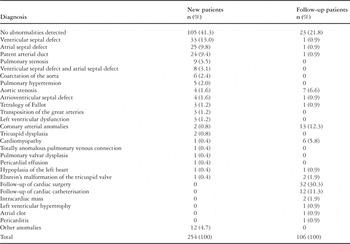
Table 1.

Age profile of children undergoing echocardiography by teletransmission, including age distribution of all children undergoing transmissions, age of children previously unknown to paediatric cardiologists (new patients), and age of patients involved in follow-up studies.
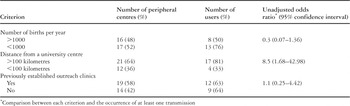
Table 2.
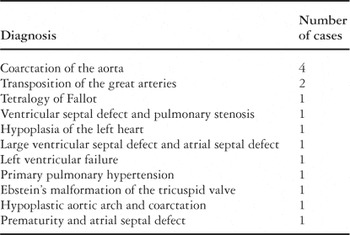
Table 3.

Impact of real time echocardiography by teletransmission using the Quebec Child Telehealth Network.
 You have
Access
- 8
- Cited by